Gardner Board of Health Meeting of October 5th Had some Mind-Boggling Surprises
Listen to the entire meeting on any device, CLICK PLAY.
Mind-Boggling Local Surprises Hidden in the Board of Health Meeting bring High-Stakes Drama: To the uninitiated, a Board of Health meeting sounds like an infallible cure for insomnia—a quiet blur of routine administrative votes, dry budget line items, and empty public gallery seats. Yet behind closed municipal doors, public health officials routinely make high-stakes decisions that directly dictate neighborhood safety, environmental health, and private property rights.
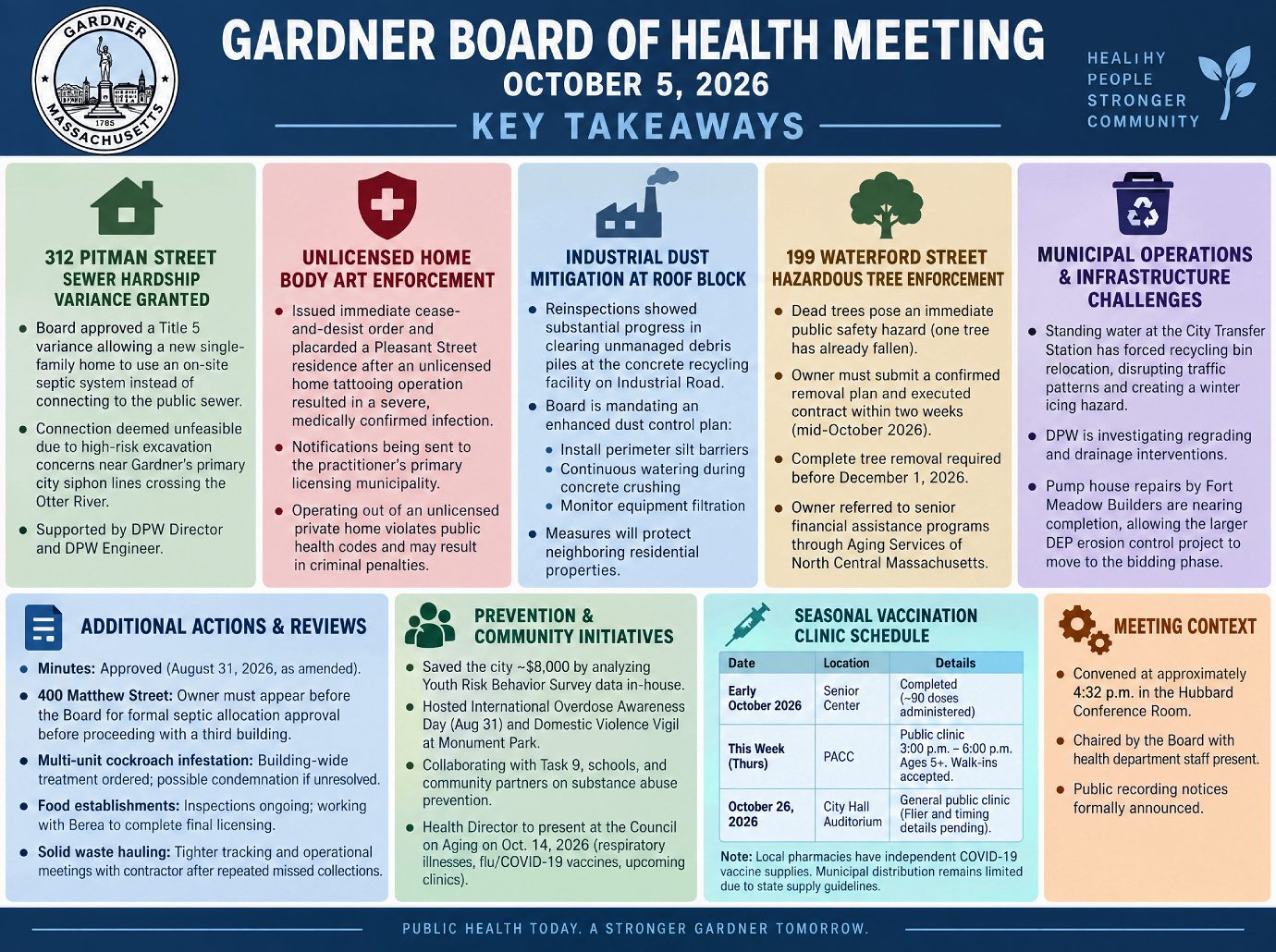
On Monday, October 5, 2026, at 4:32 p.m., the Gardner Board of Health convened in the Hubbard conference room for what appeared to be a standard monthly assembly. What actually unfolded across the agenda was a gripping cross-section of modern civic life. In under two hours, city officials wrestled with century-old underground infrastructure risks, an illicit home-tattooing operation that triggered a municipal quarantine response, industrial dust clouds invading residential living rooms, and dangerous structural hazards threatening city roads.
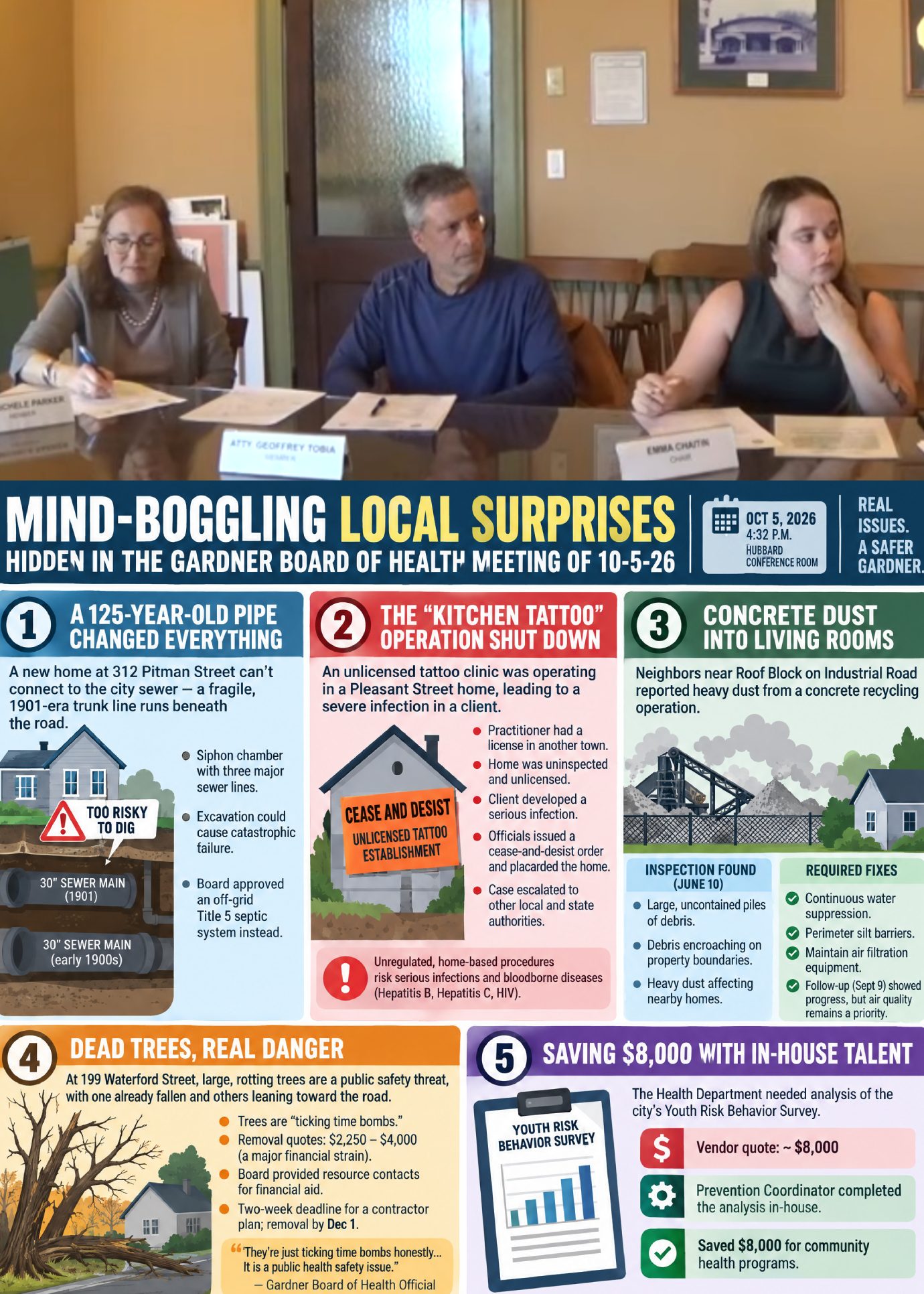
A 125-Year-Old Pipe Forced a New House to Go Off the Municipal Sewer Grid: When constructing a new residential home along an established municipal street, Massachusetts health regulations under Title 5 typically require direct connection to the public sewer grid whenever infrastructure runs along the roadway. However, a sewer connection hardship request for a vacant lot at 312 Pitman Street revealed how century-old underground engineering can completely disrupt standard regulatory mandates.
While municipal sewer lines run directly in front of the property, the technical reality beneath the asphalt made a standard connection impossibly dangerous. Directly fronting the lot is a siphon chamber housing three parallel siphon lines that convey the entirety of Gardner’s municipal wastewater across the Otter River to the treatment facility in Templeton. This underground trunk line includes two massive 30-inch sewer mains—one installed back in 1901, and a second laid shortly thereafter.
Because these primary mains operate under immense flow and pressure, a direct connection would blow out the home’s plumbing. Connecting to the public system required excavating a 5-foot-deep trench within the right-of-way to run a force main up to where the gravity line terminates near 306 Pitman Street. Digging alongside fragile, 125-year-old sewer assets carried an unacceptable risk of rupture. Consequently, the Board granted a hardship variance allowing the owner to build an off-grid Title 5 septic system on suitable soil.
“It would be catastrophic if we hit one [of the siphon lines]. It would be very high cost and high risk… because of the risk of excavating and hitting one of those lines would be a huge issue.” — Gardner Board of Health Discussion
This case underscores the hidden fragility of aging American municipal infrastructure. Across thousands of legacy industrial towns, century-old subterranean utilities silently constrain modern residential development. When legacy underground assets are too vulnerable to withstand routine physical disturbance, public health boards must compromise—approving off-grid Title 5 septic systems on municipal land to shield vital public utility networks from catastrophic failure.
The Underground “Kitchen Tattoo” Operation That Sparked a City Quarantine: A public complaint recently exposed an illegal, uninspected body art operation running out of a private residential kitchen on Pleasant Street. The practitioner held a valid body art license in a neighboring municipality, but was secretly conducting invasive cosmetic procedures inside an uninspected, unlicensed home setting in Gardner.
The situation escalated into a public health crisis when a client suffered a severe medical infection at the tattoo site, which was later confirmed by clinical evaluation. Health officials immediately intervened to shut down the rogue kitchen clinic before further harm occurred.
To neutralize the public health threat, health authorities executed a swift series of enforcement measures:
- Issued an Immediate Cease-and-Desist Order: Officials issued a formal demand citing Massachusetts state law, warning the practitioner of potential fines and imprisonment for operating an unlicensed establishment.
- Placarded the Residence: Officials posted giant orange warning placards reading “Cease and Desist – Unlicensed Tattoo Establishment” on every entrance door. When the resident tore them down, Health Inspector Eric offered to return and re-post them immediately.
- Initiated Cross-Jurisdictional Escalation: Authorities alerted health officials in a neighboring town where the operator was attempting to open a new commercial shop, and initiated steps to notify the practitioner’s primary licensing board so administrative action could be taken against their state credential.
Uninspected, home-based invasive cosmetic procedures represent a major public health hazard. Operating outside regulated, sterile environments exposes clients to grave risks, including severe bacterial infections and bloodborne pathogens such as Hepatitis B, Hepatitis C, and HIV due to systemic sterilization deficits. When rogue operators cross municipal borders to evade oversight, cross-jurisdictional reporting and aggressive health enforcement become the city’s only line of defense.
Concrete Dust and Living Room Tables: The Industrial Battle Next Door: A commercial concrete recycling operation conducted by Roof Block on Industrial Road has sparked an intense environmental health clash with nearby residents. Abutting homeowners complained of continuous clouds of heavy concrete dust drifting off the industrial property, coating outdoor lawns and invading residential living rooms to settle on indoor coffee tables.
An initial municipal inspection conducted on June 10—in coordination with MassDEP and the Gardner Fire Department—uncovered widespread uncontained hazards across the property, resulting in an official order to correct. A follow-up inspection on September 9 confirmed significant progress on general debris cleanup, but air quality mitigation remains a high-stakes focus for health inspectors.
| Inspection Findings (June 10) | Proposed & Required Mitigation Measures |
|---|---|
| Unstable Accumulations: Massive, uncontained piles of broken concrete, stone slabs, pallets, scrap metal, and industrial containers. | Operational Dust Control Plan: Formalized plan requiring continuous water suppression during active crushing and breakdown operations. |
| Hazard Encroachment: Debris spilling unchecked into active travel paths, vegetated buffer zones, and property boundaries. | Perimeter Silt Barriers: Installation of silt barriers to stop fine particulate matter and runoff from migrating into neighboring residential lots. |
| Severe Air Quality Impacts: Heavy fugitive concrete dust drifting off site and coating residential outdoor spaces and indoor household furniture. | Filtration Machinery Maintenance: Mandatory continuous operation and regular filter servicing on the site’s large industrial air filtration unit (recently repaired). |
This conflict highlights the inherent friction in local zoning where light industrial operations sit directly adjacent to residential neighborhoods. While concrete recycling facilities provide crucial economic and environmental services by diverting construction waste from landfills, their mechanical processing generates airborne particulates that threaten local respiratory health and quality of life. Municipal regulators must continually balance commercial business operations against a resident’s fundamental right to clean air inside their own home.
“Ticking Time Bombs”: How Dead Trees Became a Public Health Emergency: Severe environmental hazards on private property can rapidly spill over into public safety emergencies. At 199 Waterford Street, several large, rotting dead trees have deteriorated to a critical point. With one major tree having already collapsed into an abutting yard and others leaning perilously toward public roadways, city officials designated the decaying timber an urgent public safety threat ahead of the winter storm season.
The homeowner faces severe financial hardship, compounded by catastrophic household repairs including water damage to the electrical panel and main sewer line blockages. Professional tree removal quotes obtained by the resident ranged from $2,250 to $4,000—a prohibitive expense for a family in distress.
“They’re just ticking time bombs honestly… it is a public health safety issue.” — Gardner Board of Health Official
To help bridge the gap, the Board provided resource contacts for emergency financial aid through Aging Services of North Central Mass. Nevertheless, emphasizing the imminent risk of winter ice storms and potential roadway collapse, the Board mandated a two-week deadline for a finalized contractor plan, targeting total removal by December 1st.
This dilemma illustrates the difficult public policy tightrope local boards must walk when private poverty intersects with public safety mandates. While municipal officials express genuine empathy for homeowners experiencing extreme financial hardship, public health law obligates the city to eliminate imminent structural hazards before private neglect leads to public utility destruction or human injury.
Scrappy Small-Town Fiscal Strategy: Saving $8,000 on Data Analysis:When tasked with analyzing critical data from the city’s local Youth Risk Behavior Survey, the Gardner Health Department was confronted with an external vendor quote of approximately $8,000 to process the dataset. Rather than exhausting public funds or abandoning data-driven policy, the department’s Prevention Coordinator performed the comprehensive data analysis entirely in-house. By taking processing duties internal, the department preserved $8,000 for direct community health programming while delivering essential behavioral health metrics to local school administrators and strategic planning groups.