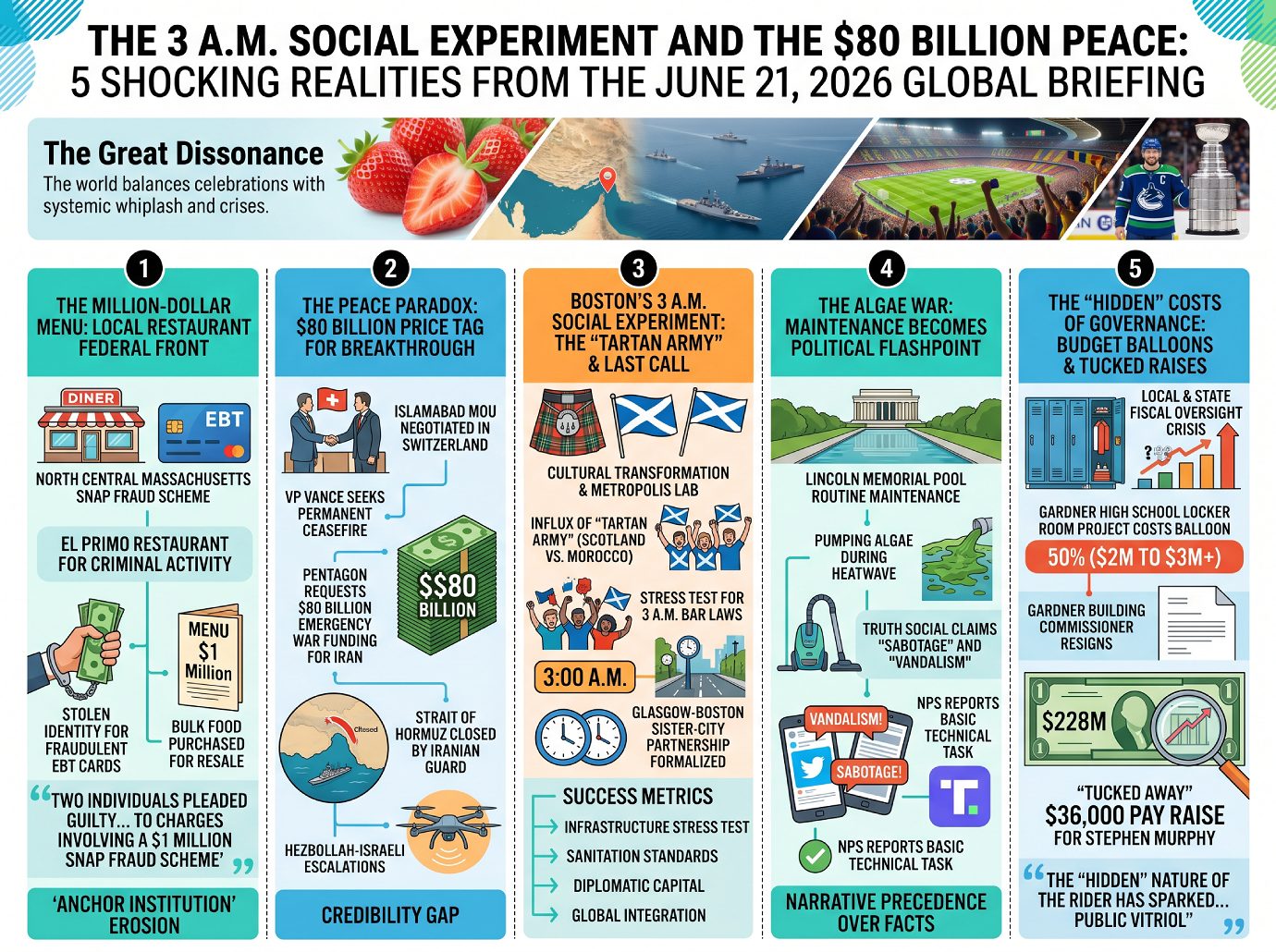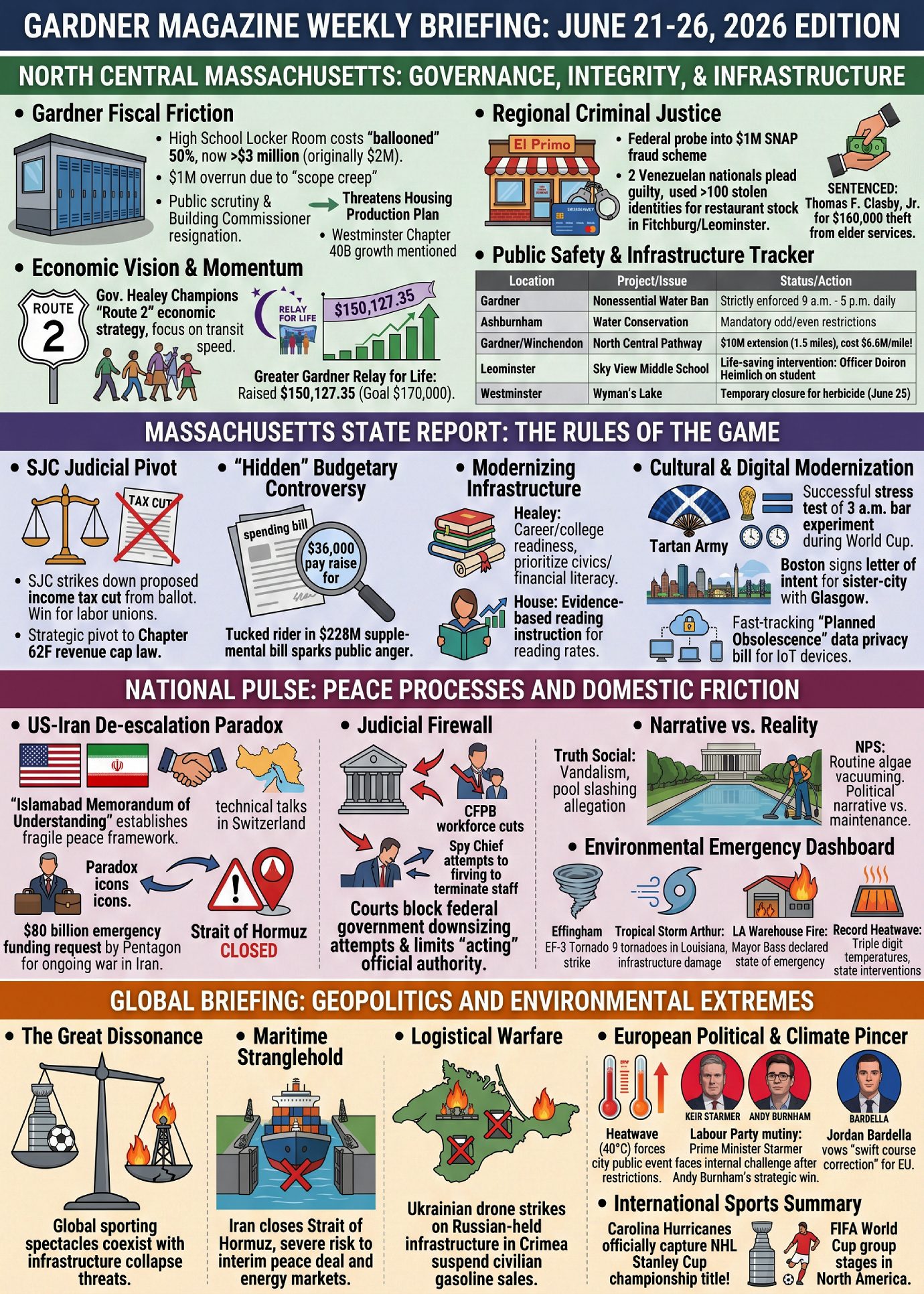
Gardner Magazine has 4 separate additional sections covering North Central MA News, a Massachusetts News Roundup, U.S. National News, and World News, all updated on June 21, 2026, this week with some additional infographics
JUMP TO SECTION: North Central MA News — State News of the Week —- National News of the Week — World News of the Week
Gardner Magazine Weekly Briefing – June 21, 2026
This week we have a total of 6 podcasts for the Weekly Briefing of June 21, 2026. The Weekly Briefing including a Deep Dive and a Debate, plus separate podcasts covering North Central MA, Massachusetts News Roundup, U.S. National News, and World News. Listen to what interests you on any device, Just CLICK PLAY.
Gardner Magazine Weekly Briefing: June 21 2026 Edition
1. North Central Massachusetts: Governance, Integrity, and Infrastructure
The third week of June 2026 has served as a rigorous stress test for the municipal frameworks of North Central Massachusetts. While the region traditionally leans into the quiet rhythms of the summer season, the current landscape is defined by a series of fiscal and social “shocks” that have forced a reckoning with local resilience. From high-stakes federal fraud investigations to significant budgetary overruns in school infrastructure, the strategic importance of municipal transparency has never been more apparent. As local leaders navigate these disruptions, the ability to maintain public trust while managing aging infrastructure remains the primary challenge for the region’s long-term stability in an era of significant transition.
The Gardner Fiscal Friction
In Gardner, a significant point of municipal friction has emerged over the High School locker room project. Originally slated to cost $2 million, Mayor Michael Nicholson recently revealed that the price tag has “ballooned” by 50%, now exceeding $3 million. This $1 million cost escalation has been attributed to “scope creep,” prompting sharp criticism from the City Council and School Committee regarding a perceived lack of evolving information. This infrastructure overrun does not happen in a vacuum; it threatens the viability of the city’s broader Housing Production Plan and creates new pressures as neighboring Westminster navigates its own Chapter 40B growth. This transparency crisis is compounded by the sudden resignation of the Building Commissioner, creating a leadership vacuum in zoning and oversight at a moment when project management is under intense public scrutiny.
Regional Criminal Justice & Federal Oversight
The integrity of the local commercial landscape faced a significant “deficit of trust” this week following a federal investigation into a $1 million SNAP fraud scheme. Two Venezuelan nationals pleaded guilty to the operation, which involved using stolen identities from over 100 individuals to obtain fraudulent EBT cards to stock the El Primo Restaurant locations in Fitchburg and Leominster. Parallel to this, the sentencing of Thomas F. Clasby, Jr. for embezzling up to $160,000 from taxpayer-funded elder service programs further underscores the vulnerabilities in public assistance. These cases serve as a sobering reminder that the failure of local oversight has direct consequences on the competitive landscape of regional commerce.
Public Safety & Infrastructure Tracker
The region continues to prioritize essential services, though the “sticker shock” of modern infrastructure is becoming impossible to ignore. Notably, the North Central Pathway extension now carries a staggering cost of approximately $6.6 million per mile for a 12-foot-wide path.
| Location | Project/Issue | Status/Action |
|---|---|---|
| Gardner | Nonessential Water Ban | Strictly enforced 9 a.m. to 5 p.m. daily to manage supply. |
| Ashburnham | Water Conservation | Mandatory odd/even day restrictions in effect. |
| Gardner/Winchendon | North Central Pathway | $10M extension (1.5 miles) connecting downtowns; cost-per-mile at $6.6M. |
| Leominster | Sky View Middle School | Life-saving intervention: Officer Derek Doiron performed the Heimlich on student Timoteo Alves Javier. |
| Westminster | Wyman’s Lake | Temporary closure for herbicide treatment (June 25). |
Economic Vision & Community Momentum
Strategic foresight remains a focus as Governor Healey champions a “Route 2” economic strategy, emphasizing that transit speed is essential to solving the logistical hurdles throttling regional equity. This top-down vision is balanced by grassroots resolve; the Greater Gardner Relay for Life has raised $150,127.35 toward its $170,000 goal. Even as the region builds momentum, the complexity of these projects ensures that every foot of progress remains under heavy fiscal scrutiny.
While North Central Massachusetts grapples with its internal fiscal oversight, the broader legislative landscape at the State House is undergoing a similarly high-stakes rewriting of the rules.
2. Massachusetts State Report: The Rules of the Game
The current legislative session has reached a pivotal juncture, creating a study in vivid contrasts. While the city of Boston is currently a hub for international tourism due to the FIFA World Cup, the celebratory atmosphere is secondary to the high-stakes policy shifts occurring under the Golden Dome. The Commonwealth is balancing the exuberance of a global sporting event with a fundamental restructuring of its judicial, educational, and fiscal frameworks, proving that world-class ambitions require precise governance.
The SJC Judicial Pivot
The Massachusetts Supreme Judicial Court (SJC) delivered a landmark ruling this week by striking down a proposed income tax cut from the state ballot. This decision effectively scrubbed a high-profile fiscal measure from the upcoming election, representing a significant victory for labor unions. In response, proponents have initiated a strategic pivot, shifting their focus toward the state’s existing revenue cap law (Chapter 62F) as the next political battlefield for managing excess state wealth.
The “Hidden” Budgetary Controversy
Public trust in the legislative process has been tested by the inclusion of a $36,000 pay raise for Stephen Murphy, the Suffolk County Register of Deeds, within a $228 million supplemental spending bill. Labeled as a “tucked” rider, the move has sparked significant public vitriol. While the sum is relatively small, the political cost of such maneuvers is high, as the “hidden” nature of the allocation erodes the transparency necessary for larger, multi-billion dollar legislative initiatives.
Modernizing the Commonwealth’s Infrastructure
The state is currently pursuing a dual-track effort to update its intellectual and professional infrastructure through the following mandates:
- Healey Administration (Graduation Requirements): A proposed shift toward career and college readiness, prioritizing civics and financial literacy.
- The House (Literacy Mandate): Legislation requiring evidence-based reading instruction to address years of stagnant literacy rates.
Cultural & Digital Modernization
The influx of the “Tartan Army” (Scottish fans) for the World Cup served as a successful stress test for the state’s 3 a.m. bar experiment. Beyond the festivities, the event facilitated long-term economic strategy, evidenced by Boston signing a letter of intent to establish a sister-city agreement with Glasgow. Simultaneously, the legislature is fast-tracking a “Planned Obsolescence” data privacy bill, requiring manufacturers to disclose the duration of software support for internet-connected devices, placing Massachusetts at the forefront of digital consumer rights.
As the state modernizes its internal policy, the national landscape is increasingly defined by a struggle between diplomatic transitions abroad and judicial firewalls at home.
3. National Pulse: Peace Processes and Domestic Friction
The United States is currently a nation in transition, attempting to project diplomatic order on the global stage while navigating a fragmented domestic landscape. High-stakes negotiations in Switzerland have been shadowed by record-breaking environmental emergencies and a series of judicial rulings that have significantly checked executive authority.
The US-Iran De-escalation Paradox
The “Islamabad Memorandum of Understanding” has established a fragile framework for peace, leading to technical talks in Switzerland involving Vice President J.D. Vance, senior Iranian officials, and mediators from Qatar and Pakistan. These discussions focus on nuclear capabilities and maritime security. However, a glaring contradiction remains: even as the administration pursues de-escalation, the Pentagon has requested $80 billion in emergency funding to cover the costs of the ongoing war in Iran. This fiscal request, coupled with the recent closure of the Strait of Hormuz, creates a significant credibility gap for the peace process.
The Judicial Firewall
The administration’s efforts to aggressively downsize the federal government have met a significant judicial firewall. Federal courts recently blocked plans to reduce the Consumer Financial Protection Bureau (CFPB) workforce by nearly two-thirds. Similarly, the courts halted an attempt by the Acting Spy Chief to terminate hundreds of intelligence staff, reinforcing the legal vulnerabilities of using “acting” officials to execute sweeping personnel changes.
Narrative vs. Reality at the Lincoln Memorial
The Lincoln Memorial Reflecting Pool became a focal point of narrative friction this week. While the administration alleged on Truth Social that “vandalism”—including the slashing of the pool’s lining—was responsible for the pool’s condition, reports from the National Park Service presented a more mundane reality. Maintenance crews were observed performing routine algae vacuuming, illustrating a recurring trend of prioritizing high-stakes political narratives over mundane institutional maintenance.
Environmental Emergency Dashboard
The nation continues to face a series of devastating natural disasters and extreme climate conditions:
- Effingham EF-3 Tornado: Confirmed strike causing severe damage in Illinois.
- Tropical Storm Arthur: Spawned nine tornadoes across Louisiana and caused widespread infrastructure damage.
- Los Angeles Warehouse Fire: Mayor Karen Bass declared a state of emergency to combat a massive blaze.
- Record Heatwave: Early summer temperatures reaching triple digits across multiple states, necessitating state-level interventions.
The internal American struggle for narrative and judicial control now shifts toward a global stage dominated by energy security threats and escalating international conflict.
4. Global Briefing: Geopolitics and Environmental Extremes
The “Great Dissonance” of June 2026 is defined by the coexistence of global sporting spectacles and the threat of total infrastructure collapse. In a week where the world celebrates the pitch and the rink, the reality of the “domestic frontline” suggests a planet on the edge of significant instability.
The Maritime Stranglehold
Global energy markets were thrown into alarm following Iran’s closure of the Strait of Hormuz. Citing truce violations, the closure puts the precarious 60-day interim peace deal—and the ongoing Switzerland talks—at extreme risk. By severing this primary energy artery, Tehran has gained high-pressure leverage, inducing a state of global economic paralysis while high-level ceasefire negotiations are still in progress.
Logistical Warfare in Crimea
In Eastern Europe, the conflict has shifted toward “logistical warfare.” Ukrainian drone strikes targeting Russian-held infrastructure in Crimea have forced occupation officials to suspend civilian gasoline sales. This neutralization of essential resources from afar has turned the peninsula into a hallmark of the “domestic frontline,” where the depletion of fuel serves as a weapon as potent as traditional artillery.
European Political & Climate Pincer
Continental Europe is facing a dual crisis of environmental and political instability. A punishing heatwave has pushed temperatures to 40°C in France and Germany, forcing major cities to restrict public events. Amidst this climate emergency, political rebellions are reshaping leadership; Prime Minister Keir Starmer faces an internal Labour Party mutiny following a strategic parliamentary seat victory by rival Andy Burnham, intended to facilitate a formal leadership challenge. Meanwhile, Jordan Bardella vows a “swift course correction” for the European Union.
International Sports Summary
Despite global friction, the “anesthetic” of sports remains prevalent. The FIFA World Cup continues its march through the group stages across North America, while the Carolina Hurricanes have officially captured the NHL Stanley Cup championship title.
This Week and Beyond
As June 2026 draws to a close, the threads of local governance and global geopolitics have become inextricably linked. Whether it is a $1 million cost overrun in a Gardner locker room or an $80 billion emergency war funding request in Washington, the recurring theme is a tension between rapid change and the necessity of oversight. We are living in a moment of “Great Dissonance,” where the anaesthetic of a Stanley Cup victory or a World Cup match coexists with the stark reality of civilian gasoline suspensions in Crimea and maritime chokepoints in the Middle East. The region, the nation, and the world are all navigating a transition where “speed and connectivity” are being marketed as the solutions to growth, yet “transparency and oversight” remain the only reliable defenses against institutional collapse. The coming months will determine if the current diplomatic breakthroughs and local reforms are the foundations of a new stability or merely a temporary reprieve before an inevitable escalation.