
Gardner MA – Model City for America
Jump to a particular section with these links: From Chair City to Model City —- Municipal Overview: Gardner Massachusetts —- An Economic Profile of Gardner, Massachusetts: From “The Chair City” to a Modern Economy — –Fact Sheet: Getting to Know Gardner, Massachusetts —-Beyond the Chair City: 5 Surprising Stories from the History of Gardner, Massachusetts — The Story of Gardner: How a Small Settlement Became “The Chair City” —- Original Song: “Model City for America” —- Gardner Guide with Convenient Phone Numbers

The City of Gardner will always be fondly known as the “Chair City” because of its manufacturing heritage, but it is increasingly being referred to as a “Model City for America” because of its recent rapid successes in so many areas.
Gardner Magazine has a “Deep Dive” with the Chair Man and the Chair Lady which goes over Gardner History. Listen on any device, CLICK PLAY.
Gardner Magazine has a “DEBATE” with Max and Maxine Rogers about the “Model City” status.
Also on this page, a complete report on the history of the City of Gardner. CLICK HERE. — At the bottom of the page: Original song “Model City for America.”
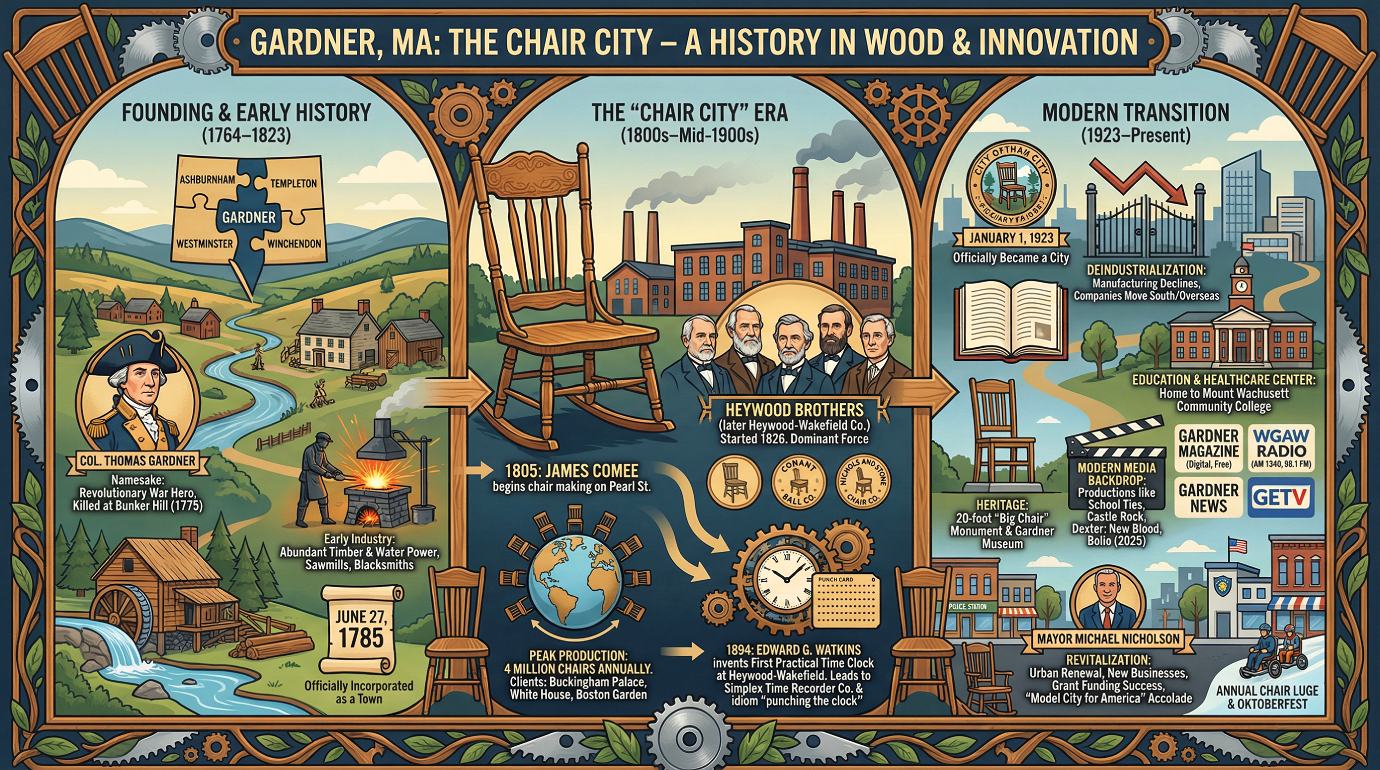
The History of Gardner, Massachusetts: From “Chair City” to Contemporary Renaissance as a “Model City”

Gardner, Massachusetts, is a city whose identity is inextricably linked to its celebrated moniker, “The Chair City.” For over a century, its factories produced millions of chairs that furnished homes and institutions across the globe, establishing it as a powerhouse of American manufacturing. This monograph provides a comprehensive historical account of the city’s remarkable evolution. It traces Gardner’s journey from its founding in the optimistic aftermath of the Revolutionary War, through its rise as a global center for furniture production, to its navigation of late 20th-century deindustrialization and its inspiring emergence as a model of contemporary revitalization.
A Video on Gardner “Model City” Play by clicking the red button. You can even make it full screen.
1. The Founding of a New England Town (1764–1804)
The founding period of Gardner was a strategic and symbolic chapter that laid the groundwork for its future identity. In the context of post-Revolutionary War America, the establishment of the town was not merely a matter of drawing lines on a map; it was an expression of a new nation’s values and aspirations. From its patriotic namesake to its early economic activities, the origins of Gardner reveal a community built on independence, resourcefulness, and a pragmatic vision that would ultimately foster an industrial giant.
The area that would become Gardner was first settled by European colonists in 1764. The town was officially incorporated on June 27, 1785, forged from land grants contributed by four established neighboring towns: Ashburnham, Templeton, Westminster, and Winchendon. In a notable departure from its neighbors, many of whom bore the names of English locations, Gardner was christened in honor of a hero of the American Revolution. The town was named for Colonel Thomas Gardner, the second-highest-ranking officer killed at the pivotal Battle of Bunker Hill in 1775. This choice cemented a distinctly American identity for the new community, reflecting the patriotic fervor of the era.
While its initial economy was agricultural, Gardner’s trajectory soon shifted. The region’s dense forests provided abundant timber, and its waterways offered the necessary power to drive the machinery of a budding industrial economy. This combination of natural resources led to a rapid transition towards woodworking, with sawmills and blacksmith shops becoming the cornerstones of the local economy. This early focus on woodworking established the perfect foundation for the singular craft—chair manufacturing—that would soon define the town for generations.
2. The Rise of the “Chair City” (1805–1922)
What began as a collection of small woodworking shops soon coalesced into a manufacturing revolution, ignited by the focused craft of a single artisan. Over the next century, Gardner would transform into an industrial titan, earning its enduring title as “The Chair City.” Its name became synonymous with quality furniture, its factories dominated the global market, and its civic identity became a proud reflection of its primary craft.
The catalyst for Gardner’s industrial boom was James Comee, who began crafting chairs on Pearl Street in 1805. This humble enterprise sparked an industry that would grow to define the town. The most significant player to emerge was the Heywood Brothers company, founded in 1826 when five brothers—Walter, Levi, Seth, Benjamin, and William—began fashioning chairs in their family barn. The company, later known as the Heywood-Wakefield Company, became the dominant force in American furniture manufacturing. At the industry’s zenith, Gardner’s factories were astonishingly productive, manufacturing over four million chairs annually. Other notable firms contributed to this output, including the Conant Ball Company and the Nichols and Stone Chair Company, which relocated to Gardner at the turn of the 20th century. The reputation of Gardner’s furniture extended far beyond New England, with its factories supplying high-quality pieces to some of the world’s most prestigious clients, including Buckingham Palace, the White House, and the original Boston Garden.
In 1922, this industrial identity was formally immortalized in the city’s official seal, designed by native illustrator Harrison Cady. The seal is a rich tapestry of Gardner’s history and geography, depicting Colonel Thomas Gardner standing before Crystal Lake with Mount Monadnock in the distance. Encircling the central image are five smaller circles: one contains a chair, symbolizing the city’s economic backbone, while the other four display the letters W, W, A, and T, representing Westminster, Winchendon, Ashburnham, and Templeton—the towns from which Gardner was formed. This climate of industrial excellence not only perfected the craft of furniture making but also fostered technological innovation in entirely new fields, most notably with the invention of the time clock.
3. Innovation Beyond Furniture: The Simplex Time Recorder Company
While Gardner was world-renowned as the “Chair City,” the intense industrial activity and engineering expertise concentrated within its factories fostered significant technological advancements in other fields. The invention of the practical time clock, born from a need within the furniture industry itself, created a second major industrial force in the city and left a lasting mark on the language of American labor.
In 1894, an engineer at the Heywood-Wakefield factory named Edward G. Watkins was tasked with creating a better method for tracking employee hours. His invention, the first practical time clock, was so effective that it gave rise to the American idiom “punching the clock.” Recognizing the immense nationwide need for his device, Watkins founded the Simplex Time Recorder Company. The company grew steadily, but its most significant expansion occurred in 1958 when it acquired the IBM Time Recorder Division. This acquisition, which included IBM’s fire protection division, propelled Simplex to a position of leadership in the fire alarm and business systems industries. The company remained a family-run institution for over a century, with leadership passing from Edward Watkins to his son, Curt, from 1942 to 1967, and then to his grandson, Chris, from 1967, until its sale to Tyco International in 2000. This period of dual industrial strength marked the apex of Gardner’s manufacturing power, preceding an era of significant economic and social transformation.
4. An Era of Transition (1923–1999)
This period began with the civic triumph of Gardner’s incorporation as a city, a testament to its industrial might. Yet, this milestone would soon be contrasted by the profound economic anxieties of the late 20th century, as the forces of deindustrialization began to challenge the very foundation of the city’s identity. Like many manufacturing-dependent communities across New England, Gardner was forced to confront the economic realities of a changing global market, setting the stage for a fundamental re-evaluation of its future.
Reflecting its growth and regional importance, Gardner was officially incorporated as a city on January 1, 1923. This transition from a town to a city marked a new chapter in its municipal governance and civic status. During the latter half of the 20th century, however, Gardner experienced the significant manufacturing declines that affected the entire region. Many of its foundational companies relocated operations to the southern United States or overseas in search of lower costs. This trend is poignantly illustrated by the fate of the Nichols and Stone Chair Company. After a long and storied history, the company terminated production in Gardner in July 2008. While its name and intellectual property were purchased by L. and J.G. Stickley, the closure of its local factory marked the end of an era for one of the city’s legacy manufacturers. The economic headwinds of this period necessitated a new vision, compelling the city to redefine its purpose and embark on a path toward renewal in the new millennium.
5. The Contemporary Renaissance (2000–Present)
The 21st century has been a period of deliberate and multifaceted revitalization for Gardner. The city has embarked on a strategic effort to leverage its proud industrial heritage while simultaneously embracing new economic sectors, bold civic initiatives, and a dynamic cultural identity. This ongoing transformation has reshaped Gardner from a former mill town into a thriving, modern community.
Gardner’s contemporary character is defined by a blend of economic evolution, civic modernization, and cultural vibrancy.
• Economic Evolution
◦ Core Sectors: The city’s economy has pivoted toward stable and growing sectors, with education (anchored by Mount Wachusett Community College) and healthcare becoming primary economic drivers.
◦ Remaining Manufacturing: A connection to its industrial roots remains through several key manufacturers, including Seaman Paper, Standard Chair of Gardner, and the Saloom Furniture Company.
◦ Retail: The furniture heritage is also preserved through retail, with two prominent stores: Lachance Interiors and Gardner Outlet Furniture.
• Civic Revitalization under Mayor Michael Nicholson (post-2020)
◦ Infrastructure & Development: A strategic revitalization has transformed the city’s commercial landscape, encompassing the redevelopment of downtown buildings, construction of the new Timpany Crossroads plaza, the successful filling of vacancies in other shopping plazas, and a feasibility study for a fourth industrial park to accommodate new growth.
◦ Municipal Modernization: The city has embraced technology to improve services, undertaking a website refresh in 2025 and expanding online access to municipal functions like building permits.
• Culture and Media
◦ Film and Television: Gardner’s classic New England aesthetic has made it an attractive backdrop for major productions, including the films School Ties and Bolio, Spirit of the Mustang, and the television series Castle Rock and Dexter: New Blood.
◦ Local Events: The city hosts unique and popular annual events that foster community spirit. As of 2025, these include the 15th annual Chair Luge and the 20th annual Oktoberfest, as well as the New England region’s largest American Cancer Society Relay For Life.
◦ Media Outlets: Gardner is served by a diverse media landscape. Gardner Magazine, a free digital-only publication founded in 2000, is the city’s largest outlet with a circulation of over 30,000 households. The Gardner News, a newspaper founded in 1869, is noted for its sports coverage and is the only local source for daily obituaries. WGAW, a news/talk radio station founded in 1946, broadcasts on AM and FM frequencies and streams globally. Other outlets include the City and Comcast funded Gardner Educational Television (GETV), the online news aggregator ChairCityNews.com, and The Fiscal 6 Project at Fiscal6.com, a website dedicated to chronicling the city’s recent successes.
The city’s successful transformation has not gone unnoticed. Gardner has earned recognition as offering the “best bang for your buck” and has been named the “kindest City in Massachusetts.” This success led some media outlets, including Gardner Magazine, to refer to it as the “Model City for America.” A key driver of this progress has been a strategic investment in a third-party grant writer, which turned an initial $50,000 investment into an astonishing $50 million in funding. This fiscal and civic achievement prompted an invitation for Mayor Michael Nicholson to the White House to share insights on the city’s success. In 2025, his leadership was further recognized with his election as President of the Massachusetts Mayors Association. The success of these initiatives has been such that local media portrayals of Mayor Nicholson often include speculation about a future on the national political stage. This dynamic story of revitalization is grounded in the city’s distinct geography and foundational demographic profile.
6. A Profile of Modern Gardner: Geography, Demographics, and Services
A complete understanding of Gardner requires an examination of its geographic and demographic foundations. This section provides a statistical profile of the city, outlining the geography, 2000 U.S. Census data, and key infrastructure that constitute the framework of modern life.
Located in Worcester County, Massachusetts, Gardner has a total area of 23.0 square miles, of which 22.2 square miles is land and 0.8 square miles is water. The city is situated on the shores of Crystal Lake, and its highest point is Reservoir Hill, which rises to an elevation of over 1,280 feet (390 m) above sea level.
The following data from the 2000 U.S. Census provides a detailed demographic profile of the city at the turn of the century, supplemented by the most recent population count.
• Population (2000): 20,770
• Population (2020): 21,287
• Households (2000): 8,282
• Families (2000): 5,085
• Racial Makeup (2000): 93.13% White, 2.29% African American, 1.37% Asian, 0.34% Native American, 0.08% Pacific Islander, 1.22% from other races, and 1.58% from two or more races.
• Hispanic or Latino (2000): 4.08% of the population.
• Key Ancestries (2000): 19.6% French Canadian, 17.6% French, 12.7% Irish, 6.7% English, 6.3% Polish, and 6.2% Italian.
• Median Household Income (2000): $37,334
• Median Family Income (2000): $47,164
• Per Capita Income (2000): $18,624
Gardner’s public school system includes Gardner Elementary School, Gardner Middle School, and Gardner High School. The city is also home to Mount Wachusett Community College, a cornerstone of regional higher education. The original Gardner Public Library opened in 1885 and its historic building now serves as the city’s history museum. The community is currently served by the state-of-the-art Levi Heywood Memorial Library. Public transport is primarily provided by the Montachusett Regional Transit Authority (MART), which operates local bus routes and van service connecting to the MBTA Fitchburg Line’s Wachusett terminus. A private service, “Swift Ride,” also offers on-demand transportation. This statistical profile provides the context for Gardner’s historical journey and its contemporary identity.
Conclusion
The history of Gardner, Massachusetts, is a compelling narrative of American resilience and adaptation. From a small, post-revolutionary settlement born of patriotic ideals, it grew into an industrial giant whose moniker, the “Chair City,” was known across the world. The city’s workshops and factories not only defined its economy but also fostered a spirit of innovation that produced transformative technologies like the Simplex time clock. When faced with the profound challenges of deindustrialization in the late 20th century, Gardner did not fade. Instead, it embarked on a deliberate and strategic path of reinvention. Through forward-thinking leadership, civic investment, and a renewed sense of community pride, Gardner has successfully transitioned into the post-industrial era, emerging as a vibrant center for education, healthcare, and culture—a true “Model City for America.”
Original Song “Gardner, Model City for America”
The History of Gardner Massachusetts – In Depth
Municipal Overview: Gardner, Massachusetts
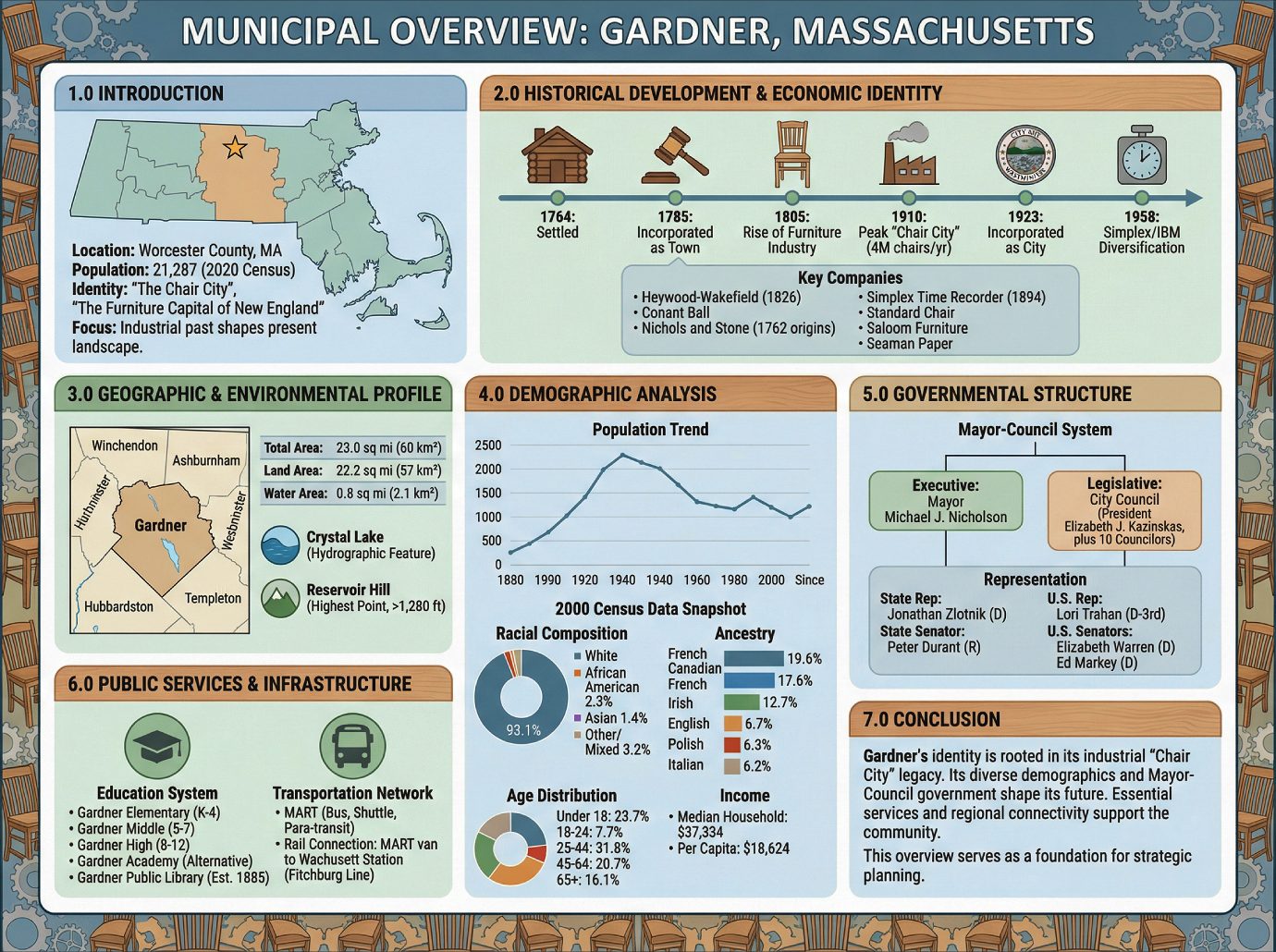
Municipal Overview: Gardner, Massachusetts
1.0 Introduction to Gardner, Massachusetts
This document provides a comprehensive analysis of the City of Gardner, Massachusetts, intended for an audience of city planners, government officials, and researchers. Located within Worcester County, Gardner is a community of 21,287 residents, according to the 2020 U.S. Census. The city’s development and character have been profoundly shaped by its industrial past, and this overview examines its historical trajectory, geographic context, demographic composition, and governmental structure. Its historical identity as “The Chair City” and “The Furniture Capital of New England” remains a central theme in its evolution and provides a crucial lens through which to understand its present-day landscape.
2.0 Historical Development and Economic Identity
Understanding Gardner’s historical trajectory, particularly its industrial foundations, is essential for interpreting its current economic landscape and civic identity. The city’s rise as a manufacturing powerhouse in the 19th and 20th centuries established an economic and cultural legacy that continues to influence its contemporary profile.
Founding and Incorporation
The area that would become Gardner was first settled by Europeans in 1764. It was officially incorporated as a town in 1785, formed from land grants provided by the surrounding towns of Ashburnham, Templeton, Westminster, and Winchendon. In addition to its industrial development, the community was also a site for innovation in public services, as the Gardner State Hospital later pioneered the use of cottage residences for patient care. After more than a century of growth, Gardner was officially incorporated as a city in 1923.
The Rise of “The Chair City”
Beginning around 1805, Gardner emerged as a prominent center for the lumber and furniture industries. This specialization became the city’s defining economic feature. At the industry’s peak in 1910, Gardner was home to twenty chair factories that collectively produced four million chairs per year, cementing its reputation as “The Chair City.” Several notable furniture companies were founded or located in Gardner, contributing to its status as “The Furniture Capital of New England.” These include:
• Heywood-Wakefield Company: Originating in 1826, this company grew from a small family operation into a major furniture manufacturer.
• Conant Ball Company: Another key firm that was instrumental in the city’s furniture-making history.
• Nichols and Stone Chair Company: Tracing its origins to 1762, the company relocated to Gardner at the beginning of the 20th century.
Innovation and Economic Diversification
Beyond furniture, Gardner was a site of significant technological innovation. In 1894, Edward G. Watkins invented the first practical time clock, leading to the founding of the Simplex Time Recorder company. A pivotal moment of economic diversification occurred in 1958 with the acquisition of the IBM Time Recorder Division. This strategic move expanded Simplex’s operations to include fire protection systems, demonstrating an early and successful pivot from Gardner’s core furniture industry towards a technology-based sector and setting a precedent for future economic development.
Contemporary Economic Profile
In recent decades, Gardner’s economy has evolved in the context of broader deindustrialization. While the scale of its manufacturing sector has changed, the city retains a core of industrial activity that honors its legacy. Key manufacturing companies that represent its present-day economic base include:
• Standard Chair of Gardner
• The Saloom Furniture Company
• Seaman Paper, a multinational paper and packaging manufacturer.
This industrial heritage shaped not only the city’s economy but also its physical development within its specific geographic context.
3.0 Geographic and Environmental Profile
A municipality’s geography is of strategic importance, influencing everything from resource management and infrastructure planning to its overall regional positioning. Gardner’s location, topography, and physical boundaries define the environment in which its community and economy operate.
Land Area and Topography
The city’s key geographic statistics are detailed below.
| Category | U.S. Customary | Metric |
|---|---|---|
| Total Area | 23.0 sq mi | 60 km² |
| Land Area | 22.2 sq mi | 57 km² |
| Water Area | 0.8 sq mi | 2.1 km² |
| Source: United States Census Bureau |
Gardner is situated on Crystal Lake, a key hydrographic feature. The city’s highest point is the summit of Reservoir Hill, which has an elevation of over 1,280 feet (390 m).
Regional Location
Gardner’s position is defined by its five bordering municipalities within Massachusetts:
• Winchendon (north)
• Ashburnham (north)
• Westminster (east)
• Hubbardston (south)
• Templeton (west)
The city’s physical landscape provides the setting for its demographic profile.
4.0 Demographic Analysis
Demographic data provides critical insights into a community’s composition, social needs, and future service requirements. This analysis of Gardner’s population trends and socioeconomic characteristics offers a quantitative snapshot of the city.
Population Trends
According to the 2020 U.S. Census, the total population of Gardner was 21,287. Historical census data reveals several distinct periods of change. The city experienced significant and sustained growth between 1880 and 1940, reflecting its industrial peak. This was followed by a period of gradual decline through 1980. Since then, the population has seen more modest fluctuations, with periods of both growth and decline.
Socioeconomic Profile (2000 Census Data)
The following summary details the city’s demographic and economic characteristics as reported in the 2000 U.S. Census.
Households There were 8,282 households and 5,085 families residing in the city. Of these households, 30.3% had children under the age of 18. The average household size was 2.35, and the average family size was 2.97.
Racial and Ethnic Composition The racial makeup of the city was reported as:
• White: 93.13%
• African American: 2.29%
• Asian: 1.37%
• From other races: 1.22%
• From two or more races: 1.58%
• Native American: 0.34%
• Pacific Islander: 0.08%
Hispanic or Latino of any race constituted 4.08% of the population.
Ancestry The most commonly reported ancestries included French Canadian (19.6%), French (17.6%), Irish (12.7%), English (6.7%), Polish (6.3%), and Italian (6.2%).
Age Distribution The population was distributed across the following age brackets:
• Under 18: 23.7%
• 18 to 24: 7.7%
• 25 to 44: 31.8%
• 45 to 64: 20.7%
• 65 or older: 16.1%
The median age in the city was 38 years.
Income and Poverty The median household income was $37,334, and the median family income was $47,164. The per capita income for the city was $18,624. Approximately 7.0% of families and 9.6% of the total population were living below the poverty line.
This demographic composition informs the structure and responsibilities of the city’s government.
5.0 Governmental Structure and Representation
Gardner operates under a Mayor-Council system of government, a framework that establishes a clear delineation between executive and legislative responsibilities at the municipal level. The Mayor serves as the chief executive officer, while the City Council functions as the primary legislative body.
Municipal Government
• Form of Government: Mayor-Council city
• Mayor: Michael J. Nicholson
• City Council:
◦ Elizabeth J. Kazinskas (Council President)
◦ Calvin D. Brooks
◦ Craig R. Cormier
◦ Brad E. Heglin
◦ Judy A. Mack
◦ George C. Tyros
◦ David R. Thibault-Munoz (Ward 1)
◦ Dana M. Heath (Ward 2)
◦ Paul G.Tassone (Ward 3)
◦ Karen G. Hardern (Ward 4)
◦ Aleksander H. Dernalowicz (Ward 5)
State and Federal Representation
Gardner is represented by elected officials at the state and federal levels, connecting the municipality to broader legislative and policy-making bodies.
| Office | Official(s) |
|---|---|
| State Representative | Jonathan Zlotnik (D) |
| State Senator | Peter Durant (R) |
| Governor’s Councilor | Paul DePalo (D) |
| U.S. Representative | Lori Trahan (D-3rd District) |
| U.S. Senators | Elizabeth Warren (D), Ed Markey (D) |
This framework of governance is responsible for delivering essential public services to the community.
6.0 Public Services and Infrastructure
The quality and structure of public services, including education and transportation, are fundamental indicators of a municipality’s commitment to community welfare and regional connectivity. These systems are vital for supporting residents and fostering economic activity.
Education System
The Gardner Public Schools district provides public education for the city’s students. The system is structured as follows:
• Gardner Elementary School: Serves grades K–4
• Gardner Middle School: Serves grades 5–7
• Gardner High School: Serves grades 8–12
In addition, Gardner Academy functions as an alternative school within the district. The city is also served by the Gardner Public Library, a community institution that first opened its doors in 1885. The original library building now serves as a museum of the city’s history, synthetically linking its past with its present public services.
Transportation Network
Public transportation in Gardner is provided primarily by the Montachusett Regional Transit Authority (MART). MART offers a range of services, including local fixed-route buses, shuttle services, and para-transit services for eligible residents within the region.
Regarding regional rail connectivity, Gardner Station historically served as the terminus for the MBTA Fitchburg Line from 1980 until 1986. While that service was later cut back, MART now provides a weekday van service that connects Gardner to the current Fitchburg Line terminus at Wachusett station, maintaining a vital link to the Greater Boston transit network.
These core services form the backbone of the city’s public infrastructure, rounding out this municipal profile.
7.0 Conclusion
This overview provides a detailed snapshot of the City of Gardner, Massachusetts, by examining its foundational elements. The city’s identity is deeply rooted in its industrial heritage as “The Chair City,” a legacy that continues to shape its economic landscape. Its demographic profile, characterized by historical population shifts and a diverse ancestry, presents both challenges and opportunities for future planning. Governed by a Mayor-Council system, the city provides essential public services, including a comprehensive public school system and a multi-modal transportation network that connects it to the wider region. Ultimately, this report offers a foundational, data-driven perspective on the City of Gardner for use in strategic planning, policy analysis, and further research.
———————–
An Economic Profile of Gardner, Massachusetts: From “The Chair City” to a Modern Economy
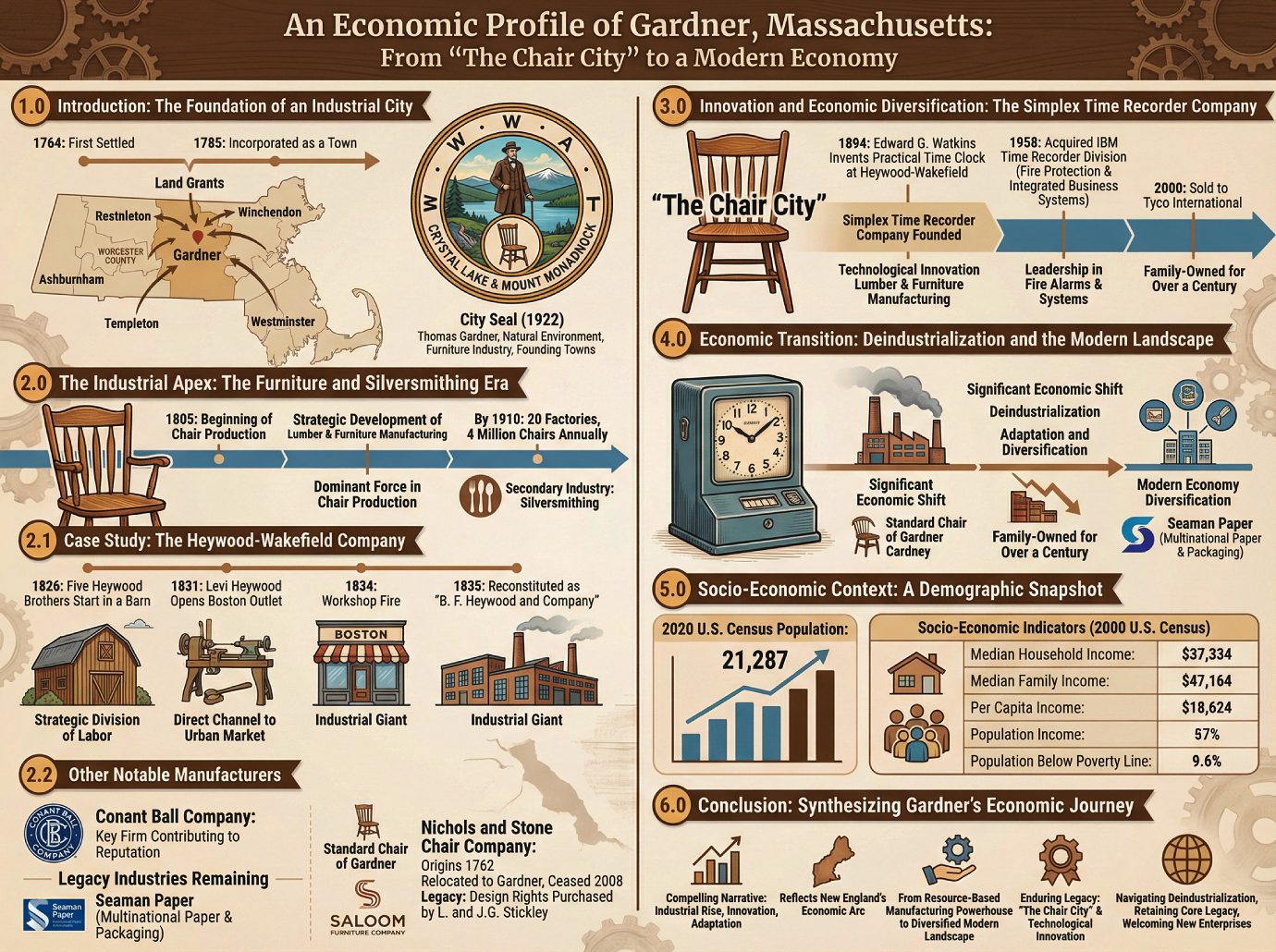
An Economic Profile of Gardner, Massachusetts: From “The Chair City” to a Modern Economy
1.0 Introduction: The Foundation of an Industrial City
Nestled in Worcester County, Gardner, Massachusetts, stands as a testament to the rise and transformation of industrial New England. For over two centuries, its economy has been shaped by the abundant natural resources of the region and the ingenuity of its residents. This profile analyzes the economic evolution of Gardner, tracing its arc from its founding and ascent as “The Furniture Capital of New England” through a period of deindustrialization and into its subsequent transition toward a more diversified economic landscape.
The city’s origins date to 1764, when the area was first settled by European colonists. It was officially incorporated as a town in 1785, formed from land grants provided by the four surrounding towns of Ashburnham, Templeton, Westminster, and Winchendon. This foundational history is encoded in its civic identity and geography.
The city seal, designed in 1922 by native artist Harrison Cady, serves as a rich visual narrative of Gardner’s history. The central figure of Thomas Gardner, for whom the city is named, is depicted before Crystal Lake with Mount Monadnock in the distance, grounding the city in its natural environment. A prominent chair within a smaller circle symbolizes the furniture industry that would become the bedrock of the local economy, while the letters W, W, A, and T represent the founding contributions of Westminster, Winchendon, Ashburnham, and Templeton.
This powerful symbolism of industry and place provides the ideal starting point for a deeper examination of the specific manufacturing sectors that powered Gardner’s economic peak.
2.0 The Industrial Apex: The Furniture and Silversmithing Era
The strategic development of lumber and furniture manufacturing was paramount in establishing Gardner’s economic identity. Beginning around 1805, the city leveraged its access to regional timber to become a dominant force in chair production, earning it the enduring moniker, “The Chair City.” This specialization was not a minor enterprise but the very engine of its growth and reputation throughout the region and beyond.
The scale of Gardner’s furniture industry was remarkable. By 1910, the city was home to twenty distinct chair factories that collectively produced an astounding four million chairs annually. This intensive focus on a single industry created a robust, self-sustaining economic ecosystem built on craftsmanship, production, and trade. While furniture was its primary claim to fame, the city was also noted for a secondary, yet significant, industry: silversmithing.
2.1 Case Study: The Heywood-Wakefield Company
No single entity is more synonymous with Gardner’s industrial legacy than the Heywood-Wakefield Company. Its story is a classic example of New England entrepreneurship, beginning in 1826 when five brothers—Walter, Levi, Seth, Benjamin, and William Heywood—started making wooden chairs in a barn near their family farm.
The company’s early growth was driven by a strategic division of labor and an ambition that quickly outgrew the family barn. Initially, Walter Heywood crafted chairs by hand and with a foot lathe. The operation expanded as Levi established an outlet store in Boston in 1831 to sell the chairs, creating a direct channel to a major urban market. Meanwhile, Benjamin and William remained in Gardner to oversee manufacturing.
A fire in 1834 destroyed their workshop but did not extinguish their ambition. A year later, the business was formally reconstituted as the “B. F. Heywood and Company” partnership—composed of Benjamin, Walter, and William Heywood, as well as Moses Wood and James Gates—solidifying its structure and setting the stage for its future as an industrial giant.
2.2 Other Notable Manufacturers
While Heywood-Wakefield was a dominant force, Gardner’s industrial strength was rooted in a diverse ecosystem of manufacturers. Among the other key firms contributing to the city’s reputation was the Conant Ball Company.
Another cornerstone of the local industry was the Nichols and Stone Chair Company. With origins tracing back to 1762 in the neighboring town of Westminster, the company relocated to Gardner at the turn of the twentieth century, further cementing the city’s status as the region’s furniture capital. The company continued production for over a century before ceasing operations in July 2008. Its legacy endured, however, as its name and design rights were subsequently purchased by L. and J.G. Stickley of New York.
This era of industrial dominance, defined by woodworking and craftsmanship, was complemented by a parallel track of technological innovation that would also leave a lasting mark on the city’s economy.
3.0 Innovation and Economic Diversification: The Simplex Time Recorder Company
While Gardner was building its reputation on furniture, a significant diversification of its industrial base was underway, showcasing the city’s capacity for technological innovation. The invention of the world’s first practical time clock in Gardner marked a pivotal moment, demonstrating that the city’s spirit of invention extended beyond traditional manufacturing.
The origin of this innovation lies with Edward G. Watkins, an engineer working at the Heywood-Wakefield Company. In 1894, tasked with creating a more effective method for tracking employee hours, Watkins invented a device that would revolutionize business operations. This invention was not an isolated stroke of genius but a direct product of the industrial ecosystem; it grew from the practical need for labor management and efficiency in a large-scale manufacturing environment like Heywood-Wakefield. Recognizing the immense nationwide demand for such a system, he founded the Simplex Time Recorder Company.
Simplex grew steadily, but a pivotal moment in its expansion came in 1958 with the strategic purchase of the IBM Time Recorder Division. This acquisition was transformative, as it included IBM’s fire protection division and propelled Simplex to a leadership position in the burgeoning fields of fire alarms and integrated business systems.
The company remained a family-owned and operated institution for over a century, a cornerstone of the Gardner economy that provided stable, skilled employment. This era came to an end in 2000 when the Watkins family sold the company to Tyco International. The century-long success of Simplex stands as a powerful counter-narrative to the city’s furniture-centric identity, highlighting a legacy of advanced technological development that shaped its economic journey into the modern era.
4.0 Economic Transition: Deindustrialization and the Modern Landscape
Like many industrial cities across New England, Gardner has experienced a significant economic shift in recent decades. The process of deindustrialization has altered its manufacturing base, moving the city away from the high-volume production that characterized its peak. This transition marks a new chapter in Gardner’s economic story, one defined by adaptation and diversification.
Despite these changes, the legacy of “The Chair City” has not been entirely erased. A handful of manufacturers remain, carrying forward the city’s long tradition of furniture craftsmanship and serving as a direct link to its industrial heritage.
• Standard Chair of Gardner
• Saloom Furniture Company
Alongside these legacy industries, the city’s modern economy shows clear signs of diversification. A prominent example is Seaman Paper, a multinational paper and packaging manufacturer located in Gardner, which represents a shift towards different, more globalized manufacturing sectors. This evolution from a specialized industrial hub to a more varied economic base is a story still unfolding. The city’s corporate structure is now supported by the demographic and social data that define its community.
5.0 Socio-Economic Context: A Demographic Snapshot
A city’s economic profile is intrinsically linked to the characteristics of its population. Demographic data provides a crucial framework for understanding the labor force, consumer base, and overall social fabric that underpins the local economy. This section provides a statistical snapshot of Gardner based on available census data.
According to the 2020 U.S. Census, the population of Gardner was 21,287. While the 2020 Census provides the latest population count, historical data from the 2000 U.S. Census offers a valuable baseline for key socio-economic indicators from the period of transition.
Socio-Economic Indicators (2000 U.S. Census)
| Metric | Value |
|---|---|
| Median Household Income | $37,334 |
| Median Family Income | $47,164 |
| Per Capita Income | $18,624 |
| Population Below Poverty Line | 9.6% |
This data provides a quantitative backdrop for the economic narrative, preparing the stage for a final synthesis of Gardner’s journey.
6.0 Conclusion: Synthesizing Gardner’s Economic Journey
The economic story of Gardner, Massachusetts, is a compelling narrative of industrial rise, innovation, and ongoing adaptation. Its journey reflects the broader historical arc of New England’s economy, from a resource-based manufacturing powerhouse to a more complex and diversified modern landscape.
Gardner’s identity was forged in its ascendancy as “The Chair City,” an economic engine powered by dozens of furniture factories like Heywood-Wakefield and Nichols and Stone. Yet, its history is not monolithic. The parallel success of the Simplex Time Recorder Company illustrates a deep-seated capacity for technological innovation that diversified its industrial portfolio long before the pressures of global competition reshaped American manufacturing. Today, the city navigates the realities of deindustrialization, retaining a core of its legacy furniture industry while making room for new enterprises. This deep-rooted industrial history, from handcrafted chairs to advanced business systems, continues to shape the character and identity of the city.
—————
Fact Sheet: Getting to Know Gardner, Massachusetts
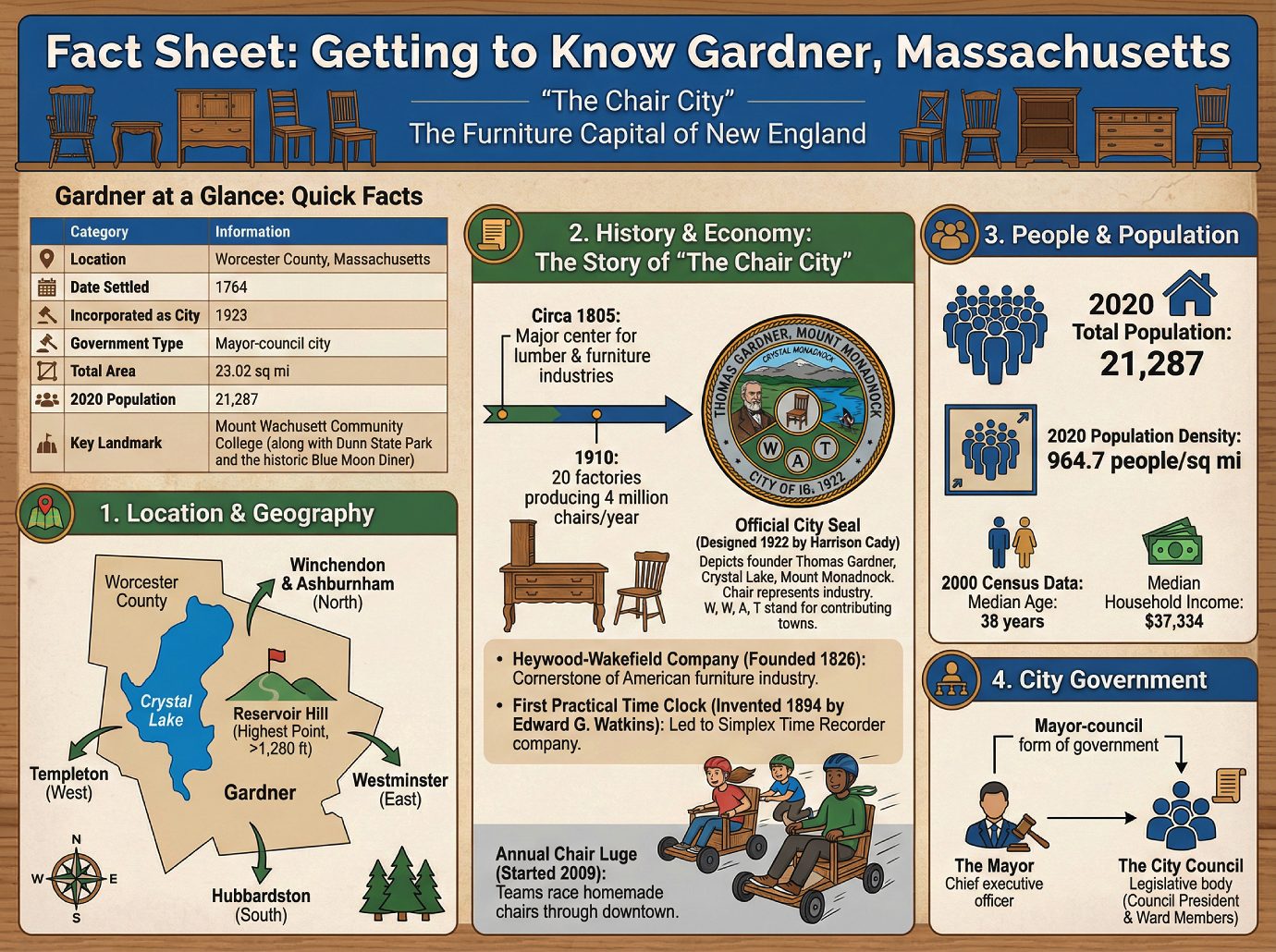
Fact Sheet: Getting to Know Gardner, Massachusetts
Introduction: Welcome to “The Chair City”
Gardner is a city located in Worcester County, Massachusetts, that holds a significant place in New England’s industrial history. It is widely known by its two distinctive nicknames, “The Chair City” and “The Furniture Capital of New England,” which it earned due to its long and celebrated history in the furniture manufacturing industry.
Gardner at a Glance: Quick Facts
The table below provides a snapshot of Gardner’s essential information.
| Category | Information |
|---|---|
| Location | Worcester County, Massachusetts |
| Date Settled | 1764 |
| Incorporated as City | 1923 |
| Government Type | Mayor-council city |
| Total Area | 23.02 sq mi |
| 2020 Population | 21,287 |
| Key Landmark | Mount Wachusett Community College (along with Dunn State Park and the historic Blue Moon Diner) |
While these facts provide a quick sketch of Gardner, the city’s true story is written in its landscape and its industrial roots.
——————————————————————————–
1. Location & Geography
Where is Gardner?
Gardner’s landscape is defined by its natural features, most notably its position on Crystal Lake. The highest point in the city is Reservoir Hill which, at over 1,280 feet above sea level, is located close to the city center. Gardner is surrounded by five other Massachusetts towns:
• Winchendon and Ashburnham (to the north)
• Westminster (to the east)
• Hubbardston (to the south)
• Templeton (to the west)
This strategic location, surrounded by forests, was the very foundation upon which the city’s famous industrial identity would be built.
——————————————————————————–
2. History & Economy: The Story of “The Chair City”
Why is Gardner Called “The Chair City”?
Beginning circa 1805, Gardner became a major center for the lumber and furniture industries. Its reputation grew so immense that by 1910, the city’s twenty factories were producing an incredible four million chairs per year. This prolific output cemented its status as “The Chair City.”
The story of Gardner is powerfully captured in its official city seal, designed in 1922 by local illustrator Harrison Cady. The seal masterfully weaves together the city’s identity: it depicts founder Thomas Gardner before Crystal Lake and Mount Monadnock, tying the city to its origins and geography. In smaller circles, a chair represents the industry that built the city, while the letters W, W, A, and T stand for Westminster, Winchendon, Ashburnham, and Templeton—the four towns that contributed land to form Gardner.
Beyond chair-making, Gardner has been home to other significant economic innovations:
• Heywood-Wakefield Company: This famous furniture company, a cornerstone of the American furniture industry, was founded in Gardner in 1826.
• The First Practical Time Clock: Gardner was also a hub of technical innovation. It was here, in 1894, that local engineer Edward G. Watkins invented the first practical time clock. This led to the creation of the Simplex Time Recorder company, which became a national leader in time clocks and fire alarm systems.
Even today, the “Chair City” identity is a living part of the culture, celebrated with the Annual Chair Luge, an event started in 2009 where teams race homemade chairs on wheels through downtown.
The industry that built Gardner also shaped the community of people who have called it home for generations.
——————————————————————————–
3. People & Population
Who Lives in Gardner?
The 2020 United States Census provides the most recent demographic data for the city.
• Total Population (2020): 21,287
• Population Density (2020): 964.7 people per square mile
According to earlier data from the 2000 census, the median age in Gardner was 38 years, and the median household income was $37,334.
Let’s now look at the civic structure that governs the lives of these residents.
——————————————————————————–
4. City Government
How is Gardner Governed?
The city of Gardner operates under a Mayor-council form of government. This system divides the city’s governance into two primary branches:
• The Mayor: Serves as the chief executive officer of the city.
• The City Council: Acts as the legislative body, composed of a Council President and members who represent the different wards of the city.
————————–
Beyond the Chair City: 5 Surprising Stories from the History of Gardner, Massachusetts
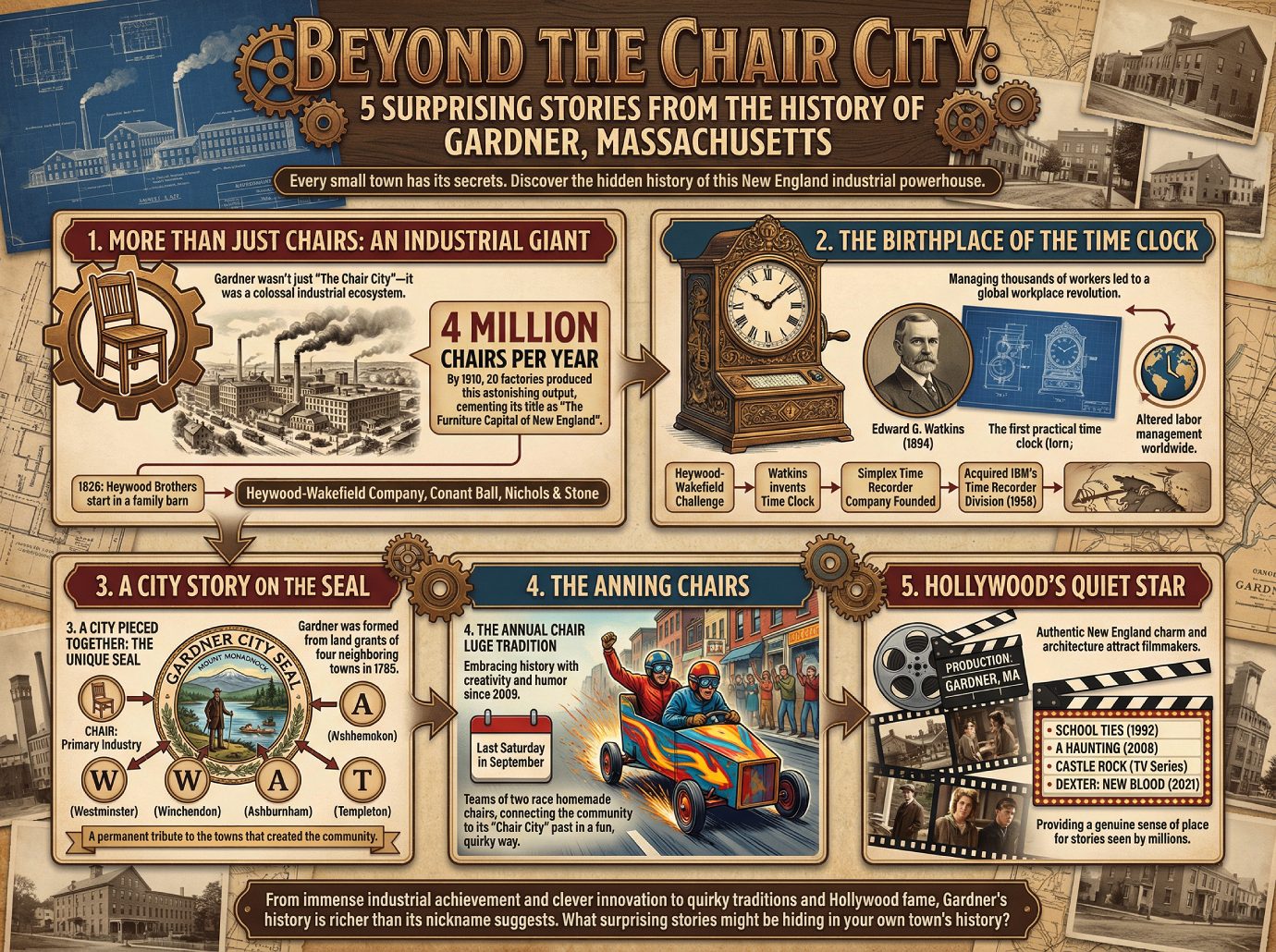
Beyond the Chair City: 5 Surprising Stories from the History of Gardner, Massachusetts
Every small American town has its stories, but some are buried deeper than others. We drive through historic downtowns and past old brick factories, often giving little thought to the pivotal moments and world-changing ideas that may have originated within their walls. These places, seemingly ordinary at a glance, can hold fascinating secrets that shaped not just their own community, but the world at large.
Gardner, Massachusetts, is a perfect example. To anyone who knows it, Gardner is “The Chair City,” a title earned through its long and dominant history in furniture manufacturing. But this well-known moniker only scratches the surface of its unique and surprising past. From an invention that redefined the modern workplace to a quirky tradition that pays homage to its roots, Gardner’s story is richer and more impactful than its nickname suggests. Here are five facts that reveal the city’s unique identity.
1. It wasn’t just “The Chair City”—it was an industrial powerhouse.
Gardner’s identity is undeniably rooted in furniture, a legacy that began when the five Heywood brothers—Walter, Levi, Seth, Benjamin, and William—started making wooden chairs in a family barn back in 1826. This humble operation would eventually grow into the famous Heywood-Wakefield Company. But this was no single success story; Gardner was a city-wide industrial ecosystem, also home to major manufacturers like the Conant Ball Company and the Nichols and Stone Chair Company.
The sheer scale of the city’s production is what truly sets it apart. By 1910, Gardner was home to twenty different chair factories that, combined, were producing an astonishing four million chairs per year. This colossal output cemented its reputation as “The Furniture Capital of New England” and fueled an economy that made the small city an industrial force. It wasn’t just a local industry; it was mass production on a scale that is difficult to comprehend today.
2. The modern time clock was invented here.
An industrial machine producing four million chairs a year needs a way to manage its thousands of workers. It was this very challenge, born from Gardner’s own success, that led to an invention that would change workplaces everywhere. In 1894, an engineer at the Heywood-Wakefield furniture company named Edward G. Watkins was tasked with creating a better way to track employee time. His solution was the first practical time clock, an invention that would permanently alter labor management across the globe.
Recognizing the immense potential of his device, Watkins founded the Simplex Time Recorder company. The business remained under the Watkins family’s leadership for over a century, passing to his son Curt and then his grandson Chris. Simplex grew into an industry leader, eventually becoming so successful that it purchased IBM’s Time Recorder Division in 1958. It’s a striking piece of history: a technology that now governs the daily schedules of millions of workers worldwide was born not in a tech lab, but in a furniture factory in a small Massachusetts city.
3. Its origin story is encoded on the official city seal.
Gardner wasn’t founded as a standalone settlement. Instead, it was pieced together like a puzzle. The town was officially incorporated in 1785 by receiving land grants from four of its neighbors: Ashburnham, Templeton, Westminster, and Winchendon.
This unique origin story is visually preserved on the city’s official seal, designed in 1922 by illustrator Harrison Cady. The seal portrays founder Thomas Gardner standing in front of Crystal Lake with Mount Monadnock in the distance. Its most interesting features, however, are five small circles. One contains a chair, symbolizing the city’s primary industry. The other four contain the letters W, W, A, and T—a permanent tribute to Westminster, Winchendon, Ashburnham, and Templeton, the four towns that gave a piece of themselves to create a new community.
4. They embrace their history by racing chairs down the street.
How does a city with such a deep-seated identity celebrate its heritage in the 21st century? In Gardner, they do it with a healthy dose of creativity and humor. Since 2009, the city has hosted the Annual Chair Luge, which takes place on the last Saturday in September.
The event features teams of two racing down downtown streets in homemade chairs on wheels. This quirky and beloved competition is a perfect modern tribute to the city’s history, connecting the community to its “Chair City” past in a fun, engaging, and utterly unique way.
5. It’s a quiet star in Hollywood productions.
Gardner’s historic New England charm hasn’t gone unnoticed by Hollywood. The city’s authentic architecture and classic small-town feel have made it an appealing backdrop for filmmakers looking to capture a specific American aesthetic. Its authentic character has been featured in major productions, from 90s dramas to modern-day streaming hits.
Over the years, Gardner has served as a filming location for several major productions:
• The 1992 movie School Ties
• An episode of the paranormal series A Haunting in 2008
• The Stephen King-based television series Castle Rock
• The 2021 revival series Dexter: New Blood
For these productions, Gardner provided more than just a set; it offered a genuine sense of place, lending its historic character to stories seen by millions.
From its dominance in one industry creating the very problem that led to the invention of the modern time clock, to encoding its history on its city seal, Gardner, Massachusetts, is a clear example of how a simple nickname can hide a much deeper story. Its history is one of immense industrial achievement, clever innovation, and a strong sense of identity that continues to be celebrated today. These stories remind us that even the most familiar places have secrets worth discovering.
What surprising stories might be hiding in your own town’s history?
————————–
The Story of Gardner: How a Small Settlement Became “The Chair City”
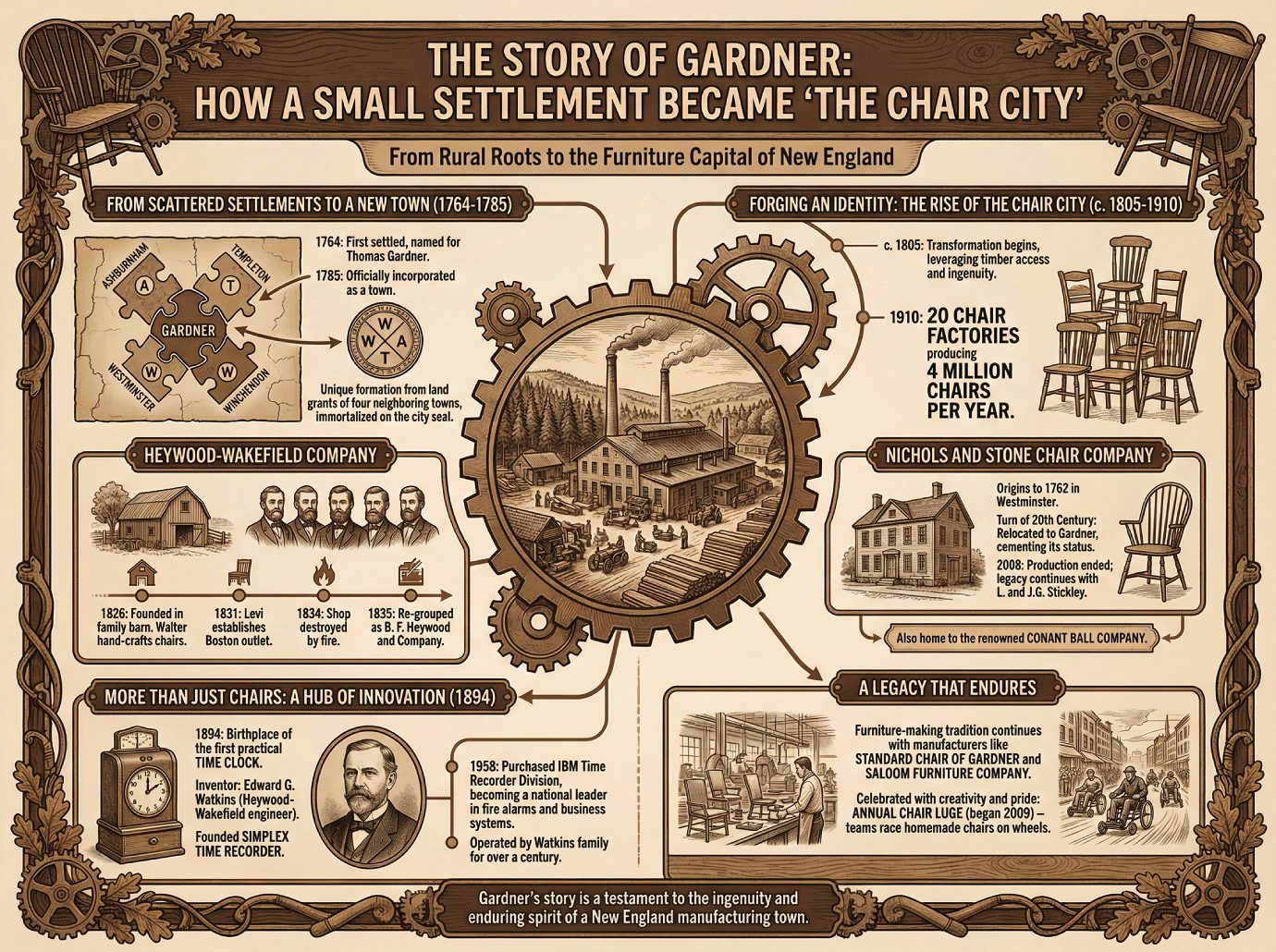
The Story of Gardner: How a Small Settlement Became “The Chair City”
Welcome to the story of Gardner, Massachusetts, a city known by two proud nicknames: “The Chair City” and “The Furniture Capital of New England.” This is a tale of how a small, rural settlement transformed into a powerhouse of American industry. We will explore how the city was founded, how it earned its proud reputation for furniture manufacturing, and highlight some of the key companies and remarkable innovations that shaped its unique history.
——————————————————————————–
From Scattered Settlements to a New Town
The land that would become Gardner was first settled by Europeans in 1764 and was named in honor of Thomas Gardner. Two decades later, in 1785, the settlement was officially incorporated as a town.
Gardner’s formation was unique, as it was pieced together from land grants provided by its already-established neighbors.
• Source of Land: The new town was created from parcels of land granted by four surrounding communities.
• Contributing Towns: Ashburnham, Templeton, Westminster, and Winchendon.
These four towns are immortalized on Gardner’s city seal, which features the letters W, W, A, and T to represent the communities that contributed to its founding. From these humble agricultural beginnings, Gardner would soon forge an industrial identity that would make it famous.
——————————————————————————–
Forging an Identity: The Rise of the Chair City
Beginning around 1805, Gardner started its remarkable transformation into a major center for the lumber and furniture industries. The town’s access to timber and the ingenuity of its residents created a booming economy built on woodworking. The scale of this industry was staggering. By 1910, the city was home to twenty chair factories that collectively produced an incredible four million chairs per year.
The Pioneers of the Furniture Industry
Gardner’s ascent was powered by the vision of several pioneering companies, with two names rising above all others in the city’s lore.
| Company | Key Contributions & History |
|---|---|
| Heywood-Wakefield Company | Founded in 1826, this company’s story began in a family barn. The five Heywood brothers started the business, with Walter initially hand-crafting chairs. In 1831, his brother Levi moved to Boston to establish an outlet store to sell their furniture. After a fire destroyed their shop in 1834, the brothers regrouped and formed the partnership of B. F. Heywood and Company a year later, setting the stage for future growth. |
| Nichols and Stone Chair Company | Tracing its origins to 1762 in Westminster, this historic company relocated to Gardner at the turn of the twentieth century, cementing the city’s status as a furniture hub. Although its production in Gardner ended in 2008, its legacy continues, as its name and design rights were purchased by L. and J.G. Stickley of New York. |
Gardner was also the home of the renowned Conant Ball Company. While Gardner’s reputation was built on furniture, the city’s spirit of innovation extended far beyond chairs.
——————————————————————————–
More Than Just Chairs: A Hub of Innovation
In 1894, Gardner became the birthplace of the first practical time clock. This pivotal invention came from Edward G. Watkins, an engineer working at the Heywood-Wakefield Company. He was asked to create a better system for tracking employee hours, and his solution sparked a new industry.
Recognizing the widespread need for his invention, Watkins founded the Simplex Time Recorder company. The company grew steadily, but its most significant expansion came in 1958 when it purchased the IBM Time Recorder Division. This acquisition propelled Simplex to become a national leader in fire alarms and business systems. The Watkins family operated the company for over a century until it was sold to Tyco International in 2000, leaving a lasting legacy of technological innovation in Gardner.
This blend of manufacturing prowess and inventive spirit defines the city’s character to this day.
——————————————————————————–
A Legacy That Endures
While Gardner, like many New England industrial towns, has faced deindustrialization in recent decades, its rich history is not forgotten. The furniture-making tradition continues, with a handful of manufacturers like the Standard Chair of Gardner and the Saloom Furniture Company still operating in the area.
Beyond this, the city’s heritage is celebrated with creativity and pride. A perfect example is the Annual Chair Luge, an event that began in 2009. Each September, teams race down the city’s streets in homemade chairs on wheels—a fun and fitting tribute to the “Chair City” heritage.
From its unique formation through land grants to its reign as a world-renowned center for furniture and the birthplace of workplace innovation, Gardner’s story is a testament to the ingenuity and enduring spirit of a New England manufacturing town.
Gardner Guide with Convenient Phone Numbers
To easily print this directory, download the PDF, CLICK HERE.

Gardner Guide with Convenient Phone Numbers
———–