World News Briefing for the Week of November 29, 2026
Listen to the Weekly World News Briefing on any device, CLICK PLAY.
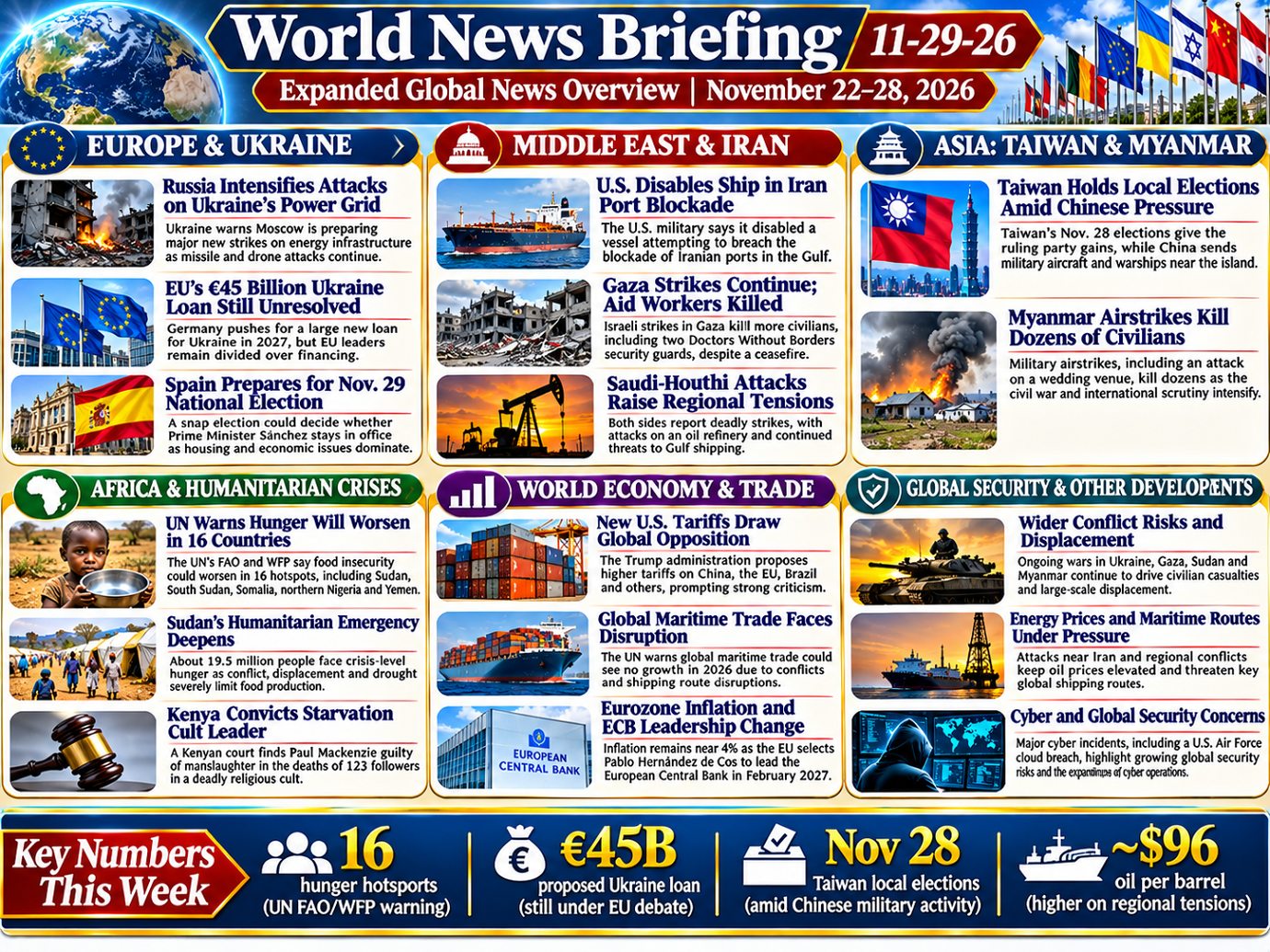
The final full week of November brought significant international developments involving the wars in Ukraine and the Middle East, tensions between China and Taiwan, political uncertainty across Europe, growing humanitarian emergencies in Africa, and disputes over international trade.
Among the most consequential developments were renewed threats to global shipping near Iran, Russian attacks on Ukraine’s energy infrastructure, Israeli strikes in Gaza, elections in Taiwan, and a United Nations warning that conflict and disrupted food supplies could push millions more people toward hunger.
This expanded briefing is organized by subject, with the most significant stories appearing first within each category. It includes breaking developments, major diplomatic decisions, humanitarian emergencies, and important continuing stories.
1. Russia, Ukraine and European Security
1. Ukraine warns Russia is preparing massive attacks on its power grid
Ukrainian President Volodymyr Zelenskyy warned November 26 that Russia was preparing another major attack on the country’s energy infrastructure. Russia had already launched ballistic missiles and 113 drones overnight, damaging homes, businesses, a hospital, and other facilities. Repair crews were working to restore electricity in six Ukrainian regions. The attacks raise concerns about Ukraine’s ability to maintain heating, electricity, and essential services during the approaching winter.
2. Zelenskyy criticizes Washington’s approach to Vladimir Putin
Ukraine’s president expressed frustration with President Donald Trump’s characterization of Russian President Vladimir Putin as a friend. In comments reported November 27, Zelenskyy urged Washington to apply greater pressure on Moscow and questioned whether the United States was paying sufficient attention to Ukraine while concentrating on Middle Eastern conflicts. The disagreement illustrates continuing tensions between Kyiv and Washington over how to end the war.
3. Russian bombing kills civilians and injures dozens in Zaporizhzhia
A Russian glide-bomb attack on Zaporizhzhia killed two civilians and injured 48 people, including four children, according to Ukrainian officials. The November 24 attack damaged residential buildings and prompted additional Ukrainian military deployments to the region. The strike demonstrates the continuing danger to civilians despite international efforts to negotiate an end to the conflict.
4. Ukraine defends unprecedented attack on Russian warship in Libya
Ukraine defended a drone attack on a Russian naval vessel docked in Benghazi, Libya. Libyan authorities protested the operation, arguing that it violated their sovereignty. The United Nations mission in Libya also expressed concern. Ukraine maintained that the operation targeted Russian military assets rather than Libya itself. The incident demonstrates how the Russia-Ukraine conflict is extending into other geographic regions.
5. Russia-Ukraine peace negotiations remain stalled over territory
American diplomatic efforts to negotiate a settlement remain deadlocked over territorial demands and security guarantees. U.S. envoy Jared Kushner described the challenge of reaching agreement with Moscow, while Ukraine continues rejecting Russian demands for additional territory. Earlier November negotiations produced progress toward a prisoner exchange but no comprehensive peace agreement.
6. Ukraine seeks additional air-defense missiles and fighter aircraft
Ukraine is asking its international partners for additional Patriot interceptors and modern fighter aircraft. Zelenskyy has emphasized the need to counter Russian ballistic missiles and increasingly sophisticated drones. Shortages of air-defense equipment have become particularly concerning as Russia intensifies attacks on civilian infrastructure.
7. Germany pushes European Union toward major new Ukraine financing
German Chancellor Friedrich Merz is pressing European governments to support a proposed €45 billion loan for Ukraine in 2027. Some EU governments have expressed reservations, creating disagreement over how future assistance should be financed. The debate is significant because Ukraine’s ability to continue defending itself depends partly on sustained international financial assistance.
8. European Union budget negotiations face divisions over Ukraine assistance
EU governments are struggling to reconcile competing priorities involving Ukraine financing, domestic spending, and the bloc’s future budget. The disagreements have exposed differences among member states over the financial burden of supporting Ukraine and maintaining European security. The outcome could influence both Ukraine’s financial stability and broader European cooperation.
2. Middle East Conflict, Iran and Regional Security
9. United States disables another ship attempting to breach blockade of Iran
The U.S. military reported November 27 that it had disabled a merchant vessel attempting to breach the American blockade of Iranian ports. The Palau-flagged Pacific Archer was struck near its stern by precision munitions fired from an American military aircraft in the Gulf of Oman. U.S. Central Command said the ship’s civilian crew was unharmed. The incident highlights continuing military tensions and threats to international shipping.
10. Attacks on oil tankers increase concerns about Persian Gulf shipping
Two commercial tankers were struck by projectiles near Oman and Dubai, according to reports published November 26. Iran’s Revolutionary Guard claimed the vessels had encountered naval mines after attempting unauthorized passage, but the explanation was not independently verified. The incidents threaten shipping confidence in a region critical to global petroleum supplies.
11. Drone attack in Kuwait kills two Italian defense personnel
Kuwait reported intercepting Iranian drones, with falling debris killing two Italian air-defense technicians and injuring a Kuwaiti and a Pakistani. Iran denied responsibility. The incident demonstrates how regional military confrontations are affecting foreign personnel stationed in Gulf countries.
12. Israeli strikes kill Palestinians in Gaza despite ceasefire
Israeli attacks in Gaza killed 10 Palestinians in incidents reported November 26, according to hospital officials. Israeli leaders said one strike killed Hamas official Khaled Abu Nada. Other attacks struck residential areas and locations near the dividing line between Israeli- and Hamas-controlled territory. The continued violence demonstrates the fragility of the ceasefire arrangement established in October 2025.
13. Additional Israeli strikes reported in Gaza on November 27
Gaza hospital officials reported seven more deaths from Israeli strikes. Israel said it had targeted militants in several incidents, while reporting remained incomplete concerning other attacks. The renewed casualties have intensified concerns about the humanitarian consequences of continued military operations.
14. Hamas reports survival of senior negotiator’s son after alleged strike
Hamas said the son of senior negotiator Khalil al-Hayya survived an alleged Israeli attack on a residential apartment. The report emerged during renewed violence in Gaza and continuing uncertainty surrounding negotiations between Israel and Hamas. The circumstances and intended target of the reported strike were not independently established.
15. Saudi Arabia and Houthi forces exchange accusations over deadly attacks
Houthi officials reported Saudi strikes that killed four people, while Saudi Arabia said an attack on an oil refinery killed a Nepalese worker. The renewed violence threatens to intensify Yemen’s prolonged conflict and disrupt regional energy infrastructure.
16. Deadly attack in Yemen’s Taiz province produces conflicting accounts
Houthi officials said an airstrike in Taiz killed at least 11 people, including children. Local authorities aligned with Yemen’s internationally recognized government blamed the Houthis. The Associated Press could not independently establish responsibility, illustrating the difficulty of verifying battlefield claims.
17. Pakistan, Saudi Arabia and Turkey strengthen defense cooperation
Pakistan, Saudi Arabia and Turkey held discussions under a trilateral defense arrangement. Turkey formally ratified the agreement, which treats an attack on one participating country as an attack on all three. The arrangement could influence regional military cooperation and security calculations across the Middle East and South Asia.
18. Regional fighting places additional pressure on international oil markets
Attacks involving ships near Iran and energy infrastructure in Saudi Arabia contributed to higher oil prices.Reuters reported Brent crude rising to approximately $96 per barrel on November 26. Higher energy costs could contribute to inflation and transportation expenses worldwide.
3. China, Taiwan and Asian Security
19. Taiwan holds major local elections watched closely by China
Taiwan’s local elections took place November 28 across its 22 cities and counties. The ruling Democratic Progressive Party increased the number of local governments it controls but failed to capture the Taipei mayoralty. The results are being closely examined for what they might indicate about Taiwan’s political direction before the 2028 presidential election.
20. China sends 30 military aircraft near Taiwan ahead of voting
Taiwan’s defense ministry reported detecting 30 Chinese military aircraft near the island on November 27.Twenty-six crossed the Taiwan Strait’s median line, accompanied by Chinese warships. Taiwan characterized the activity as a joint combat-readiness patrol, raising concerns about military pressure during the democratic election process.
21. Taiwan’s ruling party makes local election gains but loses Taipei
The Democratic Progressive Party doubled the number of cities and counties under its control. However, opposition Kuomintang Mayor Chiang Wan-an won reelection in Taipei, while the DPP captured Taichung. The mixed outcome gives both parties important political strengths as they prepare for future national elections.
22. China continues rejecting Taiwan’s claims of independent self-government
Beijing reiterated its position that Taiwan must ultimately be unified with mainland China. Taiwan’s government rejected China’s territorial claims and called for dialogue without political preconditions. The continuing disagreement remains one of the world’s most significant potential flashpoints.
23. United States proposes new tariffs on China and other trading partners
The Trump administration proposed additional tariffs targeting industrial production and alleged excess manufacturing capacity in 14 trading partners. China, Japan and the European Union were among the affected economies. The proposed measures could reshape global trade flows and increase tensions between Washington and major manufacturing countries.
24. China and Japan protest American tariff proposals
China and other American trading partners criticized the proposed tariff increases. Beijing reserved the right to respond, while other governments warned about the consequences for trade relationships. The dispute adds uncertainty to international supply chains and future investment decisions.
25. Bank of Japan signals possibility of faster interest-rate increases
A Bank of Japan policymaker called for a faster response to inflation risks, potentially including additional interest-rate increases. The comments raised expectations of a possible December policy adjustment. Japanese monetary policy is significant internationally because changes in Japanese interest rates can influence currency markets and global investment flows.
4. European Politics, Elections and Financial Stability
26. Spain prepares for major national election on November 29
Spain’s snap parliamentary election is expected to determine whether Prime Minister Pedro Sánchez remains in office or a conservative-led government takes power. Polling placed the opposition People’s Party ahead, although it might need support from the right-wing Vox party to form a government. The election is important because it could alter Spain’s economic, immigration and European Union policies.
27. Spain’s housing crisis becomes major election issue
Sánchez called the election after lawmakers rejected proposals intended to address Spain’s housing crisis. Housing affordability has become a major source of political dissatisfaction, particularly among younger residents. The election could influence future construction incentives, public housing investment and rent-related policies.
28. Europe prepares for a major cycle of national elections
Several major European countries face national elections in 2027. Political analysts are watching the growth of nationalist and Eurosceptic parties, particularly in countries where established political coalitions have weakened. The outcomes could affect immigration policy, European integration and continued assistance to Ukraine.
29. Pablo Hernández de Cos selected to lead European Central Bank
Eurozone governments selected former Bank of Spain Governor Pablo Hernández de Cos to succeed Christine Lagarde as president of the European Central Bank. He is expected to assume office in February 2027, subject to formal confirmation. The appointment comes as Europe confronts renewed inflation and concerns about financial stability.
30. European Central Bank faces inflation near 4 percent
Eurozone inflation has climbed to approximately 4%, twice the European Central Bank’s target. Officials are considering further interest-rate increases as higher energy costs affect the European economy. The bank faces the difficult task of reducing inflation without causing unnecessary economic damage.
31. France’s financial troubles threaten broader European stability
France’s high debt levels, political uncertainty and increasing government borrowing costs are raising concerns among investors. The incoming European Central Bank leadership may face pressure to respond if French financial instability spreads to other eurozone countries. The issue is especially important because France is the currency area’s second-largest economy.
32. European Central Bank faces criticism over gender representation
Reuters reported November 27 that the European Central Bank could have only one woman among its 27 monetary policymakers after Christine Lagarde and Isabel Schnabel leave. The situation has generated criticism from European lawmakers and renewed debate over representation in major economic institutions.
5. Africa: Conflict, Humanitarian Emergencies and Justice
33. United Nations warns hunger will worsen in 16 countries
The United Nations Food and Agriculture Organization and World Food Programme warned November 27 that food insecurity could worsen in 16 countries during the coming six months. Sudan, Yemen, South Sudan, Somalia and northern Nigeria face the most serious risks. Conflict, rising fuel costs, disrupted food production and declining humanitarian assistance are contributing to the emergency.
34. Nearly 19.5 million people face severe hunger in Sudan
The United Nations reports that approximately 19.5 million people in Sudan face crisis-level food insecurity or worse. Famine risks remain especially serious in parts of Darfur and South Kordofan. The country’s civil war, displacement and disrupted agriculture have created one of the world’s gravest humanitarian emergencies.
35. Conflict and drought threaten Sudan’s agricultural production
Higher fuel prices and El Niño-related drought are damaging food production in Sudan. United Nations reporting indicates that substantial portions of agricultural land in important producing regions have been affected. The combination of conflict and environmental stress could further reduce food supplies.
36. Ebola outbreak continues spreading in Central Africa
A major Ebola outbreak centered in the Democratic Republic of Congo remains a serious regional public health emergency. Earlier November figures reported more than 11,000 infections and over 5,000 deaths in Congo. Kenya has discharged its last Ebola patient and is working toward an outbreak-free declaration, but the wider regional situation remains dangerous.
37. Armed violence complicates Ebola response in eastern Congo
Militants affiliated with the Islamic State group have continued attacks in eastern Congo.
Earlier November attacks killed at least 22 civilians and resulted in abductions near the Ugandan border.
The violence threatens humanitarian operations and efforts to contain Ebola in affected communities.
38. Kenya convicts starvation cult leader in deaths of 123 followers
A Kenyan court found Paul Mackenzie guilty November 27 of manslaughter in the deaths of 123 followers. Mackenzie had instructed followers to starve themselves as part of an apocalyptic religious movement. The conviction follows earlier findings involving the deaths of hundreds of followers, including children.
39. Sudan and Ethiopia tensions threaten wider regional conflict
Sudan and Ethiopia continue accusing each other of supporting armed groups operating across their borders. The allegations have raised fears that the conflicts in Sudan and Ethiopia’s Tigray region could become more interconnected. The dispute is an ongoing regional security issue, although the principal diplomatic escalation was reported earlier in November.
6. Asia: Civil War and Human Rights
40. Myanmar military airstrike kills at least 30 at village school
A military airstrike in Myanmar’s Magway region killed at least 30 people, including children, according to opposition officials and a local witness. The attack occurred November 26 and was reported November 28. The incident adds to the mounting civilian casualties from Myanmar’s prolonged civil war.
41. Myanmar airstrikes hit wedding venue and western communities
Additional military airstrikes on November 28 reportedly killed dozens of people, including approximately 20 at a wedding venue in Moe Bye. Other attacks were reported in western Rakhine state. AFP reported that the combined death toll from several days of bombing exceeded 60, although some casualty figures remained uncertain.
42. Myanmar faces renewed scrutiny following international genocide ruling
The latest attacks occurred one week after the International Court of Justice ruled that Myanmar had committed genocide against the Rohingya minority in 2017. The ruling and continuing military operations have renewed international attention to human rights abuses and accountability in Myanmar.
7. International Trade, Economy and Global Development
43. United Nations forecasts zero growth in global maritime trade
UN Trade and Development released a report November 26 projecting that global maritime trade will record no growth in 2026. Shipping disruptions, trade uncertainty and problems at major maritime chokepoints are increasing costs and forcing longer shipping routes. The consequences are especially serious for developing countries dependent on imported goods.
44. Global food agency warns shipping disruptions could affect millions
The World Food Programme warned that disruptions involving the Black Sea, Strait of Hormuz and Bab el-Mandeb could add $727 million to its costs by mid-2027. The increased expenses could place food assistance for another 7.3 million people at risk. The warning demonstrates how military conflicts can worsen hunger far beyond the immediate war zones.
45. Global stock markets rebound after tariff-related volatility
International financial markets recovered November 26 as investors concluded that proposed American tariffs might be less disruptive than initially feared. European shares gained nearly 2%, while Asian markets also advanced. Nevertheless, uncertainty remains concerning trade policy, inflation and the sustainability of artificial intelligence investment.
46. Artificial intelligence investment raises international financial concerns
Investors are questioning the enormous capital expenditures associated with advanced artificial intelligence systems. Technology-sector volatility has affected global stock markets, with Nvidia among the companies attracting scrutiny. The concern is whether anticipated future profits will justify the scale of investment in AI infrastructure.
8. International Law, Civil Rights and Governance
47. Canada’s Supreme Court upholds most of Quebec’s religious-symbol ban
Canada’s Supreme Court ruled November 27 that Quebec’s law restricting religious symbols worn by certain public employees is largely constitutional. The law affects teachers, police officers and other workers in positions of public authority. Supporters argue that the measure protects state secularism, while opponents contend that it discriminates against religious minorities.
48. Canadian ruling raises broader questions about constitutional rights
The Quebec decision also upheld the province’s use of Canada’s constitutional notwithstanding clause to protect much of the legislation from legal challenges. Civil liberties organizations have warned that the decision could weaken protections for religious freedom and equality. The ruling may influence future debates over the balance between provincial authority and individual rights.
9. International Sports and Culture
49. Copa Libertadores final brings together Palmeiras and Estudiantes
Brazil’s Palmeiras and Argentina’s Estudiantes prepared to meet in the Copa Libertadores final. The competition is South America’s most prestigious club soccer championship and attracts international attention. The November 27 buildup highlighted the contrasting histories and playing styles of the finalists.
50. MotoGP champion Marc Márquez announces retirement
Eight-time MotoGP champion Marc Márquez announced November 27 that he would retire following the 2026 season. The decision marks the approaching end of one of motorcycle racing’s most successful careers. His announcement attracted international attention across the motorsports community.
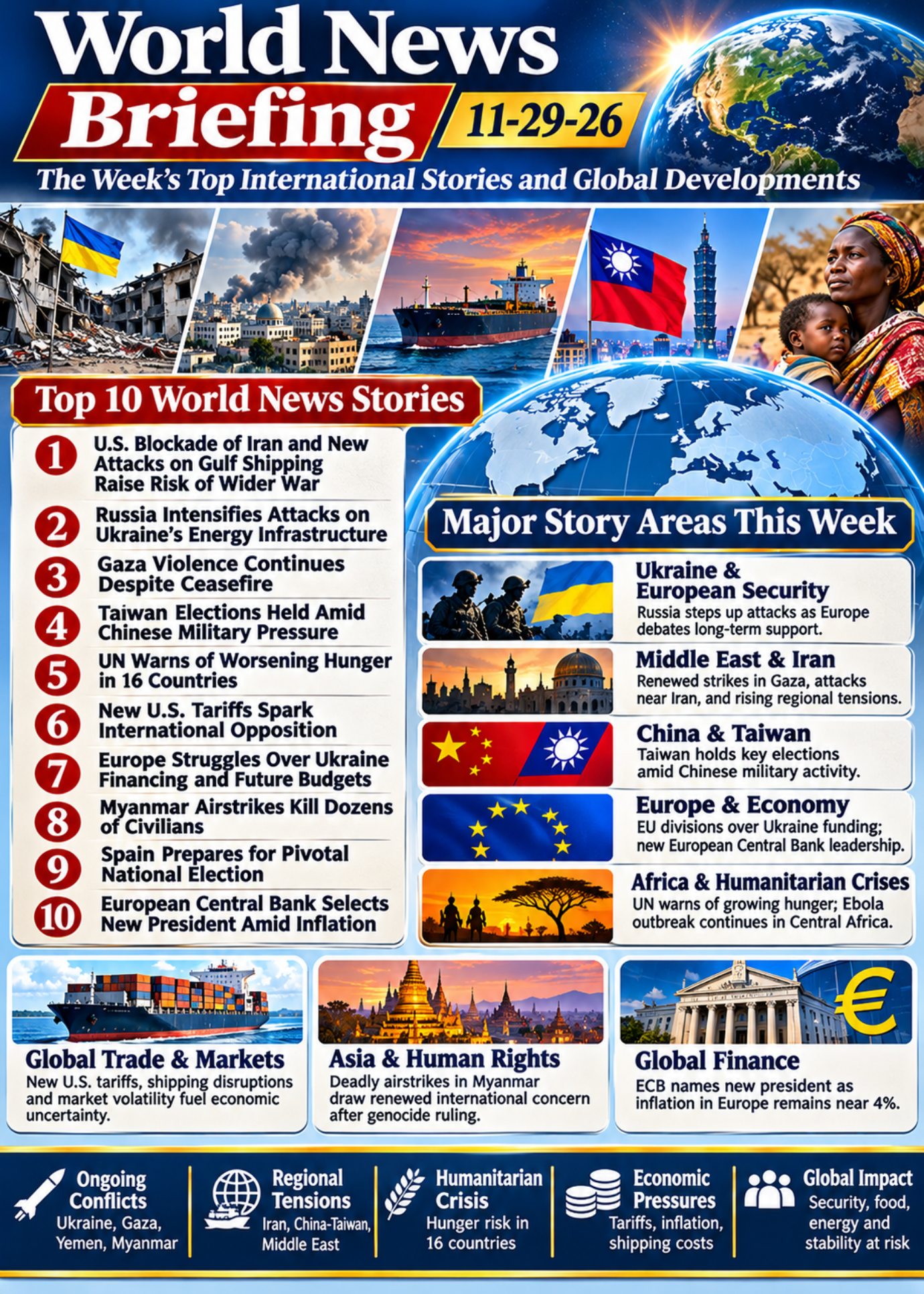
The 10 most important world news stories
| Rank … | Major story | Global significance |
|---|---|---|
| 1 | U.S. blockade of Iran and renewed attacks on Gulf shipping | Risk of wider war and higher oil prices |
| 2 | Russia intensifies attacks on Ukraine’s energy infrastructure | Civilian safety and European security |
| 3 | Gaza violence continues despite ceasefire | Middle East stability and humanitarian crisis |
| 4 | Taiwan elections occur amid Chinese military pressure | Asian security and cross-strait relations |
| 5 | United Nations warns of worsening hunger in 16 countries | Global humanitarian emergency |
| 6 | New U.S. tariffs provoke international opposition | World trade and inflation |
| 7 | Europe struggles over Ukraine financing and future budgets | European unity and Ukraine’s defense |
| 8 | Myanmar airstrikes kill dozens of civilians | Human rights and regional security |
| 9 | Spain prepares for pivotal national election | European politics and economic policy |
| 10 | European Central Bank selects new president amid inflation | Global financial stability |
Three major themes dominate this week’s international reporting
War and regional security remain the greatest immediate concerns. Fighting in Ukraine, Gaza, Yemen and Myanmar continues to threaten civilian populations, while confrontation involving Iran and shipping in the Persian Gulf creates risks for the international economy.
Global economic uncertainty is another major theme. Proposed American tariffs, higher energy costs, shipping disruptions and European financial pressures are influencing markets and government decisions.
Humanitarian emergencies continue worsening in some of the world’s poorest regions. The United Nations’ warnings about hunger, combined with continuing disease outbreaks and armed conflicts, highlight the growing difficulty of delivering assistance.