CLICK a button to go to the complete briefing:




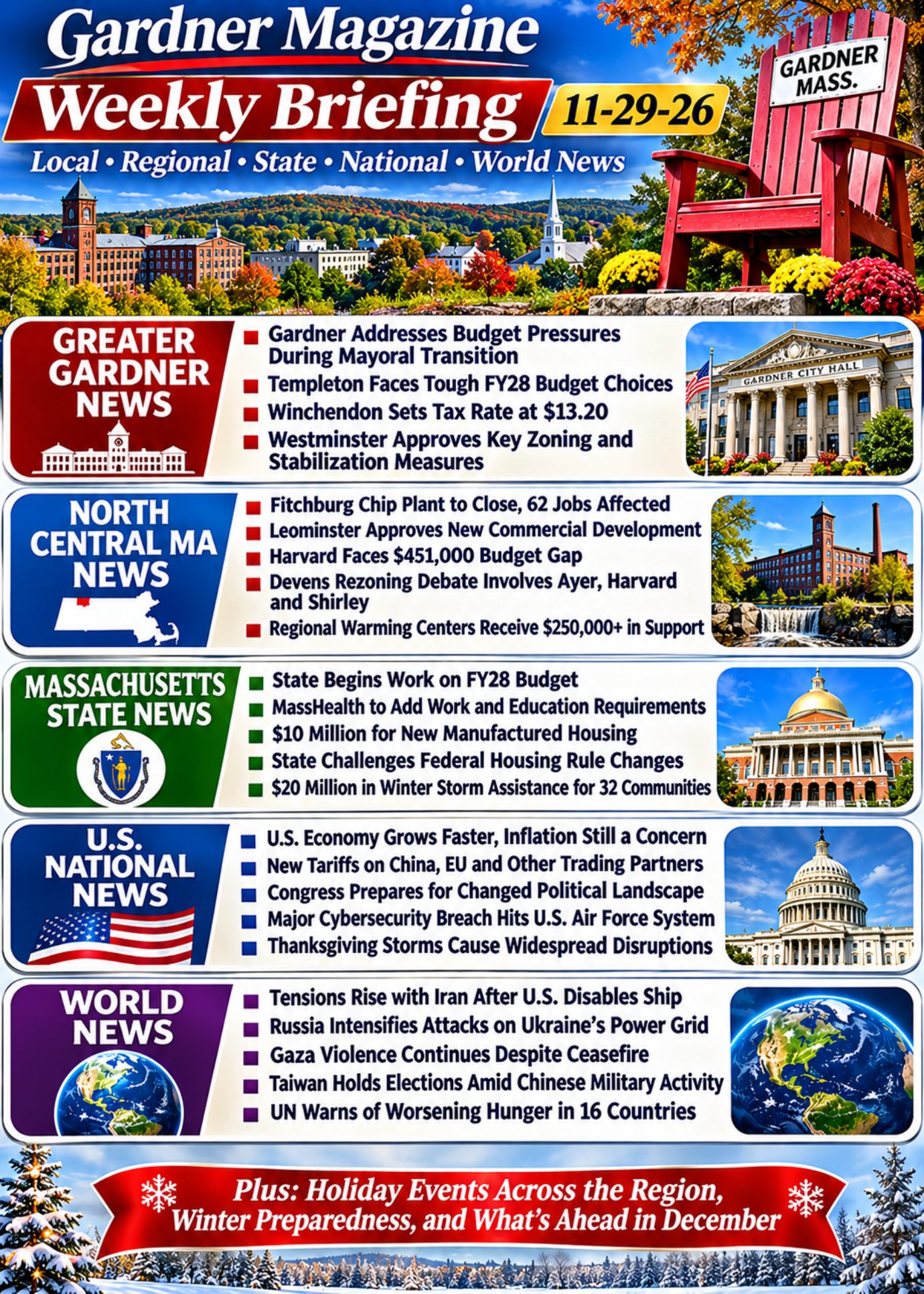
Gardner Magazine Weekly Briefing for the Week of November 29, 2026.
Listen to the Weekly Briefing on any device, CLICK PLAY.
For individual briefings offering even more information, click on one or more of the buttons at left to take you to individual briefings for North Central MA, Massachusetts, the nation, and the world.
A Comprehensive Look at the News That Matters Most to Our Region
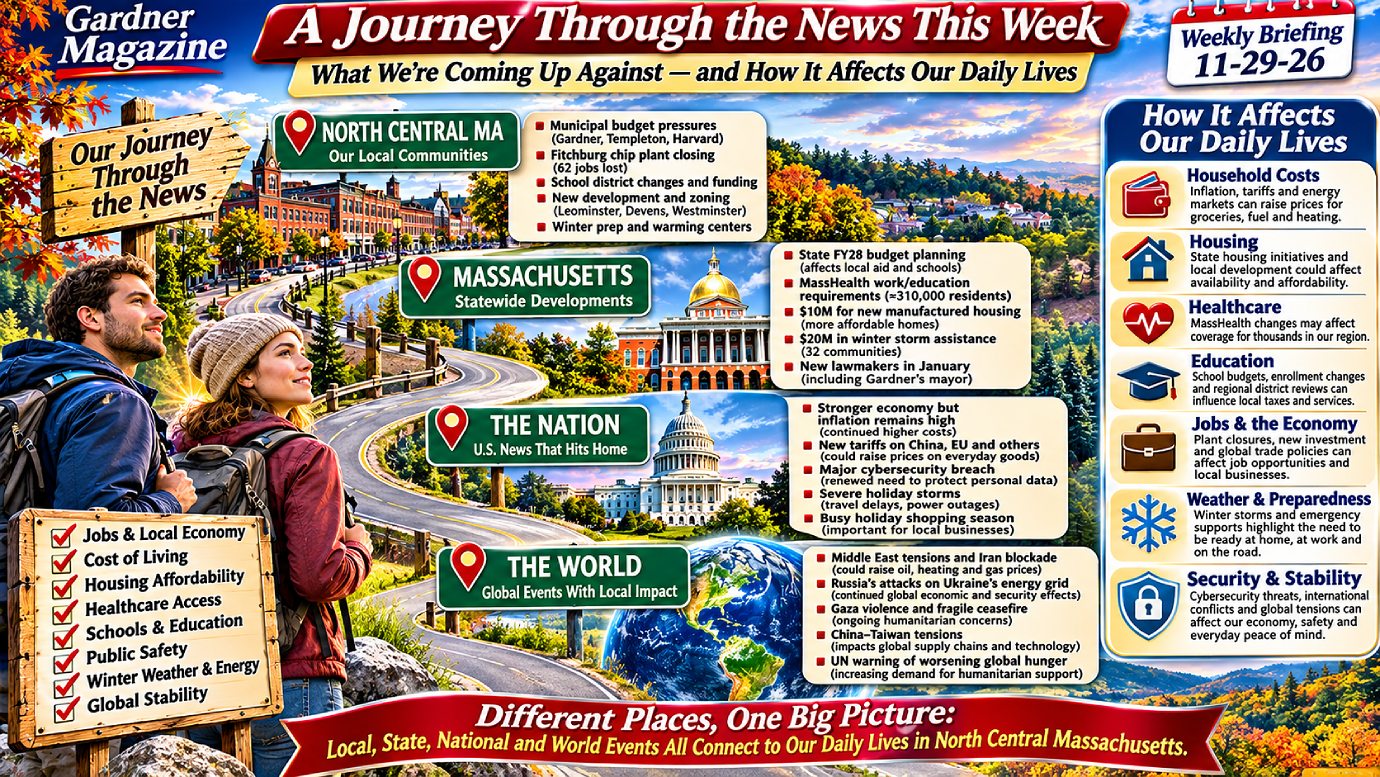
As November draws to a close and the holiday season begins, residents of Greater Gardner and North Central Massachusetts are confronting a mixture of financial challenges, government transitions, economic uncertainty, and opportunities for community growth.
This week’s Gardner Magazine Weekly Briefing takes a broader approach to the news, connecting developments in our local communities with important events across Massachusetts, the United States, and the world. The emphasis is on stories that directly affect, or have the potential to affect, the lives of people in our region.
Municipal finances remain a pressing concern, particularly in Gardner and Templeton. Schools face difficult funding decisions, communities are preparing for winter emergencies, and local organizations are stepping forward to help residents in need. Meanwhile, decisions in Boston and Washington involving healthcare, housing, government spending, and international trade could have significant consequences for local taxpayers, businesses, and families. Beyond our borders, international conflicts, energy markets, and global economic uncertainty continue to influence the prices we pay and the security of the world in which we live.
Greater Gardner: Local Government, Finances and Community Life
Gardner Faces Financial Challenges as Historic Mayoral Transition Approaches
One of the most important developments in Greater Gardner remains the City of Gardner’s financial situation. Mayor Michael Nicholson’s administration has been working to address substantial budget pressures through departmental spending reductions and the use of stabilization reserves. The financial stabilization package approved November 16 included approximately $550,000 in spending reductions and a $2.6 million withdrawal from reserves. During his November 28 appearance on WGAW Hotline Radio, Nicholson emphasized that the measures help alleviate financial pressures but do not eliminate the challenges expected in the next budget cycle. The mayor also discussed the limits imposed by Proposition 2½ and the possibility of a property tax override, which would require approval by the mayor, City Council, and voters. Nicholson indicated that he does not anticipate such an override in the immediate future.
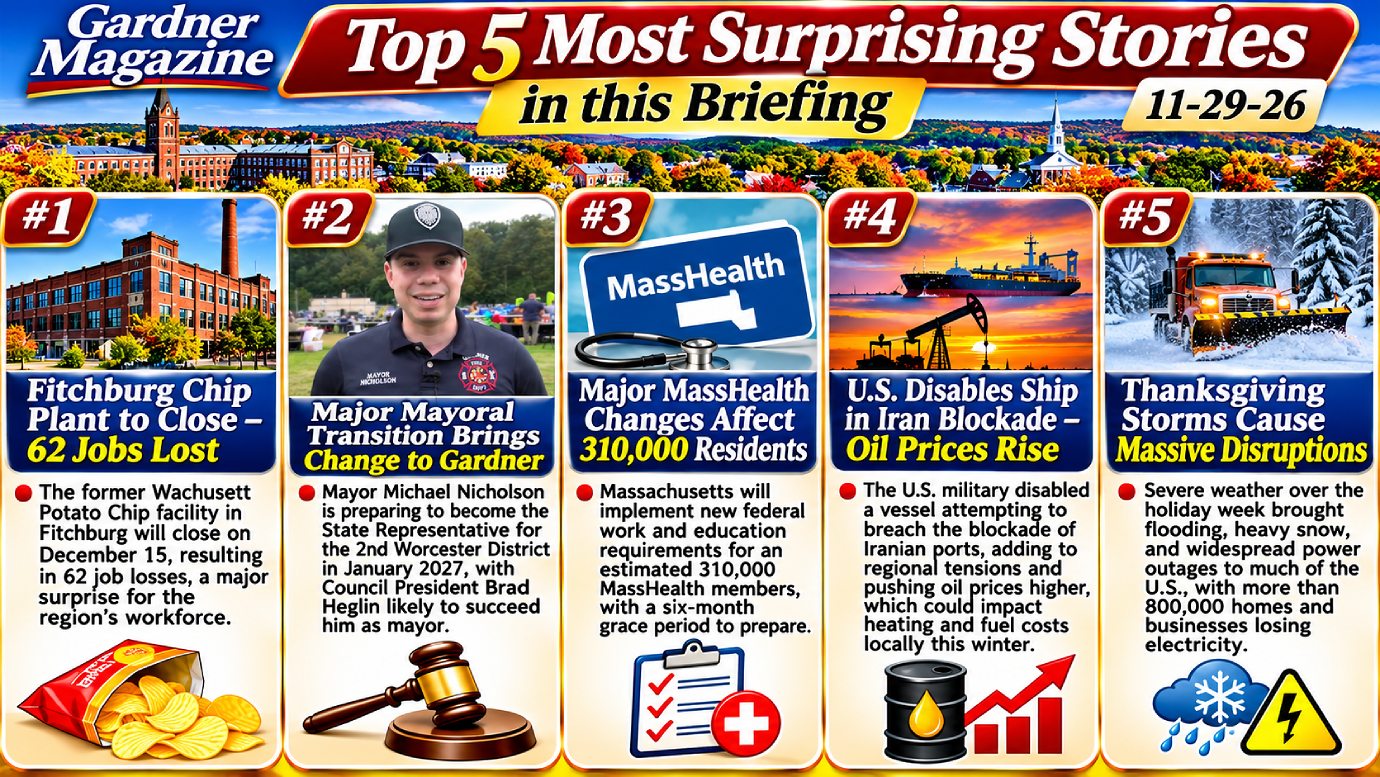
The financial situation is unfolding during a historic leadership transition. Nicholson is preparing to become the state representative for the 2nd Worcester District in January 2027. City Council President Brad Heglin is expected to succeed Nicholson as mayor if he is reelected council president in January, as required under the city’s charter succession provisions. The transition places additional importance on financial planning, communication between city officials, and continuity in municipal operations.
Templeton Confronts Difficult Budget Decisions
Templeton is also experiencing serious municipal financial challenges. The town previously used approximately $1.2 million from stabilization funds to support municipal operations during fiscal year 2027. With reserves under pressure, officials are preparing for difficult decisions involving the fiscal year 2028 budget. Potential solutions could include spending reductions, service changes, or consideration of additional revenue. The situation illustrates a challenge shared by many Massachusetts communities: the rising cost of municipal services is outpacing the growth of traditional revenue sources.
Winchendon Establishes Property Tax Classification
Winchendon’s Select Board voted November 23 to maintain a single property tax classification for residential and commercial properties. The estimated fiscal year 2027 tax rate is $13.20 per $1,000 of assessed valuation, compared with the previous $12.69 rate. Town officials also reported more than $600,000 in state reimbursement associated with snow and ice expenses from the previous winter. The reimbursement provides welcome financial assistance as the community prepares for another season of winter maintenance.
Westminster Takes Action on Development and Public Safety
Westminster voters recently approved zoning restrictions on data centers, additional public safety staffing, and a transfer of approximately $2.35 million into stabilization funds. The decisions reflect the town’s efforts to balance development, public safety, and long-term financial stability. Data center regulation is becoming an increasingly important issue across Massachusetts as communities evaluate the infrastructure, electricity, water, and land-use implications of large technology facilities.
Oakham Continues Battery Storage Debate
Oakham’s controversy involving a proposed large-scale battery energy storage facility remains a significant regional issue. The dispute raises questions about state energy policy, local zoning authority, emergency preparedness, and the impact of industrial-scale energy infrastructure on rural communities. The outcome could have implications beyond Oakham as other Massachusetts towns consider similar proposals.
Gardner and Neighboring Communities Prepare for Winter
Winter preparedness is receiving renewed attention throughout Greater Gardner. Gardner has introduced an automated winter parking information hotline at 978-991-1515, allowing residents to check current parking restrictions. Emergency management officials throughout the region are also encouraging residents to prepare for winter storms, power outages, hazardous driving conditions, and interruptions to essential services. The arrival of colder weather makes these preparations particularly important for older residents and households with limited resources.
North Central Massachusetts and North Quabbin: Regional Developments
Fitchburg Faces Manufacturing Job Losses
One of the region’s most significant economic stories is the planned December 15 closure of the former Wachusett Potato Chip manufacturing facility in Fitchburg. The shutdown is expected to affect 62 jobs. Manufacturing has historically played an important role in North Central Massachusetts, and the loss of established industrial employers affects not only the host community but workers and families throughout the region. At the same time, commercial investment continues in the Fitchburg-Leominster corridor, illustrating the changing character of the regional economy.
Leominster Continues Commercial Development
Leominster’s Planning Board recently approved a commercial development proposal involving two buildings on Hamilton Street. The project includes space for contractor businesses and retail activity. Such developments demonstrate continuing private investment in the region, even as businesses face higher operating costs and economic uncertainty.
Harvard Faces Substantial Municipal Budget Gap
Harvard is confronting a projected fiscal year 2028 budget deficit of approximately $451,000, despite efforts to identify departmental savings. The town could face another Proposition 2½ override proposal if officials cannot close the gap through spending reductions or other revenue. The situation closely resembles financial challenges facing Gardner, Templeton, and other communities.
Devens Rezoning Could Reshape Three Communities
Proposed zoning changes affecting Devens are generating debate in Ayer, Harvard, and Shirley. The proposals involve additional housing, retail, and industrial development. Harvard officials have raised concerns about removing existing housing limitations, while supporters of redevelopment emphasize the potential economic benefits. A Super Town Meeting scheduled for March 2027 is expected to play an important role in determining the proposal’s future.
Narragansett Regional School District Prepares for Leadership Change
The Narragansett Regional School District, serving Templeton and Phillipston, is preparing for the retirement of Superintendent Chris Casavant. A successor is expected to assume leadership in July 2027. The transition comes during a period when school funding, staffing, and municipal affordability remain major concerns.
Mahar Regional School Funding Remains Under Review
Orange, New Salem, Petersham, and Wendell continue examining the financial structure of the Ralph C. Mahar Regional School District. The review involves how educational expenses are distributed among participating communities. Any changes could affect municipal budgets and local taxpayers throughout the district.
Regional Warming Centers Receive Significant Support
The United Way of North Central Massachusetts and partner organizations have announced more than $250,000 in support for emergency warming center operations. The initiative involves Athol, Fitchburg, Leominster, and Winchendon. The centers are intended to provide temporary shelter during dangerous cold weather and connect vulnerable individuals with assistance. The initiative demonstrates the importance of regional cooperation in addressing homelessness, poverty, and emergency preparedness.
Food Assistance Expands in Eastern North Central Massachusetts
Loaves & Fishes Food Pantry in Devens is expanding its delivery program to assist residents who face transportation or mobility barriers. The organization serves households in Ayer, Groton, Harvard, Shirley, and neighboring communities. Food insecurity remains an important regional issue, particularly as households confront higher housing, utility, and grocery expenses.
Holiday Celebrations Bring Communities Together
The Thanksgiving weekend marks the beginning of a busy holiday season throughout Greater Gardner and North Central Massachusetts. Gardner’s Holiday Stroll, the Gardner Museum Festival of Trees, GAAMHA’s Christmas Tree Lot, and seasonal performances at Theater at the Mount are among the attractions drawing residents together. Winchendon is promoting holiday shopping through its Toy Town Christmas activities, while farms, churches, schools, museums, and community organizations throughout the region are hosting seasonal events. These activities provide opportunities for families to celebrate while supporting local businesses and charitable organizations.
Massachusetts State News: Decisions That Affect Our Communities
Massachusetts Begins Preparing Its Next State Budget
The Commonwealth is beginning the process of developing its fiscal year 2028 budget. A consensus revenue hearing scheduled for December 2 will help establish expectations for state tax collections. The outcome is particularly important to municipalities because state revenue influences local aid, education funding, transportation investment, and other programs. For communities such as Gardner and Templeton, which are already experiencing financial pressures, the level of future state assistance could be consequential.
MassHealth Faces Significant Federal Changes
Massachusetts is preparing to implement new federal Medicaid work and education requirements affecting an estimated 310,000 MassHealth members. The state has opted into a six-month grace period to prepare for implementation. The changes could affect residents throughout North Central Massachusetts who rely on MassHealth for medical coverage. They could also influence local hospitals, healthcare providers, and organizations serving low-income households.
Housing Affordability Remains a Statewide Priority
The Healey administration has announced a $10 million initiative intended to expand manufactured housing opportunities. The program is designed to encourage additional housing production and provide alternatives to increasingly expensive conventional construction. Housing affordability remains a significant concern throughout Massachusetts, including North Central communities where rents, property values, and construction costs have increased.
Massachusetts Challenges Federal Housing Assistance Restrictions
Massachusetts has joined other states in litigation challenging federal changes involving eligibility verification for housing assistance. The dispute could affect families receiving subsidized housing support. The outcome may have implications for local housing authorities and households throughout the Commonwealth.
State Provides Additional Winter Storm Assistance
Massachusetts has announced another $20 million in winter storm assistance for 32 communities. The funding is intended to help municipalities recover from severe weather and manage related expenses. Winter maintenance is a substantial financial responsibility for cities and towns, particularly those with extensive road networks and limited municipal budgets.
Springfield Schools Face Major Financial Shortfall
Springfield Public Schools is projecting a budget deficit of approximately $45 million. Declining enrollment is among the factors affecting district finances. Although Springfield is outside Gardner Magazine’s primary coverage area, its financial challenges illustrate pressures that could affect school districts across Massachusetts.
Legislature Prepares for New Membership in January
At least 21 lawmakers are expected to be new to their respective chambers when the Massachusetts Legislature convenes in January 2027. The changes include Gardner Mayor Michael Nicholson’s anticipated move to the House of Representatives. For Greater Gardner, the transition creates an opportunity for renewed attention to local government finances, infrastructure, education, and economic development at the state level.
United States National News: Economic and Political Developments
Stronger Economic Growth Meets Continuing Inflation
Revised federal economic figures indicate that the United States economy grew more strongly during the third quarter than initially reported. Consumer confidence also improved during November, reaching its highest level in nearly two years. However, inflation remains a concern. For North Central Massachusetts households, the most important question is whether economic growth will translate into improved purchasing power. Higher grocery bills, housing expenses, healthcare costs, and utility charges continue to affect family budgets.
New Tariff Proposals Could Affect Regional Businesses
The Trump administration is pursuing additional tariffs involving China, the European Union, Brazil, and other trading partners. Supporters argue that tariffs can protect domestic industries and respond to unfair trade practices. Critics warn that they can increase costs for manufacturers, retailers, and consumers. North Central Massachusetts has a substantial manufacturing heritage, and international trade policy can affect the cost of raw materials, equipment, imported products, and finished goods.
Congress Prepares for a Changed Political Environment
The November midterm elections have altered the political balance in Washington. Democratic gains are expected to influence congressional leadership, legislative priorities, and oversight of the Trump administration. The issues likely to receive significant attention include healthcare, immigration, federal spending, taxation, and international trade. For local residents, federal decisions involving Medicare, Medicaid, Social Security, education, and municipal funding remain especially important.
Major Cybersecurity Breach Raises National Security Concerns
A reported breach involving the U.S. Air Force’s Cloud One computing platform has renewed attention to cybersecurity threats. The incident illustrates the growing vulnerability of sophisticated computer systems. For local governments, hospitals, schools, businesses, and individual residents, the broader lesson is the importance of protecting digital information and preparing for service disruptions.
Thanksgiving Storms Disrupt Travel and Electricity
Severe weather affected large portions of the United States during Thanksgiving week. Storms produced flooding, heavy snow, damaging winds, and widespread electrical outages. More than 800,000 homes and businesses reportedly lost electricity during the weather events. The disruptions provide a reminder of the importance of emergency preparation as New England enters the winter season.
Holiday Shopping Provides Test of Consumer Spending
Black Friday marked the beginning of the year’s most important retail period. Early reports indicated substantial consumer spending despite inflation and weather disruptions. For North Central Massachusetts businesses, the holiday season can be particularly important to annual revenue. Shopping locally helps support jobs, community investment, and the small businesses that contribute to the region’s economic vitality.
World News: International Events With Local Consequences
Middle East Tensions Threaten Energy Prices
Military confrontations involving Iran, shipping in the Persian Gulf, and regional energy infrastructure are creating uncertainty in international oil markets. Attacks on commercial vessels and threats to important shipping routes have contributed to concerns about petroleum supplies. For Massachusetts residents, the most immediate potential consequence is higher heating oil, gasoline, and transportation costs. With winter approaching, changes in global energy prices can have a substantial effect on household budgets.
Russia Intensifies Attacks on Ukraine’s Energy Infrastructure
Russia continues targeting Ukraine’s electricity and energy systems as winter approaches. Ukrainian officials have warned of additional attacks that could interrupt heating, power, and essential services. The war also continues affecting international security, European government spending, agricultural markets, and energy supplies. These developments can influence prices and economic conditions far beyond Eastern Europe.
Gaza Violence Continues Amid Fragile Ceasefire
Israeli military strikes and continuing violence in Gaza have raised concerns about the durability of the ceasefire. The humanitarian consequences remain severe, with civilians facing insecurity and disruption to essential services. The conflict also contributes to regional instability that can affect international diplomacy, energy markets, and global security.
China and Taiwan Tensions Remain Significant
Taiwan held local elections November 28 amid continued Chinese military activity near the island. The elections attracted international attention because of Taiwan’s political relationship with mainland China and its importance to global technology manufacturing. Taiwan plays a central role in semiconductor production, making stability in the region particularly important to American manufacturers and technology companies.
New International Tariffs Raise Concerns About Global Trade
Proposed American tariffs have generated opposition from China and other major trading partners. International trade disputes can affect the cost and availability of manufactured goods, electronics, vehicles, and industrial materials. For North Central Massachusetts businesses, global trade disruptions can influence purchasing decisions, production expenses, and competitiveness.
United Nations Warns of Worsening Hunger
The United Nations has warned that food insecurity could worsen in 16 countries during the coming months. Sudan, Yemen, South Sudan, Somalia, and northern Nigeria are among the areas facing particularly serious conditions. Conflict, drought, rising transportation costs, and disruptions to humanitarian assistance are contributing to the crisis. The situation underscores the continuing importance of international humanitarian organizations and charitable assistance.
European Economic Uncertainty Could Affect Global Markets
European governments are confronting inflation, debt pressures, and disagreements over continued assistance to Ukraine. The European Central Bank faces difficult decisions involving interest rates and economic stability. Because the United States is closely connected to European markets, major economic changes overseas can influence American investment, trade, and business confidence.
The Common Thread: Why These Stories Matter to Greater Gardner
Although the subjects range from Gardner’s City Council chambers to the halls of Congress and international capitals, many of the week’s major stories are connected. Municipal finances and government spending influence the services residents receive and the taxes they pay. Healthcare and education policies affect families, older residents, students, and local employers. Economic growth, inflation, and international trade influence employment opportunities and household purchasing power. Global conflicts and energy markets can affect the cost of heating homes, driving vehicles, and operating businesses. Public safety and emergency preparedness remain essential responsibilities of local, state, and federal governments. And throughout the region, community organizations, local businesses, and volunteers continue providing services and opportunities that strengthen the communities in which we live.
Looking Ahead to December
The coming weeks will bring important developments involving Gardner’s mayoral transition, municipal budget planning, state revenue forecasts, school district finances, and the implementation of new healthcare policies. Communities throughout North Central Massachusetts will also be monitoring winter weather, emergency assistance programs, and economic conditions. At the same time, the holiday season offers opportunities to support local businesses, charitable organizations, and community traditions.
Gardner Magazine will continue following these developments and examining their significance for residents throughout Greater Gardner, North Central Massachusetts, and the North Quabbin region. The Gardner Magazine Weekly Briefing brings local, state, national, and world news together with one central purpose: helping readers understand not only what is happening, but why it matters to the communities we call home.