National News Briefing for the Week of November 8, 2026
Listen to the National News Briefing on any device, CLICK PLAY.
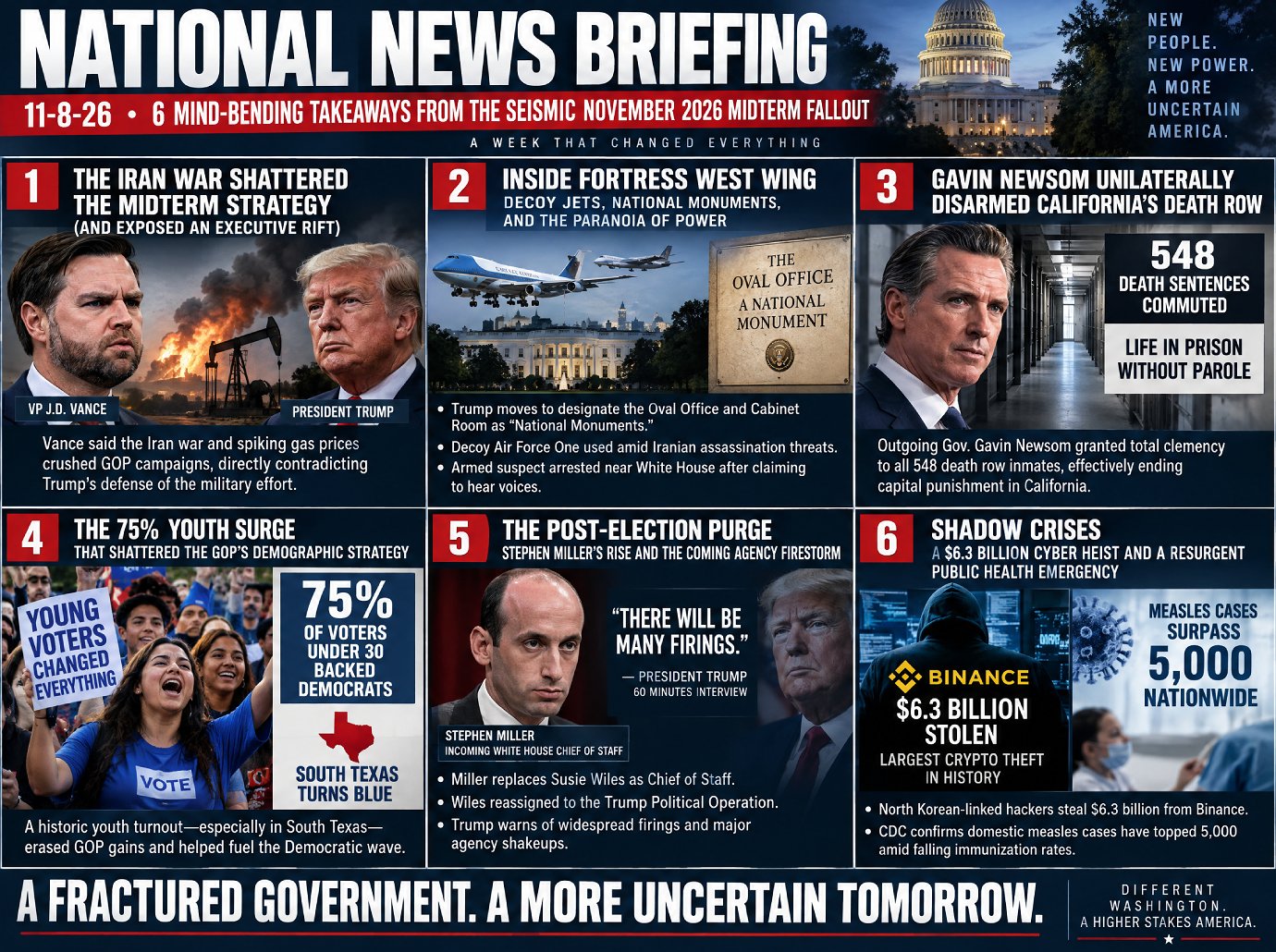
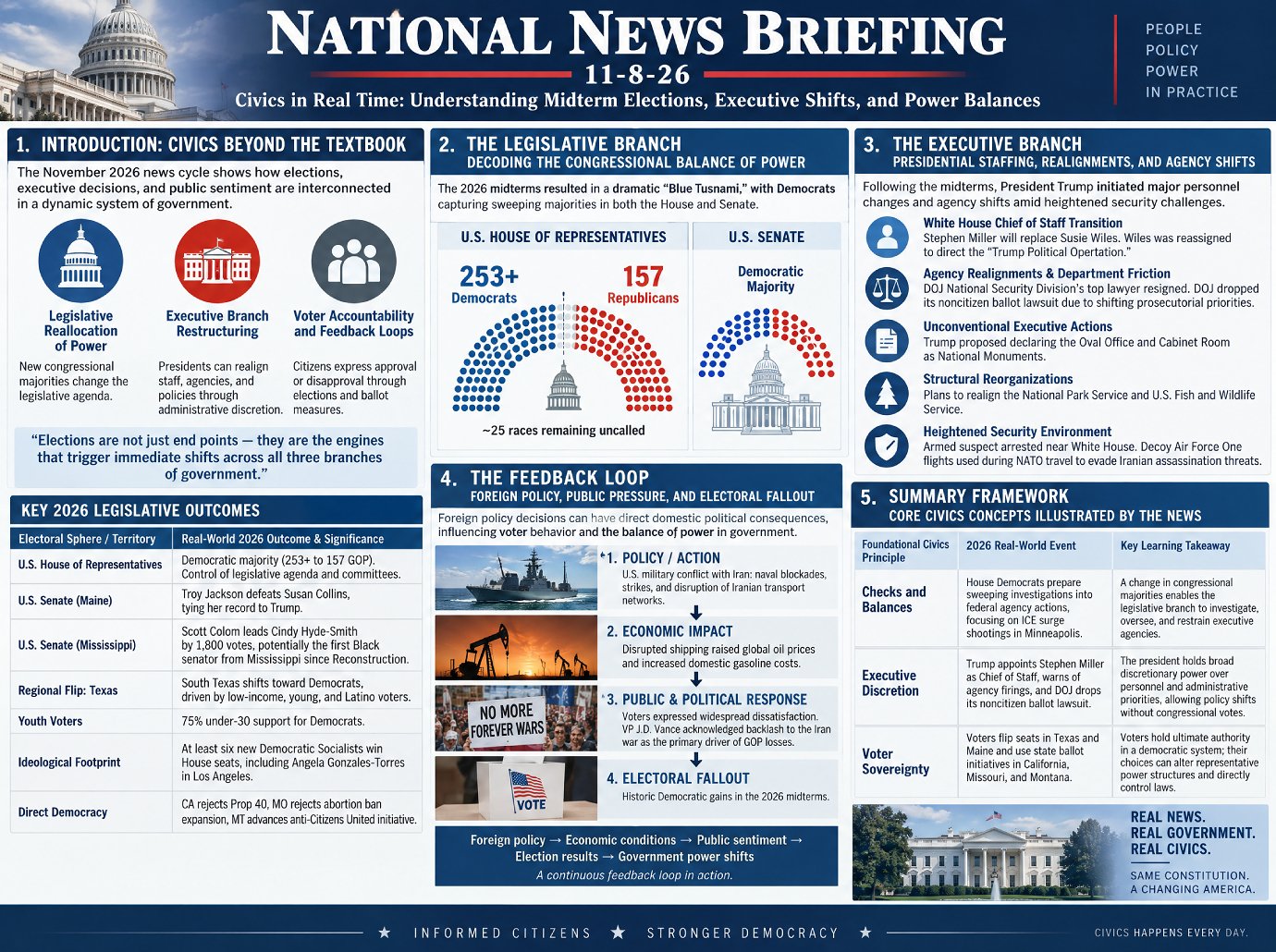
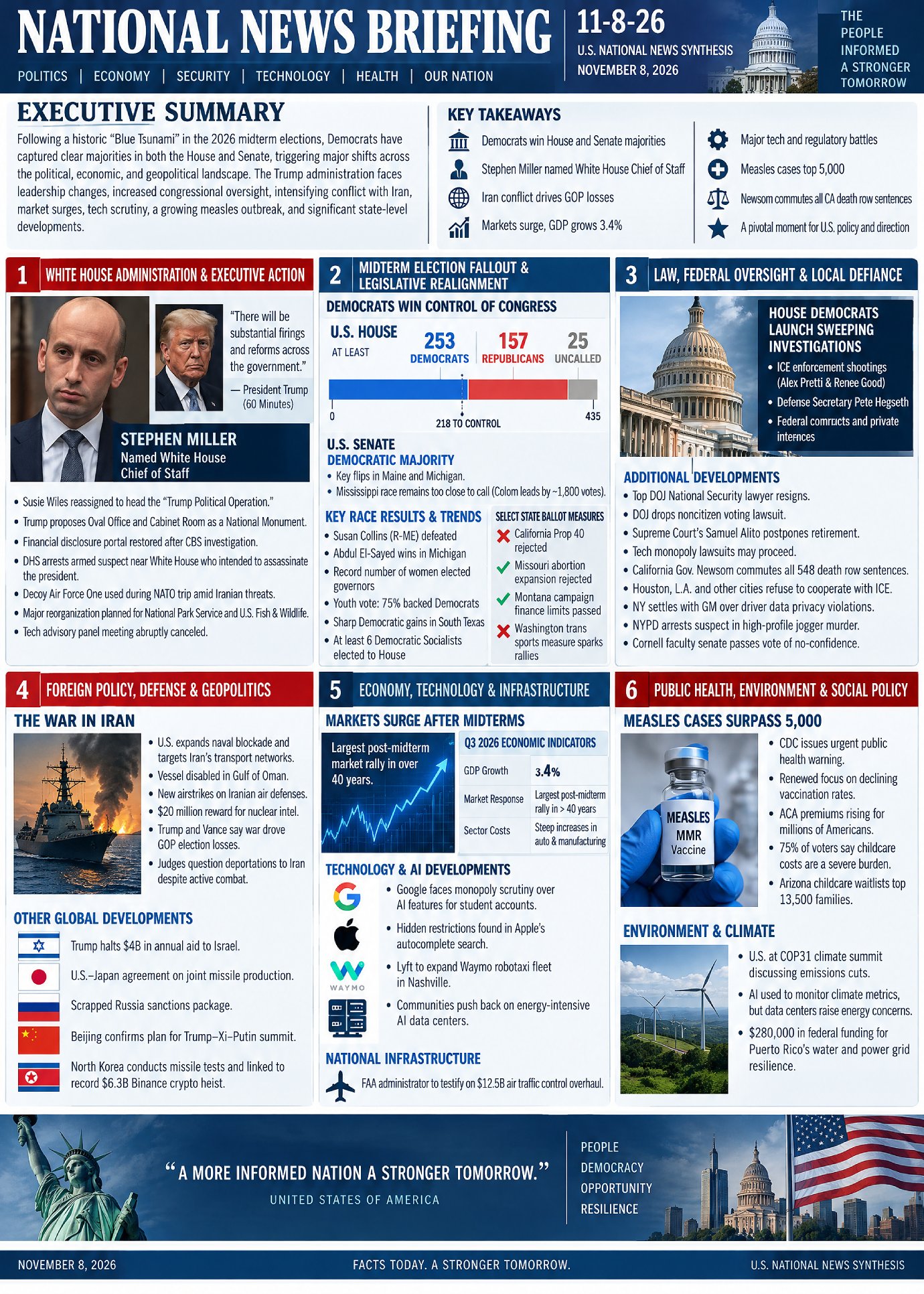
The first week of November 2026 marks a dramatic realignment across the United States political, geopolitical, economic, and regulatory landscapes. Following the 2026 midterm elections—characterized as a historic “Blue Tsunami”—the Democratic Party has captured clear majorities in both the U.S. House of Representatives and the U.S. Senate. This political shift has triggered immediate administrative shakeups within the White House, heightened scrutiny over military engagements abroad, and prompted congressional plans for sweeping executive oversight.
Key takeaways from the national landscape as of November 8, 2026, include:
- Executive Branch Realignment & Security: President Donald Trump has named immigration architect Stephen Miller as White House Chief of Staff, replacing Susie Wiles, who was reassigned following midterm losses. The administration faces severe security concerns following an assassination attempt near the White House perimeter and revelations regarding decoy travel protocols during a recent NATO summit. Concurrently, President Trump has proposed designating the Oval Office and Cabinet Room as a National Monument.
- Congressional Power Shift: Democrats secured a broad congressional majority, winning at least 253 House seats and taking key Senate seats in Maine and Michigan, with high-profile races in Mississippi still tied to razor-thin counts. House Democrats have already announced major investigations into immigration enforcement actions and federal contracting.
- Geopolitics & The War in Iran: Administration officials, including Vice President J.D. Vance, publicly attributed GOP electoral losses to the unpopular military conflict with Iran and resulting surges in global oil prices. Despite domestic political backlash, U.S. military operations against Iran have escalated through expanded naval blockades and transport disruptions, alongside controversial ongoing deportations to the conflict zone.
- Economic Surges & Technological Friction: Wall Street staged its largest post-midterm rally in over 40 years driven by expected legislative gridlock, supported by robust Q3 GDP growth of 3.4%. However, major tech policy issues have surfaced, including Google monopoly inquiries regarding school AI features, hidden autocomplete search restrictions by Apple, a record $6.3 billion Binance crypto heist tied to North Korea, and widespread local pushback against energy-intensive AI data centers.
- State Initiatives & Public Health Crisis: Active U.S. measles cases have officially surpassed 5,000. Statewide ballot initiatives produced mixed results, including the rejection of California’s Prop 40 billionaire tax, while outgoing California Governor Gavin Newsom executed a landmark decision to commute the death sentences of all 548 state death row inmates.
1. White House Administration & Executive Action
Leadership Restructuring
In the immediate aftermath of heavy Republican losses in the 2026 midterm cycle, President Donald Trump executed a major leadership overhaul:
- New Chief of Staff: Controversial domestic immigration policy architect Stephen Miller has been appointed White House Chief of Staff, officially taking control on Monday.
- Reassignment of Susie Wiles: Outgoing Chief of Staff Susie Wiles has been reassigned to head the “Trump Political Operation.” Reports indicate President Trump publicly blamed Wiles for the party’s historic midterm losses.
- Impending Agency Shakeups: In an interview with 60 Minutes, President Trump warned of extensive post-midterm firings and administrative shakeups across key executive branch agencies.
Executive Orders, Transparency, and Reorganizations
- Oval Office National Monument Proposal: President Trump proposed an unusual executive action to formally declare both the Oval Office and Cabinet Room as a National Monument. The administration cited the need to preserve their historical integrity and permanently prevent architectural overhauls by future administrations.
- Financial Disclosures Restored: Following an investigation and pressure from CBS News, the White House restored its public-facing online financial disclosure portal, which had previously been removed.
- Advisory Panel Cancellation: The administration abruptly canceled a scheduled, high-profile meeting of its technology advisory panel amid shifting post-election political priorities.
- Department of Interior Reorganization: Leaked internal documents show the administration is actively drafting plans for a sweeping structural reorganization and “realignment” of the National Park Service (NPS) and the U.S. Fish and Wildlife Service (USFWS).
Threats and Security Interventions
- White House Perimeter Arrest: The Department of Homeland Security (DHS) and Secret Service confirmed the arrest of an armed suspect near the White House perimeter. Law enforcement reported the individual explicitly intended to assassinate the president, later telling authorities he “heard voices” instructing him to carry out the act.
- NATO Travel Decoy Revelations: Congressional Democrats are demanding an investigation into operational ploys used during a recent presidential trip to a NATO summit. Reports revealed that a decoy Air Force One and smaller secondary aircraft were deployed to conceal the President’s movements in response to high-level Iranian assassination threats.
2. Midterm Election Fallout & Legislative Realignment
Balance of Power in Congress
| Congressional Body | Democratic Status | Republican Status | Outstanding / Key Highlights |
|---|---|---|---|
| U.S. House of Representatives | Secured Majority (At least 253 seats locked in) | 157 seats locked in | ~25 competitive races remain uncalled due to razor-thin margins. |
| U.S. Senate | Secured Majority | Minority status | Key flips in ME and MI; MS race remains uncalled. |
2026 House of Representatives Composition (Declared Seats)
   [======================== 253 Democrats ========================][===== 157 Republicans =====][ 25 Uncalled ]
   0                                                             218 (Threshold)              435
Key Legislative and State Election Results
- Senate Races:
- Maine: Longtime Republican Senator Susan Collins was defeated by Democrat Troy Jackson, who successfully tied her legislative voting record directly to President Trump.
- Michigan: Democrat Abdul El-Sayed won a high-stakes, heavily funded Senate race, reinforcing the Democratic Party’s industrial Midwest firewall.
- Mississippi: Democrat Scott Colom holds a narrow lead of approximately 1,800 votes over incumbent Republican Senator Cindy Hyde-Smith. If certified, Colom will become Mississippi’s first Black U.S. Senator since the Reconstruction era.
- Connecticut Legislative Impact: Senator Chris Murphy was discharged from the hospital following a stroke; his upcoming recovery period is expected to impact early legislative voting schedules.
- Gubernatorial Realignment:
- A historic record for female gubernatorial victories was achieved, delivering Democrats a national majority of state governorships for the first time in 16 years.
- Minnesota: Senator Amy Klobuchar won the Minnesota governorship, extending her party’s executive control in the state.
- Arizona: Democratic Governor Katie Hobbs secured re-election against Republican challenger Andy Biggs.
- Voter Demographics & Ideological Shifts:
- Youth Vote: Polling data shows approximately 75% of voters under age 30 supported Democratic candidates, reversing previous GOP demographic gains from 2024.
- “Blue Texas” Trend: Data revealed a sharp shift toward Democrats in South Texas, driven by strong turnout among young, low-income, and Latino voters in historically red districts.
- Democratic Socialists Footprint: At least six freshman Democratic Socialists of America (DSA) members were elected to the House, including Angela Gonzales-Torres, who unseated incumbent Jimmy Gomez in Los Angeles.
- Defeat of Incumbents: Republican Representative Max Miller lost his re-election bid in Ohio following widespread publicity surrounding abuse allegations raised by his ex-wife.
State Ballot Measures
- California Proposition 40: Despite progressive gains nationwide, California voters rejected Prop 40—a milestone tax on state billionaires intended to fund healthcare—after opponents spent over $300 million to defeat it.
- Missouri Abortion Measure: Voters in Missouri overwhelmingly rejected a ballot initiative designed to institute a strict statewide abortion ban expansion.
- Montana Political Spending Initiative: Montana citizens passed a grassroots ballot initiative aimed at restricting corporate campaign spending and directly challenging the legal framework of Citizens United.
- Washington State Sports Division Rallies: Rallies erupted across Washington State concerning a contentious ballot measure that proposed restricting transgender girls from participating in female sports divisions.
3. Law, Federal Oversight, & Local Defiance
Democratic Probes and Congressional Oversight
Empowered by their incoming majorities, House Democrats announced immediate oversight plans:
- ICE Surge Investigations: Sweeping probes will target fatal immigration enforcement shootings, specifically focusing on the deaths of Alex Pretti and Renee Good during operations in Minneapolis.
- Defense Leadership Scrutiny: Bipartisan pressure is mounting for Defense Secretary Pete Hegseth’s resignation or impeachment, alongside broad inquiries into federal defense contracts and private commercial interests.
Department of Justice Realignment & Judicial Matters
- Executive Resignation: The top lawyer in the DOJ’s National Security Division abruptly resigned following administrative friction, triggering wider discussions of internal department restructuring.
- Noncitizen Voting Lawsuit Dismissal: In a reversal of previous legal strategy, the DOJ dropped its federal lawsuit regarding noncitizen voting registries, citing shifted prosecutorial priorities.
- Supreme Court: Associate Justice Samuel Alito announced he has postponed his planned retirement.
- Monopoly Litigation: A federal appeals court ruled that ongoing landmark tech monopoly lawsuits against major platforms may proceed.
State & Local Interventions
- California Mass Death Row Commutation: Outgoing California Governor Gavin Newsom granted full clemency to all 548 inmates on the state’s death row, commuting their sentences to life in prison without parole.
- Local Defiance of Federal ICE Operations: Following regional election flips, municipal leaders—including the Mayor of Houston—have explicitly refused to cooperate with federal ICE enforcement surges. In Los Angeles, incoming officials pledged a stable municipal transition despite deep local political divides.
- GM Privacy Settlement: New York State prosecutors finalized a consumer protection settlement with General Motors over allegations of unauthorized driver data collection and privacy violations.
- NYC Homicide Arrest: New York City police apprehended a prime suspect in the high-profile murder of a jogger, ending a multi-week manhunt.
- Cornell University No-Confidence Vote: The academic faculty senate at Cornell University officially passed a vote of no-confidence in institutional leadership following extended campus disputes.
4. Foreign Policy, Defense, & Geopolitics
The War in Iran and Political Repercussions
The military conflict with Iran has emerged as the central driver of both domestic policy fallout and international tension:
- Electoral Blame: President Trump and Vice President J.D. Vance publicly acknowledged that the unpopular conflict in Iran—which sharply elevated global crude oil and domestic gasoline prices—was the primary cause of GOP midterm losses. Vice President Vance reinforced this assessment via social media. Trump maintained that military action was necessary to halt Iranian nuclear development.
- Escalated Blockade and Airstrikes: U.S. forces expanded their naval blockade to include a specialized task force targeting Iran’s overland transport networks. U.S. forces disabled a commercial vessel that breached the blockade in the Gulf of Oman and launched new airstrikes against Iranian air defense networks.
- Nuclear Intelligence Reward: The U.S. State Department announced a $20 million reward for actionable intelligence regarding Iran’s nuclear program.
- Controversial Deportations Exposed: Unsealed federal court documents revealed that the Trump administration has been actively deporting individuals back to Iran despite active combat operations. Transcripts show federal judges questioning the legality of returning deportees to regions where they face severe threats of death.
+----------------------------------------------------------------------------------+
|                        U.S.–IRAN WAR: CONFLICT ENGAGEMENTS                       |
+------------------------------------+---------------------------------------------+
| Operational Measures               | Political & Judicial Impacts                |
+------------------------------------+---------------------------------------------+
| • Expanded Task Force targeting    | • Elevated domestic oil & gasoline prices.  |
|   Iran ground transport networks.  | • Public admission by Trump & Vance that    |
| • Interdiction/disabling of Gulf  |   war caused GOP midterm losses.            |
|   of Oman blockade-breaching vessel| • Federal judges challenging legality of    |
| • Fresh airstrikes on air defenses.|   ongoing U.S. deportations to Iran.        |
| • $20M State Dept nuclear reward.  | • Assassination threats targeting U.S. leadership|
+------------------------------------+---------------------------------------------+
Global Alliances and Foreign Relations
- Reduction in Israel Aid: President Trump unilaterally halted $4 billion in scheduled annual foreign military assistance to Israel.
- U.S.–Japan Defense Agreement: The U.S. and Japan formally ratified a strategic agreement to establish joint military missile manufacturing operations on Japanese territory.
- Scrapped Russian Sanctions Package: The White House canceled a legislative sanctions package targeting Russia, originally drafted by the late Senator Lindsey Graham.
- Proposed Diplomatic Summit: Official sources in Beijing confirmed preliminary planning for a high-level trilateral summit between Xi Jinping, Donald Trump, and Vladimir Putin.
- North Korean Military & Cyber Activity: North Korea conducted fresh ballistic missile test launches. Concurrently, North Korean-state-linked hackers carried out a record-setting $6.3 billion cryptocurrency theft from the exchange platform Binance.
5. Economy, Technology, & Infrastructure
Macroeconomic Trends and Market Activity
- Post-Election Market Rally: Reacting to the projected divided government structure, Wall Street experienced its largest post-midterm stock market surge in more than 40 years.
- GDP and Inflation Pressures: Third-quarter U.S. Gross Domestic Product (GDP) grew at an annualized rate of 3.4%. However, automotive and industrial manufacturing sectors reported steeply rising baseline supply and material costs.
Economic Indicators - Q3 2026
--------------------------------------------------
Q3 GDP Growth Rate:          [3.4%]
Stock Market Response:       Largest post-midterm rally in >40 years
Sector Cost Inflation:       Steep baseline supply cost increases in Auto & Manufacturing
Technology, AI, and Autonomous Systems
- Google AI Antitrust Scrutiny: Google is facing heightened monopoly scrutiny after announcing plans to disable core AI features for student accounts unless public school administrators explicitly opt-in—a policy critics label coercive.
- Apple Autocomplete Search Restrictions: Independent technology researchers discovered hardcoded restrictions within Apple’s mobile operating software that block autocomplete suggestions for politically sensitive search queries.
- Waymo & Lyft Expansion: Lyft announced a major expansion of its Waymo-backed autonomous robotaxi fleet in Nashville, scheduled to be operational before the end of the year.
- Data Center Infrastructure Tension: Local communities are mounting organized opposition to large-scale AI data center construction. While critical to economic tech expansion, these facilities are driving local stock market volatility, regulatory battles, and energy draw concerns.
National Infrastructure and Aviation Overhaul
- FAA Modernization Scrutiny: The Administrator of the Federal Aviation Administration (FAA) is set to testify before Congress regarding a highly controversial, $12.5 billion structural overhaul of the national air traffic control system.
6. Public Health, Environment, & Social Policy
Public Health and Social Services
- Measles Outbreak Threshold: The Centers for Disease Control and Prevention (CDC) issued an urgent public health warning as confirmed active measles cases surpassed 5,000 nationwide, intensifying debates over declining community vaccination rates.
- Affordable Care Act (ACA) Cost Increases: Millions of Americans are facing steep premium increases for ACA health insurance plans.
- Childcare Affordability Crisis: Multi-state survey data shows 75% of American voters classify the cost of childcare as a severe economic burden. In Arizona, state childcare assistance waitlists have expanded to over 13,500 families.
Environmental Policy and International Summits
- COP31 International Climate Summit: U.S. delegations arrived for the opening of the COP31 global climate summit, where discussions are centered on binding near-term greenhouse gas emission cuts.
- AI Integration and Energy Impact: Major environmental watchdogs have begun integrating AI to monitor climate metrics, while simultaneously warning against the substantial carbon footprint and high electrical consumption of domestic data centers.
- Puerto Rico Utility Grid Support: The federal government finalized a $280,000 emergency funding package for Puerto Rico to strengthen vulnerable drinking water infrastructure and power grid components against climate-induced disruptions.