
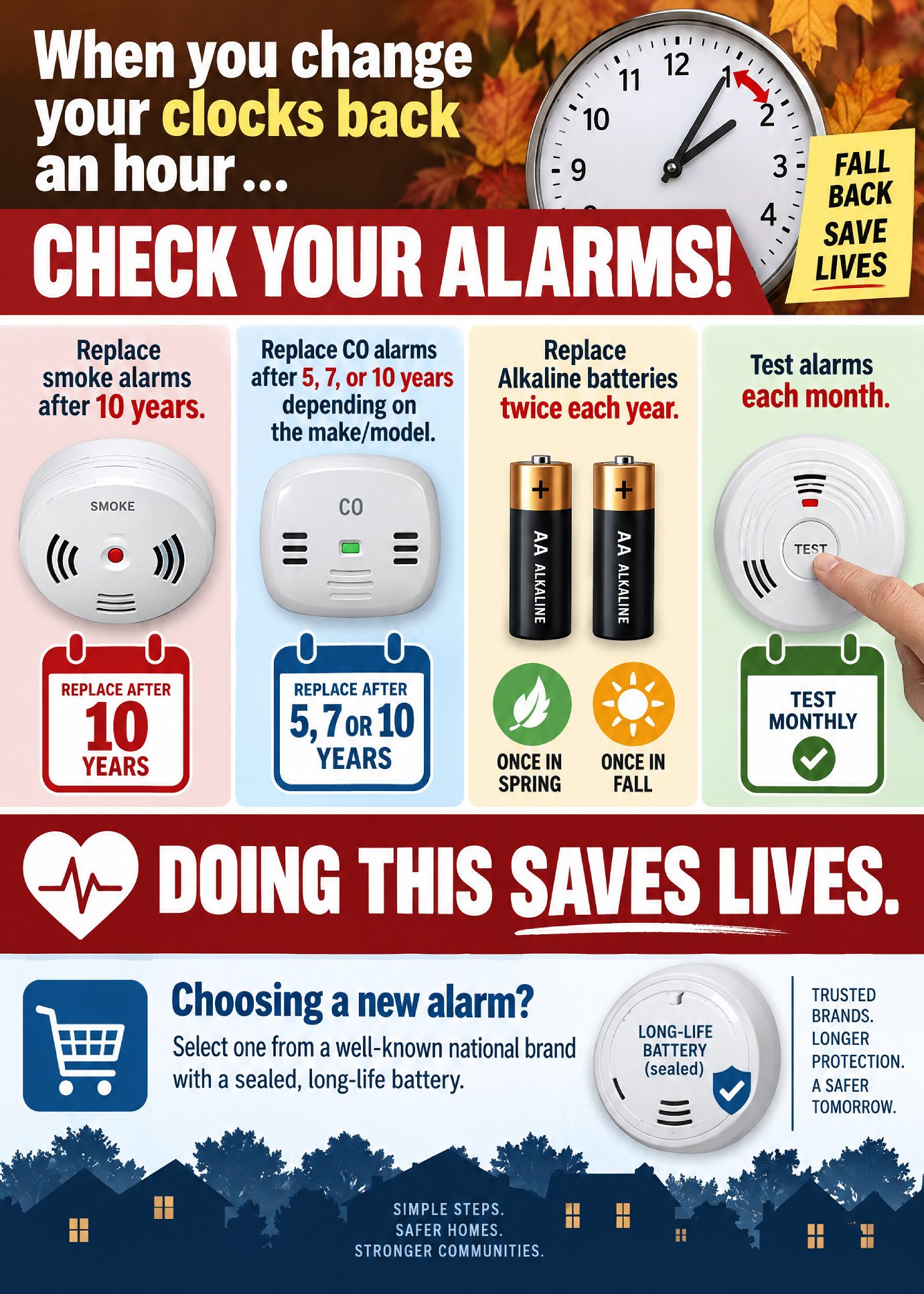
Editorial: Check Your Alarms After you’ve Turned Back the Clocks
That bi-annual tradition of adjusting your clocks for daylight saving time and standard time isn’t just about gaining or losing an hour of sleep—it’s the ultimate lifehack for your home safety routine. Using the time change as a natural anchor habit makes it effortless to remember a quick home checkup that keeps your loved ones safe.
While most of us grab a step stool, adjust the microwave clock, and maybe pop a fresh battery into a smoke detector, we often overlook crucial alarm maintenance rules. It’s easy to take these little plastic disks on our ceilings for granted, assuming they’ll work forever as long as they aren’t chirping.
Taking just five minutes to audit your home safety setup is one of the easiest, highest-impact habits you can build. Here are four essential alarm rules every homeowner needs to know to keep their house fully protected.
Smoke Alarms Have an Expiration Date (10 Years Max): Most people focus entirely on swapping out dead batteries and assume the unit itself will last indefinitely. After all, if it still beeps when you press the test button, it must be fine, right? Unfortunately, no. The internal sensors in smoke detectors degrade over time, making them far less sensitive to smoke particles as the years roll on. Smoke alarms must be completely replaced after 10 years—period. If your alarm has hit its decade mark, fresh batteries won’t restore its effectiveness; you need a whole new device. Quick Lifehack: Wondering how old your unit is? Give the alarm body a quick counter-clockwise twist to remove it from its mounting bracket. Take a look at the back label—manufacturers stamp the exact production date right there. If it’s older than 10 years, it’s time to retire it.
Carbon Monoxide Alarms Don’t All Last the Same Length of Time: Unlike smoke detectors, which universally cap out at a 10-year lifespan, Carbon Monoxide (CO) alarms are a bit more varied. Depending explicitly on the make and model of your device, CO alarms need to be replaced after 5, 7, or 10 years. Because lifespan varies so widely across different manufacturers, you shouldn’t assume your CO detector has a full decade in it. Just like you did with your smoke detector, twist your CO unit counter-clockwise off the wall or ceiling plate to check the date stamp and manufacturer specs on the back. Knowing your device’s exact model rules ensures you aren’t relying on an expired sensor to detect this odorless, dangerous gas.
The Twice-a-Year Battery Rule & The Monthly Test Habit: Keeping your safety net strong requires two simple, consistent habits: regular battery refreshes and quick monthly system checks. If your alarms run on standard Alkaline batteries, replace those batteries twice each year. Pairing this chore directly with your bi-annual clock change ensures you never forget. Beyond swapping batteries every six months, build a monthly habit of pressing the test button on every device in your home to confirm the horn and circuitry are fully operational.
What to Look For When Buying a New Alarm: When your audit reveals that an alarm has reached the end of its life, shopping for a replacement shouldn’t feel overwhelming. Stick to a straightforward rule of thumb: choose an alarm made by a well-known national brand that features a sealed, long-life battery. Opting for a unit with a sealed 10-year battery is the ultimate low-maintenance lifehack. It eliminates the annoying low-battery chirps in the middle of the night and saves you from buying replacement batteries every six months, giving you continuous, hassle-free protection for the entire operational life of the device.
Small Habits, Major Protection: Protecting your home doesn’t require complex security systems or hours of maintenance. By anchoring simple safety checks to your twice-yearly clock changes—and staying consistent with monthly tests—you build a virtually foolproof shield for your household.