5 Key Takeaways from the Royalston Town Warrant
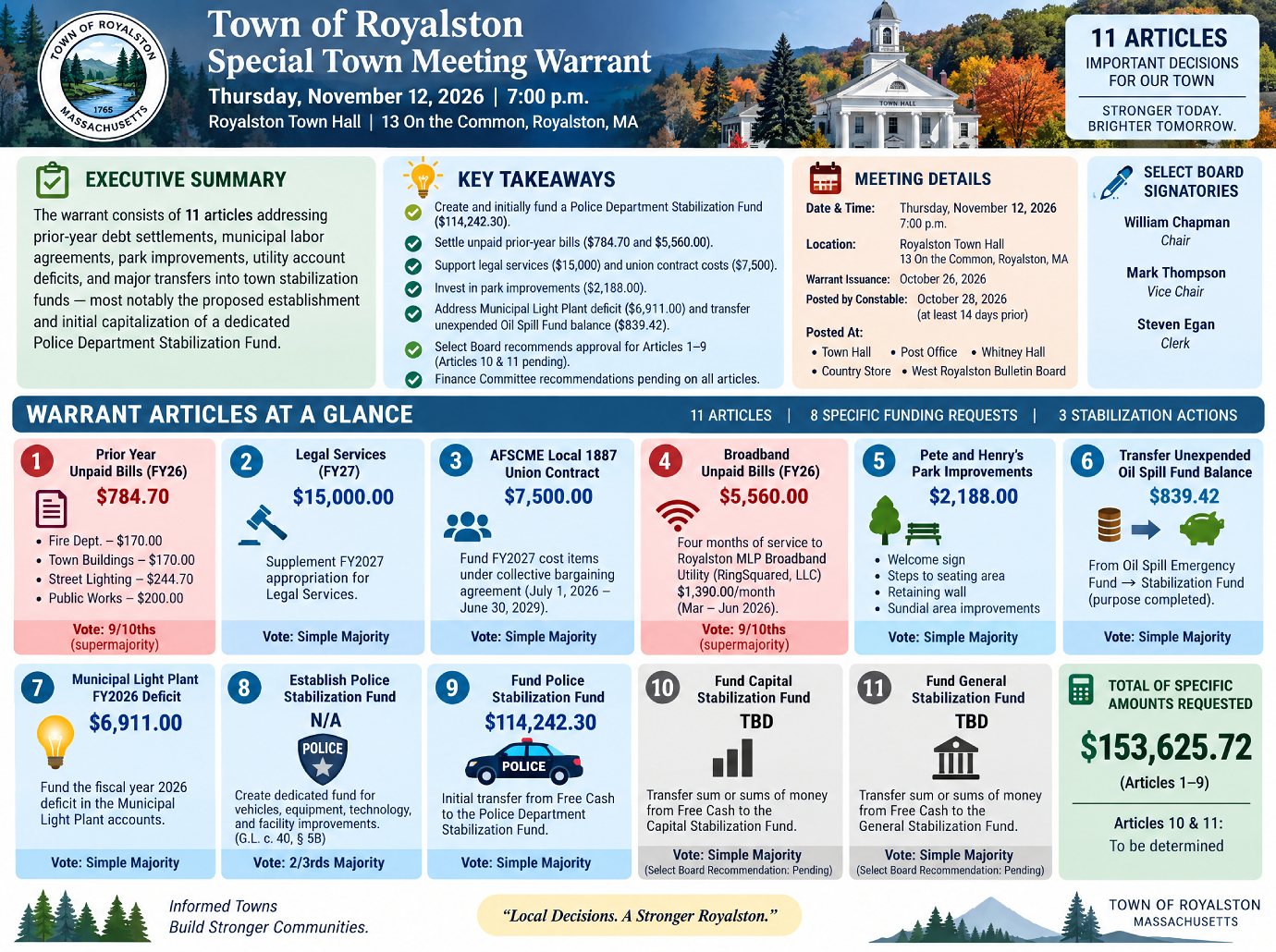
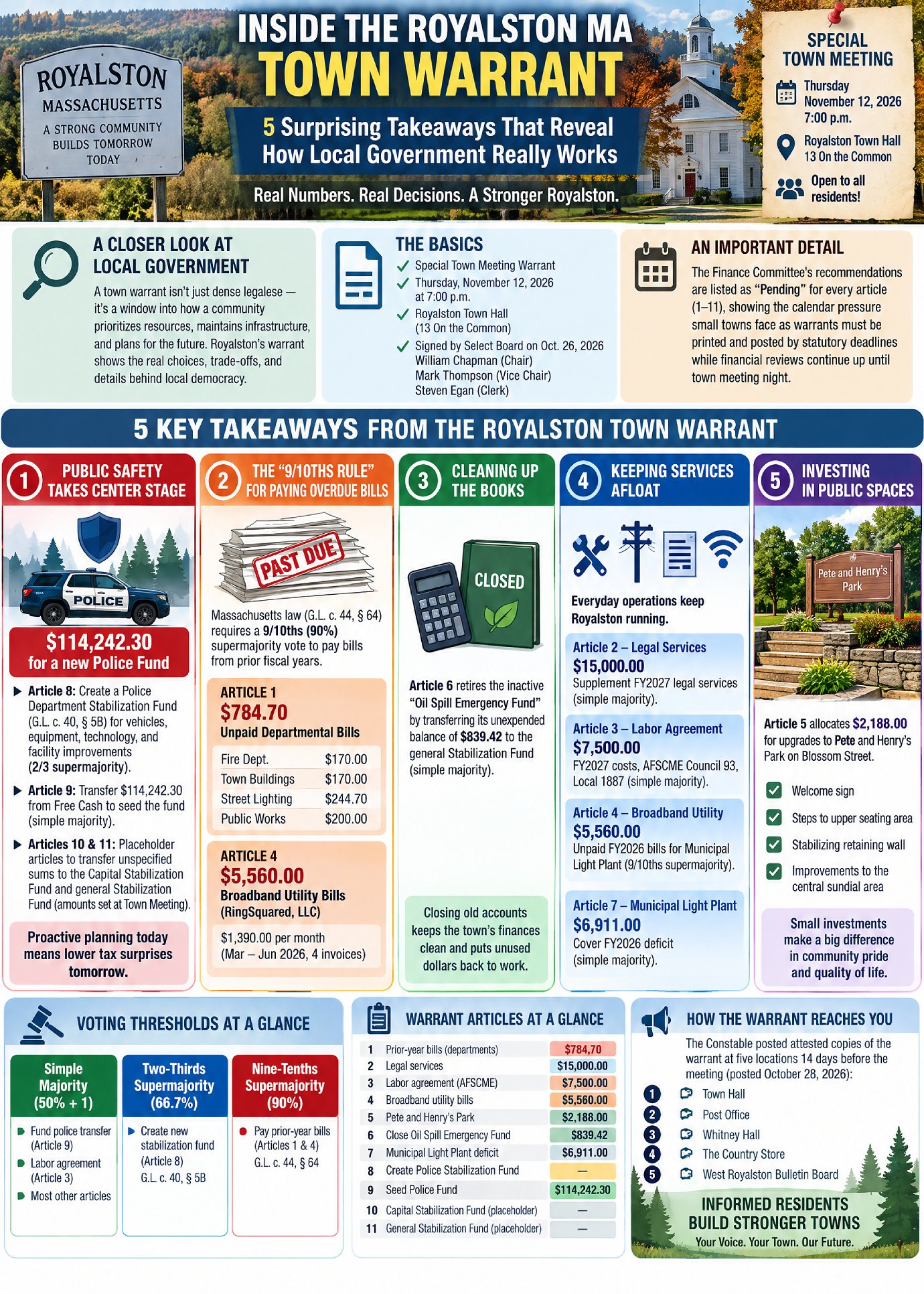
The Town of Royalston’s Special Town Meeting Warrant—scheduled for Thursday, November 12, 2026, at 7:00 p.m. at the Royalston Town Hall (13 On the Common)— highlights how small-town democracy balances major long-term safety investments, overdue operational bills, and neighborhood enhancements.
A close reading reveals that the Finance Committee’s formal recommendations are listed as “Pending” across every single item from Article 1 through Article 11.
Takeaway 1: Public Safety Takes Center Stage ($114,000+ Dedicated to a New Police Fund): In Articles 8 and 9, the Royalston Select Board proposes a major structural move to support local law enforcement. Under Article 8, voters are asked to establish a dedicated Police Department Stabilization Fund pursuant to Massachusetts General Laws (G.L. c. 40, § 5B). This special reserve is specifically designated for: Purchasing police vehicles, Acquiring capital equipment, Upgrading technology, and Executing facility improvements. Immediately following, Article 9 seeds this newly created account by transferring $114,242.30 directly from Free Cash (or other available funds).
Strategic Placeholders (Articles 10 & 11): To complement this public safety push, the Select Board inserted Articles 10 and 11 into the warrant. These articles act as flexible financial “placeholders,” seeking authorization to transfer unspecified sums from Free Cash into the town’s existing Capital Stabilization Fund (Article 10) and general Stabilization Fund (Article 11).
Takeaway 2: The “9/10ths Rule” for Paying Overdue Bills:One of the most rigid aspects of Massachusetts municipal law is how strictly it penalizes unpaid bills from prior fiscal years. Under G.L. c. 44, § 64, paying an invoice after the fiscal year has closed is not a simple administrative sign-off—it requires an extraordinary Nine-tenths (9/10ths) supermajority vote at Town Meeting. Articles 1 and 4 address several prior-year obligations where original appropriations were insufficient. To understand the legal precision involved, consider the exact wording of Article 1: “To see if the Town will vote to transfer from Free Cash, or from other available funds, the sum of $784.70, or any other sum, to pay the following unpaid bills of prior fiscal years, for which there is no sufficient appropriation…”
Article 4: Broadband Utility Telecommunications Billing (Total: $5,560.00) Vendor: RingSquared, LLC (AccessPlus) | Account: APC1110 | Account Name: Royalston MLP Broadband Utility
The Statutory Hierarchy of Voting Thresholds: Comparing the statutory voting requirements across the warrant highlights the state legislature’s deliberate fiscal design:
- Simple Majority: Required to transfer $114,242.30 into an established fund (Article 9) or fund labor agreements (Article 3).
- Two-Thirds Supermajority (66.7%): Required under G.L. c. 40, § 5B to create a new stabilization fund (Article 8), ensuring long-term capital accounts have broad consensus.
- Nine-Tenths Supermajority (90%): Required under G.L. c. 44, § 64 to pay late bills (Articles 1 & 4).
Why is paying a $170 overdue bill legally harder than transferring $114,000 into a police fund? State law intentionally sets a high legislative hurdle for late payments to enforce strict budgetary discipline. By requiring 90% floor approval for out-of-period expenses, state law forces department managers to account publicly for budget overruns and administrative oversight rather than quietly rolling old debt into new fiscal cycles.
Takeaway 3: Cleaning Up the Books—Retiring the $839.42 “Oil Spill Emergency Fund”: Small-town financial management frequently involves sweeping up legacy accounts that have outlived their original purpose. Article 6 provides a clear example of municipal accounting upkeep. Sponsored directly by the Town Accountant, Article 6 asks voters to transfer the unexpended balance of $839.42 from the inactive “Oil Spill Emergency Fund” directly into the general Stabilization Fund.
Takeaway 4: Keeping Modern Infrastructure & Services Afloat: Running a town requires ongoing attention to baseline municipal operations, organized labor contracts, and municipal utilities. Articles 2, 3, 4, and 7 demonstrate the financial commitments necessary to keep Royalston operating smoothly:
- Labor Obligations (Article 3): Transfers $7,500.00 from Free Cash to fund FY2027 cost items of the collective bargaining agreement between the Town of Royalston and AFSCME Council 93, Local 1887. Covering July 1, 2026, through June 30, 2029, this allocation fulfills statutory requirements under G.L. c. 150E, § 7(b).
- Municipal Utilities & Deficits (Articles 4 & 7): Local governments operate complex public utilities. Article 7 transfers $6,911.00 from Free Cash to cover an FY2026 deficit in the Municipal Light Plant accounts. This works alongside Article 4, which allocates $5,560.00 to resolve unpaid FY2026 broadband circuit expenses ($1,390.00 per month for managed services) owed to RingSquared, LLC (AccessPlus) for the town’s Municipal Light Plant Broadband Utility.
- Legal Representation (Article 2): To maintain professional legal counsel for municipal contracts, land use, and town governance, Article 2 transfers $15,000.00 from Free Cash or available funds to supplement the FY2027 Legal Services appropriation.
Takeaway 5: Micro-Investments in Public Spaces (Pete and Henry’s Park): Beyond large financial reserves and utility overhead, local warrants direct resources into public community spaces. Article 5, sponsored by the Park Subcommittee, asks voters to transfer $2,188.00 from Free Cash for targeted upgrades to Pete and Henry’s Park on Blossom Street. The requested funds will cover four specific physical enhancements: Fabricating and installing a welcome sign, Constructing steps leading to the upper seating area, Building a stabilizing retaining wall, Executing improvements to the central sundial area and covering related costs