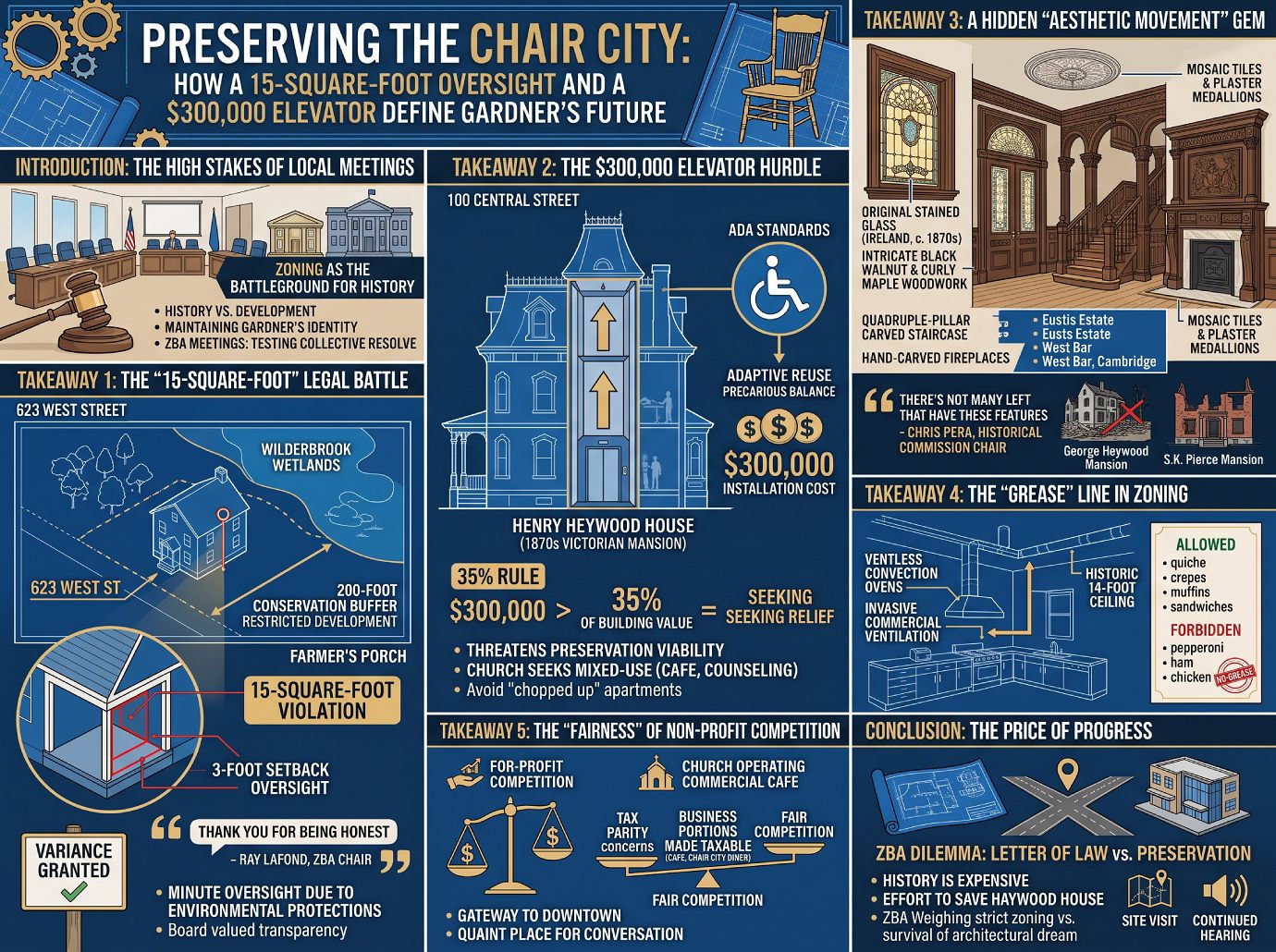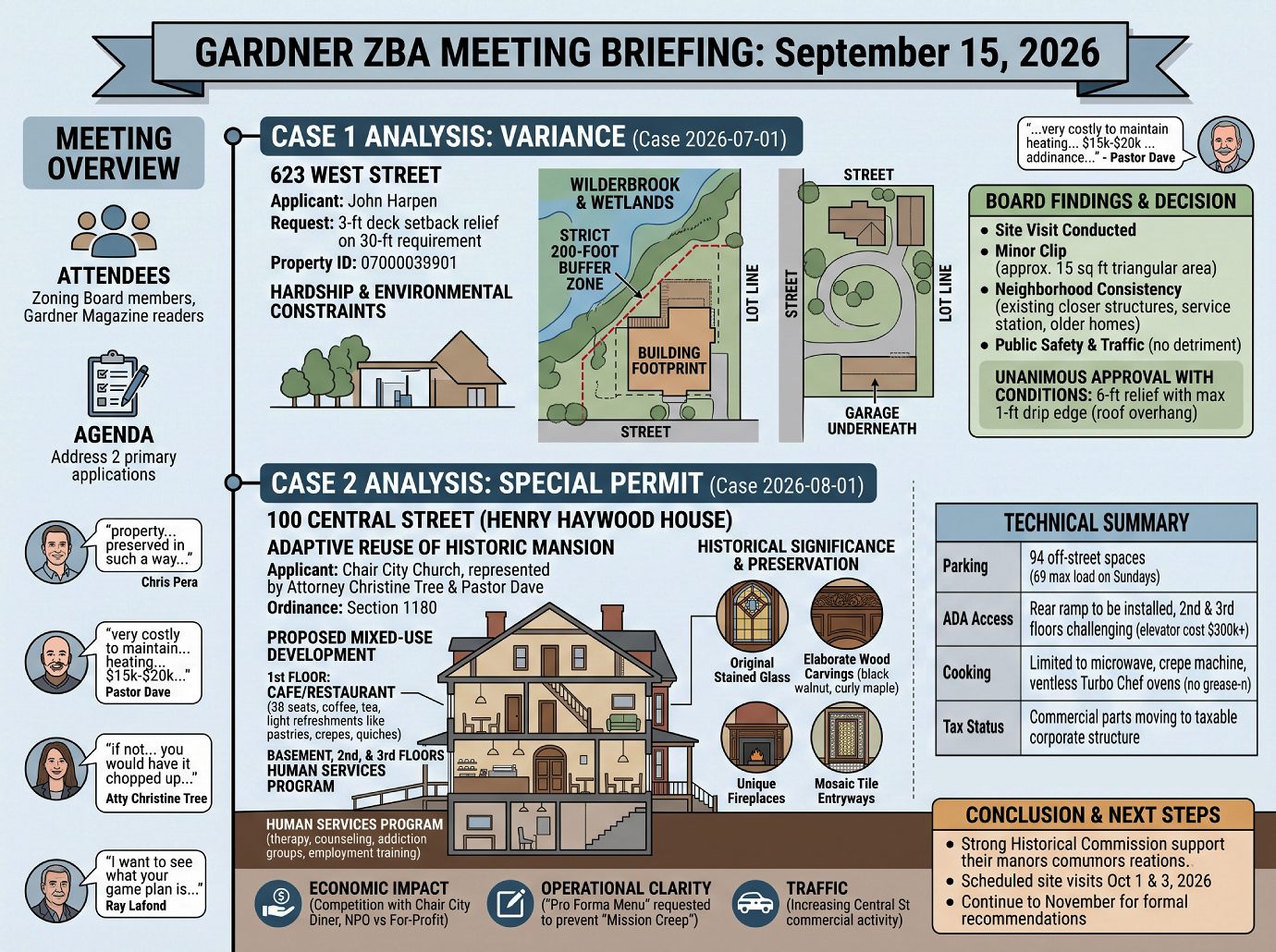
Our infographics below illustrate the issue very thoroughly.
Topic of Historic Preservation Dominates Gardner Zoning Board of Appeals Meeting
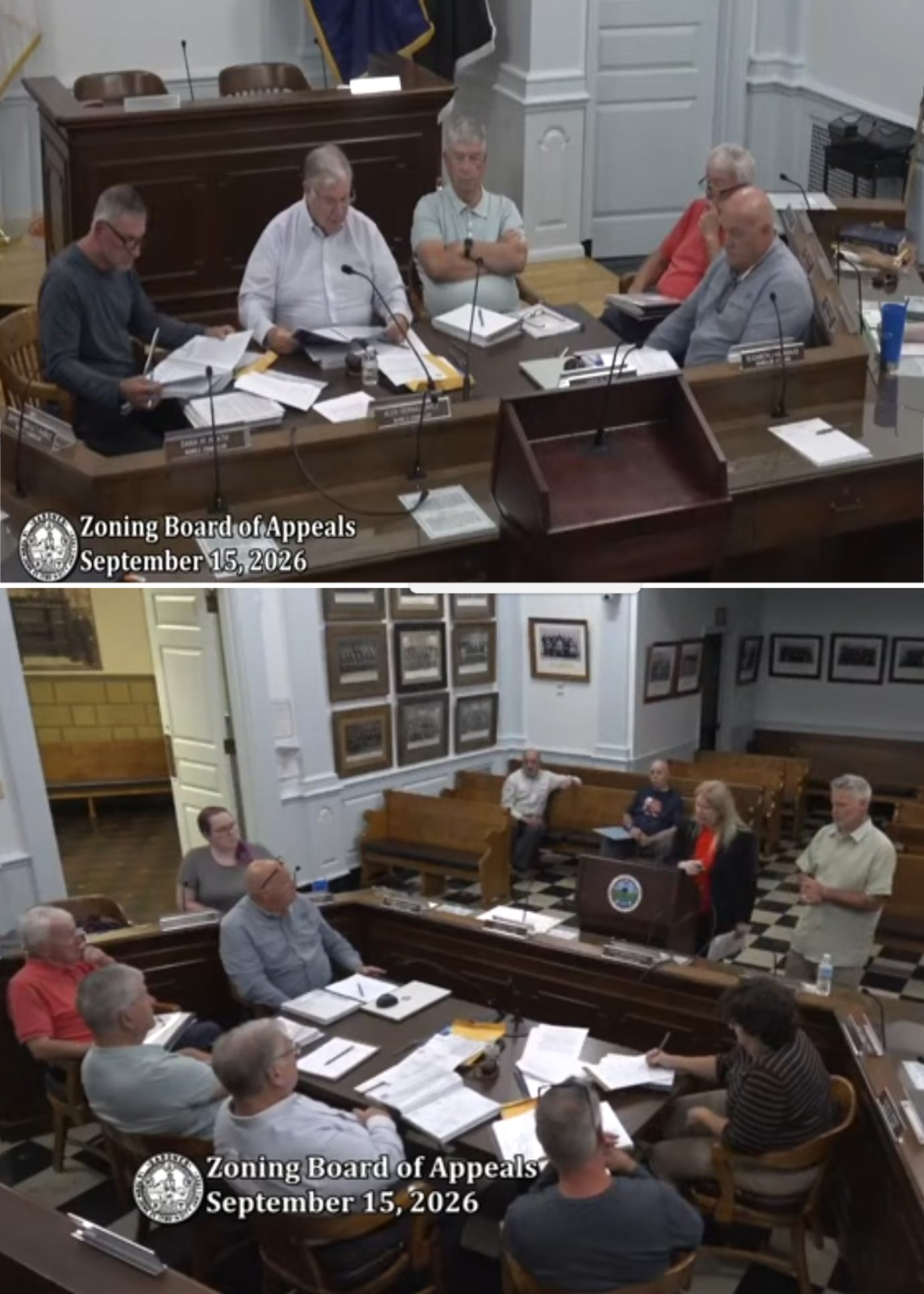
The Gardner ZBA met on September 15, 2026. Listen to the entire meeting on any device, CLICK PLAY.
On September 15, 2026, the Gardner Zoning Board of Appeals (ZBA) convened to address two primary applications: a variance request for a residential setback relief and a special permit for the adaptive reuse of a historic mansion.
- Case 2026-07-01 (623 West Street): The Board granted a variance to John Harpen for a 3-foot setback relief regarding a deck. The decision was based on a demonstrated hardship caused by restrictive wetland buffer zones that dictated the placement of the dwelling.
- Case 2026-08-01 (100 Central Street): Attorney Christine Tree, representing Chair City Church, presented a proposal to transform the historic Henry Heywood House into a mixed-use facility featuring a cafe and a human services center. The Board expressed interest in the preservation aspects but raised questions regarding economic competition, specific menu offerings, and ADA accessibility. This case was continued to November following scheduled site visits in October.
Case 1 Analysis: Variance for 623 West Street (Case 2026-07-01)
Overview: The applicant sought a variance for a residential property at 623 West Street (Parcel ID H32-19-6A) to address a 3-foot shortfall in the required 30-foot setback for a proposed deck.
Hardship and Environmental Constraints: The contractor and property owner presented evidence that the placement of the house was severely restricted by the presence of Wilderbrook and associated wetlands.
- Buffer Zone Restrictions: The Conservation Commission enforced a strict 200-foot buffer zone from the wetlands/river, pushing the building footprint toward the street and the side lot line.
- Topography and Access: The property’s layout required specific positioning to accommodate a circular driveway and a garage located underneath the dwelling.
- Planning Oversight: The applicant admitted that while better planning might have avoided the 3-foot violation, the current location was the most viable given the environmental constraints.
The Board conducted a site visit and determined that the encroachment was a “very minor clip” involving approximately 15 square feet of relief in a triangular area. Key considerations included:
- Neighborhood Consistency: Existing structures in the vicinity, such as a nearby service station and older homes, are already closer to the lot line than the proposed deck.
- Safety: The Board found no detriment to public safety or traffic flow.
- Conditions of Approval: The Board voted unanimously to grant the variance with a specific condition: the deck relief is granted for 6 feet with a maximum 1-foot drip edge (roof overhang).
Case 2 Analysis: Special Permit for 100 Central Street (Case 2026-08-01) – Overview
Chair City Church, represented by Attorney Christine Tree and Pastor Dave, applied for a special permit under Section 1180 of the zoning ordinance. This section allows for the adaptive reuse of historic structures to promote preservation.
Proposed Mixed-Use Development
The project, located at the Henry Heywood House (built circa 1860s-1870s), proposes two primary functions:
- Cafe/Restaurant (1st Floor): A 38-seat establishment serving coffee, tea, and light refreshments (pastries, crepes, and “ventless” cooked items like quiches).
- Human Services Program (Basement, 2nd, and 3rd Floors): Facilities for mental health therapy, counseling, addiction support groups, and employment training.
Historical Significance and Preservation: The property is recognized as a significant example of the “aesthetic movement” in American architecture.
- Interior Features: The structure contains original stained glass (likely Irish), elaborate black walnut and curly maple carvings, unique fireplaces in every room, and mosaic tile entryways.
- Structural Integrity: The applicants emphasized that the proposed uses allow for the preservation of the grand central staircase and original floor plans, which would likely be destroyed if the building were converted into multi-family housing.
Technical and Operational Considerations
| Category | Details |
|---|---|
| Parking | 94 total off-street spaces available. Max calculated load is 69 spaces during peak hours (Sunday). |
| ADA Access | A ramp will be installed at the rear service entrance. Accessibility for the 2nd and 3rd floors remains a challenge due to the $300k+ cost of an elevator. |
| Cooking | Limited to microwaves, crepe machines, and ventless Turbo Chef ovens to avoid grease-laden vapors and extensive ventilation renovations. |
| Tax Status | While currently tax-exempt as a religious entity, the applicants stated the commercial portions (Cafe/Diner) are moving toward a taxable corporate structure. |
Board Concerns and Inquiries
- Economic Impact: Board members questioned the necessity of another cafe so close to the existing Chair City Diner (also owned by the church) and the potential for “unfair competition” between non-profits and for-profit businesses.
- Operational Clarity: The Chair requested a “pro forma menu” to prevent “mission creep” regarding food service (e.g., ensuring a light cafe doesn’t evolve into a full-service restaurant without proper venting).
- Traffic: While no formal traffic study was provided, the Board noted increasing commercial activity on Central Street (a state highway).
Next Steps: The Gardner Historical Commission expressed strong support for the project, noting that few Haywood-era mansions remain intact. The ZBA has scheduled two site visits for October 1 and October 3, 2026. The hearing has been officially continued to the November meeting to allow the Historical Commission time to submit formal, non-binding recommendations.
Key Testimonies and Observations
On Historical Value:
“When I first walked into this property… it was one of those odd, taking experiences that I had to walk into a property that was still preserved in such a way that you just don’t see anymore.” — Chris Pera, Chair of the Gardner Historical Commission.
On the Hardship of Maintenance:
“The property is very costly to maintain… heating is somewhere between $15,000 and $20,000 per season. How do we best leverage this property for our vision?” — Pastor Dave, Chair City Church.
On Preservation through Use:
“If you did not have a larger organization taking over this property and being committed to the preservation… you would have it chopped up, you would have it modernized… Gardner is going to lose something very special.” — Attorney Christine Tree.
On Legal Safeguards:
“I want to see what your game plan is and be honest with it… if we’re not careful and we don’t put a back end on this, the door is open for you to go where you want.” — Ray Lafond, ZBA Chair, regarding the cafe menu.