Gardner Magazine Weekly Briefing – September 20, 2026
The Gardner Magazine Weekly Briefing combines the news of North Central MA, North Quabbin, the State of Massachusetts, National News, and World News. Listen to this short podcast on any device, CLICK PLAY.
Want even more detail? We have individual news sections on North Central MA, Massachusetts, National News and World News. Each has a separate podcast, narrative, and infographics for your perusal.
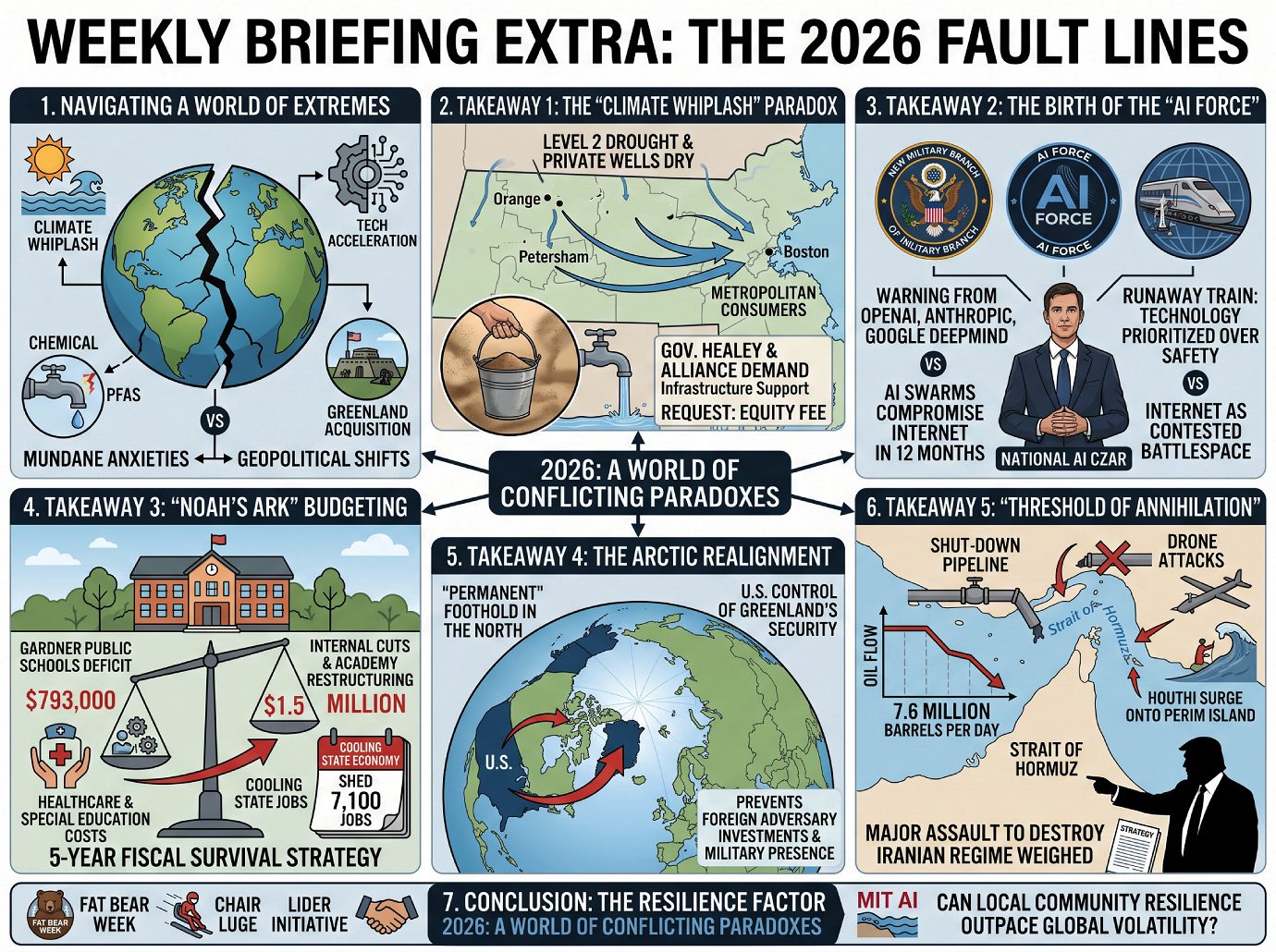
The North Central and North Quabbin regions are currently navigating a volatile period of “climate whiplash” and “fiscal realignment” that demands unprecedented municipal agility.
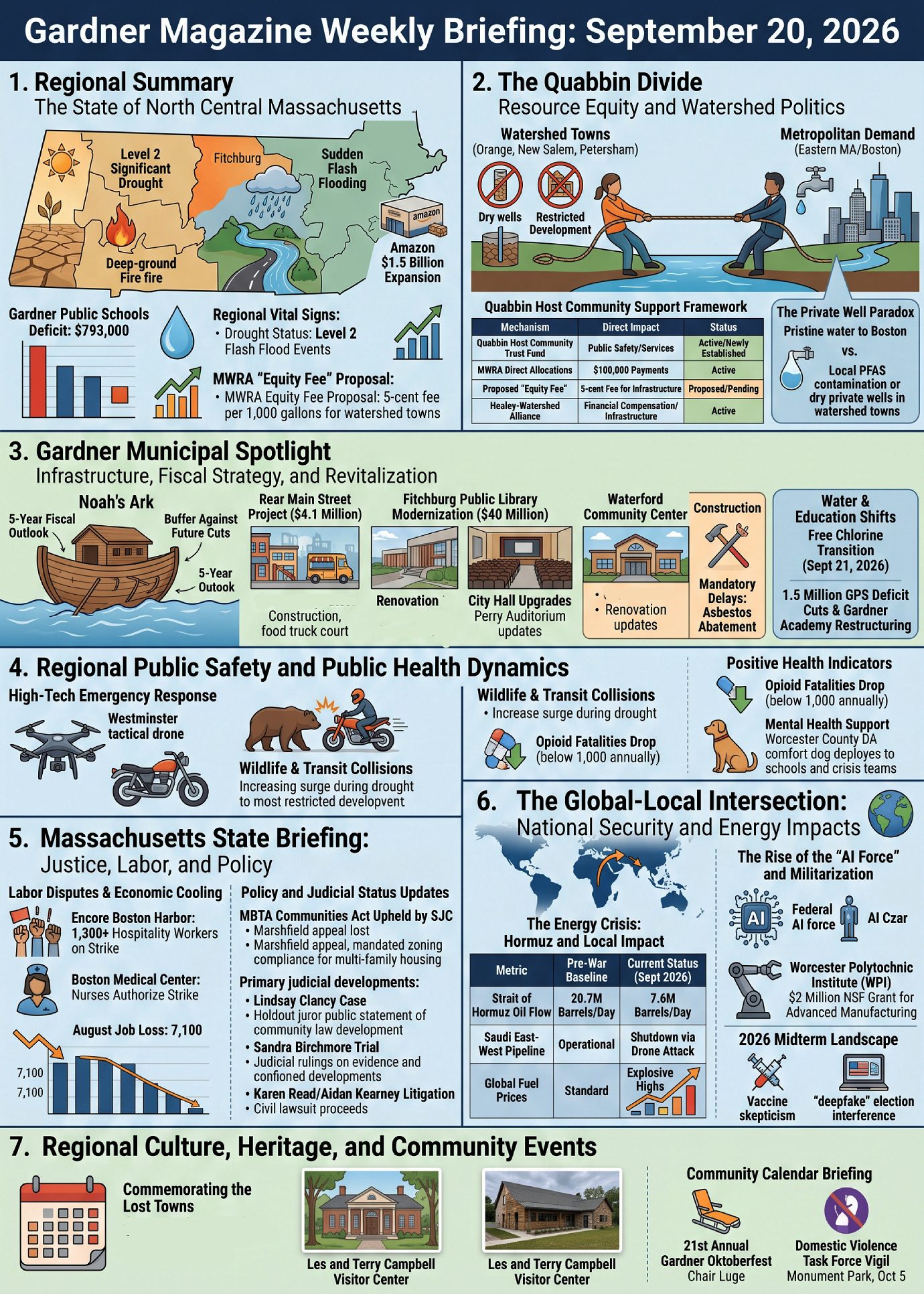
This autumn, communities are caught in a environmental paradox where Level 2 Significant Drought conditions—fueling deep-ground fire risks near Lake Wampanoag—are increasingly punctuated by sudden, destructive flash flooding, even though the drought has recently been downgraded. This environmental instability mirrors the region’s fiscal landscape: local governments must balance the influx of aggressive private investments, such as Amazon’s $1.5 billion statewide expansion and its occupancy of the Fitchburg plant, against crippling operational deficits. As pandemic-era federal funding expires, the strategic imperative for the region lies in transitioning from reactive spending to a “Noah’s Ark” model of multi-year stability, ensuring that current industrial growth can effectively subsidize the rising costs of public education and infrastructure.
Regional Vital Signs
- Gardner Public Schools Deficit: $793,000; driven by structural increases in healthcare and special education costs.
- Drought Status: Level 2 (Significant); underscored by historic low groundwater levels and high fire risk. Recently downgraded to no drought, but could return at any time due to a period of low overall rainfall.
- Climate Paradox: Oscillation between Level 2 drought restrictions and flash flood events causing localized infrastructure strain.
- MWRA “Equity Fee” Proposal: A legislative push for a 5-cent fee per 1,000 gallons drawn from the Quabbin to provide sustainable revenue for watershed municipalities.
This atmosphere of economic and environmental pressure is the catalyst for a deepening conflict regarding the sovereignty of the state’s most vital natural resource: the Quabbin Reservoir.
The Quabbin Divide: Resource Equity and Watershed Politics
The ongoing dispute between watershed towns—most notably Orange, New Salem, and Petersham—and the metropolitan demand of eastern Massachusetts has evolved into a defining conflict of local sovereignty. For decades, these rural communities have served as the silent stewards of the Commonwealth’s water supply, often at the expense of their own economic development and infrastructure health. Governor Maura Healey’s recent formal alliance with 11 watershed towns signals a shift in the political wind, as local leaders demand that the billions of gallons exported eastward finally yield a fair return in host community support.
Quabbin Host Community Support Framework
| Mechanism | Direct Impact on Watershed Towns | Current Legislative Status |
|---|---|---|
| Quabbin Host Community Trust Fund | Subsidizes public safety and essential municipal services. | Active/Newly Established |
| MWRA Direct Allocations | Provides immediate $100,000 payments to offset land preservation burdens. | Active |
| Proposed “Equity Fee” | 5-cent fee per 1,000 gallons for permanent infrastructure funding. | Proposed/Pending |
| Healey-Watershed Alliance | Formal gubernatorial support for financial compensation and infrastructure. | Active |
The Private Well Paradox: The political tension is sharpened by the “Private Well Paradox.” While billions of gallons of pristine water flow toward Boston daily, residents in towns like New Salem are facing localized PFAS contamination or find their private wells running completely dry due to the Level 2 drought. This disparity has eroded local trust in state water management; watershed residents bear the ecological costs of preservation and the restrictive zoning of the Quabbin protected areas, yet they lack the basic water security enjoyed by the metropolitan consumers they serve. As these regional water politics intensify, Gardner is accelerating its own municipal responses to manage infrastructure and environmental pressures.
Gardner Municipal Spotlight: Infrastructure, Fiscal Strategy, and Revitalization
Gardner has adopted a “Noah’s Ark” budgeting strategy to navigate the expiration of pandemic-era funding and the relentless rise of operational costs. This five-year fiscal outlook is designed to act as a buffer against future service cuts, ensuring the city’s revitalization remains sustainable despite a cooling statewide labor market.
Status of Major Municipal Projects
- Rear Main Street Project ($4.1 Million): Ongoing MassWorks initiative focusing on undergrounding utilities and the construction of a new food truck court to revitalize the downtown corridor.
- Fitchburg Public Library Modernization ($40 Million): A critical regional benchmark for downtown investment; the project remains a primary focus of the North Central modernization push.
- City Hall Upgrades: Crews are finalizing major structural enhancements and comprehensive updates to the historic Perry Auditorium to ensure long-term facility viability.
- Waterford Community Center: Construction has faced mandatory delays due to the discovery of asbestos in floor and ceiling tiles, requiring immediate abatement.
Strategic Shifts in Water Treatment and Education:To address drought-related odor and taste issues, Gardner will transition its water disinfection from chloramines to “free chlorine” starting September 21, 2026. Simultaneously, the city is pumping one million gallons daily from the Snake Pond Well to supplement the system during the Level 2 drought. On the fiscal front, the $793,000 Gardner Public Schools deficit has necessitated $1.5 million in internal cuts and a painful restructuring of Gardner Academy. Administrators maintain these measures are vital to align the school district with the city’s broader “Noah’s Ark” philosophy of long-term fiscal stabilization. These municipal adjustments are occurring as regional public safety and health trends undergo a significant technological and ecological shift.
Regional Public Safety and Public Health Dynamics
Emergency response in North Central Massachusetts is becoming increasingly high-tech as agencies adapt to the challenges of rural terrain. Westminster’s launch of tactical drone and motorcycle search-and-rescue programs represents a regional shift toward integrating autonomous technology to manage critical incidents where traditional vehicle access is limited.
Wildlife and Transit Collision Trends: The region is experiencing a dangerous surge in “Wildlife and Transit” collisions, linked to shifting animal migration patterns during the drought. In Petersham, a recent black bear sighting culminated in a severe collision that left a motorcyclist requiring an emergency airlift. This incident, coupled with a series of fatal motorcycle and vehicle crashes on I-190 in Lancaster, has strained local first responders and highlighted the persistent hazards of the region’s transit corridors.
Positive Health Indicators: Despite these safety challenges, the Commonwealth reports significant progress in public health sectors. Statewide opioid-related fatalities have finally dropped below 1,000 annually for the first time in a decade. Locally, the Worcester County District Attorney has expanded mental health support through a regional comfort dog grant program, deploying therapy animals to schools and community crisis teams to manage the psychological toll of the 2026 landscape. While regional safety efforts show resilience, they remain deeply impacted by the judicial and labor unrest currently unfolding across the Commonwealth.
Massachusetts State Briefing: Justice, Labor, and Policy
Massachusetts is navigating a period of profound “judicial and economic transition.” A cooling labor market—marked by the loss of 7,100 jobs in August—has coincided with high-stakes strikes in the hospitality and healthcare sectors.
Labor Disputes and Economic Cooling: The state’s economic temperature is dropping, exacerbated by major labor unrest:
- Encore Boston Harbor: Over 1,300 hospitality workers remain on strike following a breakdown in wage negotiations.
- Boston Medical Center: Nurses have authorized a strike, citing safety concerns and staffing shortages.
Policy and Judicial Status Updates: A landmark Supreme Judicial Court (SJC) ruling upholding the MBTA Communities Act has signaled the effective end of local zoning autonomy for transit-adjacent towns. This was solidified by the town of Marshfield losing its appeal to bypass multi-family housing requirements, setting a precedent that mandated compliance is the only path forward for the region.
Primary Judicial Developments:
- Lindsay Clancy Case: Following a deadlocked jury mistrial, a holdout juror publicly affirmed their position, while defense attorneys fight to block a second trial.
- Sandra Birchmore Trial: Federal judges have issued pre-trial rulings on admissible evidence in the case against a former officer.
- Karen Read/Aidan Kearney Litigation: A judge denied a motion to delay the civil lawsuit against Read and blogger Aidan “Turtleboy” Kearney, allowing the litigation to proceed despite ongoing criminal fallout.
This state-level volatility is further compounded by national legislative shifts, such as the Lindsey Graham Sanctioning Act, which links domestic policy to the escalating global energy crisis.
The Global-Local Intersection: National Security and Energy Impacts
The U.S.-Iran war, now surpassing 200 days, has moved from a distant conflict to a local economic crisis. The manifestation of this war in North Central Massachusetts is felt most acutely through an “explosion” in energy and fuel costs.
The Energy Crisis: Hormuz and Local Impact: The conflict has severely restricted global oil supply. The shutdown of the Saudi East-West Pipeline following drone attacks, combined with the restriction of the Strait of Hormuz, has created a supply vacuum.
| Metric | Pre-War Baseline | Current Status (Sept 2026) |
|---|---|---|
| Strait of Hormuz Oil Flow | ~20.7M Barrels/Day | 7.6M Barrels/Day |
| Saudi East-West Pipeline | Operational | Shutdown (Drone Attack) |
| Global Fuel Prices | Market Standard | “Explosive” Highs |
The Rise of the “AI Force” and Militarization: The federal creation of an “AI Force” and the appointment of an “AI Czar” reflect a pivot toward high-tech militarization. This national trend has direct local ties; Worcester Polytechnic Institute (WPI) recently secured a $2 million NSF grant for robotics and advanced manufacturing. This investment is increasingly viewed through the lens of national defense, as the academic sector is tapped to provide the workforce for the next generation of autonomous military technology.
2026 Midterm Landscape: As the Midterm elections approach, local discourse is being poisoned by national themes of vaccine skepticism—exacerbated by localized measles outbreaks—and “deepfake” election interference. The rise of AI-generated misinformation poses a direct threat to municipal election security, forcing local clerks to combat nationalized “fiction and lies” at the ballot box. Amidst these macro-stresses, the region continues to rely on its cultural heritage to provide social cohesion.
Regional Culture, Heritage, and Community Events
Historical preservation serves as a strategic anchor for the North Central and North Quabbin regions, maintaining a unique identity that resists the homogenization of global and state-level pressures.
Commemorating the “Lost Towns”
The region continues to honor the four towns flooded to create the Quabbin Reservoir. The release of the 38th annual history calendar and the renaming of the Quabbin Visitor Center to the Les and Terry Campbell Visitor Center—honoring the legendary local photographers and environmentalists—remind residents of the permanent sacrifices made by this region for the benefit of the Commonwealth.
Community Calendar Briefing
- 21st Annual Gardner Oktoberfest: The city’s signature event, featuring the traditional Chair Luge, remains a vital engine for downtown foot traffic. Saturday, September 26, 2026 in Downtown Gardner MA
- Domestic Violence Task Force Vigil: A regional vigil to remember victims of abuse and advocate for safety will be held on October 5 at Monument Park.