
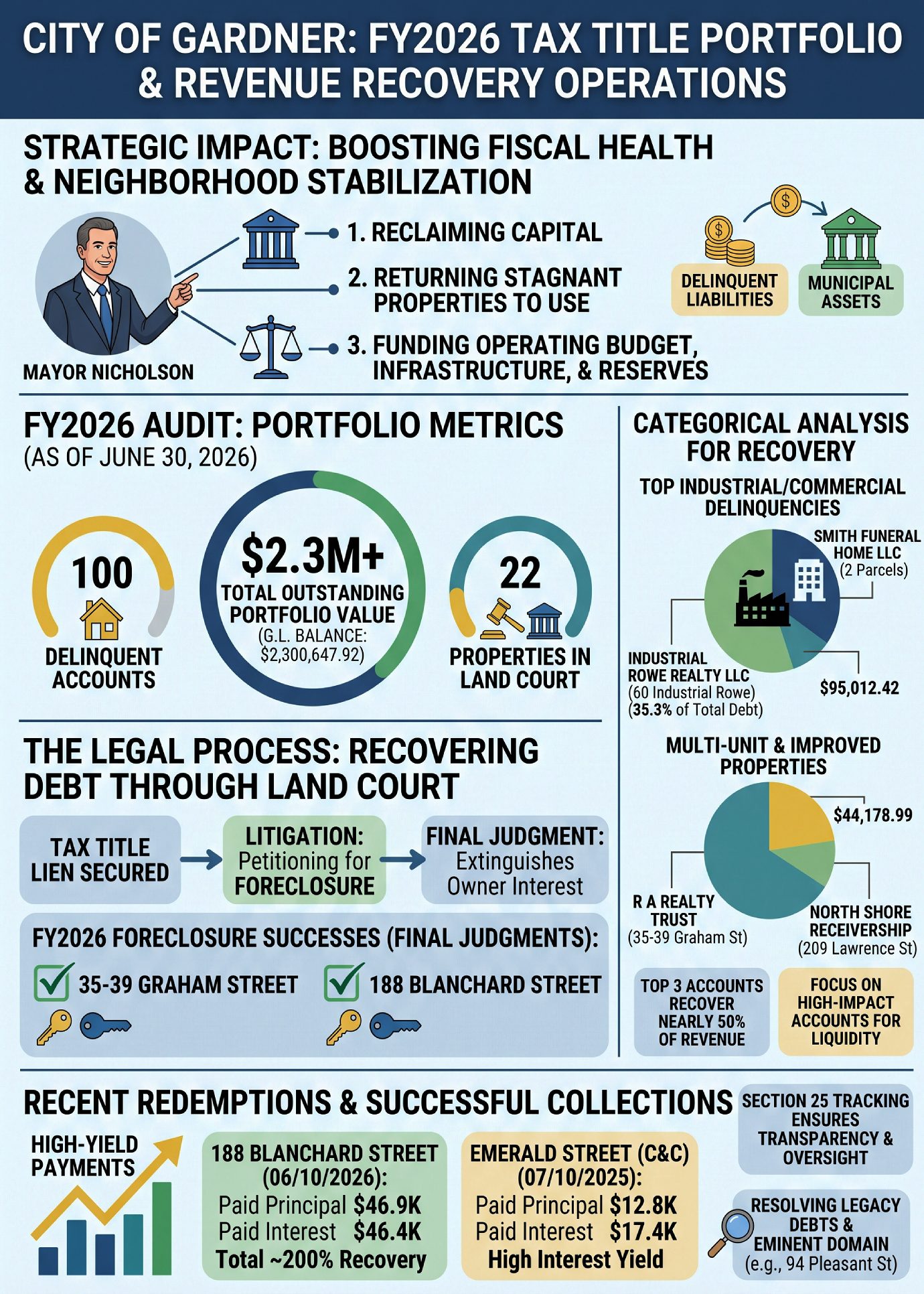
This subject will come up at the Gardner City Council meeting of Monday September 21, 2026. Gardner Magazine is publishing this analysis to once again showcase the strong fiscal focus of the “Model City for America.”
In this article we cover the impact on municipal liquidity, land court proceedings and foreclosures, a categorical analysis of delinquent accounts, historical persistence and aging of debt, and tracking recent revenue recovery successes.
City of Gardner $2.3 million Tax Title Portfolio and Recovery Operations – Complete Report
An explanation as to why the City of Gardner and Mayor Nicholson’s proactive efforts are so important for Gardner’s Balance sheets.
Effective tax title management is a critical instrument for municipal fiscal health and neighborhood stabilization. When a property owner fails to satisfy real estate tax obligations, the City of Gardner secures a legal lien known as “Tax Title.” This mechanism serves as a safeguard for the City’s revenue stream, ensuring that delinquent obligations are eventually satisfied while providing a legal framework to address blighted or abandoned parcels. For the City of Gardner, managing the “aging of receivables” within this portfolio is not merely an accounting exercise; it is a strategic effort to reclaim capital and return stagnant properties to productive use.
Based on the FY2026 Tax Title Properties audit, the City’s current position as of June 30, 2026, is summarized by the following metrics:
- Total Outstanding Portfolio Value: The General Ledger (G.L.) balance for outstanding tax titles is $2,300,647.92.
- Volume of Delinquent Accounts: There are currently 100 properties held in tax title status.
- Litigation Density: The portfolio shows significant legal movement, with 22 properties currently involved in active Land Court proceedings.
The Impact on Municipal Liquidity The significance of a $2.3 million outstanding balance lies in the “carrying cost” of these delinquent assets. These funds represent illiquid capital that is currently unavailable for the City’s operating budget, infrastructure investments, or stabilization reserves. While these receivables are secured by the underlying real estate, their lack of liquidity necessitates a proactive recovery strategy to maintain budget preparedness and minimize the need for short-term borrowing. As the City seeks to convert these liabilities into cash or municipal assets, it must navigate a complex legal landscape where court timelines often dictate the pace of recovery.
Legal Landscape: Land Court Proceedings and Foreclosures: The Massachusetts Land Court is the ultimate arbiter in municipal debt recovery, serving as the forum where the City petitions for a “Foreclosure of the Right of Redemption.” This legal milestone is essential for extinguishing an owner’s interest in a property, yet the process is frequently a bottleneck due to mandatory waiting periods, notification requirements, and court scheduling.
Despite these inherent delays, the City achieved major legal benchmarks in FY2026. Per a report to the Gardner City Council by Gardner Mayor Michael Nicholson, the Land Court issued final judgment orders and successfully foreclosed on two high-priority properties:
- 35-39 Graham Street
- 188 Blanchard Street
A “Foreclosure Judgment” is a transformative milestone; it grants the City full ownership, allowing for the public auction of the land to satisfy the debt or the retention of the site for municipal redevelopment. To illustrate current litigation density, the following table details a selection of accounts presently navigating the Land Court system:
| Property Owner | Year | Land Court Case No. | Outstanding Balance |
|---|---|---|---|
| L.H. Sawin Co., Inc. | 2018 | 22 TL001094 | $33,814.40 |
| Robert H. & Blanche R. Puustinen | 2015 | 22 TL001089 | $35,461.46 |
| Ashwani Kumar | 2017 | 21 TL000656 | $12,446.75 |
| Mary Ellen Jarvis | 2015 | 22 TL001119 | $32,007.61 |
| Yelena Medvedeva | 2017 | 22 TL001061 | $25,537.01 |
While litigation provides the teeth for enforcement, the sheer value concentrated in a handful of these accounts requires a focused, categorical analysis to maximize recovery efficiency.
Categorical Analysis of Delinquent Accounts: By categorizing delinquent accounts by property type and valuation, the City can prioritize legal resources toward “High-Impact Accounts” where a single resolution provides a substantial boost to municipal liquidity.
High-Impact Industrial and Commercial Accounts The portfolio balance is heavily skewed by a few large-scale delinquencies. Most notably:
- Industrial Rowe Realty LLC (60 Industrial Rowe): At $812,334.37, this single property accounts for approximately 35.3% of the entire City’s tax title debt.
- Smith Funeral Home LLC: This entity represents two separate parcels on Vernon Street with an aggregate delinquency of $95,012.42 ($92,243.94 + $2,768.48).
Multi-Unit and Improved Properties
- R A Realty Trust (35-39 Graham St): This multi-unit complex reached a foreclosure judgment with an outstanding balance of $194,657.21.
- North Shore Receivership: An account totaling $44,178.99 at 209 Lawrence Street.
Land-Only and Off-Road Parcels A significant number of accounts fall into the “Land-Only” category, with values typically ranging from $500 to $5,000. Examples include holdings by Wilderbrook Development ($615.68) and Dymek Custom Builders ($1,395.92). While these accounts do not individually impact liquidity as heavily as industrial sites, resolving them is vital for clearing titles and facilitating new development.
Strategic Synthesis The successful resolution of just the top three industrial and multi-unit accounts would recover nearly 50% of the total outstanding revenue. However, while high-value accounts are the primary focus for cash recovery, the “age” of a debt is the secondary factor that often complicates the City’s ability to clear a title.
Historical Persistence and Aging of Debt: The City’s historical records reveal a subset of “legacy” delinquencies that have remained unresolved for decades. These cases illustrate the challenges of long-term tax evasion and the difficulty of locating owners or clearing titles on ancient parcels.
- 1990s Delinquencies: The oldest active cases date to 1991, primarily involving the R A Realty Trust (including the former Graham Trust and Ninety Four Realty Trust) properties. Other persistent accounts include John J. Martioski (since 1995) and Melanson (since 1999).
- Legacy Entities: Foster Brook Estates, LLC represents a significant legacy delinquency, with multiple parcels (Foster Court/Willis Rd and Foster Court – Land) and debt dating back to at least 2007.
In certain cases, the City must move beyond traditional collection. The property at 94 Pleasant St., which carried a debt of $31,587.52 dating back to 1991, was recently resolved via Eminent Domain. Given its proximity to the existing City Hall at 95 Pleasant St., this action allowed the City to “wipe” the debt in exchange for taking control of the site. This shift from tax collection to land acquisition leads directly into the recent successes the City has seen in actual revenue redemption.
Tracking Revenue Recovery: Recent Successes and Payments: The Mayor’s report was a direct response to the Section 25 Information Request, a transparency and oversight tool utilized by the City Council to monitor the City’s financial interests. Current tracking efforts demonstrate that the City is effectively securing cash redemptions even as it pursues foreclosures.
FY2026 Resolved Payments and Redemptions
| Property Owner/Address | Principal Paid | Interest Paid | Date |
|---|---|---|---|
| 188 Blanchard Street | $46,960.44 | $46,374.97 | 06/10/2026 |
| 41 Chestnut Street | $11,702.66 | $2,797.76 | 10/01/2025 |
| Emerald Street (C&C) | $12,849.62 | $17,416.31 | 07/10/2025 |
| 39 School Street | $8,704.23 | $1,994.90 | 10/01/2025 |
Analysis of Interest-to-Principal Ratios From a municipal finance perspective, these redemptions yield a significant “windfall” beyond the original debt. In the case of 188 Blanchard Street, the total recovery reached 198.7% of the principal principal amount due to accrued interest. Even more striking is the Emerald Street payment, where the interest ($17,416.31) far exceeded the principal ($12,849.62), resulting in a “yield” of approximately 135.5% of the original debt. These high interest amounts act as both a substantial revenue source for the City and a powerful deterrent against further delinquency, reinforcing the City’s fiscal standing.
The City of Gardner’s FY2026 tax title portfolio represents a substantive $2.3 million asset. While the figure is large, current data indicates a highly effective management strategy. The combination of successful foreclosure judgments on properties like Graham Street and the high-yield recovery of nearly $100,000 in combined principal and interest from individual redemptions like Blanchard Street proves that the City’s pressure is producing results. While litigation remains a slow process, the use of Section 25 tracking ensures the City Council has the transparency required for fiduciary oversight. By maintaining a targeted legal strategy on high-value industrial accounts and addressing legacy debts through creative paths like Eminent Domain, the City of Gardner remains steadfast in its commitment to fiscal responsibility and the stabilization of our neighborhoods.