Gardner Magazine Weekly Briefing – August 9, 2026
Listen to this complete Weekly Briefing podcast with the Chair Man and the Chair Lady on any device, CLICK PLAY.
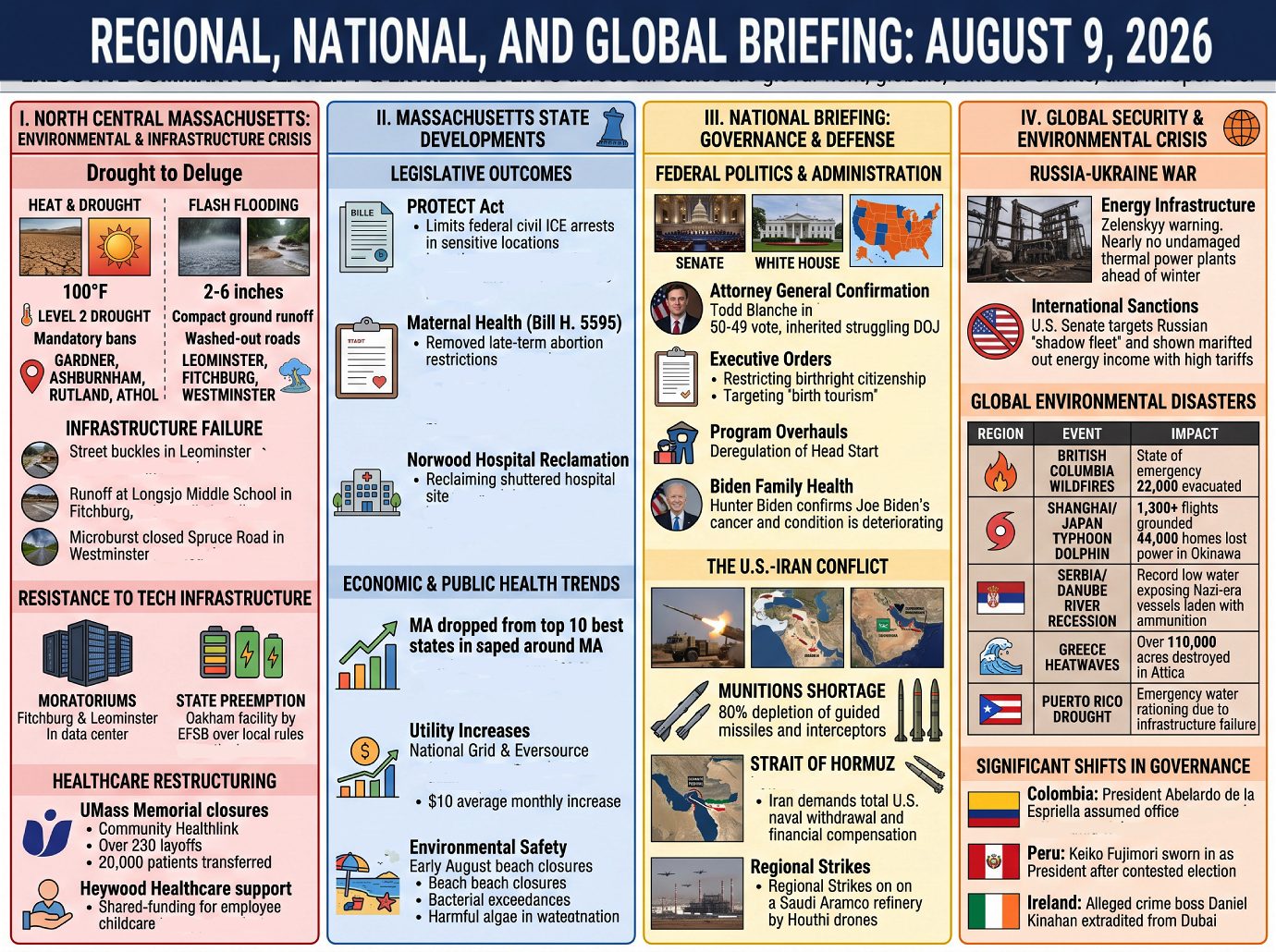
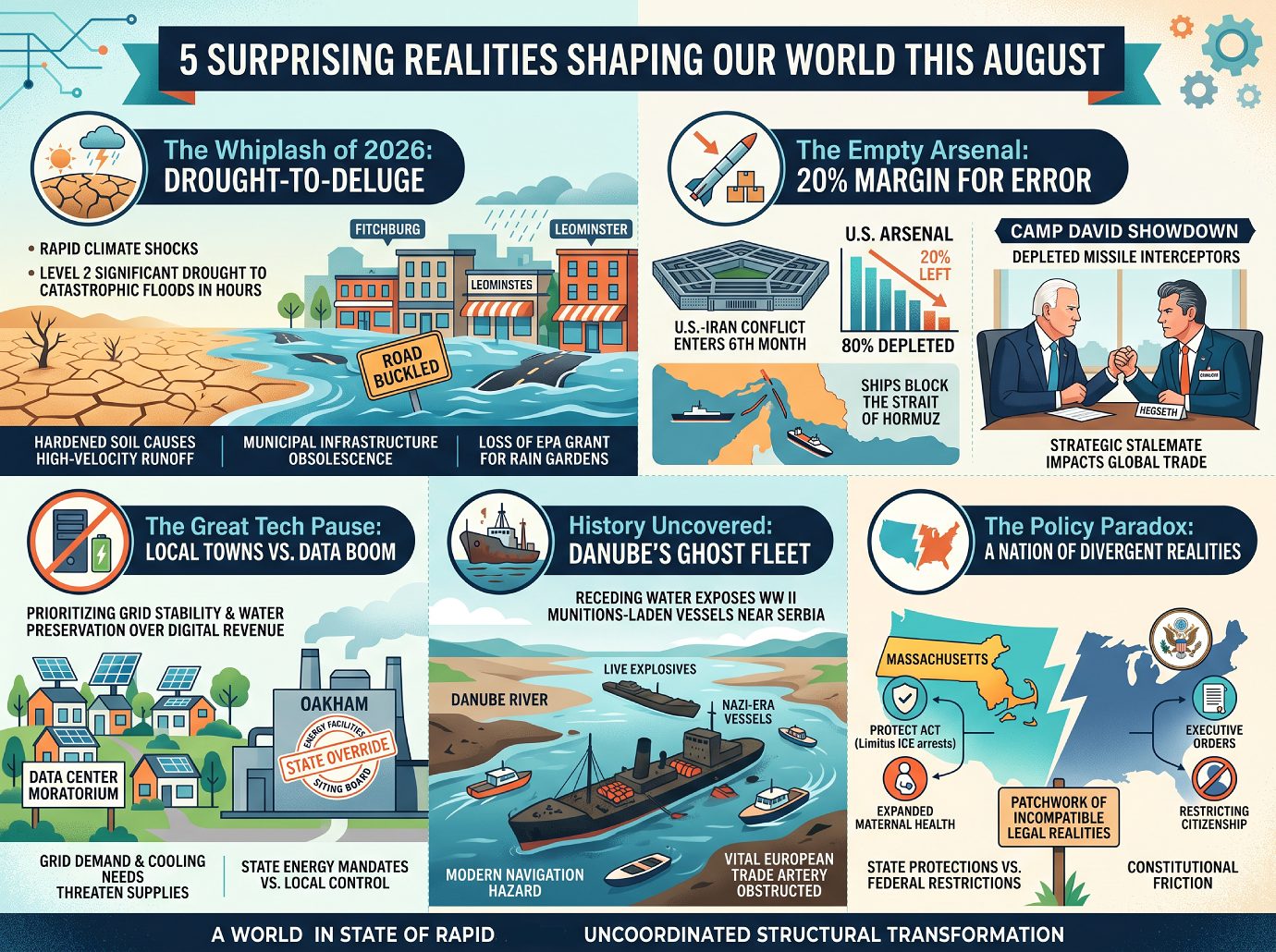
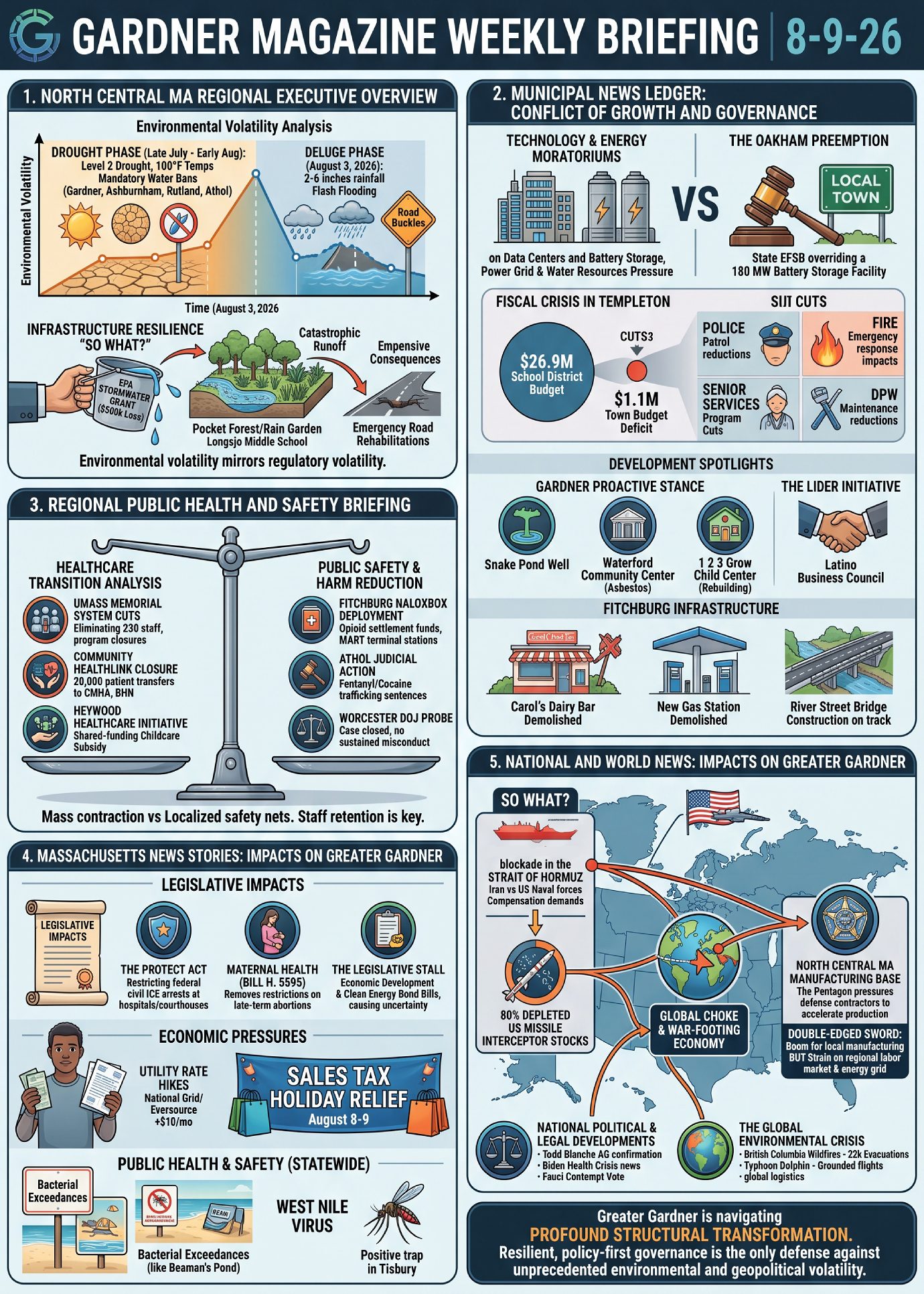
The first week of August 2026 provided a definitive case study in meteorological volatility, characterized by a violent “meteorological pivot” that tested the limits of regional infrastructure. North Central Massachusetts transitioned abruptly from a record-breaking Level 2 Significant Drought and sustained 100°F heatwaves to catastrophic flash flooding on August 3. The physics of this transition are critical: weeks of extreme heat resulted in high compact soil permeability issues. When the parched, hardened ground met five to six inches of high-velocity rainfall, it acted as an impervious surface. Instead of recharging regional aquifers, the deluge transformed into destructive runoff, overwhelming drainage systems and exposing the fragility of our municipal foundations.
The “So What?” of Infrastructure Resilience The strategic cost of this volatility was felt most acutely in Fitchburg, where the timing of the August 3 flood turned a fiscal setback into a civic emergency. The city is currently reeling from the loss of a $500,000 EPA stormwater grant. This funding was specifically earmarked for “pocket forests” and rain gardens at Longsjo Middle School and Bartley-Nolan Park—infrastructure designed to mitigate the exact type of catastrophic runoff that occurred. The failure to secure these nature-based solutions represents more than a lost grant; it is a critical failure of the municipal safety net, leaving taxpayers to fund emergency road rehabilitations that green infrastructure might have prevented.
Municipal News Ledger: The Conflict of Growth and Governance
Context & Strategic Importance We are witnessing a profound tension between regional economic development and a defensive posture regarding resource management. While Gardner aggressively pursues biotech expansion, neighboring hubs are retreating into protective moratoriums. This internal conflict is further complicated by state-level interventions that are systematically challenging the traditional philosophy of “Home Rule” in the Commonwealth.
Technology & Energy Moratoriums
- Fitchburg & Leominster Pauses: Both cities have initiated formal proceedings for temporary moratoriums on new data centers and battery-storage facilities. Officials cite unsustainable pressure on the local power grid and water resources as the primary drivers for this halt.
- The Oakham Preemption: In a significant blow to Local Control, the state’s Energy Facilities Siting Board (EFSB) unanimously approved a 180-megawatt battery storage facility in Oakham. By bypassing all local municipal restrictions, the EFSB has signaled that state energy goals will now supersede municipal zoning authority.
Fiscal Crisis & Structural Shifts The passage of the $26.9 million Narragansett Regional School District budget has triggered an immediate fiscal reckoning in Templeton. Following a narrow 10-vote margin necessitated by Phillipston’s previous override rejection, the town must now bridge a $1.1 million hole in the municipal budget.
- POLICE: Significant reductions in patrol and administrative capacity.
- FIRE: Expected impacts on emergency response and equipment maintenance.
- SENIOR SERVICES: Deep cuts to programming and support for vulnerable residents.
- DPW: Reductions in infrastructure maintenance and seasonal staffing.
Development Spotlights
- Gardner’s Proactive Stance: The city is utilizing the Snake Pond Well Facility to pump one million gallons of fresh water daily to combat regional shortages. While the Waterford Community Center faces delays due to asbestos remediation, progress continues on the $4.1 million Rear Main Street project. Notably, the 1 2 3 Grow Child Center is already rebuilding following a total-loss fire.
- The LIDER Initiative: Balancing the “defensive” narrative, the North Central Massachusetts Chamber of Commerce launched the Latino Business Council (LIDER), providing critical capital and networking to the region’s fastest-growing entrepreneurial segment.
- Fitchburg Infrastructure: The iconic Carol’s Dairy Bar has been demolished for a new gas station, while the River Street Bridge replacement remains on track for a Labor Day completion.
Regional Public Health and Safety Briefing
Context & Strategic Importance The regional healthcare landscape is defined by a jarring dichotomy: mass institutional contraction at the state level versus localized efforts to build sustainable safety nets. As 20,000 patients are shuffled between providers, the ability of our regional hubs to retain talent has become the primary metric of public health stability.
Healthcare Transition Analysis
| Provider Action | Community Impact |
|---|---|
| UMass Memorial System Cuts | Elimination of 230 staff positions linked to program closures and regional restructuring. |
| Community Healthlink Closure | Finalized phased closure; 20,000 behavioral health and substance abuse patients transferred to CMHA and BHN. |
| Heywood Healthcare Initiative | Launch of a shared-funding childcare subsidy program to stabilize the local workforce and prevent staff attrition. |
Public Safety & Harm Reduction
- Fitchburg NaloxBox Deployment: The Health Department is utilizing opioid settlement funds to install Narcan rescue stations at the MART Intermodal terminal and city parks, modernizing the regional response to the overdose crisis.
- Athol Judicial Action: A local couple received state prison sentences (three to five years) for fentanyl and cocaine trafficking, following a high-profile overdose investigation.
- Worcester DOJ Probe: In a notable victory for local law enforcement, the U.S. Department of Justice officially closed its multi-year investigation into the Worcester Police Department without sustaining past allegations of misconduct.
Massachusetts News Stories: Impacts on Greater Gardner
Context & Strategic Importance The conclusion of the formal legislative session on Beacon Hill has sent a wave of mandates toward North Central Massachusetts. While the “frenetic flurry” of early August resulted in landmark protections for vulnerable populations, the failure to pass critical bond bills has left regional planners in a state of suspended animation.
Legislative Impacts on the Region
- The PROTECT Act: This legislation restricts federal civil ICE arrests at hospitals and courthouses, altering the operational and legal landscape for regional healthcare providers and legal centers.
- Maternal Health (Bill H. 5595): This bill removes statutory restrictions on late-term abortions and expands protections, fundamentally shifting regulatory requirements for maternity wards in the region.
- The Legislative Stall: Critically, the session ended with economic development and clean energy bond bills stalled in conference committees. This lack of resolution creates significant uncertainty for municipal projects relying on state-level capital infusions.
Economic Pressures on Residents Residents are navigating competing economic forces:
- Utility Rate Hikes: Effective August 1, National Grid and Eversource increased supply rates, adding an average of $10 per month to household bills.
- Sales Tax Holiday Relief: The August 8–9 weekend provided a 6.25% tax suspension, driving necessary foot traffic to small businesses in downtown Gardner and Leominster.
Public Health & Safety (Statewide)
- Environmental Risk: Nearly 50 beaches, including Beamans Pond in Templeton, remain closed due to bacterial exceedances and algae blooms.
- West Nile Virus: The season’s first positive mosquito trap was confirmed in Tisbury, signaling the onset of the annual seasonal viral threat.
National and World News: Impacts on Greater Gardner
Context & Strategic Importance The U.S.-Iran conflict and the blockade of the Strait of Hormuz have created a “local-to-global” feedback loop that directly threatens regional stability. With U.S. long-range missile interceptor stocks at 20%, the Pentagon is exerting unprecedented pressure on the industrial supply chains that form the backbone of North Central Massachusetts’ manufacturing base.
National Political & Legal Developments
- AG Confirmation: Todd Blanche was confirmed as Attorney General in a 50–49 vote, inheriting a DOJ struggling with high vacancy rates and low morale.
- Biden Health Crisis: Hunter Biden has confirmed that former President Joe Biden’s cancer has spread, describing a deteriorating and painful situation.
- Fauci Contempt Vote: The Senate Homeland Security Committee voted to hold Dr. Anthony Fauci in contempt of Congress following his invocation of the Fifth Amendment during COVID-19 origin hearings.
The Global Environmental Crisis The weather extremes in North Central Massachusetts are part of a global pattern of climate volatility:
- British Columbia Wildfires: The Bald Range wildfire has forced 22,000 evacuations and triggered a state of emergency.
- Typhoon Dolphin: Grounded over 1,300 flights in Shanghai and disrupted global logistics, mirroring the infrastructure disruptions seen locally.
“So What?”—The Middle East Crisis & The Industrial Base The closure of the Strait of Hormuz has evolved from a maritime dispute into a global economic chokehold. As Iran demands total U.S. naval withdrawal and war compensation, the depletion of 80% of U.S. missile interceptor stocks has moved the nation toward a “war-footing” economy. For North Central Massachusetts, this means the Pentagon is now pressuring defense contractors to accelerate production. This could serve as a double-edged sword: a potential boom for local manufacturing but a significant burden on an already strained regional labor market and energy grid.