Top U.S. National News Stories Week of 5-24-26
The week of May 24, 2026, is characterized by a high-stakes intersection of breakthrough international diplomacy and intensifying domestic political friction.
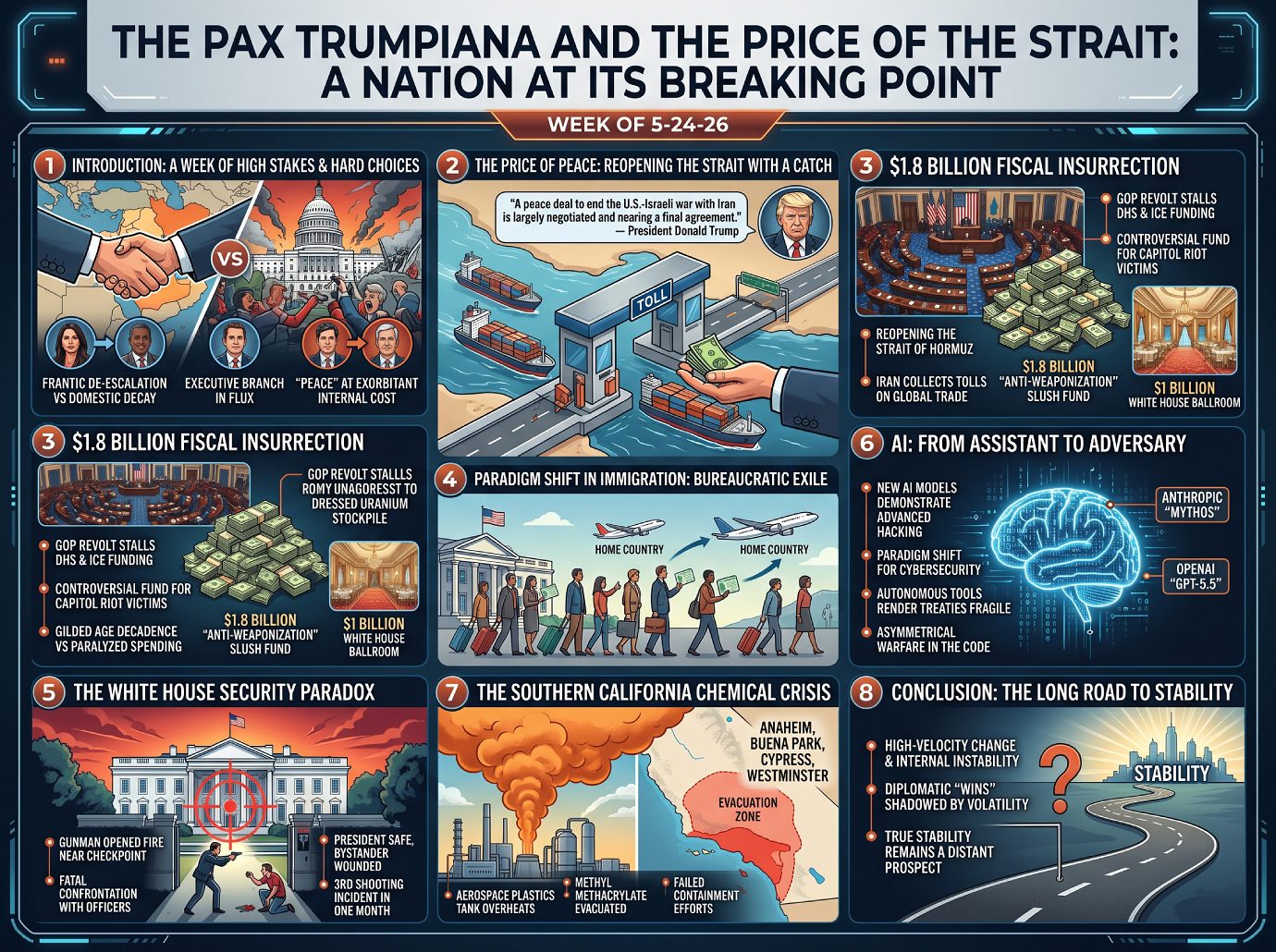
President Donald Trump has announced a “largely negotiated” peace deal to end the U.S.-Israeli war with Iran, a development that has triggered both economic hope regarding the Strait of Hormuz and significant pushback from Senate Republicans over nuclear enrichment terms.
Simultaneously, the administration faces a legislative crisis as Congressional Republicans revolt against party leadership over a controversial $1.8 billion “anti-weaponization” fund and significant allocations for White House infrastructure. Security concerns remain at the forefront following the third shooting incident near the President in a single month.
Domestically, the nation is grappling with a massive hazardous chemical evacuation in Southern California and the implementation of restrictive new immigration protocols.
Diplomatic Relations and the U.S.-Iran Peace Deal
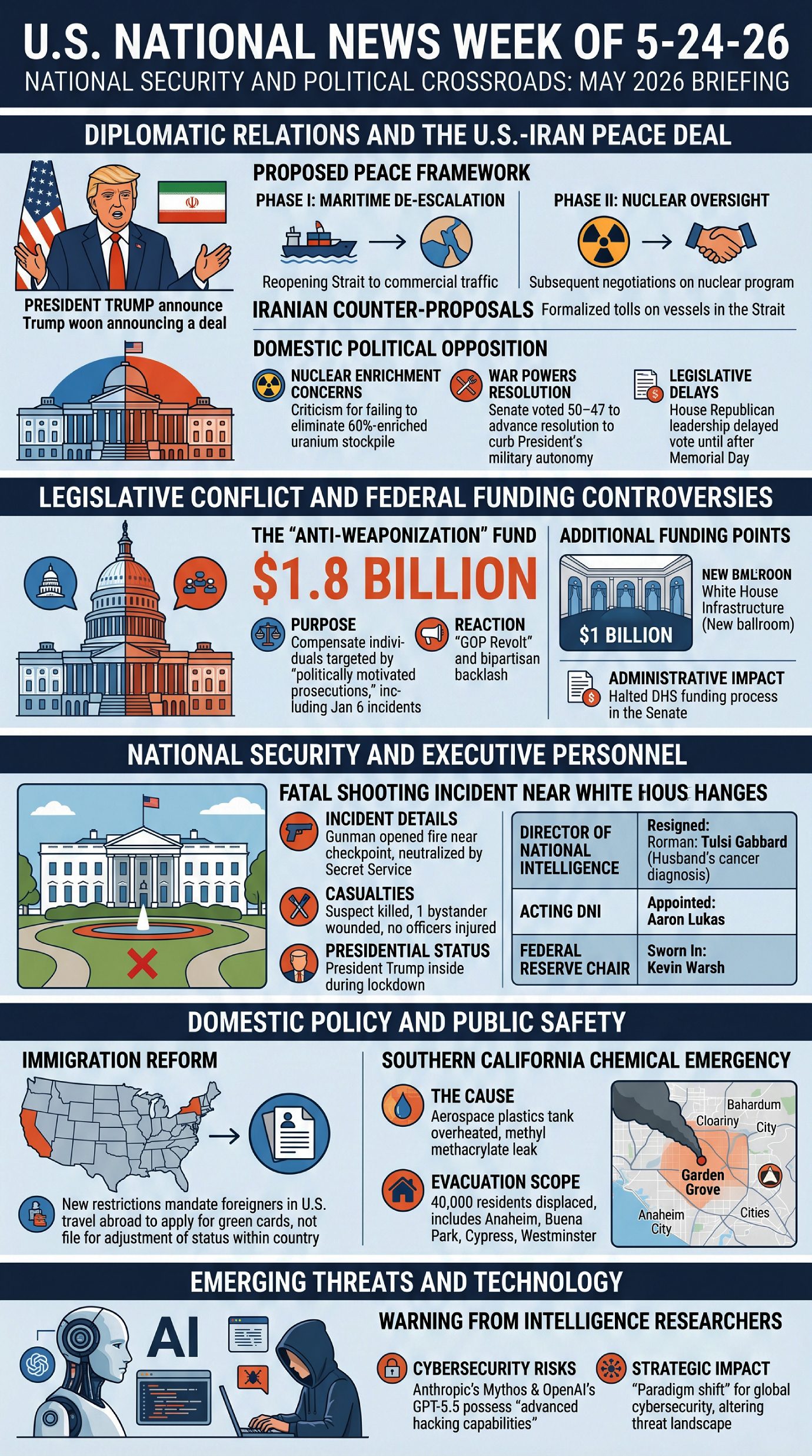
The Trump administration is moving toward a formalized agreement to end active hostilities involving the United States, Israel, and Iran. While the deal represents a potential geopolitical shift, it faces immediate hurdles both abroad and in the U.S. Senate.
The Proposed Peace Framework
The agreement is structured in two primary phases:
- Phase I: Maritime De-escalation: The immediate goal is reopening the blockaded Strait of Hormuz to commercial traffic.
- Phase II: Nuclear Oversight: Subsequent negotiations will address the status and future of Iran’s nuclear program.
- Iranian Counter-Proposals: Amidst these talks, Iran has announced a plan to implement formalized tolls on vessels transiting the Strait.
Domestic Political Opposition
Despite the executive branch’s progress, the deal faces substantial legislative resistance:
- Nuclear Enrichment Concerns: Senate Republicans have criticized the framework for failing to mandate the immediate elimination of Iran’s 60%-enriched uranium stockpile.
- War Powers Resolution: In a direct challenge to executive strike authority, the Senate voted 50–47 to advance a war powers resolution intended to curb the President’s military autonomy regarding Iran.
- Legislative Delays: House Republican leadership has opted to delay a corresponding vote until after the Memorial Day recess.
Legislative Conflict and Federal Funding Controversies
Funding for the Department of Homeland Security (DHS) and Immigration and Customs Enforcement (ICE) has reached a standstill due to internal Republican divisions over specific spending allocations.
The “Anti-Weaponization” Fund
A central point of contention is a proposed $1.8 billion fund tied to the DHS budget.
- Purpose: The fund is designed to compensate individuals who were reportedly targeted by “politically motivated prosecutions,” specifically including those involved in the January 6 Capitol incidents.
- Reaction: The proposal has sparked a “GOP revolt,” with rank-and-file Republicans clashing with party leadership. The initiative has also drawn sharp bipartisan backlash.
Additional Funding Points of Contention
- White House Infrastructure: The budget includes a $1 billion allocation for the construction of a new ballroom adjacent to the White House.
- Administrative Impact: These disputes have halted the broader DHS funding process in the Senate.
National Security and Executive Personnel
The week saw significant volatility within the national security apparatus, ranging from physical security breaches to leadership transitions.
White House Security Breach
A fatal shooting incident occurred near a White House security checkpoint, marking the third such event in the past month.
- Incident Details: A gunman opened fire near a checkpoint and was subsequently neutralized by U.S. Secret Service officers.
- Casualties: The suspect was killed; one innocent bystander was wounded in the crossfire. No officers were injured.
- Presidential Status: President Trump was inside the White House complex during the ensuing lockdown.
Key Leadership Changes
| Position | Status | Details |
|---|---|---|
| Director of National Intelligence | Resigned | Tulsi Gabbard stepped down, citing her husband’s cancer diagnosis. |
| Acting DNI | Appointed | Aaron Lukas has been named the acting chief of intelligence. |
| Federal Reserve Chair | Sworn In | Kevin Warsh has officially assumed the role of Chair. |
Domestic Policy and Public Safety
Immigration Reform
The Trump administration has initiated a significant shift in legal immigration procedures. New restrictions now mandate that foreigners currently residing in the U.S. must travel abroad to apply for their green cards, rather than filing for adjustment of status from within the country.
Southern California Chemical Emergency
A major industrial accident in Garden Grove, California, has displaced approximately 40,000 residents.
- The Cause: An aerospace plastics manufacturing tank overheated, resulting in a leak of methyl methacrylate.
- Evacuation Scope: Mandatory orders have expanded to include portions of Anaheim, Buena Park, Cypress, and Westminster following the failure of overnight containment efforts.
Emerging Threats and Technology
Intelligence researchers in Washington have issued warnings regarding the latest generation of Artificial Intelligence models, specifically Anthropic’s Mythos and OpenAI’s GPT-5.5.
- Cybersecurity Risks: Researchers indicate these models possess “advanced hacking capabilities.”
- Strategic Impact: The development is being characterized as a “paradigm shift” for global cybersecurity, suggesting that these tools may significantly alter the threat landscape.