North Central MA News Briefing for October 4, 2026
Listen to the North Central MA Weekly Briefing on any device, CLICK PLAY.
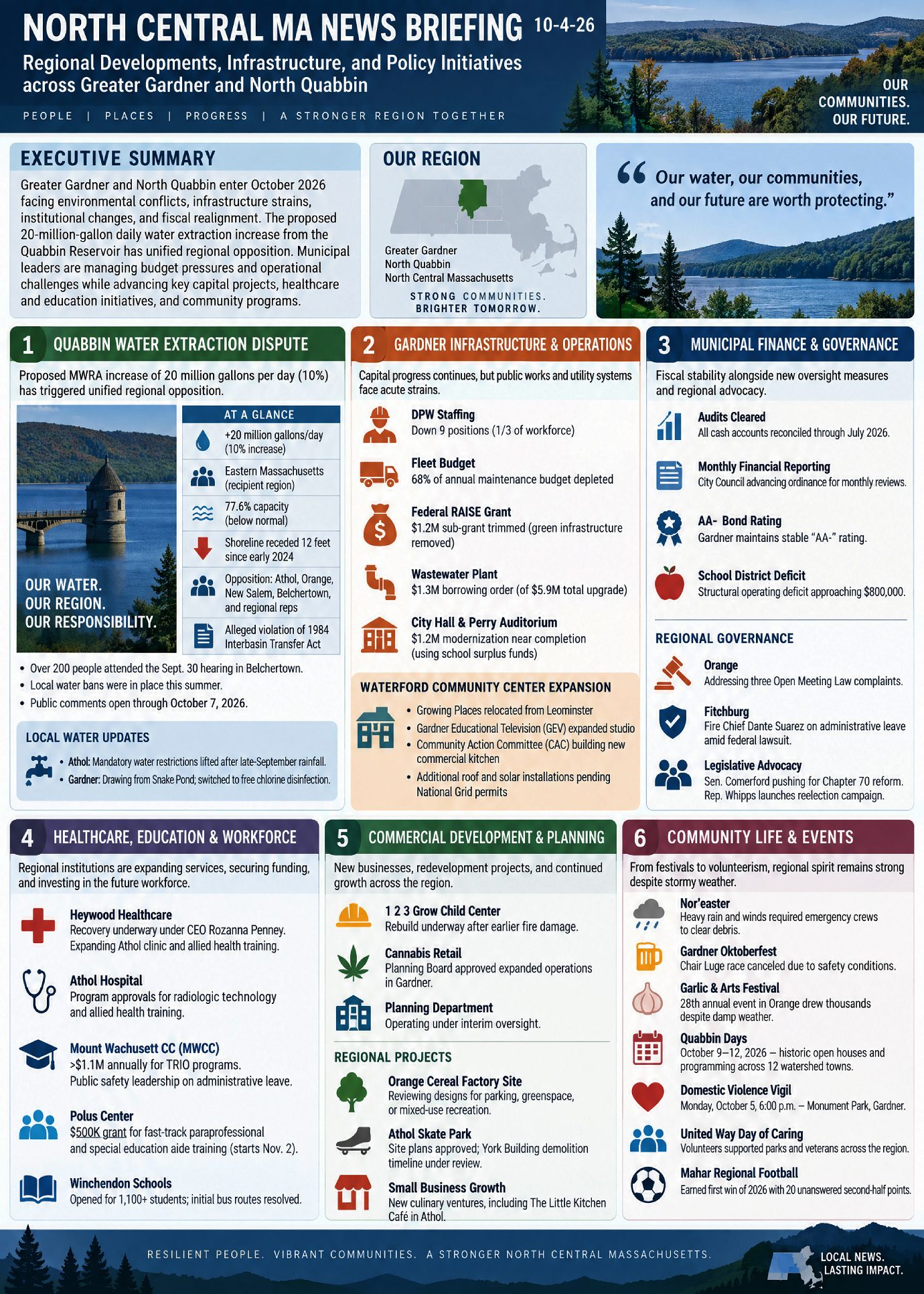
As of early October 2026, the municipalities comprising Greater Gardner, the North Quabbin region, and broader North Central Massachusetts are navigating a complex landscape of environmental conflicts, municipal infrastructure strains, institutional restructurings, and fiscal realignment.
The most pressing regional controversy centers on a proposed 20-million-gallon daily water extraction increase from the Quabbin Reservoir by the Massachusetts Water Resources Authority (MWRA), which has drawn unified opposition from local officials, state legislators, and residents citing environmental risks and a lack of economic compensation.
Concurrently, local governments are grappling with operational and fiscal challenges:
- Gardner faces acute public works staffing deficits, fleet budget exhaustion, and structural budget shortfalls within its public school system, even as capital projects like the City Hall and Perry Auditorium restorations near completion and the Waterford Community Center undergoes major tenant expansions.
- Federal and State Grant Realignments have altered municipal plans, forcing scope reductions in Gardner’s $1.2 million federal RAISE sub-grant and shifting Community Development Block Grant (CDBG) funds from facility upgrades to asbestos abatement due to changes in low-to-moderate income demographics.
- Institutional Restructuring continues across healthcare and education, highlighted by Heywood Healthcare’s post-cybersecurity and financial recovery, administrative leadership changes at Mount Wachusett Community College (MWCC), and regional advocacy for rural education funding formula reform.
Regional Water Rights and Environmental Governance
The MWRA Quabbin Reservoir Extraction Conflict
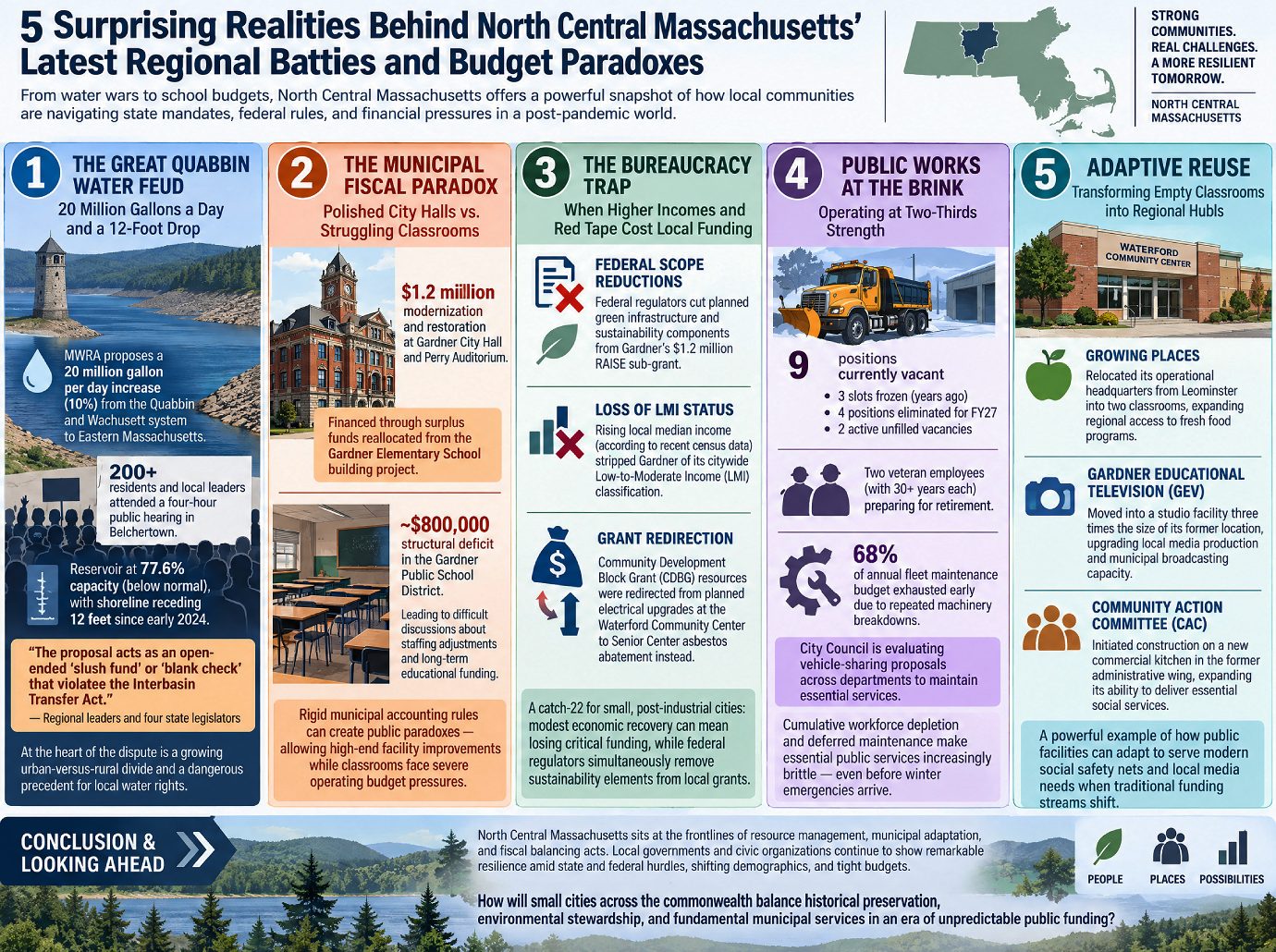
The central regional controversy heading into October 2026 is a proposed expansion of water diversions from the Quabbin and Wachusett Reservoir systems by the Massachusetts Water Resources Authority (MWRA). The plan calls for an additional extraction of 20 million gallons of water per day—a 10% increase—to supply municipalities in Eastern Massachusetts.
- Public Hearing and Opposition: On September 30, 2026, over 200 municipal officials, watershed stewards, and residents packed a four-hour public hearing hosted by the state Water Resources Commission in Belchertown. Representatives from Athol, Orange, New Salem, and Belchertown strongly denounced the plan.
- Drought Metrics and Water Restrictions: Local stewards emphasized that the Quabbin Reservoir is currently operating at 77.6% capacity—a level designated as “below normal” under drought metrics following a summer marked by Level 2 Significant Drought conditions. The shoreline has receded 12 feet since early 2024. Municipalities hosting or bordering the reservoir, such as New Salem, enforced mandatory local water bans throughout the summer, creating significant friction over proposals to send unconstrained supply to eastern communities.
- Legal and Statutory Challenges: Four state legislators and local municipal leaders argue that the MWRA’s proposal violates the 1984 Interbasin Transfer Act. Opponents contend that the requested authorization acts as an open-ended “blank check” or “slush fund” because the MWRA has failed to designate the specific receiving municipalities prior to seeking approval. Public comments regarding the proposal remain open through October 7, 2026.
Local Water System Operations
- Athol Restriction Lifted: Following beneficial late-September rainfall, the Athol Department of Public Works officially lifted mandatory municipal water restrictions that had been enforced since June 10, 2026.
- Gardner Disinfection Shift: In response to regional drought and local supply needs, Gardner drew water from Snake Pond and transitioned its municipal drinking water disinfection process to free chlorine.
Municipal Infrastructure, Public Works, and Capital Projects
City of Gardner Infrastructure Strains
The City of Gardner is balancing significant capital progress against acute operational deficits in its Department of Public Works (DPW) and municipal utilities.
- DPW Workforce and Fleet Shortages: Gardner’s DPW is operating at a one-third vacancy rate, down nine full positions due to three slots frozen in previous years, four positions eliminated for FY27, and two active unfilled vacancies. The labor shortage is projected to worsen with the impending retirement of two veteran staff members possessing over 30 years of individual service. Additionally, frequent equipment breakdowns forced the DPW to exhaust 68% of its annual fleet maintenance budget early in the fiscal year, leading the City Council Finance Committee to evaluate vehicle-sharing policies.
- RAISE Sub-Grant Modifications: Scope reductions mandated by federal regulators trimmed components of Gardner’s $1.2 million federal RAISE sub-grant (administered through MassDOT), stripping green infrastructure and sustainability elements from the project. Despite re-bidding constraints and administrative setbacks, municipal planners are proceeding with multi-year downtown mobility upgrades, parking expansions, and design specifications for the West Street garage through 2029.
- Utility Cutover Delays: Delays involving National Grid contractors compressed the construction timeline for the Rear Main Street Northside utility project, forcing accelerated work to complete utility cutovers ahead of late-autumn industrial plant closures and winter weather.
- Wastewater Treatment Plant Modernization: To ensure compliance with Environmental Protection Agency (EPA) mandates, the Gardner City Council Finance Committee advanced a $1.3 million borrowing order to fund a portion of a comprehensive $5.9 million wastewater treatment plant overhaul.
Facilities Modernization and CDBG Reallocations
- Gardner City Hall & Perry Auditorium: Capital restorations updating Gardner City Hall and Perry Auditorium are entering their final stages. The $1.2 million modernization efforts have been financed largely using reallocated capital budget surpluses carried over from the recently completed Gardner Elementary School construction project under Mayor Michael Nicholson’s administration.
- Waterford Community Center Realignment: Changes in federal census data raised Gardner’s median income, stripping the city of its overall Low-to-Moderate Income (LMI) designation. As a result, federal CDBG funding was redirected away from planned electrical upgrades at the Waterford Community Center to fund mandatory asbestos abatement at the Senior Center.
- Waterford Center Expansion: Despite funding shifts, the Waterford Community Center is undergoing significant expansion:
- Growing Places: The non-profit food organization relocated its operational headquarters from Leominster into two dedicated classrooms.
- Gardner Educational Television (GEV): Completed its move into a studio three times larger than its former facility.
- Community Action Committee (CAC): Commenced construction on a new commercial kitchen in the facility’s former administrative wing.
- Solar & Structural Infrastructure: Additional roof and solar installations remain pending approval of National Grid permits.
Municipal Finance, Governance, and Fiscal Oversight
Financial Controls and Auditing
- Gardner Auditing Reconciliations: City Auditor Karen Butler confirmed that long-standing municipal accounting backlogs have been fully cleared, with all cash accounts reconciled through July 2026.
- Financial Reporting Ordinances: The Gardner City Council advanced legislative measures transitioning financial reporting requirements from quarterly to monthly reviews, enabling tighter municipal oversight of city expenditures and the tax-title property portfolio. Gardner maintained its “AA-” stable bond rating.
- School District Budget Pressures: Despite overall municipal fiscal stability, the Gardner Public School District is dealing with a structural operating deficit approaching $800,000, driven by escalating health insurance premiums and retiree costs. Community discussions are underway regarding long-term local educational funding and potential staffing adjustments.
Regional Governance and Legal Matters
- Orange Selectboard Open Meeting Law Complaints: The Town of Orange is working to resolve three distinct Open Meeting Law compliance complaints regarding procedural actions taken during executive sessions.
- Fitchburg Legal Proceedings: Fitchburg Fire Chief Dante Suarez remains on administrative leave amid an ongoing federal lawsuit filed against city leadership alleging workplace retaliation.
- Legislative Campaigns and Advocacy: State Sen. Jo Comerford hosted public forums in Orange—including at Fisher Hill School—advocating for comprehensive revisions to the state’s Chapter 70 education funding formula, which regional leaders argue structurally underfunds rural school districts. Simultaneously, State Rep. Susannah Whipps launched her reelection campaign for the 2nd Franklin District, focusing on Western Massachusetts equity, public works funding, and veteran support.
Healthcare, Higher Education, and Workforce Development
Healthcare Restructuring and Expansion
- Heywood Healthcare Recovery: Following network cybersecurity disruptions and operational restructuring, Heywood Healthcare continues its recovery path under President and CEO Rozanna Penney, navigating state fiscal compliance reviews.
- Athol Hospital Program Approvals: Heywood Healthcare acquired commercial property on South Main Street in Athol to expand local clinic capacity. Concurrently, Athol Hospital secured program approvals to establish hands-on training pipelines for radiologic technology and allied healthcare students.
Higher Education and Workforce Grants
- MWCC Leadership and Grant Funding: Mount Wachusett Community College in Gardner secured over $1.1 million in annual federal funding to maintain its TRIO student support programs. However, campus law enforcement and public safety leadership were recently placed on administrative leave pending an internal review, necessitating transitional leadership structures.
- Polus Center Paraprofessional Workforce Grant: The Polus Center for Social and Economic Development in Athol was awarded a $500,000 workforce grant by the Executive Office of Labor and Workforce Development. Effective November 2, 2026, the funding will establish a fast-track training program to qualify local candidates for roles as special education assistants and teacher’s aides in regional schools.
Commercial Development, Planning, and Local Real Estate
Commercial Rebuilding and Retail Approvals
- Childcare Facility Reconstruction: In Gardner, the 1 2 3 Grow Child Center daycare is undergoing an active rebuild following severe fire damage sustained earlier in the year.
- Cannabis Retail Expansion: The Gardner Planning Board granted site approvals for expanded commercial cannabis retail operations.
- Planning Department Administration: Following the departure of Gardner’s Conservation Agent to Marblehead, the Community Development and Planning Department is operating under interim oversight, with the Department Director directly managing Conservation Commission filings and site inspections.
Regional Real Estate and Redevelopment Projects
- Orange Cereal Factory Site Planning: Town planners and residents in Orange are reviewing development designs for the demolished former cereal factory parcel. Active proposals include municipal parking, public greenspace, or a combined recreational format.
- Athol Municipal Projects: Athol officials approved site plans for a new municipal skate park, while public works engineers evaluate demolition timelines for the dilapidated York Building prior to winter.
- Small Business Expansion: Commercial property sales and small-business investments increased across the region, highlighted by the opening of new culinary ventures, including The Little Kitchen Café near the Uptown Common in Athol.
Community Civic Affairs, Public Safety, and Seasonal Events
Weather Impacts and Event Adjustments
Early autumn weather patterns heavily impacted regional schedules. A coastal nor’easter brought heavy rain and severe winds across Worcester County and the Montachusett area, requiring emergency management crews to clear fallen debris.
- Gardner Oktoberfest Adjustments: Slick pavement from storm conditions led municipal organizers and Mayor Michael Nicholson to cancel the signature Chair Luge race during the 21st Annual Oktoberfest due to safety concerns.
- Garlic & Arts Festival: The 28th annual North Quabbin Garlic & Arts Festival (referred to locally as “The Festival That Shall Not Be Named”) proceeded in Orange, drawing thousands of attendees despite damp conditions.
Cultural Events, Civic Initiatives, and Athletics
- Quabbin Days Festival: Scheduled for October 9–12, 2026, the second annual festival organized by the Friends of the Quabbin highlights the culture and history of the 12 watershed towns. Programming includes historic open houses and a historical presentation by the Swift River Valley Historical Society in New Salem regarding the former Rabbit Run Railroad.
- Civic and Health Programming:
- Domestic Violence Vigil: Scheduled for Monday, October 5, at 6:00 p.m. in Gardner’s Monument Park.
- Public Health Screenings: MWCC is hosting community mental health events, including screenings of the postpartum depression awareness documentary “More Than Blue”.
- Volunteer Mobilization: The 31st annual United Way Day of Caring mobilized volunteers across Fitchburg, Leominster, and Gardner for municipal park restoration and veteran support projects.
- Community Fundraisers: The Winchendon CAC and Greater Gardner Artists Association (GALA) launched the “Pins for POSSIBILITIES” fundraiser supporting youth and social services.
- Municipal Services: Municipal curbside yard waste pickup operated by EL Harvey was scheduled in Gardner for October 6–9.
- High School Athletics: The Mahar Regional High School football team (serving Orange and surrounding towns) secured its first victory of the 2026 season by scoring 20 unanswered points in a second-half comeback.