Voters Pay Attention: 5 November Ballot Questions Could Redefine the Commonwealth of MA
Listen to this podcast explaining the consequences of YES or NO to all the ballot questions on the November 3, 2026 ballot. CLICK PLAY.
The November 3, 2026, Massachusetts State Election features nine binding statewide ballot questions and several non-binding public policy questions.
These measures represent significant proposed changes to the Commonwealth’s governance, electoral systems, fiscal policies, and social regulations.
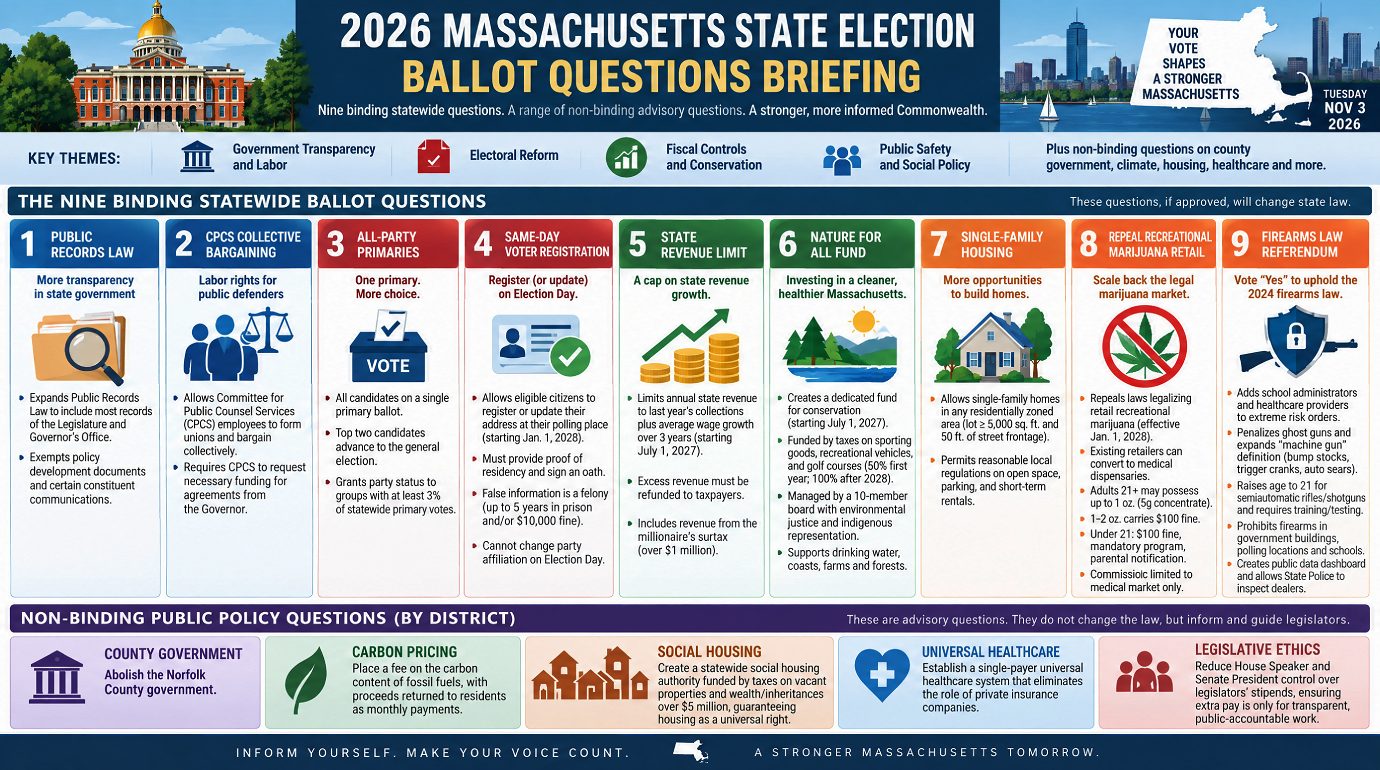
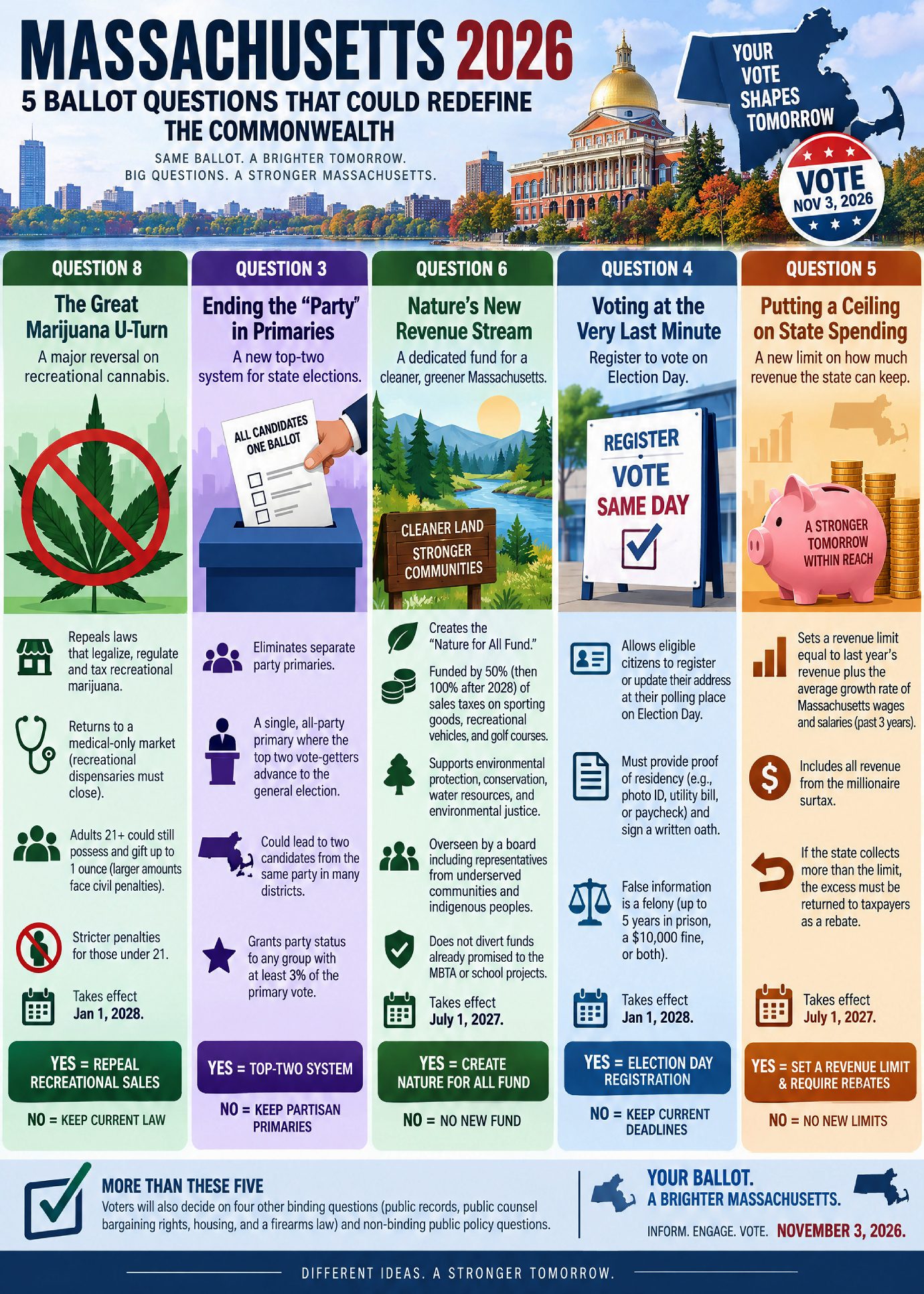
An infographic below summarizes the various ballot questions.
Key themes among the binding questions include:Government Transparency and Labor: Efforts to subject the Legislature and Governor’s Office to public records laws and granting collective bargaining rights to public defenders. Electoral Reform: Proposals to move toward an all-party primary system and the implementation of same-day voter registration. Fiscal Controls and Conservation: The establishment of a new state revenue limit based on wage growth and the creation of a dedicated “Nature for All Fund” for environmental conservation.Public Safety and Social Policy: Proposals to modify housing density requirements, repeal the retail sale of adult recreational marijuana, and a referendum to uphold or repeal comprehensive firearm regulation laws.
Question 1: Public Records Law – Expands the Massachusetts Public Records Law to include most records held by the Legislature and the Office of the Governor. Exempts policy development documents and certain constituent communications related to government services.
Question 2: CPCS Collective Bargaining – Permits employees of the Committee for Public Counsel Services (CPCS) to form unions and engage in collective bargaining. Requires CPCS to request necessary funding for agreements from the Governor.
Question 3: All-Party Primaries and Political Party Status – This initiative seeks to eliminate separate political party primaries for state elections. The Single Primary System: All candidates, regardless of party affiliation, would appear on a single ballot. Every voter could vote for any candidate. General Election Advancement: Only the two candidates receiving the most votes in the primary would advance to the general election.
Question 4: Same-Day Voter Registration – Effective January 1, 2028, this law would allow eligible citizens to register to vote or update their address at their polling place on Election Day.
Question 5: State Revenue Limit – This proposal establishes a formula to cap the amount of revenue the state can collect annually, effective July 1, 2027. The Formula: Revenue would be limited to the previous year’s net collections, increased by the average growth rate of Massachusetts wages and salaries over the preceding three years. Taxpayer Rebates: Any revenue exceeding this limit must be refunded to taxpayers the following year. Inclusions: The limit specifically includes all revenue generated from the surtax on incomes exceeding $1 million.
Question 6: Nature for All Fund – This initiative creates a dedicated fund for natural resource conservation, effective July 1, 2027. Funding Sources: Revenue would come from state taxes on sporting goods, recreational vehicles, and golf course use (50% in the first year; 100% after July 1, 2028). It excludes revenue already designated for the MBTA or school modernization. Usage: Funds would be managed by the Executive Office of Energy and Environmental Affairs to protect drinking water, coasts, farms, and forests.
Question 7: Single-Family Housing Requirements -This law would permit the construction of single-family homes in any residentially zoned area provided the lot is at least 5,000 square feet and has 50 feet of street frontage. While allowing these builds, the law permits “reasonable local regulation” regarding open space, parking, and short-term rental restrictions.
Question 8: Repeal of Recreational Marijuana Retail – This initiative seeks to significantly scale back the legal marijuana market in Massachusetts, effective January 1, 2028. Retail Prohibition: Repeals laws legalizing, regulating, and taxing the retail sale of adult recreational marijuana. Existing retailers would be allowed to convert to medical dispensaries. Possession Limits: Permits individuals 21+ to possess up to 1 ounce (with no more than 5g of concentrate). Possession of 1 to 2 ounces would carry a $100 civil penalty. Underage Penalties: Possession of 2 ounces or less by those under 21 would result in a $100 fine, forfeiture, mandatory drug awareness programs, and parental notification. Regulatory Shift: The Cannabis Control Commission would be retained but restricted to regulating only the medical marijuana market.
Question 9: Referendum on Firearms Law – A “Yes” vote on Question 9 upholds a comprehensive firearms law passed by the Legislature in July 2024. Key components of the law include: Extreme Risk Protection Orders: Adds school administrators and healthcare providers to those who can petition the court to require an individual to surrender firearms. Ghost Guns and Technology: Imposes penalties for untraceable “ghost guns” and expands “machine gun” definitions to include bump stocks, trigger cranks, and auto sears.Age and Licensing: Increases the age requirement for owning semiautomatic rifles or shotguns to 21 and requires State Police training/testing for new applicants.
Non-Binding Public Policy Questions -In specific legislative districts, voters will encounter advisory questions (typically labeled as Question 10, 11, or 12). These results do not change the law but serve as instructions to legislators.