Gardner Finance Committee Reviews City Fleet, Financial Policies, and Projects – DETAILED REPORT
Listen to the entire meeting on any device, CLICK PLAY.
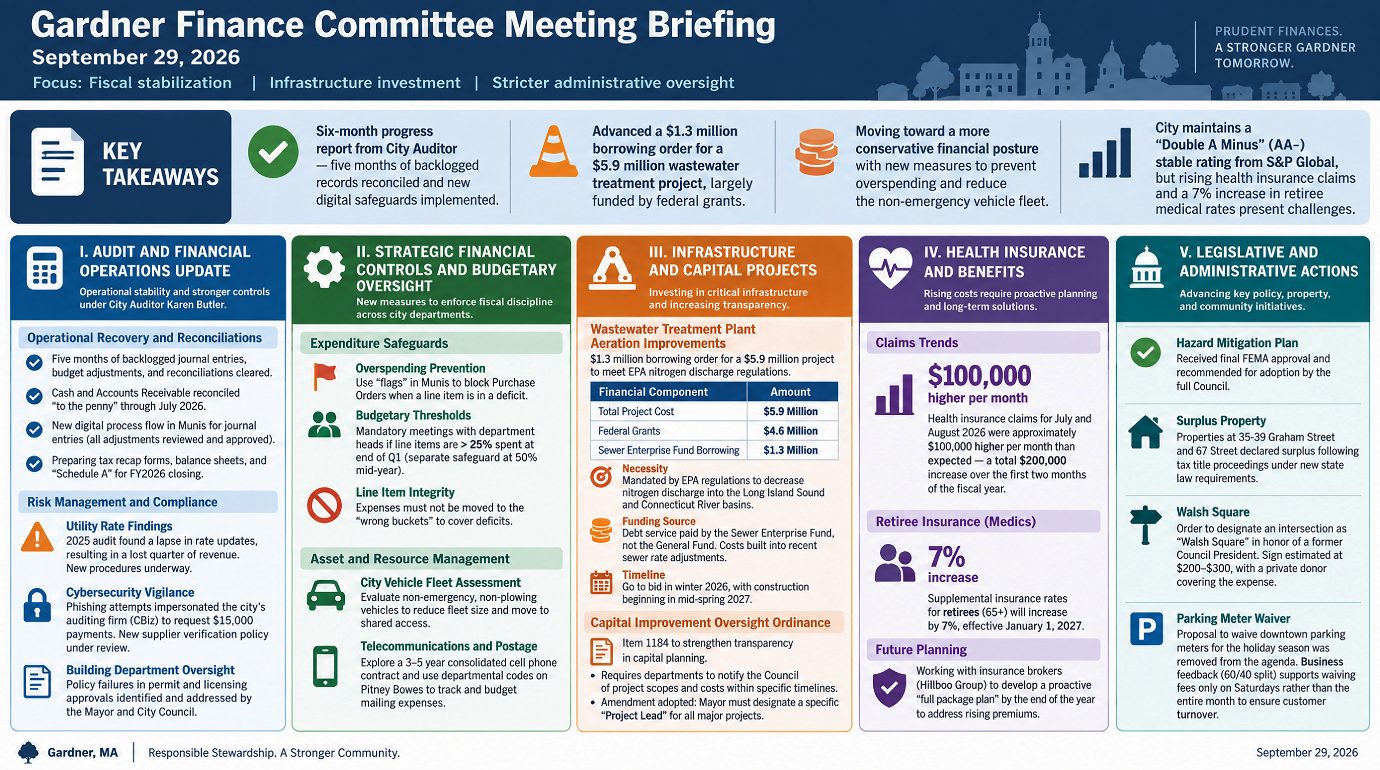
The Gardner Finance Committee meeting held on September 29, 2026, focused on fiscal stabilization, infrastructure investment, and the implementation of stricter administrative oversight. Key takeaways include a successful six-month progress report from the City Auditor, who has reconciled five months of backlogged records and implemented new digital safeguards. The committee also advanced a $1.3 million borrowing order for a $5.9 million wastewater treatment project—largely funded by federal grants—to comply with EPA nitrogen discharge regulations.
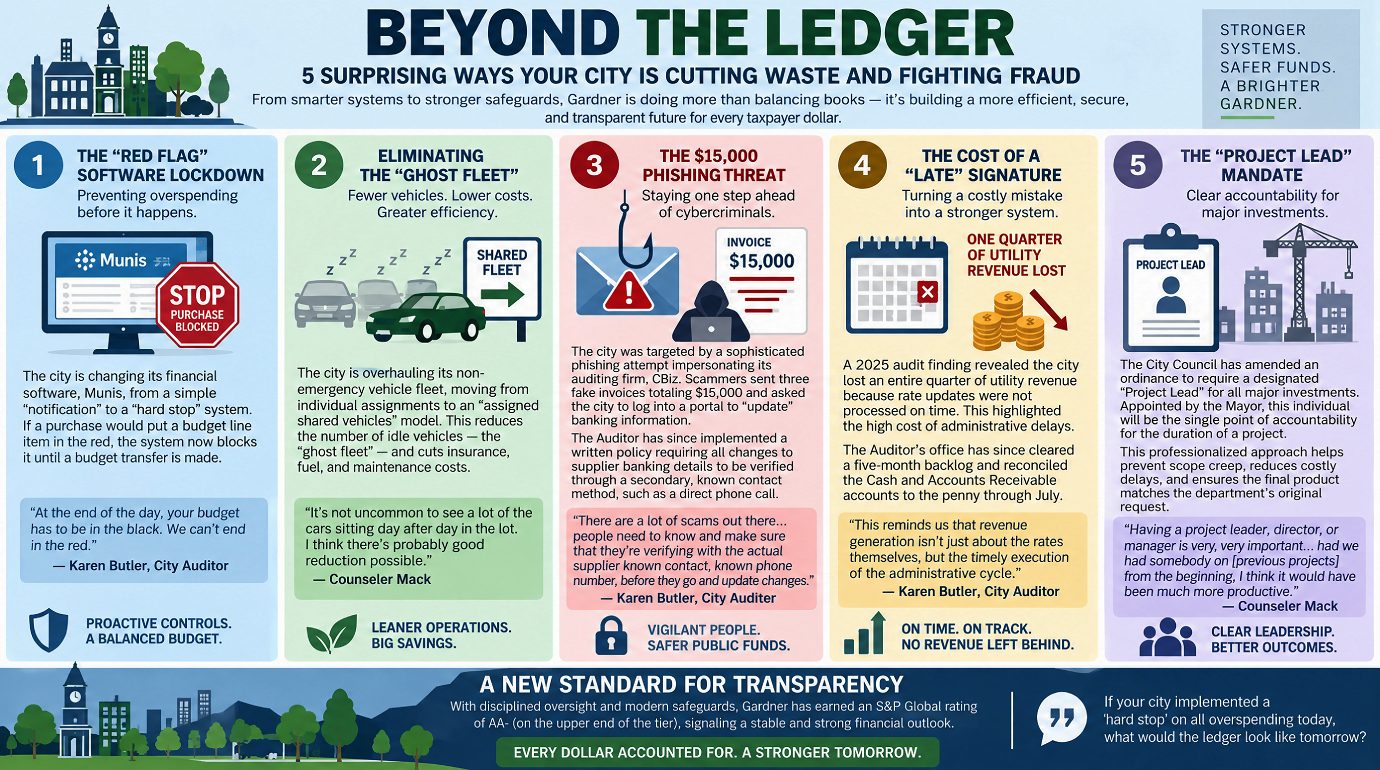
The administration is moving toward a more conservative financial posture, introducing measures to prevent departmental overspending and launching an assessment to reduce the city’s non-emergency vehicle fleet. While the city maintains a “Double A Minus” (AA-) stable rating from S&P Global, rising health insurance claims and a 7% increase in retiree medical rates present ongoing budgetary challenges.
Audit and Financial Operations Update: City Auditor Karen Butler provided a comprehensive six-month update following her appointment in March 2026. The department has transitioned from a period of vacancy and corrective action to a state of operational stability.
Operational Recovery and Reconciliations: Backlog Clearance: Upon hiring, the department was five months behind on journal entries, budget adjustments, and reconciliations. Balance Accuracy: Cash and Accounts Receivable (AR) have been reconciled “to the penny” through July 2026.Policy Improvements: A new digital process flow has been established in the Munis system for journal entries to ensure all adjustments are reviewed and approved for accuracy. FY2026 Closing: The department is currently preparing tax recap forms, balance sheets, and “Schedule A” to determine the tax rate and “free cash” levels.
Risk Management and Compliance: Utility Rate Findings: The 2025 audit identified a lapse in utility rate updates that resulted in a lost quarter of revenue. New procedures are being implemented to ensure timeliness. Cybersecurity Vigilance: The Auditor reported a series of “phishing” attempts where scammers impersonated the city’s auditing firm (CBiz) to request fraudulent payments of $15,000 via updated banking information. A new policy for verifying supplier remittance changes is under review. Building Department Oversight: Policy failures regarding proper approvals for permits and licensing were identified and addressed by the Mayor and City Council.
Strategic Financial Controls and Budgetary Oversight: The committee and administration discussed several new measures designed to enforce fiscal discipline across city departments.
Expenditure Safeguards: — Overspending Prevention: The Auditor and Mayor discussed utilizing “flags” within the Munis system to prevent users from processing Purchase Orders (POs) when a line item is in a deficit. Budgetary Thresholds: The Mayor has implemented a new policy requiring meetings with any department head whose line items are more than 25% spent at the end of Quarter 1. A separate safeguard exists for those exceeding 50% spending mid-year. Line Item Integrity: The administration emphasized that expenses must not be moved to “wrong buckets” to cover deficits, as this undermines budgeting and forecasting accuracy.
Asset and Resource Management: — City Vehicle Fleet Assessment: The administration is conducting a needs assessment of non-emergency, non-plowing vehicles. The goal is to reduce the fleet size and shift from per-person assignments to shared vehicle access to cut insurance, gas, and maintenance costs. Telecommunications and Postage: Counselor Mack suggested a 3-to-5-year consolidated contract for city cell phones to reduce costs. Additionally, the committee is exploring the use of departmental codes on the Pitney Bowes postage machine to track and budget mailing expenses more accurately.
Infrastructure and Capital Projects: Wastewater Treatment Plant Aeration Improvements. The committee reviewed a $1.3 million borrowing order to fund critical upgrades at the wastewater treatment facility. Total Project cost is $5.9 million. Federal Grants are $4.6 million. Balance of $1.3 million is Sewer Enterprise Fund Borrowing. Necessity: The project is mandated by EPA regulations requiring decreased nitrogen discharge into the Long Island Sound and Connecticut River basins. Funding Source: The debt service will be paid by the Sewer Enterprise Fund, not the General Fund. These costs were built into the most recent sewer rate adjustments. Timeline: The project is expected to go to bid in winter 2026, with construction beginning in mid-spring 2027.
Capital Improvement Oversight Ordinance: A new ordinance (Item 1184) was discussed to strengthen transparency in capital planning. Transparency: Requires departments to notify the Council of project scopes and costs within specific timelines. Amendment: The committee adopted an amendment requiring the Mayor to designate a specific “Project Lead” (individual employee or official) for all major projects to ensure accountability and timeline adherence.
Health Insurance and Benefits: The city is facing significant upward pressure regarding health insurance costs. Claims Trends: Health insurance claims for July and August 2026 were approximately $100,000 higher per month than the base expectations, totaling a $200,000 increase over the first two months of the fiscal year. Retiree Insurance (Medics): The rates for supplemental insurance for retirees (65+) will increase by 7% for the upcoming calendar year, effective January 1, 2027. Future Planning: The administration is working with insurance brokers (Hillboo Group) to develop a proactive “full package plan” by the end of the year to address rising premiums.
Legislative and Administrative Actions: — Hazard Mitigation Plan: Received final FEMA approval and was recommended for adoption by the full Council.Surplus Property: Properties at 35-39 Graham Street and 67 Street were declared surplus following tax title proceedings under new state law requirements. Walsh Square: An order to designate an intersection as “Walsh Square” in honor of a former Council President was recommended. The cost for the sign is estimated at $200–$300, and a private donor has offered to cover the expense. Parking Meter Waiver: A proposal to waive downtown parking meters for the holiday season was removed from the agenda. Feedback from local businesses (60/40 split) suggests a preference for waiving fees only on Saturdays rather than for the entire month to ensure customer turnover.