Gardner MA School Committee Meeting of September 14, 2026:
We cover facilities and infrastructure status, academic performance and strategic planning, governance and the city charter, administrative actions, and various updates.
View the infographics below for additional details.
Gardner School Committee Meets for First time this School Year
Listen to the entire meeting on any device, CLICK PLAY.
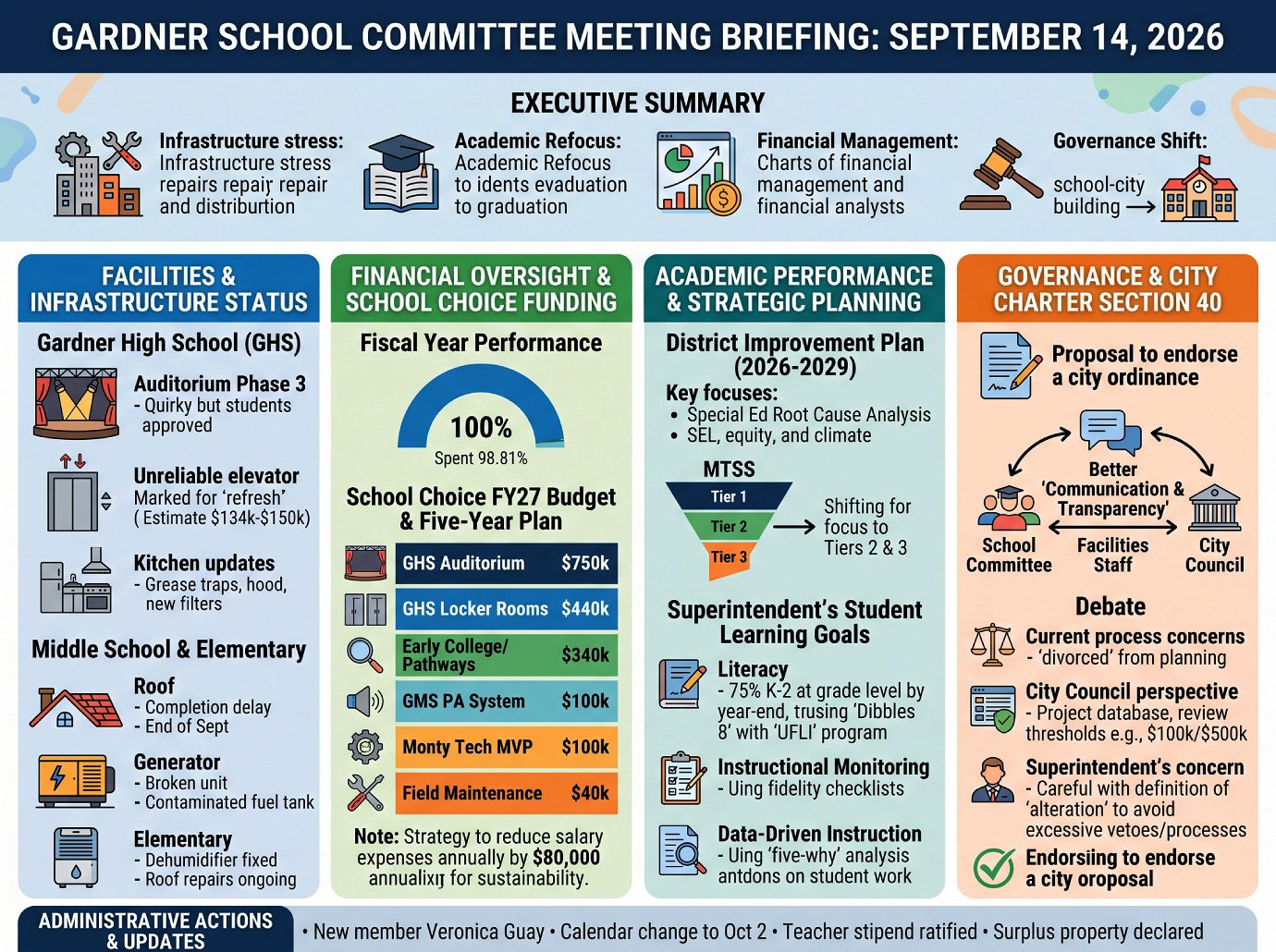
The Gardner School Committee meeting on September 14, 2026, focused on critical infrastructure updates, financial health, and the formal adoption of new academic and governance strategies. Key highlights include:
- Infrastructure Stress: Significant facility concerns were raised regarding the Gardner High School (GHS) elevator, the Middle School roof and generator, and the final phase of the GHS auditorium project.
- Academic Refocus: The district has accelerated its District Improvement Plan (now covering 2026–2029) to address special education performance gaps and align with new state Department of Elementary and Secondary Education (DESE) requirements.
- Financial Management: The district closed the previous fiscal year having spent 98.81% of its budget. A strategic five-year plan for School Choice funds is in place to cover capital projects and salary deficits.
- Governance Shift: The Committee voted to endorse a proposed city ordinance regarding Section 40 of the City Charter, seeking to establish a more transparent and communicative process for capital improvement projects between the school department and the city government.
Facilities and Infrastructure Status
Gardner High School (GHS)
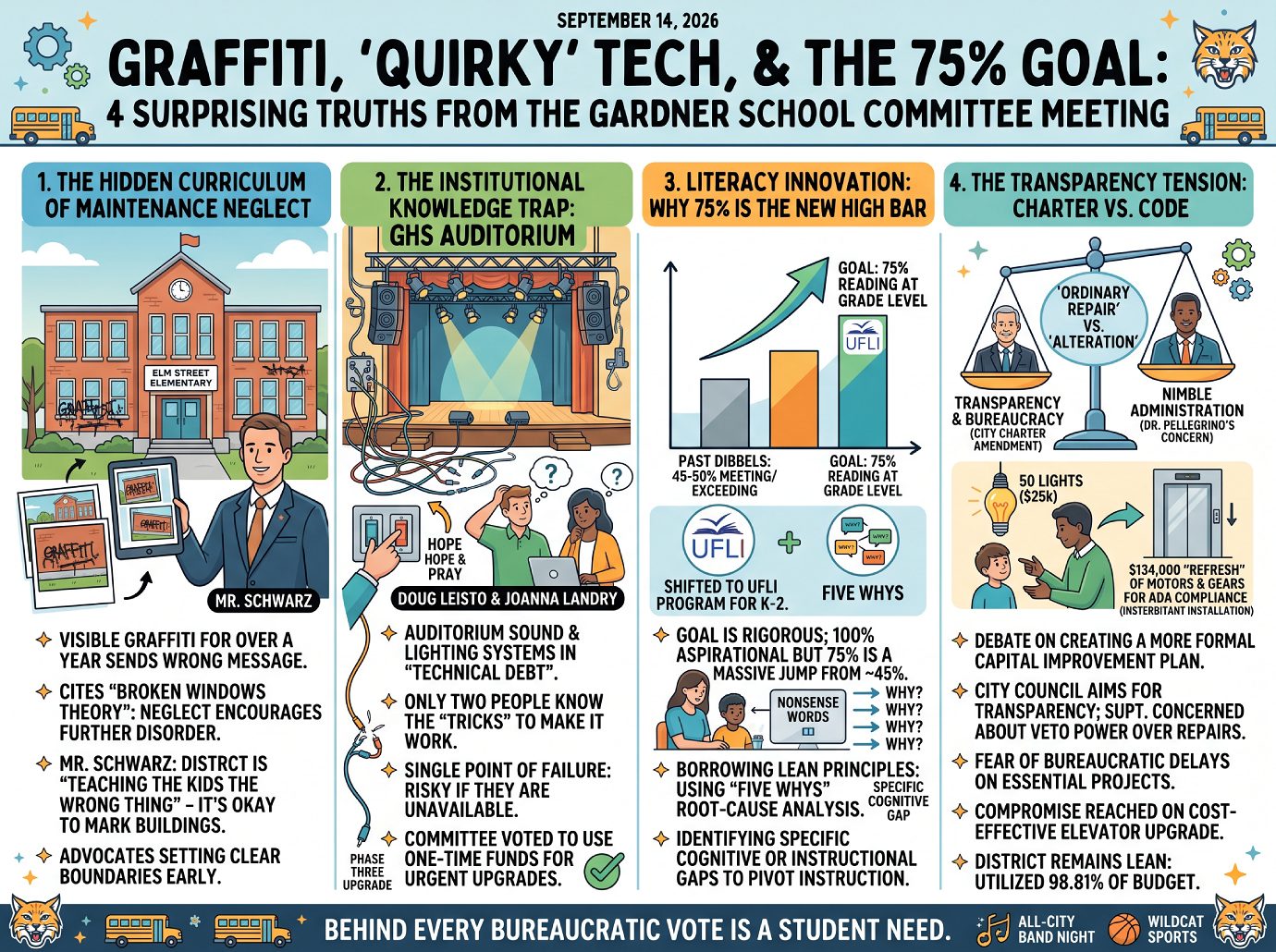
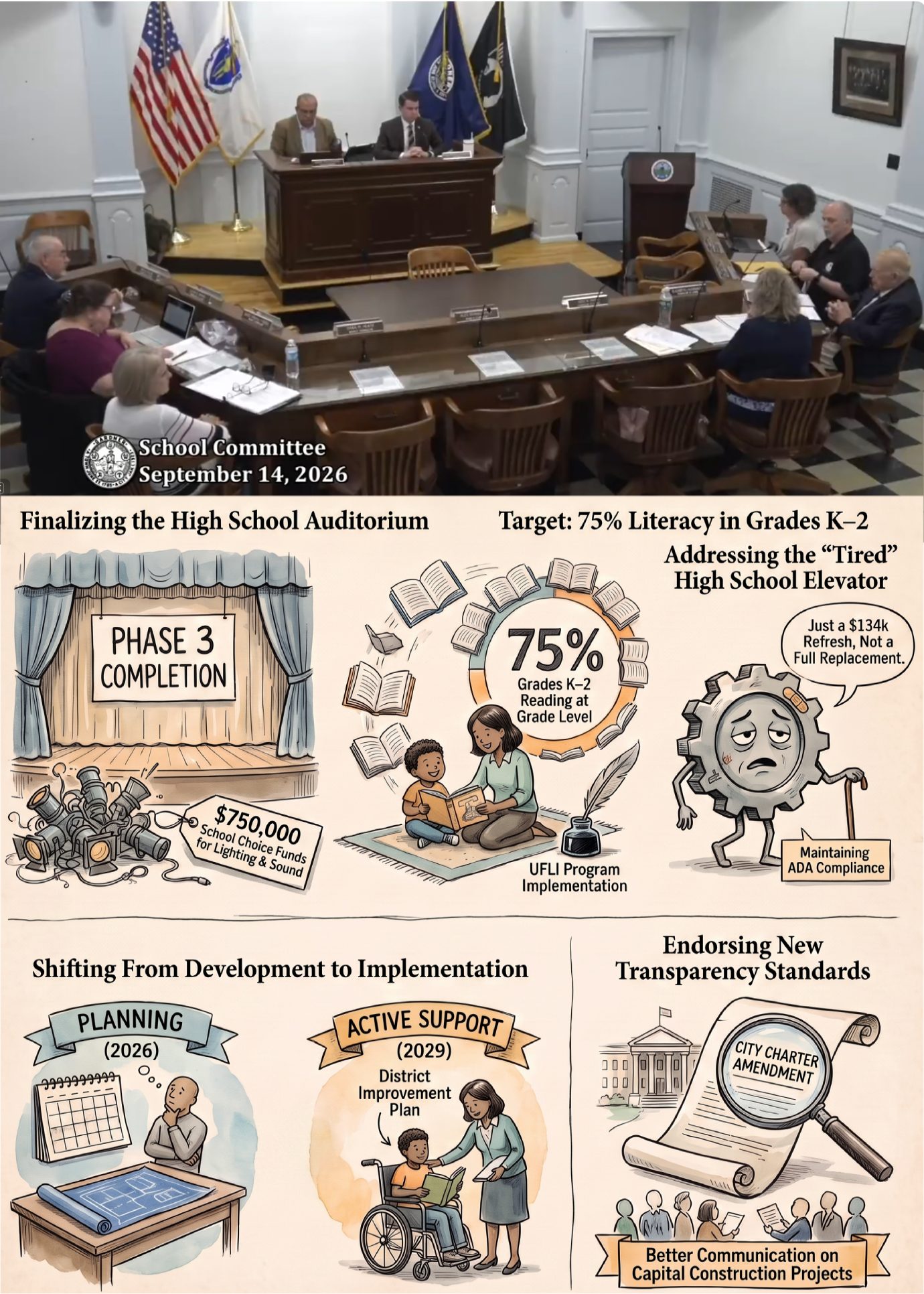
- Auditorium Project: The project is entering Phase 3, which involves stage lighting and the sound system. Currently, the system is described as unreliable, requiring specific personnel to navigate “quirky” connections. The Committee approved the use of one-time school choice funds to complete this phase.
- Elevator Failure: The elevator is “tired and old” and has been unreliable for over a year, causing accessibility issues. A “refresh” (replacing motors and gears) is estimated at $134,000–$150,000, which is significantly cheaper than a full replacement.
- Kitchen and General Maintenance: Two grease traps and the kitchen hood have been replaced. New water filter systems have been procured and will be installed during the school year.
Middle School and Elementary Schools
- Middle School Roof: Completion has been delayed due to a “broken” logistical train; the project is now expected to be finished by the end of September.
- Middle School Generator: The unit is currently inoperative because the underground fuel tank is contaminated. Repairs are scheduled for the current school year.
- Dehumidification (Elementary): One of the three “A/N” units (dehumidifiers) failed and has been fixed. Roof repairs at the elementary level are ongoing.
Financial Oversight and School Choice Funding
The Finance Subcommittee reported a stable financial position with a focus on offsetting upcoming deficits and funding capital projects through the School Choice revolving account. The district successfully utilized 98.81% of its budget, with the remaining 1.19% redirected to offset school choice expenditures. All revolving accounts are reported as “healthy.” The district anticipates $650,000 in revenue for FY27 but faces $800,000 in budgeted salary expenses. The Committee outlined specific allocations for the School Choice funds:
| Allocation Category | Estimated Cost |
|---|---|
| GHS Auditorium Project | $750,000 |
| GHS Locker Room Project (Shortfall) | $440,000 |
| Early College/Pathways (MWCC) | $340,000 |
| GMS PA System | $100,000 |
| Monty Tech MVP Program | $100,000 |
| Field Maintenance | $40,000 |
The district’s five-year plan includes a strategy to reduce salary expenses by $80,000 annually to reach a more sustainable balance. Additionally, the district will seek grant funding from the William Rockwell Fund to potentially lower the burden on School Choice funds for the auditorium project.
Academic Performance and Strategic Planning
Dr. Goyen and Dr. Pellegrino presented updates on district-wide goals, emphasizing a shift from planning to active implementation. District Improvement Plan (2026–2029) The plan was updated a year early due to a special education determination requiring a “root cause analysis” of underperformance in MCAS scores for students with disabilities.
- Key Focus Areas: Academic improvements, social-emotional learning (SEL), closing equity gaps for vulnerable populations, and improving school climate/communication.
- Strategic Shifts: The district is moving from developing Tier 1 (universal) instruction to implementing Tiers 2 and 3 of the Multi-Tiered System of Supports (MTSS).
- Literacy: A rigorous goal has been set for 75% of K–2 students to read at grade level by year-end, as measured by “Dibbles 8.” The district recently switched its reading program to “UFLI” (University of Florida), which has already shown score increases.
- Instructional Monitoring: The administration will use fidelity checklists to ensure that teachers are implementing specific accommodations for students with disabilities as designed during common planning times.
- Data-Driven Instruction: Teachers will perform “five-why” root cause analyses on student work to identify why specific learners are struggling and pivot instruction accordingly.
Governance and City Charter Section 40
A significant portion of the meeting involved a debate over a proposed amendment to the City Charter Section 40 process, which governs the construction and alteration of school buildings. Vice Chair Rachel Cormier moved to endorse a city council ordinance aimed at improving communication regarding capital projects. The intent is to ensure the School Committee and City Council are informed of project scopes and costs before funds are committed.
- Current Process Concerns: Critics argued the current process “divorces” the School Committee from capital planning, with decisions often made by facilities staff and the city before the Committee is notified.
- City Council Perspective: The City Council President noted that the city has struggled to manage large projects. The proposed ordinance would create a database of projects and establish thresholds (e.g., $100,000 or $500,000) that trigger higher levels of review and committee oversight.
- Superintendent’s Reservation: Dr. Pellegrino expressed concern that if the definition of “alteration” becomes too broad, minor but necessary repairs might be subject to mayoral vetoes or lengthy city council processes, potentially hindering district operations.
- Outcome: The Committee voted to endorse the proposal to the City Council, with the understanding that language refinements would occur during the Council’s legislative process.
Administrative Actions and Updates
- Committee Appointments: Veronica Guay was welcomed as a new member. Rachel Cormier was elected as the alternate for the Finance Subcommittee. Robert Schwarz was elected as the MASC delegate.
- Calendar Change: The half-day Professional Development (PD) day was moved from September 25 to October 2, 2026, to accommodate a specific instructional coach.
- Stipend Agreement: The Committee ratified a stipend of $55 per day (for 180 days) for two English Language Learner (ELL) teachers who are teaching extra sections across the middle and high schools.
- Surplus Property: Various pieces of equipment no longer needed by the district were declared surplus for disposal by the city purchasing agent.