
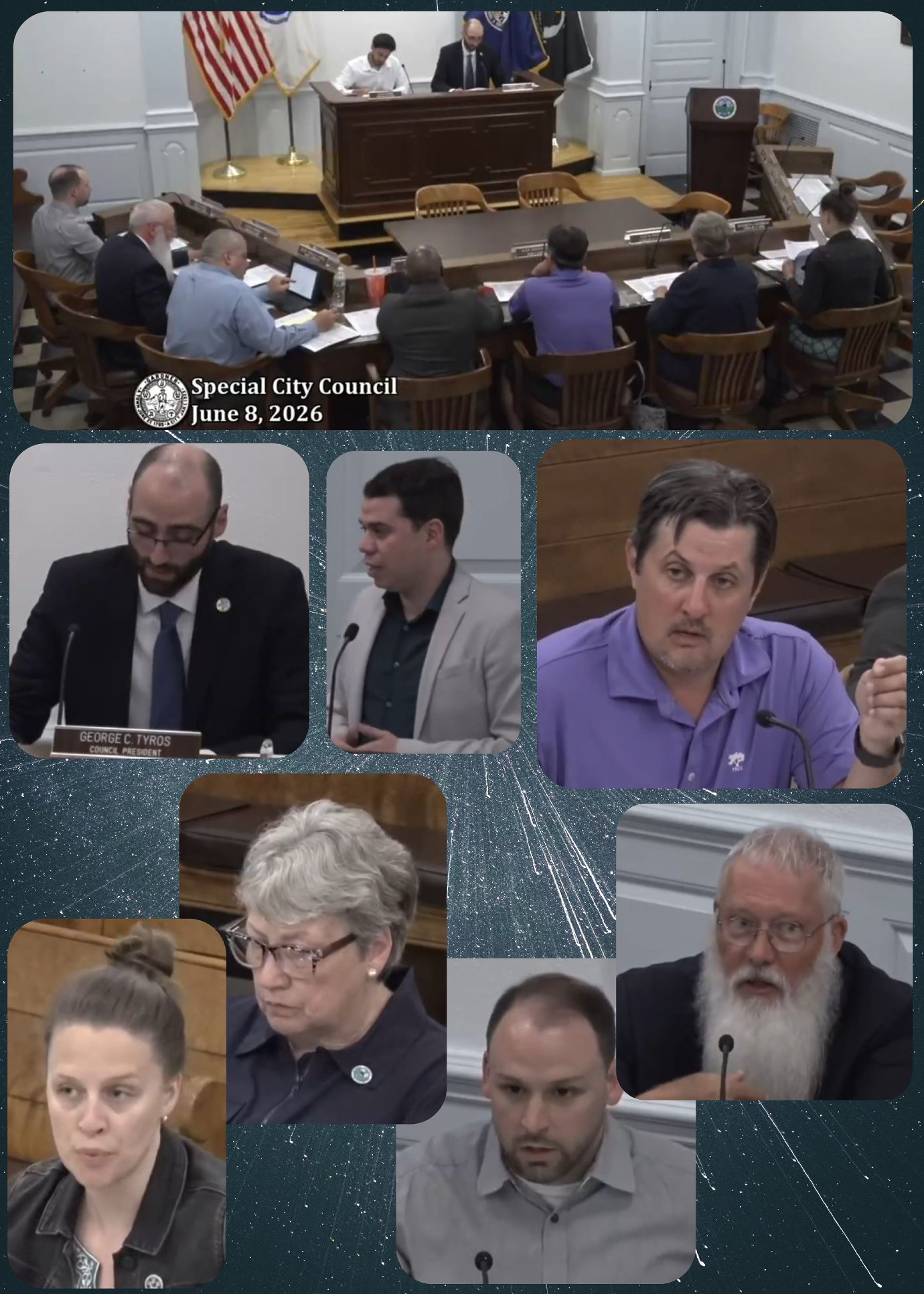
Gardner City Council Meets Regarding Budget in Special Meeting
The Gardner MA City Council met on June 8, 2026 to consider the FY27 Budget. Listen to the meeting on any device, CLICK PLAY.
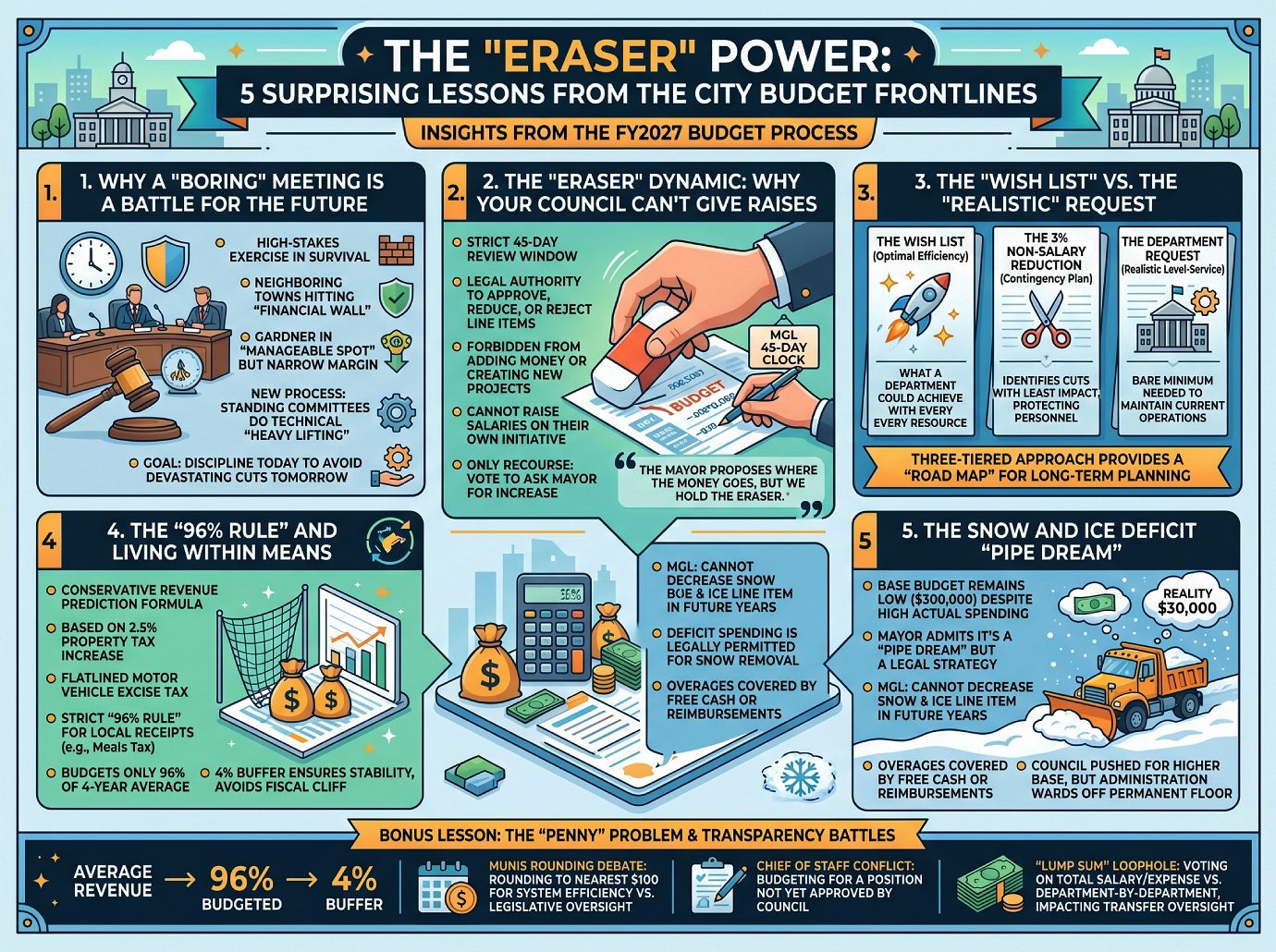
Gardner Magazine has prepared 2 additional infographics to illustrate the topics under consideration. Find them below. CLICK IMAGE for a larger view.
The primary takeaway is that while Gardner is currently in a “manageable” fiscal position, it faces significant regional pressure as neighboring municipalities hit “financial walls” characterized by multi-million dollar shortfalls and failed overrides. The proposed FY2027 budget is balanced based on conservative revenue projections, including a 2.5% property tax increase and a “96% rule” for local receipts to ensure a budgetary buffer.
Key points of discussion included the consolidation of professional development and travel funds into the Mayor’s unclassified account to improve tracking, the discovery of transposition errors in the original budget orders, and a debate over the chronic under-funding of the “snow and ice” account. The City Council remains under strict Massachusetts legal mandates, possessing the power to reduce or reject line items but lacking the authority to increase funding or salaries independently.
Council President George Tyros opened the meeting by clarifying the specific legal constraints placed on the City Council under Massachusetts law during the budget review process:
- Review Timeline: The Council has 45 days to review the Mayor’s proposal and must pass a final budget by June 30.
- The “Eraser” Power: The Council holds the legal authority to approve figures, reduce them, or reject line items entirely to protect tax dollars.
- Prohibitions: The Council cannot add money to the budget, create new projects, or raise salaries independently. If the Council believes a department requires more funding, it must formally vote to ask the Mayor to send down an increase.
- Committees of Oversight: Prior to the special meeting, standing committees (Public Safety, Public Service, and Finance) held preliminary hearings to drill down into specific department numbers.
Gardner Mayor Michael Nicholson characterized the city’s financial status as “manageable” but warned against overconfidence. The administration’s goal is to avoid the “devastating cuts” being seen elsewhere in Central Massachusetts. Revenue Calculation Methodology – To maintain a “healthy zone” and live within means, the city utilizes the following projections:
- Property Taxes: A 2.5% increase in both real and personal property taxes.
- Motor Vehicle Excise: Projected as flat or with a minimal increase due to current economic conditions.
- Local Receipts: Calculated at 96% of the average of the previous four fiscal years. For example, while meals tax brought in approximately $525,000 last year, the budget uses a lower estimate (closer to high $400,000s) to create a buffer.
The Gardner City Council discussed the disparity between the $300,000 budgeted for “snow and ice” and the actual costs, which have exceeded $1 million in recent years.
- Legal Constraint: Under Massachusetts law, if a municipality increases the snow and ice budget line, it cannot be decreased in subsequent years.
- Current Strategy: The city utilizes “deficit spending” for snow and ice, which is permitted by general law, often covering the gap with free cash or supplemental reimbursements from the state.

Update: June 11, 2026 to Include Gardner Finance Committee Meeting of 6-9-26. That meeting occurred before the City Council meeting. Listen to the Meeting on any device. CLICK PLAY.
Local officials evaluated several long-term municipal strategies, including the Hazard Mitigation and Housing Production Plans, and the, surplus property study.
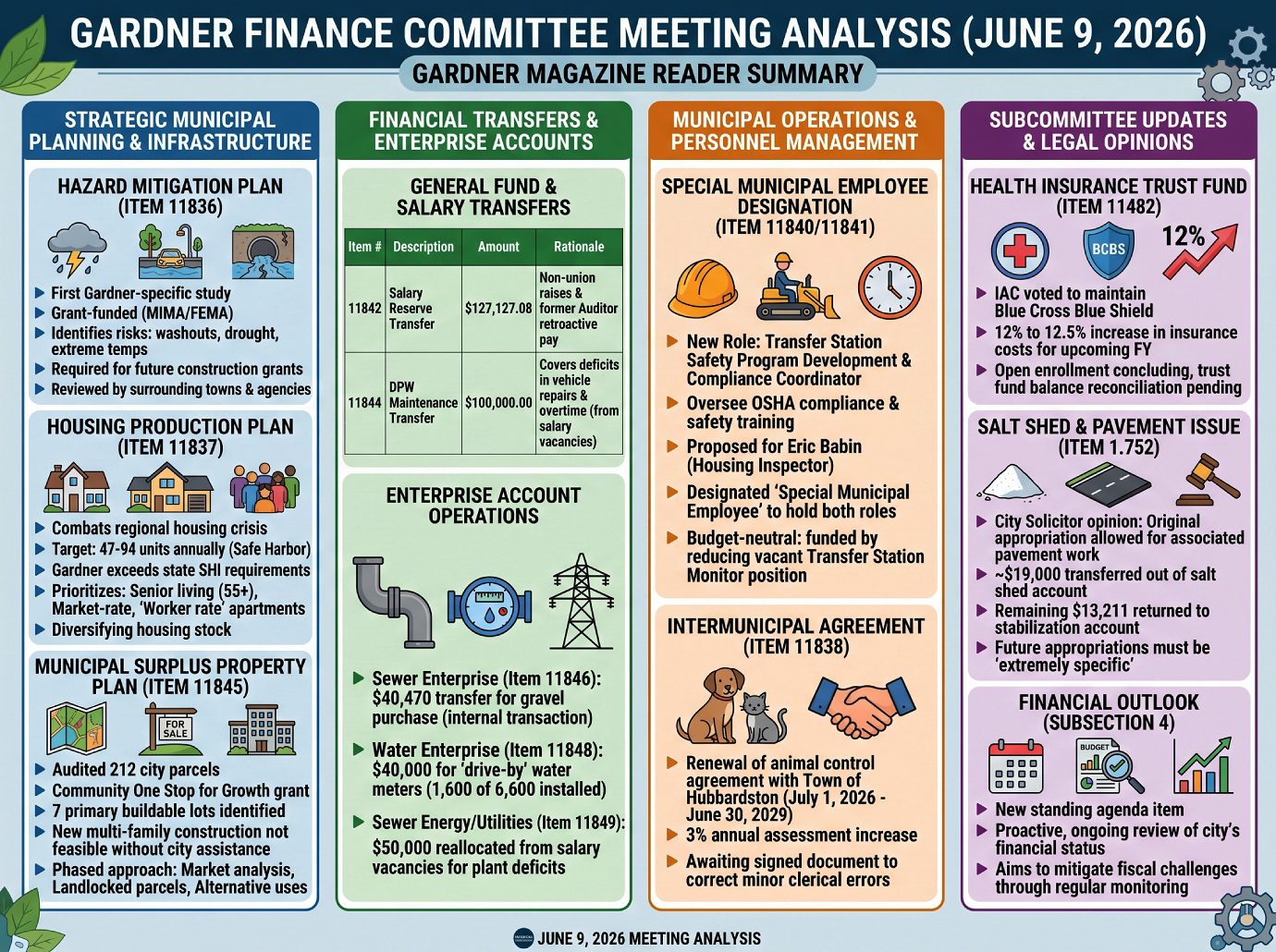
These initiatives, largely supported by state and federal grants, aim to strengthen the city’s infrastructure against natural disasters and address the regional housing crisis by identifying buildable city-owned lots – 7 were specifically identified. The committee also deliberated on intermunicipal agreements for animal control and the creation of a specialized safety coordinator role at the transfer station. Significant discussion focused on budgetary management, specifically regarding the transfer of funds to cover departmental deficits, vehicle maintenance, and the modernization of water meter systems. Furthermore, the members addressed salary adjustments for non-union employees and debated the appropriate compensation for a golf administrative assistant position.