Top U.S. National News – Week of June 7, 2026
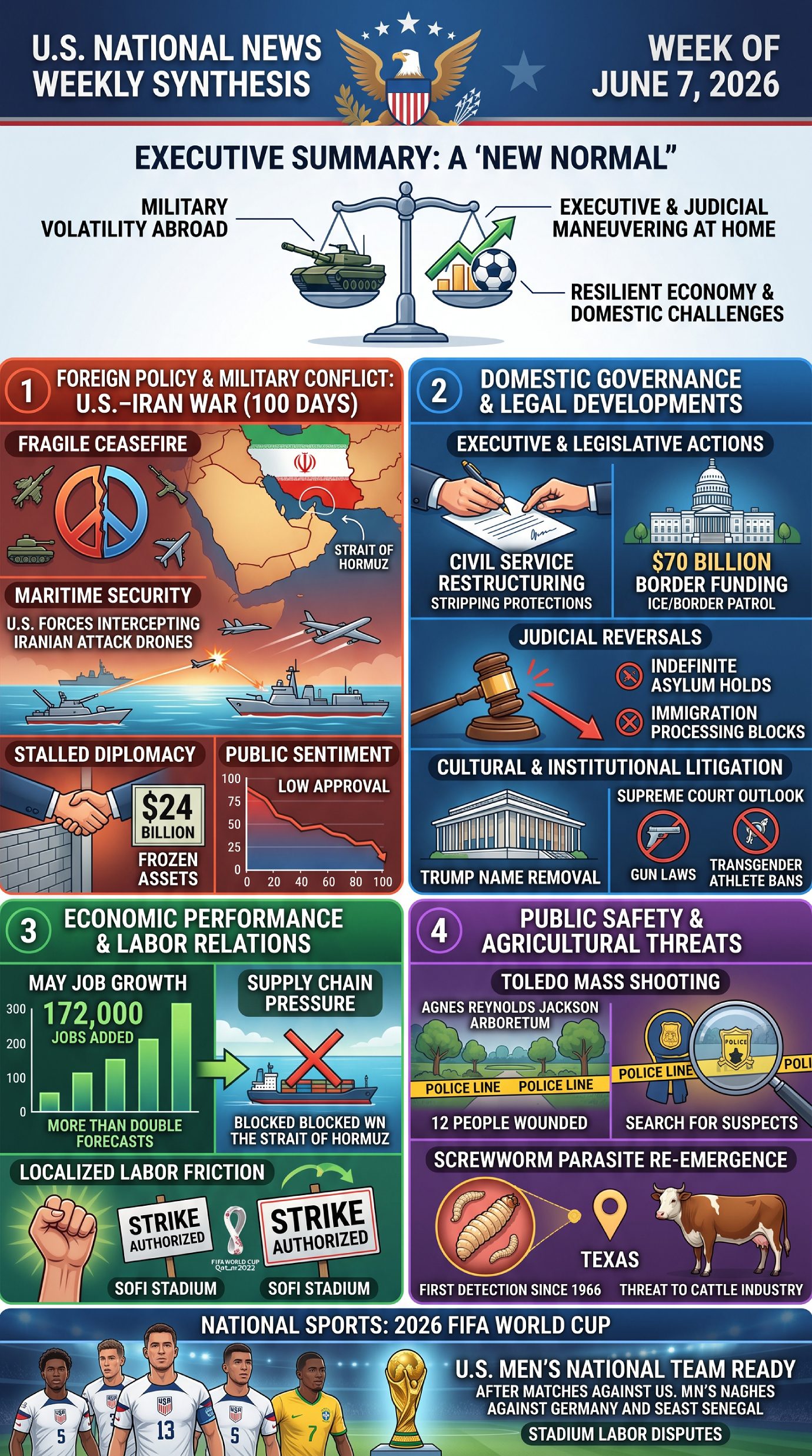
The week of June 7, 2026, is characterized by a “new normal” of military volatility abroad and aggressive executive and judicial maneuvering at home. The conflict between the United States and Iran has reached its 100th day, with a fragile ceasefire strained by direct military exchanges and stalled diplomatic negotiations.
Domestically, the Trump administration has launched a significant effort to restructure the federal workforce via executive order while facing various legal setbacks regarding immigration and institutional branding.
Economic indicators remain unexpectedly resilient despite the conflict, with May job growth doubling forecasts.
However, domestic stability is challenged by a mass shooting in Ohio and the re-emergence of the New World Screwworm parasite in the agricultural sector.
As the nation prepares for the 2026 FIFA World Cup, labor friction at key venues and pending Supreme Court rulings on cultural issues further complicate the national landscape.
Foreign Policy and Military Conflict: The U.S.–Iran War
The military engagement with Iran has reached a critical 100-day milestone, transitioning into a persistent state of naval blockades and tactical exchanges.
- Status of the Ceasefire: Although a fragile ceasefire is technically in place, it is under extreme duress. Both nations have engaged in direct strikes, with the U.S. military recently targeting Iranian radar and coastal surveillance sites.
- Maritime Security: U.S. Central Command confirmed the interception of multiple Iranian attack drones over the weekend. These drones posed a direct threat to maritime traffic in the Strait of Hormuz, a vital economic artery that remains currently restricted.
- Stalled Diplomacy: Peace negotiations, mediated through Pakistan, are deadlocked. The primary point of contention is $24 billion in frozen Iranian assets. President Trump has maintained a firm stance, stating he will neither unfreeze assets nor lift sanctions until a formal, comprehensive peace deal is finalized.
- Public Sentiment: Despite the military’s adaptation to this “new normal,” domestic polling indicates the conflict is highly unpopular among the American public.
Domestic Governance and Legal Developments
The administration is currently engaged in a multifaceted effort to reshape federal authority, meeting resistance in both the legislature and the courts.
Executive and Legislative Actions
- Civil Service Restructuring: President Trump signed an executive order stripping job protections from thousands of federal employees. The stated goal is to allow a newly appointed intelligence director to “clean house” by terminating a significant number of civil servants. Labor groups have condemned the move as an attack on independent civil service safeguards.
- Border and Immigration Funding: The Senate passed a $70 billion funding bill for ICE and border patrol. However, a legislative battle persists over the President’s proposed “anti-weaponization” fund, which faces significant opposition from lawmakers.
- Judicial Reversals: A federal judge struck down several administration policies, including the practice of indefinite holds on asylum applications and the blocking of immigration processing for individuals from 39 specific countries.
Cultural and Institutional Litigation
- The Kennedy Center: A federal judge ordered the removal of President Trump’s name from the Kennedy Center. While the administration is complying with the name removal for now, it continues to fight for permission to proceed with planned ballroom construction on the property.
- Supreme Court Outlook: The Court is preparing to release major end-of-term rulings on high-profile issues, including new gun laws and Republican-led bans on transgender athletes participating in female sports.
Economic Performance and Labor Relations
Despite the pressures of a 100-day war and supply chain disruptions, the U.S. labor market has shown surprising strength.
| Metric | Outcome |
|---|---|
| May Job Growth | 172,000 jobs added |
| Forecast Variance | More than double the early consensus forecasts |
| Primary Economic Headwind | Supply chain pressure due to the closed Strait of Hormuz |
While the macro-economy shows growth, localized labor friction is emerging. Venue workers at SoFi Stadium in California have voted to authorize a strike, threatening to disrupt operations just as the 2026 FIFA World Cup begins.
Public Safety and Agricultural Threats
Toledo Mass Shooting
A mass shooting occurred during the Agnes Reynolds Jackson Arboretum festival (part of the Old West End street festival) in Toledo, Ohio.
- Casualties: At least 12 people were wounded.
- Investigation: Federal and local law enforcement are searching for at least two suspects who fled the scene.
Re-emergence of the Screwworm Parasite
Agricultural officials have confirmed the presence of the New World Screwworm in a Texas calf.
- Historical Significance: This is the first detection of the flesh-eating parasitic larvae in U.S. livestock since the species was eradicated in 1966.
- Causal Factors: Scientists suggest that recent reallocations of funding away from monitoring programs likely contributed to the parasite’s return, posing a significant threat to the cattle industry.
National Sports: 2026 FIFA World Cup
As North America prepares to host the World Cup this month, the U.S. Men’s National Soccer Team has completed its final preparations. Following exhibition matches against Germany and Senegal, the team is reported to be in a state of “strong readiness” for tournament play, even as stadium labor disputes loom over the event’s infrastructure. —
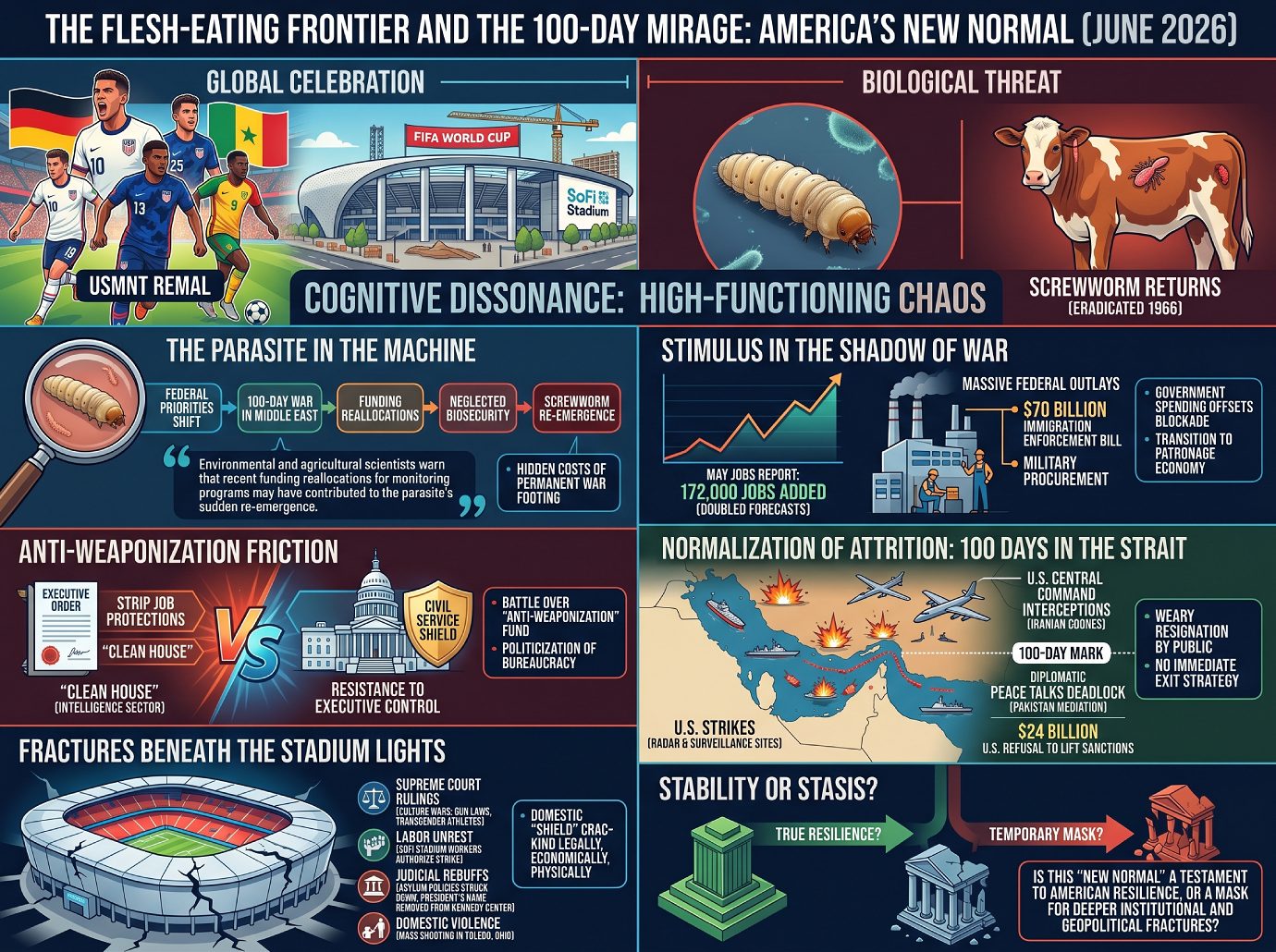
The Flesh-Eating Frontier and the 100-Day Mirage: America’s New Normal
The United States enters the second week of June 2026 caught in a state of high-functioning chaos. On one hand, the nation is vibrating with the energy of the upcoming FIFA World Cup, with the Men’s National Team showing resilience in high-intensity tune-ups against Germany and Senegal. On the other, we are grappling with the grim 100-day milestone of a war with Iran and the horrific return of a flesh-eating parasite thought long-vanished.
This collision of global celebration and biological threat creates a profound sense of cognitive dissonance. Even as the Strait of Hormuz remains a flashpoint of naval blockades, the domestic economy has produced a hiring surge that defies every conventional model of wartime contraction. We are watching a nation prepare for a party while its defensive perimeters—both military and biological—are being tested.
What do these clashing headlines reveal about the current American landscape? We appear to be settling into a period where institutional instability and geopolitical violence coexist alongside a strange, state-sponsored economic resilience. It forces us to ask whether our current “stability” is a genuine achievement or a temporary mask for deeper fractures.
The Parasite in the Machine
In a development that has blindsided agricultural officials, the New World Screwworm has been detected in a Texas calf. This marks the first time these flesh-eating parasitic fly larvae have appeared in U.S. livestock since the pest was officially eradicated in 1966. Its return is a jarring reminder that the victories of the past require constant, expensive vigilance to maintain.
The re-emergence of this parasite is a direct symptom of shifting federal priorities. As the nation’s attention and capital have been consumed by the 100-day conflict in the Middle East, the quiet, essential work of biosecurity has clearly suffered from neglect.
“Environmental and agricultural scientists warn that recent funding reallocations for monitoring programs may have contributed to the parasite’s sudden re-emergence.”
This biological setback highlights the hidden costs of a nation on a permanent war footing. When resources are siphoned away from domestic defensive perimeters to fund foreign engagements, the “eradicated” threats of the 20th century can quickly become the front-page crises of the 21st.
Stimulus in the Shadow of War
The May Jobs Report presents a startling economic paradox that challenges traditional trend analysis. Despite the closure of the Strait of Hormuz and the resulting pressure on global supply chains, the U.S. economy added 172,000 jobs—more than doubling early consensus forecasts. This is the “new normal” in action: an economy that appears to be decoupling from international turmoil.
This surge in hiring isn’t happening in a vacuum; it is being buoyed by massive federal outlays. The Senate’s recent passage of a $70 billion immigration enforcement bill, combined with intensive military procurement for the ongoing conflict, is acting as a hidden stimulus package. The labor market is staying afloat not because the world is stable, but because the government is spending at a rate that offsets the maritime blockade.
This creates a puzzling reality for the American worker. While geopolitical instability usually triggers a cooling of the labor market, the current administration’s pivot toward high-expenditure border and military policies is artificially sustaining growth. We are witnessing a transition into a patronage economy where federal spending shields the domestic market from the consequences of global conflict.
The Anti-Weaponization Friction
While the economy booms, the structural integrity of the federal government is facing a radical overhaul through a new executive order. President Trump has moved to strip job protections from thousands of federal employees, specifically targeting the intelligence sector to “clean house.” This move seeks to dismantle the civil service “shield” that has historically protected non-partisan experts from political whims.
However, the President’s attempt to consolidate executive power is meeting fierce resistance in the halls of the Senate. Lawmakers are currently battling the White House over the creation of a controversial “anti-weaponization” fund, which critics see as a mechanism for political patronage. This legislative pushback illustrates the growing friction between a President intent on total administrative control and a Senate wary of losing its oversight role.
The long-term implications of this struggle are profound. If the civil service is successfully politicized, the independent safeguards that ensure the continuity of government during crises could vanish. This internal battle over the “anti-weaponization” fund is not just a budget dispute; it is a fight over the fundamental nature of the American bureaucracy.
The Normalization of Attrition: 100 Days in the Strait
The conflict with Iran has now hit its 100-day mark, transitioning from a sudden crisis into a sustained military routine. U.S. Central Command recently confirmed the interception of multiple Iranian attack drones, while U.S. forces launched strikes against radar and coastal surveillance sites. This “new normal” of regular exchanges of fire suggests a conflict that has no immediate exit strategy.
On the diplomatic front, the situation is equally stagnant. Peace talks mediated by Pakistan have reached a total deadlock over $24 billion in frozen Iranian assets, with the U.S. refusing to lift sanctions without a formal peace deal. Despite the high-stakes military action, the primary lever of power remains the financial blockade, which continues to squeeze Tehran even as it stresses global markets.
Domestic polling indicates that this “unpopular war” is being met with a sense of weary resignation by the American public. The military has adapted to the attrition, but the lack of a clear diplomatic breakthrough suggests that the Strait of Hormuz will remain a volatile combat zone for the foreseeable future.
Fractures Beneath the Stadium Lights
As the nation prepares for the global spotlight of the World Cup, internal legal and social frictions are reaching a boiling point. The Supreme Court is poised to deliver major rulings on high-stakes culture war issues, including gun laws and bans on transgender athletes. This judicial tension is mirrored by labor unrest, as venue workers at SoFi Stadium have authorized a strike just as the opening matches are set to begin.
This “battle of the branches” is further complicated by recent judicial rebuffs to the executive branch. A federal judge recently struck down the administration’s asylum policies and ordered the President’s name removed from the Kennedy Center, creating a stark counter-weight to the White House’s executive orders. These rulings signal that the judiciary remains a potent site of resistance to the centralization of power.
The reality of domestic instability was driven home this weekend by a mass shooting at the Agnes Reynolds Jackson Arboretum festival in Toledo, Ohio. With at least 12 people wounded and shooters still at large, the tragedy serves as a sobering reminder of the internal violence that continues to plague the national consciousness. While the eyes of the world turn toward our soccer stadiums, the domestic “shield” is cracking legally, economically, and physically.
Stability or Stasis?
The week’s news presents a portrait of a nation in a state of high-functioning chaos. We see military and biological threats resurfacing from the past, yet they are met with surprising job growth and a sports culture preparing for a global milestone. It is a moment defined by the tension between institutional decay and individual resilience.
The dismantling of civil service protections and the ongoing deadlock in the Middle East suggest we are in the midst of a deep, perhaps permanent, institutional transition. Whether the current economic strength is a true foundation for the future or merely a temporary buffer provided by war spending remains the critical question.
Is this “new normal” a testament to American resilience, or is it a mask for deeper institutional and geopolitical fractures that are becoming harder to ignore?