
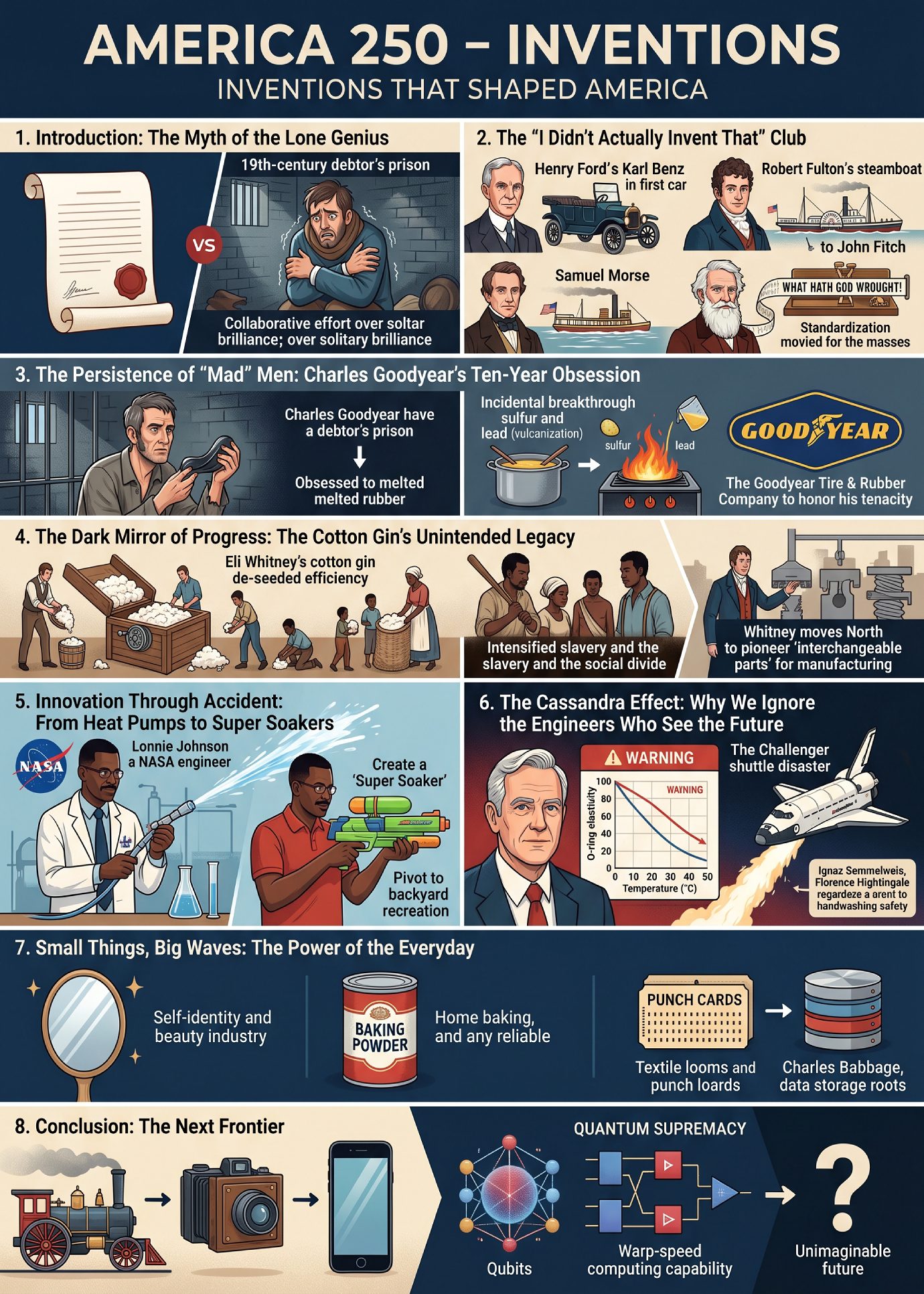
Listen to this DEEP DIVE on how American Inventions built Modern Life. CLICK PLAY.
What inventions impacted the United States the most? What were the most important? Listen to this debate on any device, CLICK PLAY.
America 250 -1776 to 2026 – A Special Report on the History of Inventions That Shaped America
Not only is the United States of America a unique experiment in governance, it has also been a place of life-changing inventions since its beginnings. Our page goes into great detail.
Gardner Magazine has a page with 6 reports on Inventions in America, CLICK FOR PAGE. You can also jump to a section on that page: The Architecture of American Ingenuity: A Comprehensive Analysis of Transformative Inventions — 10 Patents That Rebuilt the World: The Surprising Stories Behind America’s Greatest Inventions — Beyond the Patent: 7 Mind-Bending Truths About the Inventions That Shaped America — Demystifying the World: The Science Behind History’s Greatest Inventions — The Ancestry of Innovation: How Yesterday’s Tools Built Today’s Tech — The Architecture of Progress: Foundational Technologies and the Transformation of the American Economy
Watch this very sharp and excellent video on American Inventions:
Foundations of American Innovation (1700s–1830s)
The earliest era of American invention was dominated by polymaths like Benjamin Franklin and Thomas Jefferson, who applied scientific principles to solve practical problems of daily life and governance.
- Lightning Rod (1752): Benjamin Franklin’s experiments with electricity led to this application, which protected structures by conducting lightning bolts safely into the ground.
- Swim Fins (1717): Originally wooden palettes for the hands, Franklin’s design aimed to increase swimming speed.
- Bifocals (1784): Franklin is credited with creating lenses that allowed for both near and distance vision.
- The Swivel Chair (1776): Thomas Jefferson modified a Windsor chair with a central iron spindle, reportedly using it while drafting the Declaration of Independence.
- Improved Moldboard Plow: Jefferson designed an iron-faced plow in the late 1700s to improve agricultural efficiency.
- The Cotton Gin (1793/1794): Eli Whitney’s machine automated the separation of cotton fibers from seeds. While it revolutionized the Southern economy, it is also noted for making the slavery system more sustainable.
- Interchangeable Parts (1797): Whitney championed the use of standardized parts in musket manufacturing, laying the groundwork for modern mass production.
- The Steamboat (1807): Robert Fulton’s Clermont proved that steam power could be commercially viable for two-way river travel, traveling 150 miles upstream at 5 mph.
- The Revolver (1836): Samuel Colt’s design for a rotating cylinder allowed for multiple shots without reloading, a technology inspired by the mechanics of a ship’s wheel.
The Industrial and Electronic Expansion (1840s–1890s)
As the nation expanded, inventions moved toward stabilizing materials, improving health, and conquering distance through electricity.
- Vulcanized Rubber (1839/1843): After years of poverty and failed experiments, Charles Goodyear discovered that heating rubber with sulfur made it stable across temperature extremes, enabling the creation of tires and waterproof goods.
- The Passenger Elevator (1857): Elisha Graves Otis demonstrated a safety braking system that prevented elevators from falling if cables snapped, which directly enabled the rise of the skyscraper.
- Steelmaking Industry (1850s): The adoption of the Bessemer process scaled up steel smelting, stabilizing costs and allowing for the construction of massive bridges and rail networks.
- Oil Drilling (1859): “Colonel” Edwin Drake struck oil in Pennsylvania, initiating the petroleum revolution to meet the demand for kerosene.
- The Telegraph (1837/1844): Samuel Morse and Alfred Vail developed the telegraph and Morse Code, allowing for near-instantaneous communication over long distances. The first message, “What hath God wrought!”, was sent from the Supreme Court.
- The Telephone (1876): Alexander Graham Bell’s invention allowed for the transmission of the human voice over wires, a leap that Bell Labs later used to foster established scientific facilities.
- The Incandescent Light Bulb (1879): Thomas Edison perfected a commercially viable bulb, transforming the night into a period of productivity and safety. Edison eventually held over 1,000 patents, including the phonograph and the universal stock printer.
The Century of Acceleration (1900–1949)
The first half of the 20th century was defined by rapid urbanization and the technological demands of two world wars.
- The Airplane (1903): Orville and Wilbur Wright achieved the first sustained, controlled, powered flight at Kitty Hawk, NC. Their 12-horsepower engine changed global connectivity and warfare forever.
- The Moving Assembly Line (1913): Henry Ford revolutionized manufacturing by breaking down car assembly into turnkey tasks. This reduced production time for a Model T from hours to just 93 minutes and allowed Ford to double his workers’ wages.
- Air Conditioning (1902): Willis Carrier designed the first system to control temperature and humidity, which saved lives during heatwaves and eventually became critical for the operation of computer hardware.
- Radio (1901/1920): After the first successful radio transmission in 1901, the first commercial station (KDKA) began broadcasting in 1920, delivering election results.
- Television (1927): Philo T. Farnsworth demonstrated the first electronic television system. Despite lengthy legal battles with RCA, his technology became the foundation of modern home entertainment.
- Frozen Food (1923/1929): Inspired by Inuit freezing techniques, Clarence Birdseye developed quick-freezing methods that preserved food quality, leading to the modern frozen food industry.
- Portable Refrigeration (1930s): Frederick Jones invented units for trucks that were essential during WWII for transporting food, blood, and medicine to the frontlines.
- The Atomic Bomb (1945): A team including J.R. Oppenheimer and Enrico Fermi developed the fission weapon used at Hiroshima and Nagasaki, marking a terrifying peak in military technology.
- Penicillin (1928/1940s): Formulated into a standardized antibiotic, it turned previously fatal infections into easily curable ones.
The Digital and Information Age (1950–Present)
Post-war innovation shifted toward miniaturization, digital networking, and space exploration.
- The Transistor (1947): Developed at Bell Labs, this semiconductor device replaced bulky vacuum tubes, allowing for the miniaturization of all modern electronics.
- The Internet (1960s): Originating from U.S. government and ARPANET research, it evolved into a global network that democratized information.
- Personal Computers (1970s/1980s): Inventors like Steve Jobs and Steve Wozniak (Apple) and companies like IBM moved computers from industrial labs into homes, fostering a new era of digital creativity.
- GPS (1970s): Originally a military project by the Department of Defense, Global Positioning System technology now powers civilian navigation, logistics, and disaster response.
- The Microwave Oven (1946): Percy Spencer discovered microwave cooking as a byproduct of radar technology, revolutionizing home meal preparation.
- Smoke Detectors (1960s): The commercialization of replaceable battery smoke detectors significantly reduced fire-related fatalities in American homes.
- Financial Convenience: The 1950s saw the birth of the Credit Card, followed by the ATM in the late 1960s, both of which transformed consumer spending and banking.
- The Space Shuttle (1981): A groundbreaking reusable spacecraft that took off like a rocket and landed like an airplane, operating for decades as a laboratory for space experiments.
- Gene Sequencing (1970s): Techniques were invented to sequence the human genome, unlocking secrets of human nature and health.
- Quantum Supremacy (2019): Google claimed to reach a state where quantum computers could perform calculations at speeds unachievable by traditional supercomputers, marking the start of a new era in computational power.
This short article contains just a fraction of the reports from Gardner Magazine. For all, visit the complete page, CLICK HERE.