



Evolution of American Media – 1776 to 2026 – America 250
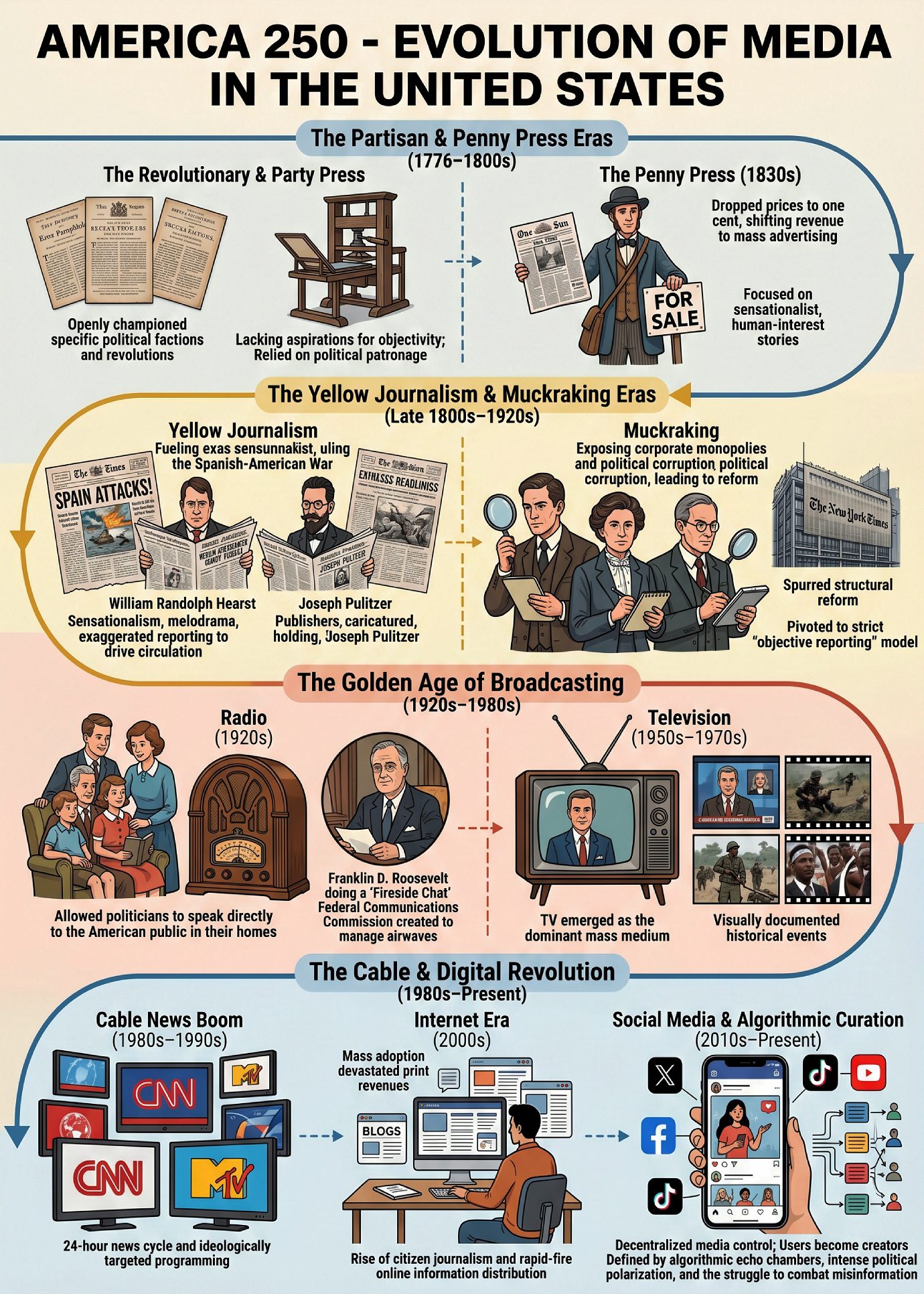
Evolution of Media in the United States
Jump to Various Sections:
Evolution of Mass Communication – From Early Print to Digital Media
From Broadsides to Bitrate: The Five Technical Ruptures That Invented the American Audience
The Handkerchief that Went Viral: How 1776 Invented the Digital Age
The Invisible Thread: From Light Theory to the Invention of Radio
From Broadside to Broadcast: The Great Acceleration of American Communication
From Post Riders to Radiowaves—The Democratization of American Information
Watch this short video on the Evolution of American Media:
Two Informative and Exciting Podcasts on This Subject
Listen to a “Deep Dive” podcast with the Chair Man and the Chair Lady. CLICK PLAY.
Listen to a “Debate” with Max and Maxine Rogers. CLICK PLAY.
The Evolution of Mass Communication: From Early Print to Digital Media
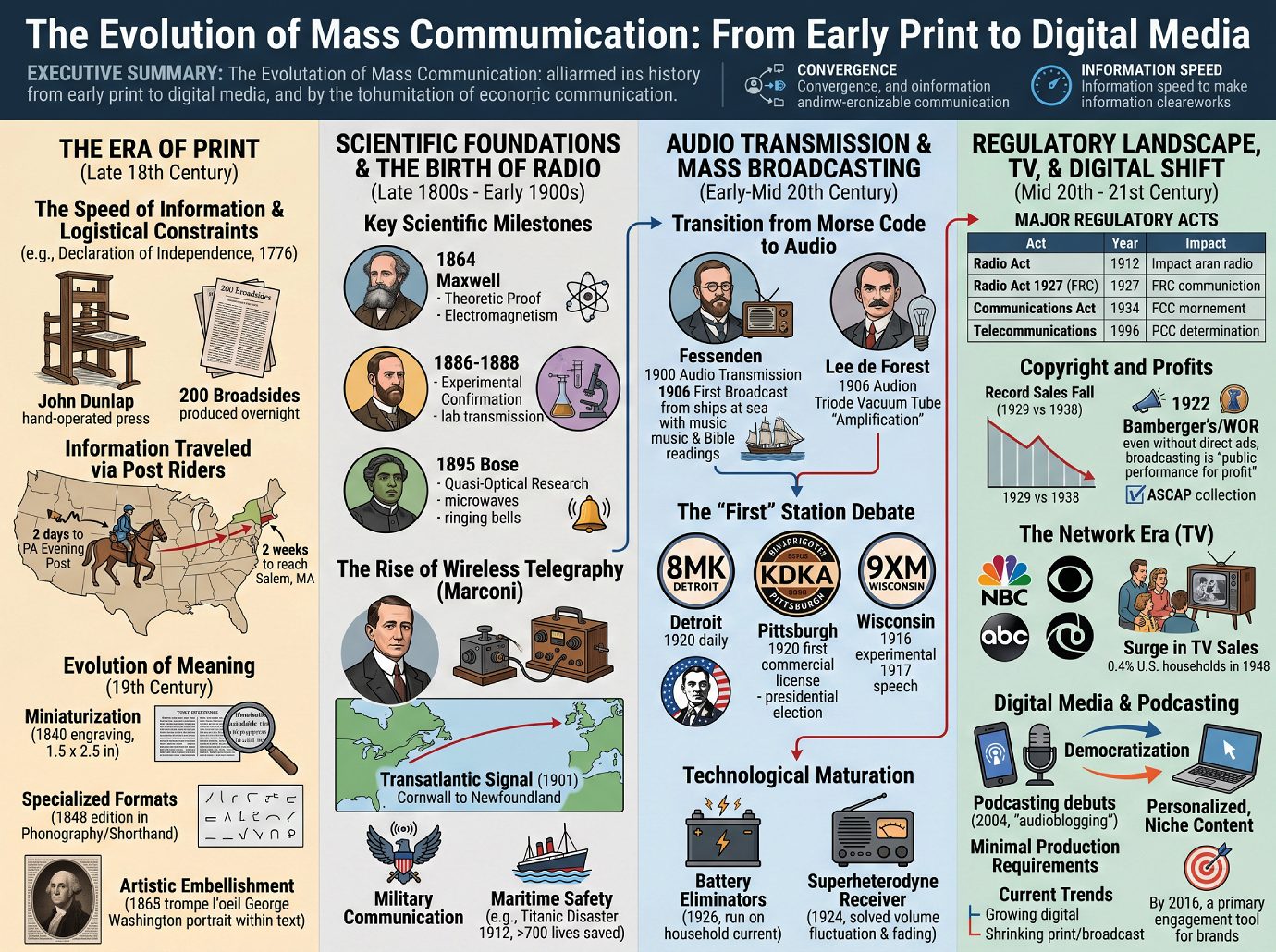
The history of mass communication is a narrative of technological convergence and the pursuit of instantaneous information delivery. Beginning with the hand-operated presses of the 18th century, which required weeks to disseminate foundational documents like the Declaration of Independence, communication evolved through the scientific discovery of electromagnetic waves into the era of radio. Radio transformed from a point-to-point military and nautical tool into a shared cultural experience that redefined American entertainment and politics.
The mid-20th century saw the transition from audio to visual delivery through television, which largely inherited the organizational structures of established radio networks. The late 20th and early 21st centuries have been defined by the “digital revolution,” characterized by the shift toward internet-based consumption, mobile telephony, and the democratization of content through mediums like podcasting. Throughout this evolution, three recurring tensions have shaped the industry: the debate over technical priority (who “invented” what), the necessity of government regulation to manage interference and safety, and the conflict between free public access and intellectual property rights.
The Era of Print and the Speed of Information
In the late 18th century, mass communication was a labor-intensive, physical process. The dissemination of the Declaration of Independence in 1776 serves as a primary example of the era’s logistical constraints.
- Production: After approval on July 4, 1776, printer John Dunlap worked through the night to produce approximately 200 “broadsides”—single-sheet copies.
- Dissemination: Information traveled via post riders. It took two days for the first newspaper (The Pennsylvania Evening Post) to publish the text, and two weeks for the news to reach Salem, Massachusetts.
- Evolution of Meaning: Over the 19th century, the Declaration transitioned from “breaking news” to a commercial and iconic symbol. This led to diverse printing innovations, including:
- Miniaturization: An 1840 engraving by Charles Toppan squeezed the entire text into a 1.5 x 2.5-inch space, readable only with a magnifying glass.
- Specialized Formats: An 1848 edition was printed entirely in shorthand (phonography) for practitioners of the craft.
- Artistic Embellishment: The 1865 trompe l’oeil print used varying letter thickness to create a portrait of George Washington within the text.
Scientific Foundations and the Birth of Radio
Radio technology did not emerge from a single invention but from a series of cumulative scientific breakthroughs in the late 1800s.
Key Scientific Milestones
- Theoretic Proof: James Clerk Maxwell proposed the theory of electromagnetism in 1864, proving that light and radio waves were electromagnetic waves.
- Experimental Confirmation: Between 1886 and 1888, Heinrich Rudolf Hertz successfully transmitted and received radio waves in a laboratory setting.
- Quasi-Optical Research: Scientists like Oliver Lodge and Jagadish Chandra Bose explored the optical qualities of waves. In 1895, Bose demonstrated microwaves triggering detectors to ring bells and ignite gunpowder at a distance.
The Rise of Wireless Telegraphy
Guglielmo Marconi is credited with turning laboratory experiments into a commercially viable “wireless telegraphy” system. By grounding his transmitter and raising his antenna, he achieved a range of two miles by 1895. In December 1901, he transmitted the first transatlantic signal from Cornwall, England, to Newfoundland. Early radio was primarily used for:
- Military communication.
- Maritime safety: The Wireless Ship Act of 1910 mandated radio equipment on large vessels. Marconi’s technology was famously credited with saving over 700 lives during the Titanic disaster in 1912.
The Transition to Audio and Mass Broadcasting
The shift from Morse code (on-off signaling) to audio transmission allowed radio to become a true mass medium.
- Audio Pioneers: Reginald Fessenden achieved the first successful audio transmission in 1900. On Christmas Eve 1906, he reportedly conducted the first radio broadcast, featuring music and Bible readings heard by ships at sea. Lee de Forest’s invention of the “Audion” (triode vacuum tube) in 1906 further enabled the amplification of signals.
- The “First” Station Debate: Several stations claim the title of the first public broadcaster:
- 8MK (Detroit): Began daily broadcasts in August 1920.
- KDKA (Pittsburgh): Received the first “limited commercial” license and broadcast the 1920 presidential election returns.
- 9XM (University of Wisconsin): Began experimental transmissions in 1916 and regular speech in 1917.
- Technological Maturation: The 1920s saw the introduction of “battery eliminators” (1926), allowing sets to run on household current, and the superheterodyne receiver (1924), which solved volume fluctuation and fading issues.
The Regulatory and Legal Landscape
As radio popularity grew, the U.S. government intervened to manage the “chaos” of the airwaves.
Major Regulatory Acts
| Act | Year | Impact |
|---|---|---|
| Radio Act | 1912 | Passed following the Titanic disaster; distinguished between normal and emergency traffic. |
| Radio Act | 1927 | Established the Federal Radio Commission (FRC) to grant licenses and assign frequencies. |
| Communications Act | 1934 | Established the Federal Communications Commission (FCC) to oversee telephone, telegraph, and radio. |
| Telecommunications Act | 1996 | Aimed to foster competition in the modern telecommunications market. |
Copyright and Profits
The “free” nature of radio initially threatened the phonograph industry. Profits from record sales fell from $75 million in 1929 to $26 million in 1938. A landmark 1922 case against Bamberger’s Department Store (owner of WOR) established that even if a station did not air direct advertisements, broadcasting copyrighted music constituted a “public performance for profit.” This led the American Society of Composers, Authors and Publishers (ASCAP) to begin collecting licensing fees from broadcasters in 1923.
Television and the Modern Digital Shift
The Network Era
Television news was a direct progression of radio. Established radio syndicates—NBC, CBS, and ABC (the latter formed from a split of two NBC radio stations)—produced content for distribution through central organizations. Television sales surged in the late 1940s; while only 0.4% of U.S. households owned a set in 1948, the medium quickly became the centerpiece of the American home.
Digital Media and Podcasting
The “democratization of entertainment” continued into the 21st century with the internet.
- Podcasting: Debuting in 2004 (originally called “audioblogging”), podcasting allowed for personalized, niche content.
- Accessibility: Modern production requires only a smartphone, microphone, and laptop, a sharp contrast to the massive capital requirements of early TV and radio stations.
- Consumer Trends: Current trends show that digital media consumption is growing while traditional print and broadcast mediums are shrinking. By 2016, major brands and marketers had fully adopted podcasts as a primary engagement tool.
———————
From Broadsides to Bitrate: The Five Technical Ruptures That Invented the American Audience
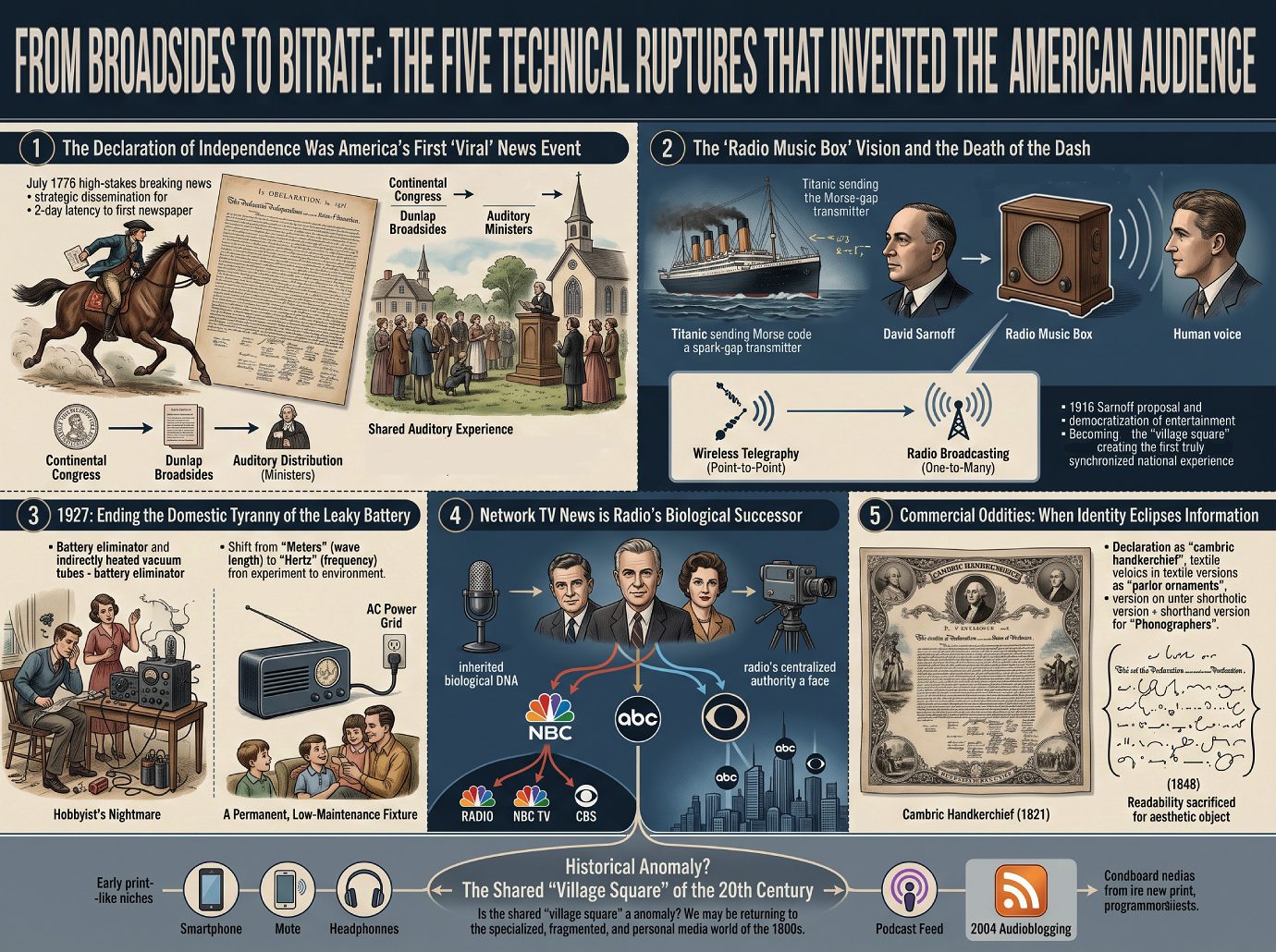
In our modern ecosystem, the “velocity of truth” is nearly synonymous with the speed of light. When a tectonic shift in global politics occurs, the news doesn’t just arrive; it erupts, lighting up billions of smartphone screens in a synchronized vibration of breaking news alerts. We live in an age of instantaneity that makes the summer of 1776 look like it was moving through molasses. Back then, the most radical political rupture in Western history was a physical object, carried by “post riders” on horseback through a landscape of staggering latency.
How did we travel from hand-pressed sheets of damp paper to the 24-hour stream? The journey wasn’t a linear march of progress, but a series of counter-intuitive technical ruptures. By tracing the evolution of U.S. print, radio, and television, we see that media didn’t just change how we receive information—it rewired our very concept of a national audience.
1. The Declaration of Independence Was America’s First “Viral” News Event
We are conditioned to view the Declaration of Independence as a static, hallowed relic under glass. In July 1776, however, it was a piece of high-stakes “breaking news.” After the Continental Congress approved the text, official printer John Dunlap worked through the night to produce approximately 200 “broadsides”—large, single-sheet copies designed for immediate, public consumption.
The dissemination was a masterpiece of 18th-century “virality,” but it functioned with a distinct institutional friction. There was a two-day latency before the first newspaper, The Pennsylvania Evening Post, could even print the text. To solve this, the spread was strategically orchestrated: the Revolutionary Council of Massachusetts actually ordered the document sent to “the Ministers of each Parish” to be read from the pulpit. This wasn’t just about sharing information; it was a deliberate act of distribution designed to build public support through shared auditory experience. As John Bidwell, curator emeritus at the Morgan Library & Museum, notes, the document eventually transitioned from news into a “precious relic,” as artists and printers transformed the radical text into a commercial product for a public eager to own a piece of their new identity.
2. The “Radio Music Box” Vision and the Death of the Dash
Radio was never intended to be a stage for the masses. In its infancy, it was “wireless telegraphy”—a utilitarian, nautical tool for private, point-to-point communication. This was the world of the Titanic, where radio was a lifeline of cold dots and dashes (Morse code). The shift from these abstract signals to the visceral intimacy of the human voice was the first great psychological rewiring of the 20th century.
The catalyst was David Sarnoff. In 1916, while the world viewed radio as a military necessity, Sarnoff proposed the “radio music box.” He envisioned a shift from one-to-one communication to a one-to-many household utility. This was the “democratization of entertainment,” a concept that transformed a tool for war and rescue into the “village square” of the American home. As noted in the Concise History of Early Radio, it was through syndicated radio that “a grandmother in California and a cousin in Michigan could all be laughing and listening” to the same program simultaneously, creating the first truly synchronized national experience.
3. 1927: Ending the Domestic Tyranny of the Leaky Battery
For the first decade of its existence, home radio was a hobbyist’s nightmare. Early sets were cumbersome, temperamental, and required the “domestic tyranny of the leaky battery”—expensive, delicate power sources that made radio a high-maintenance chore. Radio was a guest in the living room, not a resident.
That changed in 1927. The invention of the “battery eliminator” and indirectly heated vacuum tubes allowed radios to finally cut the cord and plug directly into the electrical grid. This technical milestone turned radio into a permanent, low-maintenance fixture. This era of maturation was perfectly captured by the industry’s shift from measuring signals in “meters” (the physical length of the wave) to “hertz” (frequency). Frequency represented a move toward precise, mathematical control—a professionalized management of an increasingly crowded dial. By moving to the grid, radio stopped being an experiment and started being an environment.
4. Network TV News is Radio’s Biological Successor
We often treat the arrival of television as a clean break, but in the world of news, TV was less a revolution and more a biological progression. The “Big Three”—ABC, NBC, and CBS—didn’t just invent a new way of doing things; they inherited the literal voices, habits, and organizational DNA of their radio predecessors.
The structure was identical: a central organization producing content for wide distribution. Even the corporate landscape was a direct graft. ABC was born from the “forcible split” of two NBC radio stations, a corporate mitosis that brought the old radio power dynamics into the television age. The irony of the screen’s rise is that while the form became visual, the network structure remained a 20th-century radio artifact. Television news didn’t kill radio; it simply gave radio’s centralized authority a face.
5. Commercial Oddities: When Identity Eclipses Information
Once a medium becomes iconic, its primary function often shifts from “conveying information” to “signifying identity.” This is how the Declaration of Independence ended up as a “cambric handkerchief.” In 1821, Glasgow printers produced red, blue, and black textile versions of the document, adorned with George Washington’s portrait and vignettes of the Boston Tea Party. These weren’t for reading; they were “parlor ornaments” aimed at U.S. consumers who wanted to wear or display their patriotism.
Perhaps the strangest example is the 1848 version written entirely in “phonography”—a shorthand system of swoops and dots. It was utterly illegible to the average citizen, yet it was marketed as an “ornament for the parlor of any Phonographer.” These oddities illustrate a fundamental media truth: when we’ve fully absorbed the content, we begin to treat the medium itself as a badge of who we are. Readability is sacrificed for the sake of the aesthetic object.
Conclusion: The Full Circle of Intimacy
We have traveled from the physical broadsides of the 1700s to the live, centralized “village square” of the 20th-century network, and now back toward something curiously familiar. Today’s digital landscape—defined by the rise of podcasts, which began in 2004 as “audioblogging”—mirrors the specialized, niche nature of early 19th-century print. The shorthand Declaration of 1848 was a niche product for a specific community; today’s podcast feeds are the same, catering to micro-audiences with a level of intimacy that radio and TV networks could never afford.
As our media becomes increasingly digital and instant, we are left with a final irony: Is the shared “village square” of the 20th century merely a historical anomaly? We may find that as we move deeper into the bitrate, we aren’t moving toward a new future, but simply returning to the specialized, fragmented, and deeply personal media world of the 1800s.
————–
The Handkerchief that Went Viral: How 1776 Invented the Digital Age
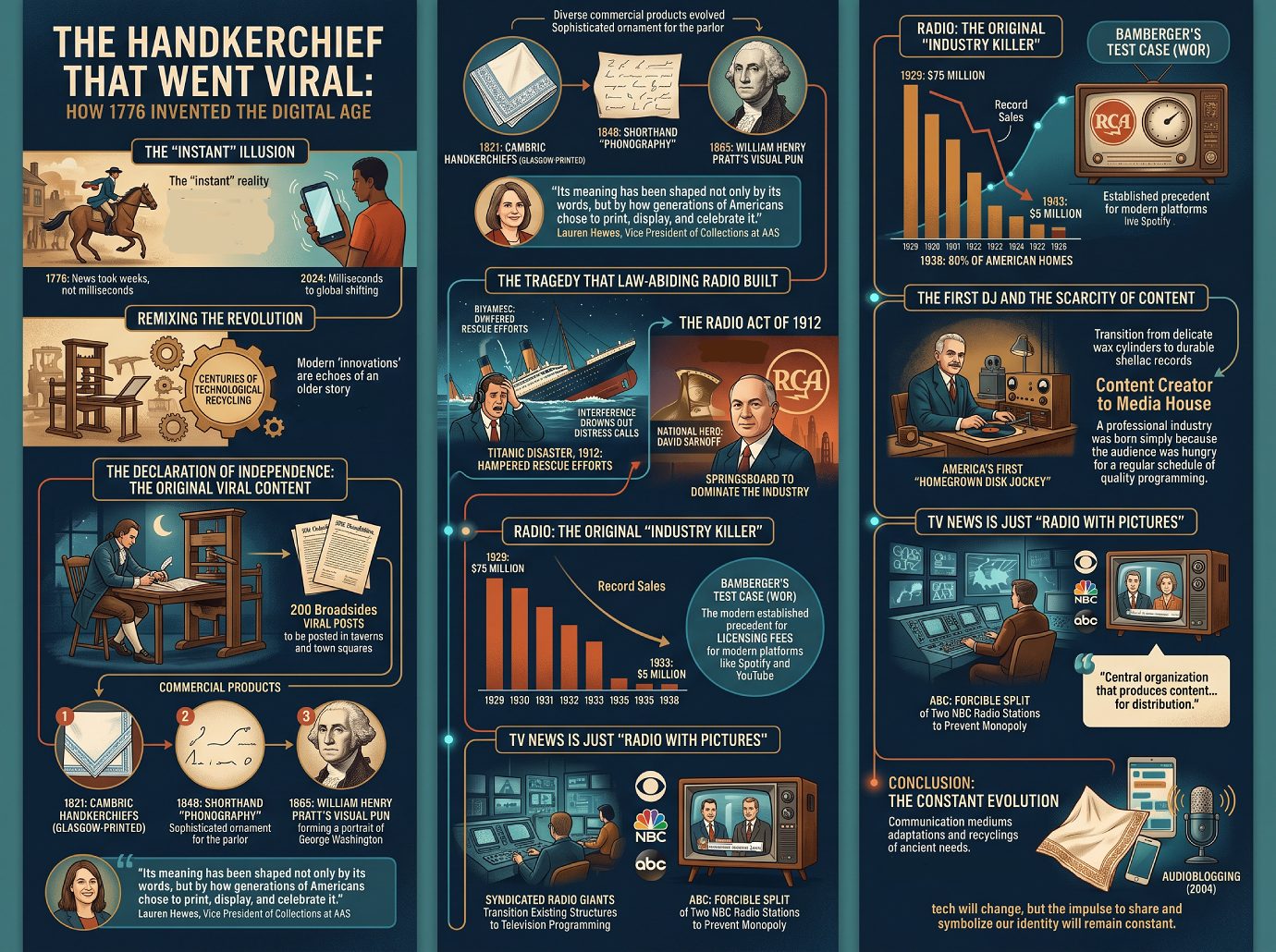
The “Instant” Illusion
We live in a world where a smartphone vibration notifies millions of a global shift in milliseconds. This “instant” reality is a historical anomaly compared to the grueling, physical reality of 1776, where news moved only as fast as a post rider’s horse. In the late 18th century, a single dispatch could take days or even weeks of hard riding to reach the far corners of the colonies.
To a media historian, our current digital landscape is less of a revolution and more of a remix. Our consumption habits are the result of centuries of technological recycling, high-stakes failures, and creative adaptation. By exploring how “breaking news” became “mass media,” we can see that our modern “innovations” are actually echoes of a much older story.
The Declaration of Independence was the Original Viral Content
When the Continental Congress approved the Declaration of Independence, it wasn’t a static archive; it was a high-speed media launch. Printer John Dunlap worked through the night on July 4, 1776, to set 1,320 words into type, producing roughly 200 “broadsides” to be posted in taverns and read in town squares. These single sheets were the original viral posts, designed to circulate rapidly to build a brand-new national identity.
As the document moved from news to icon, it evolved into diverse commercial products like Glasgow-printed cambric handkerchiefs in 1821. By 1848, it appeared in shorthand “phonography” versions, marketed as a sophisticated “ornament for the parlor.” Perhaps the most clever iteration was William Henry Pratt’s 1865 “visual pun,” where the text was arranged so that from a distance, it formed a portrait of George Washington.
“These objects remind us that the Declaration has never been a static document,” says Lauren Hewes, Vice President of Collections at AAS. “Its meaning has been shaped not only by its words, but by how generations of Americans chose to print, display, and celebrate it.”
The Tragedy that Law-Abiding Radio Built
In its infancy, radio was a “wireless telegraph” used primarily for point-to-point communication between ships and land. This unregulated “Wild West” of the airwaves proved fatal during the Titanic disaster in 1912. Excessive and interfering radio traffic from amateur and competing operators hampered rescue efforts, drowning out critical distress calls.
In a classic futurist pattern, we only regulated the tech after it broke in a tragic, public way. The resulting Radio Act of 1912 mandated professional operators and created the legal distinction between emergency and normal traffic. David Sarnoff, the land transmitter operator during the rescue, became a “national hero” for his service—a fame he used as a springboard to dominate the industry at RCA.
Radio: The Original “Industry Killer”
When radio broadcasting exploded in the 1920s, the phonograph industry faced its first “Napster moment.” Because radio provided “free” music to anyone with a receiver, the record industry’s revenue model collapsed almost overnight. Sales plummeted from $75 million in 1929 to a staggering low of $5 million in 1933, while radio ownership reached 80 percent of American homes by 1938.
The legal battle over this “free” content was settled by the Bamberger’s Department Store test case involving station WOR. The court ruled that even though the station played “free” music, it was for commercial gain because it promoted the store. This established the crucial precedent for licensing fees that still governs how platforms like Spotify and YouTube pay artists today.
The First DJ and the Scarcity of Content
The professional radio industry didn’t start with a grand vision; it started because “nothing was on air.” In the early 1920s, Westinghouse established station KDKA to promote the sale of radio sets, but quality live programming was scarce and expensive. To fill the silence, Dr. Frank Conrad began playing records from his own collection, coining the term “broadcast” to describe the wide distribution of audio.
Conrad became America’s first “homegrown disk jockey,” bridging the gap between the delicate wax cylinders of the past and the durable shellac records of the future. His transition from an amateur experimenter to a centralized programmer mirrors the “Content Creator to Media House” pipeline we see on modern platforms. A professional industry was born simply because the audience was hungry for a regular schedule of quality programming.
TV News is Just “Radio with Pictures”
Modern television news is not a new invention, but a direct descendant of the radio “Network” model. In the 1940s, syndicated radio giants like NBC and CBS simply transitioned their existing structures into television programming. Even ABC was born from a “forcible split” of two NBC radio stations mandated by government regulators to prevent a monopoly.
This era solidified the definition of a network that has persisted for nearly a century. This model relies on a central organization that produces content for wide distribution, a system that dominated the landscape until the internet began to decentralize it. While the medium shifted from audio to “radio with pictures,” the underlying organizational logic remained remarkably unchanged.
“So what makes a network?” the Cronkite School of Journalism defines it. “Essentially, it is a central organization that produces content… for distribution.”
Conclusion: The Constant Evolution
Communication mediums are rarely entirely new; they are adaptations and recyclings of ancient needs. Just as television grew out of radio, today’s digital media thrives on old concepts, like podcasts being framed as “audioblogging” in 2004. We continue to use new tools to satisfy the same desire: to stay knowledgeable and connected in a chaotic world.
As we move further into a world of decentralized digital media, we must ask what our current “viral” documents will look like to historians 250 years from now. Will our digital files seem as quaint and tactile as a silk handkerchief printed with the Declaration of Independence? History suggests that the tech will change, but the impulse to share and symbolize our identity will remain constant. ————-
The Handkerchief that Went Viral: How 1776 Invented the Digital Age
The “Instant” Illusion
We live in a world where a smartphone vibration notifies millions of a global shift in milliseconds. This “instant” reality is a historical anomaly compared to the grueling, physical reality of 1776, where news moved only as fast as a post rider’s horse. In the late 18th century, a single dispatch could take days or even weeks of hard riding to reach the far corners of the colonies.
To a media historian, our current digital landscape is less of a revolution and more of a remix. Our consumption habits are the result of centuries of technological recycling, high-stakes failures, and creative adaptation. By exploring how “breaking news” became “mass media,” we can see that our modern “innovations” are actually echoes of a much older story.
The Declaration of Independence was the Original Viral Content
When the Continental Congress approved the Declaration of Independence, it wasn’t a static archive; it was a high-speed media launch. Printer John Dunlap worked through the night on July 4, 1776, to set 1,320 words into type, producing roughly 200 “broadsides” to be posted in taverns and read in town squares. These single sheets were the original viral posts, designed to circulate rapidly to build a brand-new national identity.
As the document moved from news to icon, it evolved into diverse commercial products like Glasgow-printed cambric handkerchiefs in 1821. By 1848, it appeared in shorthand “phonography” versions, marketed as a sophisticated “ornament for the parlor.” Perhaps the most clever iteration was William Henry Pratt’s 1865 “visual pun,” where the text was arranged so that from a distance, it formed a portrait of George Washington.
“These objects remind us that the Declaration has never been a static document,” says Lauren Hewes, Vice President of Collections at AAS. “Its meaning has been shaped not only by its words, but by how generations of Americans chose to print, display, and celebrate it.”
The Tragedy that Law-Abiding Radio Built
In its infancy, radio was a “wireless telegraph” used primarily for point-to-point communication between ships and land. This unregulated “Wild West” of the airwaves proved fatal during the Titanic disaster in 1912. Excessive and interfering radio traffic from amateur and competing operators hampered rescue efforts, drowning out critical distress calls.
In a classic futurist pattern, we only regulated the tech after it broke in a tragic, public way. The resulting Radio Act of 1912 mandated professional operators and created the legal distinction between emergency and normal traffic. David Sarnoff, the land transmitter operator during the rescue, became a “national hero” for his service—a fame he used as a springboard to dominate the industry at RCA.
Radio: The Original “Industry Killer”
When radio broadcasting exploded in the 1920s, the phonograph industry faced its first “Napster moment.” Because radio provided “free” music to anyone with a receiver, the record industry’s revenue model collapsed almost overnight. Sales plummeted from $75 million in 1929 to a staggering low of $5 million in 1933, while radio ownership reached 80 percent of American homes by 1938.
The legal battle over this “free” content was settled by the Bamberger’s Department Store test case involving station WOR. The court ruled that even though the station played “free” music, it was for commercial gain because it promoted the store. This established the crucial precedent for licensing fees that still governs how platforms like Spotify and YouTube pay artists today.
The First DJ and the Scarcity of Content
The professional radio industry didn’t start with a grand vision; it started because “nothing was on air.” In the early 1920s, Westinghouse established station KDKA to promote the sale of radio sets, but quality live programming was scarce and expensive. To fill the silence, Dr. Frank Conrad began playing records from his own collection, coining the term “broadcast” to describe the wide distribution of audio.
Conrad became America’s first “homegrown disk jockey,” bridging the gap between the delicate wax cylinders of the past and the durable shellac records of the future. His transition from an amateur experimenter to a centralized programmer mirrors the “Content Creator to Media House” pipeline we see on modern platforms. A professional industry was born simply because the audience was hungry for a regular schedule of quality programming.
TV News is Just “Radio with Pictures”
Modern television news is not a new invention, but a direct descendant of the radio “Network” model. In the 1940s, syndicated radio giants like NBC and CBS simply transitioned their existing structures into television programming. Even ABC was born from a “forcible split” of two NBC radio stations mandated by government regulators to prevent a monopoly.
This era solidified the definition of a network that has persisted for nearly a century. This model relies on a central organization that produces content for wide distribution, a system that dominated the landscape until the internet began to decentralize it. While the medium shifted from audio to “radio with pictures,” the underlying organizational logic remained remarkably unchanged.
“So what makes a network?” the Cronkite School of Journalism defines it. “Essentially, it is a central organization that produces content… for distribution.”
Conclusion: The Constant Evolution
Communication mediums are rarely entirely new; they are adaptations and recyclings of ancient needs. Just as television grew out of radio, today’s digital media thrives on old concepts, like podcasts being framed as “audioblogging” in 2004. We continue to use new tools to satisfy the same desire: to stay knowledgeable and connected in a chaotic world.
As we move further into a world of decentralized digital media, we must ask what our current “viral” documents will look like to historians 250 years from now. Will our digital files seem as quaint and tactile as a silk handkerchief printed with the Declaration of Independence? History suggests that the tech will change, but the impulse to share and symbolize our identity will remain constant. ———————-
The Invisible Thread: From Light Theory to the Invention of Radio
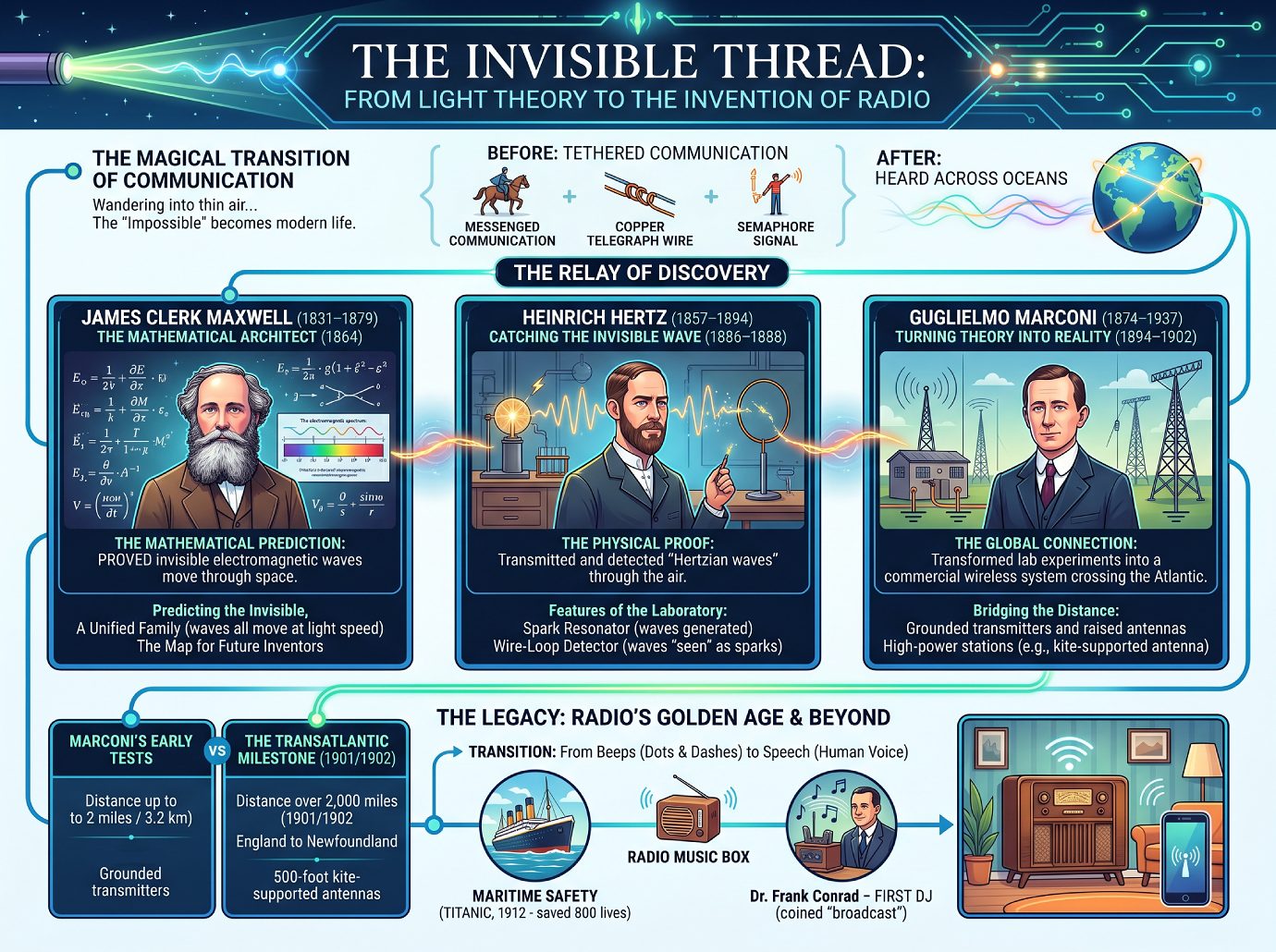
1. Introduction: The Magic of Wireless Communication
For most of human history, communication over long distances was tethered to the physical world—dependent on the speed of a horse, the endurance of a messenger, or the reach of a copper telegraph wire. The birth of radio represents a “magical” transition in our species’ capability: the moment we learned to whisper into the thin air and be heard across vast oceans. This was not the work of a lone “wizard” but a relay of genius. It began with James Clerk Maxwell, who used pure mathematics to map an invisible world; continued with Heinrich Hertz, who physically proved that world existed; and culminated with Guglielmo Marconi, who engineered these scientific curiosities into a global nervous system. Together, they wove an invisible thread that tied the planet together, transforming the “impossible” into the foundation of modern life.
The Relay of Discovery
| Scientist | The Breakthrough Idea |
|---|---|
| James Clerk Maxwell | The Mathematical Prediction: Used equations to prove that invisible electromagnetic waves move through space. |
| Heinrich Hertz | The Physical Proof: Conducted the first laboratory experiments to transmit and detect “Hertzian waves” through the air. |
| Guglielmo Marconi | The Global Connection: Transformed lab experiments into a commercial wireless system capable of crossing the Atlantic. |
Before a single spark was ever struck in a laboratory, the foundation of this revolution was built entirely out of numbers, ink, and pure theoretical insight.
2. James Clerk Maxwell: The Mathematical Architect (1864)
In a landmark 1864 presentation (later published in 1865), James Clerk Maxwell proposed a theory that fundamentally altered our understanding of the universe. He provided the mathematical proof that electricity and magnetism were not separate forces, but two sides of a single electromagnetic field. His profound “so what?” was the realization that light itself is an electromagnetic wave. Maxwell predicted a “unified family” of waves—including those we now call radio waves—all moving through free space at the speed of light.
The Architect’s Blueprint
Maxwell’s legacy is defined by three core contributions:
- Predicting the Invisible: He used complex equations to describe waves that no human eye could see and no instrument of his time could detect.
- A Unified Family: He proved that light, heat, and invisible radiation were all siblings in the electromagnetic spectrum, differing only in their wavelengths.
- The Map for Future Inventors: By providing the mathematical “map” of how these waves behave, he gave future pioneers the exact coordinates needed to find them in the physical world.
While Maxwell provided the map to this invisible realm, the world still needed a physical pioneer to prove these waves were a reality rather than just beautiful mathematics.
3. Heinrich Hertz: Catching the Invisible Wave (1886–1888)
Between 1886 and 1888, German physicist Heinrich Hertz turned Maxwell’s theories into physical truth. In his laboratory, Hertz performed a series of experimental milestones that successfully transmitted electromagnetic waves through the air without wires. At the time, these were known as “Hertzian Waves,” a term that would remain the scientific standard for nearly 20 years before “radio” became the universal name.
Features of the Hertzian Laboratory
Hertz successfully “caught” the invisible wave using a specialized setup:
- The Spark Resonator: Hertz used small metal ball spark resonators to generate high-frequency electromagnetic waves (microwaves).
- The Wire-Loop Detector: To “see” the waves, Hertz utilized a simple loop of wire with a tiny spark gap. When waves hit the loop, a small spark would jump across the gap, providing visual proof of the wave’s arrival.
- Physical Proof: By demonstrating that these waves could be reflected and refracted just like light, he confirmed they were the exact electromagnetic waves Maxwell had predicted.
While Hertz proved the waves existed, he viewed them primarily as a laboratory curiosity. It would take a new generation of inventors to see these waves not just as a physics lesson, but as a tool for a connected world.
4. Guglielmo Marconi: Turning Theory into Reality (1894–1902)
Guglielmo Marconi was the visionary who recognized a world-changing tool where others saw only an experiment. In the mid-19th century, attempts to lay a transatlantic cable had failed repeatedly, including a disastrous 1857 attempt where the cables could not survive the Atlantic waters. Marconi realized that wireless was the only solution. His genius lay in engineering; he discovered that by grounding both the transmitter and receiver and raising the height of his antenna, he could send signals far beyond the laboratory.
Bridging the Distance
| Feature | Marconi’s Early Tests (1895) | The Transatlantic Milestone (1901/1902) |
|---|---|---|
| Distance Achieved | Up to 2 miles (3.2 km). | Over 2,000 miles (England to Newfoundland). |
| Primary Technology | Grounded transmitters and raised antennas. | High-power stations and 500-foot kite-supported antennas. |
| Legal/Social Impact | Established a commercial “stranglehold” by refusing to communicate with non-Marconi ships. | The Wireless Ship Act of 1910 eventually made his technology a legal requirement for safety. |
Marconi’s success was also part of a larger, global race. In 1895, Russian physicist Aleksander Poppov secretly sent a wireless message to a Navy ship, illustrating that science often moves through parallel discoveries. However, Marconi’s aggressive patenting and commercial drive made his system the global standard.
As these early wireless “beeps” of Morse code became more reliable, the stage was set for the next great leap: the transition from dots and dashes to the human voice.
5. Synthesis: The Evolution from Theory to Global News
The progression from Maxwell to Marconi provides a vital lesson: discovery is a ladder. Maxwell provided the theoretical rungs, Hertz confirmed the ladder was solid, and Marconi climbed it to reach the world. This synergy created the foundation for the “Golden Age of Radio.” The transition from “beeps” to “speech” was completed by visionaries like Dr. Frank Conrad, who coined the term “broadcast” and became the first DJ by playing phonograph records over the air.
The Legacy of the Pioneers The work of these men transitioned radio from a nautical necessity to a “household utility.” While early radio was famous for its role in maritime safety—famously saving 800 lives during the Titanic disaster in 1912—it soon became much more. David Sarnoff, the land transmitter who became a national hero during the Titanic rescue, later proposed the “radio music box” concept. His vision shifted radio from a point-to-point tool into a mass medium that brought news and music directly into the living room.
For the student learner, the story of radio is a reminder that the most world-changing technologies often begin as “invisible” ideas. By building upon the theories of the past, scientists and engineers turn the impossible into the everyday, proving that even the air around us is full of hidden potential. ————————–
From Broadside to Broadcast: The Great Acceleration of American Communication
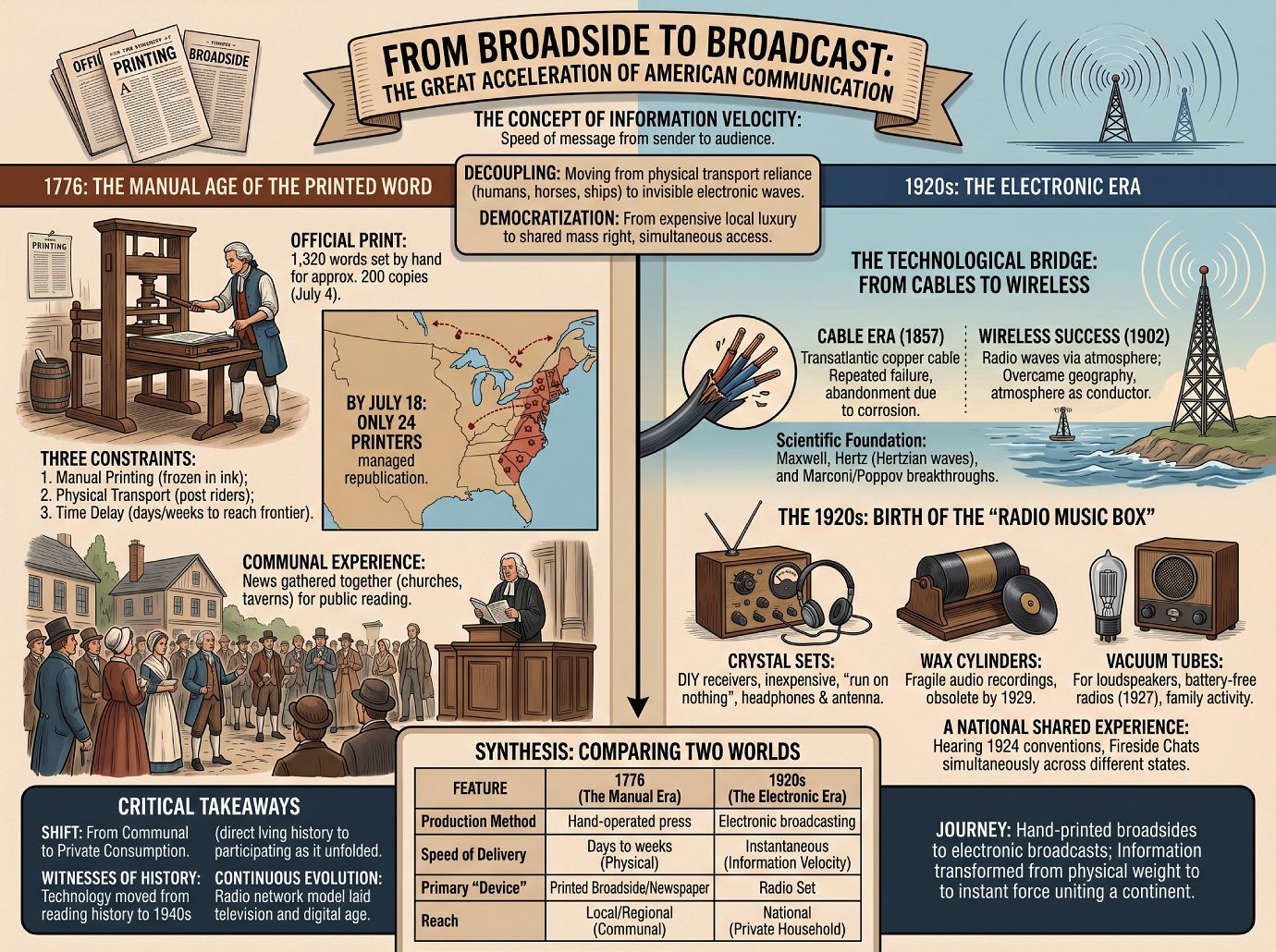
1. Introduction: The Concept of Information Velocity
In the study of media history, we use the term Information Velocity to describe the speed at which a message travels from its sender to its audience. For most of human history, information velocity was inextricably tied to “physical transport”—the speed of a human, a horse, or a ship. News could only move as fast as the physical body carrying it.
The great shift in American communication occurred through the “decoupling” of information from geography. By moving from physical reliance to “electronic transmission,” we began to harness invisible waves to move data at near-instantaneous speeds. This meant that the location of an event no longer dictated how long it took for the world to hear about it.
The Big Picture: Why it Matters The evolution of communication technology represents the democratization of information. By shifting from expensive, manually produced documents to widely available electronic broadcasts, society moved from a world where news was a slow, local luxury to one where entertainment and information became a shared right accessible to the masses simultaneously.
To understand the magnitude of this acceleration, we must look back to the summer of 1776, when a new nation’s birth certificate traveled at the grueling pace of a galloping horse.
2. 1776: The Manual Age of the Printed Word
When the Continental Congress approved the Declaration of Independence in July 1776, there were no digital alerts. The news was a physical object. Official printer John Dunlap spent the night of July 4 setting the document’s 1,320 words into type by hand, pulling approximately 200 single-sheet “broadsides.” Just two days later, Benjamin Towne’s Pennsylvania Evening Post became the first newspaper to include the full text, turning “state secrets” into public news.
In this manual era, three primary constraints dictated the flow of information:
- Manual Printing: Every individual letter was set by hand, and every page was physically pulled on a wooden press. This labor-intensive process meant that information could not be updated “live”; it was frozen in ink the moment the press closed.
- Physical Transport: Distribution relied on “post riders.” Imagine a merchant in Savannah, Georgia; he might wait nearly a month in agonizing silence, wondering if the war he was funding in Philadelphia had actually begun, or if the Declaration had even been signed.
- Time Delay: Because news was tied to the horse, it took days to reach nearby colonies and weeks to reach the frontier. By July 18, only twenty-four colonial printers had managed to republish the text.
Because of these delays and the high cost of paper, news was a communal experience. The Revolutionary Council of Massachusetts actually ordered that copies be sent to “Ministers of each Parish” to be read from the pulpit. On July 17, 1776, Reverend Caleb Curtis stood before his congregation in Charlton and read those historic words aloud. For the average colonist, news wasn’t something you checked on a device; it was something you gathered in town squares, churches, or taverns to hear together.
This reliance on the physical world remained the status quo until scientists discovered they could harness the “invisible” power of electromagnetic waves.
3. The Technological Bridge: From Cables to Wireless
The electronic age was built on the mathematical theories of James Clerk Maxwell and the 1880s experiments of Heinrich Hertz, who proved that “Hertzian waves” could carry energy through the air. While Guglielmo Marconi is often credited with the invention of radio, a media historian must note the secret experiments of Russian physicist Aleksander Poppov, who transmitted the first wireless message to a Navy ship in 1895—a breakthrough hidden by the Russian government for years.
The Shift to Wireless
| Feature | The Cable Era (1857) | The Wireless Success (1902) |
|---|---|---|
| Primary Method | Transatlantic copper cable | Radio waves sent through the air |
| Outcome | Repeated failures and abandonment | Successful transatlantic signal (Marconi) |
| Scientific Barrier | Physical durability; cables could not survive saltwater corrosion and pressure | Overcame geography; waves utilized the atmosphere as a conductor |
Before the human voice could be transmitted, the world spoke in the “on-off” signals of Morse Code. The life-saving necessity of this technology was forever etched into history during the 1912 Titanic disaster. Wireless operators successfully called for help across the open ocean, saving 800 people who otherwise would have been lost. This maritime tool was about to undergo its most significant transformation: moving from the deck of a ship into the American living room.
4. The 1920s: The Birth of the “Radio Music Box”
In 1916, a young wireless operator named David Sarnoff envisioned the radio as a “household utility”—a “radio music box.” His vision was delayed by the outbreak of World War I, but by the early 1920s, the “revolution of entertainment” had begun.
Early listeners used a variety of methods to bring the world into their homes:
- Crystal Sets: These were simple, DIY receivers built by hobbyists. They were popular because they were inexpensive and “ran on nothing,” requiring no batteries or external power—only a set of headphones and a long wire antenna.
- Wax Cylinders: Before shellac and vinyl records took over, audio was recorded on these delicate cylinders. However, they were incredibly fragile and could only be played a few times before the sound wore away, rendering them obsolete by 1929.
- Vacuum Tubes: Introduced in the mid-1920s, these allowed for the development of “battery-free” radios (by 1927) and built-in loudspeakers, moving radio from a solitary headphone experience to a family activity.
The most profound impact was the creation of a “National Shared Experience.” For the first time, a family in New York and a cousin in Michigan could hear the 1924 political conventions or a “Fireside Chat” from the President at the exact same moment. History was no longer something you read about weeks later; it was something you participated in as it unfolded.
5. Synthesis: Comparing Two Worlds
The leap from 1776 to the 1920s didn’t just change the speed of news; it changed the very fabric of national identity.
Communication Contrast: 1776 vs. 1920s
| Feature | 1776 (The Manual Era) | 1920s (The Electronic Era) |
|---|---|---|
| Method of Production | Hand-operated press (John Dunlap) | Electronic broadcasting (KDKA, NBC) |
| Speed of Delivery | Days to weeks (Physical Transport) | Instantaneous (Information Velocity) |
| Primary “Device” | Printed Broadside / Newspaper | Radio Set (Crystal or Console) |
| Reach | Local/Regional (Communal Reading) | National (Private Household Listening) |
Critical Takeaways
- From Communal to Private Consumption: In 1776, you had to go to a church or tavern to hear the news. By the 1920s, the most important events in the world were delivered directly into the privacy of your own living room.
- The Shift to “Live” Participation: Technology moved the public from being “readers of history” (learning about the past) to “witnesses of history” (experiencing events as they happened).
- Continuous Evolution: The radio infrastructure of the 1920s created the “network” model. In the early 1940s, syndicated radio giants like NBC and CBS used this exact foundation to transition into the first television networks, setting the stage for our modern digital age.
Ultimately, the journey from the hand-printed broadside to the electronic broadcast transformed information from a slow, physical weight into an invisible, instant force that could unite a continent. ——————-
From Post Riders to Radiowaves—The Democratization of American Information
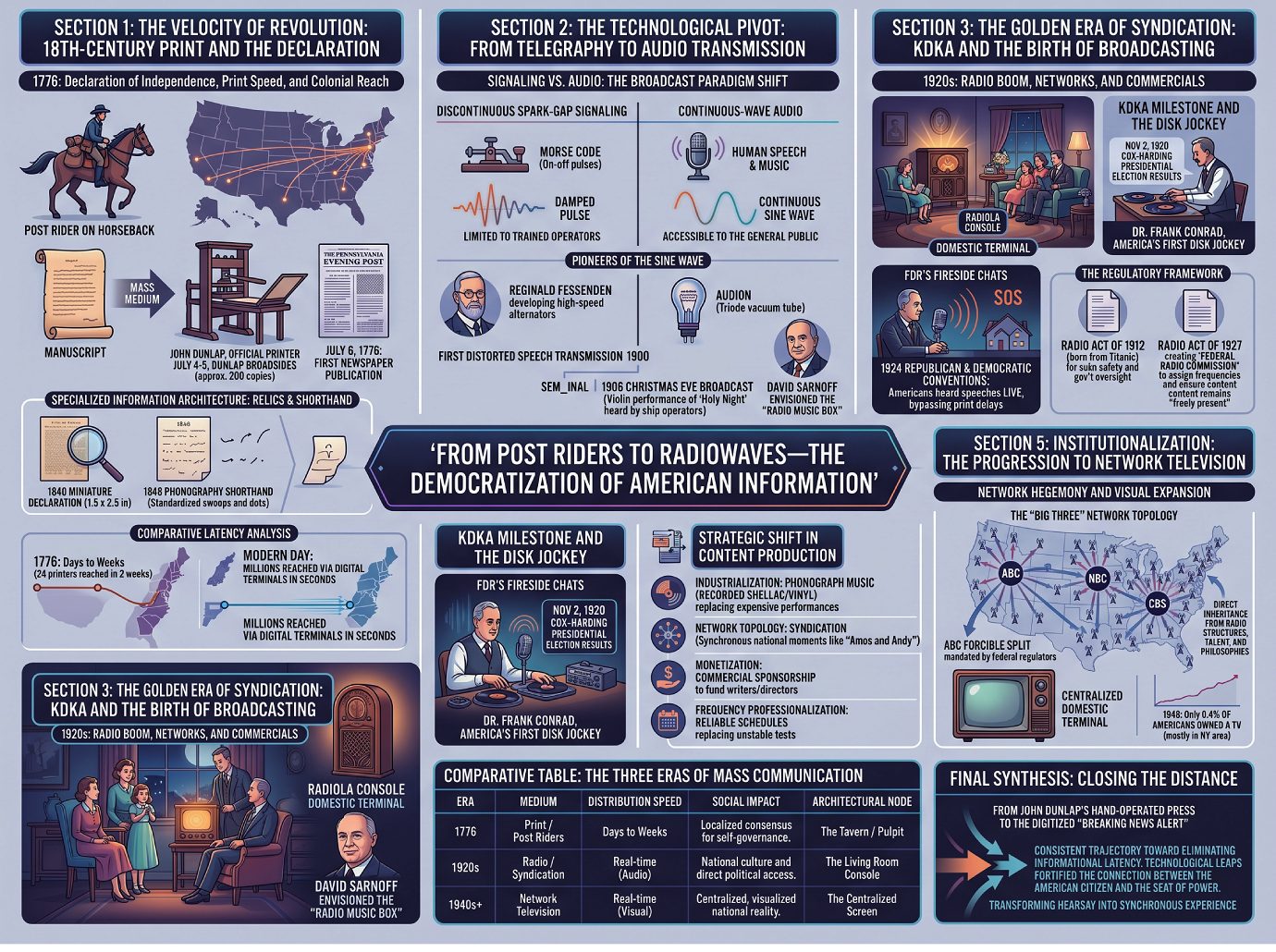
1. The Velocity of Revolution: 18th-Century Print and the Declaration
In the summer of 1776, the legitimization of the nascent American state was fundamentally a function of the strategic velocity and topological reach of its communications. For the Continental Congress, the Declaration of Independence was not merely a philosophical manifesto but a critical informational inflection point that required immediate, pervasive dissemination to catalyze a unified national identity from thirteen disparate colonies. The primary hurdle was the high latency inherent in the “radial” information architecture of the era; the authority of the new government was tethered to the physical endurance of post riders and the localized output of manual presses. In this environment, the “Town Square” served as a vital interstitial decompression point where information was decoded and socialized for the masses.
The Printing Milestone: Broadside to Newspaper
Following the approval of the Declaration on July 4, 1776, the transition from manuscript to mass medium was orchestrated by John Dunlap, the official printer, who worked through the night to produce approximately 200 “Dunlap Broadsides.” However, the reach of the text expanded significantly on July 6, 1776, when Benjamin Towne’s The Pennsylvania Evening Post became the first newspaper to publish the full text. This shifted the document from a formal government notice into a portable, civilian-accessible format.
Specialized Information Architecture: Relics and Shorthand
As the 19th century progressed, the Declaration evolved from mass news into a technical benchmark. In 1840, Charles Toppan produced an ultra-miniature Declaration (1.5 by 2.5 inches), readable only with a magnifying glass, to demonstrate the anti-forgery intricacies of bank-note engraving. Even more strategically significant was the 1848 edition printed in “Phonography”—a shorthand system using standardized swoops and dots to represent sounds. This specialized architecture served as a precursor to data encoding, allowing information to be compressed for a professionalized “Phonographer” class.
Comparative Latency Analysis: 1776 vs. Modern Day
The collapse of the information gap is best illustrated by the following contrast in distribution speeds:
- 1776 Distribution: News reached twenty-four colonial printers within two weeks; full regional penetration required weeks of manual transit.
- Modern Expectations: Critical informational inflection points reach millions via digital terminals within seconds.
- Information Decay: In the 18th century, news maintained cultural currency for a month; today, news cycles are measured in minutes, reflecting the elimination of spatial latency.
The Communal Decompression Point
The democratization of this text occurred in the “Town Square”—encompassing taverns, churches, and homes—where public readings bridged the gap for a semi-literate population. By July 17, 1776, the document was being read from pulpits in Massachusetts, transforming Thomas Jefferson’s inspiring terms into a shared visceral experience. While print established the national ideals, the physical constraints of paper necessitated a technological leap toward simultaneity to achieve a truly synchronous national consciousness.
2. The Technological Pivot: From Telegraphy to Audio Transmission
The transition from the late 19th century to the early 20th marked a strategic pivot from point-to-point “wireless telegraphy” to the revolutionary paradigm of the “broadcast.” This move beyond the cryptic abstraction of Morse code to the immediacy of human speech was essential for democratization. By standardizing the “sine wave,” engineers removed the technical barrier to entry, allowing the citizenry to interface with information through the most natural human protocol: audio.
Pioneers of the Sine Wave
The shift was predicated on move from “damped” pulses to “continuous-wave” (CW) transmission. Reginald Fessenden synthesized this by developing high-speed alternators to generate pure sine waves, while Lee de Forest’s “Audion” (triode vacuum tube) provided the necessary amplification to make these signals practical. These breakthroughs enabled the first distorted speech transmission in 1900 and Fessenden’s seminal 1906 Christmas Eve broadcast from Brant Rock, which ship operators heard as a violin performance of “O Holy Night.”
From Maritime Safety to the Home Terminal
Initially, radio was a tool of maritime utility, a role brought into sharp relief by the Titanic disaster in 1912. Wireless technology was credited with saving 700 survivors, an event that served as the catalyst for the Radio Act of 1912, establishing government oversight of the airwaves. David Sarnoff, who assisted during the rescue, famously envisioned a shift in 1916 from military utility to the “radio music box,” a domestic terminal for information and entertainment.
Technological Comparison: Signaling vs. Audio
| Feature | Discontinuous Spark-Gap Signaling | Continuous-Wave Audio |
|---|---|---|
| Data Format | Morse Code (On-off pulses) | Human Speech and Music |
| Bandwidth | Very Broad (up to 30 MHz) | Narrow (10 kHz for AM) |
| Efficiency | Low; high interference | High; precise frequency control |
| Accessibility | Limited to trained operators | Accessible to the general public |
3. The Golden Era of Syndication: KDKA and the Birth of Broadcasting
The 1920s boom democratized radio through a combination of “EZ credit” and standardized hardware. The Radiola console became the domestic terminal of a national network, moving radio from a hobbyist’s laboratory into the center of the middle-class living room. This era established the economic and organizational structures that defined the 20th-century media landscape.
The KDKA Milestone and the Disk Jockey
On November 2, 1920, KDKA in Pittsburgh inaugurated licensed commercial broadcasting by delivering the Cox-Harding presidential election results. This demonstrated the medium’s ability to collapse the latency of traditional print news. Dr. Frank Conrad, the station’s engineer, coined the term “broadcast” and became America’s first disk jockey by playing phonograph records to ensure there was “something on the air” for new receiver owners.
The Strategic Shift in Content Production
The institutionalization of radio required a move from one-off, expensive performances to a sustainable “syndicated” model:
- Industrialization of Content: Transitioning from high-priced, “one-and-done” Vaudeville acts to recorded phonograph music on shellac and vinyl.
- Network Topology: Using syndication to allow cousins in New York, Michigan, and California to share a synchronous cultural moment via Amos and Andy or Burns and Allen.
- Monetization: Introducing commercial sponsorship to fund a complex system of writers and directors.
- Frequency Professionalization: Moving from unstable, temperature-dependent experimental tests to reliable, scheduled time slots.
4. The Unified National Experience: Political and Cultural Synchronization
The strategic significance of mass media lies in the creation of a synchronous national consciousness. Radio replaced the “hearsay from a newspaper” with a visceral, direct experience of history as it unfolded. This proximity to real-time events fundamental altered the legitimacy of the state by closing the distance between the citizen and the seat of power.
Presidential Radio Strategy and Convention Live Coverage
While Warren Harding was an early media-savvy adopter, Franklin D. Roosevelt mastered the “radio music box” through his “Fireside Chats,” establishing a direct, intimate presence in American homes. This synchronization reached a milestone during the 1924 Republican and Democratic conventions; for the first time, Americans heard political speeches and actions as they happened, bypassing the interpretive delays of the print press.
The Regulatory Framework
The necessity of organizing a cluttered electromagnetic spectrum led to two foundational pieces of legislation:
- Radio Act of 1912: Born from the Titanic disaster, it established the role of government in managing radio traffic for safety.
- Radio Act of 1927: Created the Federal Radio Commission to assign frequencies and ensure that broadcast content remained “freely present” without government interference, professionalizing the industry into a centralized hegemony.
5. Institutionalization: The Progression to Network Television
The institutionalization of American communication reached its zenith with the move to television, which acted as a visual progression of the radio news model rather than a radical departure. The structures, talent, and distribution philosophies of the “Big Three”—ABC, NBC, and CBS—were direct inheritances from the radio era.
Centralized Hegemony and the ABC Forcible Split
A “network” is a central organization producing content for wide-scale distribution. In the late 1940s, the American Broadcasting Company (ABC) was born from the forcible split of two NBC radio stations mandated by federal regulators to prevent an informational monopoly. This visual era expanded rapidly: in 1948, only 0.4 percent of Americans owned a TV—mostly in the New York area—but the medium soon replaced the radio console as the centralized domestic terminal.
The Three Eras of Mass Communication
| Era | Medium | Distribution Speed | Social Impact | Architectural Node |
|---|---|---|---|---|
| 1776 | Print / Post Riders | Days to Weeks | Localized consensus for self-governance. | The Tavern / Pulpit |
| 1920s | Radio / Syndication | Real-time (Audio) | National culture and direct political access. | The Living Room Console |
| 1940s+ | Network Television | Real-time (Visual) | Centralized, visualized national reality. | The Centralized Screen |
Final Synthesis: Closing the Distance
From John Dunlap’s hand-operated press to the digitized “breaking news alert,” the evolution of mass communication has been a consistent trajectory toward the elimination of informational latency. Each technological leap—whether the refinement of the sine wave or the visualization of the network—has served the same democratic impulse: to close the distance between the individual and the collective national experience. By transforming hearsay into synchronous experience, technology has fortified the connection between the American citizen and the seat of power, ensuring that a shared national identity remains the bedrock of the state. ——————-
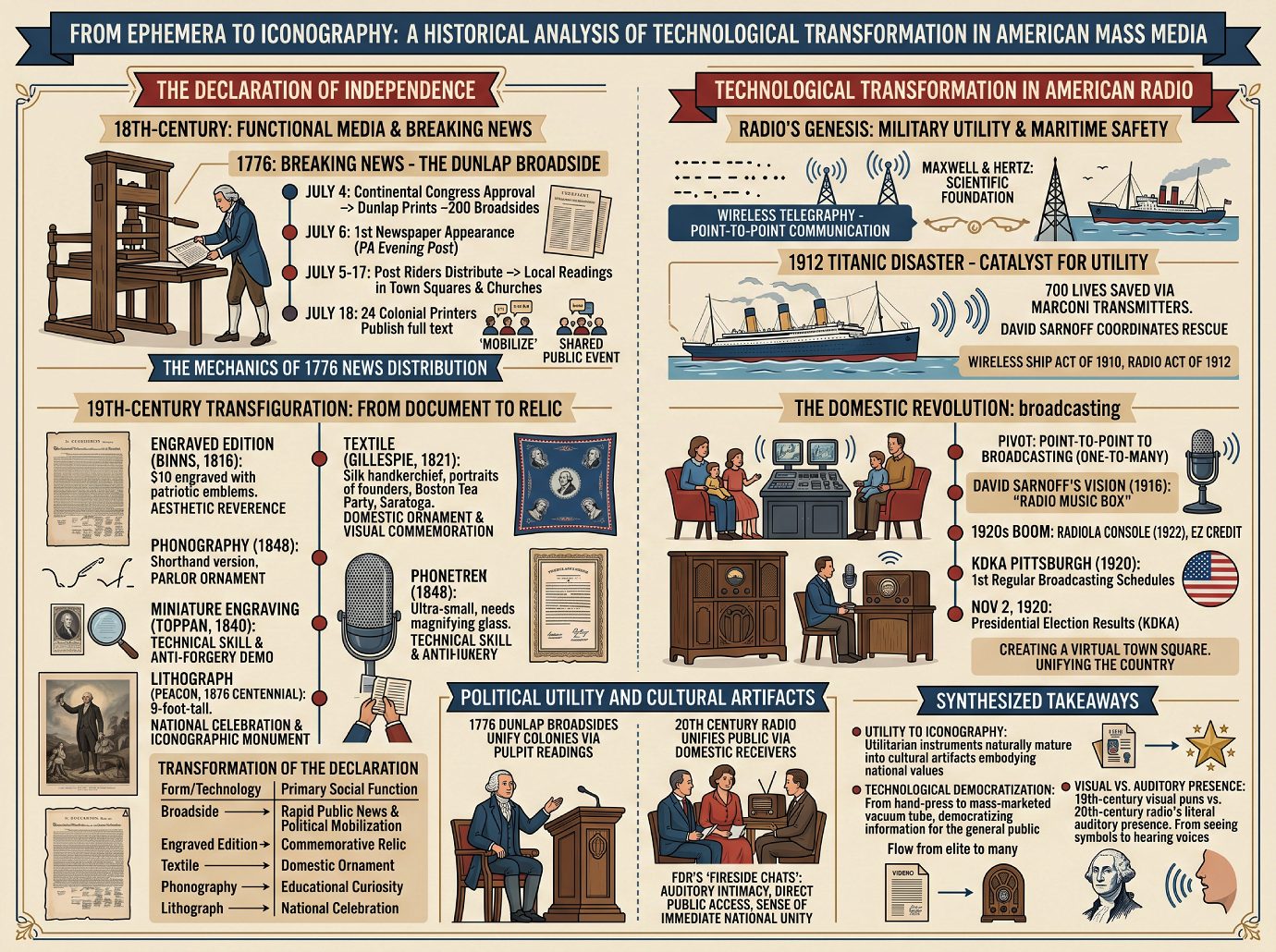
From Ephemera to Iconography: A Historical Analysis of Technological Transformation in American Mass Media
1. Introduction: The Dual Trajectory of Functional Media
This Historical Analysis Report delineates the strategic evolution of mass communication tools from utilitarian instruments into enduring cultural icons. For the curator of political history, it is essential to recognize that functional media—specifically the 18th-century news broadside and early 20th-century wireless telegraphy—possess a dual trajectory. They begin as tactical solutions for the rapid dissemination of data, yet they inevitably transcend their original utility to become foundational artifacts of national identity. This report establishes a parallel between the distribution of the Declaration of Independence and the rise of radio, arguing that technological shifts do not merely deliver information but fundamentally reconfigure the social, symbolic, and commercial value of the medium itself. By examining these non-static objects, we observe how the “breaking news” of one era is transfigured into the “precious relic” of the next. This transformation begins with the hand-operated press and the urgent mobilization of the American colonies in 1776.
2. The Declaration of Independence as 18th-Century Breaking News
In the summer of 1776, the American colonies faced a strategic mandate for rapid information dissemination to ensure the survival of the revolutionary cause. The approval of the Declaration of Independence was a high-stakes “breaking news” event, requiring a swift tiered rollout to build public support for a nascent, self-governing nation.
Following the Continental Congress’s approval on July 4, 1776, official printer John Dunlap undertook an extraordinary overnight effort to set the document’s 1,320 words into type. Working on a hand-operated press, he produced approximately 200 single-sheet “Dunlap Broadsides.” These were immediately dispatched via post riders to the thirteen colonies. By July 6, printer Benjamin Towne published the first newspaper edition in The Pennsylvania Evening Post, and by July 18, twenty-four colonial printers, including Ezekiel Russell in Salem, had shared the text. The social impact was immediate: the document was read aloud in town squares, taverns, and pulpits to mobilize the citizenry. In Charlton, Massachusetts, Reverend Caleb Curtis read the text from his pulpit on July 17, acting on state orders to ensure the word reached every parish. This localized auditory experience was the 18th-century equivalent of a national broadcast, turning the written word into a shared public event.
The Mechanics of 1776 News Distribution
- July 4: Continental Congress approves the text; John Dunlap prints ~200 broadsides overnight for immediate dispatch.
- July 6: Benjamin Towne publishes the first newspaper appearance in The Pennsylvania Evening Post.
- July 5–17: Post riders distribute broadsides to the colonies; local readings occur in town squares and churches (e.g., Reverend Caleb Curtis).
- July 18: Twenty-four colonial printers have published the full text, completing the initial “breaking news” cycle and severing political ties via the press.
3. The 19th-Century Transfiguration: From Document to Relic
By the 1810s, the cultural function of the Declaration shifted from a political notice to a “precious relic.” This era saw the commercialization and artistic reinvention of the document, as printers utilized new technologies to evoke the “living presence” of the founders. These artifacts were no longer just for reading; they were intended for domestic framing and display as symbols of patriotic identity.
In 1816, John Binns proposed a $10 engraved edition featuring patriotic emblems and facsimiled signatures, prioritizing aesthetic reverence over simple legibility. Competitors quickly adapted this iconography into diverse formats. In 1821, Robert and Collin Gillespie produced cambric silk handkerchiefs featuring portraits of Adams, Jefferson, and Washington, alongside historical vignettes such as “Patriotic Bostonians discharging the British Ships in Boston harbor” (The Boston Tea Party) and “General Burgoyne’s Surrender to General Gates at Saratoga.” In 1848, Dyer and Webster published a shorthand “phonography” version as a parlor ornament. Innovation also occurred on the micro-scale; in 1840, Charles Toppan produced an ultra-miniature engraving, readable only with a magnifying glass, to demonstrate technical skill in preventing bank note forgery. By the 1876 Centennial, William Peacon’s nine-foot-tall lithograph finalized this transition from document to massive iconographic monument.
Transformation of the Declaration
| Form/Technology | Primary Social Function |
|---|---|
| Broadside (Hand-operated press) | Rapid Public News & Political Mobilization |
| Engraved Edition (Binns/Toppan) | Commemorative Relic & Technical Demonstration (Anti-Forgery) |
| Textile (Gillespie Silk Handkerchief) | Domestic Ornament & Visual Historical Commemoration |
| Phonography (Shorthand Engraving) | Specialized Educational Curiosity & Parlor Ornament |
| Lithograph (Peacon Centennial Print) | National Celebration & Artistic Iconography |
4. Radio’s Genesis: Military Utility and Maritime Safety
Radio followed a similar trajectory, beginning not as entertainment but as “wireless telegraphy”—a point-to-point communication tool. Unlike the later “broadcasting” model, early wireless was a technical extension of the Morse telegraph (1835), utilizing a standardized language of dots and dashes for military and nautical safety.
The scientific foundation was laid by Maxwell and Hertz, with experimental work by Lodge and Bose exploring quasioptical waves. However, it was the 1912 Titanic disaster that served as the definitive catalyst for the medium’s transition into a vital safety utility. The use of Marconi transmitters saved 700 lives, and David Sarnoff, the land transmitter who helped coordinate the rescue, became a national hero. This event spurred the Wireless Ship Act of 1910 and the Radio Act of 1912, establishing government oversight and frequency regulation to ensure emergency signals were prioritized. This era was defined by technical utility, but Sarnoff soon envisioned a shift from this point-to-point telegraphy toward a domestic application that would reach the masses.
5. The “Radio Music Box”: Sarnoff and the Domestic Revolution
The strategic pivot from “point-to-point” communication to “broadcasting” (one-to-many) fundamentally reconfigured the American household. In 1916, David Sarnoff suggested using radio as a “radio music box,” a household utility. This vision was realized during the 1920s boom, facilitated by the 1922 Radiola console and the rise of “EZ credit” for middle-class acquisition.
In 1920, KDKA in Pittsburgh, under Dr. Frank Conrad, established the first regular broadcasting schedules. Notably, KDKA’s inaugural broadcast on November 2, 1920, covered the presidential election results, creating a modern bookend to the 1776 mobilization efforts. Radio created a “virtual town square,” allowing disparate family members across states to share identical entertainment experiences, such as Vaudeville skits and syndicated music, simultaneously. This technological shift re-localized the national experience, unifying the country through a shared auditory presence.
6. Political Utility and Cultural Artifacts
Technology provides political leaders with direct access to the public, moving from the silent authority of print to the “living presence” of the voice. Just as the Dunlap broadsides unified the colonies through pulpit readings, radio unified the 20th-century public through the domestic receiver.
The 1920 and 1924 election broadcasts allowed the public to hear the actions of conventions as they unfolded. This culminated in FDR’s “Fireside Chats,” where the president reached citizens directly in their homes and taverns. This auditory intimacy replaced the distant hearsay of newspapers with a sense of immediate national unity.
Synthesized Takeaways
- Utility to Iconography: Utilitarian instruments (Dunlap broadsides, maritime telegraphy) naturally mature into cultural artifacts that embody national values and identity.
- Technological Democratization: The transition from the hand-press to the mass-marketed vacuum tube democratized information, moving it from the hands of professional printers and telegraphers to the general public.
- Visual vs. Auditory Presence: Where 19th-century artists used visual puns—such as the 1865 Washington portrait composed entirely of calligraphic text—to evoke the presence of leaders, 20th-century radio provided a literal auditory presence, broadcasting the human voice directly into the domestic sphere.
7. Conclusion: The Persistence of Meaning Through Technological Change
The history of American media demonstrates that while technical means—the hand-operated press, the engraved plate, the vacuum tube—become obsolete, the signals and documents they produced endure as cultural icons. As AAS Curator Lauren Hewes notes, these artifacts are “non-static”; their meaning is continuously reshaped by how generations choose to display and celebrate them. The Dunlap Broadside and the early radio broadcast both began as ephemeral tools of functional urgency, but they were ultimately transfigured into icons that define the American experience. While the technology of delivery is in constant flux, the human desire to transform “breaking news” into a “national treasure” remains a constant of our history.