American Inventions – America 250 – a History of United States Innovation
This page contains 6 different reports on American Inventions.
Jump to a report: The Architecture of American Ingenuity: A Comprehensive Analysis of Transformative Inventions — 10 Patents That Rebuilt the World: The Surprising Stories Behind America’s Greatest Inventions — Beyond the Patent: 7 Mind-Bending Truths About the Inventions That Shaped America — Demystifying the World: The Science Behind History’s Greatest Inventions — The Ancestry of Innovation: How Yesterday’s Tools Built Today’s Tech — The Architecture of Progress: Foundational Technologies and the Transformation of the American Economy
Watch this very sharp and excellent video on American Inventions:
Listen to this DEEP DIVE on how American Inventions built Modern Life. CLICK PLAY.
What inventions impacted the United States the most? What were the most important? Listen to this debate on any device, CLICK PLAY.
America 250 – United States Inventions
The Architecture of American Ingenuity: A Comprehensive Analysis of Transformative Inventions
The Architecture of American Ingenuity: A Comprehensive Analysis of Transformative Inventions
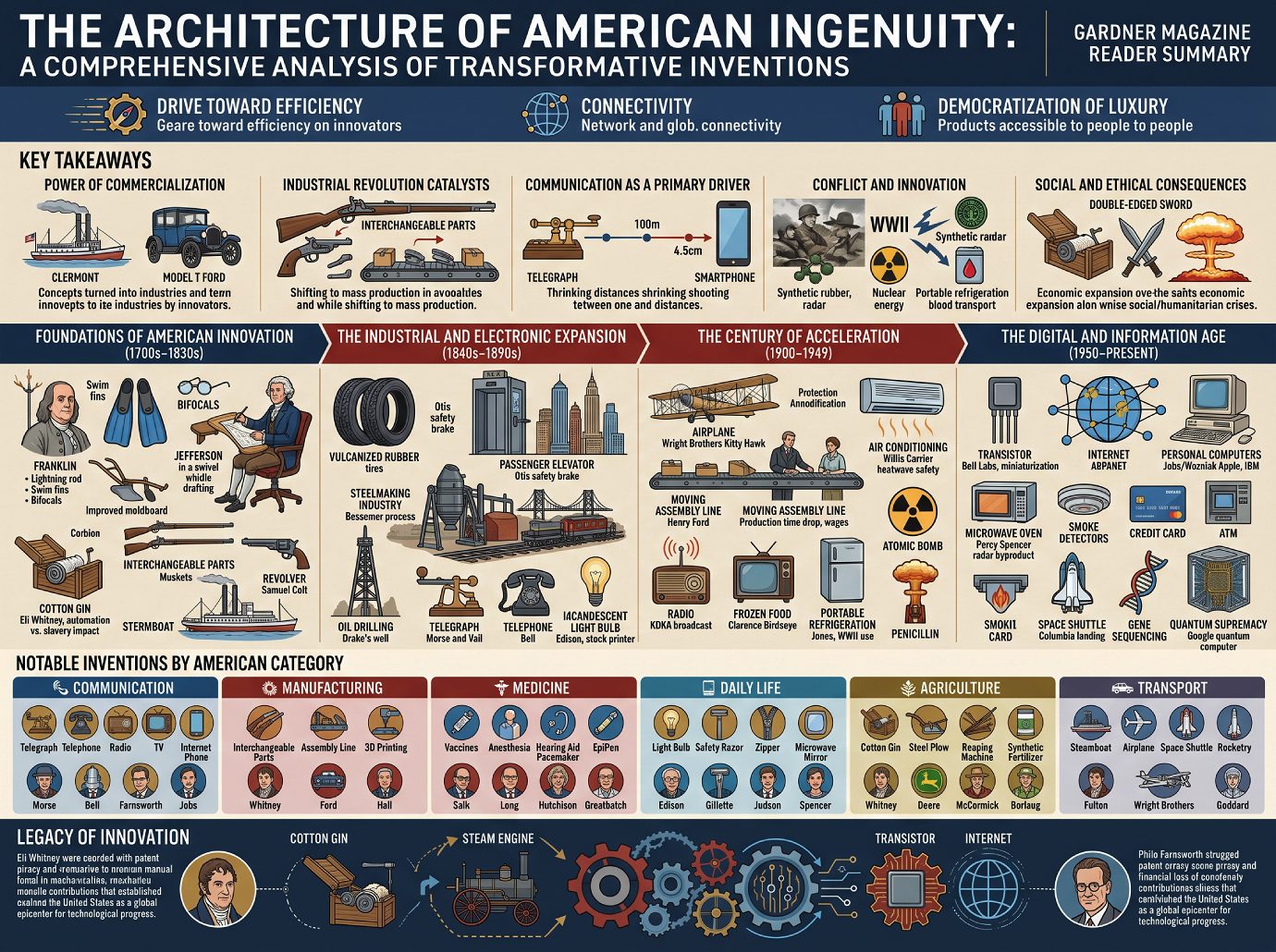
American innovation is characterized by a relentless drive toward efficiency, connectivity, and the democratization of luxury. From the early experiments of Benjamin Franklin to the quantum breakthroughs of the 21st century, American inventors have fundamentally reshaped the global landscape. Key takeaways include:
- The Power of Commercialization: Many iconic “American” inventions—such as the steamboat and the automobile—were not necessarily originated by Americans, but were perfected and commercialized by them (e.g., Robert Fulton and Henry Ford), turning experimental concepts into viable global industries.
- Industrial Revolution Catalysts: The introduction of interchangeable parts and the moving assembly line shifted the world from artisanal craftsmanship to mass production, lowering costs and making technology accessible to the common man.
- Communication as a Primary Driver: A significant portion of American ingenuity has focused on shrinking distances, beginning with the telegraph and telephone and evolving into the internet and mobile computing.
- Conflict and Innovation: World Wars I and II served as massive accelerators for technology, yielding breakthroughs in synthetic rubber, radar, nuclear energy, and portable refrigeration.
- Social and Ethical Consequences: Inventions like the cotton gin and the atomic bomb illustrate the “double-edged sword” of progress, where technological leaps have facilitated both economic expansion and profound social or humanitarian crises.
Foundations of American Innovation (1700s–1830s)
The earliest era of American invention was dominated by polymaths like Benjamin Franklin and Thomas Jefferson, who applied scientific principles to solve practical problems of daily life and governance.
The Franklin and Jefferson Influence
- Lightning Rod (1752): Benjamin Franklin’s experiments with electricity led to this application, which protected structures by conducting lightning bolts safely into the ground.
- Swim Fins (1717): Originally wooden palettes for the hands, Franklin’s design aimed to increase swimming speed.
- Bifocals (1784): Franklin is credited with creating lenses that allowed for both near and distance vision.
- The Swivel Chair (1776): Thomas Jefferson modified a Windsor chair with a central iron spindle, reportedly using it while drafting the Declaration of Independence.
- Improved Moldboard Plow: Jefferson designed an iron-faced plow in the late 1700s to improve agricultural efficiency.
Agricultural and Industrial Breakthroughs
- The Cotton Gin (1793/1794): Eli Whitney’s machine automated the separation of cotton fibers from seeds. While it revolutionized the Southern economy, it is also noted for making the slavery system more sustainable.
- Interchangeable Parts (1797): Whitney championed the use of standardized parts in musket manufacturing, laying the groundwork for modern mass production.
- The Steamboat (1807): Robert Fulton’s Clermont proved that steam power could be commercially viable for two-way river travel, traveling 150 miles upstream at 5 mph.
- The Revolver (1836): Samuel Colt’s design for a rotating cylinder allowed for multiple shots without reloading, a technology inspired by the mechanics of a ship’s wheel.
The Industrial and Electronic Expansion (1840s–1890s)
As the nation expanded, inventions moved toward stabilizing materials, improving health, and conquering distance through electricity.
Material Science and Infrastructure
- Vulcanized Rubber (1839/1843): After years of poverty and failed experiments, Charles Goodyear discovered that heating rubber with sulfur made it stable across temperature extremes, enabling the creation of tires and waterproof goods.
- The Passenger Elevator (1857): Elisha Graves Otis demonstrated a safety braking system that prevented elevators from falling if cables snapped, which directly enabled the rise of the skyscraper.
- Steelmaking Industry (1850s): The adoption of the Bessemer process scaled up steel smelting, stabilizing costs and allowing for the construction of massive bridges and rail networks.
- Oil Drilling (1859): “Colonel” Edwin Drake struck oil in Pennsylvania, initiating the petroleum revolution to meet the demand for kerosene.
The Dawn of Global Communication
- The Telegraph (1837/1844): Samuel Morse and Alfred Vail developed the telegraph and Morse Code, allowing for near-instantaneous communication over long distances. The first message, “What hath God wrought!”, was sent from the Supreme Court.
- The Telephone (1876): Alexander Graham Bell’s invention allowed for the transmission of the human voice over wires, a leap that Bell Labs later used to foster established scientific facilities.
- The Incandescent Light Bulb (1879): Thomas Edison perfected a commercially viable bulb, transforming the night into a period of productivity and safety. Edison eventually held over 1,000 patents, including the phonograph and the universal stock printer.
The Century of Acceleration (1900–1949)
The first half of the 20th century was defined by rapid urbanization and the technological demands of two world wars.
Transportation and Manufacturing
- The Airplane (1903): Orville and Wilbur Wright achieved the first sustained, controlled, powered flight at Kitty Hawk, NC. Their 12-horsepower engine changed global connectivity and warfare forever.
- The Moving Assembly Line (1913): Henry Ford revolutionized manufacturing by breaking down car assembly into turnkey tasks. This reduced production time for a Model T from hours to just 93 minutes and allowed Ford to double his workers’ wages.
- Air Conditioning (1902): Willis Carrier designed the first system to control temperature and humidity, which saved lives during heatwaves and eventually became critical for the operation of computer hardware.
Media and Consumer Goods
- Radio (1901/1920): After the first successful radio transmission in 1901, the first commercial station (KDKA) began broadcasting in 1920, delivering election results.
- Television (1927): Philo T. Farnsworth demonstrated the first electronic television system. Despite lengthy legal battles with RCA, his technology became the foundation of modern home entertainment.
- Frozen Food (1923/1929): Inspired by Inuit freezing techniques, Clarence Birdseye developed quick-freezing methods that preserved food quality, leading to the modern frozen food industry.
War and Medical Innovation
- Portable Refrigeration (1930s): Frederick Jones invented units for trucks that were essential during WWII for transporting food, blood, and medicine to the frontlines.
- The Atomic Bomb (1945): A team including J.R. Oppenheimer and Enrico Fermi developed the fission weapon used at Hiroshima and Nagasaki, marking a terrifying peak in military technology.
- Penicillin (1928/1940s): Formulated into a standardized antibiotic, it turned previously fatal infections into easily curable ones.
The Digital and Information Age (1950–Present)
Post-war innovation shifted toward miniaturization, digital networking, and space exploration.
The Computing Revolution
- The Transistor (1947): Developed at Bell Labs, this semiconductor device replaced bulky vacuum tubes, allowing for the miniaturization of all modern electronics.
- The Internet (1960s): Originating from U.S. government and ARPANET research, it evolved into a global network that democratized information.
- Personal Computers (1970s/1980s): Inventors like Steve Jobs and Steve Wozniak (Apple) and companies like IBM moved computers from industrial labs into homes, fostering a new era of digital creativity.
- GPS (1970s): Originally a military project by the Department of Defense, Global Positioning System technology now powers civilian navigation, logistics, and disaster response.
Modern Life and Safety
- The Microwave Oven (1946): Percy Spencer discovered microwave cooking as a byproduct of radar technology, revolutionizing home meal preparation.
- Smoke Detectors (1960s): The commercialization of replaceable battery smoke detectors significantly reduced fire-related fatalities in American homes.
- Financial Convenience: The 1950s saw the birth of the Credit Card, followed by the ATM in the late 1960s, both of which transformed consumer spending and banking.
The New Frontiers
- The Space Shuttle (1981): A groundbreaking reusable spacecraft that took off like a rocket and landed like an airplane, operating for decades as a laboratory for space experiments.
- Gene Sequencing (1970s): Techniques were invented to sequence the human genome, unlocking secrets of human nature and health.
- Quantum Supremacy (2019): Google claimed to reach a state where quantum computers could perform calculations at speeds unachievable by traditional supercomputers, marking the start of a new era in computational power.
Notable Inventions by American Category
| Category | Key Inventions | Notable Inventors |
|---|---|---|
| Communication | Telegraph, Telephone, Radio, Television, Internet, Cell Phone | Morse, Bell, Farnsworth, Jobs |
| Manufacturing | Interchangeable Parts, Assembly Line, 3D Printing | Whitney, Ford, Chuck Hall |
| Medicine | Vaccines, Anesthesia, Hearing Aid, Pacemaker, EpiPen | Salk, Long, Hutchison, Greatbatch |
| Daily Life | Light Bulb, Safety Razor, Zipper, Microwave, Mirror | Edison, Gillette, Judson, Spencer |
| Agriculture | Cotton Gin, Steel Plow, Reaping Machine, Synthetic Fertilizer | Whitney, Deere, McCormick, Borlaug |
| Transport | Steamboat, Airplane, Space Shuttle, Rocketry | Fulton, Wright Brothers, Goddard |
Legacy of Innovation
The history of American invention is not merely a list of objects but a record of systemic shifts. The transition from manual labor to mechanization (Cotton Gin, Steam Engine), and later from analog to digital (Transistor, Internet), highlights a consistent theme of increasing the velocity of human activity. While many inventors, such as Eli Whitney and Philo Farnsworth, struggled with patent piracy and financial loss, their contributions established the United States as a global epicenter for technological progress. ————————
10 Patents That Rebuilt the World: The Surprising Stories Behind America’s Greatest Inventions
Introduction: The Spark in the Machine
We live in a world defined by invisible miracles. Every time you flip a toggle to illuminate a room, glance at a notification on a glass slab in your pocket, or board a pressurized tube to cross an ocean in hours, you are interacting with the culmination of an arduous lineage of American innovation. These shifts in our daily existence are so seamless that we rarely pause to consider the profound socio-economic revolutions that birthed them.
America’s history is a narrative written not just in treaties and battlefields, but in the workshop and the laboratory. It is defined by landmark projects that remapped the possible and high-stakes “wildcards”—inventions that began as the obsessive dreams of outsiders before becoming absolute necessities. By tracing the human story behind these patents, we find a saga of persistence, unintended consequences, and the enduring drive to tame the environment and shrink the map.
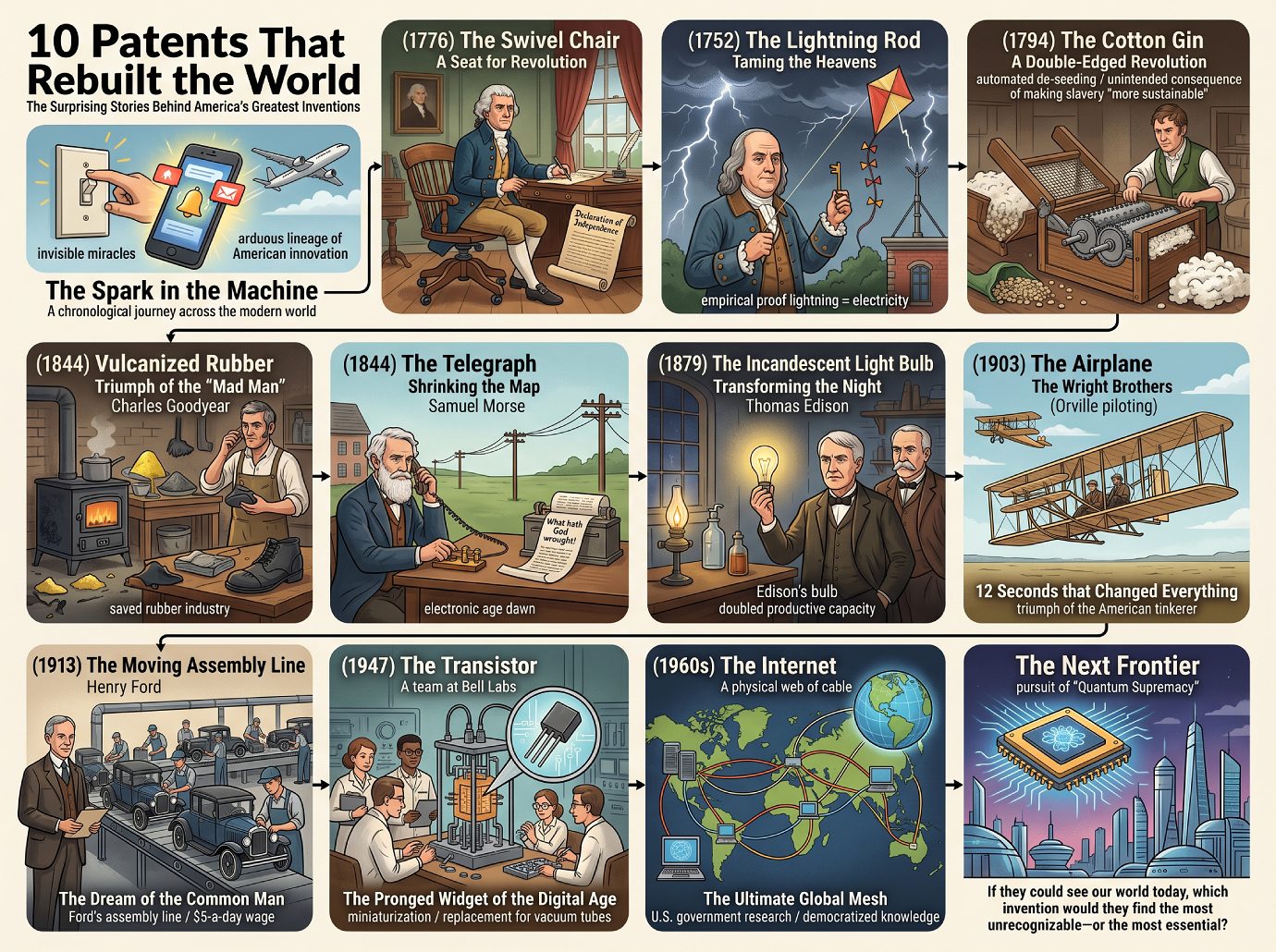
1. The Swivel Chair: A Seat for Revolution (1776)
Innovation is often born from the simple need for greater utility. In the early months of 1776, Thomas Jefferson took a standard English-style Windsor chair and fundamentally altered its mechanics. By incorporating a central iron spindle between the top and bottom sections, he enabled the seat to rotate 360 degrees on window-style casters.
While the mechanical shift was modest, the context was monumental. It was from this very chair, while the Second Continental Congress convened in Philadelphia, that Jefferson drafted the Declaration of Independence. It serves as a rare example of a mechanical invention facilitating a political breakthrough; the chair provided the literal and metaphorical pivot point for the birth of a nation. This modest piece of furniture reminds us that even the loftiest ideals of democracy required a practical space in which to be articulated.
2. The Lightning Rod: Taming the Heavens (1752)
Before the mid-18th century, lightning was viewed primarily through the lens of terror—a divine omen or an unstoppable act of a vengeful nature. Benjamin Franklin changed this perception forever with his 1752 “electrical kite” experiment. By drawing a charge from a storm, he provided the empirical proof that lightning and electricity were identical forces.
This scientific epiphany led directly to the application of the lightning rod. When placed at the apex of a structure, the rod conducted bolts harmlessly into the ground, protecting the flammable timber cities of the era. This invention represented a massive psychological shift in the human story: it was the moment humanity moved from fearing “divine” natural forces to understanding and managing them through physics. As Franklin mastered the heavens, he paved the way for a century that would soon learn to harness that same electricity for communication.
3. The Cotton Gin: A Double-Edged Revolution (1794)
In 1794, Eli Whitney patented a machine designed to automate the laborious process of de-seeding green seed cotton. Using a system of rotating teeth and a mesh screen, his “cotton gin” could process in a single hour what previously took a worker an entire day to complete by hand.
However, the outcome of this invention was profoundly counter-intuitive. While it revolutionized the economy and made cotton the primary cash crop of the South, it also made the slavery system “more sustainable” by exponentially increasing the demand for land and labor. Whitney’s story is also a cautionary tale of the patent system’s early struggles; despite the machine’s massive economic impact, Whitney himself saw little profit as his design was widely pirated by farmers who built their own “bogus” versions rather than purchasing his patented machine.
4. Vulcanized Rubber: The Triumph of the “Mad Man” (1844)
The story of Charles Goodyear is one of “stubborn and tenacious” persistence bordering on the pathological. In the early 1830s, the rubber industry was collapsing because the material was unstable—melting into goo in the summer and cracking like glass in the winter. Goodyear, a man with no formal knowledge of chemistry, spent a decade in abject poverty, frequently jailed for debt, while pursuing a solution.
“When his experiments with rubber continually failed, Goodyear reduced his family to poverty, was jailed for debt and derided by society as a mad man.”
In 1844, Goodyear finally patented the process of “vulcanization”—heating rubber with sulfur to create a durable, weather-resistant material. His obsession saved an entire industry and laid the foundation for the modern age of tires and industrial hoses. He proved that the “wildcard” tinkerer, through sheer grit, could solve problems that had baffled the scientific establishment.
5. The Telegraph: Shrinking the Map (1844)
Before the mid-19th century, information could only move as fast as a horse could gallop or a ship could sail. Samuel Morse shattered this geographic limitation in 1844 when he demonstrated the first long-distance telegraph message, sent from the Supreme Court chambers in Washington, D.C., to a terminal in Baltimore.
“What hath God wrought!”
This first message marked the dawn of the electronic age. By allowing information to move at the speed of electricity, the telegraph essentially shrunk the world, enabling real-time coordination of business and government across vast distances. Just as Goodyear’s rubber allowed for physical travel, Morse’s pulses of light and sound allowed the human mind to inhabit two places at once, setting the stage for the literal illumination of the American home.
6. The Incandescent Light Bulb: Transforming the Night (1879)
While he did not “invent” the concept of artificial light, Thomas Edison’s 1879 patent for a commercially viable incandescent bulb was the spark that ignited the modern city. Backed by substantial research funds from investors like J.P. Morgan, Edison’s bulb replaced hazardous gas lamps and expensive candles with safe, affordable illumination.
The true impact was the wholesale transformation of the night. It turned the evening into a time of “unprecedented activity” and spurred massive urban growth. By making the workday and social life independent of the sun, Edison’s invention effectively doubled the productive capacity of human civilization. This shift from flame to filament moved the American story into its next phase: the conquest of the air itself.
7. The Airplane: 12 Seconds that Changed Everything (1903)
In 1903, at Kitty Hawk, North Carolina, Orville and Wilbur Wright achieved 12 seconds of sustained, controlled flight, covering 120 feet. The significance of this feat lies in the identity of the inventors: the brothers were self-taught mechanics with no formal engineering degrees. While the academic establishment struggled with the theory of flight, the Wrights used a bicycle-shop-funded wind tunnel and tireless trial and error to master the mechanics of bird-like control.
Their success was the ultimate triumph of the American tinkerer over the credentialed academic. This breakthrough did more than provide a new way to travel; it fundamentally reshaped our perception of distance. By proving that humans could steer a powered machine in the air, the Wrights initiated an age of global connectivity where continents were separated by hours rather than months.
8. The Moving Assembly Line: The Dream of the Common Man (1913)
Henry Ford did not invent the car, but his 1913 implementation of the moving assembly line and automatic conveyor belt redefined the Industrial Revolution. By breaking production into simple, repetitive tasks, his Michigan factory began producing a complete Model T every 93 minutes.
The human impact of this engineering project was profound. Ford increased wages to an unprecedented $5-a-day, ensuring his own workers could afford to purchase the cars they were building. This innovation shifted the automobile from a luxury toy for the elite into an essential tool for the common man. As physical production reached its zenith of efficiency, the next great frontier was the miniaturization of the very circuits that powered the world.
9. The Transistor: The Pronged Widget of the Digital Age (1947)
In 1947, a team at Bell Labs invented the transistor, a tiny semiconducting “widget” designed to replace bulky, heat-producing vacuum tubes. This invention enabled “miniaturization”—the ability to pack immense computing power into microscopic spaces.
The transistor is the silent foundation of nearly every modern convenience. It made microchips possible, which in turn powered the computer revolution and the smartphones we carry today. It is the invisible engine of the digital age, a breakthrough that allowed for the creation of a global mesh that would eventually connect every human being on the planet.
10. The Internet: The Ultimate Global Mesh (1960s)
The roots of the internet trace back to U.S. government research in the 1960s. Far from being an abstract “cloud,” the internet was and is a monumental engineering project—a physical web of cables that blankets the nation and the world.
It began as a network to link government labs and universities, but it evolved into a force that democratized knowledge and created entirely new economies once thought unimaginable. It is the ultimate global infrastructure, fostering digital globalization and touching every aspect of modern life. This “web of cables” represents the final stage of our current era of connectivity, even as we begin to look toward a future that transcends classical physics.
Conclusion: The Next Frontier
These ten inventions followed a strikingly similar trajectory: they began as startling novelties, often pursued by “mad men” or self-taught tinkerers, before transitioning into things we now take for granted. We stand today on the cusp of a new shift, such as the pursuit of “Quantum Supremacy”—the point where quantum computers reach the warp-speed promise of processing that will make today’s silicon chips look as primitive as Jefferson’s swivel chair.
As we look back at this lineage of progress, it raises a compelling thought: If these ten men and women could see our world today, which invention would they find the most unrecognizable—or the most essential? —————————–
Beyond the Patent: 7 Mind-Bending Truths About the Inventions That Shaped America
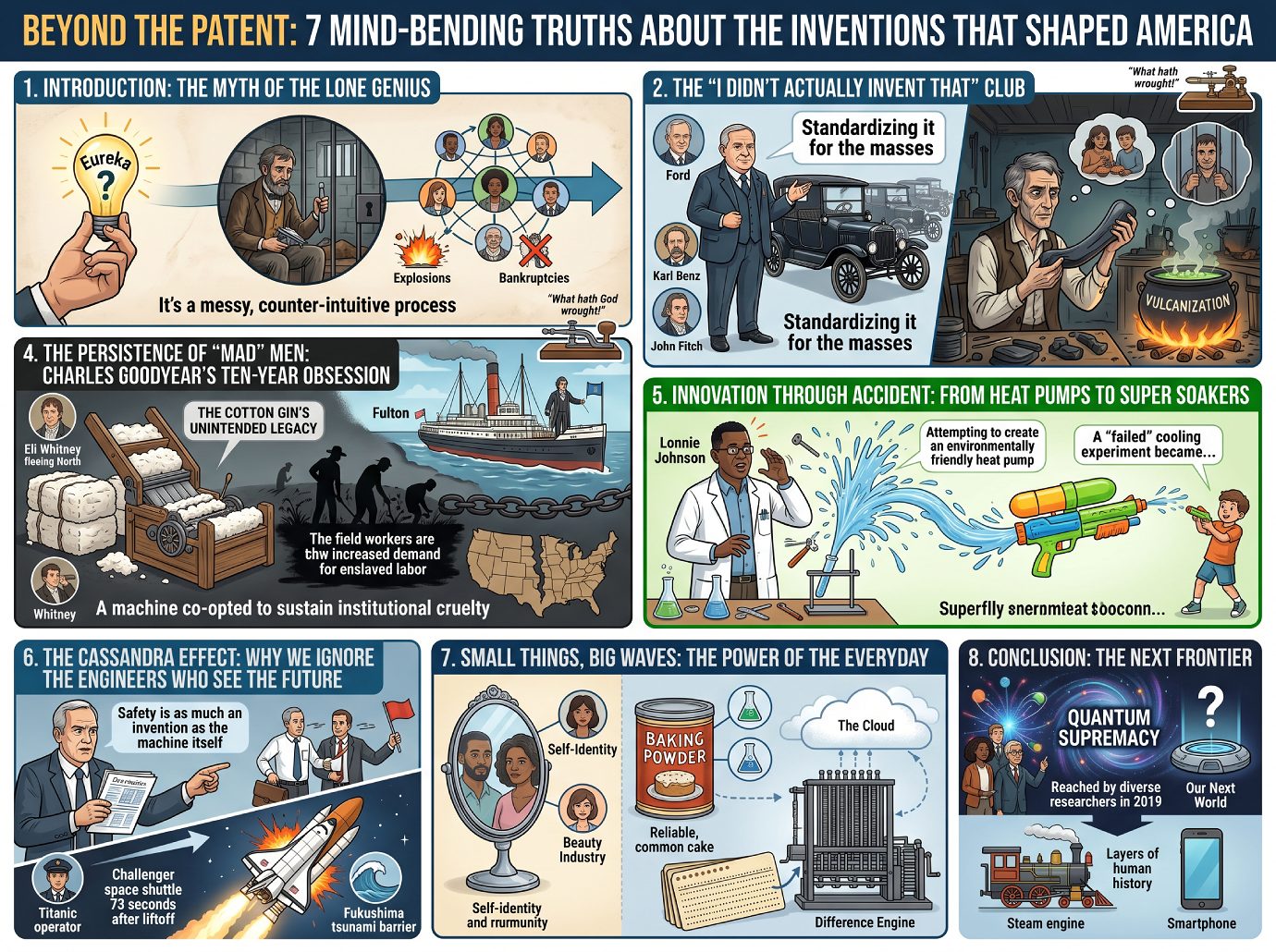
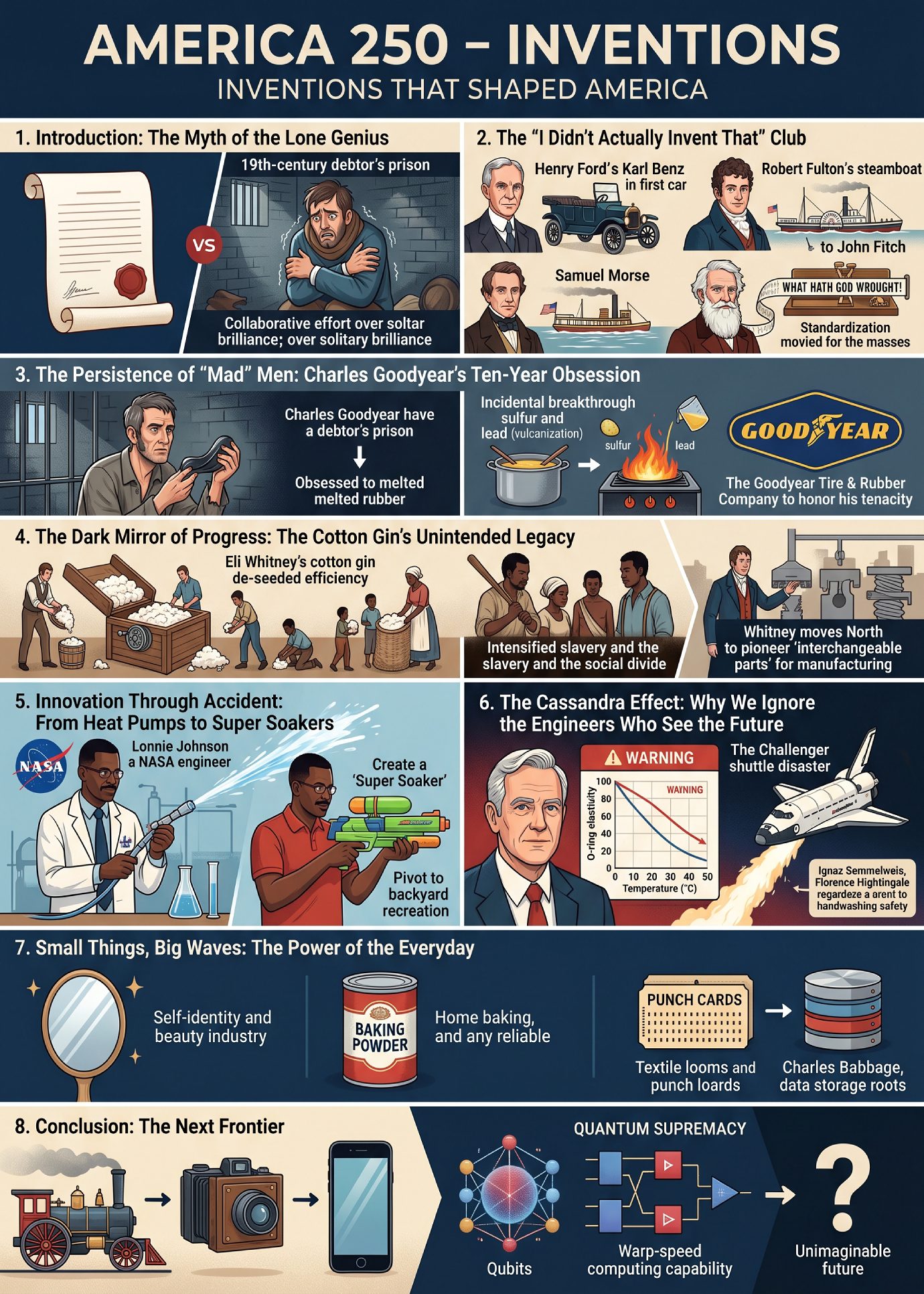
1. Introduction: The Myth of the Lone Genius
Picture a pristine, wax-sealed parchment in a quiet patent office, then contrast it with a desperate man shivering in a 19th-century debtor’s prison. We have been sold a sanitized version of history where progress arrives in a single, solitary lightning bolt of brilliance. The truth is far grittier, defined more by collaborative sweat and catastrophic failure than by “Eureka” moments.
Why do we obsess over a handful of famous names while the true pioneers—the ones who actually survived the first explosions and bankruptcies—vanish into the archives? This curiosity reveals that innovation is rarely about having the first idea. It is a messy, counter-intuitive process of trial, error, and social transformation.
This narrative explores five centuries of the American experience, looking at the accidents and ignored warnings that built our modern world. From the unintended consequences of agricultural tools to the “failed” lab tests that became cultural icons, we are looking at the true DNA of progress. It is a journey through the “what ifs” and the “nearly missed” moments of human ingenuity.
2. The “I Didn’t Actually Invent That” Club
Many of the titans of American industry did not actually invent the machines that made them legendary. While Henry Ford is the face of the automobile, the first true car is credited to Karl Benz of Germany. Similarly, Robert Fulton is celebrated as the father of the steamboat, yet the first steam-powered vessel was the work of John Fitch.
The distinction lies in the chasm between inventing a technology and standardizing it for the masses. Ford’s true genius was not the car itself, but the process: he famously slashed the time required to build a Model T from 12.5 hours to just 93 minutes. He and Fulton provided the “tipping point” by moving these ideas into the realm of the usable and affordable.
Even the telegraph, the internet of its day, was a collaborative marathon rather than a sprint by Samuel Morse. While Morse provided the standardized code, he relied on a network of innovators to make the hardware sing. He signaled this shift with a message sent from the Supreme Court that still haunts our technological ambition:
“What hath God wrought!”
3. The Persistence of “Mad” Men: Charles Goodyear’s Ten-Year Obsession
In the mid-1830s, the American rubber industry was collapsing because the material was an unstable goo, melting in summer and cracking in winter. The man who saved it, Charles Goodyear, possessed absolutely no formal training in chemistry. He was driven by a decade-long obsession that reduced his family to starvation and landed him in debtor’s prison multiple times.
Goodyear was derided as a madman, yet his tenacity eventually led to an incidental breakthrough that saved the industry. In 1839, he discovered that heating rubber with a specific sulfur-and-lead process rendered the material melt-proof and reliable. This process, known as vulcanization, was born from his tireless refusal to accept the “fatal flaw” of natural rubber.
The irony of Goodyear’s life is that he never saw the massive wealth his tenacity generated for others. He died in 1860, still struggling to protect his patents against those who sought to profit from his suffering. The Goodyear Tire & Rubber Company was named posthumously by two brothers who simply wanted to honor the “madman” who made their product possible.
4. The Dark Mirror of Progress: The Cotton Gin’s Unintended Legacy
Technology is never neutral; it scales the social systems it is introduced into, often with devastating results. Eli Whitney’s cotton gin, patented in 1794, was a mechanical marvel that could de-seed a day’s worth of cotton in just one hour. It was designed to solve a labor bottleneck, but it inadvertently made the slavery system in the Southern U.S. more profitable.
By making “King Cotton” a viable global cash crop, Whitney’s invention increased the demand for enslaved labor and land. This transformed the agricultural economy while deepening the social divide that eventually tore the nation apart. It is a haunting precedent for how a machine designed for efficiency can be co-opted to sustain institutional cruelty.
Whitney’s personal story took a sharp turn when his patent was pirated by Southern plantation owners who refused to pay him. Penniless and frustrated, he fled to the North and pivoted his mechanical genius toward a different kind of progress. He eventually pioneered “interchangeable parts” for the U.S. Army, a move that effectively birthed the modern American manufacturing system.
5. Innovation Through Accident: From Heat Pumps to Super Soakers
Not every breakthrough begins with a grand laboratory plan. Many of history’s most famous discoveries—from saccharin to vulcanization—occurred while researchers were looking for something else entirely. A classic example of this “pivot” is the story of Lonnie Johnson, a former NASA and Air Force engineer.
In 1982, Johnson was attempting to create an environmentally friendly heat pump that used water instead of Freon. During a laboratory test, a nozzle failed and shot a powerful, high-pressure stream of water across his bathroom. Instead of seeing a failure, Johnson recognized the potential for a cultural phenomenon and pivoted his research toward play.
This “failed” cooling experiment became the Super Soaker, a toy that redefined backyard recreation and generated millions. It serves as a sharp reminder that the most successful inventors are those who recognize when an accident has more value than their original goal. Innovation often requires the humility to follow the data where it leads, even if it leads to the toy aisle.
6. The Cassandra Effect: Why We Ignore the Engineers Who See the Future
The most critical part of an invention isn’t the hardware, but the “human protocol” that governs its use. Throughout history, “Cassandras”—named after the prophet cursed to never be believed—have warned of impending disasters, only to be overruled by managers. A haunting example is Roger Boisjoly, the engineer who tried to stop the Challenger launch in 1986.
Boisjoly provided data showing that the shuttle’s O-ring seals lost elasticity at temperatures below 53°F. Because NASA was under intense schedule pressure, his urgent warnings about the 36°F launch conditions were dismissed. The shuttle exploded 73 seconds after liftoff, exactly as his data predicted, grounding the program for years.
Boisjoly belongs to a haunted lineage of ignored voices, including the operators who warned the Titanic about ice fields and the geologist who warned about the Fukushima tsunami. This pattern shows that safety is as much an invention as the machine itself. We see this in the tragic legacy of Ignaz Semmelweis, who discovered that handwashing saved lives before helping Florence Nightingale apply it during the Crimean War.
7. Small Things, Big Waves: The Power of the Everyday
While rockets and computers capture the headlines, subtle inventions often trigger the most profound social shifts. These “wildcards” changed the American landscape in quiet but irreversible ways:
- The Silver-Backed Mirror (1835): Once an expensive luxury, this invention turned gazing at one’s reflection into a “populist pastime.” It did more than show a face; it birthed the modern concept of self-identity and fueled the multi-billion-dollar beauty industry.
- Baking Powder (1856): Before this chemical leavener, bakers relied on fickle yeast or whipped egg whites. This simple powder transformed home baking into a reliable science, making the common cake a staple of the American household.
- Punch Cards (1837): Originally used to automate textile looms, Charles Babbage adapted these cards for his “difference engine.” These physical cards are the analog roots of “the cloud,” proving that data storage began in the factory, not the lab.
8. Conclusion: The Next Frontier
The history of American innovation proves that we are the beneficiaries of “mad” persistence, lucky accidents, and ignored warnings. Progress is rarely a straight line; it is a zig-zagging path carved out by people who refused to stop when things got messy. From the first steam engines to the smartphones in our pockets, every tool is a layer of human history.
The next “changed America” moment may have already arrived in the form of “Quantum Supremacy.” Reached by researchers in 2019, this is a hypothetical state where computers reach a warp-speed capability that defies our current understanding of physics. It represents a potential leap that could make our current digital world look like a collection of stone tools.
If the inventors of the mirror or the assembly line couldn’t see the world they were creating, what are we building today? We are currently shaping a future that will likely be unrecognizable to us 100 years from now. The only certainty is that the most important breakthroughs will likely come from the things we currently consider accidents. ——————————–
Demystifying the World: The Science Behind History’s Greatest Inventions
1. Introduction: The Curiosity of “Why”
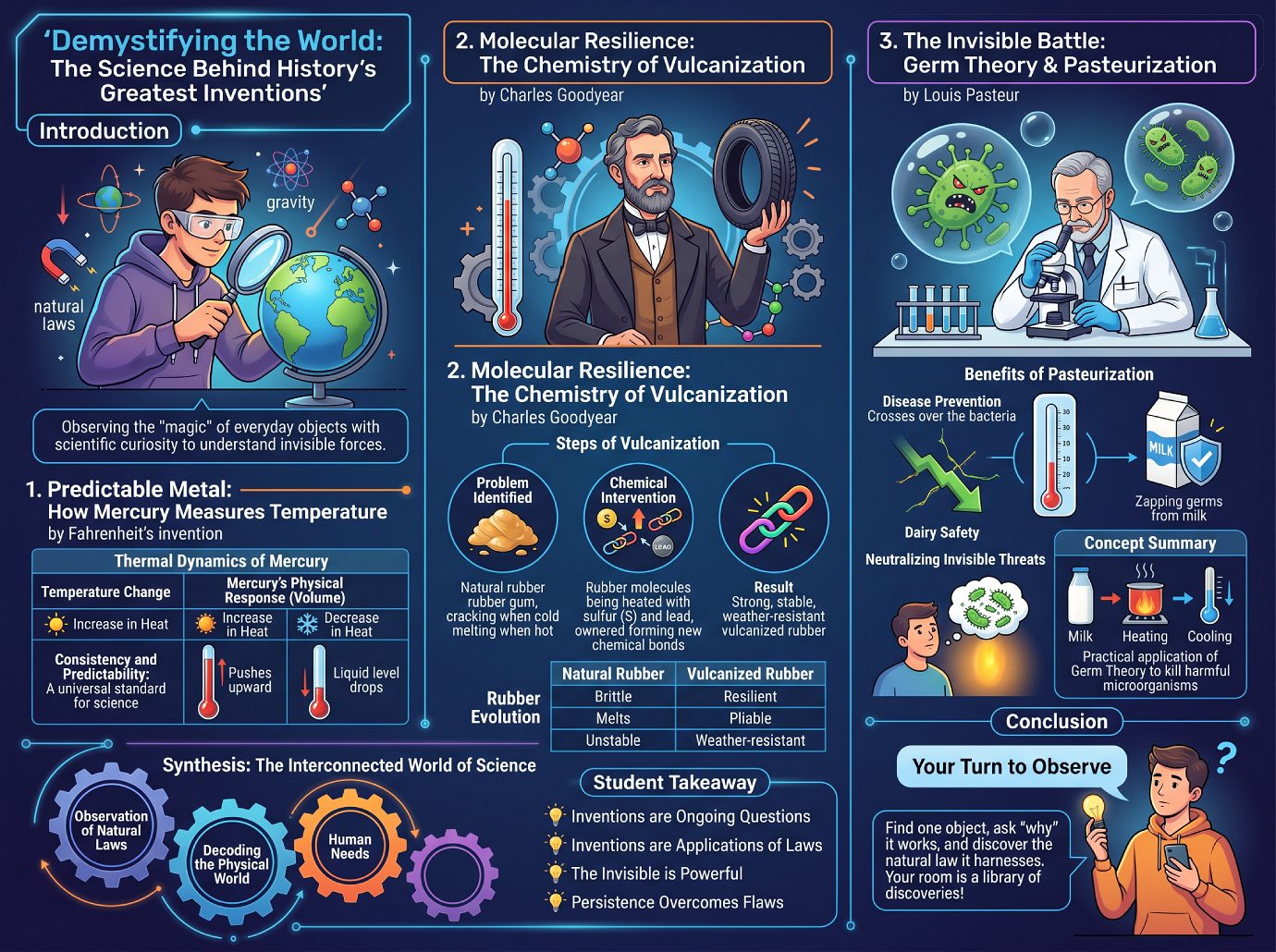
We live in an age of technological miracles masquerading as everyday objects. We check a thermometer during a fever, rely on the molecular resilience of the tires on our school buses, and drink milk with the quiet confidence that it is safe to consume. To the casual observer, these are merely tools of convenience. To the student of science, however, they are the triumphant results of deciphering the hidden laws of the physical world. The “magic” of these inventions is, in reality, the disciplined application of predictable natural behaviors.
Scientific curiosity is the bridge between observing an object and understanding the universe. By relentlessly asking “why,” we stop being mere consumers of technology and become investigators of the invisible forces that govern our existence.
The goal of this exploration is to pull back the curtain on three transformative scientific milestones. We will examine how the expansion of metals, the chemical reorganization of polymers, and the management of microbiology were harnessed to safeguard and advance human life. Our journey begins with a look at how a unique liquid metal provided the first exact language for the invisible energy we call heat.
2. The Predictable Metal: How Mercury Measures Temperature
In 1714, Gabriel Fahrenheit addressed a significant hurdle in the scientific community: the lack of a truly precise method for measuring temperature. While earlier sensing devices existed, they could not meet the demands of a world seeking exactness. Fahrenheit’s breakthrough centered on the specific physical properties of mercury.
The core scientific principle at play is the predictable physical behavior of mercury as a liquid metal. Unlike many substances that react erratically to environmental shifts, mercury responds to thermal energy with mathematical consistency.
Thermal Dynamics of Mercury
| Temperature Change | Mercury’s Physical Response (Volume) |
|---|---|
| Increase in Heat | The metal’s volume expands with precision, pushing the liquid upward. |
| Decrease in Heat | The volume contracts (shrinks), causing the liquid level to drop. |
Key Insight: Consistency and Predictability Mercury was superior to previous technologies because it provided a “predictable, extremely consistent instrument.” Because it is a liquid metal that behaves the exact same way across a wide range of temperatures, it allowed scientists to establish a universal standard, ensuring that a measurement taken in one lab would finally match a measurement taken in another.
While scientists were mastering the behavior of liquid metals, others were engaged in a decade-long struggle to stabilize a solid material that seemed determined to fall apart under those very same temperature changes.
3. Molecular Resilience: The Chemistry of Vulcanization
In the early 1800s, natural rubber was a substance of immense potential but possessed a “Fatal Flaw.” It was highly sensitive to temperature extremes: it became brittle and cracked in the winter, then melted into a useless “goo” during the summer. Between the 1830s and 1843, inventor Charles Goodyear—despite having no formal knowledge of chemistry—embarked on a ten-year quest to solve this instability through the process of vulcanization.
The Three Steps of Vulcanization
- Identification of the Problem: Recognizing that natural rubber’s instability (brittleness vs. melting) made it impractical for industrial or consumer use.
- The Chemical Intervention: After years of trial and error, Goodyear discovered that uniformly heating rubber fortified with sulfur and lead triggered a fundamental change in the material.
- The Result: This process rendered the rubber “melt-proof” and reliable, transforming it into a soft, pliable substance unaffected by temperature.
Comparison Highlight: Rubber Evolution
- Natural Rubber
- Unstable and highly weather-dependent.
- Freezes solid and cracks in cold conditions.
- Melts into a sticky substance in heat.
- Vulcanized Rubber
- Molecularly resilient and durable.
- A “soft, pliable substance unaffected by temperature.”
- Weather-resistant and suitable for tires, shoes, and industrial belts.
This mastery over how solid materials react to heat provided the foundation for a new scientific frontier: the study of the invisible organisms that exist within our food and environment.
4. The Invisible Battle: Germ Theory and the Pasteurization Process
By the mid-1800s, science shifted from the visible to the microscopic. For centuries, humanity blamed “miasma” (bad air) for disease. This changed with the emergence of Germ Theory, the realization that bacteria were the true culprits of illness. In 1863, Louis Pasteur provided one of the most immediate and urgent applications of this theory to solve the human problem of food safety through Pasteurization.
The Benefits of Pasteurization for Human Health
- Disease Prevention: By identifying bacteria as the specific cause of infection, the process moves from guesswork to targeted biological defense.
- Dairy Safety: The process specifically “zaps” the germs from fresh milk, which was historically a common source of grave illness.
- Neutralizing Invisible Threats: It allows for the destruction of organisms that are “invisible to the naked eye” but capable of causing fatal health outcomes.
Concept Summary: “Zapping” Germs
Pasteurization is the practical application of Germ Theory used to kill harmful microorganisms (germs) without destroying the product itself. By using controlled heat to “zap” these biological threats, we ensure that modern staples like dairy are safe for public consumption and free from the invisible dangers of the microbial world.
These three discoveries—temperature measurement, material stabilization, and microbiological control—work together to form the bedrock of a safe, predictable modern life.
5. Synthesis: The Interconnected World of Science
The common thread through these milestones is the rigorous observation of natural laws. Whether observing the expansion of mercury, the chemical reaction of sulfur, or the lifecycle of bacteria, these inventions were not accidental “finished products.” They were the result of human beings successfully decoding the laws of the physical world to solve urgent needs.
Student Takeaway
- Inventions are Ongoing Questions: Do not view a thermometer or a tire as a final answer. Each is an ongoing question regarding how we can better measure, manipulate, and protect our environment.
- Inventions are Applications of Laws: Technology is simply a natural law (like thermal expansion) given a functional shape (like a glass tube).
- The Invisible is Powerful: As Pasteur proved, the things we cannot see (germs and molecular bonds) often have a greater impact on our lives than the things we can.
- Persistence Overcomes Flaws: Progress often requires decades of reconciliating a material’s natural behavior with society’s requirements.
6. Conclusion: Your Turn to Observe
The history of discovery proves that you do not need an elite laboratory to change the world; you need a keen eye and a persistent mind. Charles Goodyear had no formal chemistry training, and the Wright brothers were simply bicycle mechanics. Yet, they transformed the world through observation and tenacity.
Your challenge: Find one “everyday object” in your room—a battery, a mirror, or even a piece of plywood. Ask yourself “why” it works the way it does. What natural law is it harnessing? Once you begin looking for the science behind the object, your room is no longer just a collection of things—it is a library of fascinating discoveries waiting for you to understand them. —————————–
The Ancestry of Innovation: How Yesterday’s Tools Built Today’s Tech
1. Introduction: The Great Technological Relay Race
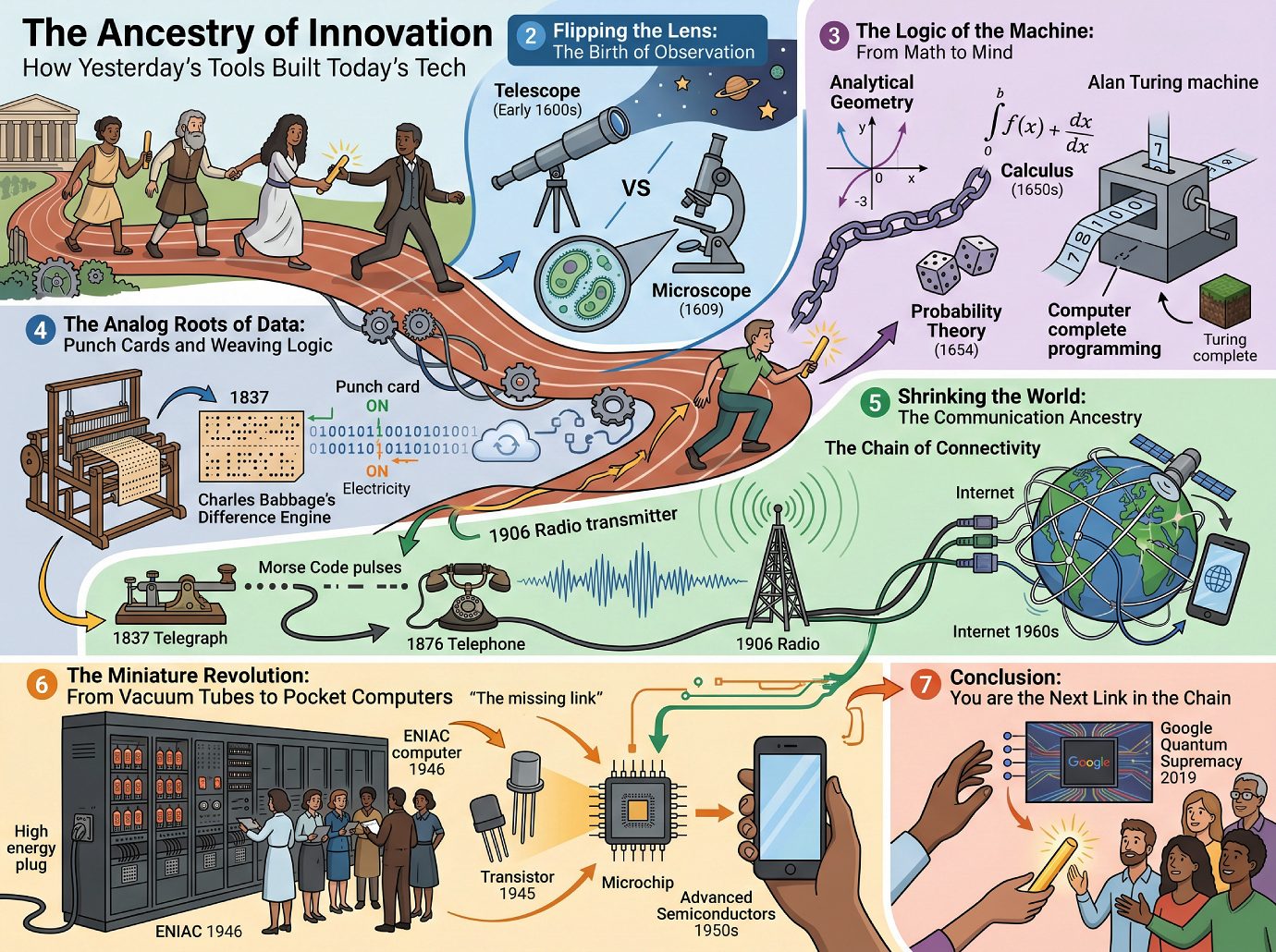
The story of human progress is often told through “eureka” moments—sudden flashes of genius where an isolated inventor creates a marvel out of thin air. In reality, the history of science and technology is much more like a relay race. No single inventor runs the entire course; instead, each generation carries the baton forward, meticulously building upon the foundations laid by their predecessors.
To understand the complexity of our modern world, we must realize that our smartphones, high-speed networks, and medical breakthroughs are actually the “grandchildren” of mechanical and analog ancestors. Every digital tool we hold is a collection of ancient concepts refined over centuries. This journey of discovery follows a specific path of learning: before we could build the computers of today, we first had to learn how to see the invisible.
2. Flipping the Lens: The Birth of Observation
Our digital age depends on our ability to observe things that are either too far away or too small for the naked eye to perceive. This journey began in the early 1600s with a simple but profound piece of technology: the magnifying lens.
Hans Lippershey, a pioneer of optical tools, realized that lenses could be used to bend light to our advantage. His core insight was that the same magnifying technology used to peer into the heavens could be reversed to look at the microscopic world. By “flipping the lens,” Lippershey and his contemporaries moved humanity from merely wondering about the stars to documenting the very building blocks of life, such as cells, which were observed just 60 years after his patent.
| Feature | The Telescope (Early 1600s) | The Microscope (1609) |
|---|---|---|
| Shared Technology | Magnifying lens fitted into a tube. | Compound magnifying lenses (the telescope “in reverse”). |
| Primary Goal | Observing distant objects like stars and planets. | Observing the invisible world of tiny structures. |
| Key Result | Expanded our understanding of the universe. | Led to the documentation of biological cells. |
Once we could see the world more clearly, scientists were no longer content just to watch; they wanted to calculate, predict, and master the patterns they observed.
3. The Logic of the Machine: From Math to Mind
While lenses gave us “eyes,” mathematics gave us a “mind” for our future machines. Before a computer could ever be built, humans had to invent the logic that would eventually run as software. This evolution moved from the physical relationships of geometry to the abstract logic of programming.
- Analytical Geometry (1500s): René Descartes invented a system of notation that allowed the communication of relationships between shapes and numbers. This provided the foundational “language” that machines eventually adopted to represent the physical world as data.
- Probability Theory (1654): This allowed people to make “educated guesses” about future events. It introduced the concepts of forecasting and long-term trends, which remain the engine of modern data science and algorithms.
- Calculus (1650s): While history identifies Isaac Newton as a primary “father” of calculus, the notation system we use today to describe the behavior of objects was mostly developed by Gottfried Leibniz. This math provided the logic necessary to describe real-world motion in a way a machine could process.
This mathematical journey culminated in 1936 with the Turing Machine. A theoretical model by Alan Turing, it defined what a programming language needs to be “complete.” To see this logic in action today, you need only look at the game Minecraft; because it follows this universal logic, it is “Turing complete,” meaning users can theoretically build a working computer within the game itself.
As math gave computers a way to “think,” inventors realized these machines would still need a physical way to remember information.
4. The Analog Roots of Data: Punch Cards and Weaving Logic
We often think of data storage as something invisible—a “cloud” or a digital file. However, data began as something you could touch. In 1837, Charles Babbage adapted a technique from manufacturing and weaving for his “Difference Engine.” He used physical punch cards as a way to control the machine’s behavior.
The physical holes in an 1830s punch card are the direct ancestors of the binary 1s and 0s used in modern programming. A hole acted as an “on” signal for electricity to pass through a circuit, while a lack of a hole served as an “off” signal. This created the very first physical language for machines to store and process instructions.
While Modern Data is stored in the cloud or on microchips, its lineage is firmly rooted in these physical cards. Once we learned to record data onto these cards, the next great leap was finding a way to send those same electrical pulses across the long distances of a growing nation.
5. Shrinking the World: The Communication Ancestry
The internet and cell phones are the current winners of a 200-year “Chain of Connectivity.” This relay race moved from simple on/off signals to the global dissemination of information.
The most critical link was the Telephone (1876), which evolved from the telegraph’s pulses into a system for the instantaneous human voice. Following the telephone, the Radio (1906) expanded this further, allowing the military and government to communicate in real-time across vast distances without wires, paving the way for the broadcast of critical information to the masses. The telephone, specifically, introduced features that served as the blueprint for the internet:
- Real-Time Interaction: It removed the delay of letters, proving humanity’s demand for instant feedback.
- Wired Infrastructure: It blanketed nations in a physical web of cables that the internet would later inhabit.
- Universal Standards: It established a standardized network layout, providing the physical and logical “Chain of Connectivity” that allowed different regions to speak the same language.
The Chain of Connectivity:
- The Telegraph (1837): Used Morse Code to send simple “on/off” signals over wires. a. The Telephone (1876): Allowed voices to travel across the wires of a standardized national network. i. The Radio (1906): Enabled the real-time broadcast of information across great distances. * The Internet (1960s): Evolved from government networks into the global web of cables we use today.
As these communication networks grew to cover the globe, the hardware itself had to shrink to become truly personal.
6. The Miniature Revolution: From Vacuum Tubes to Pocket Computers
The first computers were room-sized giants. The ENIAC (1946) required a team of operators and massive amounts of energy to process punch cards. The “missing link” in shrinking this technology was the invention of the Transistor (1945) and Advanced Semiconductors (1950s).
Semiconductors were the breakthrough that allowed scientists to build tiny electrical circuitry. This led directly to the creation of the microchip, which replaced bulky, fragile, and energy-hungry vacuum tubes. This transition is what finally allowed room-sized technology to fit into a human pocket.
| Feature | Early Computers (ENIAC Era) | Personal Computers (1970s–Present) |
|---|---|---|
| Size | Occupied entire rooms (1946). | Fits on a desk or in a pocket. |
| Energy Use | Highly inefficient; powered by vacuum tubes. | Minimal; enabled by microchips and batteries. |
| Primary User | Military, government, and large labs. | Civilians and individual consumers. |
This miniaturization allowed technology to transition from a specialized industrial tool into a household staple, eventually leading to the personal computer revolution of the 1970s.
7. Conclusion: You are the Next Link in the Chain
The history of technology proves that invention is a gradual, ongoing process of refinement. We have moved from simple lenses and wooden plows to a world where, in 2019, Google reached the milestone of Quantum Supremacy—a new frontier where quantum computers reach speeds once thought to be impossible.
Every complex tool you use today is simply a collection of “old ideas” that someone dared to build upon. As you use your phone or browse the web, remember that you are not just a consumer; you are part of a centuries-old journey. You are the next runner in the race, standing ready to take the baton and build the ancestors of tomorrow. ——————————–
The Architecture of Progress: Foundational Technologies and the Transformation of the American Economy
1. Introduction: The Framework of Technological Dependency
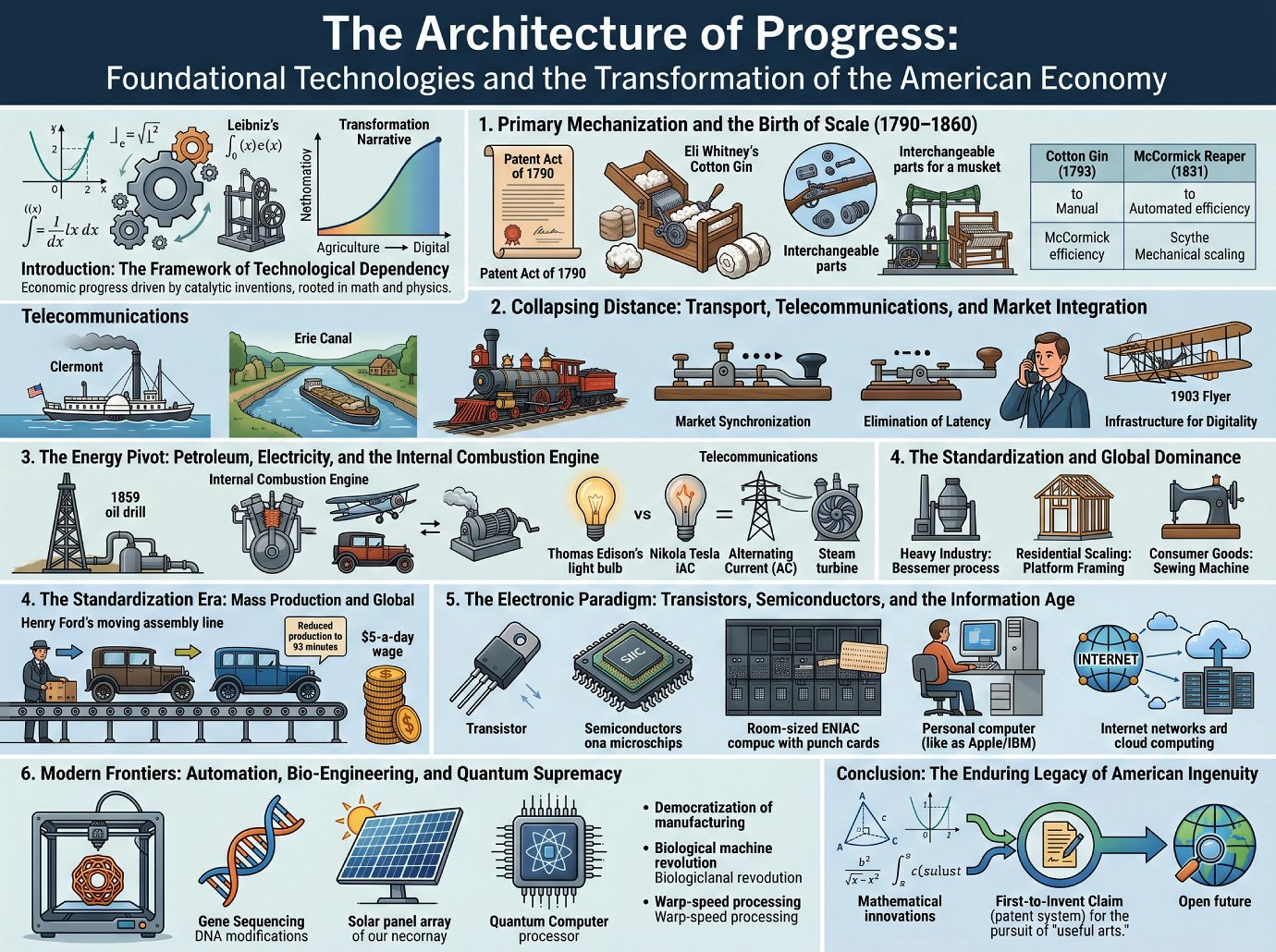
Economic progress is rarely a linear accumulation of effort; rather, it is a series of structural shifts driven by “catalytic inventions.” These foundational technologies do not merely facilitate market activity—they redefine the very boundaries of commercial feasibility. For the industrial systems analyst, understanding the historical dependency of market expansion on mechanical and mathematical innovation is a strategic necessity. Modern economic growth is the terminal product of a dependency chain that begins with the abstract and moves toward the physical.
The American “Transformation Narrative”—the shift from agrarian labor to mass production and into the digital age—is predicated on mathematical breakthroughs that date back centuries. Analytical geometry, codified by René Descartes in the 1500s, and the calculus notations developed by Gottfried Leibniz in the 1650s, provided the essential language to describe the behavior of real objects in motion. Without this mathematical bedrock, the subsequent leaps in thermodynamics and electromagnetism would have lacked the precision required for industrial scaling. This evolution toward higher complexity began with the first wave of physical mechanization, a transition that fundamentally decoupled production capacity from the limitations of human biological endurance.
2. The First Wave: Primary Mechanization and the Birth of Scale (1790–1860)
The transition from artisan-centered labor to machine-assisted production created the initial surge in American commercial viability. By shifting production from one-off handcrafted goods to standardized mechanical output, the United States began to achieve the capital intensity required for global trade. Central to this era was the Patent Act of 1790, which established the “First-to-Invent” claim as a cultural and legal mandate, fostering a climate where intellectual property became the primary driver of industrial transformation.
Eli Whitney acted as a chief architect of this shift. His Cotton Gin (1793) revolutionized the agricultural South by automating the separation of seeds from green seed cotton. The mechanical efficiency was staggering: the machine performed in one hour what previously required a full day of manual labor. Simultaneously, Whitney’s 1797 musket contract introduced the concept of Interchangeable Parts. This was a landmark in process modularity; by dividing labor into discrete, repeatable steps and standardizing measurements, Whitney shifted the manufacturing model from the artisan’s bench to a system where components were universally compatible.
Comparative Efficiencies of Early Mechanization
| Innovation | Pre-Mechanical Constraints | Post-Innovation Efficiencies |
|---|---|---|
| Cotton Gin (1793) | Labor-intensive manual de-seeding; output limited by the volume of available human hands. | Automated separation; one hour of machine processing achieved parity with 24 hours of manual labor. |
| McCormick Reaping Machine (1831) | Harvesting pace dictated by human endurance with a scythe; high risk of crop decay during slow harvests. | Mechanized grain cutting; substituted human endurance for mechanical reliability, enabling the scaling of agrarian land use. |
The energy required for this mechanization was supplied by the Steam Engine. Refined through iterations in the 1712 and 1790s, steam power converted thermal energy into mechanical work. This provided a reliable, site-independent power source for both factory equipment and early locomotives. These localized mechanical successes eventually created an acute demand for a nationalized infrastructure of transport and communication to integrate disparate regional markets.
3. Collapsing Distance: Transport, Telecommunications, and Market Integration
The strategic importance of “shrunk distance” lies in its ability to allow regional markets to coalesce into a unified national economy. By increasing the “average speed” of commerce, transportation technologies enabled the high-velocity movement of goods. The Steamboat (1807), pioneered by Robert Fulton with the Clermont, opened rivers to two-way travel, while the Erie Canal (1817) and the mid-century rise of the Locomotive established a network of high-volume trade arteries.
Parallel to the physical movement of goods was the instantaneous movement of information. The transition from the Telegraph (1837) to the Telephone (1876) represented a paradigm shift from coded signal to human voice.
Key Takeaways from the Telecommunications Shift:
- Market Synchronization: Real-time communication allowed for the coordination of prices and inventory across vast distances, creating the first true “network effects” in American business.
- Elimination of Latency: Voice communication removed the technical barrier of Morse code, allowing for immediate negotiation and decision-making.
- Infrastructure for Digitality: The physical web of wires required for the telephone network served as the structural blueprint for the eventual emergence of the internet.
The collapse of distance reached its logical conclusion with the Airplane (1903). By enabling rapid transcontinental and transoceanic travel, flight transformed international relations and tourism. However, these expanding networks required an energy pivot—a shift toward fuels that offered higher energy density and versatility.
4. The Energy Pivot: Petroleum, Electricity, and the Internal Combustion Engine
As the economy scaled, it transitioned from the heavy, site-dependent power of coal and steam to the versatile energy of oil and electricity. This pivot was triggered by the first American oil drill in 1859, which initially met the demand for kerosene. This discovery launched a “domino effect” in industrial refining, eventually yielding gasoline. By the 1890s, the Internal Combustion Engine utilized these petroleum fumes to power automobiles and airplanes, replacing simple propellers and wheels with a rotating explosion of energy.
Simultaneously, the “Current Wars” of the 1890s between Thomas Edison and Nikola Tesla determined the standard for the modern power grid. While Edison’s incandescent light bulb (1879) transformed the night into a period of “unprecedented activity” for urban growth, it was Tesla’s Alternating Current (AC) system that became the global standard due to its ability to transmit power efficiently over long distances.
Infrastructure Milestones in Energy Systems:
- Oil Pipelines (1864): Samuel van Syckel’s pump-operated pipeline made oil transport infinitely more efficient, overcoming the logistical bottleneck of horse-drawn teams.
- Steam Turbine (1884): A foundational technology that converts heat into mechanical energy; it remains the primary method for American power generation today, whether fueled by coal or nuclear reactions.
These energy breakthroughs provided the necessary power for the next major leap in industrial methodology: the transition to hyper-efficient standardization.
5. The Standardization Era: Mass Production and Global Dominance
In the era of mass production, the focus of industry shifted from the act of invention to the science of hyper-efficient execution. The primary catalyst was Henry Ford’s 1913 moving assembly line. By installing a conveyor belt and dividing labor into uniform, turnkey tasks, Ford minimized the “dead-time” between value-added operations. This reduced the production time of a Model T to just 93 minutes. Strategically, Ford’s $5-a-day wage doubled the minimum standard, turning his workers into consumers and effectively creating the modern middle-class market.
This era relied on “Precision and Standardization” across multiple sectors:
- Heavy Industry: The Bessemer process (1850s) allowed for the industrial-scale smelting of steel, while Arc Welding (1890) used electricity to join metal with unprecedented strength.
- Residential Scaling: Platform Framing (1920) introduced a “modular system” of two-by-fours and gypsum sheets. This standardized approach revolutionized construction speed, making home ownership accessible through process simplification.
- Consumer Goods: The Sewing Machine (1846) moved the clothing industry from custom tailoring to ready-to-wear retail.
As physical assembly reached its efficiency limit, the industrial focus moved toward the management of the electrical data and signals that controlled these systems.
6. The Electronic Paradigm: Transistors, Semiconductors, and the Information Age
The mid-20th century saw a strategic shift from fragile vacuum tubes to solid-state electronics, enabling the miniaturization of industrial systems. The Transistor (1945) and Advanced Semiconductors (1950s) acted as the “semiconducting widgets” that made the microchip possible, transitioning the economy from a mechanical foundation to a digital one.
The evolution of computing transformed data processing from labor-intensive manual entry to automated logic:
- ENIAC (1946): Housed in an entire room, it used punch cards as a physical way to run electricity through specific circuitry to direct messages.
- Personal Computer (1970s): Companies like Apple and IBM moved computing from government labs to the household, empowering individuals with complex task-management tools.
- The Internet (1960s/1990s): Originally a government-built web of cables, it evolved into a global platform for digital globalization and democratized knowledge.
This era replaced physical punch cards and floppy disks with “the cloud,” moving the economy into a phase where information itself became a primary commodity.
7. Modern Frontiers: Automation, Bio-Engineering, and Quantum Supremacy
The contemporary industrial landscape is defined by the democratization of manufacturing and the shift toward intelligent systems. 3D Printing (1980s/Modern) has revolutionized rapid prototyping, allowing for the decentralization of production facilities. By enabling individuals and small firms to manufacture complex objects without large-scale infrastructure, 3D printing represents a reversal of the centralization that defined the Ford era.
At the same time, we are witnessing a revolution in the “biological machine”:
- Gene Sequencing (1970s): By identifying genetic “switches,” scientists have created a new system for health management, transitioning medicine from reactive treatment to proactive engineering.
- Solar Cells (1950s/Modern): As we move away from petroleum, solar energy offers a path toward energy independence and the reduction of carbon-intensive power.
The latest frontier is Quantum Supremacy (2019). While 3D printing decentralizes the physical, quantum computing promises a massive centralization of computational power, achieving “warp-speed” processing that could redefine the limits of materials science and cryptography. These modern breakthroughs are the culmination of the centuries of mathematical and mechanical work that preceded them.
8. Conclusion: The Enduring Legacy of American Ingenuity
The trajectory of American economic history is a clear validation of the dependency thesis. Without the early 16th-century groundwork of analytical geometry, the 17th-century foundations of calculus, the 18th-century mechanics of steam, and the 19th-century mastery of electromagnetism, the modern digital economy would be a physical impossibility.
The engine of this persistent innovation has been the “First-to-Invent” claim—a patent system that ensures the rights of the creator and provides the financial incentive for iterative improvement. From the first patent issued in 1790 to the claim of quantum supremacy, the pursuit of “useful arts” has been the bedrock of the national interest. As we venture into the frontiers of intelligent automation and bio-engineering, the architecture of progress remains rooted in the same analytical rigor and mechanical ingenuity that first transformed the American landscape. ———————–