



The High Price of “No” – Overrides Defeated in Templeton, Now the Pain Begins
The Chair Man and the Chair Lady discuss the results in this podcast. Listen on any device, CLICK PLAY.
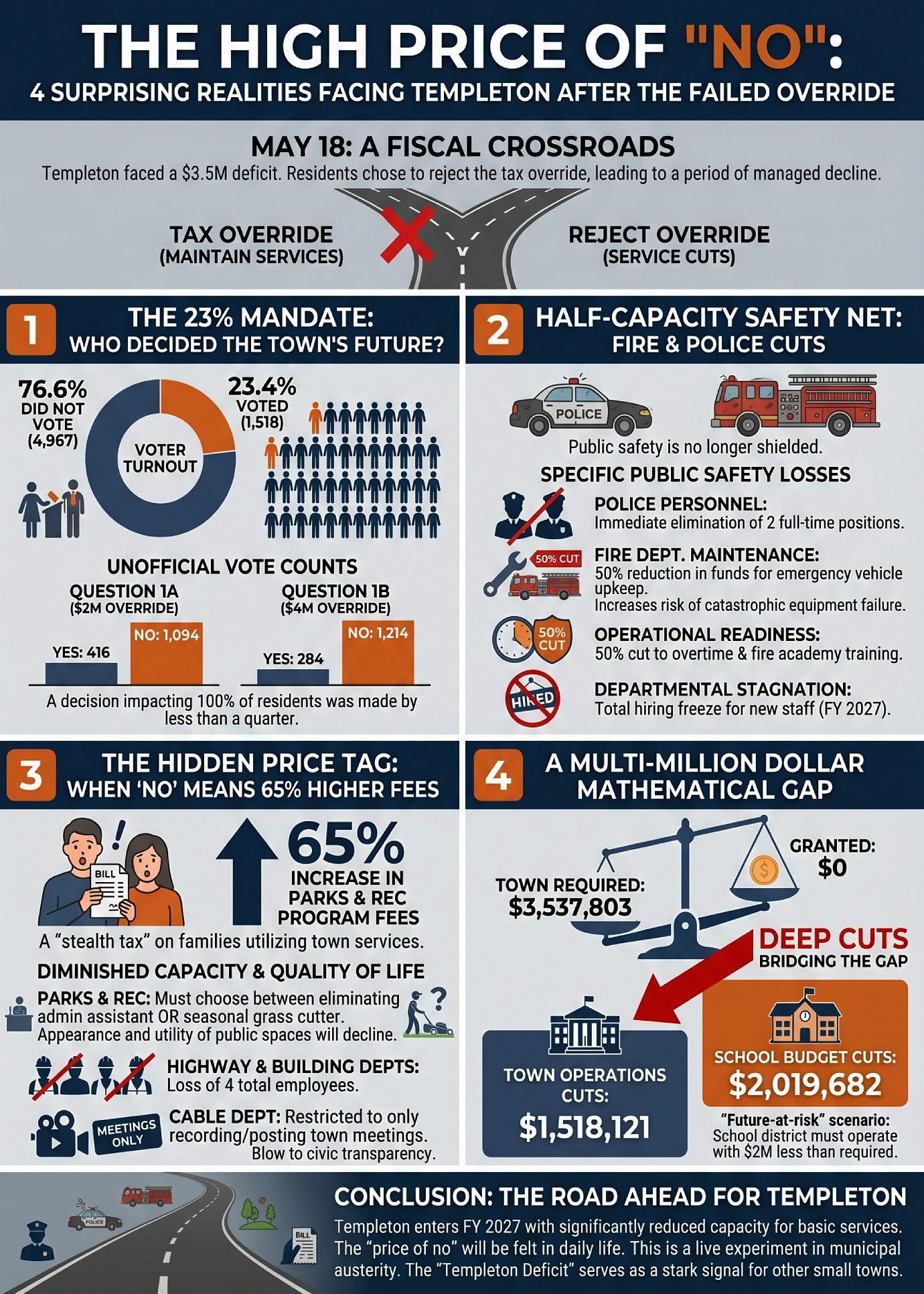
On May 18, 2026 Templeton reached a fiscal crossroads that will redefine the community for years to come. Facing a staggering $3.5 million deficit, town officials presented residents with a stark choice: approve a tax override or dismantle the current standard of municipal service. The electorate delivered a stinging rebuke, effectively choosing the latter.
This result captures the quintessential tension of modern municipal governance—the “unstoppable force” of rising operational costs meeting the “immovable object” of voter resistance. While the residents have made their preference for lower taxes clear, the reality of a $0 solution to a multi-million dollar problem is about to set in. The town now enters a period of managed decline where every “No” vote has a concrete, service-level consequence.
The 23% Mandate: Who Decided the Town’s Future?
The most striking aspect of this fiscal pivot was the lack of participation. Despite the massive stakes of the Annual Town Election, only 1,518 out of 6,485 registered voters cast a ballot. This represents a turnout of just 23.41%, a remarkably low figure for a decision with such high-impact gravity.
It is a counter-intuitive reality of local democracy: a decision that will impact 100% of residents was determined by less than a quarter of the population. The margin of defeat suggests that voters weren’t just being frugal; they were sending a message of total non-intervention. This was particularly evident in the failure of the larger $4 million request, which faced even steeper opposition than the smaller measure.
Unofficial Vote Counts:
- Question 1A ($2 Million Override): 416 Yes | 1,094 No
- Question 1B ($4 Million Override): 284 Yes | 1,214 No
The Half-Capacity Safety Net: Fire and Police Cuts
Public safety is the core promise of municipal government, yet it is no longer shielded from Templeton’s fiscal contraction. The Fire and Police departments are facing immediate, severe operational restrictions that go beyond simple belt-tightening. These aren’t just budget lines; from a policy perspective, they represent a significant “deferred liability” for the town.
The Fire Department is being forced to slash maintenance and training funds by 50%. Cutting truck maintenance in half does not actually save money in the long run; rather, it increases the risk of catastrophic equipment failure during an emergency. Furthermore, the loss of police personnel and training funds signals a fundamental shift toward a reactive, rather than proactive, public safety model.
Specific Public Safety Losses:
- Police Personnel: Immediate elimination of two full-time personnel positions.
- Fire Department Maintenance: 50% reduction in funds for emergency vehicle upkeep.
- Operational Readiness: 50% cut to overtime coverage and fire academy training funds.
- Departmental Stagnation: A total hiring freeze on all new staff or personnel for Fiscal Year 2027.
The Hidden Price Tag: When “No” Means 65% Higher Fees
Voters often view a “No” vote as a way to protect their wallets, but in Templeton, this has triggered an immediate “user-end penalty.” To keep essential services operational without tax revenue, the Parks and Recreation department must implement a staggering 65% increase in program fees. This is essentially a “stealth tax” on families who utilize town services.
The quality of life in Templeton will also take a visible hit through a choice of “diminished capacity.” The town must now choose between eliminating the part-time administrative assistant who runs the Parks department or the seasonal grass cutter who maintains the fields. Regardless of the choice, the appearance and utility of public spaces will decline as the Highway and Building and Grounds departments lose four total employees.
Even civic transparency is on the chopping block. The Cable department will be restricted to only recording and posting town meetings, a significant blow to the “civic transparency” necessary for a healthy local democracy. When tax revenue is denied, the cost of participation spikes, and the visibility of government operations fades.
A Multi-Million Dollar Mathematical Gap
The math facing Templeton is unforgiving and absolute. The town required $3,537,803 to maintain its current trajectory; following the election, it was granted exactly $0. This gap is now being bridged through deep cuts that disproportionately impact the town’s youngest residents.
Of the total cuts, approximately $1,518,121 will be stripped from town operations, while $2,019,682 will be gutted from the school budget. This “future-at-risk” scenario means the school district must operate with two million dollars less than what is required for standard operations. The fact that the $4 million override failed by a wider margin than the $2 million measure proves that voters rejected even the idea of a “bridge-gap” compromise.
The Road Ahead for Templeton
As Templeton enters Fiscal Year 2027, it does so with a significantly reduced capacity to provide the basic services residents expect. From reduced police patrols and hazardous equipment maintenance to unmaintained parks and soaring recreation fees, the “price of no” will be felt in the daily lives of every citizen. This is no longer a theoretical debate about tax rates; it is a live experiment in municipal austerity.
Publisher’s Editorial Note: The outcome of this election leaves us with a difficult question: What is the true balance between tax sensitivity and the essential nature of municipal services? The “Templeton Deficit” serves as a stark signal for other small towns facing similar crossroads. It proves that when a budget gap remains unbridged, the resulting cuts are not just numbers on a ledger—they are a fundamental rollback of the community’s quality of life.

Election Results: Municipal Boards and Commissions
- Select Board: April Cover (958 votes) and Timothy Toth (795 votes) were elected to the two available seats.
- Board of Assessors: George Barnes, Jr. (1,148 votes).
- Board of Health: Cynthia Cadoret (1,102 votes).
- Cemetery Commission: Matthew McDonald (1,123 votes).
- Community Preservation Committee: John Henshaw (1,166 votes).
- Light & Water Commission: Dana Blais (1,137 votes).
- Sewer Commission: Mark Moschetti (1,001 votes).
- Housing Authority: Louise Chaffee (1,081 votes).
- Planning Board: Michael Caruso was elected to a 4-year unexpired term (1,032 votes).
- Moderator: John Graves (1,078 votes).
Election Results: Narragansett Regional School District (NRSD)
- NRSD-Templeton: Shawn Case (965 votes) and Yasmine Khdeer (778 votes) were elected to the two available seats.
- NRSD-Phillipston: Several unexpired terms and a full term saw no formal candidates, with votes distributed among write-ins and blanks.