
Feds Nab 18 in Multi-State Gardner MA Drug Bust
An unusual Federal Bust has nabbed18 Defendants on various charges in conjunction with an alleged drug trafficking and money laundering scheme including 9 from North Central MA. According to the Press Release, the scheme was coordinated by a man in Gardner. See Press Release from the U.S. Department of Justice.
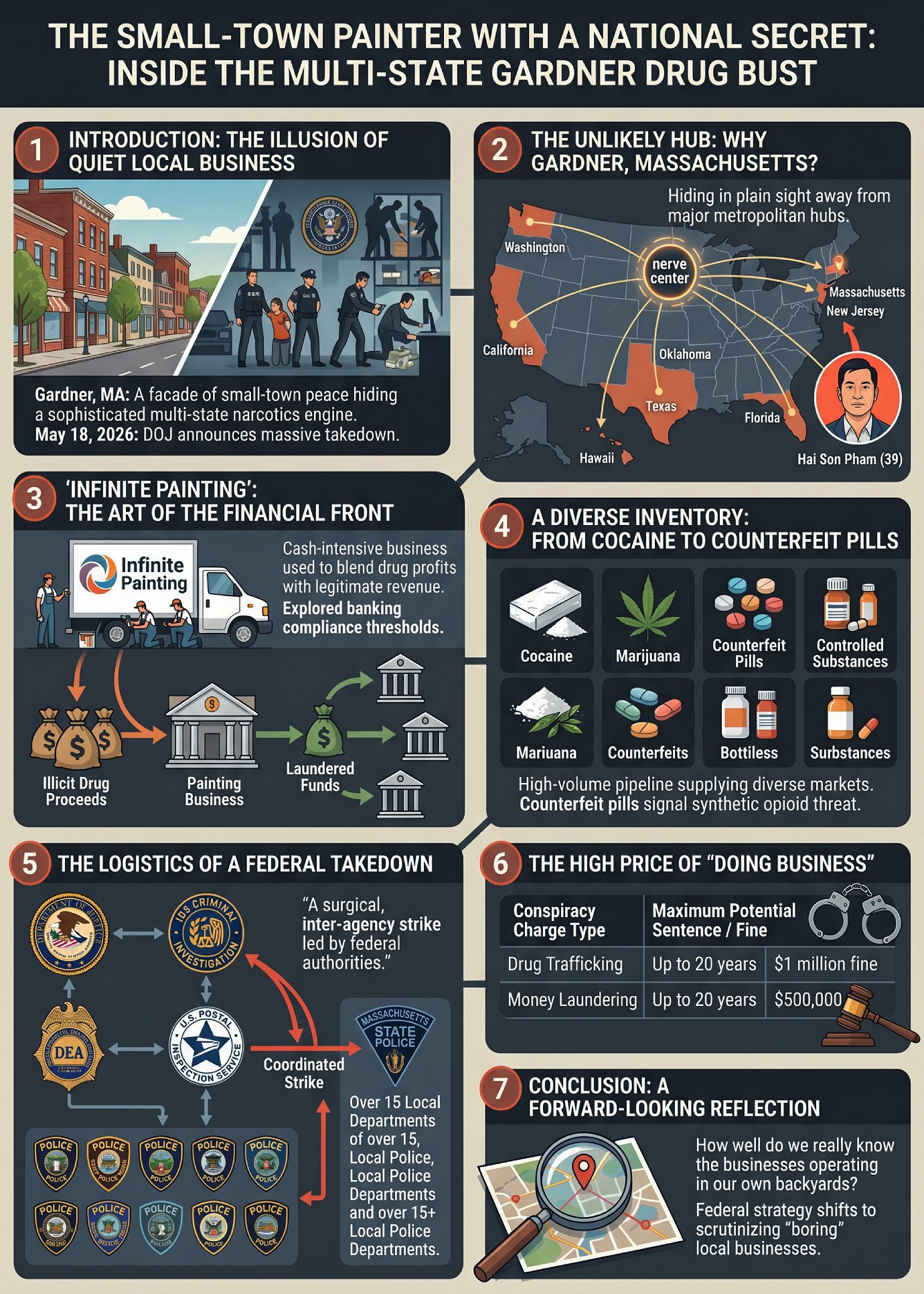
Gardner is a landscape of brick facades and quiet residential streets that suggest a slow, predictable rhythm of life. But according to federal investigators, that mask hid a sophisticated multi-state narcotics engine. On May 18, 2026, the Department of Justice shattered this image of small-town peace with the announcement of a massive takedown: 18 individuals arrested across seven states, all linked to a narcotics trafficking and money laundering syndicate. This was not a street-corner operation; it was a sprawling criminal enterprise that allegedly utilized a local trade business to bridge the gap between small-town North Worcester County and the distant shores of Hawaii.
The Unlikely Hub: Why Gardner, Massachusetts?
In the world of high-stakes drug trafficking, major urban ports and border cities are the expected nodes of power. Yet, federal authorities allege that the “nerve center” of this conspiracy was nestled in the heart of Gardner. At the center of the indictment stands Hai Son Pham, a 39-year-old Gardner resident who allegedly directed a network that metastasized across the country.
The reach of this organization was counter-intuitive, proving that in the digital and logistics-heavy modern era, a kingpin can operate from a quiet suburb as easily as a skyscraper. According to the charging documents, the network managed logistics and distribution across eight different states: “Massachusetts, New Jersey, Florida, Oklahoma, California, Texas, Washington and Hawaii.” By centering operations in North Worcester County, the organization likely sought to exploit the lower profile of a small community, effectively “hiding in plain sight” away from the high-intensity federal task forces that saturate major metropolitan hubs.
To the neighbors, it was likely just another local service provider—a commercial and residential painting company. But federal investigators allege that Infinite Painting, a business registered and controlled by Hai Son Pham, served a far more cynical purpose. The company is accused of being the primary vehicle for laundering drug proceeds through multiple financial institutions.
In the analytical view of a financial crimes investigator, a painting company is a brilliant, albeit “boring,” choice for a front. These businesses are cash-intensive, have fluctuating material costs, and utilize a rotating labor force—variables that provide the perfect cover for blending illicit drug profits with legitimate revenue. This was not a simple “cash-under-the-mattress” scheme; it was a calculated attempt to exploit the banking system’s compliance thresholds by masking the origin of millions of dollars in narcotics transactions.
Diverse Inventory: From Cocaine to Counterfeit Pills
The scale of the “inventory” allegedly moved by the Pham organization suggests a high-volume pipeline capable of supplying diverse markets across the country. The Department of Justice alleges the conspiracy was responsible for distributing “large quantities” of substances that reflect both traditional demands and modern synthetic threats.
The identified substances include: Cocaine, Marijuana, Counterfeit pills, and other controlled substances. The presence of counterfeit pills is particularly telling. In today’s illicit market, these pills are often the delivery mechanism for high-potency synthetic opioids, signaling that the Gardner-based organization was tapped into the most dangerous and profitable sectors of the national drug trade.
The investigation was a masterclass in jurisdictional cooperation, led by the U.S. Attorney’s Office, the IRS Criminal Investigation unit, and the DEA. The sheer complexity of the takedown was illustrated by the involvement of the U.S. Postal Inspection Service, the Massachusetts State Police, and a coalition of over 15 local police departments—including Worcester, Gardner, Leominster, Fitchburg, Clinton, Lunenburg, Hopkinton, Westminster, Ashburnham, Winchendon, Templeton, Phillipston, Boylston, Sterling, and Weymouth.
“United States Attorney Leah B. Foley; Thomas Demeo, Special Agent in Charge of the Internal Revenue Service, Criminal Investigation, Boston Field Office; and Jarod A. Forget, Special Agent in Charge of the Drug Enforcement Administration, New England Field Division made the announcement today.”