



Gardner Magazine is publishing a very complete set of information here in this article regarding the reasons for the electric rate increase in Gardner despite a plan which runs through 2028.
Electric Rates Up in Gardner MA Despite 3 Year Plan – Here’s Why…
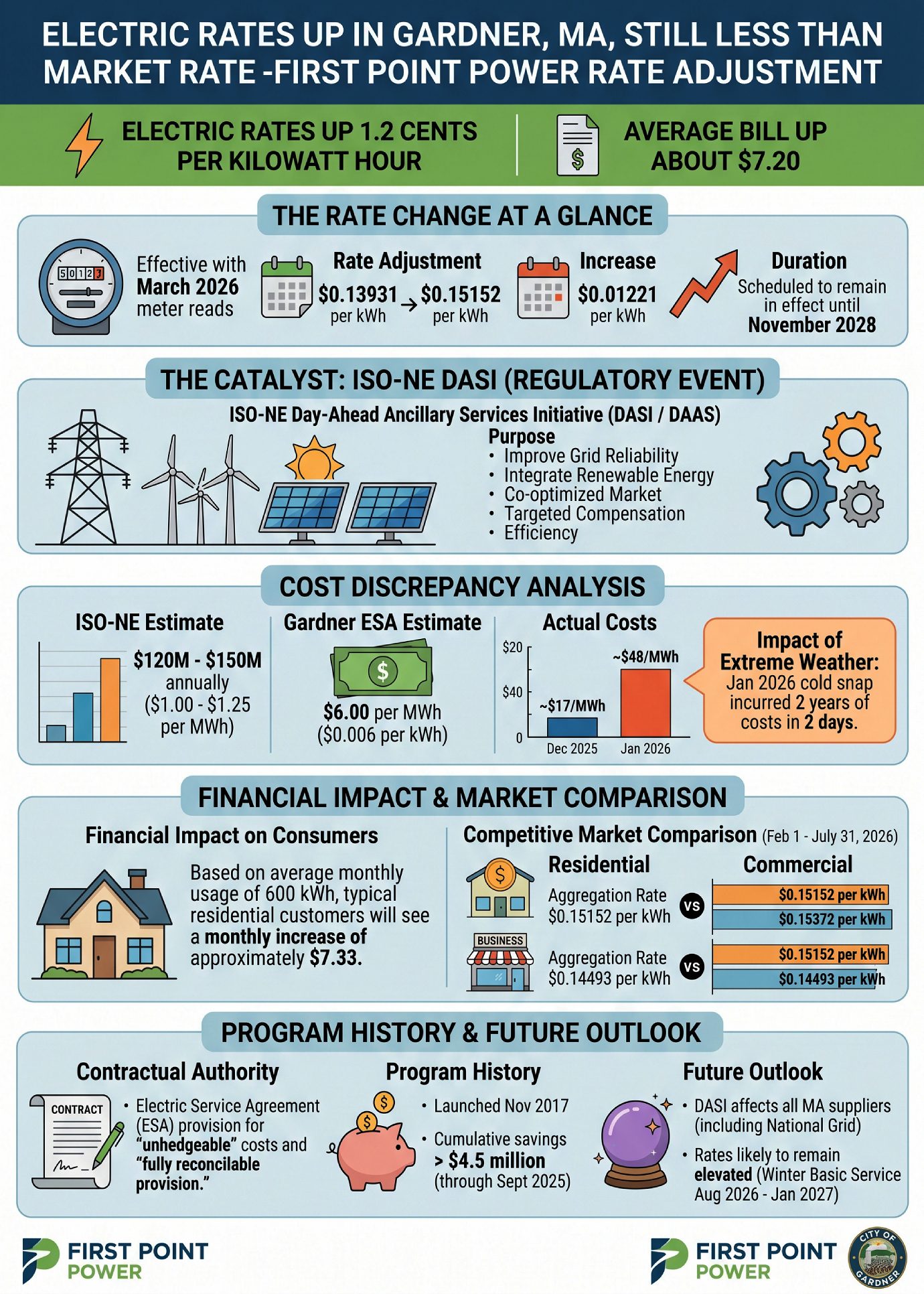
First Point Power Rate Adjustment – Electric Rates up 1.2 cents per kilowatt hour – Average bill up about $7.33. Rate increase notice on PDF, click here.
Effective with the March 2026 meter reads, the City of Gardner provider implemented a rate adjustment to its municipal electricity aggregation program. The rate will increase from $0.13931 per kWh to $0.15152 per kWh, an increase of $0.01221 per kWh. This adjustment is the direct result of a “regulatory event” involving the ISO-NE Day-Ahead Ancillary Services Initiative (DASI), a market restructuring approved by the Federal Energy Regulatory Commission (FERC).
The adjustment is necessitated by actual DASI costs significantly exceeding the initial projections provided by ISO-NE. While the City’s Electric Service Agreement (ESA) included a cost estimate of $6/MWh for these services, actual market costs reached as high as $48/Mwh (just under 5 cents per kilowatt hour) in January 2026. Despite this increase, the program continues to offer competitive rates compared to National Grid’s Basic Service and has saved residents and small businesses over $4.5 million since its inception in 2017.
Overview of Rate Adjustments: The rate change is scheduled to remain in effect for the duration of the current contract term, which concludes in November 2028.
Financial Impact on Consumers: Based on an average monthly usage of 600 kWh, the rate adjustment will result in a monthly increase of approximately $7.33 for typical residential customers.
Competitive Market Comparison: The new aggregation rate remains lower than the National Grid Basic Service rates fixed for the period of February 1 through July 31, 2026:
| Service Type | Adjusted Aggregation Rate | National Grid Basic Service |
|---|---|---|
| Residential | $0.15152 per kWh | $0.15372 per kWh |
| Commercial | $0.15152 per kWh | $0.14493 per kWh |
The Regulatory Catalyst: ISO-NE DASI: A “regulatory event” is defined as an action or change by a regulatory authority that causes a direct, material shift in costs during the term of a power supply contract. In this instance, the event is the implementation of the ISO-NE Day-Ahead Ancillary Services Initiative (DASI), also referred to as DAAS.
Purpose and Function of DASI: DASI was designed to improve grid reliability, particularly as renewable energy sources become more integrated into the power system. Key features include:
- Co-optimized Market: It introduces a day-ahead market that simultaneously evaluates energy and ancillary services, replacing the former Forward Reserve Market.
- Targeted Compensation: It ensures resources providing essential services, such as operating reserves, are adequately compensated and financially obligated to perform.
- Efficiency: FERC approved the initiative to improve operating reserve resource readiness and day-ahead price formation.
Market Dynamics and Variability: DASI alters the market by reducing the reliance on fast-start generation assets and diminishing loads settled on the real-time market over time. However, it introduces a new component to the ancillary market designed to bridge the gap between supplier bids and expected demand. Because this component is set on the real-time market, it creates price volatility and increased costs during periods of high uncertainty, such as extreme weather events.
Analysis of Cost Discrepancies: The primary driver for the rate increase is the massive divergence between ISO-NE’s projected costs and the actual costs realized following the program’s implementation in March 2025.
Projected vs. Actual Costs : ISO-NE originally estimated DASI costs to range between $120 million and 150 million annually, which translates to approximately 1.00 to 1.25 per Mwh. The City of Gardner’s ESA factored in a more conservative estimate of 6.00 per MWh ($0.006 per kWh).
Actual market data revealed that these projections were insufficient: December 2025: Costs reached approximately $17/MWh. January 2026: Costs climbed to approximately $48/MWh.
Impact of Extreme Weather
The financial volatility of the new DASI structure was demonstrated during a severe cold snap in early 2026. On January 26 and January 27, the market incurred costs equivalent to two years of expected expenditures in only two days.
Contractual Authority and Program History
The rate adjustment is being implemented pursuant to a specific provision in the Electric Service Agreement (ESA).
- Hedgeability: Because DASI was a new program, the costs were initially “unhedgeable,” forcing suppliers to rely on ISO-NE guidance for estimates.
- Reconcilable Provision: The ESA included a fully reconcilable provision allowing for adjustments once actual costs were confirmed.
- Historical Performance: Since its launch in November 2017, the City’s electricity program has demonstrated significant value. Through September 2025, it has provided a cumulative savings of more than $4.5 million compared to National Grid Basic Service.
Future Outlook: The cost increases associated with DASI are not unique to the City of Gardner. All electricity suppliers in Massachusetts, including National Grid, are subject to this new market structure. Consequently, all ratepayers in the state are expected to experience impacts. Projections indicate that Winter Basic Service rates (effective August 1, 2026, through January 31, 2027) will likely remain elevated due to the ongoing influence of the DASI regulatory framework.