
A Weekly Briefing from Gardner Magazine – May 3, 2026
The Chair Man and the Chair Lady discuss the news of the week including Greater Gardner MA, North Central MA, the State of Massachusetts, National News, and World News. They tie it all together in a great podcast. Listen on any device, CLICK PLAY.
Gardner Magazine has 4 separate additional sections covering North Central MA News, a Massachusetts News Roundup, U.S. National News, and World News.
JUMP TO SECTION: North Central MA News — State News of the Week —- National News of the Week — World News of the Week
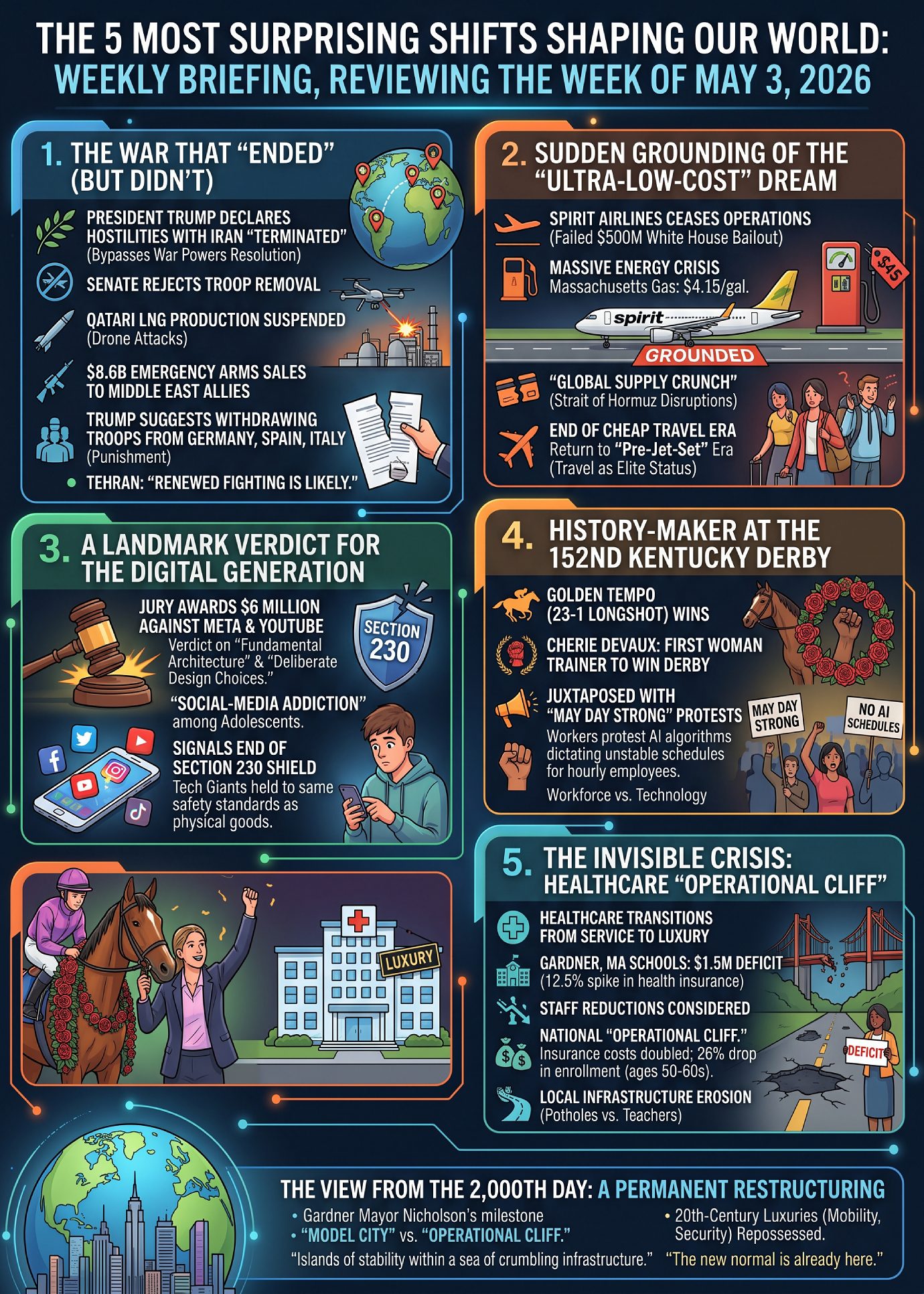
The 5 Most Surprising Shifts Shaping Our World: A Week in Review (May 3, 2026)
1. Introduction: The Complexity of Now
The global news cycle of early May 2026 has reached a state of dizzying fragmentation, yet beneath the surface, a singular narrative of institutional erosion and systemic volatility is beginning to coalesce. This week, the public consciousness was asked to bridge the impossible gap between the mundane and the existential: from Gardner’s localized “Pothole Patrols” to the high-stakes geopolitical brinkmanship of the War Powers Resolution in Washington and Tehran. While these events appear disconnected—a municipal budget deficit here, a historic horse race there, a grounded airline everywhere—they are, in fact, the jagged edges of a rapidly reconfiguring reality. To look closely at this week is to see a world where the 20th-century social contract is being rewritten in real-time, signaling a shift from a society of mass accessibility to one defined by an “operational cliff.”
2. The War That “Ended” (But Didn’t)
We are currently witnessing a profound legal fiction intended to mask a kinetic reality. President Trump has officially declared that hostilities with Iran have “terminated,” a calculated maneuver timed precisely to coincide with the 60-day deadline of the War Powers Resolution. This declaration seeks to bypass the necessity for formal Congressional authorization, even as the administration pushes for a multibillion-dollar Pentagon funding infusion.
The friction between this “terminated” status and the ground truth is stark. While the White House signals an end to the war period, the Senate remains paralyzed, recently rejecting a resolution to remove U.S. forces. The global ripple effects are already devastating: Qatari liquefied natural gas (LNG) production has been suspended following drone attacks, and the U.S. has greenlit $8.6 billion in emergency arms sales to Middle Eastern allies. Perhaps most telling of the fracturing Western alliance is the President’s suggestion to withdraw 5,000 troops from Germany and potentially pull forces from Spain and Italy as punishment for their vocal criticism of the conflict. Amidst the administration’s claims of peace, the sentiment from Tehran remains chillingly pragmatic; as one senior Iranian officer noted, “Renewed fighting is likely.”
3. The Sudden Grounding of the “Ultra-Low-Cost” Dream
The era of cheap, accessible air travel—an anomaly of the 2010s and early 2020s—effectively died this week with the total cessation of operations by Spirit Airlines. The collapse followed a failed $500 million White House bailout, leaving travelers at Logan International and regional hubs in a state of logistical paralysis.
Spirit’s demise is a direct casualty of a global energy crisis that has pushed Massachusetts gas prices to a staggering $4.15 per gallon. This “global supply crunch,” exacerbated by the ongoing disruptions in the Strait of Hormuz, has rendered the low-cost carrier model a relic of a bygone era. This is not merely a corporate failure; it is the re-stratification of class mobility. We are returning to a “pre-jet-set” era where travel is once again a marker of elite status rather than a middle-class expectation. The dream of the ultra-low-cost flight has been grounded by the hard reality of 2026’s energy economics.
4. A Landmark Verdict for the Digital Generation
In a decision that likely signals the twilight of tech platform immunity, a jury has awarded $6 million in damages against Meta and YouTube. This landmark verdict was not about content moderation, but about the fundamental architecture of the digital world. The case, brought by a 20-year-old plaintiff, successfully argued that “social-media addiction” among adolescents is the result of deliberate design choices rather than accidental byproducts.
By focusing on the “product” itself, the court has signaled that the era of Section 230 serving as a total shield for Silicon Valley is ending. This ruling suggests that tech giants will now be held to the same safety standards as manufacturers of physical goods. The “signal” here is clear: the digital frontier is being forcibly tamed, and the cost of doing business in the attention economy is about to skyrocket.
5. The History-Maker at the 152nd Kentucky Derby
The sports world provided a rare moment of historic progress this weekend, though it was framed by the shadows of a restless labor force. Golden Tempo’s 23-1 longshot victory at the Kentucky Derby was a masterclass in performance, but the true story was in the winner’s circle: Cherie DeVaux became the first woman in history to train a Derby winner.
However, this cultural milestone stands in jarring contrast to the “May Day Strong” protests rippling through the nation. As DeVaux celebrated, thousands of workers took to the streets to protest the increasing use of AI algorithms to dictate unstable schedules for hourly employees—a technological grievance that is becoming the new front line of labor rights. This juxtaposition reveals the duality of 2026: pockets of historic individual achievement occurring against a backdrop of widespread institutional instability and a workforce increasingly at odds with the very technology supposed to optimize their lives.
6. The Invisible Crisis: The Healthcare “Operational Cliff”
While the headlines are dominated by drone strikes and airline collapses, the most impactful shift for the average citizen is the quiet transition of healthcare from a service to a luxury. In Gardner, Massachusetts, the school system is navigating a $1.5 million deficit—a crisis driven almost entirely by a 12.5% spike in health insurance costs. To balance the books, the city is now forced to consider significant staff reductions, a move that sacrifices the future of education to pay for the present costs of survival.
This local struggle mirrors a national “operational cliff” where insurance costs have doubled for those without subsidies, leading to a 26% drop in enrollment among those in their 50s and early 60s. There is a bitter irony in the math: while towns like Templeton face a $4 million override to keep their libraries and senior centers from shuttering, the nation approves $8.6 billion for emergency arms sales. The economic oxygen is being sucked out of our local infrastructure to fuel global kinetic energy, leaving communities to decide between fixing a pothole or funding a teacher’s health plan.
7. Conclusion: The View from the 2,000th Day
Recently, Gardner Mayor Michael Nicholson marked his 2,000th day in office, a milestone Gardner Magazine has used to champion the “Model City” status of his administration. Yet, just a few miles away, the “operational cliff” remains a literal threat to the survival of municipal services. The contrast is sharp: we are creating islands of stability within a sea of crumbling infrastructure.
As we look at the world through the lens of May 2026, we must ask if the “Model City” is a sustainable future or merely a temporary fortress. The events of this week—the legal maneuvers to extend war, the grounding of mass travel, and the prioritization of arms over insurance—suggest we are not in a temporary crisis. Instead, we are witnessing a permanent restructuring of society. The “new normal” is not coming; it is already here, and it is defined by a world where the 20th-century luxuries of mobility and security are being repossessed by the realities of a volatile new age.
Werner Poegel, Publisher