



Fire, Police, Building, and Health Department Budgets and Initiatives Discussed at Public Safety Meeting
The Gardner Public Safety Committee met on May 15, 2026. Listen on any device, CLICK PLAY.
The Fire Chief highlighted the need for a new “floater” position to mitigate rising overtime costs and discussed critical facility repairs. Meanwhile, the Police Chief advocated for increasing the force to reach recommended staffing levels while addressing aging vehicle fleet concerns. Building and Health department heads also presented their funding requests, focusing on modernization through technology and necessary maintenance for the city’s landfill and public structures.
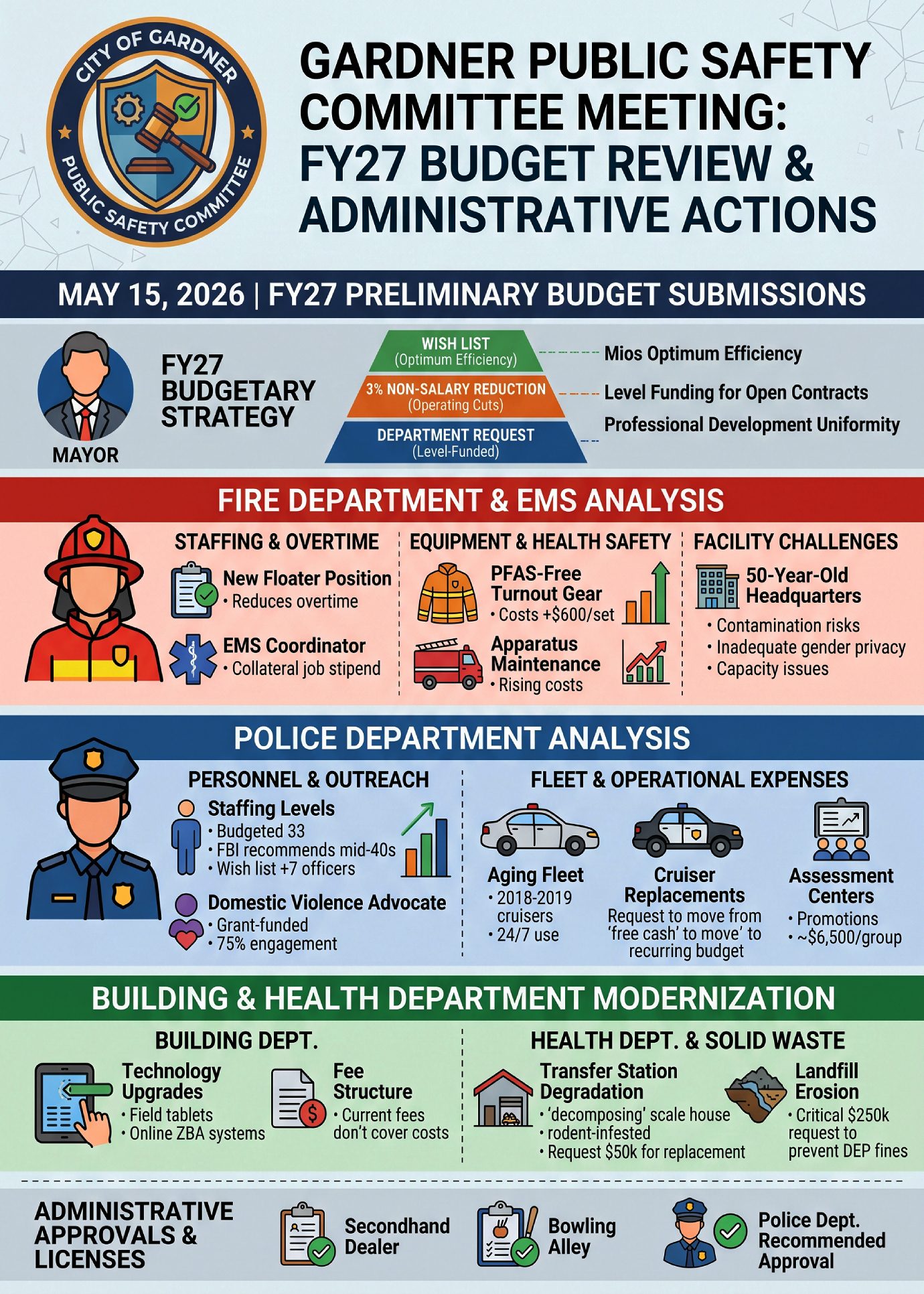
Budgetary Framework: The Mayor’s office utilized a three-tier budget request system (Wish List, 3% Non-Salary Reduction, and Level-Funded) to identify both operational necessities and ideal growth paths.
Personnel & Staffing: The Fire Department is proposing a new “floater” position to reduce long-term overtime, while the Police Department is seeking to move closer to FBI-recommended staffing levels.
Infrastructure Deficiencies: The Fire Department’s 50-year-old headquarters faces significant space, contamination, and gender-privacy issues. Similarly, the Health Department reported that the transfer station facilities are “decomposing” and rodent-infested.
Equipment & Modernization: There is a strong emphasis on transitioning to PFAS-free protective gear for firefighters and a request from the Police Department to shift cruiser replacements from sporadic “free cash” funding to a predictable annual budget item.
Environmental Liability: A high-priority request of approximately $250,000 was made to address erosion at the capped landfill to prevent accruing daily fines from the Department of Environmental Protection (DEP).
Gardner Mayor Michael Nicholson provided an overview of the preliminary FY27 budget process. Key financial principles guiding the current cycle include:
- Level Funding for Open Contracts: Departments with active collective bargaining negotiations are level-funded for those specific line items. Appropriations will be adjusted once contracts are signed.
- Professional Development Uniformity: The city is working toward a consistent system across all departments for professional development and travel line items to ensure equity and oversight.
- Three-Tier Submission: Department heads were required to submit three scenarios:
- Wish List: Funding required for optimum efficiency and effectiveness.
- 3% Non-Salary Reduction: Potential cuts to operating expenses.
- Department Request: A level-funded budget necessary to maintain current FY26 operations.
Fire Department and EMS Analysis: The Fire Department’s submission emphasized a shift toward proactive staffing and the remediation of hazardous facility conditions.
- New Floater Position: The Mayor and Fire Chief Greg Lagoy proposed funding a “group floater” (private-level firefighter). Historical data from a 2013-2014 study suggests this position pays for itself by reducing the need for overtime to cover sick leave and vacancies.
- EMS Coordinator: Currently a “collateral job” stipend position, the Chief and Mayor agree this should eventually become a full-time role to manage reporting requirements. However, the Mayor is deferring this change until the next ambulance contract is finalized to ensure revenue stability.
- Overtime Realities: The department requested $400,000 for overtime, which is considered the minimum required to backfill short-term leave, assuming no long-term vacancies or injuries occur.
- PFAS Remediation: The department has successfully disposed of PFAS-containing foam. New turnout gear orders are now “PFAS-free” to reduce carcinogen exposure, though this adds approximately $600 in cost per set.
- Apparatus Maintenance: Repair costs are rising due to increased labor rates and parts costs for aging vehicles.
- The 50-year-old fire headquarters was identified as inadequate in several areas.
- Contamination Risks: Lack of dedicated decontamination zones forces firefighters to store gear in living quarters, increasing the risk of cross-contamination.
- Gender Inclusivity: The facility lacks adequate private bathroom and shower facilities for female employees, with only one shared multi-bay bathroom on the second floor.
- Capacity: The department still utilizes the deteriorating South Gardner station for storage because the main headquarters cannot house all apparatus and trailers.
Police Department: The Police Department’s budget focus remains on addressing a long-term staffing deficit and modernizing fleet management.
- Staffing Levels: The department is currently budgeted for 33 officers. Police Chief Eric McAvene noted that FBI recommendations suggest the city should have in the mid-40s. A “wish list” request for seven additional officers was made to reach a total of 40.
- Domestic Violence Advocate: This position is funded by a year-to-year grant. The Chief highlighted its criticality, noting that the advocate has a 75% engagement rate with victims, a level of follow-up that uniformed officers cannot provide.
- Recruitment: The department has seen a recent uptick in highly qualified and diverse applicants for open academy slots.
- Aging Fleet: The department is operating cruisers from 2018 and 2019 that run 24/7.
- Funding Shift: The Chief requested that cruiser replacements (averaging 80,000–90,000 per outfitted vehicle) be moved to a recurring budget line item rather than relying on irregular “free cash” appropriations.
- Assessment Centers: Since moving out of Civil Service, the department utilizes assessment centers for promotions to ensure a fair, “double-blind” process, costing approximately $6,500 per group.
Building Department Modernization
- Structural Separation: A long-term goal is to separate the Building Department from Public Building Maintenance to improve operational focus.
- Technology Upgrades: The department is pushing for field technology (tablets) and online systems for the Zoning Board of Appeals (ZBA) to reduce paper costs and streamline resident interactions.
- Fee Structure: Building Commissioner Melissa MacDonald noted that current permitting fees do not adequately cover inspectional and administrative costs, suggesting a future proposal for fee adjustments.
Health Department and Solid Waste
- Transfer Station Degradation: Health Director Lauren Saunders described the current scale house as “decomposing” and rodent-infested. A request for $50,000 was made to replace dilapidated sheds with a single container-office to provide basic climate control and hygiene for staff.
- Landfill Erosion: A critical request for $250,000 was submitted to repair significant erosion at the capped landfill. This project was deferred last year to handle an emergency pump repair. The DEP is currently monitoring the site, and further delays could lead to daily fines.
- Administrative Anomaly: The Director noted that it is a “rarity” for a Health Department to oversee a capped landfill, a task typically handled by the Department of Public Works (DPW).