



Music – One Hit Wonders – Reports by Gardner Magazine
A “one-hit wonder” is traditionally defined as a musical artist who achieves significant success with a single song but fails to secure a comparable follow-up hit. However, the application of this label is subject to varying professional criteria used by music journalists and chart analysts. While some define the status strictly by a lack of multiple appearances in the Top 40 or the Hot 100, others use it to describe artists whose entire legacy is overshadowed by a single “signature” song, regardless of other charting successes. The phenomenon is further complicated by “multiple one-hit wonders”—performers who achieve single-hit success across various groups or solo ventures. As you explore this page, you’ll notice quickly that we go back 300 years in American history, way before the concept of the “one hit wonder” actually made sense. However, it is an interesting exploration which shows us that music has always been a part of the American Experience, from before the Revolutionary War to its beginnings as a nation, right up to this day. While technology has changed so much over time, Americans have always loved music.
One Hit Wonders – A Series of Reports, Infographics Podcasts, and a Video
Listen to a “Deep Dive” podcast on any device, CLICK PLAY.
Listen to a “Debate” on what constitutes a “One Hit Wonder” on any device, CLICK PLAY.
Defining the Phenomenon: When One is All You Get
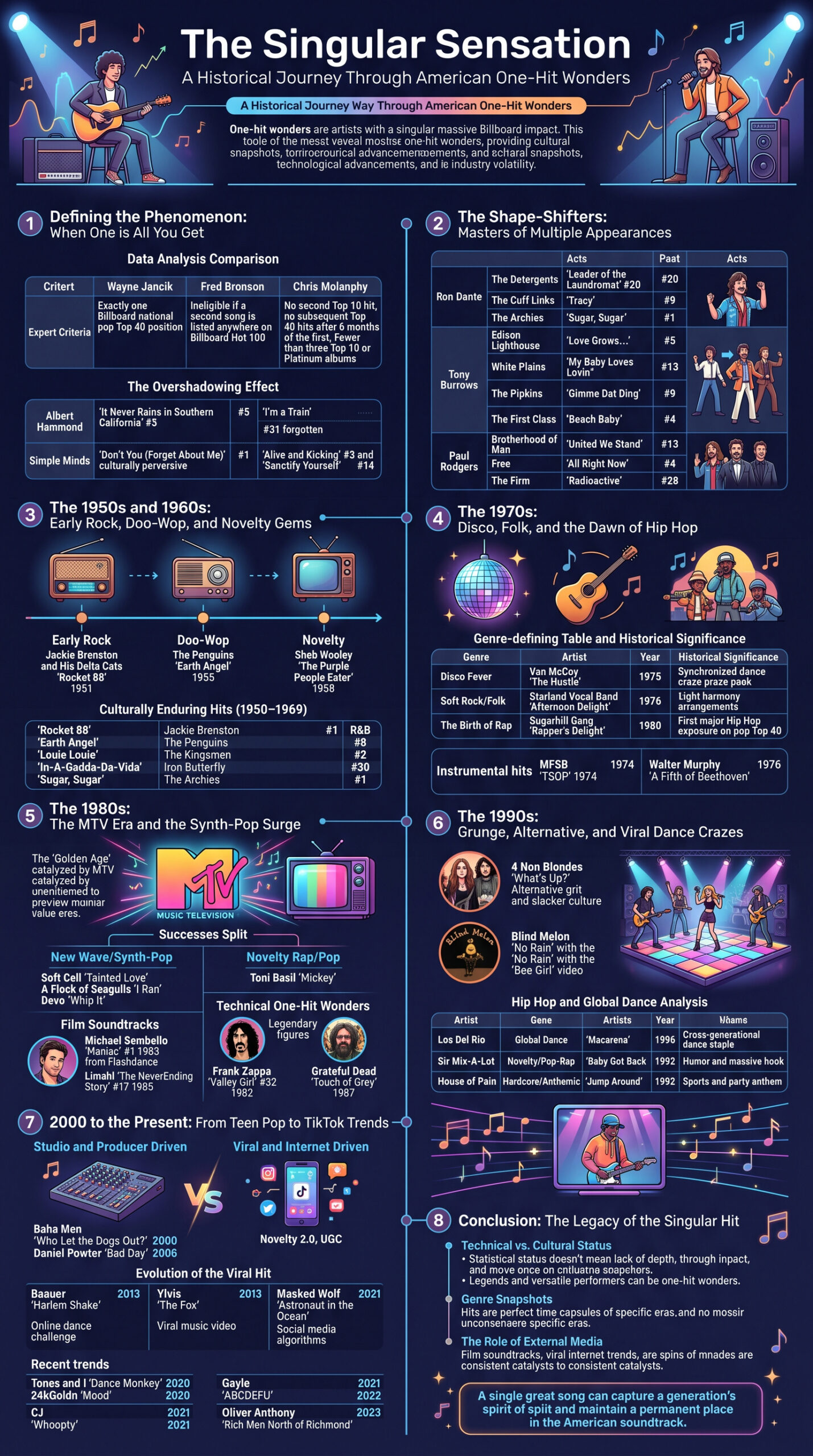
Defining a one-hit wonder requires a rigorous analysis of chart data. While the general public often uses the term colloquially, music historians and analysts utilize specific—and sometimes conflicting—technical criteria to categorize these artists.
Data Analysis: Expert Criteria for One-Hit Wonders
| Expert | Core Definition / Chart Criteria |
|---|---|
| Wayne Jancik | An act that has won a position on the Billboard national pop Top 40 exactly once. |
| Fred Bronson | An artist is ineligible if they have a second song listed anywhere on the Billboard Hot 100. |
| Chris Molanphy | An artist with no second Top 10 hit, no subsequent Top 40 hits after six months of the first, and fewer than three Top 10 or Platinum albums. |
Jump to a section
: The Fluke That Wasn’t: 5 Surprising Truths About Music’s One-Hit Wonders
Jump to a period in time profiled on this page.
—- 1996-2016 — 1975-1995 —- 1954-1974 — 1933- 1953 —1912-1932 — 1891-1911 —-1870-1890 — 1849-1869 —- 1828-1848 —- 1807-1827 —- 1786-1806 — 1765-1785 — 1744-1764 — 1723-1743 — 1702-1722
View this Short Video.
The Fluke That Wasn’t: 5 Surprising Truths About Music’s One-Hit Wonders
The Fluke That Wasn’t: 5 Surprising Truths About Music’s One-Hit Wonders
1. Introduction: The Myth of the “Forgotten” Artist
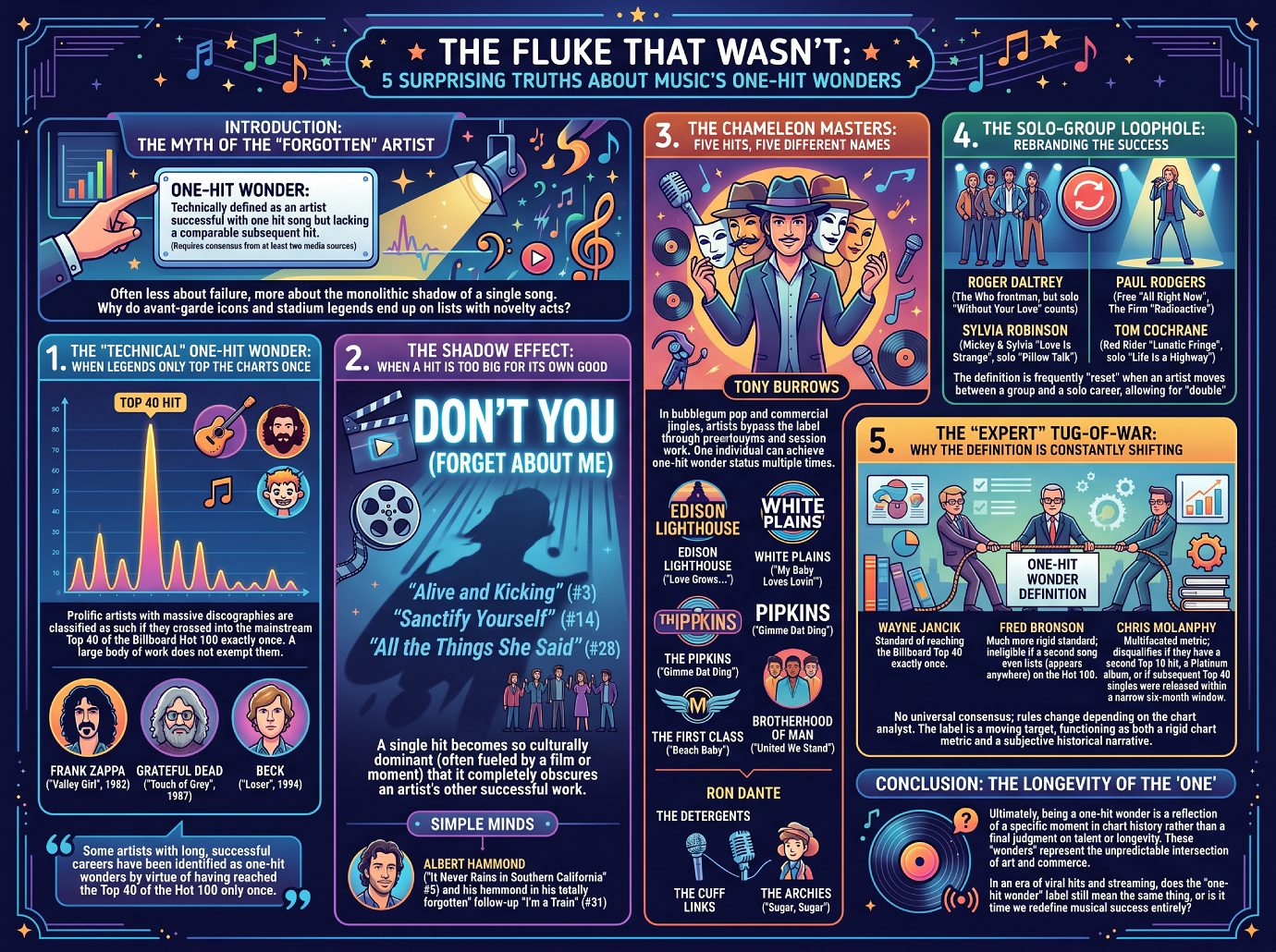
In the shorthand of pop culture, the “one-hit wonder” is frequently dismissed as a musical accident—a stroke of luck for a flash-in-the-pan act that disappeared as quickly as they arrived. However, to a music historian, the label is far more complex than a simple lack of talent. According to industry standards and media consensus, a one-hit wonder is technically defined as an artist successful with one hit song but lacking a comparable subsequent hit. To qualify for most historical lists, an artist must be regarded as such by at least two media sources, creating a definition rooted in public perception as much as chart data.
The curiosity factor lies in the fact that the “one-hit wonder” tag is often less about an artist’s failure and more about the monolithic shadow of a single song. This explains the presence of avant-garde icons like Frank Zappa and stadium legends like the Grateful Dead on lists right alongside novelty acts like “Macarena.” Why does an artist with over 60 albums find themselves in the same category as a session singer? The answer lies in the rigid, often debated mechanics of the American charts.
The “Technical” One-Hit Wonder: When Legends Only Top the Charts Once One of the most persistent misconceptions in music history is that one-hit wonders are defined by short careers. In reality, prolific artists with massive discographies and devoted followings are often classified as such because they crossed into the mainstream Top 40 of the Billboard Hot 100 exactly once. As the data suggests, a large body of work does not exempt an artist from this classification if their chart history remains lopsided.
Consider the “technical” status of Beck, whose alternative anthem “Loser” (1994) remains his only Top 40 entry, or the Grateful Dead, who despite decades of touring, only reached the Top 40 with “Touch of Grey” (1987). Perhaps most striking is the case of Frank Zappa; despite his status as a high-art revolutionary, his only brush with the Top 40 was the satirical anomaly “Valley Girl” (1982), a song that mocked San Fernando Valley culture and stood in stark contrast to his usual experimental output. These artists represent a specific phenomenon in music history, as noted by researchers:
“Some artists with long, successful careers have been identified as one-hit wonders by virtue of having reached the Top 40 of the Hot 100 only once.”
The Shadow Effect: When a Hit is Too Big for its Own Good Pop culture analyst Brent Mann identifies another category: the “Signature Song” phenomenon. This occurs when a single hit becomes so culturally dominant—often fueled by a film or a specific cultural moment—that it completely obscures an artist’s other successful work.
The Scottish rock band Simple Minds provides a textbook example. They are inextricably linked to “Don’t You (Forget About Me),” the defining anthem of the 1985 film The Breakfast Club. While they are remembered as one-hit wonders by the casual listener, the data tells a different story: they followed that hit with “Alive and Kicking” (#3), “Sanctify Yourself” (#14), and “All the Things She Said” (#28). Because the first hit “overshadows the rest of the artist’s discography,” the follow-ups are historically minimized. A similar fate befell Albert Hammond; though “It Never Rains in Southern California” (#5) is a classic, his follow-up “I’m a Train” (#31) was dismissed by Mann as “totally forgotten,” proving that a Top 40 position cannot always save a song from the “Shadow Effect.”
The Chameleon Masters: Five Hits, Five Different Names In the realm of bubblegum pop and commercial jingles, the “one-hit wonder” label can be bypassed through the use of pseudonyms and session work. This creates a loophole where a single individual can achieve one-hit wonder status multiple times over under different identities.
The ultimate master of this was Tony Burrows, an English session singer who provided the lead vocals for five different “one-hit” songs for five separate groups in the early 1970s: Edison Lighthouse (“Love Grows (Where My Rosemary Goes)”), White Plains (“My Baby Loves Lovin'”), The Pipkins (“Gimme Dat Ding”), The First Class (“Beach Baby”), and the initial incarnation of Brotherhood of Man (“United We Stand”). Similarly, Ron Dante achieved this feat with three different acts, including the parody group The Detergents (“Leader of the Laundromat”), the group The Cuff Links (“Tracy”), and the fictional animated band The Archies, who scored a massive #1 hit with “Sugar, Sugar.”
The Solo-Group Loophole: Rebranding the Success The definition of a one-hit wonder is frequently “reset” when an artist moves between a group dynamic and a solo career. Music historian Wayne Jancik applies a specific criterion that distinguishes between a solo performer and a group performance. This allows for a “double” one-hit wonder status through rebranding.
Jancik points to Roger Daltrey as an example; while he has had numerous hits as the frontman for The Who, his solo effort “Without Your Love” is counted as a standalone one-hit wonder. We see this again with Paul Rodgers, who reached the Top 40 once with the English band Free (“All Right Now”) and once more with the British supergroup The Firm (“Radioactive”). Other notable rebrandings include Sylvia Robinson, who had a hit as half of the duo Mickey & Sylvia (“Love Is Strange”) before a solo hit as “Sylvia” (“Pillow Talk”), and Tom Cochrane, who found fame with the Canadian band Red Rider (“Lunatic Fringe”) a decade before his solo smash “Life Is a Highway.”
The “Expert” Tug-of-War: Why the Definition is Constantly Shifting There is no universal consensus on what constitutes a one-hit wonder, and the rules change depending on which chart analyst you consult. This lack of uniformity makes the label both a point of contention and a source of analytical fascination.
The “Expert Rules” vary significantly:
- Wayne Jancik: Maintains the standard of reaching the Billboard Top 40 exactly once.
- Fred Bronson: Follows a much more rigid standard; an artist is ineligible if they have a second song even listed (appearing anywhere) on the Hot 100, regardless of its peak position.
- Chris Molanphy: Uses a multifaceted metric. He disqualifies artists if they have a second Top 10 hit, a Platinum album, or if their subsequent Top 40 singles were released within a narrow six-month window of their first hit, suggesting that true success requires sustained momentum.
These varying metrics show that the label is a moving target, functioning as both a rigid chart metric and a subjective historical narrative.
Conclusion: The Longevity of the “One”
Ultimately, being a one-hit wonder is a reflection of a specific moment in chart history rather than a final judgment on an artist’s talent or longevity. Whether an artist was a session singer hiding behind multiple band names or a legend like Frank Zappa whose work was simply too avant-garde for the Top 40, these “wonders” represent the unpredictable intersection of art and commerce.
In an era of viral hits and streaming, does the “one-hit wonder” label still mean the same thing it did in the 1950s, or is it time we redefine musical success entirely?NotebookLM can be inaccurate; please double check its responses.
One Hit Wonders by 20 Year Period – We cover the music in reverse order
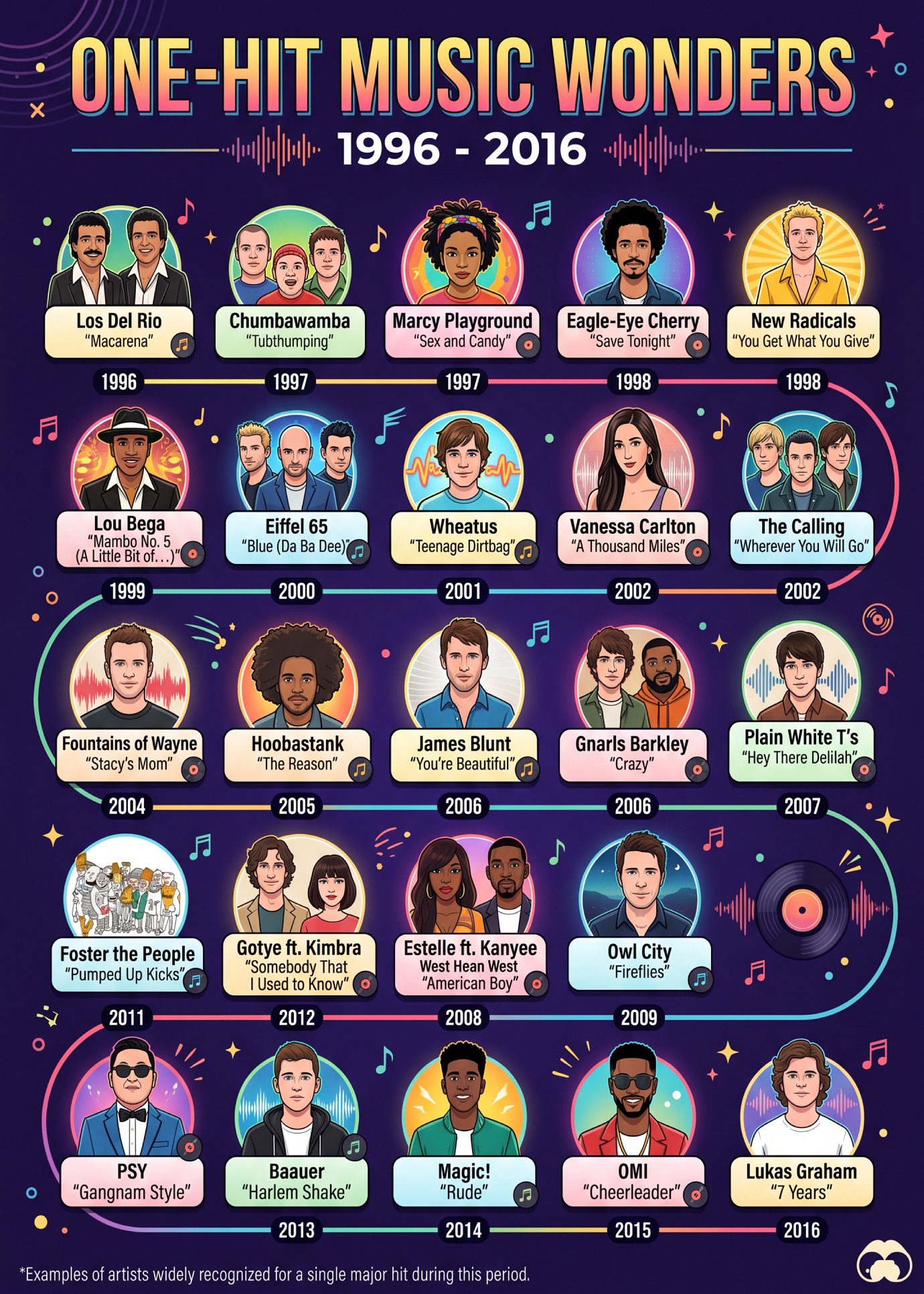
Notable One-Hit Wonders (1996–2016)
Between 1996 and 2016, the music industry saw several iconic one-hit wonders—artists who achieved massive, singular chart success, often defining a year with their song before disappearing from the mainstream.
“How Bizarre” – OMC (1996): Reached number one worldwide and was a global dance-pop phenomenon.
“Tubthumping” – Chumbawamba (1997): An omnipresent rock anthem, often cited as one of the most popular, and maddening, hits of the late ’90s.
“Sex and Candy” – Marcy Playground (1997): A laid-back alternative rock hit that received heavy airplay into 1998.
“Bitter Sweet Symphony” – The Verve (1997): While they had other songs, this song is frequently considered their only major mainstream hit, as noted on Dave’s Music Database.
“You Get What You Give” – New Radicals (1998): A highly regarded pop-rock track that reached top spots before the band split.
“Closing Time” – Semisonic (1998): A lasting alt-rock hit that was popular in the late ’90s, says The Vault at Music & Arts.
“Steal My Sunshine” – Len (1999): Described as a “people’s hit” that defined the summer of 1999.
“Mambo No. 5” – Lou Bega (1999): An iconic pop remake and a global dance hit.
“Who Let the Dogs Out?” – Baha Men (2000): A massive dance hit that defined the early 2000s, according to the Loyolan.
“Teenage Dirtbag” – Wheatus (2000): A pop-punk staple that gained popularity in both the UK and US, as discussed on Songkick.
“Butterfly” – Crazy Town (2001): A popular rap-rock hit in the early 2000s, as identified in Medium.
“A Thousand Miles” – Vanessa Carlton (2002): A staple pop song from the 2000s, listed in Reddit discussions.
“Bad Day” – Daniel Powter (2006): The biggest hit of 2006, as ranked on Reddit.
“Somebody That I Used to Know” – Gotye ft. Kimbra (2011): An massive international hit, noted for its singular success in this era, as discussed on Reddit.
“Rude” – MAGIC! (2014): A pop-reggae hit that topped charts globally.
“Shut Up And Dance” – Walk The Moon (2014): A major radio hit, frequently cited in 2010s pop discussions
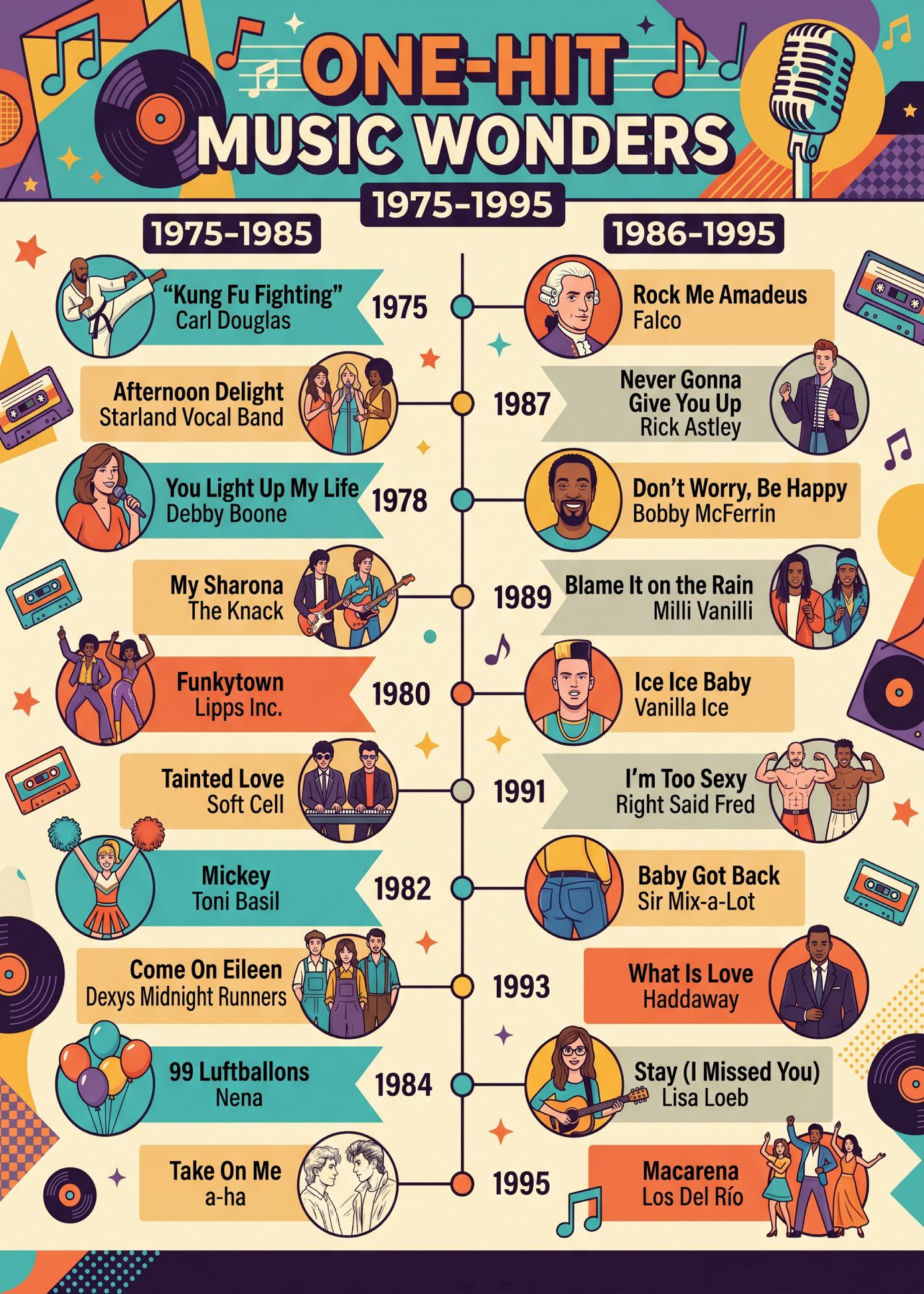
1975-1995
The period between 1975 and 1995 produced some of the most iconic one-hit wonders in music history, with artists who topped the Billboard Hot 100 or gained massive global popularity with a single song before fading from the mainstream spotlight.
Here is a chronological list of notable one-hit wonders from this period based on their peak popularity:
1975–1979: Disco, Funk, and Rock Hits
Minnie Riperton – “Lovin’ You” (1975): Known for her incredible five-octave range, this was her only #1 hit.
Carl Douglas – “Kung Fu Fighting” (1975): A massive disco hit that topped the charts.
Ace – “How Long” (1975): A popular soft-rock hit.
Starland Vocal Band – “Afternoon Delight” (1976): A chart-topping song that defined the era.
Wild Cherry – “Play That Funky Music” (1976): A crossover disco/rock hit.
Vicki Sue Robinson – “Turn the Beat Around” (1976): A disco classic.
Ram Jam – “Black Betty” (1977): A rock hit with a distinct sound.
Debby Boone – “You Light Up My Life” (1977): Spent 10 weeks at #1.
Nick Gilder – “Hot Child In The City” (1978): A popular pop-rock hit.
Anita Ward – “Ring My Bell” (1979): A major late-70s disco hit.
1980–1989: New Wave, Pop, and Rock
The Buggles – “Video Killed the Radio Star” (1980): Famous for being the first music video played on MTV.
Gary Numan – “Cars” (1980): A seminal electronic pop hit.
Toni Basil – “Mickey” (1982): An iconic cheerleader-pop song.
Dexys Midnight Runners – “Come On Eileen” (1983): A global smash hit.
Modern English – “I Melt with You” (1982/1983): A staple of the 80s new wave sound.
Nena – “99 Luftballons” (1984): A German hit that became a global success.
Rockwell – “Somebody’s Watching Me” (1984): Famous for featuring Michael Jackson on chorus vocals.
a-ha – “Take On Me” (1985): Known for its groundbreaking music video.
John Parr – “St. Elmo’s Fire (Man in Motion)” (1985): Movie theme song success.
1990–1995: Hip Hop, Dance, and Alternative
Vanilla Ice – “Ice Ice Baby” (1990): The first hip-hop single to hit #1 on the Billboard Hot 100.
Deee-Lite – “Groove Is In the Heart” (1990): A popular dance-pop hit.
EMF – “Unbelievable” (1991): A British alternative rock hit.
Sir Mix-a-Lot – “Baby Got Back” (1992): An massive hip-hop hit.
Right Said Fred – “I’m Too Sexy” (1992): A popular humorous dance hit.
Blind Melon – “No Rain” (1993): An alternative rock classic.
Los Del Rio – “Macarena” (1995/1996): An inescapable dance craze that spanned two years.
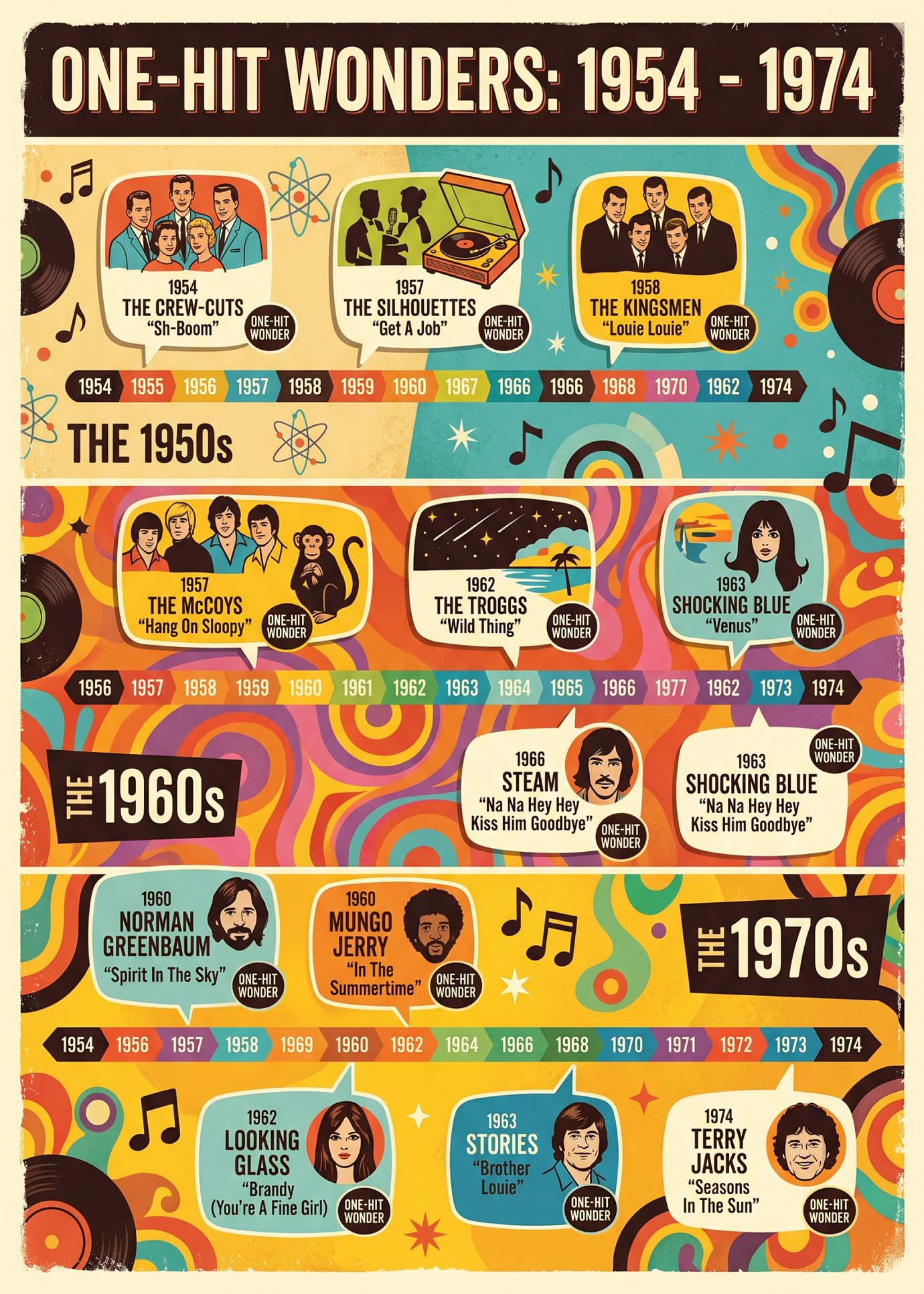
1954-1974
Between 1954 and 1974, several iconic one-hit wonders dominated the US charts, defined by artists who hit #1 (or the top 40) only once before fading from the spotlight. Memorable examples include “Sh-Boom” by The Chords (1954), “Earth Angel” by The Penguins (1955), “In the Still of the Night” by The Five Satins (1956), “Venus” by Shocking Blue (1970), and “Kung Fu Fighting” by Carl Douglas (1974).
Here are some of the most famous one-hit wonders from that era:
1950s
1954: The Chords – “Sh-Boom” – Regarded as one of the earliest rock and roll hits.
1954: The Penguins – “Earth Angel” – A massive doo-wop hit.
1956: The Five Satins – “In the Still of the Night”.
1958: The Silhouettes – “Get a Job”.
1958: Sheb Wooley – “Purple People Eater”.
1958: Bobby Day – “Rockin’ Robin”.
1960s
1966: ? and The Mysterians – “96 Tears”.
1969: Steam – “Na Na Hey Hey Kiss Him Goodbye”.
1969: Rhinoceros – “Apricot Brandy”.
Early 1970s (1970–1974)
1970: Norman Greenbaum – “Spirit in the Sky”.
1970: Mungo Jerry – “In the Summertime”.
1970: Shocking Blue – “Venus”.
1970: The Ides of March – “Vehicle”.
1971: The Beginning of the End – “Funky Nassau”.
1972: Malo – “Suavecito”.
1973: Vicki Lawrence – “The Night the Lights Went Out in Georgia”.
1974: Carl Douglas – “Kung Fu Fighting”.
1974: Redbone – “Come And Get Your Love”.
1974: Terry Jacks – “Seasons in the Sun”.
1974: Paper Lace – “The Night Chicago Died”.
1974: Reunion – “Life is a Rock (But the Radio Rolled Me)”
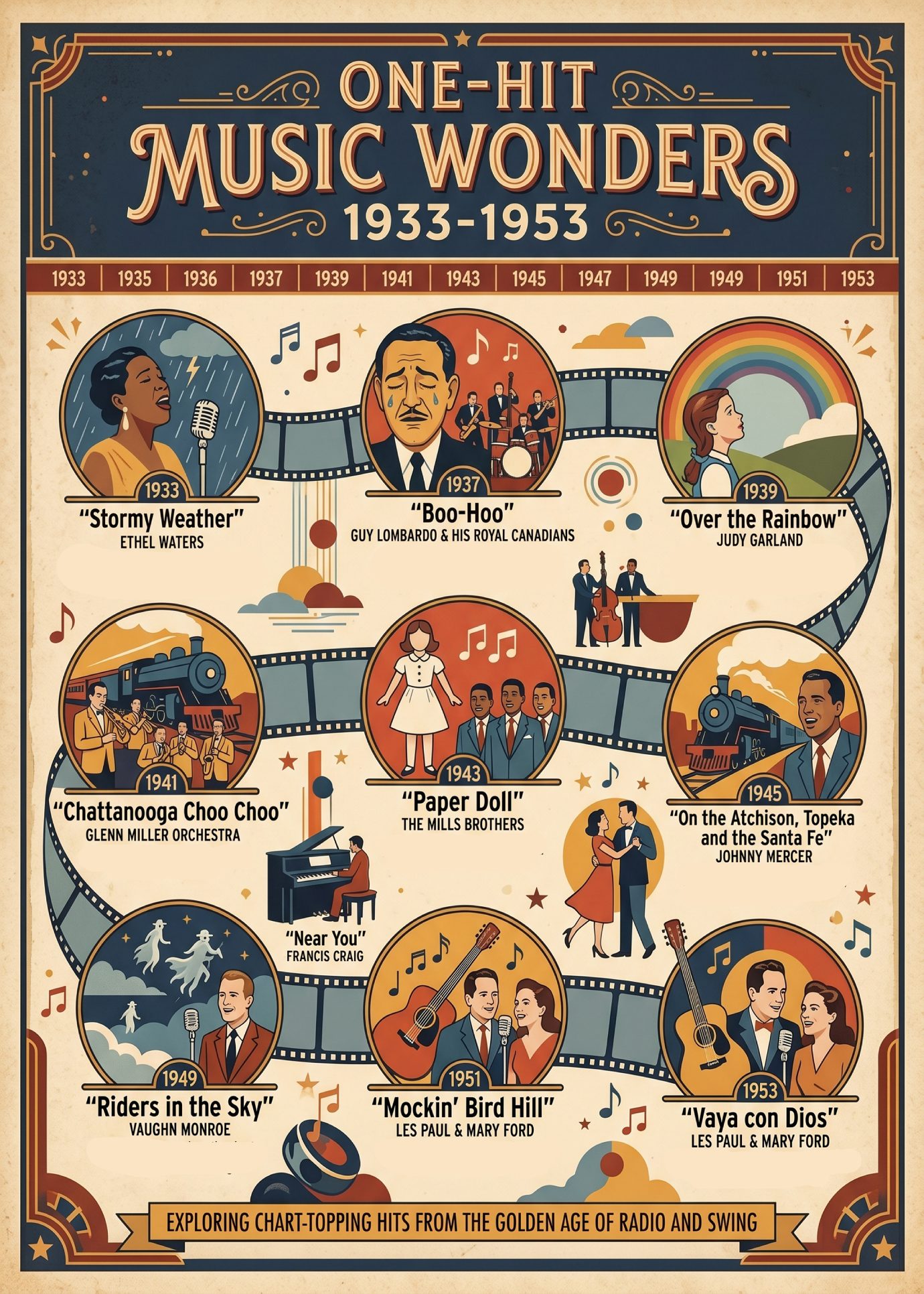
1933-1953
Between 1933 and 1953, the music industry was dominated by big bands and crooners, making “one-hit wonders” less common than in the later rock era. However, several artists achieved massive success with a single song before fading from the spotlight.
Key one-hit wonders and iconic, singular hits from this era include:
1930s–1940s One-Hit Wonders & Singular Hits
“Brother, Can You Spare a Dime?” – Rudy Vallee (1933): While Vallee was a massive star, this specific song became the defining, singular anthem of the Depression era for him.
“It’s Only a Paper Moon” – Cliff Edwards (1933): Known as “Ukulele Ike,” this was his major hit that became a lasting standard.
“Thanks for the Memory” – Bob Hope & Shirley Ross (1938): Specifically known as Bob Hope’s signature song from the film The Big Broadcast of 1938.
“Goodnight, Irene” – The Weavers (1950): While Lead Belly wrote it, the folk quartet the Weavers brought it to #1 for 13 weeks.
“The Wayward Wind” – Gogi Grant (1956 – Note: Slightly outside range, but a definitive early 50s-style hit): A massive hit that defined her career.
“Peg O’ My Heart” – The Harmonicats (1947): A unique instrumental hit that topped the charts.
“Heartaches” – Ted Weems & His Orchestra (1947): Originally recorded in 1933, it was re-released in 1947 and became a massive, surprise hit.
Early 1950s One-Hit Wonders
“Rocket 88” – Jackie Brenston and His Delta Cats (1951): Often cited as one of the first rock and roll records; it was the only major hit for this group, which was actually Ike Turner’s band.
“Cry Me a River” – Julie London (1955 – Early 50s style): Though slightly later, she is often considered a one-hit wonder for this classic jazz-pop standard.
“Let Me Go, Lover!” – Joan Weber (1954): A #1 hit on Your Hit Parade that was her only significant success.
“I Believe” – Jane Froman (1953): A massive hit that year, it is often associated as her primary popular achievement.
Other Notable One-Hit Wonders (Early 50s/Mid-50s)
“Sh-Boom” – The Chords (1954): A major crossover hit from the R&B charts to pop.
“Earth Angel (Will You Be Mine)” – The Penguins (1954): A landmark doo-wop hit that topped the R&B charts.
“Suddenly There’s a Valley” – Various (1955): A hit for Lee Lawrence in the UK and Gogi Grant in the US
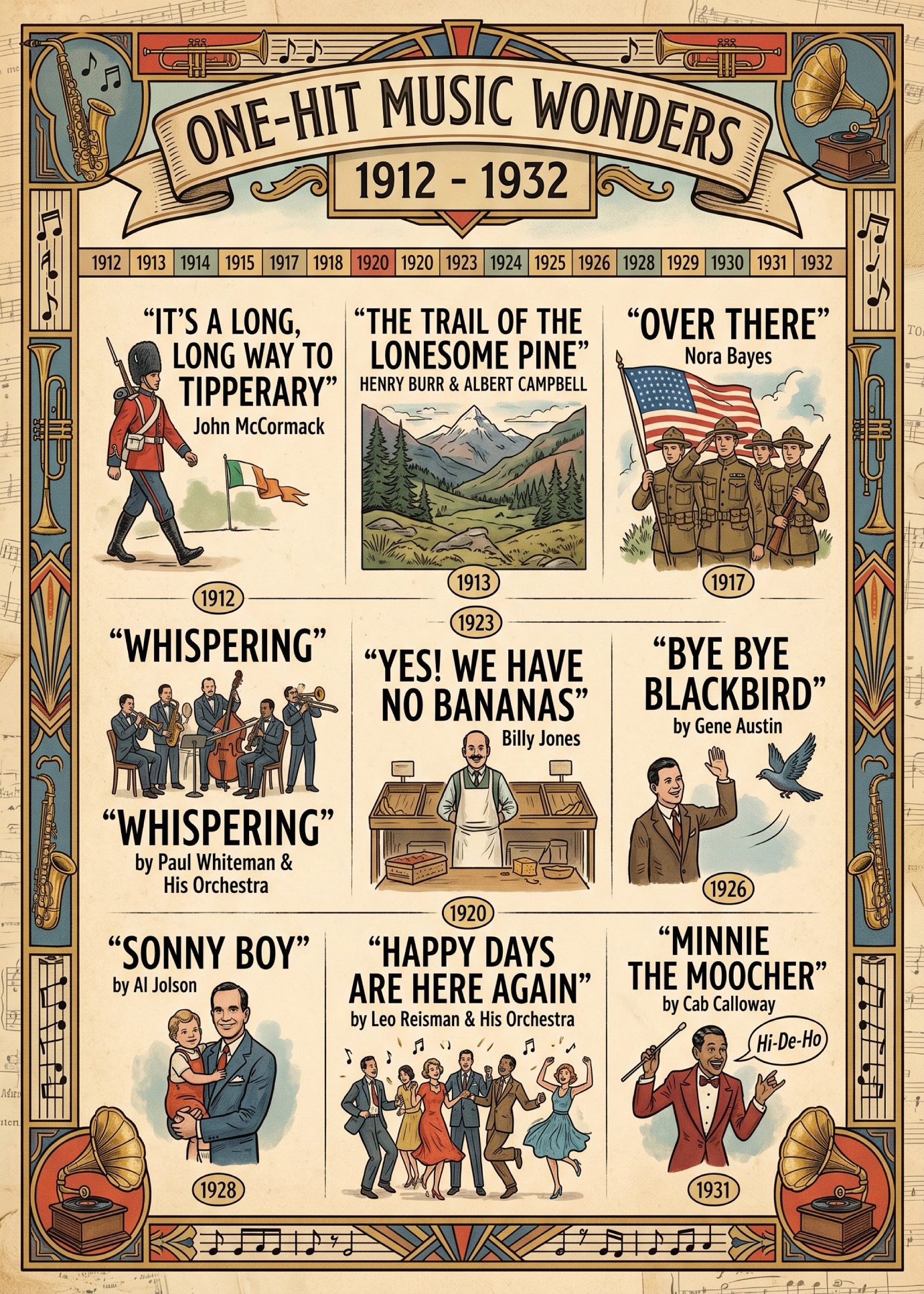
1912-1932
Notable one-hit wonders or artists known for a single dominant, historic recording between 1912 and 1932 included “Ragging the Baby to Sleep” by Al Jolson (1912), “Whispering” by Paul Whiteman’s Orchestra (1920), and “Sonny Boy” by Al Jolson (1928). This era focused on sheet music and early recordings, featuring popular, yet fleeting, hits like “The Gaby Glide” (1912).
Based on Billboard’s historical data and records of the era, key examples include:
1912: “Ragging the Baby to Sleep” – Al Jolson
1912: “The Gaby Glide” – Various (Recorded 1912)
1912: “On Moonlight Bay” – American Quartet
1917: “Over There” – American Quartet
1918: “Tiger Rag” – Original Dixieland Jazz Band
1920: “Whispering” – Paul Whiteman’s Orchestra
1920: “Avalon” – Al Jolson
1928: “Sonny Boy” – Al Jolson
These artists often had long careers in vaudeville or theater, but specific recordings became definitive, singular hits of that time period.
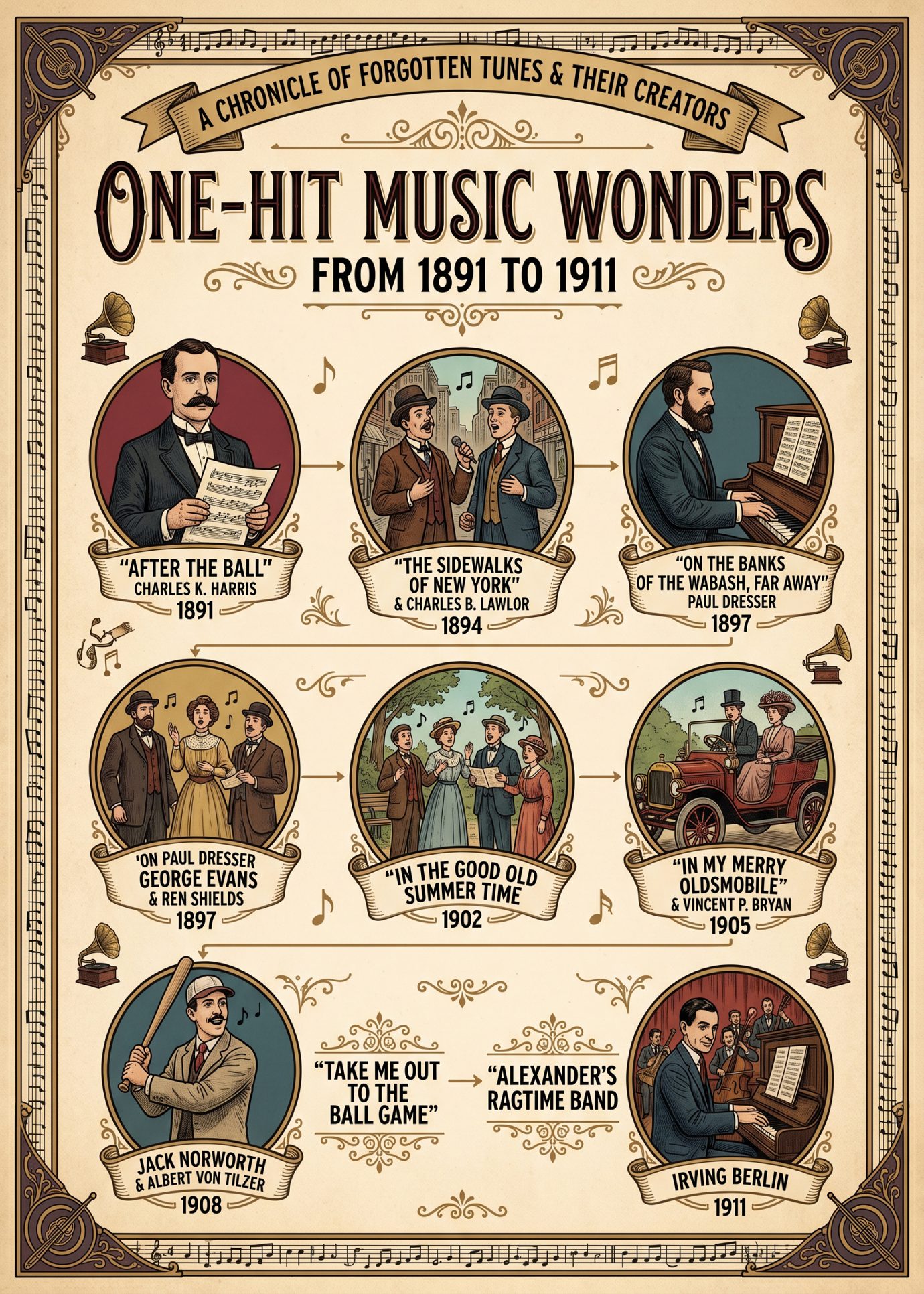
1891-1911
Based on data from Dave’s Music Database, key one-hit wonders from 1891 to 1911 include John Yorke Atlee’s “Listen to the Mocking Bird” (1891), Len Spencer’s “Ta-Ra-Ra Boom-De-Ay” (1892), and Arthur Collins’ “Hello Ma Baby” (1899). These artists achieved immense success with a single hit in that era’s early popular music market.
Key 1891–1911 “One-Hit Wonder” Recordings
Beyond those mentioned, notable examples included:
1892: Manhansett Quartette – “The Picture Turned to the Wall”
1893–96: George J. Gaskin (“After the Ball”) and Dan Quinn (“The Band Played On,” “A Hot Time in the Old Town”)
1897–99: John Philip Sousa (“The Stars and Stripes Forever”), Scott Joplin (“Maple Leaf Rag”), and Arthur Collins (“Hello Ma Baby”)
Key Trends & Context
Recording Limits: Early technology often limited artists to one major hit on wax cylinder or disc.
Genre Shifts: The era saw a shift toward ragtime, exemplified by “Maple Leaf Rag”.
Short-Lived Fame: Performers often achieved massive popularity with single songs like “After the Ball” without sustaining a long-term catalog.
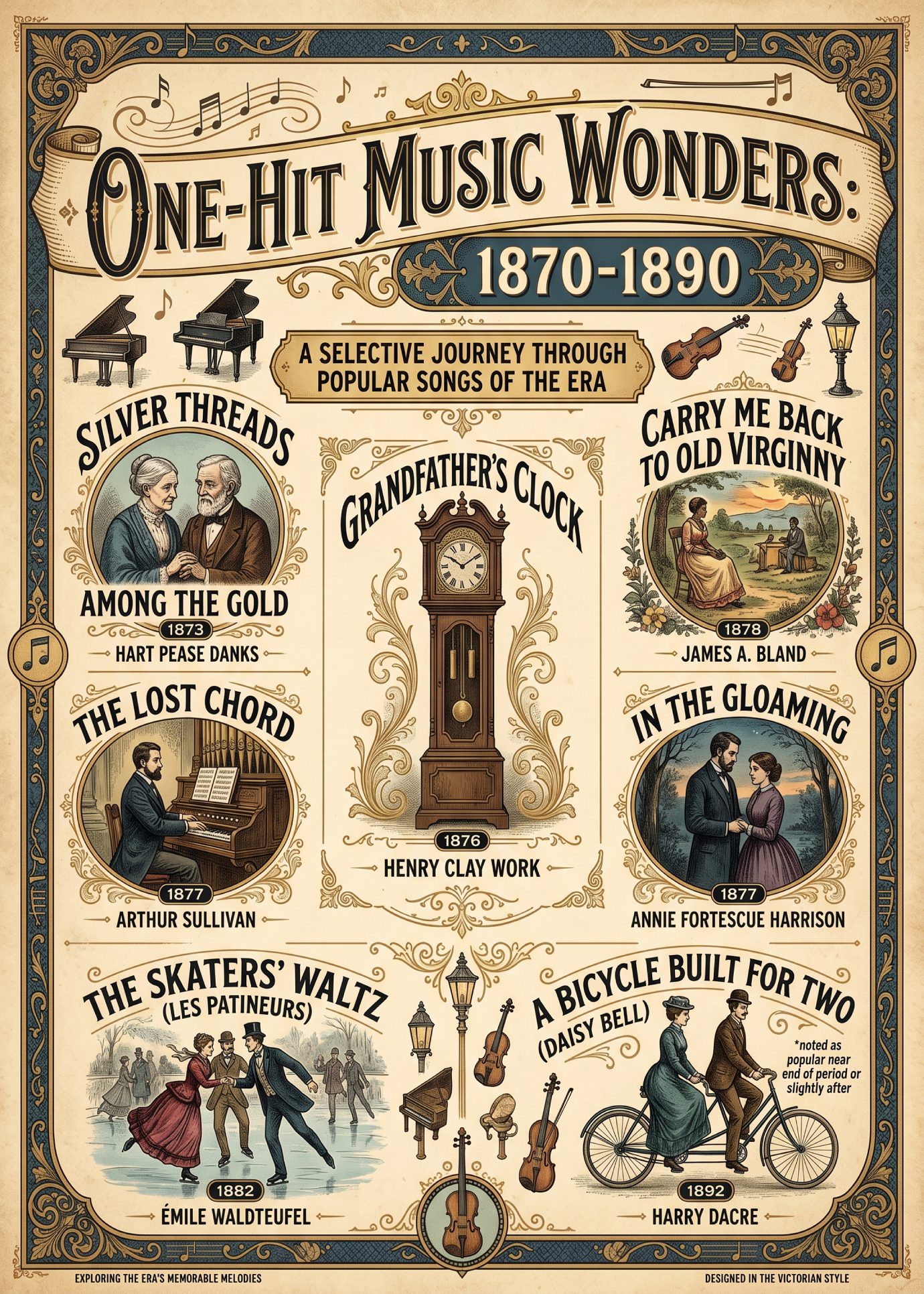
1870-1890
Key one-hit wonders or defining single-hit popular songs between 1870 and 1890 include enduring folk-style hits like “I’ll Take You Home Again, Kathleen” (1876) by Thomas P. Westendorf and “My Grandfather’s Clock” (1876) by Henry Clay Work. Other notable, popular songs from this period often cited as unique successes include “Home on the Range” (1873) and “Chopsticks” (1877).
“I’ll Take You Home Again, Kathleen” (1875/1876): Written by Thomas P. Westendorf, this song became a lasting, sentimental standard in America.
“My Grandfather’s Clock” (1876): A massive hit by Henry Clay Work that remains widely known today.
“Silver Threads Among the Gold” (1873): A popular ballad from this era.
“What a Friend We Have in Jesus” (1876): While a hymn, it gained significant popularity as a standard during this specific period.
“The Fisherman and His Child” (1870s): Written by C.A. White, a prolific writer of popular, though not always remembered, parlor songs.
Contextual Note: “One-hit wonder” is a modern term designed for the Top 40 era. In the 1870s-1880s, hits were measured by sheet music sales rather than radio or streaming, often favoring parlor songs and minstrel show tunes
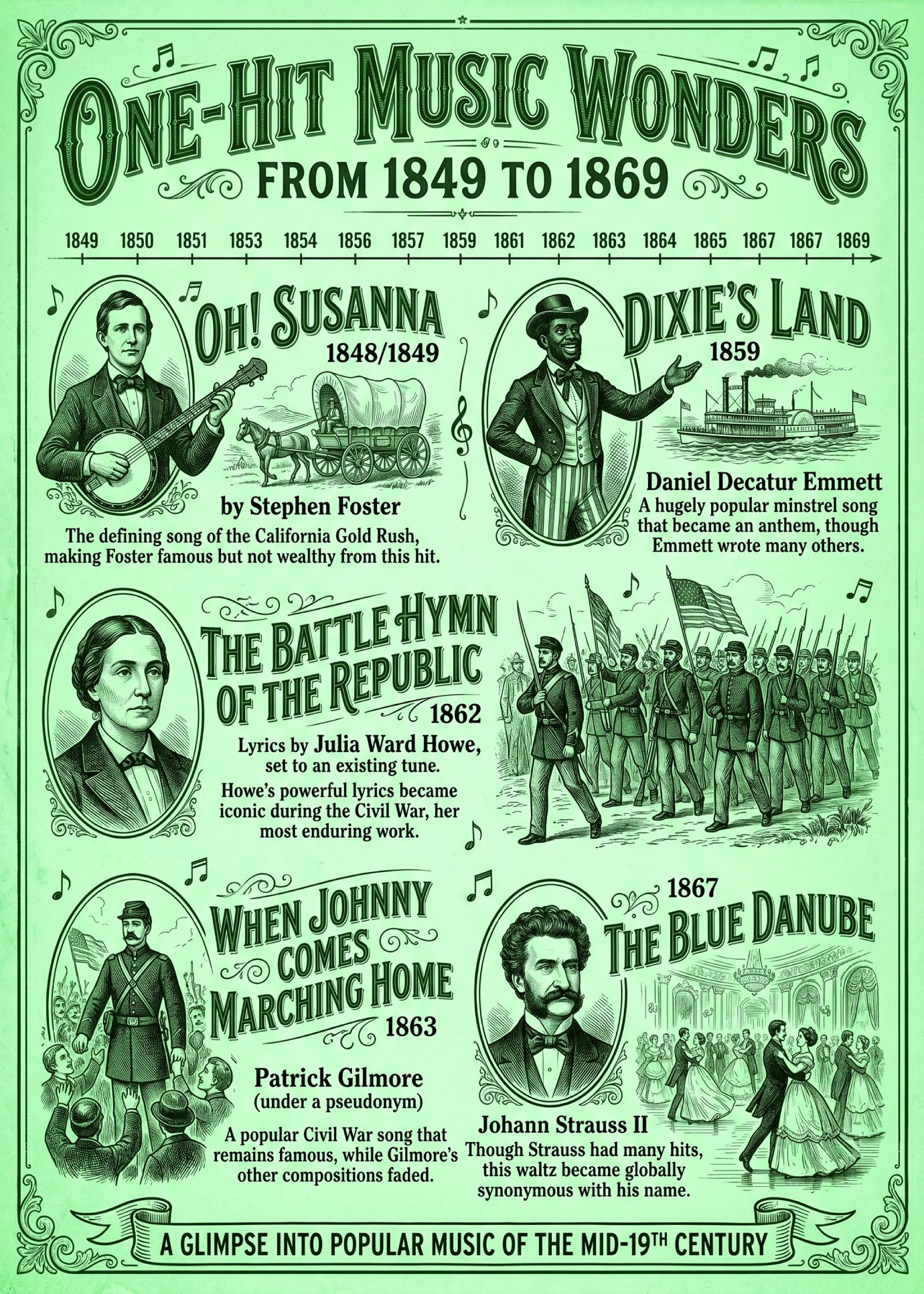
1849-1869
Between 1849 and 1869, the concept of a “one-hit wonder” existed through popular sheet music rather than Billboard charts, with notable examples including “Home! Sweet Home!” (widely popular during the Civil War), “Dixie” by Dan Emmett (1860), and “What Are The Wild Waves Saying” (1850). Other significant single-hit successes included “The Battle Cry of Freedom” and various parlor songs that defined the era.
“Dixie” (1860): Composed by Dan Emmett, this minstrel song became an unofficial anthem for the Confederacy.
“What Are The Wild Waves Saying” (1850): A popular duet by Stephen Glover and Joseph Edwards Carpenter.
“Home! Sweet Home!” (1823, popularized through 1860s): While written earlier, this song by Henry Rowley Bishop became arguably the most popular song on both sides of the American Civil War.
“Home Again” (1850): A popular song by M. S. Pike.
“Lincoln and Liberty” (1860): A campaign song for Abraham Lincoln, with lyrics by Jesse Hutchinson, Jr..
Note on the Era: The music industry in this period was dominated by parlor songs, minstrel tunes, and war anthems published as sheet music rather than recordings. Artists often didn’t record, and popular songs were often written by professional songwriters who had only one runaway success, or performers whose fame faded quickly after one hit.
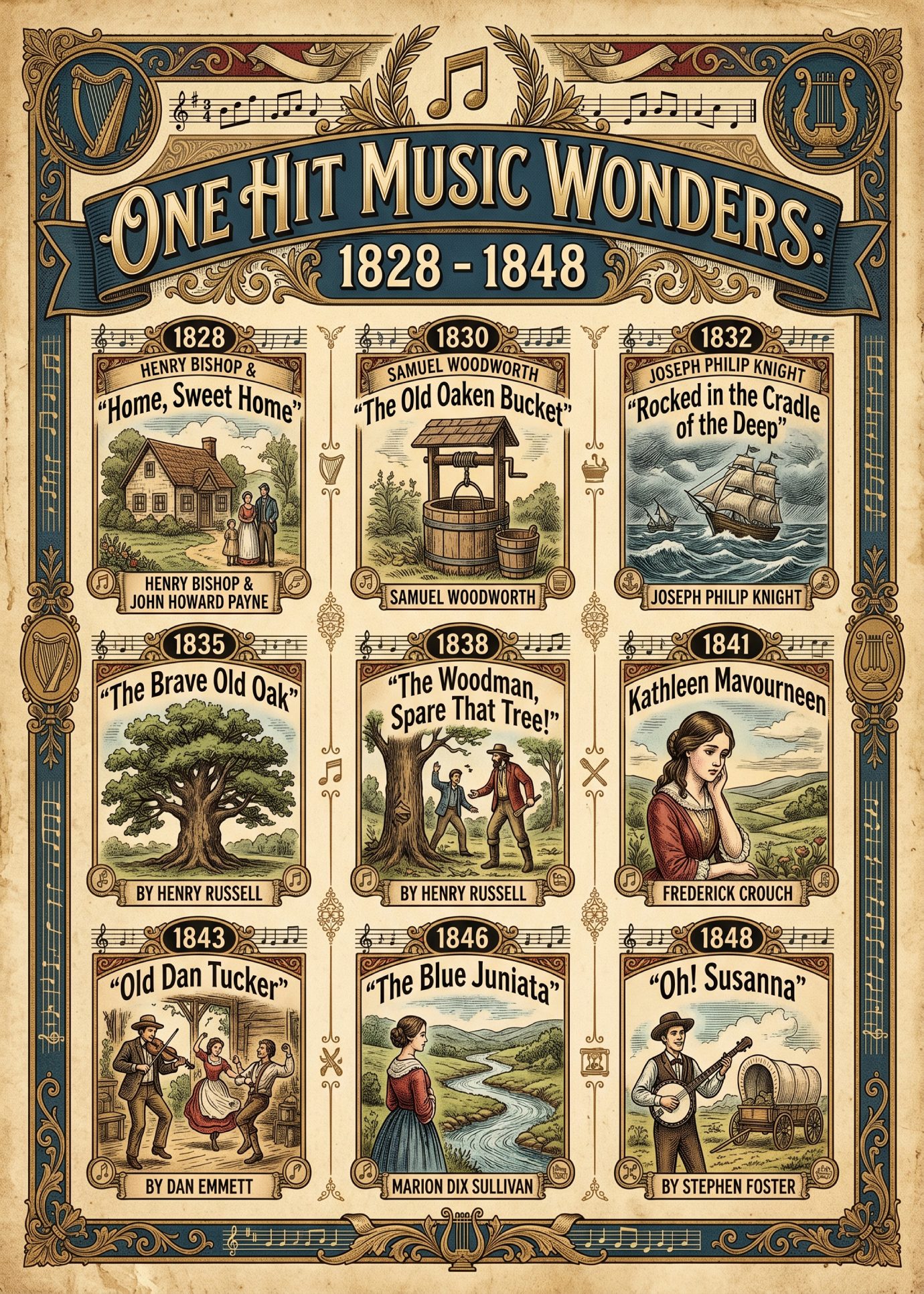
1828-1848
Based on popular songs, parlour music, and sheet music successes published between 1828 and 1848, several composers and songs achieved massive popularity, often overshadowing other works by the same artists.
Key “one-hit wonders” (or defining hits) of this era included:
“Ben Bolt” (1848) by Nelson Kneass: An immensely popular parlour song and ballad, often considered the primary hit for its composer.
“The Minstrels Return from the War” (c. 1820s-1830s) by John Hill Hewitt: Known as the first internationally successful song by an American songwriter, establishing Hewitt, who otherwise wrote many lesser-known works.
“Buffalo Gals” (1844) by Cool White (John Hodges): Though its authorship was sometimes disputed, it was a massive hit in minstrel shows and popularized largely by this act.
“Simple Gifts” (1848) by Elder Joseph Brackett: A Shaker dance song that became a massive success within its community and, in later centuries, a famous American folk standard.
“The Spider and the Fly” (c. 1840s) by Jesse Hutchinson: Part of the famous Hutchinson Family Singers, this was a massive hit among a repertoire of social-cause songs.
Contextual Notes
“Oh! Susanna” (1848) by Stephen Foster was a massive hit, but Foster was a prolific composer rather than a one-hit wonder.
“Home! Sweet Home!” (1823/1840s) by Henry Rowley Bishop remained a massive hit during this period, but Bishop was a prolific composer.
Edward Hicks, known for “The Peaceable Kingdom,” is often cited as a “one-hit wonder” in American art (1820-1849) for creating dozens of versions of the same subject.
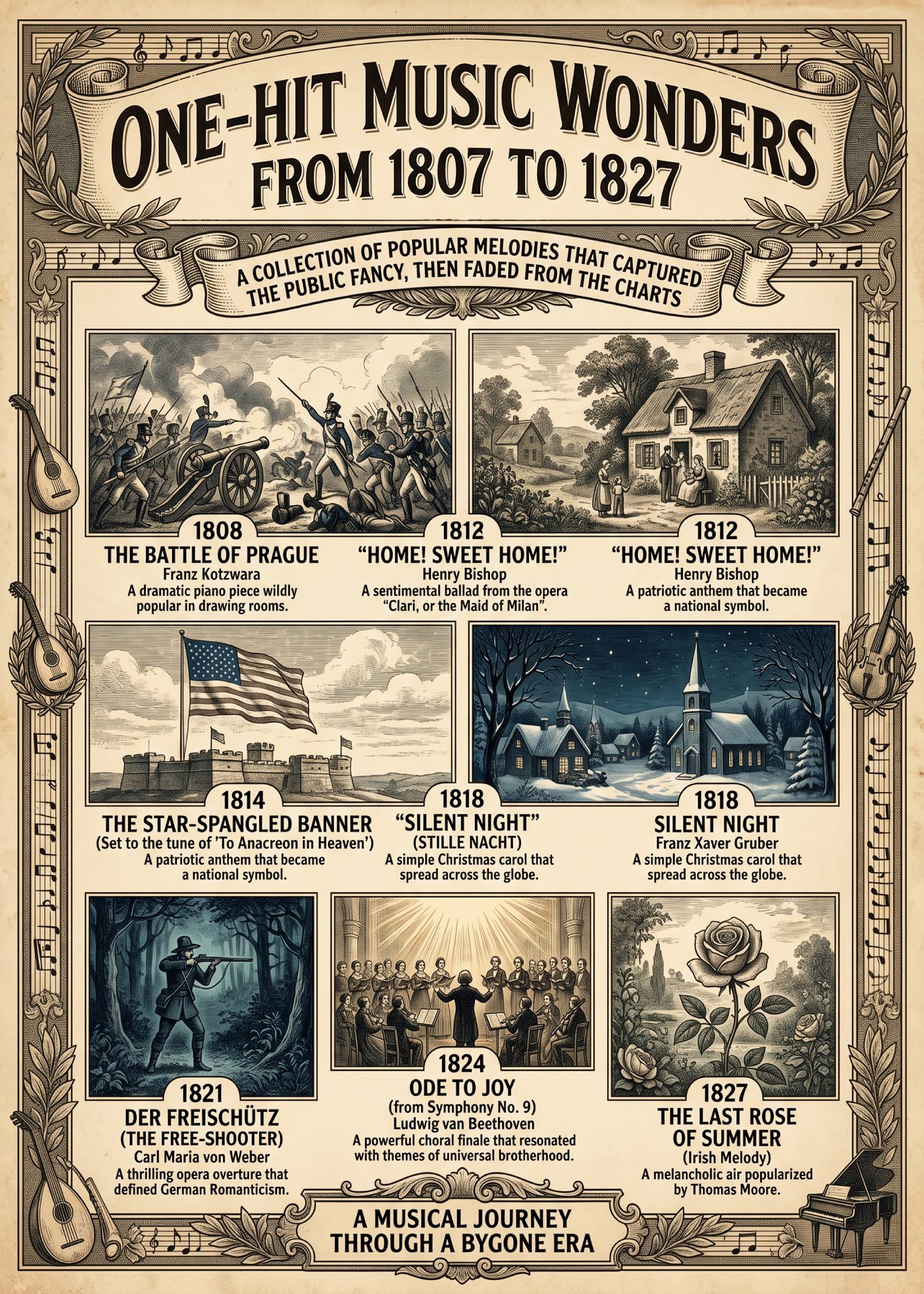
1807-1827
Based on the musical landscape of 1807–1827, “one-hit wonders” were defined by popular parlor songs and single-work successes rather than modern chart statistics. Key examples include Marion Dix Sullivan’s “The Blue Juniata” (1820s), often cited as the first commercial hit by an American woman, and James Sanderson’s 1800s composition of “Hail to the Chief”.
Marion Dix Sullivan – “The Blue Juniata” (c. 1820s): This parlor song achieved massive, lasting popularity, marking the first time an American woman achieved a commercial hit song.
James Sanderson – “Hail to the Chief” (1810s): While a prolific songwriter, this specific composition became his defining hit, adopted for American political usage during this period.
Gioachino Rossini – La cambiale di matrimonio (1810): While Rossini became famous later, this was his first opera and a major early hit in 1810, often considered a “one-act” success in his early career.
These works represented the emerging commercial music scene, similar to later 19th-century staples like “Amazing Grace” or “Jingle Bells”, which became dominant hits within their respective, often limited, musical markets
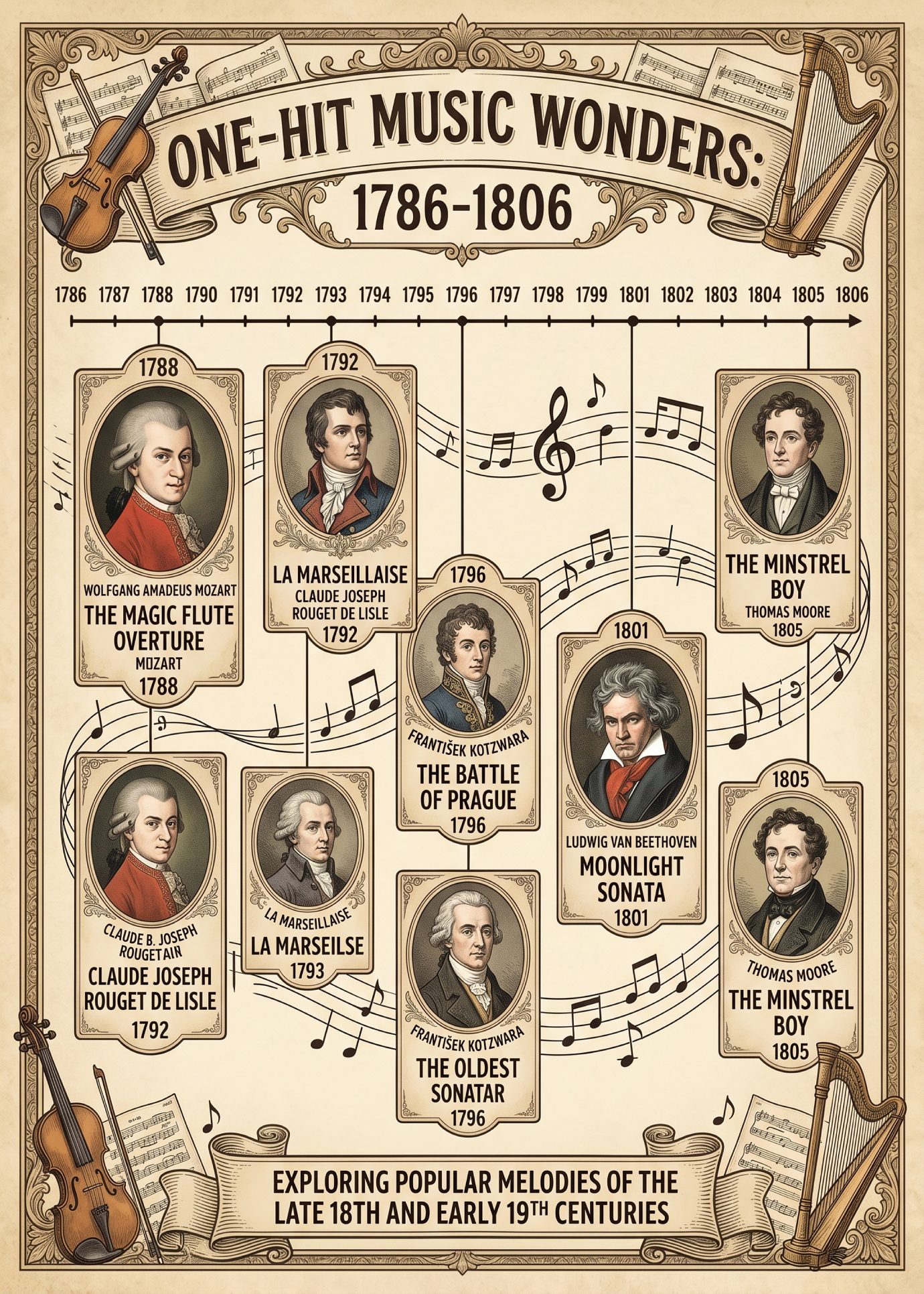
1786-1806
Based on historical records of late 18th and early 19th-century music, one-hit wonders in the modern sense did not exist. Instead, this era relied on popular ballads, marches, and musical theater hits, such as “Yankee Doodle Dandy” (re-popularized throughout the 1790s), or popular songs of the early 1800s like “The Last Rose of Summer” (1805).
Popular Musical Trends (1786–1806): Popular musical culture in this period was dominated by ballads, folk-style songs, and theater tunes rather than artist-driven “hit” singles.
Key “Hits” of the Time:
“Yankee Doodle Dandy” (1790s): While having older roots, this tune was widely popularized and used as a staple in American culture during this time.
“The Last Rose of Summer” (1805): A traditional Irish air popularized by Thomas Moore, which became immensely popular in the early 1800s.
Ballad Operas: Popular performances that often featured single memorable tunes (airs) that became public favorites.
Classical Parallel: While not within the 1786-1806 timeframe, many composers in that era created popular pieces that overshadowed their other work, similar to later 19th-century examples like Humperdinck’s Hänsel and Gretel.
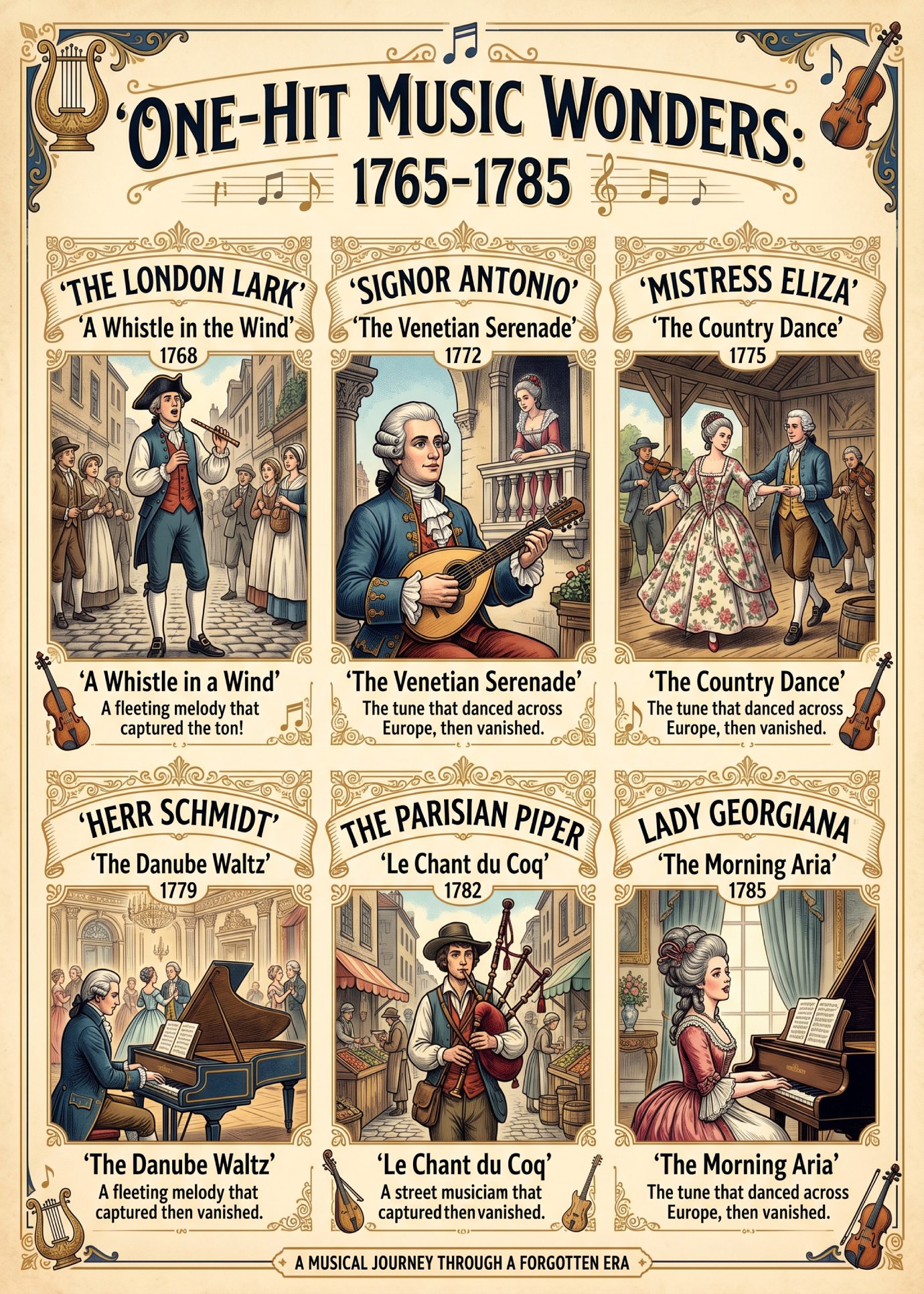
1765–1785
During the American Revolutionary period (1765–1785), musical “one-hit wonders”—popular tunes or anthems that defined the era but were the only major success for their specific composer or remained the only lasting song from a particular production—included William Billings’ hymn “Chester” (1770) and songs from the first American ballad opera, The Disappointment (1767).
“Chester” by William Billings (1770): While Billings wrote other tunes, “Chester” was the anthem of the American Revolution, appearing in his 1770 collection The New England Psalm-Singer and remaining his singular enduring hit.
“The Liberty Song” (1768): Written by John Dickinson set to the tune of “Hearts of Oak,” it was arguably the first American patriotic song, dominating popular culture during the early resistance.
“The Disappointment” Songs (1767): Andrew Barton’s ballad opera, which was scheduled to be performed in Philadelphia, featured popular, but largely single-use, airs for the era, including “[The] Black Joke” and “[The] Lass of Paties Mill”.
“The Taxed Tea” (1770s): A broadside ballad that was popular for a short period during protests.
While “The Yankee Doodle” was the most popular song of the period, it was a traditional tune rather than a single-composer hit.
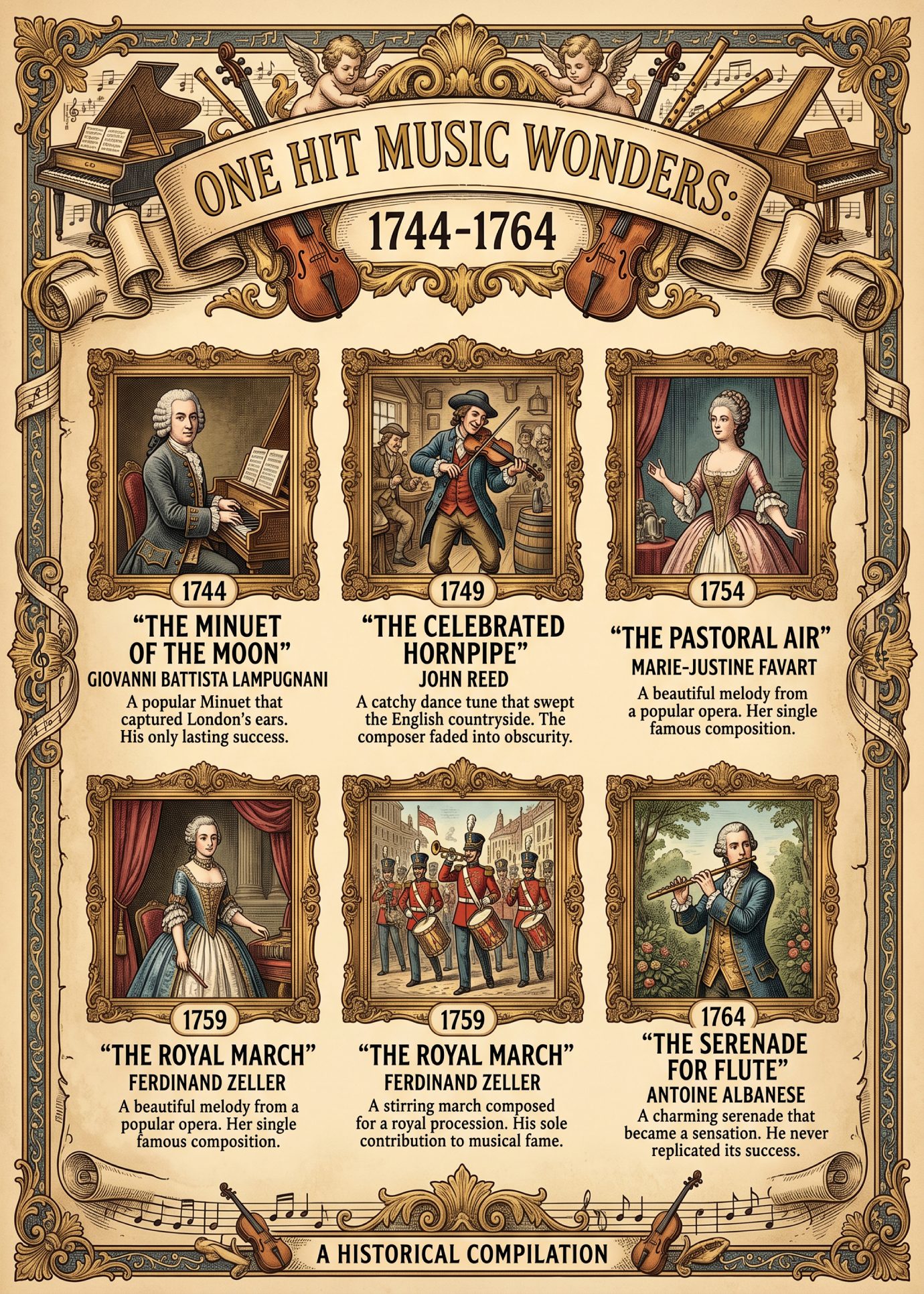
1744-1764
During the 1744–1764 period, musical hits were defined by popular ballads, opera-ballets, and tunes from the British pleasure gardens rather than charts. Key “one-hit” style successes of that era include Thomas Arne’s 1746 composition for the Shakespearean song “To fair Fidele’s grassy Tomb” and Pierre de la Garde’s 1750s success with “Léandre et Héro”.
“To fair Fidele’s grassy Tomb” (1746): Composed by Thomas Arne, this was a popular dirge based on Cymbeline and performed at London pleasure gardens, representing the popular “art song” of the time.
“Léandre et Héro” (c. 1750s): A popular opéra-ballet by Pierre de la Garde, which was a significant success in France during the era of Madame de Pompadour.
“Nancy Dawson” (c. 1750s): An immensely popular tune in the mid-18th century, named after a famous dancer. It was used in various ballad operas and dance collections, often considered a fleeting smash hit of that era.
Ballad Operas: Similar to modern one-hit wonders, many composers contributed to popular musical theater, with songs from works like The Disappointment (1767, but representing 1760s trends) using popular hits like “Black Joke”
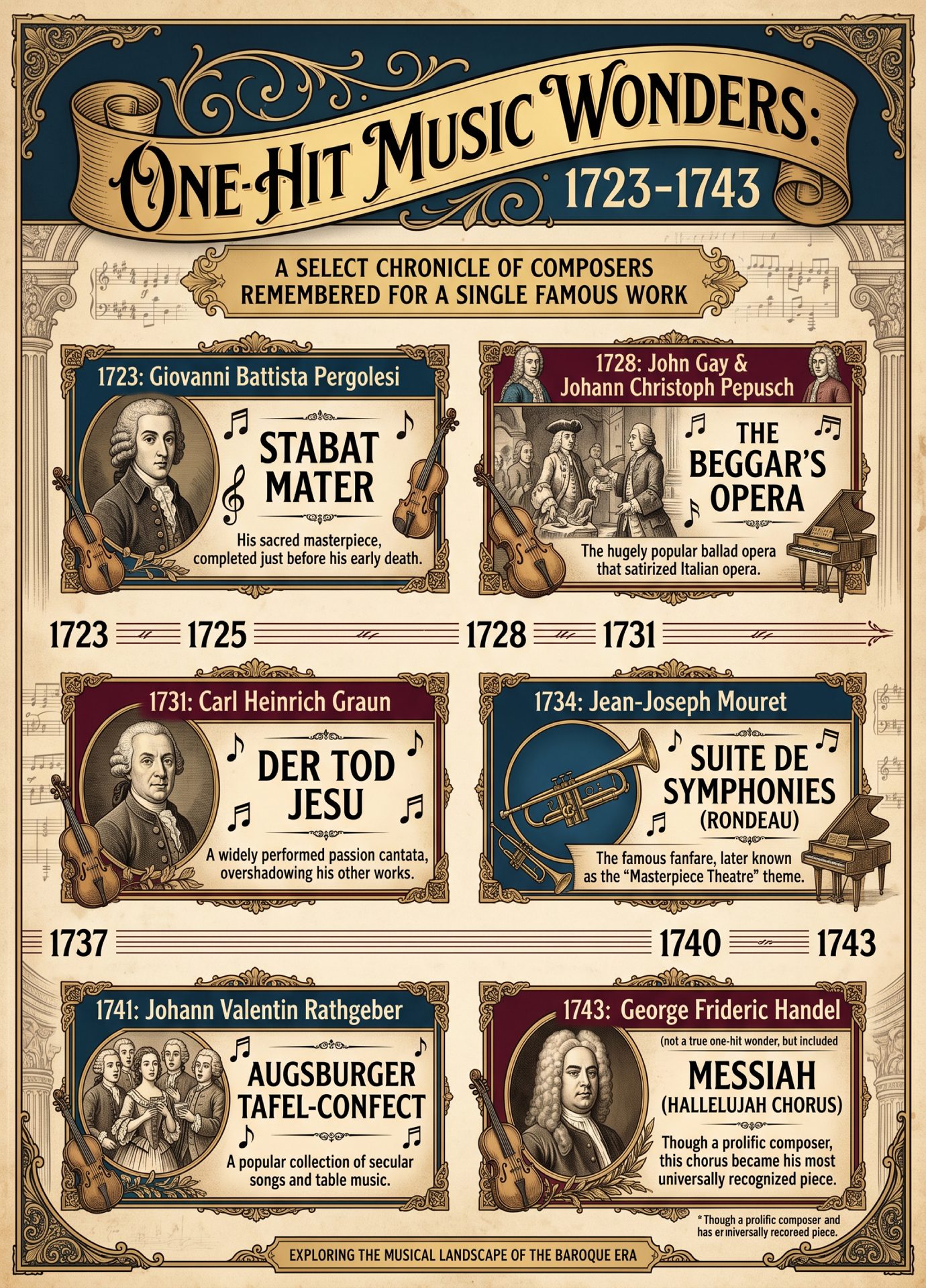
1723-1743
Based on the musical landscape of the 1720s–1740s, while formal “hit parade” charts did not exist, the most significant, singular “one-hit wonder” success of that era was John Gay’s The Beggar’s Opera (1728). This ballad opera was a phenomenon, forcing Handel to change his approach to Italian opera.
1723–1743 Musical “One-Hit Wonders” (Key Popular Successes):
The Beggar’s Opera (1728) – John Gay/Johann Christoph Pepusch: The standout success of the period. Its massive popularity (partly due to parodying Italian opera) made it a unique, massive success, often considered to have given one-hit status to its creators’ popular success model at the time.
The Great Awakening Era Music (1730s–1740s): While not traditional “one-hit wonders,” the religious revival popular music in the American colonies saw several hymns and tunes rise to momentary, high popularity.
“Lascia ch’io pianga” (from Rinaldo) – George Frideric Handel: While Handel was not a one-hit wonder, this specific aria from his earlier opera became a sensation, echoing in popularity during this period.
Key Contextual Trends:
Ballad Operas (1720s–1730s): This was a British reaction to the stiff, formal, and musically sophisticated Italian operas of the day, which became immensely popular in the colonies and England.
Venetian “Stars” (1730s): Pietro Guarneri was crafting violins during this time while performers like Farinelli dominated the scene as individual, singular successes
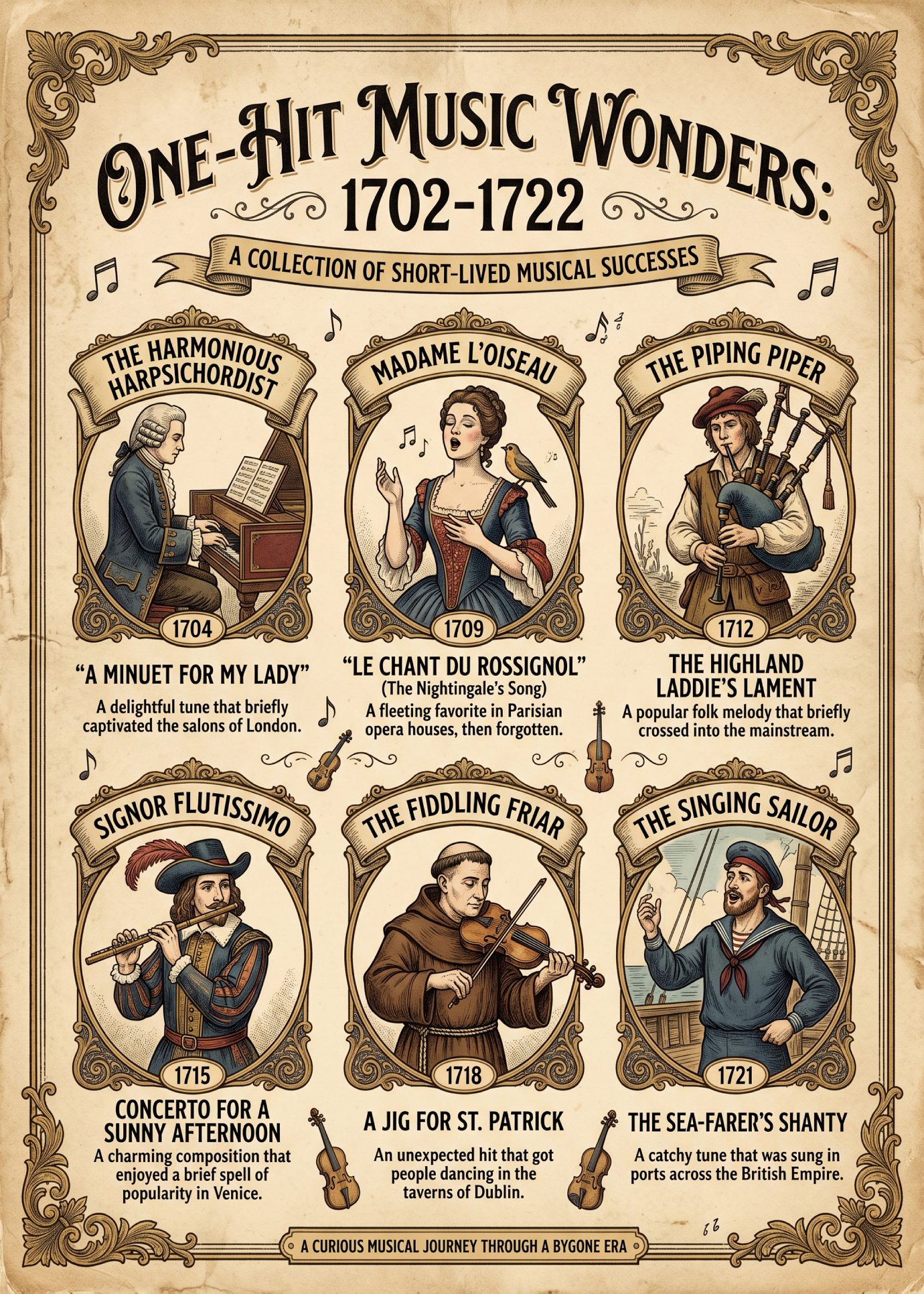
1702-1722
Between 1702 and 1722, popular music was dominated by British [Ballad Operas] and European baroque works, rather than single-hit pop acts. During this era of classical and early public theater, individual composers often created singular, enduring successes, such as Alessandro Scarlatti whose various operas were popular, but none more enduringly recognized today, compared to the rise of George Frideric Handel later in the period.
The Period Context (1702–1722): This era preceded the modern music industry and billboard charts, focusing on Baroque compositions, cantatas, and the early stages of theater music in Europe.
Key “One-Hit” Composers of the Era: Many composers of this time are known for just one or two widely performed works today, while their extensive portfolios are rarely heard.
Baroque Trends: Popularity was defined by patronage and public concerts, with artists like Tomaso Albinoni often remembered by a modern adaptation (the Adagio in G minor, though actually 20th-century) or specifically single instrumental concertos.
Musical Legacy: While not “one-hit wonders” in the modern pop sense, many composers from this period produced massive bodies of work where only one piece remains widely performed, similar to the enduring popularity of Pachelbel’s “Canon,” which was composed just prior to this period