
Extraterrestrials – the UFO Files – Reports by Gardner Magazine

Various reports on Flying Saucers – Aliens – Extra-Terrestrials, Unexplained Aerial Phenomena
The U.S. Government has released many thousands of files related to UFOs and other mysterious related phenomena. Gardner Magazine used 5 separate file dumps from the U.S. Government to generate these reports: (Section 2,3,4,5,and 10) To download the original material yourself and hundreds more files, visit the official site, CLICK HERE.
The Chair Man and the Chair Lady explain as much of it as they can in this podcast, Listen on any device, CLICK PLAY.
Max and Maxine Rogers debate whether the evidence proves the existence of extraterrestrials in this Debate, Listen on any device, CLICK PLAY.
Jump to various reports on this page: FBI Briefing: Synthesis of Investigative Records on Unidentified Flying Discs (1947–1948) —- The Hoover Files: 5 Surprising Takeaways from the FBI’s Early “Flying Disc” Archives —Aviation Observation Guide: Identifying Early Aerial Phenomena (1947–1948) —- Intelligence Synthesis Report: 1947-1948 Aerial Phenomenon and Official Intelligence Responses —-Evidence Evaluation Primer: The 1947–1948 “Flying Disc” Files —-Administrative Case Narrative: The Bureaucratic Architecture of FBI File 62-HQ-83894 (1947-1948) —-
–
Technical Assessment of the 1947–1948 “Flying Disc” Phenomenon: Evidence and Counter-Explanations
————————————
FBI Briefing: Synthesis of Investigative Records on Unidentified Flying Discs (1947–1948)
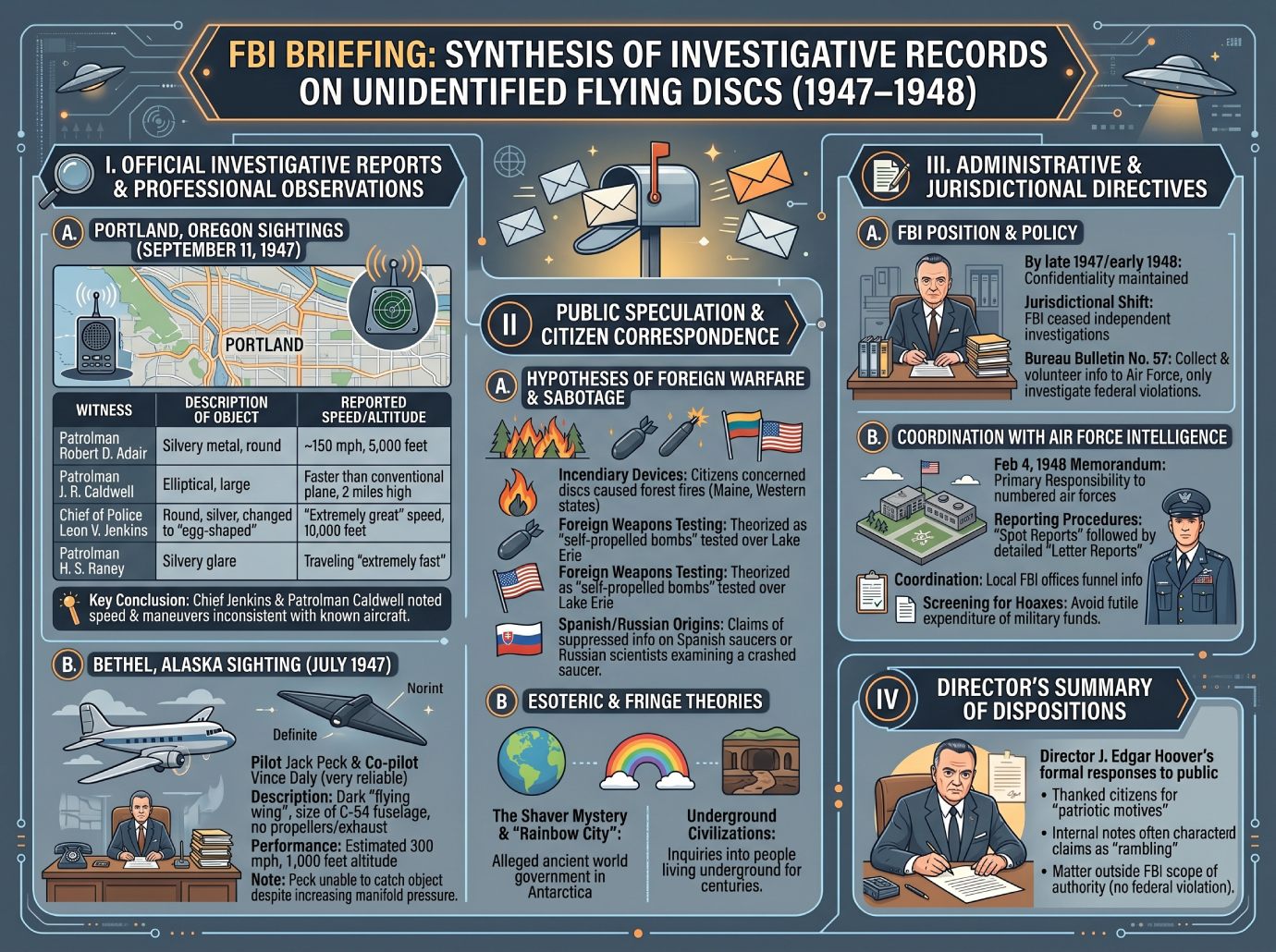
FBI Briefing: Synthesis of Investigative Records on Unidentified Flying Discs (1947–1948)
Summary
Between late 1947 and early 1948, the Federal Bureau of Investigation (FBI) received numerous reports regarding “flying discs” or “unidentified objects” from both professional observers (law enforcement, pilots) and the general public. The documentation reveals a period of high-level concern regarding national security, the potential for foreign sabotage, and the administrative transition of investigative responsibility from the FBI to the United States Air Force.
Key findings include:
- Credible Eyewitness Accounts: Professional reports from Portland, Oregon, and Bethel, Alaska, describe metallic, high-speed objects (150–300 mph) capable of maneuvers beyond the perceived limits of conventional 1947 aircraft.
- Public Theory and Anxiety: Correspondence from citizens frequently linked these sightings to broader national concerns, including forest fires, foreign weapons testing (specifically Spanish or Russian), and esoteric theories involving “underground peoples” or Antarctic bases.
- Policy and Jurisdiction: By early 1948, the FBI officially ceased independent investigations into “flying discs,” shifting its role to a liaison capacity, where it funneled information to Air Force Intelligence while maintaining that the FBI would only investigate if a direct violation of federal statute occurred.
——————————————————————————–
I. Official Investigative Reports and Professional Observations
Official records detail several significant sightings by trained observers, characterized by specific technical descriptions of the objects’ appearance, speed, and behavior.
A. Portland, Oregon Sightings (September 11, 1947)
A series of reports from the Portland Police Department radio dispatcher recorded sightings over the northeast section of the city.
| Witness | Description of Object | Reported Speed/Altitude |
|---|---|---|
| Patrolman Robert D. Adair | Silvery metal, round shape; no oscillation visible. | ~150 mph; 5,000 feet. |
| Patrolman J. R. Caldwell | Elliptical shape, “much greater” size than a conventional plane. | Faster than a conventional airplane; 2 miles high. |
| Chief of Police Leon V. Jenkins | Round, silver object that changed shape to “egg-shaped” as it turned. | “Extremely great” speed; 10,000 feet. |
| Patrolman H. S. Raney | Silvery glare, unable to determine exact shape due to sun reflection. | Traveling “extremely fast.” |
Key Conclusion: While Patrolman Adair believed it might be an “ordinary metal airplane,” Chief Jenkins and Patrolman Caldwell noted that the speed and maneuvers were inconsistent with known aircraft or balloons.
B. Bethel, Alaska Sighting (July 1947)
Pilot Jack Peck (Al Jones Flying Company) and co-pilot Vince Daly reported a sighting while approaching Bethel Airport in a DC-3.
- Description: The object was described as a “flying wing” approximately the size of a C-54 fuselage but without a fuselage, propellors, or visible exhaust. It was dark in color with a “definite, concise outline.”
- Performance: The object traveled at an estimated 300 mph at an altitude of 1,000 feet. Peck increased his manifold pressure to 42 inches in an attempt to catch the object but was unable to do so.
- Note on Credibility: Anchorage FBI files describe Peck and Daly as “very reliable and responsible people.”
——————————————————————————–
II. Public Speculation and Citizen Correspondence
The Bureau received a high volume of letters from the public, ranging from technical suggestions to speculative theories regarding the origin of the discs.
A. Hypotheses of Foreign Warfare and Sabotage
Several correspondents suggested the discs were weapons of war or tools of sabotage.
- Incendiary Devices: Multiple citizens (Mrs. McCaul, Mrs. Milo A. Durand) expressed concern that the discs were “incendiary” and responsible for recent forest fires in Maine and the Western states. Mrs. McCaul suggested we were “at war with someone” who was “hitting us” while the government remained silent.
- Foreign Weapons Testing: N. J. Marshall (Ohio) theorized that the discs were “self-propelled bombs” or “tests” by a foreign country, suggesting they were being tested over Lake Erie to allow for retrieval or to hide evidence of a crash.
- Spanish/Russian Origins: One report claimed a Red Cross director (Joe Lippincott) stated the saucers were from Spain and that the U.S. Government was aware of this but suppressed the information. Another citizen, Joseph W. Oniline, questioned the FBI regarding a suppressed newsreel allegedly showing Russian scientists examining a crashed saucer.
B. Esoteric and Fringe Theories
The Bureau also processed letters involving more unconventional theories:
- The Shaver Mystery and “Rainbow City”: Correspondent Marion Beuscher shared information regarding “Rainbow City” in Antarctica, alleged to be the headquarters of an ancient world government of “oppressed peoples” who operated the discs.
- Underground Civilizations: Inquiries were made into the “Shaver Mystery,” which claimed that people had been living underground for centuries.
——————————————————————————–
III. Administrative and Jurisdictional Directives
The documents track the internal government struggle to define who should investigate these incidents.
A. FBI Position and Policy
By late 1947 and early 1948, FBI Director J. Edgar Hoover maintained a standard response to public inquiries:
- Confidentiality: The Bureau generally stated that information in its files was confidential and available for “official use only.”
- Jurisdictional Shift: Internal memos from February 1948 (specifically from SAC San Francisco) confirm that Bureau Bulletin No. 57 (dated October 1, 1947) remained in effect. This policy stated that the FBI was not conducting investigations into flying discs but would merely collect and volunteer information to the Air Force.
B. Coordination with Air Force Intelligence
A confidential memorandum from the Headquarters Air Defense Command (Mitchel Air Force Base) dated February 4, 1948, established clear protocols:
- Primary Responsibility: The numbered air forces (e.g., First, Second, Fourth) were responsible for investigating sightings within their areas.
- Reporting Procedures: “Spot Reports” (fragmentary) were to be followed by detailed “Letter Reports.”
- Coordination: Investigations were to be coordinated with local FBI offices, though the Air Force was the lead agency.
- Screening for Hoaxes: Instructions explicitly stated that “futile expenditure of military funds and manpower must be avoided” by quickly identifying hoaxes or fabrications.
——————————————————————————–
IV. Director’s Summary of Dispositions
Director J. Edgar Hoover’s responses to the public remained consistently formal, frequently thanking citizens for their “patriotic motives” while providing no specific information. Internal “notes” appended to these letters often characterized the correspondents’ claims as “rambling” or noted that the information provided did not reflect a violation of federal law, thereby placing the matter outside the FBI’s scope of authority. —————————————————
The Hoover Files: 5 Surprising Takeaways from the FBI’s Early “Flying Disc” Archives
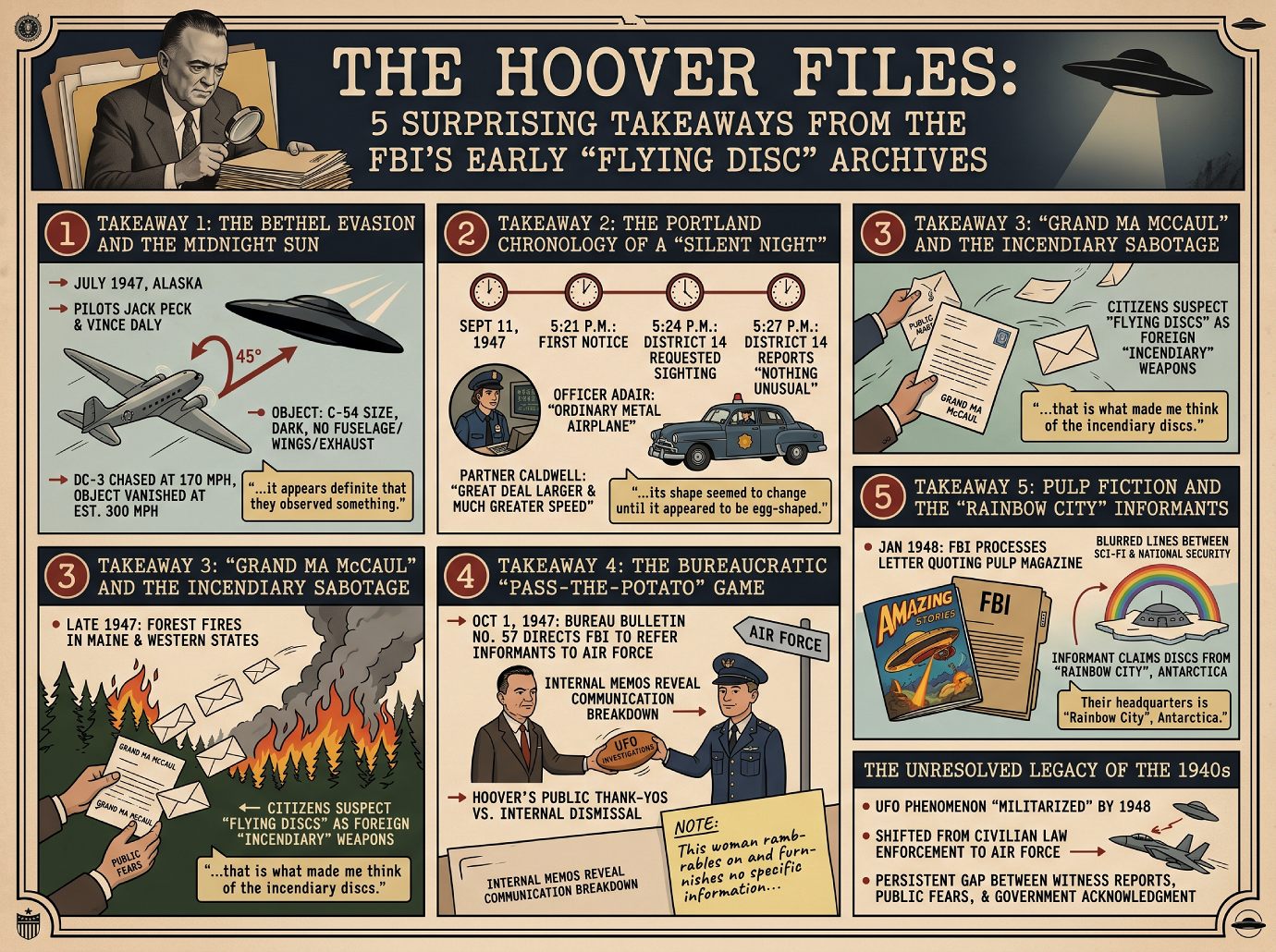
The Hoover Files: 5 Surprising Takeaways from the FBI’s Early “Flying Disc” Archives
1. Introduction: A Summer of Silvery Shadows
The late 1940s were defined by a peculiar American brand of post-war anxiety. Beneath the surface of victory lay the cold shadow of the Iron Curtain and the frantic tapping of teletype machines carrying reports of a new, inexplicable threat. By the summer of 1947, the skies were no longer just the domain of the DC-3; they had become the staging ground for the “flying saucer.”
Tucked behind nondescript cover sheets labeled “Security Matter – X” in the Bureau’s declassified archives lies a paper trail of a government in transition. What did J. Edgar Hoover actually know? These five takeaways, distilled from memos and letters crossing his desk between 1947 and 1948, reveal the tension between technical reality and bureaucratic dismissal.
2. Takeaway 1: The Bethel Evasion and the Midnight Sun
In the Alaskan frontier, where it was “daylight the entire night,” the Bureau recorded one of its most compelling technical reports. At 10:00 P.M. in July 1947, pilot Jack Peck and co-pilot Vince Daly were approaching the Bethel Airport in a DC-3 when they encountered a craft that defied the laws of mid-century aviation.
The object was described as the size of a C-54 transport plane but was “dark but of definite shape,” lacking a fuselage, wings, or any visible exhaust. To avoid a mid-air collision, the pilots were forced to physically manipulate the controls, throwing their DC-3 into a forty-five-degree turn. Despite increasing manifold pressure to 42 inches in an attempt to give chase at 170 miles per hour, the object—traveling at an estimated 300 miles per hour—simply vanished toward Nome.
Internal memos emphasize that these were not men prone to flights of fancy:
“It may be stated to the Bureau that Mr. PECK is a well known flyer as well as Mr. DALY and both are known to be very reliable and responsible people, and it appears definite that they observed something.”
3. Takeaway 2: The Portland Chronology of a “Silent Night”
On September 11, 1947, a wave of egg-shaped objects over Portland, Oregon, triggered a real-time bureaucratic scramble. The log entries from the Portland Police Department’s Radio Dispatcher provide a minute-by-minute account of the confusion:
- 5:21 P.M.: First notice received from officers in District 18.
- 5:23 P.M.: Radio requests District 14, further south, to attempt location.
- 5:24 P.M.: Chief of Police Leon V. Jenkins reports a sighting from his own car.
- 5:27 P.M.: District 14 reports seeing “nothing unusual” in the sky.
The encounter revealed a striking internal conflict between observers. Officer Robert D. Adair believed he saw an “ordinary metal airplane,” but his partner, J.R. Caldwell, disagreed entirely, stating the object was a “great deal larger” and traveling at a “much greater speed” than any conventional craft. Even the local media joined the hunt; Fred M. White, Assistant City Editor of The Oregonian, confirmed the paper was flooded with calls.
Chief Jenkins’ own account highlighted the object’s fluid nature:
“…it turned gradually until it was travelling due south, and as it did so, its shape seemed to change until it appeared to be egg-shaped.”
4. Takeaway 3: “Grand Ma McCaul” and the Incendiary Sabotage
As the mystery deepened, the public began to view the discs through the lens of national security. In late 1947, a string of forest fires ravaged Maine and the Western states. For many, this was no coincidence. Citizens like Mrs. Milo A. Durand and a woman who signed her letter “Grand Ma McCaul” wrote to the FBI, convinced the discs were foreign “incendiary” weapons deployed to ignite the American landscape.
This correspondence captures a nation gripped by the fear of “time bombs” and hidden saboteurs. The fear was that the “flying discs” were not visitors from afar, but tools of a very terrestrial war. Mrs. Durand’s postscript to the Director perfectly encapsulates this dread:
“I read that scientist were investigating the way the fires flared up in different parts away from the main fire that is what made me think of the incendiary discs.”
5. Takeaway 4: The Bureaucratic “Pass-the-Potato” Game
By late 1947, the Bureau was eager to wash its hands of the phenomenon. This shift was codified in Bureau Bulletin No. 57, dated October 1, 1947, which officially directed that the FBI would no longer conduct investigations into “flying discs,” referring all informants to the Air Force.
However, the transition was riddled with administrative irony. Internal memos reveal that the military was often the last to know about the Bureau’s change of heart. A March 1, 1948, memo from V.P. Keay to Mr. Ladd exposes a breakdown in communication between agencies:
“Colonel Martin advised Mr. Reynolds that apparently the Air Defense Command was not aware of the fact that the Bureau was no longer conducting investigations regarding flying discs.”
While Hoover sent cordial, standardized thank-you notes to the public, the internal reality was far more dismissive. On the bottom of a response to “Grand Ma” McCaul, a handwritten note reveals the Bureau’s true fatigue:
“NOTE: This woman rambles on and furnishes no specific information about anything.”
6. Takeaway 5: Pulp Fiction and the “Rainbow City” Informants
The final takeaway from the archives is the staggering challenge of “information synthesis.” The FBI’s database was a catch-all for everything from technical pilot logs to wild narratives lifted from the pages of pulp magazines like Amazing Stories.
In January 1948, the Bureau processed a letter from Marion Beuscher of Menomonee Falls, Wisconsin. Beuscher, an informant who admitted “neighbors think we’re slightly queer,” was actually quoting a letter from W.C. Hefferlin that had been published in the magazine. The letter spoke of a world government of oppressed peoples governed by the “Ancient Three,” operating out of a hidden base. It was a moment where the lines between science fiction and national security reporting became hopelessly blurred.
The letter pointed to a fantastic origin for the discs:
“Their headquarters is ‘Rainbow City’, Antarctica.”
7. Conclusion: The Unresolved Legacy of the 1940s
The “Hoover Files” offer more than just accounts of strange lights; they document the moment the UFO phenomenon was officially “militarized.” By 1948, the mystery had been shifted away from civilian-facing law enforcement and placed firmly behind the Air Force’s curtain.
The tension remains: on one hand, we have the precise, terrifying reports from reliable flyers like Jack Peck; on the other, the dismissive “ramblings” of a bureaucracy overwhelmed by the public’s imagination. As we navigate our modern era of unidentified aerial phenomena, the cycle remains remarkably the same: a persistent gap between what witnesses see, what the public fears, and what the government is willing to acknowledge. ————————————–
Aviation Observation Guide: Identifying Early Aerial Phenomena (1947–1948)
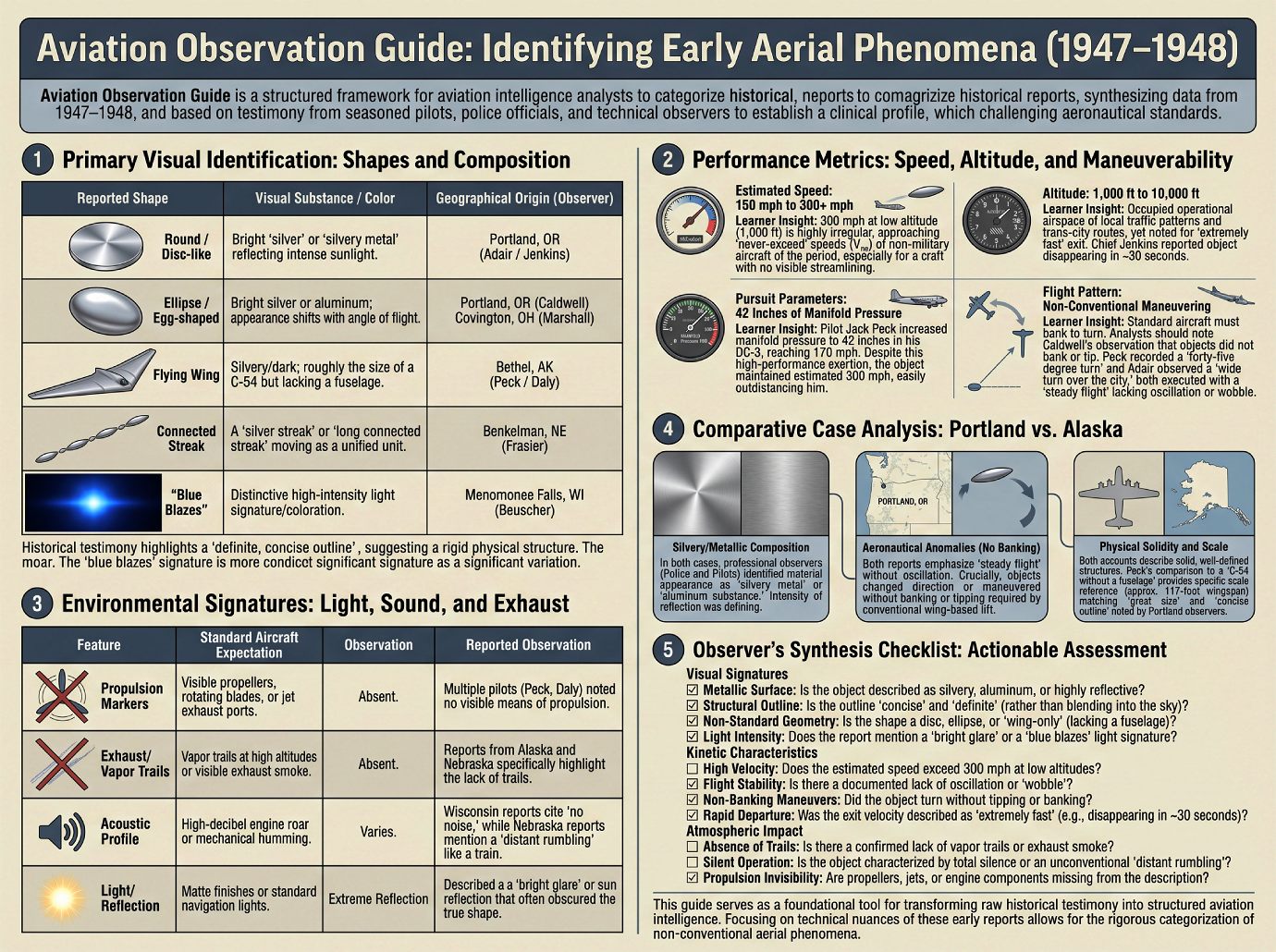
Aviation Observation Guide: Identifying Early Aerial Phenomena (1947–1948)
This guide provides a structured framework for aviation intelligence analysts to categorize and evaluate historical reports of unidentified aerial phenomena. By synthesizing data from 1947–1948—relying on testimony from seasoned pilots, police officials, and technical observers—we can establish a clinical profile of objects that challenged the aeronautical standards of the era.
1. Primary Visual Identification: Shapes and Composition
A critical phase of identification involves assessing the object’s geometry and material composition. Analysts should prioritize reports that emphasize the “concise outline” of these objects, distinguishing solid craft from mere atmospheric illusions or debris.
| Reported Shape | Visual Substance / Color | Geographical Origin (Observer) |
|---|---|---|
| Round / Disc-like | Bright “silver” or “silvery metal” reflecting intense sunlight. | Portland, OR (Adair / Jenkins) |
| Ellipse / Egg-shaped | Bright silver or aluminum; appearance shifts with the angle of flight. | Portland, OR (Caldwell); Covington, OH (Marshall) |
| Flying Wing | Silvery/dark; roughly the size of a C-54 but lacking a fuselage. | Bethel, AK (Peck / Daly) |
| Connected Streak | A “silver streak” or “long connected streak” moving as a unified unit. | Benkelman, NE (Frasier) |
| “Blue Blazes” | Distinctive high-intensity light signature/coloration. | Menomonee Falls, WI (Beuscher) |
Historical testimony frequently highlights a “definite, concise outline” that did not blend into the sky, suggesting a rigid physical structure. While silver and aluminum reflections are the baseline, the “blue blazes” signature reported in the Midwest provides a significant variation in the visual profile.
Successful identification of physical form leads directly to the more complex task of evaluating the object’s flight characteristics and performance capabilities.
2. Performance Metrics: Speed, Altitude, and Maneuverability
Data from professional observers like Jack Peck and Robert Adair allow us to establish performance baselines. These metrics are often presented in contrast to the capabilities of conventional 1940s aircraft, such as the DC-3 or C-54.
- Estimated Speed: 150 mph to 300+ mph
- Learner Insight: While 150 mph was standard for civilian transport, an estimated speed of 300 mph at a low altitude (1,000 ft) is highly irregular. For an analyst, this is significant because it approaches the “never-exceed” speeds (Vne) of many non-military aircraft of the period, particularly for a craft with no visible streamlining or fuselage.
- Altitude: 1,000 ft to 10,000 ft
- Learner Insight: These objects occupied the same operational airspace as local airport traffic patterns (Bethel) and trans-city routes (Portland), yet were noted for an “extremely fast” exit. Chief Jenkins reported an object disappearing in approximately 30 seconds.
- Pursuit Parameters: 42 Inches of Manifold Pressure
- Learner Insight: Pilot Jack Peck attempted to close the gap with an object by increasing his manifold pressure to 42 inches, reaching 170 mph. Despite this high-performance exertion from his DC-3, the object maintained an estimated 300 mph, easily outdistancing him.
- Flight Pattern: Non-Conventional Maneuvering
- Learner Insight: Standard aircraft must bank or tip to execute turns. Intelligence analysts should note Caldwell’s observation that these objects did not bank or tip during maneuvers. Furthermore, Peck recorded a “forty-five degree turn” while Adair observed a “wide turn over the city,” both executed with a “steady flight” lacking any oscillation or wobble.
The absence of traditional aeronautical movement leads to an investigation of the physical signatures—or lack thereof—associated with the object’s propulsion systems.
3. Environmental Signatures: Light, Sound, and Exhaust
Diagnostic data is often found in the “negative space” of a report—features that should be present for conventional aircraft but are explicitly missing in these encounters.
| Feature | Standard Aircraft Expectation | Reported Observation |
|---|---|---|
| Propulsion Markers | Visible propellers, rotating blades, or jet exhaust ports. | Absent. Multiple pilots (Peck, Daly) noted no visible means of propulsion. |
| Exhaust/Vapor Trails | Vapor trails at high altitudes or visible exhaust smoke. | Absent. Reports from Alaska and Nebraska specifically highlight the lack of trails. |
| Acoustic Profile | High-decibel engine roar or mechanical humming. | Varies. Wisconsin reports cite “no noise,” while Nebraska reports mention a “distant rumbling” like a train. |
| Light/Reflection | Matte finishes or standard navigation lights. | Extreme Reflection. Described as a “bright glare” or sun reflection that often obscured the true shape. |
By analyzing these interactions with the environment, the analyst can move toward a comprehensive synthesis of geographically separated but technically similar cases.
4. Comparative Case Analysis: Portland vs. Alaska
A comparative analysis of the September 11, 1947 (Portland) and July 1947 (Alaska) sightings reveals a cohesive operational profile despite the distance between reports.
- Silvery/Metallic Composition: In both cases, professional observers (Police and Pilots) identified a material appearance described as “silvery metal” or “aluminum substance.” The intensity of the reflection was a defining characteristic in both environments.
- Aeronautical Anomalies (No Banking): Both reports emphasize a “steady flight” without the oscillation common in balloons. Crucially, observers noted that the objects could change direction or maneuver without the banking or tipping required by conventional wing-based lift.
- Physical Solidity and Scale: Both accounts describe solid, well-defined structures. Peck’s comparison to a “C-54 without a fuselage” provides a specific scale reference (approx. 117-foot wingspan) that matches the “great size” and “concise outline” noted by the Portland observers.
The final step for any intelligence specialist is the application of these identified patterns to a systematic evaluation of new or historical data.
5. Observer’s Synthesis Checklist: Actionable Assessment
Use this checklist to perform a standardized evaluation of aerial phenomenon reports from the 1947–1948 period.
Visual Signatures
- [ ] Metallic Surface: Is the object described as silvery, aluminum, or highly reflective?
- [ ] Structural Outline: Is the outline “concise” and “definite” (rather than blending into the sky)?
- [ ] Non-Standard Geometry: Is the shape a disc, ellipse, or “wing-only” (lacking a fuselage)?
- [ ] Light Intensity: Does the report mention a “bright glare” or a “blue blazes” light signature?
Kinetic Characteristics
- [ ] High Velocity: Does the estimated speed exceed 300 mph at low altitudes?
- [ ] Flight Stability: Is there a documented lack of oscillation or “wobble”?
- [ ] Non-Banking Maneuvers: Did the object turn without tipping or banking?
- [ ] Rapid Departure: Was the exit velocity described as “extremely fast” (e.g., disappearing in ~30 seconds)?
Atmospheric Impact
- [ ] Absence of Trails: Is there a confirmed lack of vapor trails or exhaust smoke?
- [ ] Silent Operation: Is the object characterized by total silence or an unconventional “distant rumbling”?
- [ ] Propulsion Invisibility: Are propellers, jets, or engine components missing from the description?
This guide serves as a foundational tool for transforming raw historical testimony into structured aviation intelligence. Focusing on the technical nuances of these early reports allows for the rigorous categorization of non-conventional aerial phenomena. ———————————————————————-
Intelligence Synthesis Report: 1947-1948 Aerial Phenomenon and Official Intelligence Responses
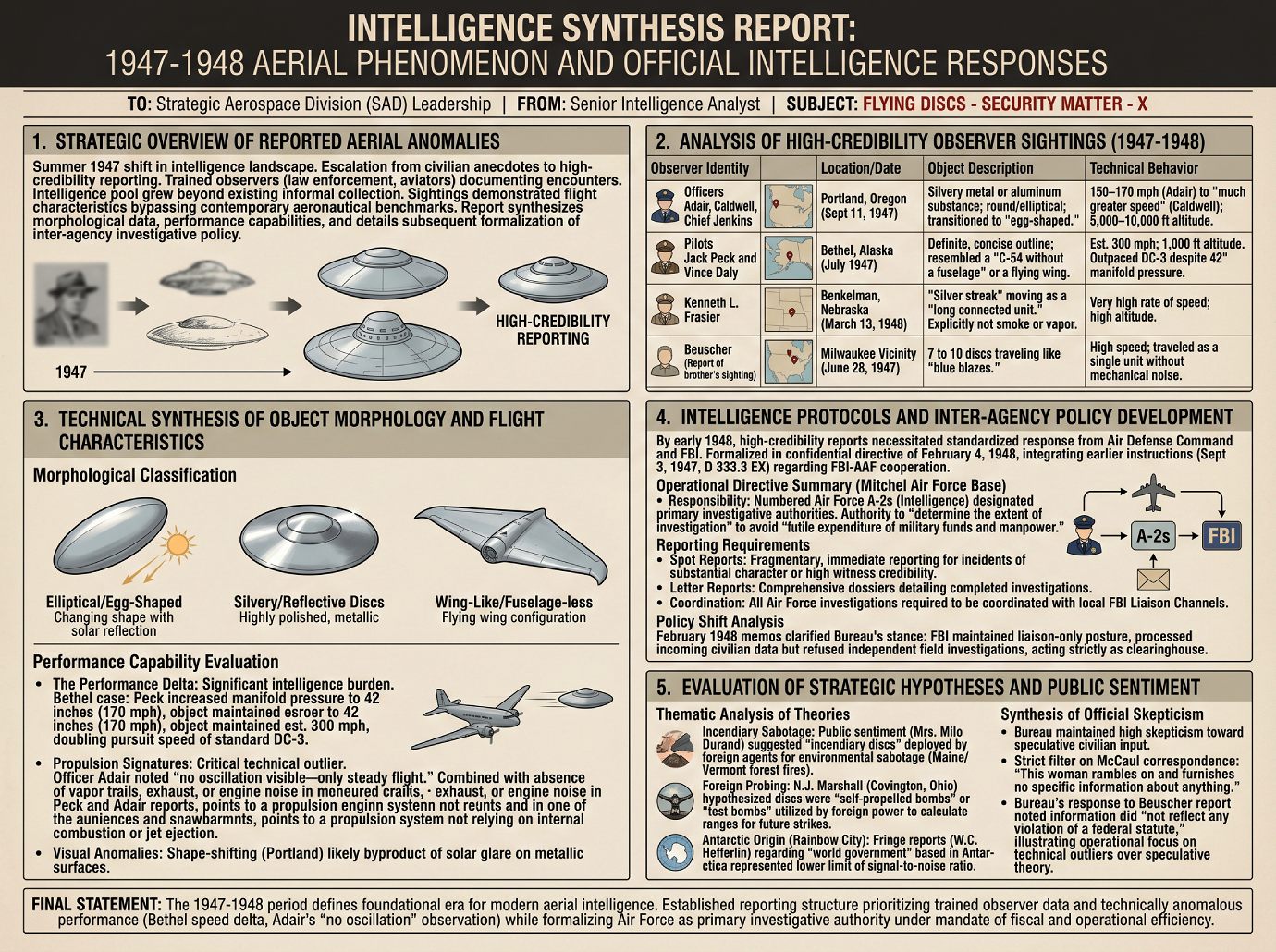
Intelligence Synthesis Report: 1947-1948 Aerial Phenomenon and Official Intelligence Responses
To: Strategic Aerospace Division (SAD) Leadership From: Senior Intelligence Analyst Subject: FLYING DISCS – SECURITY MATTER – X
——————————————————————————–
1. Strategic Overview of Reported Aerial Anomalies
The summer of 1947 initiated a fundamental shift in the domestic intelligence landscape, characterized by an escalation of unidentified aerial sightings that transitioned from civilian anecdotes to high-credibility reporting. As trained observers—including law enforcement officers and professional aviators—began documenting encounters with “flying discs,” the resulting intelligence pool grew beyond the capacity of existing informal collection requirements. These sightings were not merely atmospheric anomalies; they presented a significant intelligence burden by demonstrating flight characteristics that bypassed contemporary aeronautical benchmarks. This report synthesizes morphological data and performance capabilities to establish a structured narrative of the phenomenon and details the subsequent formalization of inter-agency investigative policy.
2. Analysis of High-Credibility Observer Sightings (1947-1948)
A rigorous credibility assessment of the 1947-1948 data indicates that technical training among observers is the primary differentiator in data quality. Reports from the Portland Police Department and veteran pilots provide a technical baseline that allows for the filtering of signal from environmental noise.
| Observer Identity | Location/Date | Object Description | Technical Behavior (Speed/Altitude) |
|---|---|---|---|
| Officers Adair, Caldwell, and Chief Jenkins | Portland, Oregon (Sept 11, 1947) | Silvery metal or aluminum substance; round/elliptical; transitioned to “egg-shaped.” | 150–170 mph (Adair) to “much greater speed” (Caldwell); 5,000–10,000 ft altitude. |
| Pilots Jack Peck and Vince Daly | Bethel, Alaska (July 1947) | Definite, concise outline; resembled a “C-54 without a fuselage” or a flying wing. | Est. 300 mph; 1,000 ft altitude. Outpaced DC-3 despite 42″ manifold pressure. |
| Kenneth L. Frasier | Benkelman, Nebraska (March 13, 1948) | “Silver streak” moving as a “long connected unit.” Explicitly not smoke or vapor. | Very high rate of speed; altitude high enough to initially suggest a vapor trail. |
| Beuscher (Report of brother’s sighting) | Milwaukee Vicinity (June 28, 1947) | 7 to 10 discs traveling like “blue blazes.” | High speed; traveled as a single unit without mechanical noise. |
These geographically dispersed reports confirm the presence of technical outliers, specifically regarding metallic composition and a total absence of traditional airframe components.
3. Technical Synthesis of Object Morphology and Flight Characteristics
The synthesis of high-credibility intelligence reveals a consistent pattern of aeronautical anomalies. The strategic “So What?” lies in the apparent bypass of known aerodynamic constraints, suggesting a potential leap in propulsion technology that does not align with either domestic or known adversarial inventories.
Morphological Classification
Observers consistently identified three primary structural profiles:
- Elliptical/Egg-Shaped: Documented by Chief Jenkins (Portland) and N.J. Marshall (Covington, Ohio). These objects demonstrated an apparent ability to change shape based on the angle of solar reflection.
- Silvery/Reflective Discs: Officers Adair and Caldwell noted a “bright reflection” from a “silvery metal” or “aluminum substance,” suggesting a highly polished or metallic exterior.
- Wing-Like/Fuselage-less: Pilot Jack Peck provided a specific technical description of a “flying wing” configuration, emphasizing the total absence of a central fuselage or tail assembly.
Performance Capability Evaluation
- The Performance Delta: The most significant intelligence burden stems from the delta between conventional power and object velocity. In the Bethel case, Peck increased manifold pressure to 42 inches—reaching 170 mph—yet the object maintained an estimated 300 mph, effectively doubling the pursuit speed of a standard DC-3.
- Propulsion Signatures: A critical technical outlier is the lack of visible oscillation. Officer Adair specifically noted, “There was no oscillation visible—only steady flight.” This, combined with the absence of vapor trails, exhaust, or engine noise in the Peck and Adair reports, points to a propulsion system that does not rely on internal combustion or jet ejection.
- Visual Anomalies: Reported shape-shifting (Portland) is likely a byproduct of solar glare on metallic surfaces, which temporarily obscured the concise outlines of the objects.
This inability of technical analysis to reconcile these behaviors with conventional aviation was the direct catalyst for the formalization of inter-agency protocols.
4. Intelligence Protocols and Inter-Agency Policy Development
By early 1948, the frequency of high-credibility reports necessitated a standardized response from the Air Defense Command and the FBI. This was formalized in the confidential directive of February 4, 1948, which integrated earlier instructions such as the September 3, 1947, mandate (D 333.3 EX) regarding FBI-AAF cooperation.
Operational Directive Summary (Mitchel Air Force Base)
- Responsibility: The Numbered Air Force A-2s (Intelligence) were designated as the primary investigative authorities. They were explicitly granted the authority to “determine the extent of investigation” to ensure that “futile expenditure of military funds and manpower” was avoided.
- Reporting Requirements:
- Spot Reports: Fragmentary, immediate reporting for incidents of substantial character or high witness credibility.
- Letter Reports: Comprehensive dossiers detailing completed investigations.
- Coordination: All Air Force investigations were required to be coordinated with local FBI Liaison Channels to ensure maximum data collection without redundancy.
Policy Shift Analysis
The February 1948 memos clarified the Bureau’s stance: despite Air Force requests for active investigative support, the FBI maintained a liaison-only posture. The Bureau processed incoming civilian data but refused to conduct independent field investigations, acting strictly as a clearinghouse for information volunteered to or by the Air Forces.
5. Evaluation of Strategic Hypotheses and Public Sentiment
Intelligence assessments must also account for the signal-to-noise ratio within civilian reporting, characterizing non-official theories as both Counter-Intelligence (CI) vulnerabilities and psychological indicators of public fear.
Thematic Analysis of Theories
- Incendiary Sabotage: Following severe forest fires in Maine and Vermont (late 1947), public sentiment—exemplified by Mrs. Milo Durand—suggested “incendiary discs” were being deployed by foreign agents to compromise internal security through environmental sabotage.
- Foreign Probing: N.J. Marshall (Covington, Ohio) hypothesized that the discs were “self-propelled bombs” or “test bombs” utilized by a foreign power to calculate exact ranges for future strikes on U.S. population centers.
- Antarctic Origin (Rainbow City): Fringe reports from W.C. Hefferlin regarding a “world government” based in Antarctica represented the lower limit of the signal-to-noise ratio.
Synthesis of Official Skepticism
The Bureau maintained a high degree of skepticism toward speculative civilian input. Internal notations reflect a strict filter; on the McCaul correspondence, a header note explicitly states: “This woman rambles on and furnishes no specific information about anything.” Similarly, the Bureau’s response to the Beuscher report noted that the information did “not reflect any violation of a federal statute,” illustrating an operational focus on technical outliers over speculative theory.
Final Statement: The 1947-1948 period defines the foundational era for modern aerial intelligence. It established a reporting structure that prioritized trained observer data and technically anomalous performance (the Bethel speed delta and Adair’s “no oscillation” observation) while formalizing the Air Force as the primary investigative authority under a mandate of fiscal and operational efficiency. —————————————
Intelligence Synthesis Report: 1947-1948 Aerial Phenomenon and Official Intelligence Responses
Intelligence Synthesis Report: 1947-1948 Aerial Phenomenon and Official Intelligence Responses
To: Strategic Aerospace Division (SAD) Leadership From: Senior Intelligence Analyst Subject: FLYING DISCS – SECURITY MATTER – X
——————————————————————————–
1. Strategic Overview of Reported Aerial Anomalies
The summer of 1947 initiated a fundamental shift in the domestic intelligence landscape, characterized by an escalation of unidentified aerial sightings that transitioned from civilian anecdotes to high-credibility reporting. As trained observers—including law enforcement officers and professional aviators—began documenting encounters with “flying discs,” the resulting intelligence pool grew beyond the capacity of existing informal collection requirements. These sightings were not merely atmospheric anomalies; they presented a significant intelligence burden by demonstrating flight characteristics that bypassed contemporary aeronautical benchmarks. This report synthesizes morphological data and performance capabilities to establish a structured narrative of the phenomenon and details the subsequent formalization of inter-agency investigative policy.
2. Analysis of High-Credibility Observer Sightings (1947-1948)
A rigorous credibility assessment of the 1947-1948 data indicates that technical training among observers is the primary differentiator in data quality. Reports from the Portland Police Department and veteran pilots provide a technical baseline that allows for the filtering of signal from environmental noise.
| Observer Identity | Location/Date | Object Description | Technical Behavior (Speed/Altitude) |
|---|---|---|---|
| Officers Adair, Caldwell, and Chief Jenkins | Portland, Oregon (Sept 11, 1947) | Silvery metal or aluminum substance; round/elliptical; transitioned to “egg-shaped.” | 150–170 mph (Adair) to “much greater speed” (Caldwell); 5,000–10,000 ft altitude. |
| Pilots Jack Peck and Vince Daly | Bethel, Alaska (July 1947) | Definite, concise outline; resembled a “C-54 without a fuselage” or a flying wing. | Est. 300 mph; 1,000 ft altitude. Outpaced DC-3 despite 42″ manifold pressure. |
| Kenneth L. Frasier | Benkelman, Nebraska (March 13, 1948) | “Silver streak” moving as a “long connected unit.” Explicitly not smoke or vapor. | Very high rate of speed; altitude high enough to initially suggest a vapor trail. |
| Beuscher (Report of brother’s sighting) | Milwaukee Vicinity (June 28, 1947) | 7 to 10 discs traveling like “blue blazes.” | High speed; traveled as a single unit without mechanical noise. |
These geographically dispersed reports confirm the presence of technical outliers, specifically regarding metallic composition and a total absence of traditional airframe components.
3. Technical Synthesis of Object Morphology and Flight Characteristics
The synthesis of high-credibility intelligence reveals a consistent pattern of aeronautical anomalies. The strategic “So What?” lies in the apparent bypass of known aerodynamic constraints, suggesting a potential leap in propulsion technology that does not align with either domestic or known adversarial inventories.
Morphological Classification
Observers consistently identified three primary structural profiles:
- Elliptical/Egg-Shaped: Documented by Chief Jenkins (Portland) and N.J. Marshall (Covington, Ohio). These objects demonstrated an apparent ability to change shape based on the angle of solar reflection.
- Silvery/Reflective Discs: Officers Adair and Caldwell noted a “bright reflection” from a “silvery metal” or “aluminum substance,” suggesting a highly polished or metallic exterior.
- Wing-Like/Fuselage-less: Pilot Jack Peck provided a specific technical description of a “flying wing” configuration, emphasizing the total absence of a central fuselage or tail assembly.
Performance Capability Evaluation
- The Performance Delta: The most significant intelligence burden stems from the delta between conventional power and object velocity. In the Bethel case, Peck increased manifold pressure to 42 inches—reaching 170 mph—yet the object maintained an estimated 300 mph, effectively doubling the pursuit speed of a standard DC-3.
- Propulsion Signatures: A critical technical outlier is the lack of visible oscillation. Officer Adair specifically noted, “There was no oscillation visible—only steady flight.” This, combined with the absence of vapor trails, exhaust, or engine noise in the Peck and Adair reports, points to a propulsion system that does not rely on internal combustion or jet ejection.
- Visual Anomalies: Reported shape-shifting (Portland) is likely a byproduct of solar glare on metallic surfaces, which temporarily obscured the concise outlines of the objects.
This inability of technical analysis to reconcile these behaviors with conventional aviation was the direct catalyst for the formalization of inter-agency protocols.
4. Intelligence Protocols and Inter-Agency Policy Development
By early 1948, the frequency of high-credibility reports necessitated a standardized response from the Air Defense Command and the FBI. This was formalized in the confidential directive of February 4, 1948, which integrated earlier instructions such as the September 3, 1947, mandate (D 333.3 EX) regarding FBI-AAF cooperation.
Operational Directive Summary (Mitchel Air Force Base)
- Responsibility: The Numbered Air Force A-2s (Intelligence) were designated as the primary investigative authorities. They were explicitly granted the authority to “determine the extent of investigation” to ensure that “futile expenditure of military funds and manpower” was avoided.
- Reporting Requirements:
- Spot Reports: Fragmentary, immediate reporting for incidents of substantial character or high witness credibility.
- Letter Reports: Comprehensive dossiers detailing completed investigations.
- Coordination: All Air Force investigations were required to be coordinated with local FBI Liaison Channels to ensure maximum data collection without redundancy.
Policy Shift Analysis
The February 1948 memos clarified the Bureau’s stance: despite Air Force requests for active investigative support, the FBI maintained a liaison-only posture. The Bureau processed incoming civilian data but refused to conduct independent field investigations, acting strictly as a clearinghouse for information volunteered to or by the Air Forces.
5. Evaluation of Strategic Hypotheses and Public Sentiment
Intelligence assessments must also account for the signal-to-noise ratio within civilian reporting, characterizing non-official theories as both Counter-Intelligence (CI) vulnerabilities and psychological indicators of public fear.
Thematic Analysis of Theories
- Incendiary Sabotage: Following severe forest fires in Maine and Vermont (late 1947), public sentiment—exemplified by Mrs. Milo Durand—suggested “incendiary discs” were being deployed by foreign agents to compromise internal security through environmental sabotage.
- Foreign Probing: N.J. Marshall (Covington, Ohio) hypothesized that the discs were “self-propelled bombs” or “test bombs” utilized by a foreign power to calculate exact ranges for future strikes on U.S. population centers.
- Antarctic Origin (Rainbow City): Fringe reports from W.C. Hefferlin regarding a “world government” based in Antarctica represented the lower limit of the signal-to-noise ratio.
Synthesis of Official Skepticism
The Bureau maintained a high degree of skepticism toward speculative civilian input. Internal notations reflect a strict filter; on the McCaul correspondence, a header note explicitly states: “This woman rambles on and furnishes no specific information about anything.” Similarly, the Bureau’s response to the Beuscher report noted that the information did “not reflect any violation of a federal statute,” illustrating an operational focus on technical outliers over speculative theory.
Final Statement: The 1947-1948 period defines the foundational era for modern aerial intelligence. It established a reporting structure that prioritized trained observer data and technically anomalous performance (the Bethel speed delta and Adair’s “no oscillation” observation) while formalizing the Air Force as the primary investigative authority under a mandate of fiscal and operational efficiency. ——————————-
Evidence Evaluation Primer: The 1947–1948 “Flying Disc” Files
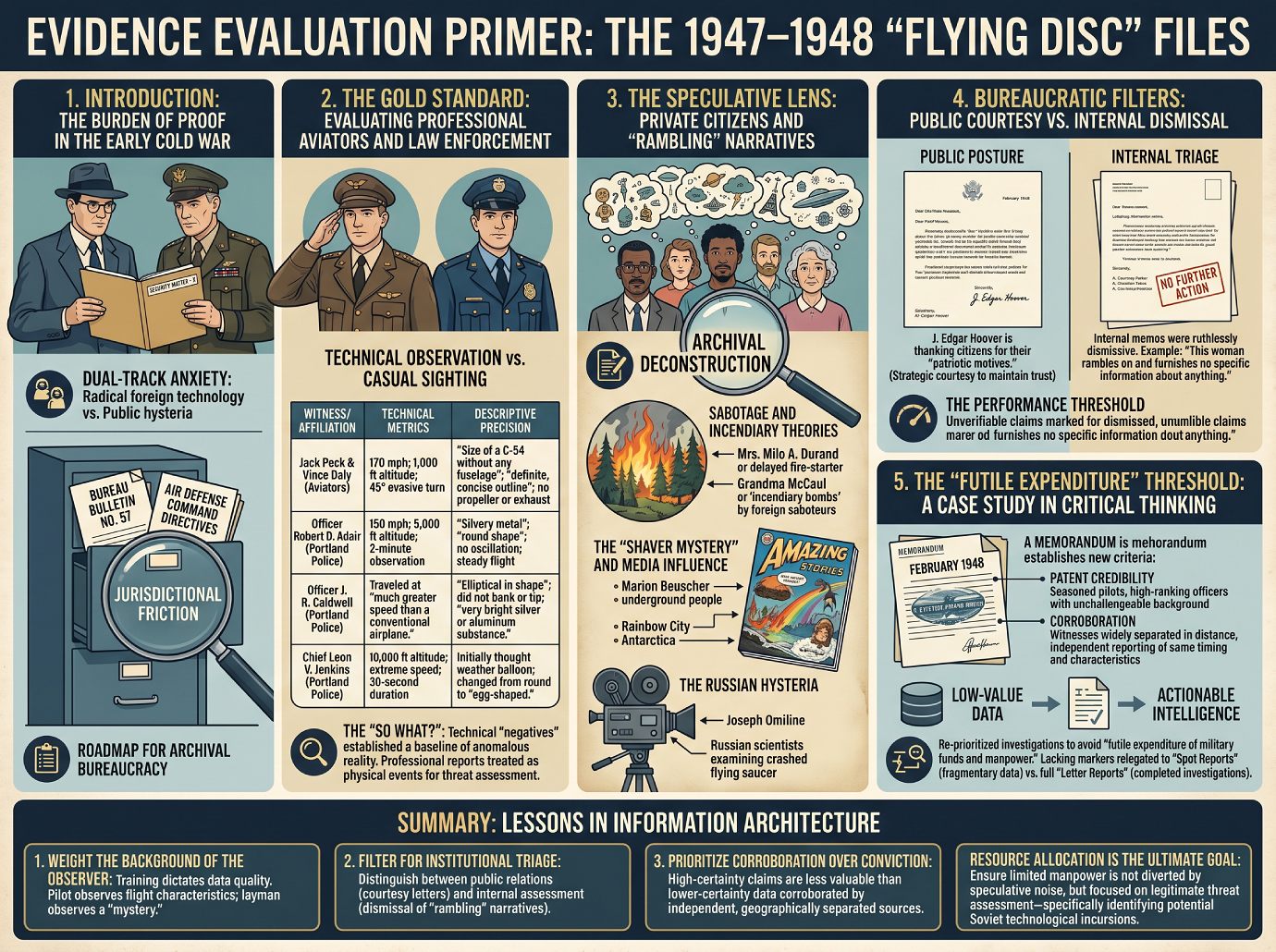
Evidence Evaluation Primer: The 1947–1948 “Flying Disc” Files
1. Introduction: The Burden of Proof in the Early Cold War
In the latter half of 1947, the United States intelligence apparatus encountered a persistent evidentiary crisis. As reports of unidentified aerial phenomena proliferated, the FBI and military intelligence designated the phenomenon as “Security Matter – X.” This classification reflected a dual-track anxiety: the potential for radical foreign technological advancements and the escalating internal threat of public hysteria.
The primary obstacle for investigators was the architecture of information. To manage this, the Bureau had to reconcile its existing protocols—namely Bureau Bulletin No. 57—with emerging directives from the military, such as those issued by the Air Defense Command at Mitchel Air Force Base. This jurisdictional friction required a rigorous methodology to filter actionable data from noise. As a result, the “Security Matter – X” files provide a roadmap for how archival bureaucracy weights witness credibility against the backdrop of national security.
2. The Gold Standard: Evaluating Professional Aviators and Law Enforcement
Forensic analysis of the 1947 files reveals that the “Gold Standard” of evidence was reserved for observers with technical training. Investigators prioritized witnesses like Jack Peck and Vince Daly of the Al Jones Flying Company, and law enforcement personnel from the Portland Police Department, because their professional backgrounds allowed them to record metrics rather than just impressions.
The Bureau explicitly labeled Peck and Daly as “very reliable and responsible people.” Their reporting was not merely valued for what was seen, but for what was not seen—specifically the absence of conventional propulsion markers. This precision allowed the Bureau to establish “Patent Credibility,” a military metric used to justify the expenditure of investigative resources.
Technical Observation vs. Casual Sighting
| Witness/Affiliation | Technical Metrics | Descriptive Precision |
|---|---|---|
| Jack Peck & Vince Daly (Aviators) | 170 mph; 1,000 ft altitude; 45° evasive turn. | “Size of a C-54 without any fuselage”; “definite, concise outline”; no propeller or exhaust from jet propulsion. |
| Officer Robert D. Adair (Portland Police) | 150 mph; 5,000 ft altitude; 2-minute observation. | “Silvery metal”; “round shape”; no oscillation; steady flight. |
| Officer J. R. Caldwell (Portland Police) | Traveled at “much greater speed than a conventional airplane.” | “Elliptical in shape”; did not bank or tip; “very bright silver or aluminum substance.” |
| Chief Leon V. Jenkins (Portland Police) | 10,000 ft altitude; extreme speed; 30-second duration. | Initially thought to be a weather balloon; changed from round to “egg-shaped.” |
The “So What?”: By focusing on technical “negatives” (the lack of wings, fuselages, or exhaust), these professional reports provided the Bureau with a baseline of anomalous reality. These sightings were treated as physical events requiring threat assessment, whereas reports from the untrained public were often viewed through the lens of psychological profiling.
3. The Speculative Lens: Private Citizens and “Rambling” Narratives
In contrast to the data-driven reports of pilots, correspondence from private citizens often featured high-velocity speculation influenced by the cultural zeitgeist. These narratives were frequently dismissed because they lacked the “specific information” required to trigger an intelligence response.
Archival deconstruction identifies three recurring speculative themes that investigators were forced to filter:
- Sabotage and Incendiary Theories: Citizens such as Mrs. Milo A. Durand and Mrs. A. McCaul (the latter signing as “Grandma McCaul”) linked the discs to the devastating forest fires in Maine and the West. They theorized the objects were “new delayed fire-starter” technology or incendiary bombs utilized by foreign saboteurs.
- The “Shaver Mystery” and Media Influence: Heavily influenced by science fiction publications like Amazing Stories, witnesses such as Marion Beuscher questioned if the discs originated from “underground people.” These narratives often relied on second-hand information, such as Beuscher quoting the “Rainbow City” theories of W.C. Hefferlin, which posited a world government based in Antarctica.
- The Russian Hysteria: A quintessential Cold War intelligence detail is found in the report of Joseph Omiline, who questioned the FBI regarding a suppressed newsreel allegedly showing “Russian scientists examining a crashed flying saucer.” This highlights the “public hysteria” investigators had to mitigate.
4. Bureaucratic Filters: Public Courtesy vs. Internal Dismissal
The FBI employed a “two-track” communication strategy, utilizing the Liaison Section to coordinate with the Air Forces while maintaining a mask of public gratitude.
- Public Posture: Letters signed by J. Edgar Hoover utilized boilerplate language, thanking citizens for their “patriotic motives.” This was a strategic courtesy designed to maintain public trust without validating the content of the reports.
- Internal Triage: Internal memos were ruthlessly dismissive. A note on the back of Mrs. McCaul’s letter explicitly states: “This woman rambles on and furnishes no specific information about anything.”
- The Performance Threshold: Reports involving unverifiable human performance were marked for “No Further Action.” For instance, A. Courtney Parker of Vermont claimed his sighting was valid because he possessed “unusually good eyesight” that allowed him to “see bees” at extreme distances. The Bureau dismissed this as a subjective claim lacking physical corroboration.
5. The “Futile Expenditure” Threshold: A Case Study in Critical Thinking
By February 1948, the Headquarters of the Air Defense Command at Mitchel Air Force Base moved to restrict the flow of low-value data. A memorandum addressed to the Command’s Operating Intelligence Echelon established a new threshold to avoid the “futile expenditure of military funds and manpower.”
The military re-prioritized investigations based on two strict criteria:
- Patent Credibility: The source’s professional background and character must be beyond challenge (e.g., seasoned pilots or high-ranking officers).
- Corroboration: The event must be observed by witnesses widely separated in distance who independently report the same timing and characteristics.
Under this policy, incidents lacking these markers were relegated to “Spot Reports” (fragmentary data) rather than full “Letter Reports” (completed investigations). This redefined “evidence” as that which could be cross-referenced across the USAF intelligence structure, rather than isolated testimony.
6. Summary: Lessons in Information Architecture
The “Flying Disc” files of 1947–1948 illustrate how national security agencies manage evidence in a high-stakes environment. Investigators prioritized narrative style (concise, metric-heavy) and technical background over speculative theory (ideological or media-influenced).
Critical Takeaways for the Learner:
- Weight the Background of the Observer: Training dictates the quality of the data. A pilot observes flight characteristics; a layman observes a “mystery.”
- Filter for Institutional Triage: Distinguish between public relations (courtesy letters) and internal assessment (dismissal of “rambling” narratives).
- Prioritize Corroboration over Conviction: High-certainty claims (like the ability to “see bees”) are less valuable than lower-certainty data corroborated by independent, geographically separated sources.
- Resource Allocation is the Ultimate Goal: The analyst’s role is to ensure that limited manpower is not diverted by speculative noise, but remains focused on legitimate threat assessment—specifically identifying potential Soviet technological incursions.
In the deconstruction of anomalous events, the analyst serves as the final filter for national security. Their objective is not the pursuit of “truth” in a philosophical sense, but the preservation of institutional resources for actionable defense. ——————————
Administrative Case Narrative: The Bureaucratic Architecture of FBI File 62-HQ-83894 (1947-1948)
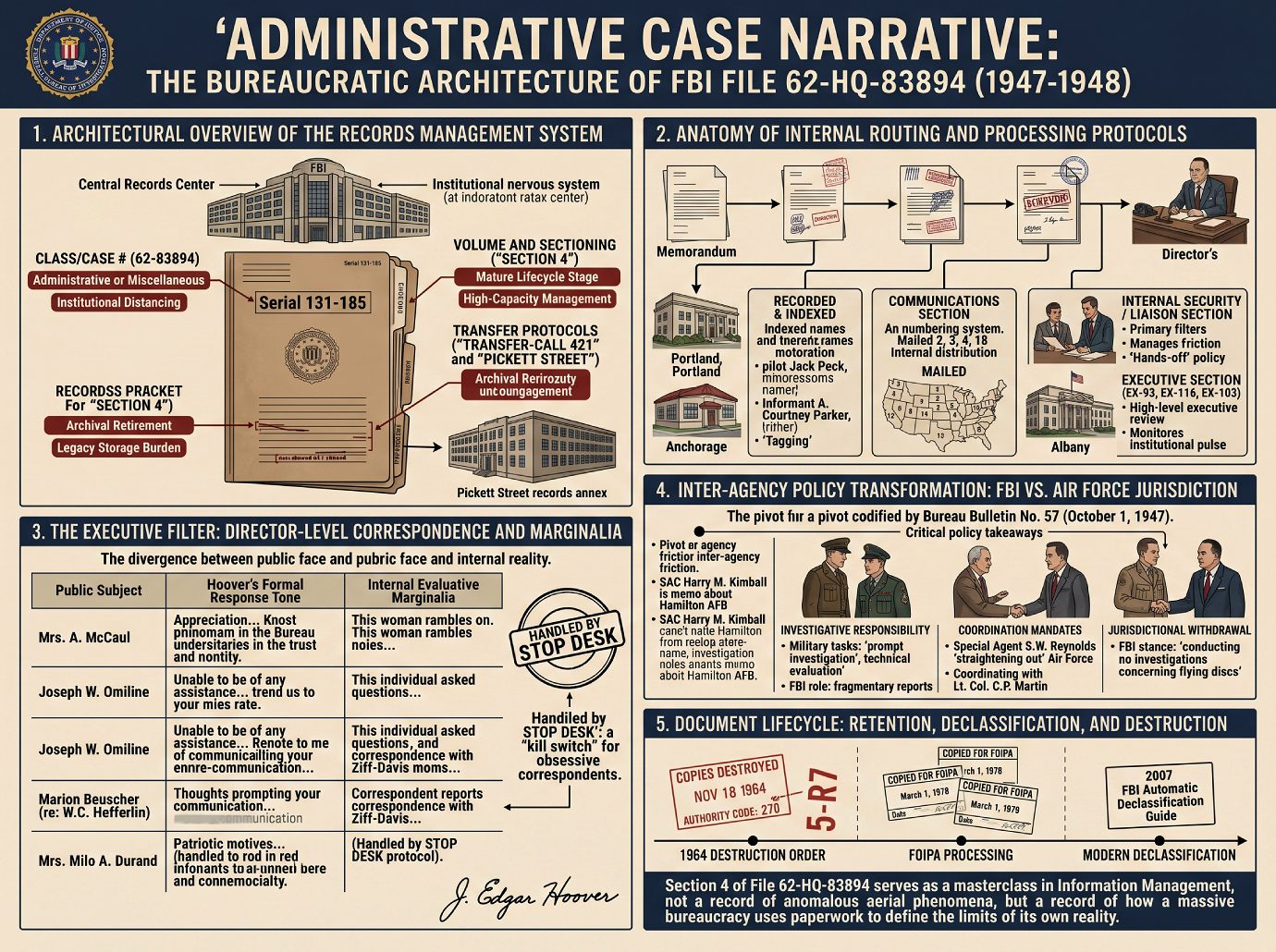
Administrative Case Narrative: The Bureaucratic Architecture of FBI File 62-HQ-83894 (1947-1948)
1. Architectural Overview of the Records Management System
During the late 1940s, the FBI’s “Central Records Center” functioned as the institutional nervous system, managing a massive post-war information economy. The administrative handling of “Security Matter – X” files—the designation for the “Flying Disc” phenomenon—was not merely a clerical reaction to public interest; it was a strategic exercise in redefining inter-agency boundaries and internal priority shifts. As the Cold War dawned, the Bureau used these files to gatekeep its jurisdiction, ensuring that resources remained focused on domestic subversion rather than technical military anomalies.
The physical file jacket for Serial 131-185 serves as a primary blueprint of this filing hierarchy. The following identifiers delineate the record’s status and migration:
- Class/Case # (62-83894): The “62” classification indicates the Bureau’s “Administrative or Miscellaneous” category. This is a critical indicator of institutional distancing; by placing the phenomenon here, the Bureau categorized it as a nuisance or informational matter rather than a primary criminal or subversive investigation.
- Volume and Sectioning (“Section 4”): The explicit designation of “Section 4” encompassing Serials 131-185 signifies a mature lifecycle stage for the file. This volume indicates that the Bureau had already processed hundreds of reports, necessitating a tiered folder system for high-capacity management.
- Transfer Protocols (“Transfer-Call 421” and “Pickett Street”): These markings reveal the archival retirement of the phenomenon. “Pickett Street” refers to the Bureau’s records annex in Alexandria, VA. The presence of “Transfer-Call 421” indicates the moment the “Flying Disc” transitioned from an active intelligence priority to a legacy storage burden, physically removed from HQ to off-site archival space.
This bureaucratic architecture reveals a persistent tension: while field reports often carried an air of urgency, the headquarters machinery was designed to standardize and eventually “shelve” the data once its political or investigative utility was exhausted.
2. Anatomy of Internal Routing and Processing Protocols
A memorandum’s path from a Field Office to the Director’s desk is validated by a rigorous “chain of custody” established through time-stamps and organizational marks. These stamps are the DNA of the Bureau’s internal logic, proving that information was not just received, but vetted and filtered according to specific protocols. Analysis of memos from SAC Portland, SAC Anchorage, and SAC Albany reveals the specialized functions of the following units:
- RECORDED & INDEXED: This step transformed raw data into a permanent searchable asset. By indexing names (e.g., pilot Jack Peck or informant A. Courtney Parker), the Bureau ensured that these individuals could be cross-referenced against future files, effectively “tagging” witnesses within the wider intelligence database.
- COMMUNICATIONS SECTION: The “MAILED” numbering system—specifically Mailed 2, 3, 4, 8, 10, 11, and 12 found across Serials 134–143—serves as a map of internal distribution. These numbers likely correspond to specific distribution lists or internal Bureau units, signifying the breadth of the “standardized” narrative being circulated to various desks.
- INTERNAL SECURITY / LIAISON SECTION: These desks acted as the primary filters for “Security Matter – X.” The Liaison Section, in particular, managed the friction between civilian reports and the military’s technical jurisdiction, ensuring the Bureau maintained a “hands-off” policy for the actual investigation of sightings.
- EXECUTIVE SECTION (EX-93, EX-116, EX-103): The recurring “EX” stamps are vital indicators that specific serials were being prepared for high-level executive review or were earmarked for the Director’s Office to monitor the institutional pulse on the phenomenon.
These protocols standardized disparate reports—from sightings in Alaska to “crackpot” letters from New York—into a unified Bureau narrative, allowing executive oversight to remain detached yet informed.
3. The Executive Filter: Director-Level Correspondence and Marginalia
J. Edgar Hoover’s signature on public-facing correspondence served as a “bureaucratic shield.” Standardized responses allowed the Bureau to maintain an image of patriotic engagement while reinforcing rigid jurisdictional boundaries. However, the true institutional sentiment is revealed in the internal marginalia, which often contradicted the formal, appreciative tone of the outgoing letters.
The following table illustrates the divergence between the Bureau’s public face and its internal evaluative reality:
| Public Subject | Hoover’s Formal Response Tone | Internal Evaluative Marginalia |
|---|---|---|
| Mrs. A. McCaul | Appreciation for “having written as you did.” | “This woman rambles on and furnishes no specific information about anything.” |
| Joseph W. Omiline | “Unable to be of any assistance” due to confidential files. | “This individual asked questions concerning… Russians.” |
| Marion Beuscher (re: W.C. Hefferlin) | “Thoughts prompting your communication are indeed appreciated.” | Correspondent reports correspondence with Ziff-Davis Publishing Company and Amazing Stories… mentions a threat that does not refer [to] injury. |
| Mrs. Milo A. Durand | “Patriotic motives… are indeed appreciated.” | (Handled by STOP DESK protocol) |
The HANDLED BY STOP DESK stamp is particularly instructive for the records consultant. This was the Bureau’s “kill switch” for obsessive or redundant correspondents. By routing letters to the Stop Desk, the Bureau effectively neutralized recurring inquiries from individuals like Mrs. McCaul, preventing them from clogging the primary investigative pipeline. This executive filter defined the boundaries of Bureau jurisdiction by determining which voices were “valid” and which were merely “rambling.”
4. Inter-Agency Policy Transformation: FBI vs. Air Force Jurisdiction
The period between late 1947 and early 1948 marked a definitive administrative pivot, codified by Bureau Bulletin No. 57 (October 1, 1947). This directive was designed to terminate active FBI investigations into “Flying Discs,” but its implementation was hindered by inter-agency friction. SAC Harry M. Kimball (San Francisco) noted this tension in a February 12, 1948, memo, reporting that the Air Force (specifically Hamilton AFB) was still issuing instructions that investigations “will be coordinated with the FBI,” in direct contradiction to Bulletin 57.
This necessitated a “re-education” of the military, documented in the March 1, 1948, internal response. Three critical policy takeaways emerged:
- Investigative Responsibility: The military was officially tasked with “prompt investigation” and technical evaluation. The FBI’s role was reduced to collecting “fragmentary reports” or data volunteered by the military.
- Coordination Mandates: Special Agent S.W. Reynolds of the Liaison Section was tasked with “straightening out” the Air Force. He coordinated directly with Lieutenant Colonel C.P. Martin (Air Force Intelligence) to ensure the military understood the FBI was out of the disc business.
- Jurisdictional Withdrawal: The Bureau’s final stance was one of total investigative cessation. As communicated to SAC San Francisco, the FBI was “conducting no investigations concerning flying discs.”
This administrative pivot effectively offloaded the public relations and technical burden of the “Flying Disc” to the military while the FBI retreated into a passive intelligence conduit, monitoring only for potential national security threats hidden within the reports.
5. Document Lifecycle: Retention, Declassification, and Destruction
The lifecycle of File 62-HQ-83894—from a 1947 intelligence asset to a modern historical artifact—is punctuated by markers of destruction and declassification. In intelligence records management, the stamps of disposal are as analytically significant as those of creation.
The record’s lifecycle is defined by several key milestones:
- The 1964 Destruction Order: The red stamp “COPIES DESTROYED NOV 18 1964” is accompanied by the handwritten authority code “270” and disposal marker “5-R7.” These identify a formalized purge of non-permanent copies, signaling the end of the file’s primary administrative utility during the peak of the Cold War.
- FOIPA Processing: The “COPIED FOR FOIPA” stamps (e.g., March 1, 1978) mark the file’s transition into the public domain, a result of the legislative expansion of transparency in the 1970s.
- Modern Declassification: The 2007 “FBI Automatic Declassification Guide” stamp on the file jacket represents the final institutional release of these documents into the historical record.
Section 4 of File 62-HQ-83894 serves as a masterclass in Information Management. It is not a record of anomalous aerial phenomena, but a record of how a massive bureaucracy uses paperwork to define the limits of its own reality. The administrative framework of 1947-1948 created the rigorous historical trail that allows us today to analyze the Bureau’s internal logic and its mastery of institutional distancing. —————————————-
Technical Assessment of the 1947–1948 “Flying Disc” Phenomenon: Evidence and Counter-Explanations
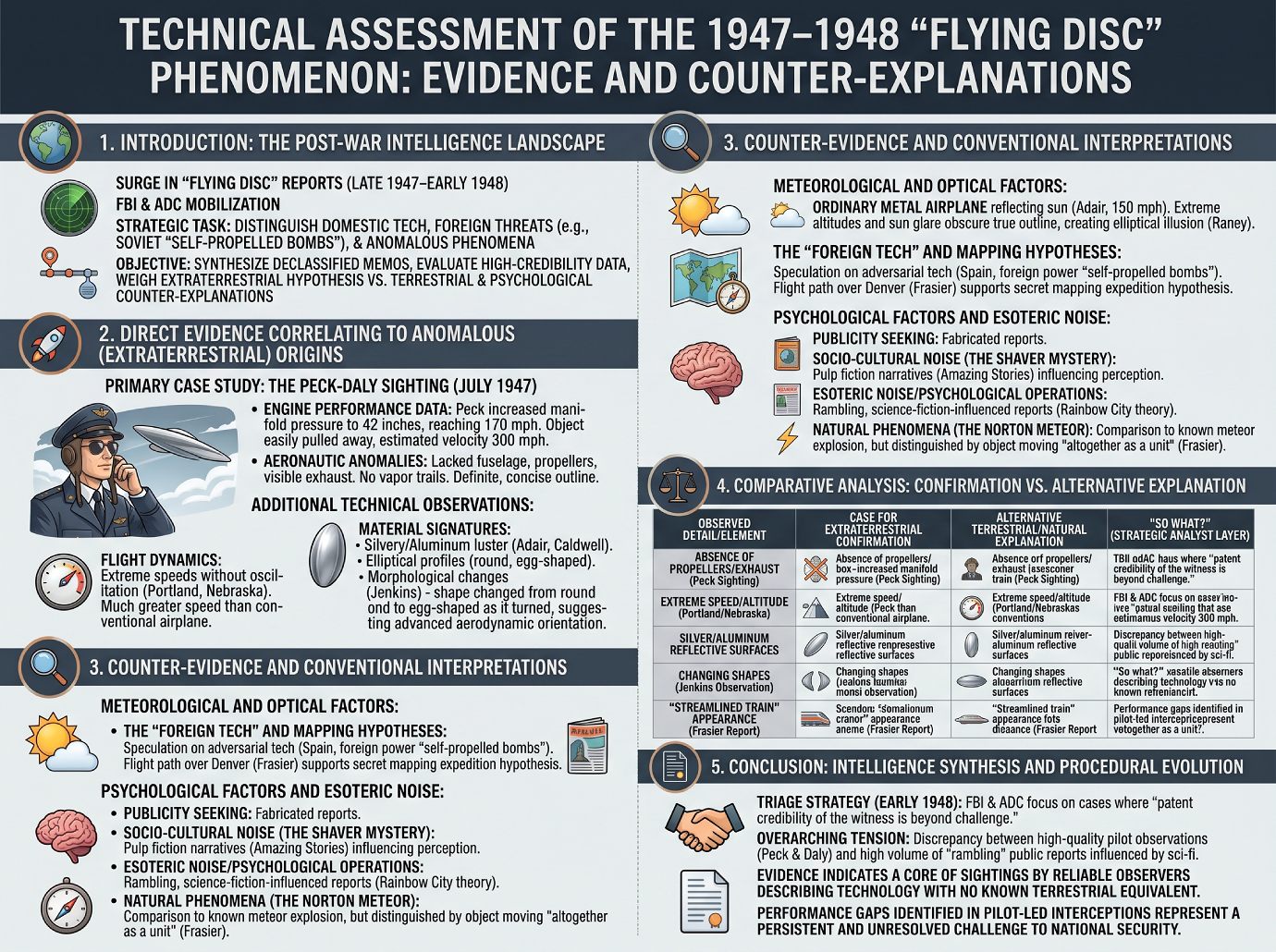
Technical Assessment of the 1947–1948 “Flying Disc” Phenomenon: Evidence and Counter-Explanations
1. Introduction: The Post-War Intelligence Landscape
Following the conclusion of World War II, the period between late 1947 and early 1948 witnessed a profound surge in “Flying Disc” reports throughout the United States and its territories. This phenomenon necessitated an immediate mobilization of the Federal Bureau of Investigation (FBI) and the Air Defense Command (ADC) to determine the nature of these incursions. From a strategic standpoint, the intelligence community faced the critical task of distinguishing between domestic technological breakthroughs, foreign adversarial threats—primarily the potential for Soviet “self-propelled bombs”—and truly anomalous phenomena. The primary objective of this assessment is to synthesize declassified memoranda, evaluate high-credibility eyewitness data, and weigh the extraterrestrial hypothesis against terrestrial and psychological counter-explanations. Understanding these reports is vital for establishing whether the phenomenon represents a legitimate threat to national air superiority.
2. Direct Evidence Correlating to Anomalous (Extraterrestrial) Origins
The significance of these reports is anchored by the testimony of high-credibility witnesses—specifically pilots, military personnel, and law enforcement officers—whose professional training in aerial observation makes them less susceptible to the “imagination” found in general public accounts. These witnesses consistently documented flight dynamics and physical profiles that defy the aerodynamic capabilities of mid-20th-century aviation.
Primary Case Study: The Peck-Daly Sighting (July 1947) The sighting near Bethel, Alaska, by pilots Jack Peck and Vince Daly provides the most rigorous technical data on performance gaps. While operating a DC-3, Peck attempted to intercept a wing-like object the size of a C-54.
- Engine Performance Data: To close the distance, Peck increased his manifold pressure to 42 inches, reaching a speed of 170 mph. Despite this, the object easily pulled away, with Peck estimating its velocity at 300 mph.
- Aeronautic Anomalies: The craft lacked a fuselage, propellers, and visible exhaust. Furthermore, it produced no vapor trails, even while maintaining a “definite, concise outline” that did not blend into the sky.
Additional Technical Observations:
- Flight Dynamics: Observations in Portland and Nebraska describe objects traveling at extreme speeds without oscillation. J.R. Caldwell (Portland) noted the object was traveling at a “much greater speed than a conventional airplane,” while Kenneth Frasier (Nebraska) observed an object moving fast enough to disappear over the horizon rapidly.
- Material Signatures: Declassified files highlight a recurring physical profile:
- Silvery/Aluminum Luster: Reported by Robert Adair and J.R. Caldwell as “very bright silver” or “aluminum substance.”
- Elliptical Profiles: Described as “round,” “egg-shaped,” or “streamlined.”
- Morphological Changes: Chief of Police Leon Jenkins reported an object that appeared to change shape from round to “egg-shaped” as it turned, suggesting advanced aerodynamic orientation.
The consistent reporting of non-conventional propulsion and extreme velocity by experienced flyers suggests the presence of technology currently unaccounted for in the U.S. inventory.
3. Counter-Evidence and Conventional Interpretations
Intelligence protocol demands the application of the “null hypothesis,” wherein mundane explanations are exhausted before accepting anomalous origins. Investigators categorized a significant portion of the data as meteorological, optical, or psychological “noise.”
Meteorological and Optical Factors Investigators utilized atmospheric data to contextualize sightings. While Portland Police initially considered weather balloons, Officer Robert Adair ultimately concluded his observation (estimated at 150 mph) was likely an “ordinary metal airplane” reflecting the afternoon sun. Patrolman H. S. Raney supported this, noting that extreme altitudes and sun glare can obscure a craft’s true outline, creating an elliptical illusion.
The “Foreign Tech” and Mapping Hypotheses Speculation regarding adversarial technology was prevalent. Mary Teater (citing a Dr. H. E. Cromwell) reported theories that the craft originated from Spain. N.J. Marshall proposed that “self-propelled bombs” were being tested for range by a foreign power. A critical data point comes from Kenneth Frasier, who noted an object traveling from East to West, appearing to have passed directly over Denver, Colorado. This flight path supports the hypothesis of a secret mapping expedition, potentially by an adversarial power or a hypothesized “world government.”
Psychological Factors and Esoteric Noise The memoranda identify several layers of socio-cultural influence that contaminated the data pool:
- Publicity Seeking: Fabricated reports intended to capitalize on the “Flying Disc” craze.
- Socio-Cultural Noise (The Shaver Mystery): Correspondence from Joseph Omiline specifically questioned the FBI regarding the “Shaver Mystery” and Ray Palmer’s Amazing Stories, indicating that pulp fiction narratives regarding “people living underground” influenced public perception.
- Esoteric Noise/Psychological Operations: W.C. Hefferlin (via Marion Beuscher) proposed the “Rainbow City” theory, claiming craft were part of an Antarctic mapping mission. Analysts categorize these as rambling, science-fiction-influenced reports that obscure high-quality data.
- Natural Phenomena (The Norton Meteor): Kenneth Frasier explicitly compared his sighting to a known meteor explosion over Norton, Kansas. However, he distinguished his observation by noting the object moved “altogether as a unit,” whereas the Norton meteor was a fragmented “smoke cloud.”
4. Comparative Analysis: Confirmation vs. Alternative Explanation
| Observed Detail/Element | Case for Extraterrestrial Confirmation | Alternative Terrestrial/Natural Explanation | “So What?” (Strategic Analyst Layer) |
|---|---|---|---|
| Absence of propellers/exhaust (Peck Sighting) | Indicates non-combustion, exotic propulsion system. | High-altitude gliders or conventional craft viewed at “glare” angles. | If accurate, the ability to reach 300 mph without visible propulsion renders current ADC interceptors obsolete. |
| Extreme speed/altitude (Portland/Nebraska) | Velocities exceeding 300 mph at altitude without vapor trails suggest breakthrough tech. | Meteors or high-velocity rockets. | High human error in ground-based speed estimation; however, Frasier’s “unit” movement challenges natural meteor fragmentation models. |
| Silver/Aluminum reflective surfaces | Suggests a metallic, manufactured hull of unknown origin. | Direct sun reflection on unpainted aluminum airframes (C-54, DC-3). | Signature is consistent with the post-war proliferation of aluminum aircraft, increasing the probability of misidentification. |
| Changing shapes (Jenkins Observation) | Suggests a morphing hull or advanced aerodynamic banking. | Optical illusion caused by a craft turning relative to the sun’s angle. | Most “shape-shifting” reports correlate exactly with the object changing its flight path relative to the observer’s line of sight. |
| “Streamlined train” appearance (Frasier Report) | Suggests a large, unified structural craft of massive proportions. | Atmospheric “silver streaks” or smoke trails from high-altitude rockets. | Frasier’s East-to-West path over Denver suggests a structured flight plan, reinforcing the secret “mapping” threat hypothesis. |
5. Conclusion: Intelligence Synthesis and Procedural Evolution
By early 1948, the FBI and Air Defense Command transitioned from open investigation to a “triage” strategy. The February 4, 1948 directive from the Headquarters of the Air Defense Command explicitly instructed investigators to avoid the “futile expenditure of military funds and manpower” on hoaxes or fabrications. Investigations were henceforth restricted to cases where the “patent credibility of the witness is beyond challenge.”
The overarching tension in the declassified archives remains the stark discrepancy between high-quality pilot observations (such as Peck and Daly) and the high volume of “rambling” public reports influenced by science fiction magazines. As of early 1948, the evidence indicates a core of sightings by reliable observers describing technology with no known terrestrial equivalent. While the majority of reports are dismissible as “noise,” the performance gaps identified in pilot-led interceptions represent a persistent and unresolved challenge to national security.