Greater Gardner MA Local News May 2026
- National Safety Month 2026 (5/31/2026)

Are you a local official, department head, have a group or organization and would like to share some safety tips or what you’re doing about safety? Just email News@GardnerMagazine.com or call our voicemail line at (978) 632-6324 and we’ll gladly and enthusiastically help you get the word out. To our first responders: Thank you for all you do to keep us safe.
June is National Safety Month – Let’s Be Safer
For 3 decades, organizations and individuals across the United States have joined the National Safety Council in observing National Safety Month. The 2026 Safety Topics are June 1-6: Moving Safety Forward, June 7-13: Roadway Safety, June 14-20: Holistic Worker Health, and June 21-30: Slips, Trips, and Falls. For FREE safety tools and resources for your organization, group, class, or household, visit NSC.org/nsm to get a campaign poster, weekly fact sheets and safety talks, weekly articles, weekly videos, and weekly research.
The Chair Man and the Chair Lady discuss how the Human Brain Ignores Everyday Hazards along with some safety tips. Listen on any device, CLICK PLAY.
Here’s some local examples of safety initiatives: In the City of Gardner, the Gardner Fire Department has increased safety through its proactive education efforts directed at people of every age. The Gardner Police Department has a full-time Domestic Violence Advocate to increase safety in relationships and families. The Gardner PD also maintains a FREE disposal service in the lobby for old medications, so for example, kids can’t get access to opioids you are no longer using. Through various initiatives, the crime rate in Gardner has fallen by almost half in the last 5 years.

- Weekly Briefing 5-31-26 (5/31/2026)
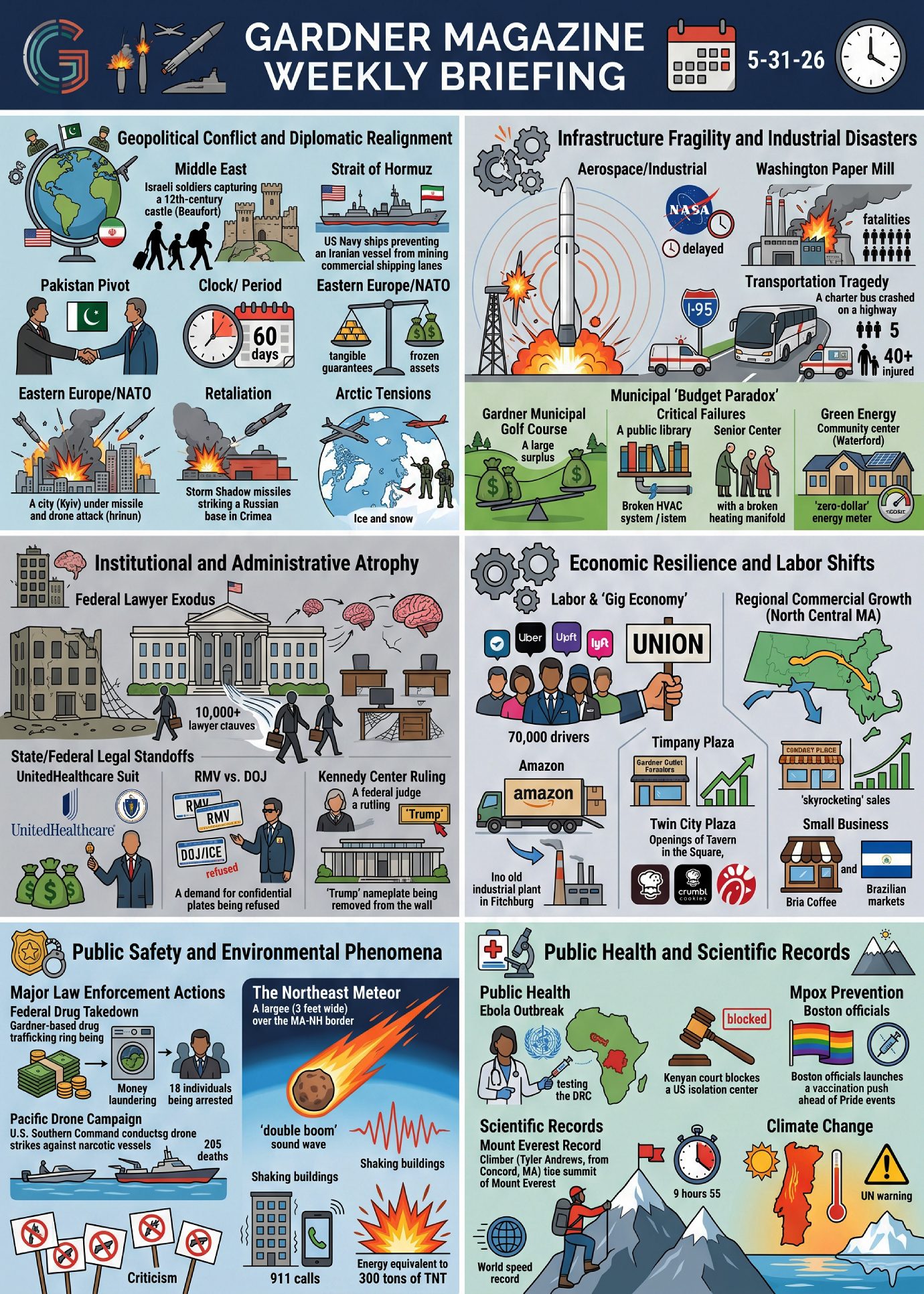
A Weekly Briefing from Gardner Magazine – May 31, 2026
The Chair Man and the Chair Lady discuss the news of the week including Greater Gardner MA, North Central MA, the State of Massachusetts, National News, and World News. They tie it all together in a great podcast. Listen on any device, CLICK PLAY.
DEEP DIVE – Weekly Briefing 5-31-26 This week we have a special feature: A “Debate” with Max and Maxine Rogers discussing the impact of the week’s news stories. Listen on any device, CLICK PLAY.
DEBATE: Top Impacts 5-31-26 Gardner Magazine has 4 separate additional sections covering North Central MA News, a Massachusetts News Roundup, U.S. National News, and World News, all updated on May 31, 2026, this week with some additional infographics
JUMP TO SECTION: North Central MA News — State News of the Week —- National News of the Week — World News of the Week
The final week of May 2026 was defined by a profound “paradox of progress,” where significant technological and commercial milestones were offset by institutional atrophy, infrastructure failure, and escalating global conflict. Internationally, the landscape shifted from the deepest Israeli ground incursion into Lebanon in 26 years to a precarious Pakistan-mediated ceasefire attempt in the Strait of Hormuz. Domestically, the United States faces an administrative crisis following an exodus of 10,000 federal attorneys and the catastrophic failure of a Blue Origin rocket engine, which has delayed NASA’s lunar ambitions.
In Massachusetts, a rare celestial event—a three-foot meteor generating the energy of 300 tons of TNT—provided a unifying, jarring experience across New England. Regionally, while commercial sectors like retail and logistics (Amazon) are booming, municipal governments are grappling with a “budget paradox,” balancing million-dollar surpluses in recreational assets against “end of life” failures in essential public infrastructure.
- George Tyros – Presidents Desk – 5-31-26 (5/31/2026)
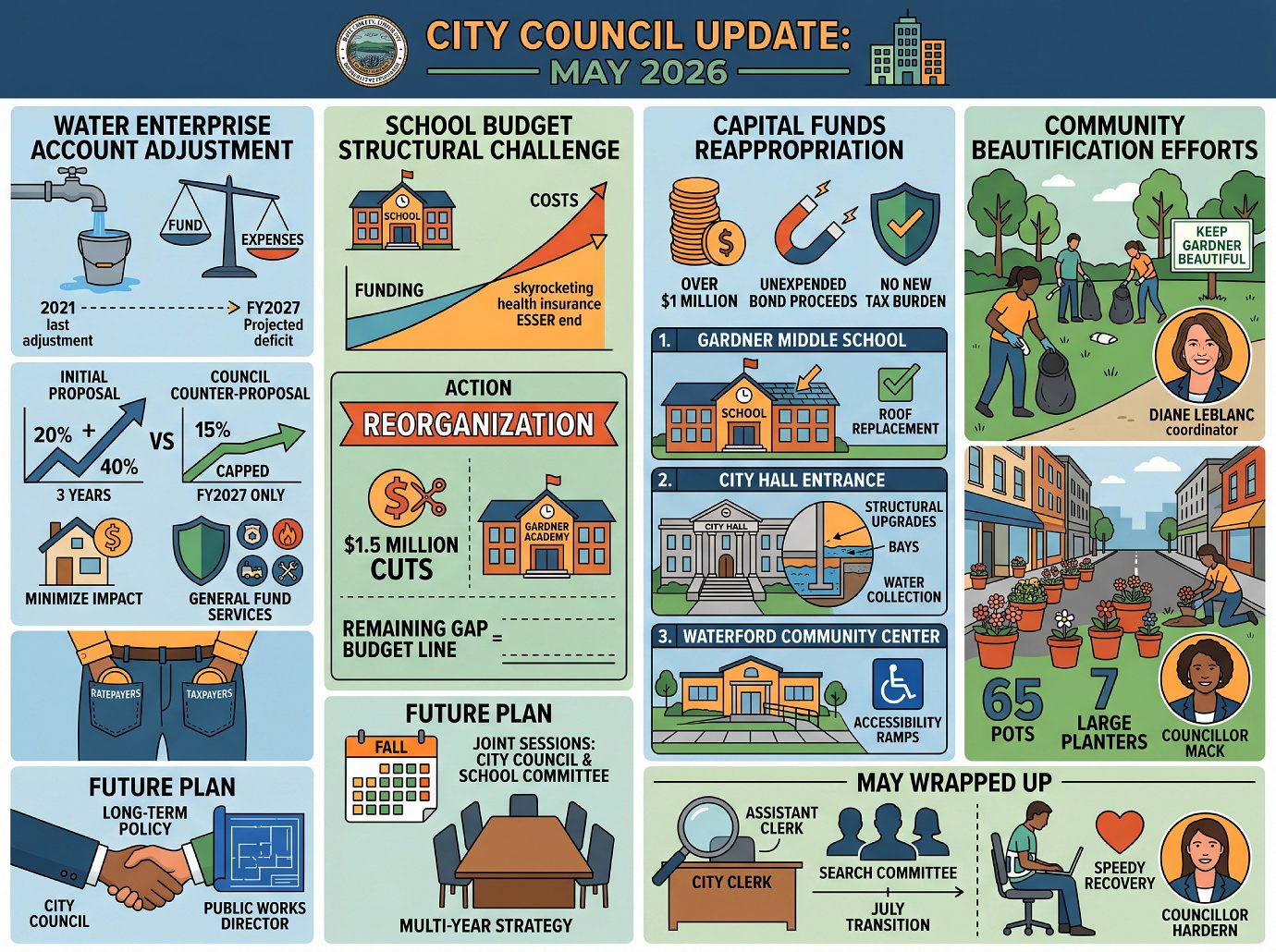
This update from Gardner City Council President George Tyros focuses on the Water Enterprise Account, the School Budget, Reappropriation of unexpended bond proceeds, annual Downtown Flower Pot Program, City Clerk search, and well wishes for Councilor Karen Hardern who is suffering from a back issue.
May 2026 Update from Gardner City Council President George Tyros
Gardner City Council President George Tyros released the May 2026 “From the President’s Desk” on May 31, 2026. CLICK FOR PDF.
Finding a Better Flow: A Reasonable Rate
This month, the City Council tackled a difficult but necessary challenge: addressing a structural shortfall in our Water Enterprise Account. For many years, the city has used a staggered system, adjusting sewer rates for a five-year block and then switching to adjust water rates for the following five years. Because our water rates haven’t been adjusted since 2021, the fund has not kept pace with contractual changes, inflation, and essential maintenance, leaving the account projected to fall into a deficit during Fiscal Year 2027.While the administration initially proposed a 20% increase starting July 1st, followed by an additional 40% over the next three years, the Council’s Finance Committee pushed for a more measured, yet still proactive alternative. The Council voted to approve a first printing of a counter-proposal, setting a 15% rate increase capped strictly for Fiscal Year 2027 alone to keep the enterprise fund in the black, while keeping the impact to residents to a minimum.
“Whether we’re talking about the ratepayers or the taxpayers, those are two pockets but part of the same pair of pants.” — Councillor Heglin
By limiting this adjustment to a single year rather than locking in a long-term annual hike, we are holding our municipal operations accountable. This temporary step avoids severe “sticker shock” for residents while preventing a deficit that would otherwise force painful cuts to our general fund services like police, fire, and public works.
Over the coming months, we will be working closely with Public Works Director Arnold to develop a clearer, long-term policy that ensures better ratepayer predictability and fiscal stability moving forward.
What’s the Number? Setting the School Budget Straight
On May 12th, the City Council held an informal meeting with Superintendent Dr. Pellegrino and School Business Manager Hawke to review the Fiscal Year 2027 school budget. While Gardner Public Schools have achieved remarkable educational outcomes in recent years—with Gardner High School significantly outperforming peer districts statewide in managing a high-needs student population—the end of federal pandemic relief funds (ESSER) and skyrocketing costs (including health insurance) have created a significant structural gap.To meet this challenge, the school department implemented a major reorganization totaling $1.5 million in cuts, which includes shutting down Gardner Academy.
However, there is a remaining gap that highlights a broader conversation about how we plan as a city. While our local school funding has increased faster than any other sector of municipal government over the last five years, relying on one-time fixes or waiting until April to address budget shortfalls puts immense pressure on our systems. Going forward, the Council is advocating for structural, joint sessions between the City Council and the School Committee much earlier in the fiscal year.
By analyzing trends and fixed costs collaboratively in the fall, we can replace short-term scrambling with a sustainable, multi-year strategy.
Keeping Our Capital Working: Over $1 Million Reappropriated
In a unanimous vote, the Council approved the reappropriation of just over $1 million in unexpended bond proceeds to fund critical infrastructure and municipal adjustments. Because these funds are heavily restricted and tied directly to capital projects, this legislative move allows us to maximize existing city resources without adding any new burden to our taxpayers.The funding package directly targets three key community areas:
- Gardner Middle School: Covering a significant bid variance to ensure the essential roof replacement stays on schedule.
- City Hall Entrance: Fixing it the right way, with structural upgrades to fill the bays underneath the main steps. This will prevent the previous long-standing water collection and prevent future foundation damage.
- Waterford Community Center: Funding the construction of concrete accessibility ramps and entryway sidewalks to make the facility fully navigable, for everyone.
Gardner in Bloom: Volunteers Step Up to Beautify Downtown
As we transition into the warmer months, May offered an incredible reminder of what makes Gardner a truly special place to live: our community volunteers.We owe a massive thank you to the hundreds of residents and over a dozen organizations who rolled up their sleeves for the City Keep Gardner Beautiful cleanup event. A special shout-out goes to Diane LeBlanc, who has dedicated years to coordinating these cleanup efforts and keeping our neighborhoods beautiful.
Our community pride doesn’t stop there. The annual Downtown Flower Pot Program is officially underway. Volunteers will be gathered to plant 65 pots and seven large planters across our business district. Thank you to Councillor Mack for all of her efforts ensuring the success of this beautiful program!
May Wrapped Up
Clerk Search Underway: Following the announcement of our City Clerk’s upcoming departure in July, a Special Search Committee consisting of myself, Councillor Kazinskas, and Councillor Mack has officially formed. The Council has approved the updated job descriptions for both the City Clerk and Assistant City Clerk roles, and we are moving forward swiftly to ensure a smooth transition for this vital City Hall artery.
Wishing the Dean Well: Our longest-serving member, Dean of the Council, Councillor Hardern, is temporarily stepping back from her subcommittee assignments until September 1st to receive medical attention for a severe back issue. True to her 16-plus years of dedicated public service, she is actively keeping up with all municipal business from home. Please join the rest of the Council in wishing her a speedy and full recovery!See you all next month!
from City Council President George Tyros 5-31-26
- Gardner High Graduation 2026 (5/30/2026)
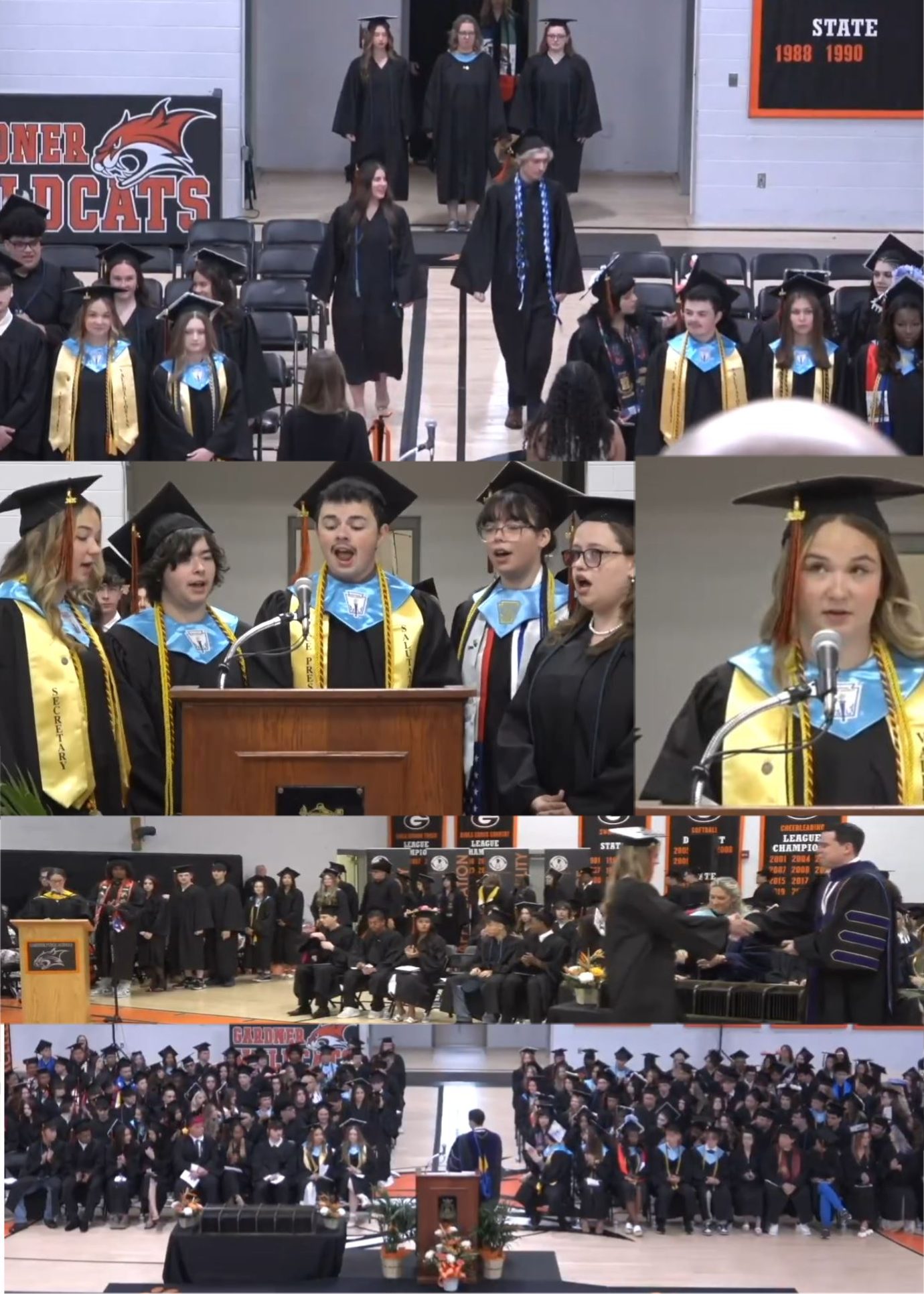
Gardner High School Graduation 2026 – Complete Coverage
Listen to the ceremonies on any device, CLICK PLAY.
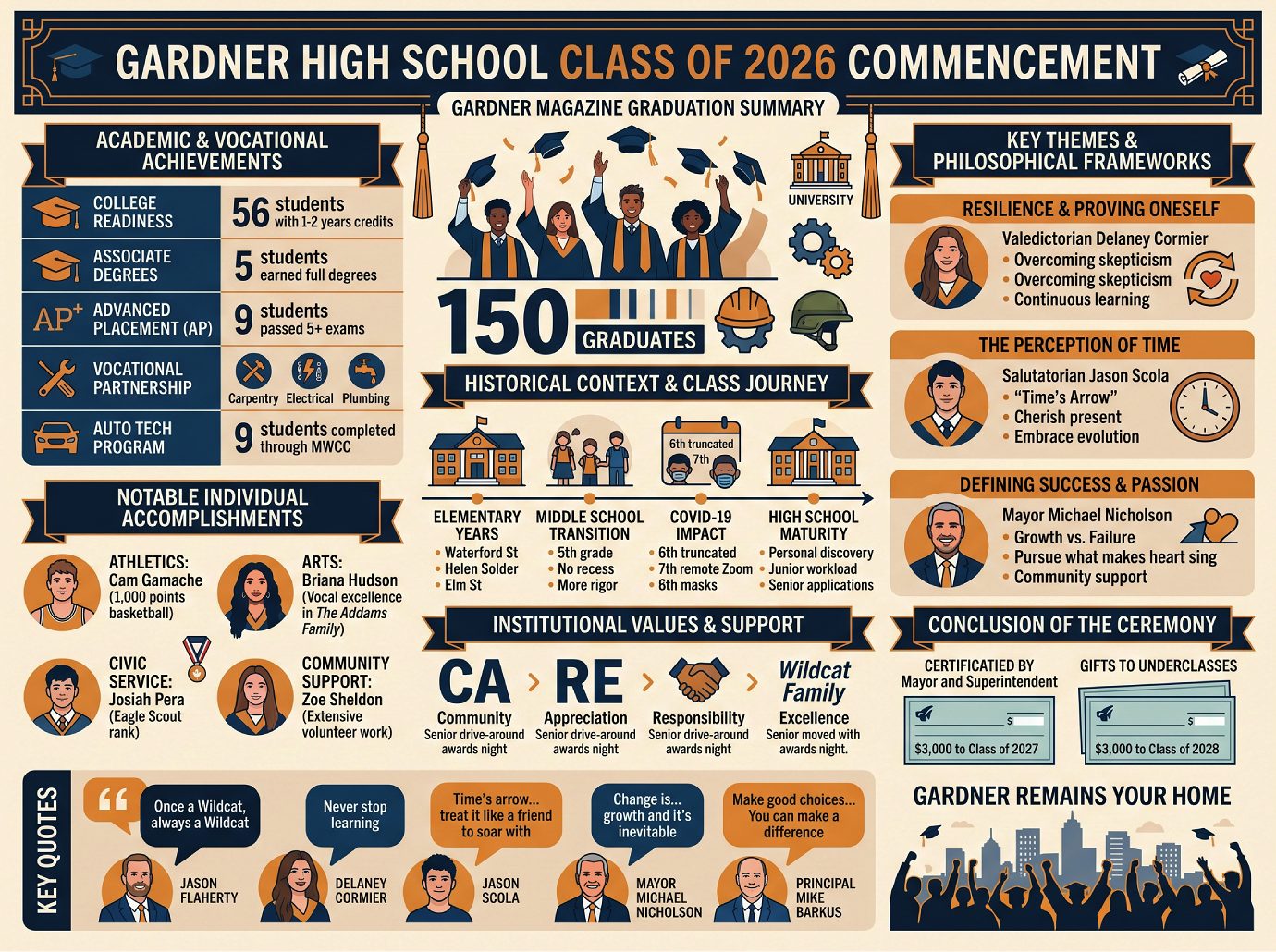
Gardner High School Graduation 2026 The graduation ceremony for the Gardner High School Class of 2026 celebrates the transition of 150 graduates from their foundational education into diverse future paths, including higher education, the workforce, and the military. The ceremony highlights a class defined by significant academic and vocational achievements, with over a third of the students having already completed substantial college coursework. The collective narrative of the class is characterized by resilience, particularly in navigating the disruptions caused by the COVID-19 pandemic during their middle school years. The overarching themes of the commencement include the importance of community support, the necessity of cherishing the present moment, and the drive to define success through personal passion rather than traditional metrics.
Academic and Vocational Achievements
The Class of 2026 has demonstrated high levels of excellence across various academic and technical disciplines. Principal Mike Barkus highlighted several key performance indicators for the 150-member class:
Category Achievement Data College Readiness 56 students graduated with 1–2 years of college credits completed. Associate Degrees 5 students earned full associate degrees prior to high school graduation. Advanced Placement (AP) 9 students passed five or more AP exams during their high school careers. Vocational Partnership Participation in the Monty Tech partnership (carpentry, electrical, plumbing). Auto Tech Program 9 students completed the program through Mount Wachusett Community College. Notable Individual Accomplishments
- Athletics: Cam Gamache achieved a career milestone of 1,000 points in basketball.
- Arts: Briana Hudson’s performance in The Addams Family was specifically noted for its vocal excellence.
- Civic Service: Josiah Pera attained the rank of Eagle Scout.
- Community Support: Zoe Sheldon was recognized for extensive volunteer work within and outside the school.
Historical Context and Class Journey
The Class Treasurer, Jason Flaherty, provided a chronological reflection of the class’s journey through the Gardner school system, emphasizing their adaptability through structural changes and global crises.
- Elementary Years: The class began at Waterford Street School, with some moving to Helen Solder. They were the inaugural second-grade class at the Elm Street School.
- Middle School Transition: In fifth grade, students transitioned to middle school, noting the loss of recess and increased academic rigor.
- COVID-19 Impact: The sixth-grade year was truncated by the pandemic. Seventh grade was conducted via remote learning (Zoom), and eighth grade required a return to the building under mask mandates, where students could “only see the tops halves of each other’s faces.”
- High School Maturity: The four years of high school focused on personal discovery, navigating increasingly heavy workloads in junior year, and the complexities of the application process in senior year.
Resilience and Proving Oneself
Valedictorian Delaney Cormier emphasized that success is often born from the support of others and the desire to overcome the skepticism of peers. She encouraged graduates to use critique as motivation to become the best versions of themselves and to maintain a mindset of continuous learning.
The Perception of Time
Salutatorian Jason Scola introduced the concept of “Time’s Arrow,” noting that time neither stands still nor reverses. He urged his classmates to:
- Cherish the Present: Recognize the difficulty of living in the moment when the future seems so pressing.
- Embrace Evolution: View time as a “friend to soar with” rather than a hazard to avoid.
- Acknowledge Finality: Celebrate the “fruits of labor” before swapping tassels and transitioning to alumni status.
Defining Success and Passion
Mayor Michael Nicholson offered a critique of traditional definitions of success, arguing that job titles and salary are secondary to personal fulfillment.
- Growth vs. Failure: He asserted that changing one’s path (e.g., switching majors or career fields) is a sign of growth, not failure.
- Authenticity: He encouraged graduates to pursue what makes their “heart sing,” whether that be art, nursing, science, or public office.
- Community Support: He reinforced the idea that the city of Gardner “stands behind” the graduates even when the future is “something we know absolutely nothing about.”
Institutional Values and Support
Principal Barkus identified the core expectations of Gardner High School as Community, Appreciation, Responsibility, and Excellence (CARE). He noted that the class exemplified these traits, specifically citing:
- Responsibility: Observed during the senior “drive-around,” where students maintained safety and traffic etiquette.
- Community Appreciation: Observed during awards night, where students showed genuine joy for their peers’ successes.
- The “Family” Concept: Barkus described the class as a family unit, having grown together over 13 years, and emphasized that “once a Wildcat, always a Wildcat.”
Conclusion of the Ceremony
The ceremony concluded with the official certification of the graduates by the Mayor and Superintendent. As a gesture of continuity and community support, the Class of 2026 presented financial gifts to the underclasses:
- $3,000 to the Class of 2027.
- $3,000 to the Class of 2028.
The final message from administration and city officials was one of welcoming: while the students are leaving to pursue new chapters, Gardner remains their “home” and the community remains their primary cheering section.
Key Quotes
“Part of the journey is the end… wherever life may take you, just remember: once a Wildcat, always a Wildcat.” — Jason Flaherty, Class Treasurer
“We may be done with high school, but we should never stop learning.” — Delaney Cormier, Valedictorian
“Time’s arrow neither stands still nor reverses; it merely marches forward. So don’t treat the arrow like a hazard to avoid; treat it like a friend to soar with.” — Jason Scola, Salutatorian
“Don’t let anyone tell you that change is synonymous to failure because in reality it’s growth and it’s inevitable.” — Mayor Michael Nicholson
“Make good choices over your years because I’d like for you to be the best you can be… You can make a difference.” — Principal Mike Barkus
- Gardner Academy Graduation 2026 (5/30/2026)
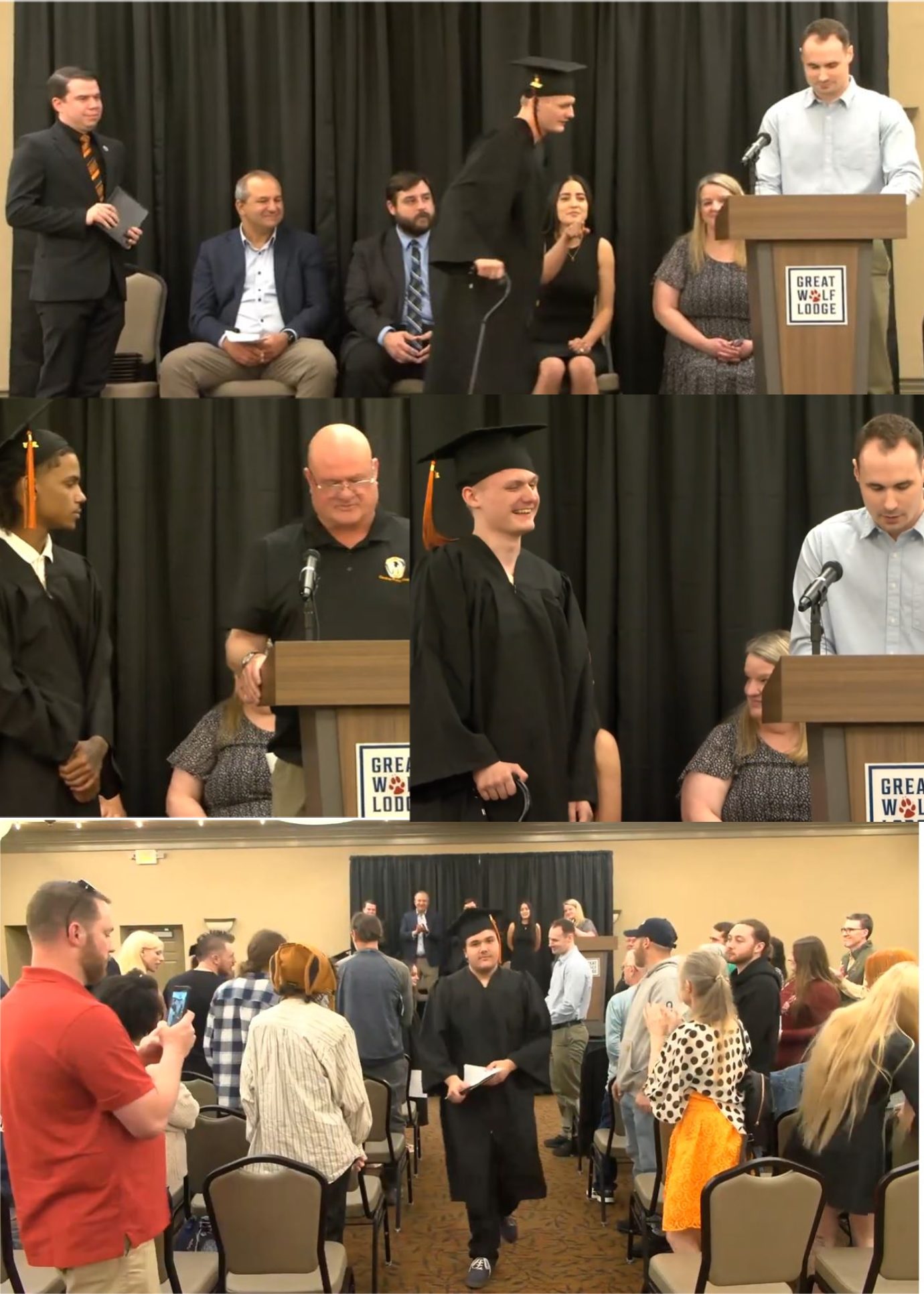
Gardner Academy Graduation 2026 – Complete Coverage
Listen to the ceremonies on any device, CLICK PLAY.
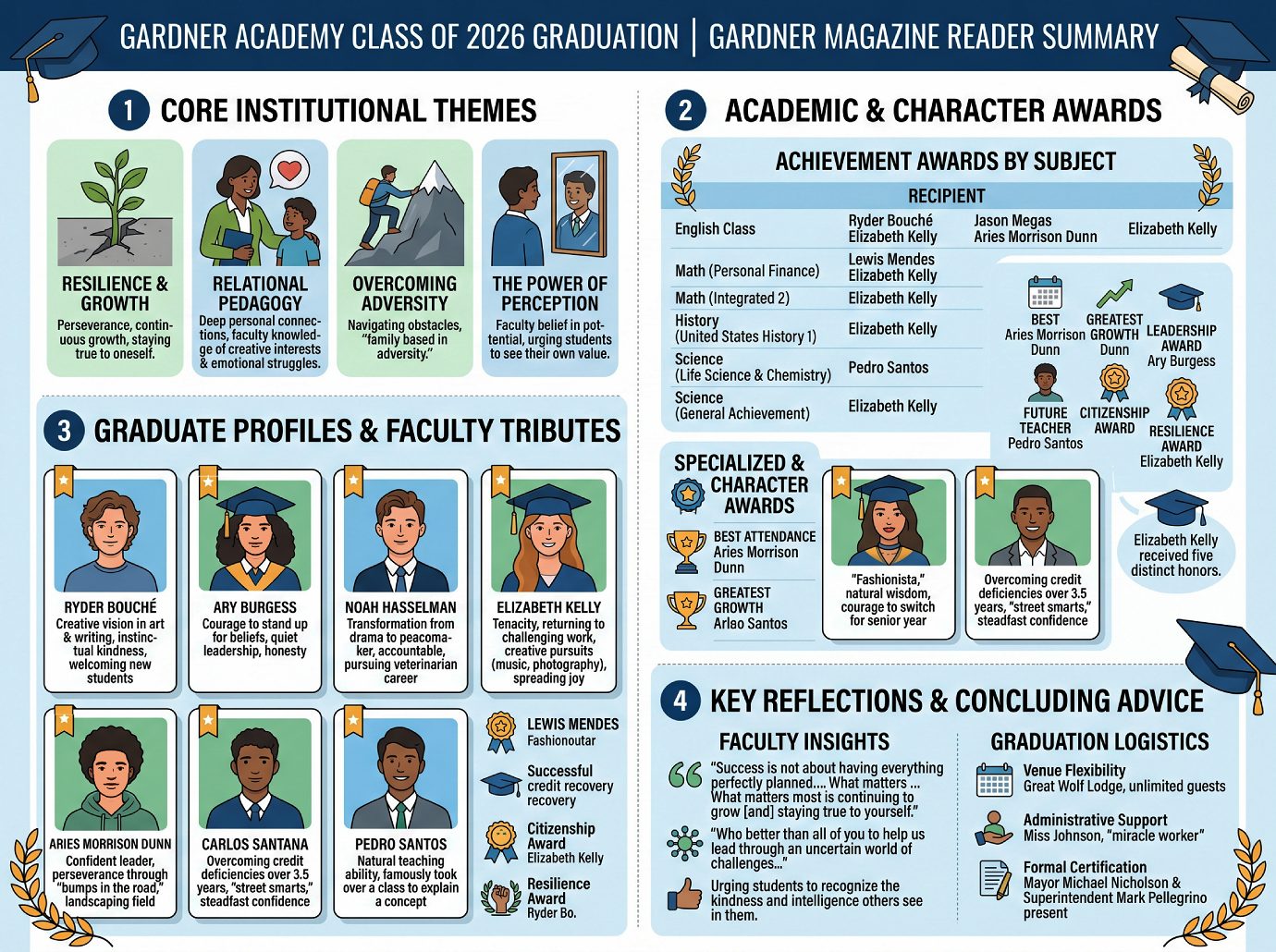
Gardner Academy 2026 Graduation The Gardner Academy Class of 2026 graduation ceremony served as a formal recognition of student perseverance, growth, and the successful navigation of non-traditional academic paths. The proceedings emphasized that for this cohort, graduation represents more than the accumulation of credits; it signifies the mastery of “second chances” and the ability to move forward despite significant personal and academic obstacles.
The academy’s culture is defined by deep interpersonal relationships between faculty and students, a focus on emotional resilience, and an environment where students are “seen, supported, and encouraged.” Key outcomes of the 2026 academic year include successful credit recovery for students who previously doubted their ability to graduate, the development of leadership and vocational interests, and a collective emphasis on seeing internal value beyond academic metrics.
The Gardner Academy mission, as evidenced by the ceremony’s addresses, is built upon several foundational pillars:
- Resilience and Growth: The school views graduation as proof of the “ability to keep moving forward even when things are difficult.” Success is framed not as perfection, but as continuous growth and staying true to oneself.
- Relational Pedagogy: Faculty members prioritize personal connections. Tributes highlighted teachers’ knowledge of students’ personal lives, creative interests, and emotional struggles, suggesting that these relationships are the primary drivers of academic success.
- Overcoming Adversity: The ceremony explicitly recognized that many graduates faced “obstacles along [the] path that could have easily become reasons to give up.” The academy positions itself as a “family based in adversity.”
- The Power of Perception: A recurring theme was the gap between a student’s self-doubt and the faculty’s belief in their potential. The closing address emphasized the need for students to “see themselves the way [the faculty] see them.”
Academic and Character Awards
The ceremony included the presentation of achievement awards across various disciplines and character categories. Notably, Elizabeth Kelly was the most decorated student of the evening, receiving five distinct honors.
Achievement Awards by Subject
Category Recipient(s) English Class Ryder Bouché, Elizabeth Kelly, Jason Megas, Aries Morrison Dunn Math (Personal Finance) Lewis Mendes, Elizabeth Kelly Math (Integrated 2) Elizabeth Kelly History (United States History 1) Elizabeth Kelly Science (Life Science & Chemistry) Pedro Santos (recognized for both) Science (General Achievement) Elizabeth Kelly Specialized and Character Awards
Award Criteria Recipient Best Attendance Highest attendance record for the school year. Aries Morrison Dunn Greatest Growth Most significant social and academic development. Aries Morrison Dunn Future Teacher Forecasted potential in the field of education. Pedro Santos Leadership Award Leading by example with responsibility and integrity. Ary Burgess Citizenship Award Meaningful impact and positive presence in the school. Elizabeth Kelly Resilience Award Perseverance and strength in overcoming challenges. Ryder Bouché Graduate Profiles and Faculty Tributes
Each graduate received a personalized tribute from a faculty member, detailing their unique journey and contributions to the school community.
- Ryder Bouché: Acknowledged for his creative vision in art and writing, and his “instinctual kindness.” He was specifically noted for welcoming new students who were intimidated by the school environment.
- Ary Burgess: Commended for her courage to stand up for her beliefs and her “quiet leadership.” Her move to a neighboring town and her character-driven honesty were highlighted as defining traits.
- Noah Hasselman: Recognized for significant personal evolution. Formerly involved in “school drama,” he transformed into a peacemaker and a positive presence who held himself accountable and supported his peers. He intends to pursue a career as a veterinarian.
- Elizabeth Kelly: Celebrated for her tenacity and ability to return to “challenging classwork” with a fresh perspective. She was noted for her creative pursuits in music and photography, as well as her daily efforts to spread joy to staff through art.
- Lewis Mendes: Described as a “fashionista” with “natural wisdom.” He was praised for the courage it took to switch to Gardner Academy for his senior year to prioritize his academic success.
- Jason Managus: Highlighted for his successful credit recovery. Despite needing a significant number of credits at the start of the year, he passed all his classes for the full school year, a feat he had not achieved in some time.
- Aries Morrison Dunn: Described as a leader with high confidence and a “perseverance” that saw him through “bumps in the road.” He plans to enter the landscaping field working with his grandfather.
- Carlos Santana: His journey was described as a “long strange trip” involving three and a half years of overcoming credit deficiencies. He was noted for his “street smarts,” steadfast confidence, and his refusal to give up despite numerous struggles.
- Pedro Santos: Honored for his natural teaching ability. He famously took over a class to explain a concept to a fellow student more effectively than the teacher, leading to his “Future Teacher” recognition.
Faculty Insights
- On Success: “Success is not about having everything perfectly planned… What matters most is continuing to grow [and] staying true to yourself.”
- On Adversity: “Who better than all of you to help us lead through an uncertain world of challenges than those that have already faced adversity and conquered it.”
- On Self-Worth: Faculty repeatedly emphasized that students are often their own “toughest critics,” urging them to recognize the kindness and intelligence others see in them.
Graduation Logistics
- Venue Flexibility: The ceremony was held at the Great Wolf Lodge, which provided additional space to allow for an unlimited number of guests per student.
- Administrative Support: Miss Johnson, the administrative assistant, was singled out for her “miracle worker” status in managing a date change and the logistical complexities of the event.
- Formal Certification: Mayor Michael Nicholson and Superintendent Mark Pellegrino were present for the formal certification of the graduates according to Gardner Public Schools and Massachusetts state guidelines.
- Hotline Radio 5-30-26 (5/30/2026)
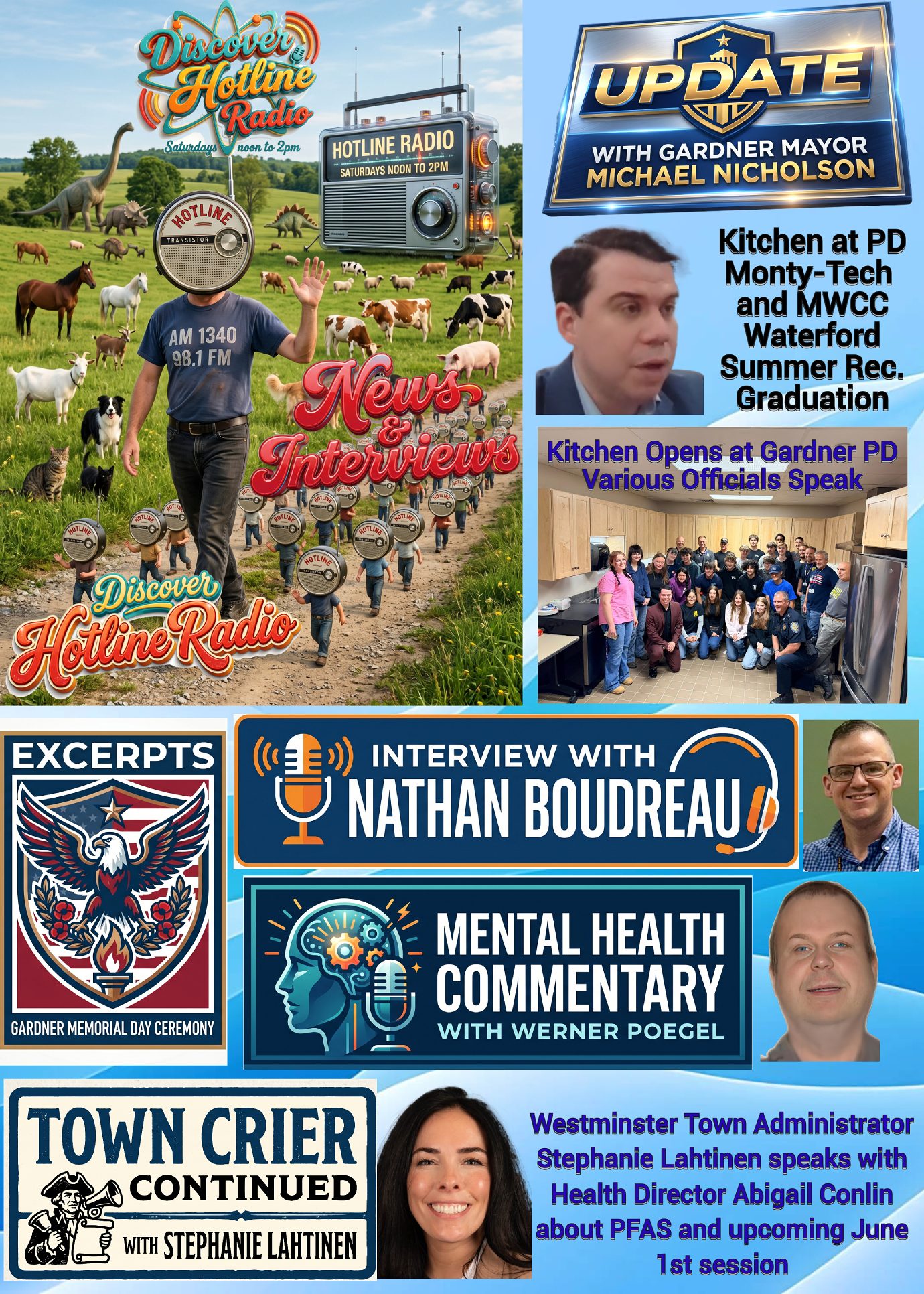
WGAW Hotline Radio 5-30-26
Listen to the entire show on any device, CLICK PLAY.
Hotline Radio 5-30-26 Update with Gardner Michael Nicholson: Kitchen opens in Emergency Operations Center at Gardner Police Station, built by Monty-Tech students — A discussion of admission policies at Monty-Tech — MWCC partnership with Gardner Public Schools offering Early Collage program – Waterford Street School update – GETV will be moving there —- Summer Recreation Program —- Greenwood Pool opens on the last day of school. Will be open 6 days a week and possibly 7 days a week in July. – Discussion of scholarships and graduation in Gardner.
Coverage of the Dedication of kitchen facility at the Gardner Police Station. Gardner Police Chief Eric McAvene, Mayor Nicholson, and Monty Tech officials speak about the kitchen.
Memorial Day Ceremony Gardner MA – Excerpts featuring State Representative Jonathan Zlotnik, an invocation, and Mayor Michael Nicholson.
Interview with State Representative Candidate Nathan Boudreau – Will not appear on the ballot due to insufficient signatures, but fully plans to continue with a write-in campaign. Will qualify for General Election if he receives at least 150 write-in votes and if he receives the most votes in the Septembe primary. Website: BoudreauforRep.org
Mental Health Commentary and Report with Werner Poegel – Details on what’s going on in the United States and local resources.
Westminster Town Administrator Stephanie Lahtinen speaks with Health Director Abigail Conlin about PFAS and an upcoming June 1st session in the town.
- Editorial – Chief of Staff (5/30/2026)
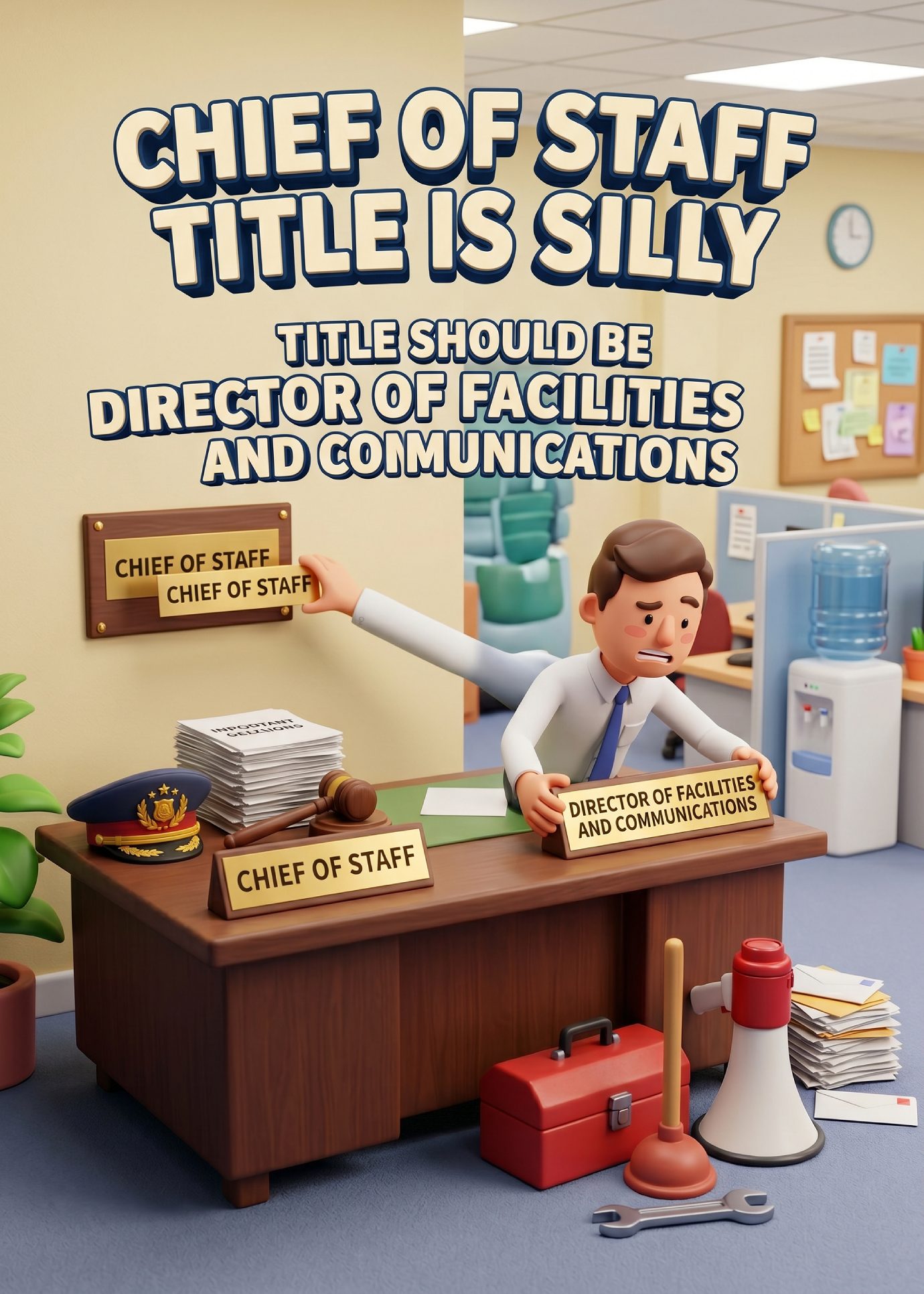
Gardner Magazine Editorial: Proposed Chief of Staff Title is Silly. Title should reflect role “Director of Facilities and Communications.”
Editorial – Proposed Chief of Staff Title is Silly
The Gardner City Council on Monday June 1st is poised to accept the new “Chief of Staff” title and position proposed by the Mayor to replace the Executive Aide position albeit at a higher salary. While we often report on what we think are awesome ideas, this one gets a complete thumbs down from Gardner Magazine. In a nutshell, the title is silly and a mistake. If the intent is to oversee Facilities and Communications, then by all means, give it that title: Director of Facilities and Communications. That way a “Chief of Staff” title does not undermine the authority of future Mayors, lead to any confusion, or allow future Mayors to simply be lazy in the role and allow a “Chief of Staff” to rule the roost.
Hands down “NO” to Chief of Staff. Change the title to match what the position actually is and the change will yield a much better result in the long run. The Mayor doesn’t need a “Chief of Staff”. The Mayor is the Chief of Staff and should function as such and keep his eye on the ball. And just because other cities and towns have a Chief of Staff doesn’t make it right. They after all are not the “Model City for America.” We hope the Gardner City Council catches the proposed error before it becomes reality.
- Kitchen at PD (5/30/2026)

Monty-Tech Programs Come Together to Construct Emergency Operations Kitchen
The Gardner Police Department has a new Emergency Operations Kitchen thanks to the efforts of students and their teachers at Monty Tech.
From Gardner PD on 5-29-26: “The Gardner Police Department would like to extend our sincere appreciation to the students and instructors of Montachusett Regional Vocational Technical High School for their outstanding assistance in the construction of our new Emergency Operations Kitchen.
Students and staff from the Cabinetmaking, House Carpentry, Plumbing, Electrical, and HVAC programs all played an important role in bringing this project to completion. Their hard work, professionalism, and dedication provided the City with an incredible opportunity to complete a long-awaited and much-needed project.
This accomplishment would not have been possible without their support and expertise. We are grateful for their contributions and proud to partner with an institution that helps prepare the next generation of skilled professionals.
Thank you to everyone involved for your commitment and outstanding work!” – Gardner PD
- Mayor’s Update 5-29-26 (5/29/2026)

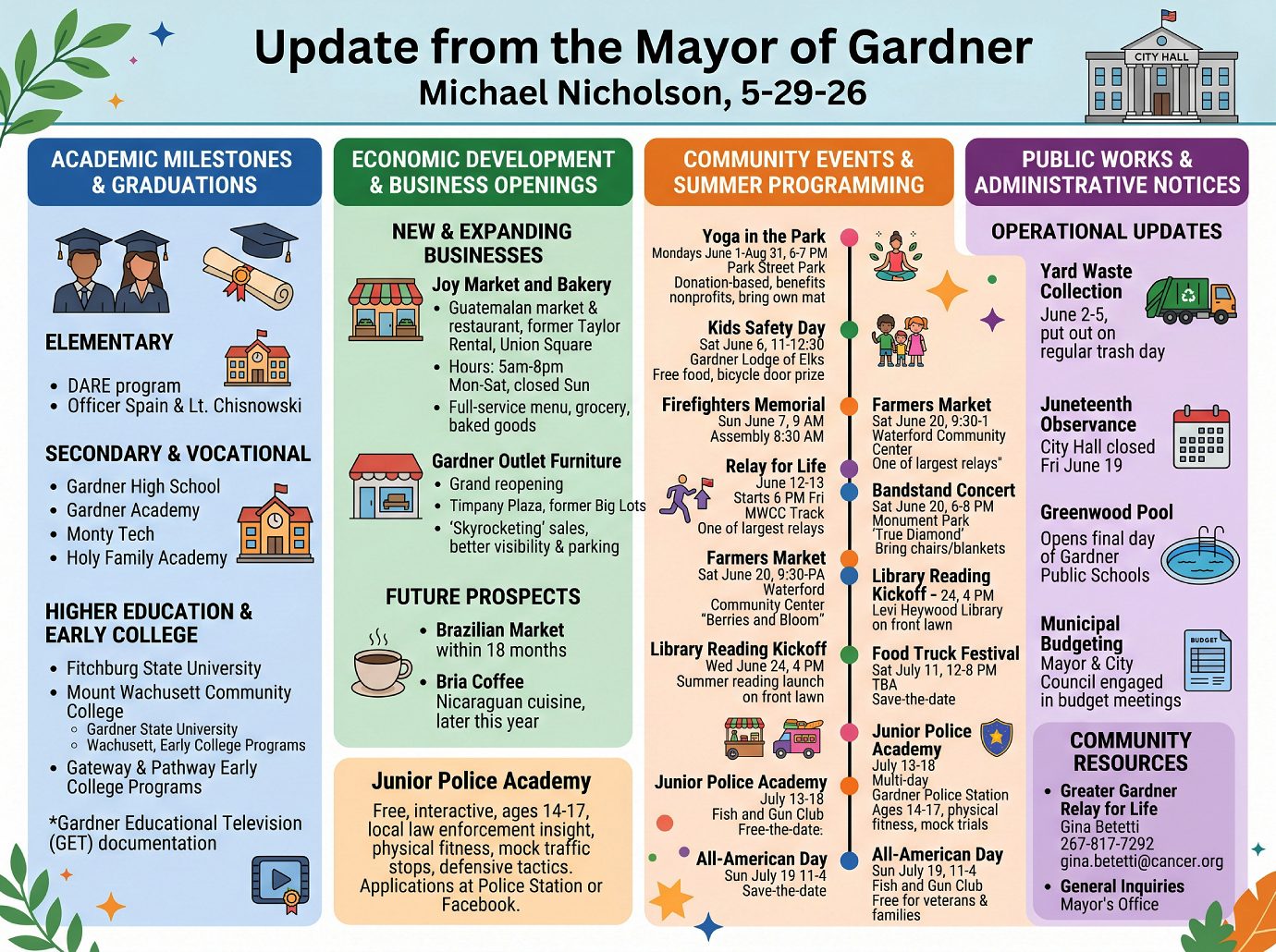
This end of May Update from Gardner Mayor Michael Nicholson covers various milestones, community growth, and a list of events which we are showing in a table below and also in the infographic. For more information at any time about the City of Gardner visit the official website at Gardner-MA.gov
Milestones – Community Growth – Community Events – Focus of an end of May Update with Gardner Mayor Michael Nicholson
Listen to the update on any device, CLICK PLAY.
Mayor’s Update 5-29-26 The May 29, 2026, update from Gardner Mayor Michael Nicholson highlights a period of significant transition and high community activity. The report focuses on three primary pillars: the conclusion of the academic year through numerous graduation ceremonies, a burgeoning local economy characterized by culinary diversification and retail expansion, and a robust schedule of summer community events.
Key takeaways include:
- Educational Milestones: A wide range of graduations, from elementary programs like DARE to higher education institutions, are being celebrated across the city.
- Economic Growth: The city is seeing a shift toward a more diverse business landscape with the opening of international markets and the expansion of local furniture retail.
- Community Engagement: A dense calendar of events—including the Relay for Life, farmers markets, and youth academies—aims to foster community connection and support local veterans and nonprofits.
- Administrative Notices: Essential service updates include yard waste collection schedules and City Hall closures for the Juneteenth holiday.
Academic Milestones and Graduations
The city is currently in a “jam-packed” season of celebrating student achievements across various levels of education. Mayor Nicholson expressed gratitude to faculty, administration, and Gardner Educational Television (GET) for documenting these events for those unable to attend in person.
Recognized Institutions and Programs
- Elementary: Fifth-grade students recently completed the DARE program, conducted by Officer Spain and Lieutenant Chisnowski of the community policing department.
- Secondary and Vocational: Gardner High School, Gardner Academy, Monty Tech, and Holy Family Academy.
- Higher Education and Early College: Fitchburg State University, Mount Wachusett Community College, and the Gateway and Pathway Early College Programs.
Economic Development and Business Openings
Gardner is experiencing a notable trend in diversifying its local cuisine and revitalizing vacant commercial spaces.
New and Expanding Businesses
- Joy Market and Bakery: Located at the former Taylor Rental site on Union Square (near Pearson Boulevard), this Guatemalan market and restaurant officially opened on Memorial Day.
- Hours: 5:00 a.m. to 8:00 p.m., Monday through Saturday (Closed Sundays).
- Services: Full-service menu for breakfast, lunch, and dinner, plus a small grocery market and baked goods.
- Gardner Outlet Furniture: Held a grand reopening at Timpany Plaza in the former Big Lots site. The move has reportedly resulted in “skyrocketing” sales due to improved visibility and parking.
- Future Prospects: The city is in conversations regarding a Brazilian market expected to open within the next 18 months, and Bria Coffee, which will feature Nicaraguan cuisine, is slated to open later this year.
Community Events and Summer Programming
The city has scheduled an extensive array of events to promote health, local agriculture, and veteran appreciation. Event Schedule and Details:
Event Date(s) Time Location Notes Yoga in the Park Mondays (June 1–Aug 31) 6:00 PM – 7:00 PM Park Street Park Donation-based; benefits local nonprofits. Bring own mat. Kids Safety Day Saturday, June 6 11:00 AM – 12:30 PM Gardner Lodge of Elks Free food and bicycle door prize. Firefighters Memorial Sunday, June 7 9:00 AM N/A Assembly for current/retired firefighters at 8:30 AM. Relay for Life June 12 – June 13 Starts 6:00 PM (Fri) MWCC Track One of the largest relays in the country. Farmers Market Saturday, June 20 9:30 AM – 1:00 PM Waterford Community Center Theme: “Berries and Bloom.” Bandstand Concert Saturday, June 20 6:00 PM – 8:00 PM Monument Park Featuring “True Diamond.” Bring chairs/blankets. Library Reading Kickoff Wednesday, June 24 4:00 PM Levi Heywood Memorial Library Summer reading program launch on front lawn. Food Truck Festival Saturday, July 11 12:00 PM – 8:00 PM To be announced Preliminary save-the-date. Junior Police Academy July 13 – July 18 Multi-day Gardner Police Station For ages 14–17; includes physical fitness and mock trials. All-American Day Sunday, July 19 11:00 AM – 4:00 PM Fish and Gun Club Free event for veterans and their families. Youth Opportunities: Junior Police Academy
This free, interactive program for teenagers (ages 14–17) provides insight into local law enforcement. Curriculum highlights include:
- Physical fitness training.
- Mock traffic stops and investigative techniques.
- Defensive tactics. Applications are available at the Gardner Police Station or via the department’s Facebook page. Space is limited.
Public Works and Administrative Notices
- Yard Waste Collection: Pickup is scheduled for June 2 through June 5. Residents should put out yard waste on their regular trash day.
- Juneteenth Observance: City Hall will be closed on Friday, June 19, in observance of the federal holiday.
- Greenwood Pool: The facility is scheduled to open on the final day of the Gardner Public Schools academic year.
- Municipal Budgeting: The Mayor and City Council are currently engaged in budget meetings to finalize the city’s financial planning.
Greater Gardner Relay for Life Contact Information
For information regarding the Greater Gardner Relay for Life, residents may contact regional organizer Gina Betetti at 267-817-7292 or via email at gina.betetti@cancer.org. General inquiries regarding city updates can be directed to the Mayor’s Office.
- Greenwood Pavilion Electric Bids (5/28/2026)

Electric Bids Opened for Greenwood Pavilion Project – Vary Widely
On May 28, 2026, the City of Gardner held the formal bid opening for the electrical work on the Greenwood Pavilion construction project. Listen to the meeting on any device, CLICK PLAY.
Greenwood Bids 5-28-26
The meeting specifically focused on reviewing electrical subcontracting proposals submitted by two different firms. Dagel Electric presented a significantly lower offer of $77,777, while Hub Electric Incorporated submitted a much higher bid of $196,000. Both companies formally acknowledged the project’s addendum, though one Hub Electric included a specific restriction against working with a particular general contractor.
- Heywood Chief Medical Officer (5/28/2026)

Heywood Healthcare Announces Appointment of Chief Medical Officer
Heywood Healthcare has appointed Dr. Kavita Babu to the position of Chief Medical Officer and Vice President of Medical Affairs. According to the COMPLETE PRESS RELEASE, CLICK HERE, Dr. Babu brings more than 20 years of clinical and leadership experience and is known for her collaborative leadership style Dr. Babu remains an active practicing emergency physician and is widely recognized for her expertise in addiction medicine, medical toxicology, clinical informatics, and healthcare operations.
Heywood President and CEO Roxanna Penney stated: “We are excited to welcome her to Heywood Healthcare and look forward to the impact she will have on our organization and the communities we serve.”
Heywood also thanked Dr. Frank Sweeney for serving in the Chief Medical Officer role over the past year.
- First Responder of the Year (5/28/2026)

Templeton Police Officer Selected First Responder of the Year
Templeton Police Officer Caleb Matson was recently selected as the First Responder of the Year. View official Newsletter for Central Mass EMS on pdf, CLICK HERE.
PRESS RELEASE: “Templeton Police would like to formally recognize Officer Caleb Matson, who was recently selected as the First Responder of the Year by the Central Mass EMS Corporation.
Officer Matson was recognized for his extraordinary medical care provided to a seriously injured party involved in a late-night motor vehicle accident. Through his quick recognition of critical injuries, calm actions under pressure, and immediate life-saving treatment, Officer Matson made a tremendous difference during a critical moment.
It is our belief that without Officer Matson’s rapid assessment and decisive care, a life may have been lost.We are extremely proud of Officer Matson and congratulate him on this well-deserved recognition. His actions reflect the highest standards of professionalism, dedication, and service to our community.”
- Boudreau not on ballot (5/28/2026)
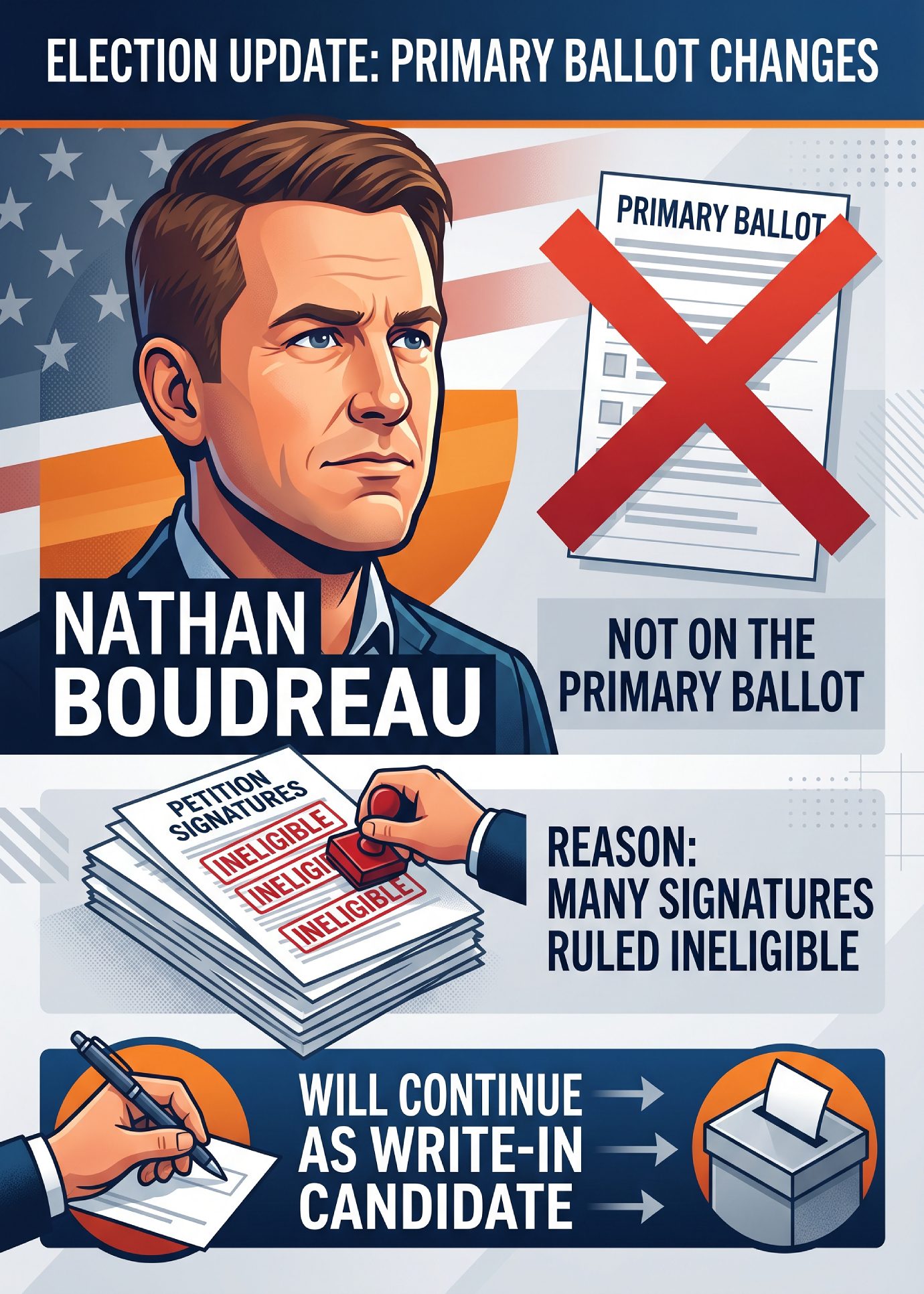
Nathan Boudreau will not be on the ballot – Not Enough Eligible Signatures
Nathan Boudreau’s campaign for State Representative for the 2nd Worcester District has come across a major setback which was explained to Gardner Magazine in a statement from the candidate: “I’m continuing my campaign for State Representative as a write-in candidate in September’s Republican primary. When the incumbent announced he would not seek re-election, the window to act became extremely short, and enough of mine were ruled ineligible to keep my name off the printed Republican primary ballot. But the issues facing voters in Gardner, Ashburnham, Templeton, and Winchendon are too important to walk away from. Voters deserve a real choice for State Representative this fall, and I intend to continue earning their support.”
This week Gardner Mayor Nicholson announced that he is officially on the ballot. The Mayor obtained over 500 eligible signatures.
- Public Welfare 5-28-26 (5/28/2026)
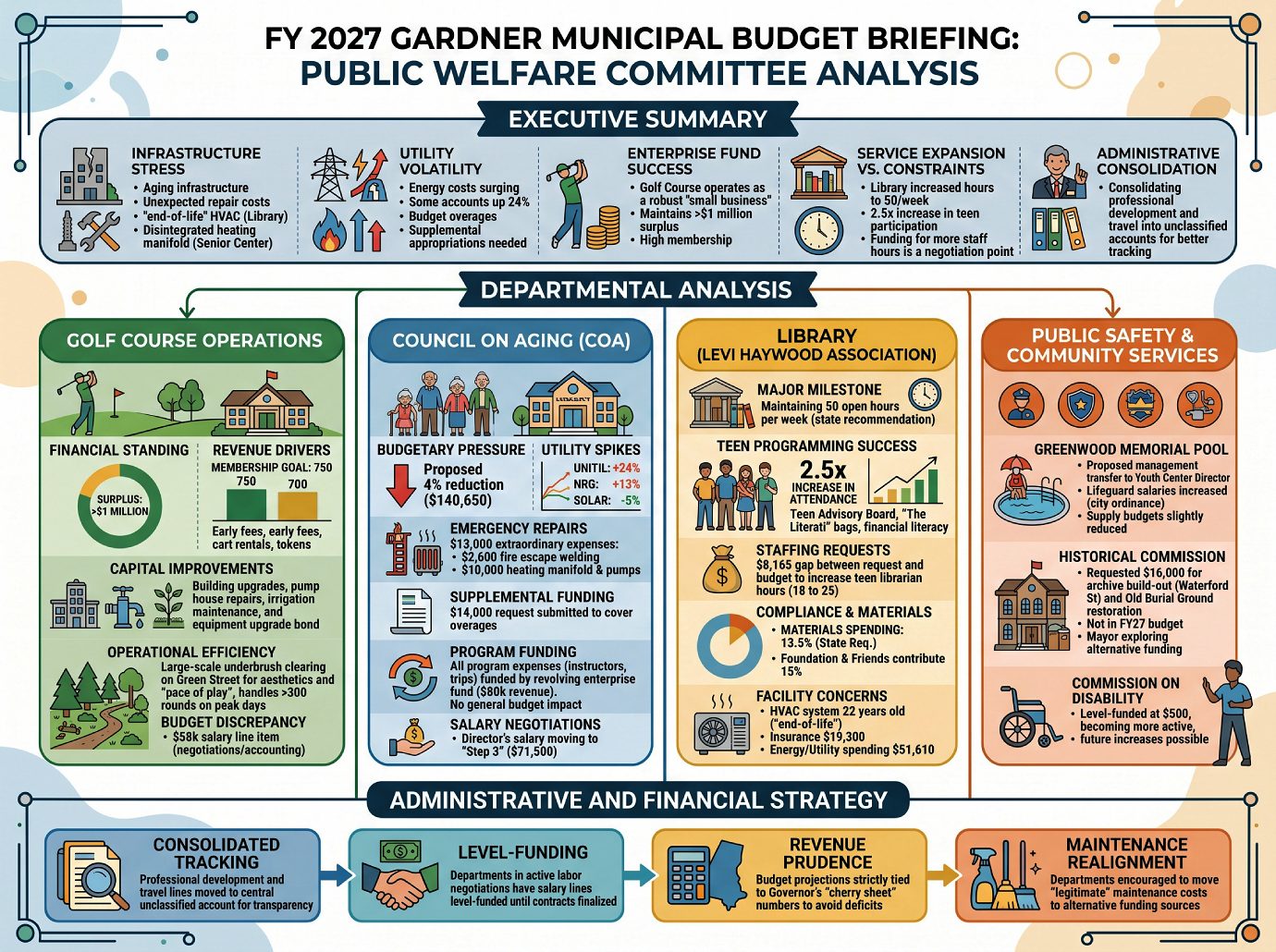
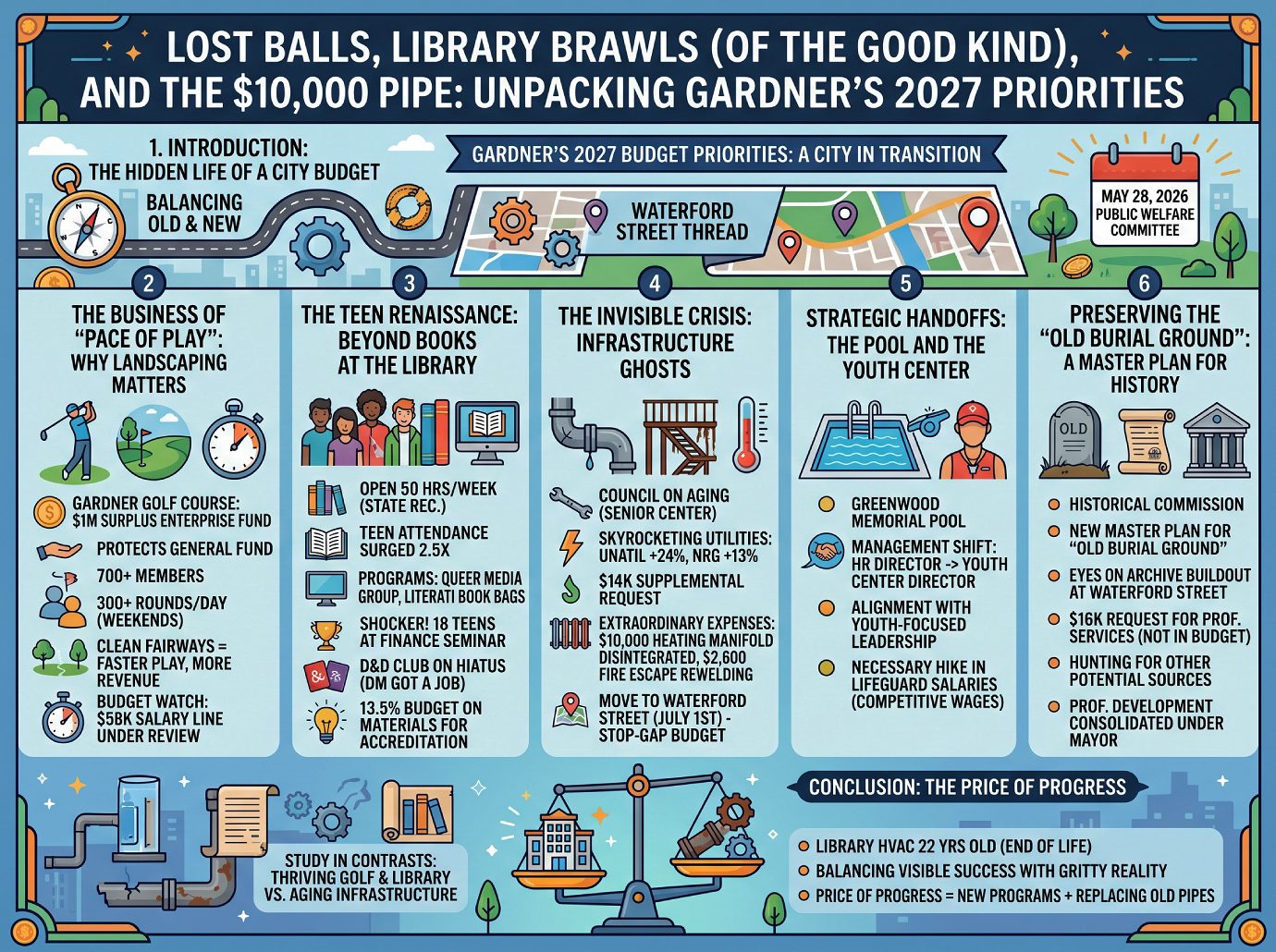
For additional details and impacts, view the additional infographics below on the Public Welfare Committee meeting of May 28, 2026
Just CLICK on the IMAGE for a larger view.
Golf Course, Senior Center, Library, Greenwood Pool Focus of Public Welfare Committee
The Gardner Public Welfare Committee met on May 28, 2026. Listen to the meeting on any device, CLICK PLAY.
Public Welfare 5-28-26 The central theme this year: balance rising operational costs, specifically in utilities and maintenance against conservative revenue projections.
Multiple departments including the Council on Aging and the Library are grappling with aging infrastructure and unexpected repair costs such as the Library’s “end of life” HVAC system and the Senior Center’s disintegrated heating manifold. Energy costs have surged with some departments reporting a 24% increase in specific utility accounts. The Gardner Municipal Golf Course continues to operate as a robust “small business” within Gardner, maintaining a surplus of over $1 million and high membership numbers. While the Library has successfully increased its hours to the state recommended 50 hours per week and seen a 2.5 times increase in teen participation, funding for additional staff hours remains a point of negotiation. A proposal is pending to transfer oversight of the Greenwood Memorial Pool from the HR Director to the Youth Center Director.
- Economic Development 5-27-26 (5/27/2026)
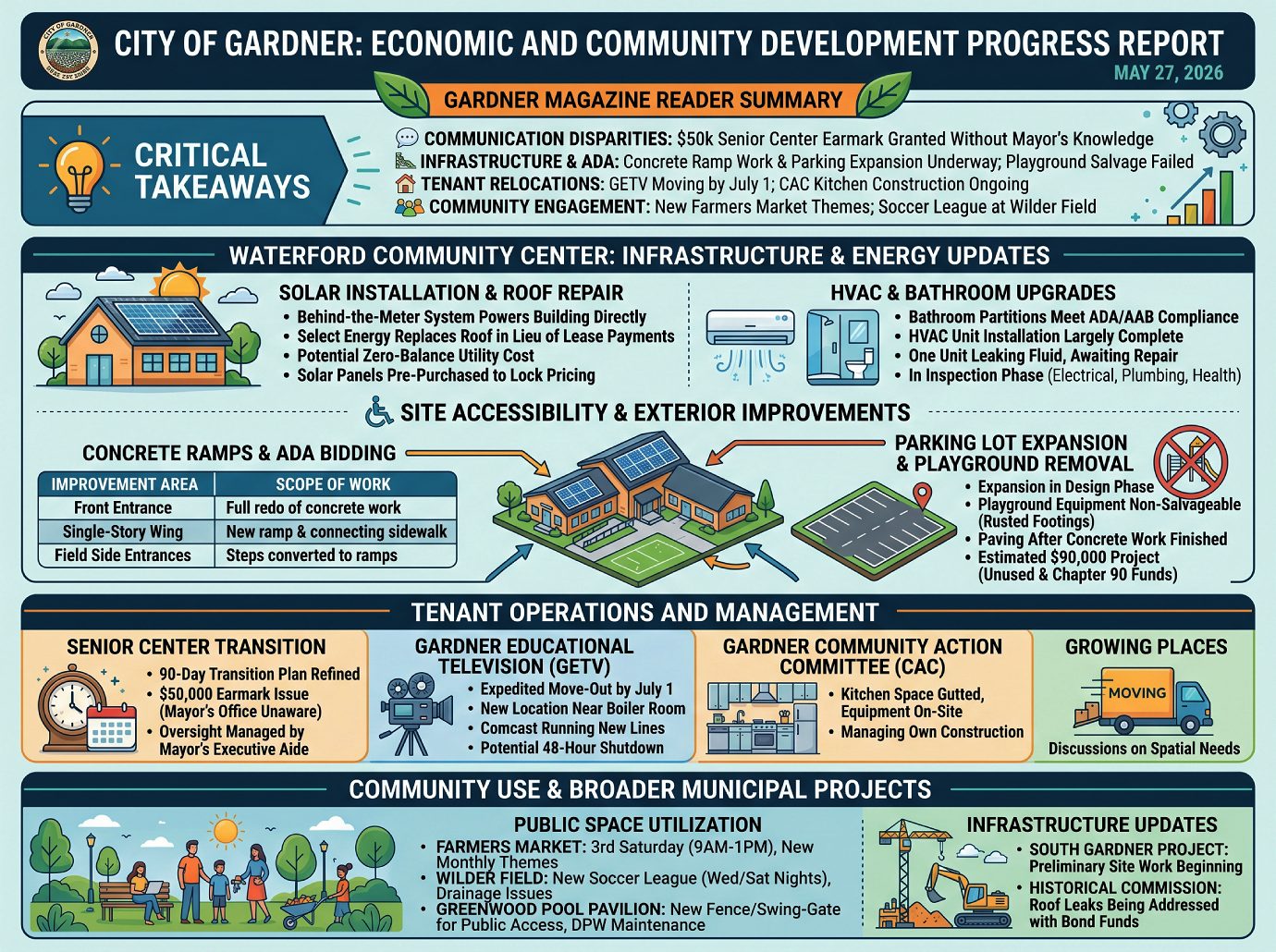
To view the infographics on the Economic Development Meeting of 5-27-26 in larger view, just click on the image.
Economic and Community Development Committee Discusses Municipal Updates in Gardner MA
Listen to the meeting on any device, CLICK PLAY.
Economic Development 5-27-26
A significant portion of the meeting focused on the Waterford Community Center, specifically regarding a solar panel installation and roof replacement project aimed at eliminating the building’s electric bill. Gardner Mayor Michael Nicholson provided status reports on ADA-compliant bathroom upgrades, HVAC repairs, and the relocation of Gardner Educational Television to the facility. Additionally, the committee addressed the seasonal farmers market, the expansion of parking facilities, and the development of a 90-day transition plan for the local Senior Center. Local leaders also expressed surprise regarding a $50,000 state budget earmark for the senior center that was allegedly requested without the Mayor’s prior knowledge. The session concluded with updates on infrastructure improvements in South Gardner and maintenance plans for the Greenwood Pool Pavilion.
- Finance 5-26-26 (5/27/2026)
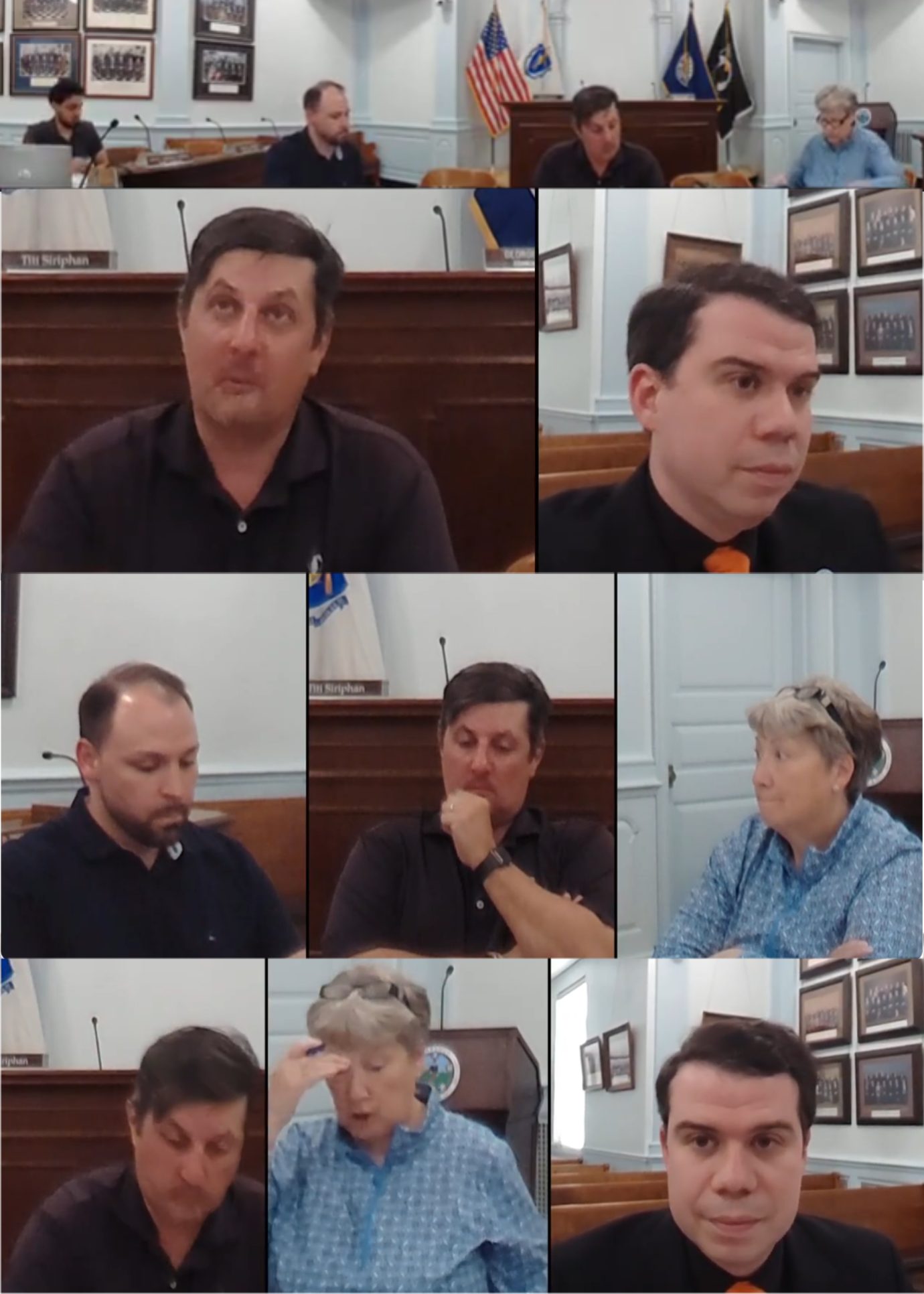
Finance Committee May 26, 2026 Reviews Budget and Addresses Other Issues
Listen to the meeting on any device, CLICK PLAY.
Finance Committee 5-26-26
The Garder City Council Finance Committee meeting primarily focused on reviewing the FY2027 proposed budget* Key discussions involved Mayor Nicholson’s proposal to consolidate professional development and travel funds into a single account to ensure equitable distribution across departments. The committee also debated the creation of a Chief of Staff position, with members expressing conflicting views on whether the role’s facilities management duties and salary are justified. To address these concerns, the committee moved to reduce the proposed starting salary for the position to $70,000 and delay its implementation until August. Additionally, the meeting touched on health insurance rate increases, the repayment of funds related to a salt shed project, and the status of the youth center director’s role. Ultimately, the committee aimed to ensure budgetary neutrality while refining job descriptions and departmental allocations before making final recommendations to the full council.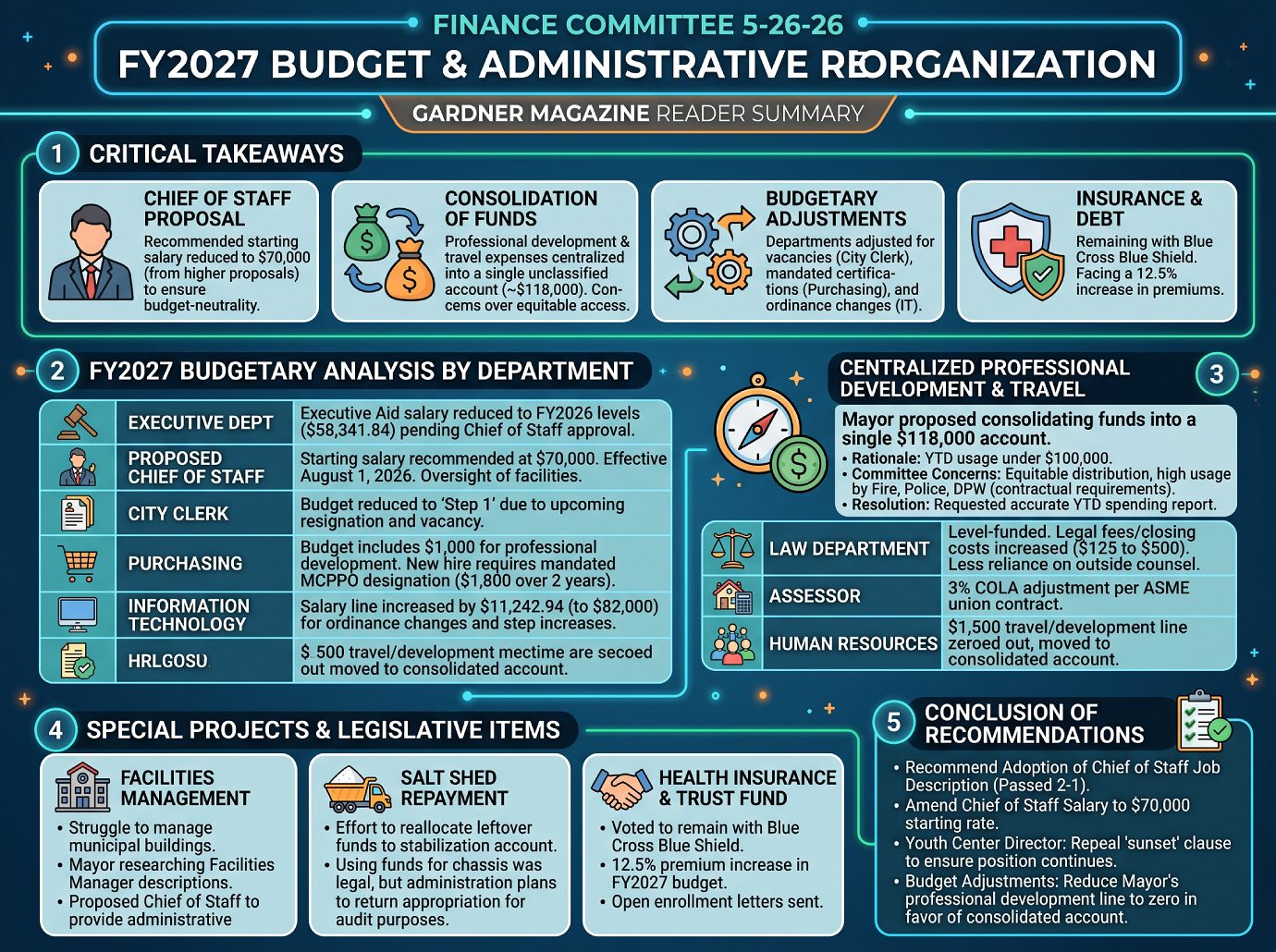
- Roadway Striping – Markers (5/27/2026)
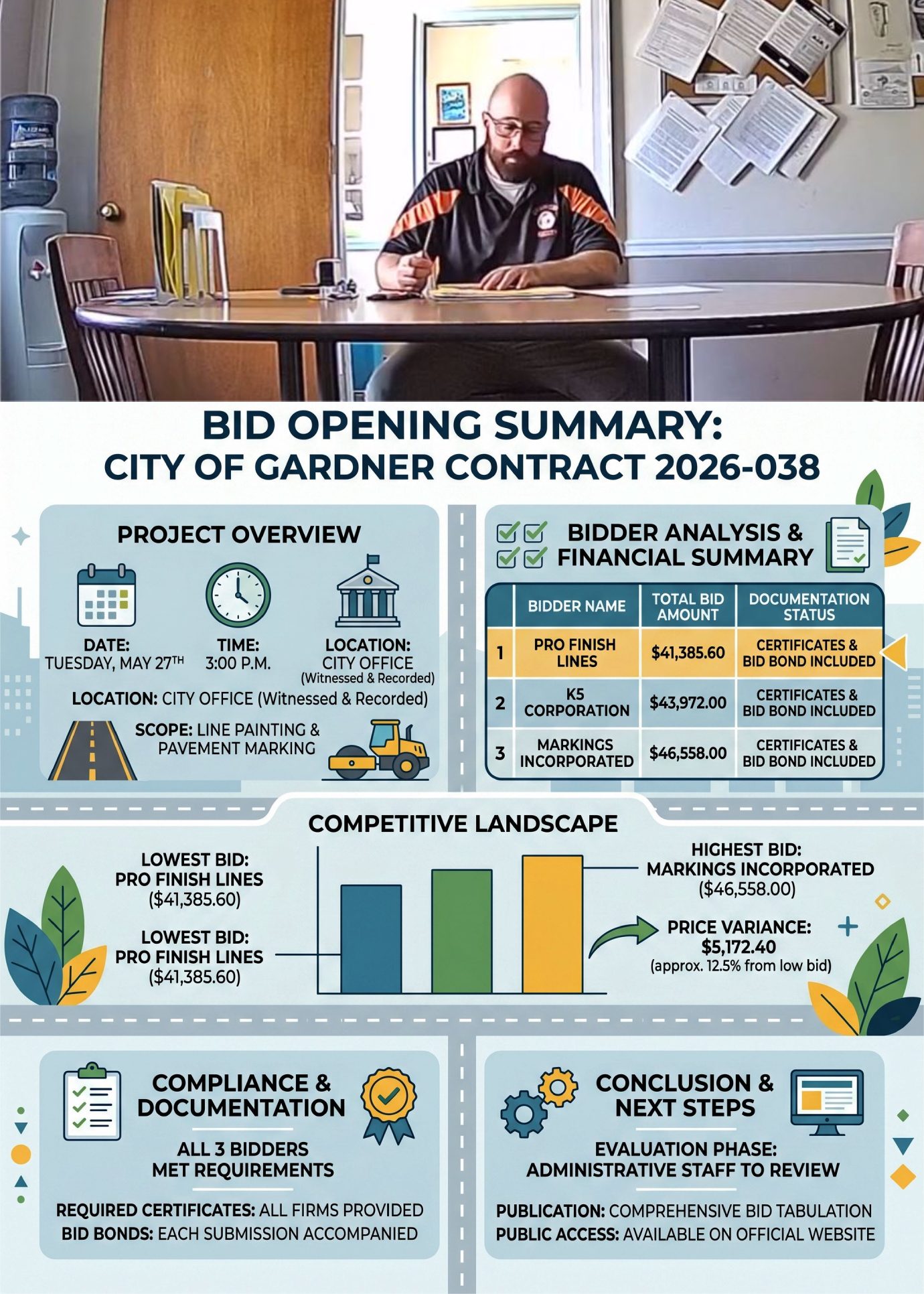
Exciting Public Bid Opening for Roadway Striping and Pavement Markers.
The public bid opening lasted only 2 minutes with Gardner Purchasing Agent Joshua Cormier.. Listen on any device.
Bid Opening 5-27-26
The Public Bidding Session was held on May 27th by the City of Gardner, , regarding roadway striping and pavement markers. Three separate companies submitted formal proposals for the contract. The participants included Pro Finish Lines, Markings Incorporated, and K5 Corporation, with their respective bids ranging from roughly $41,000 to $46,000. All candidates provided the necessary legal documentation and financial bonds required for consideration by the local government. The session concluded with the assurance that a comparison of these figures would be published on the official city website for public review.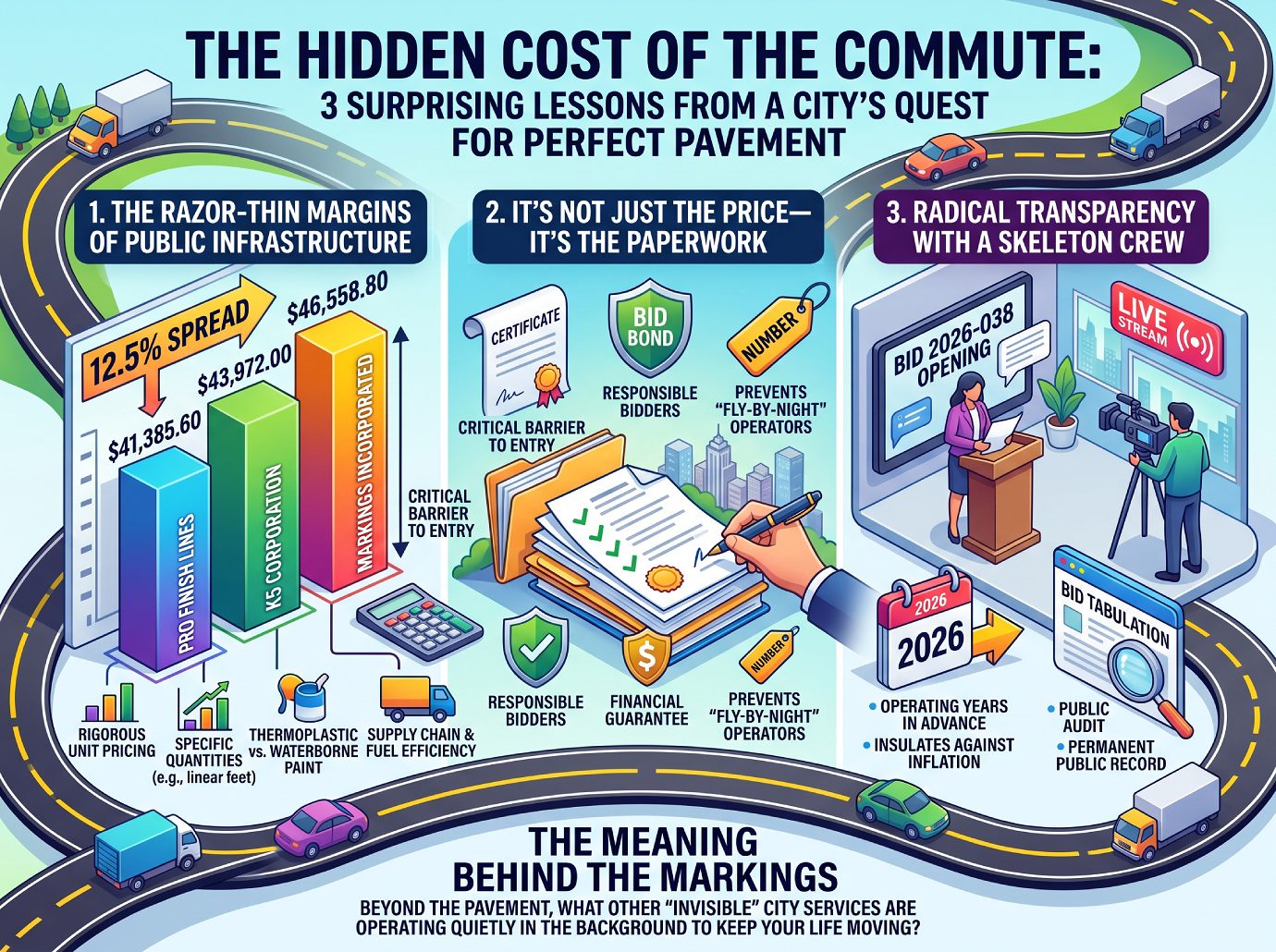
- Nicholson for State Rep 5-27-26 (5/27/2026)
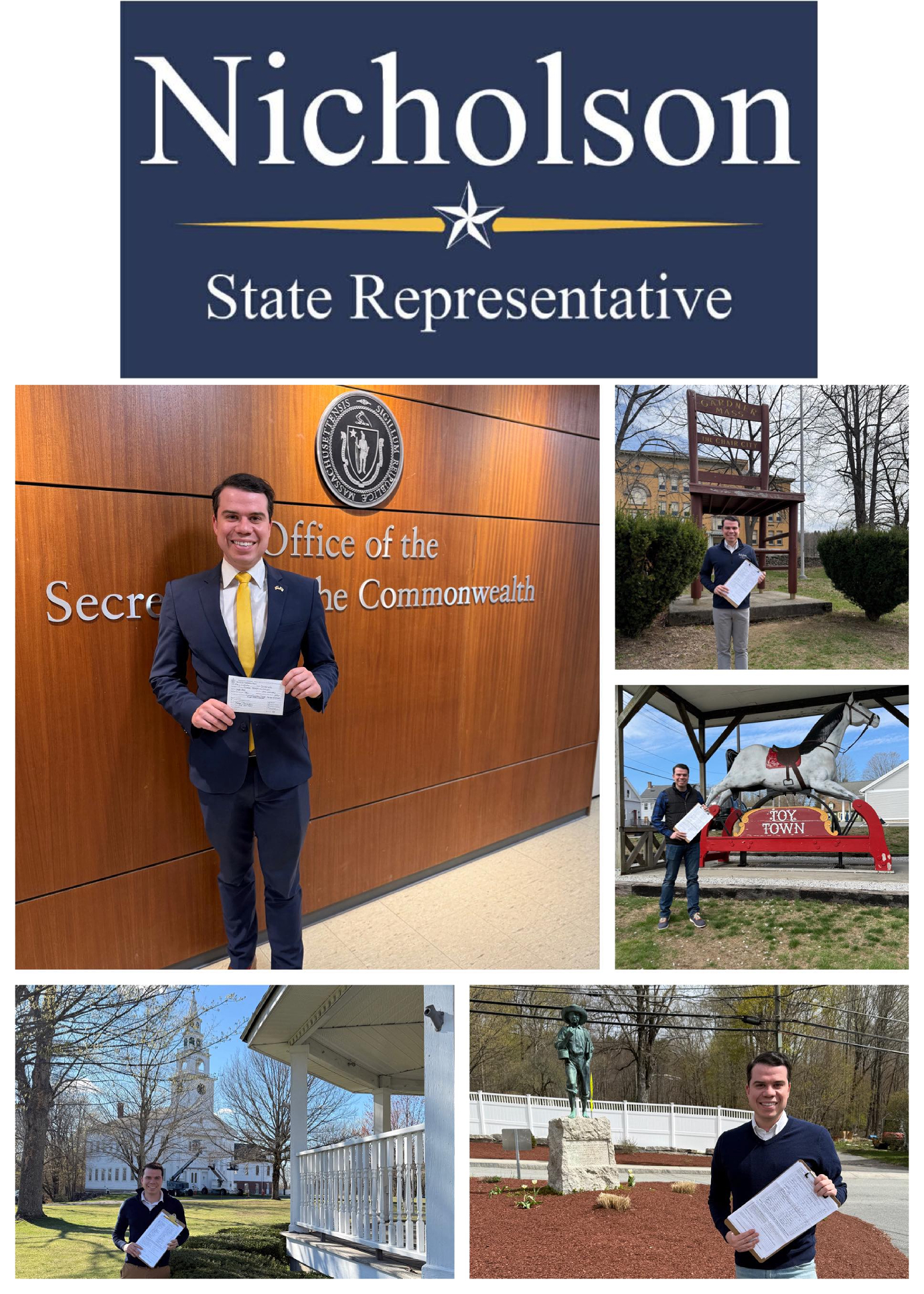
PHOTOS from Gardner Mayor Michael Nicholson Nicholson Announces he is Officially on the Ballot in State Representative Race
Gardner Mayor Michael Nicholson thanked supporters on May 27, 2026 stating: “Thank you to everyone who signed my nomination papers for my run to be our next State Representative! We collected well over the required amount and I am officially on the ballot!
It was so great to meet so many individuals across Gardner, Ashburnham, Templeton, and Winchendon and I look forward to seeing more of you over the course of the next few months. Especially those of you who requested to sign but due to time constraints I wasn’t able to get to!”The Mayor is running for State Representative in the 2nd Worcester District which is comprised of Gardner, Ashburnham, Templeton, and Precincts 2 and 3 of Winchendon.
Nicholson posted this collage of photos which has has views of each town in the 2nd Worcester District and links for those who wish to get involved in his campaign: Donations —- Lawn Sign Requests — Campaign Volunteer Form — Email Sign Up.
Michael Nicholson also stated: “Thank you also to those who volunteered to help collect signatures from your family and friends. I’ve truly been blown away and humbled by the amount of support I’ve received since announcing. I’m asking for you vote this year to move the 2nd Worcester District forward and make our region stronger.”
- Help Wanted 5-26-26 (5/26/2026)

Here’s a 60 second RADIO Help Wanted Ad. Listen on any device, CLICK PLAY.
HELP WANTED – Public Safety Dispatchers Gardner MA City of Gardner Announces Openings for Public Safety Dispatchers
The City of Gardner is looking for Public Safety Dispatchers and we have an original song called: “Be a Dispatcher” Listen on any device, CLICK PLAY.
POP – CLASSIC ROCK – Be a Dispatcher From the City of Gardner: “Public Safety Dispatchers
The City of Gardner is taking applications for full time Public Safety Dispatchers. This position is responsible for receiving all incoming emergency 911 calls, information, administrative and non-emergency requests for service for the City of Gardner Public Safety Department. Also receives all emergency 911 calls for service for Police, Fire Department and EMS – Private Ambulance Service. The public safety dispatcher is expected to perform technical and clerical work involved in the operations of a twenty-four (24) hour, seven (7) day a week emergency communications dispatch center that has rotating shifts.
Duties and Responsibilities: Responsible for receiving and processing both non-emergency and emergency 911 calls from public requesting police, fire, EMS or other emergency services.
Determine the nature and location of emergency; Determine priorities and dispatch police, fire EMS or other emergency units as necessary and in accordance with established policy and procedures.
Maintain contact, status and location of police, fire and EMS units. Monitor direct emergency alarms. Enter, update and retrieve information form a variety of computer systems. Receive and process multiple requests for information simultaneously. Requests will be processed accurately and in a timely fashion. Monitor complex public safety radio frequencies simultaneously.
Operate a variety of communications equipment, including radio consoles, telephones, computer systems, closed circuit camera systems and alarm monitoring equipment. Perform technical and clerical work involved in the operation of a 24 hour/7 day/week emergency communications dispatch center with rotating shifts. Performs cell watches for individuals in custody per Police Department regulations.
Qualifications: • Preferred certifications in EMD, CPR, NextGen 911, APCO PST 1, CJIS. If not current, ability to obtain mandatory certifications within two (2) months of hire. • Strong communication skills, both written and verbal, including the ability to speak English in a clear and concise manner. • Basic computer keyboard familiarity (30 wpm). • Ability to multi-task. • Must be capable of working in high stress environment and good customer service skills when working with the general public as well as co-workers in a positive manner. • Shift work including overnights, holidays, weekends. • Overtime required
Miscellaneous Information: If you are interested and qualified, please submit a letter of interest and resume to Amanda Morse, Human Resources Director, City of Gardner, 95 Pleasant Street, Gardner, MA 01440 or via e-mail to amorse@gardner-ma.gov.”
- Memorial Day Ceremony 2026 (5/25/2026)
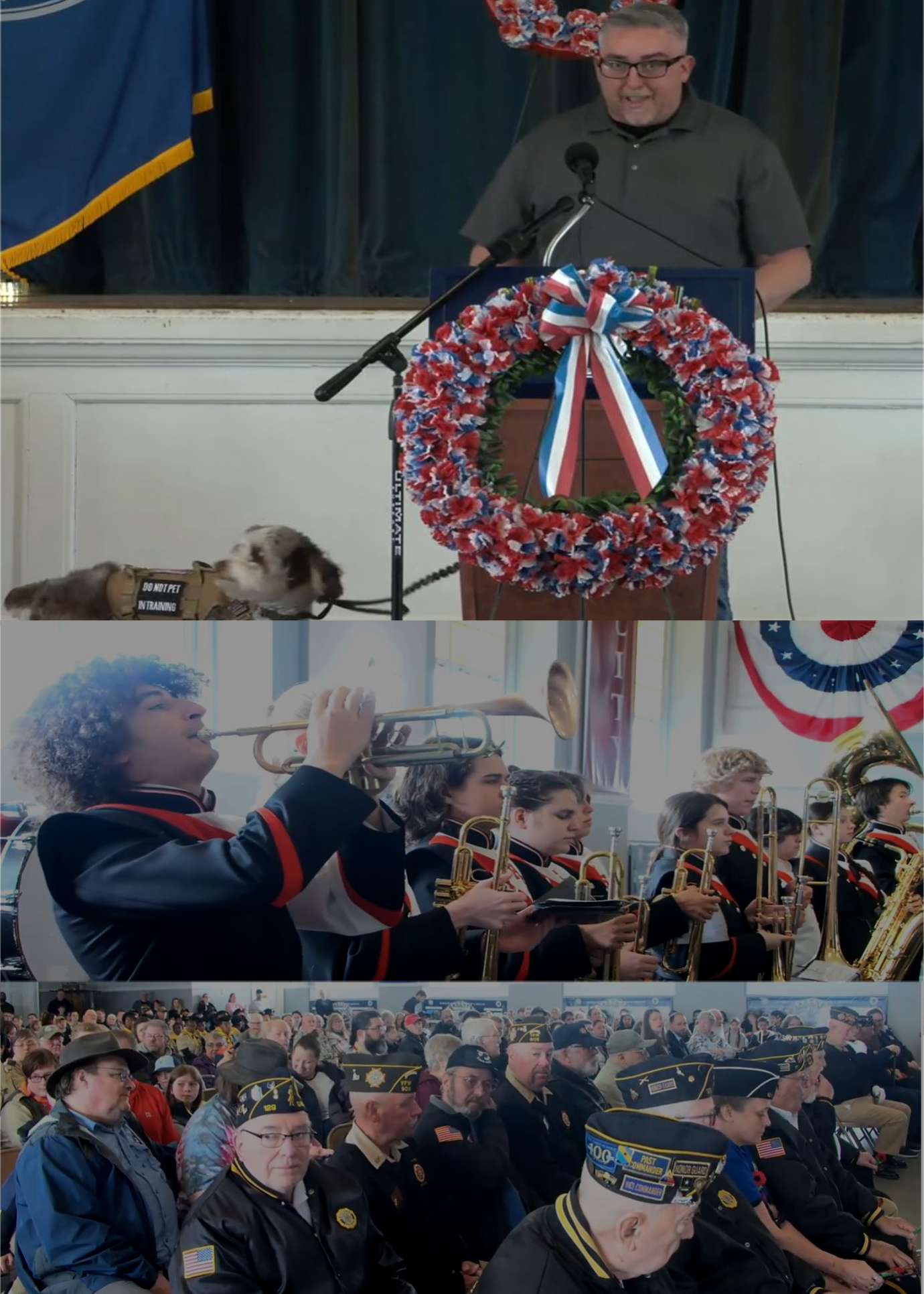
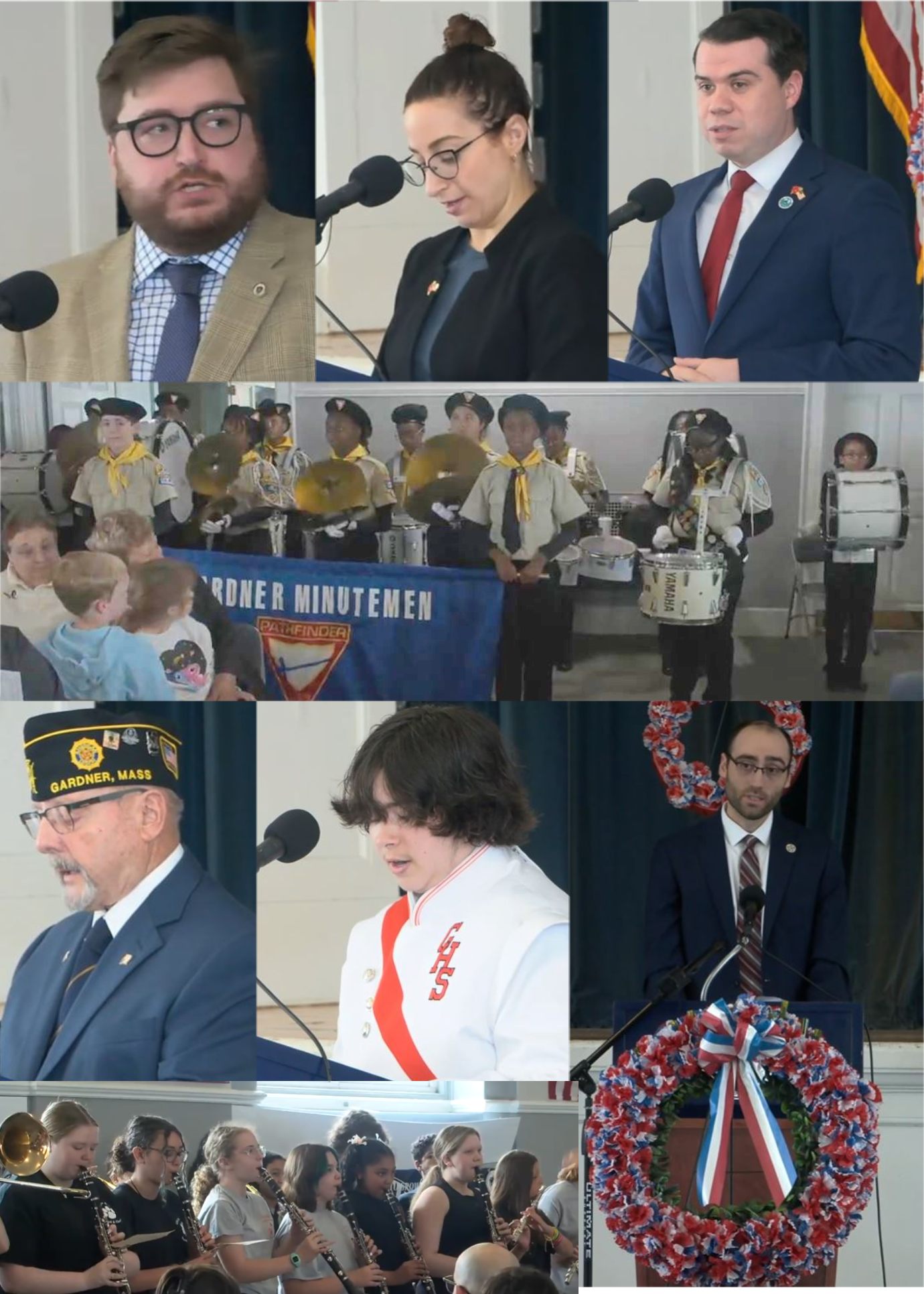
Memorial Day 2026 was observed in Perry Auditorium at Gardner City Hall on Monday, May 25, 2026. Speakers highlighted the city’s historical connection to Colonel Thomas Gardner, a Revolutionary War hero, and reflected on the deep cost of maintaining American liberty. The event featured a variety of ceremonial traditions, including the Gettysburg Address, a symbolic thirteen-fold flag demonstration, and musical performances.
Gardner Memorial Day Ceremony Held Indoors at Perry Auditorium at Gardner City Hall
The 2026 Gardner Memorial Day Ceremony served as a profound commemoration of military sacrifice, bridging the historical legacy of the American Revolution with the modern challenges faced by veterans.
Held in the city auditorium, the event emphasized that Gardner’s identity is inextricably linked to military service, beginning with its namesake, Colonel Thomas Gardner, who fell at the Battle of Bunker Hill.
Listen to the ceremony on any device, CLICK PLAY.
Gardner Memorial Day Ceremony May 25, 2026 The ceremony highlighted three critical themes:
- The Local Cost of Global Freedom: Gardner has lost 173 residents in service since its founding, with lessons learned on local streets being applied to global battlefields.
- The Evolution of Sacrifice: Recognition was given not only to those who died in combat but also to those who returned with “unseen wounds” and those lost to the ongoing crisis of veteran suicide (currently averaging 17 deaths per day).
- Active Remembrance: Speakers argued that true remembrance requires more than words; it necessitates a “sacred pledge” to care for living veterans and ensure their struggles are not faced in silence.
The “Unseen” Cost
Keynote speaker Garrett Foley, a Marine Corps veteran of Operation Iraqi Freedom, expanded the definition of Memorial Day sacrifice to include the psychological toll of war.
- Unseen Wounds: Many veterans return having left “pieces of themselves” behind, carrying memories and wounds that are not visible to the public.
- Veteran Suicide Statistics: Foley noted that while numbers have slightly improved, the nation still loses approximately 17 veterans a day to suicide. He characterized these individuals as “warriors” whose battlefield was “within their own mind.”
- Generational Losses: Foley cited that in his generation alone, over 4,400 service members have been killed in action, adding to the 58,000 lost in Vietnam and hundreds of thousands in prior conflicts.
Key Quotes
“If we have more victories like this it will ruin the British army.” — British Parliament member (quoted by Rep. John Zlotnik) regarding the 40% casualty rate at Bunker Hill.
“Freedom is not an idea that exists on its own; it is something that was bought, paid for, and protected.” — Garrett Foley, Marine Corps Veteran.
“Remembrance means telling the whole truth, not just the parts that are easy to honor, but the parts that are hard to understand.” — Garrett Foley, on the reality of veteran suicide and unseen wounds.
“From Green Street to Gettysburg, Nichols Street to Normandy, Baker Street to Baghdad, the lessons that they were taught here they brought with them over there.” — Mayor Michael Nicholson.
- Weekly Briefing 5-24-26 (5/24/2026)
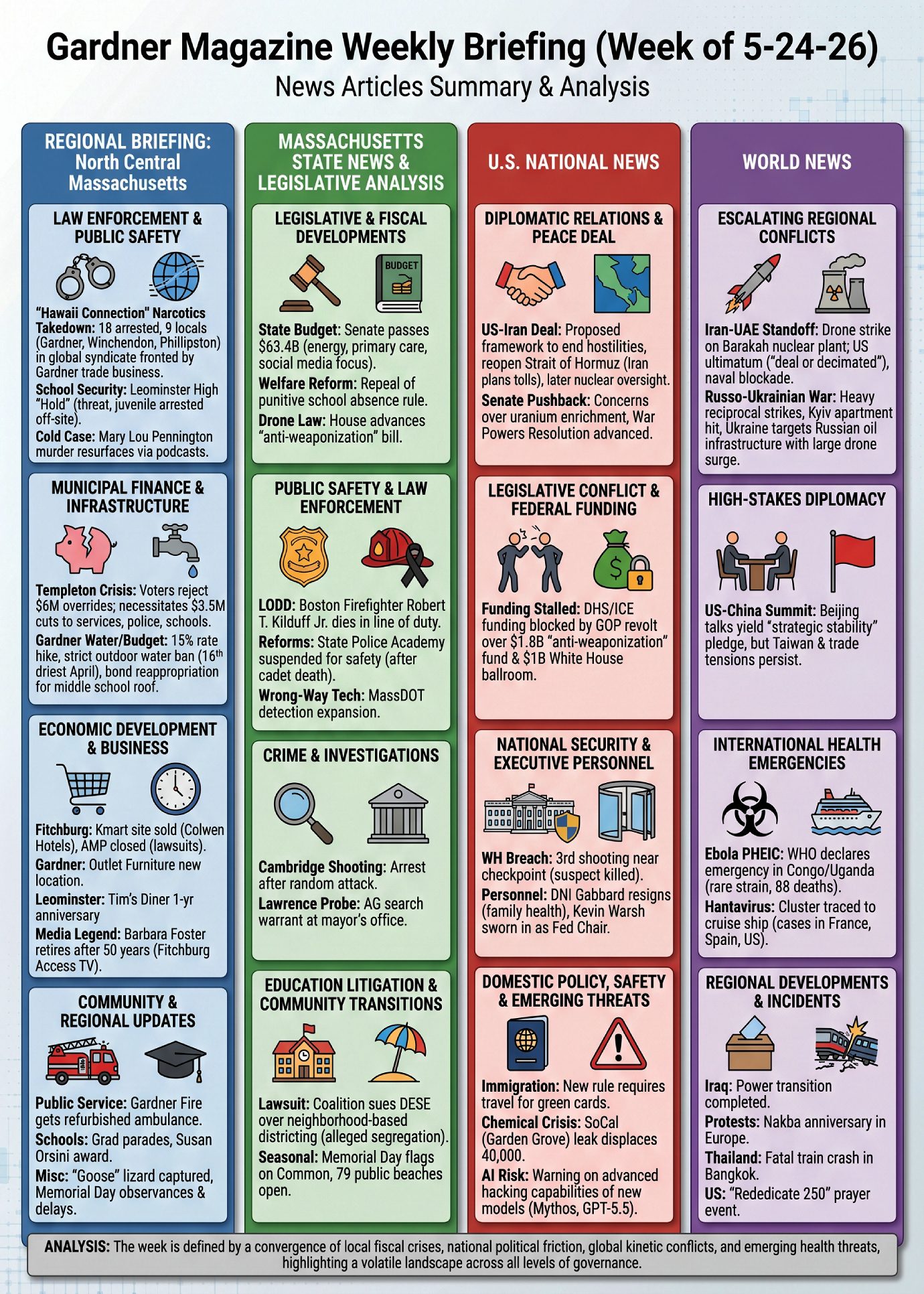
News Sections 5-24-26: North Central MA — State News —- National News — World News
A Weekly Briefing from Gardner Magazine – May 24, 2026
The Chair Man and the Chair Lady discuss the news of the week including Greater Gardner MA, North Central MA, the State of Massachusetts, National News, and World News. They tie it all together in a great podcast. Listen on any device, CLICK PLAY.
DEEP DIVE – Weekly Briefing 5-24-26 This week we have a special feature: A “Debate” with Max and Maxine Rogers discussing the impact of the week’s news stories. Listen on any device, CLICK PLAY.
DEBATE – Impacts 5-24-26 Gardner Magazine has 4 separate additional sections covering North Central MA News, a Massachusetts News Roundup, U.S. National News, and World News, all updated on May 24, 2026, this week with some additional infographics
JUMP TO SECTION: North Central MA News — State News of the Week —- National News of the Week — World News of the Week
- Templeton – Declaration Reading 2026 (5/23/2026)

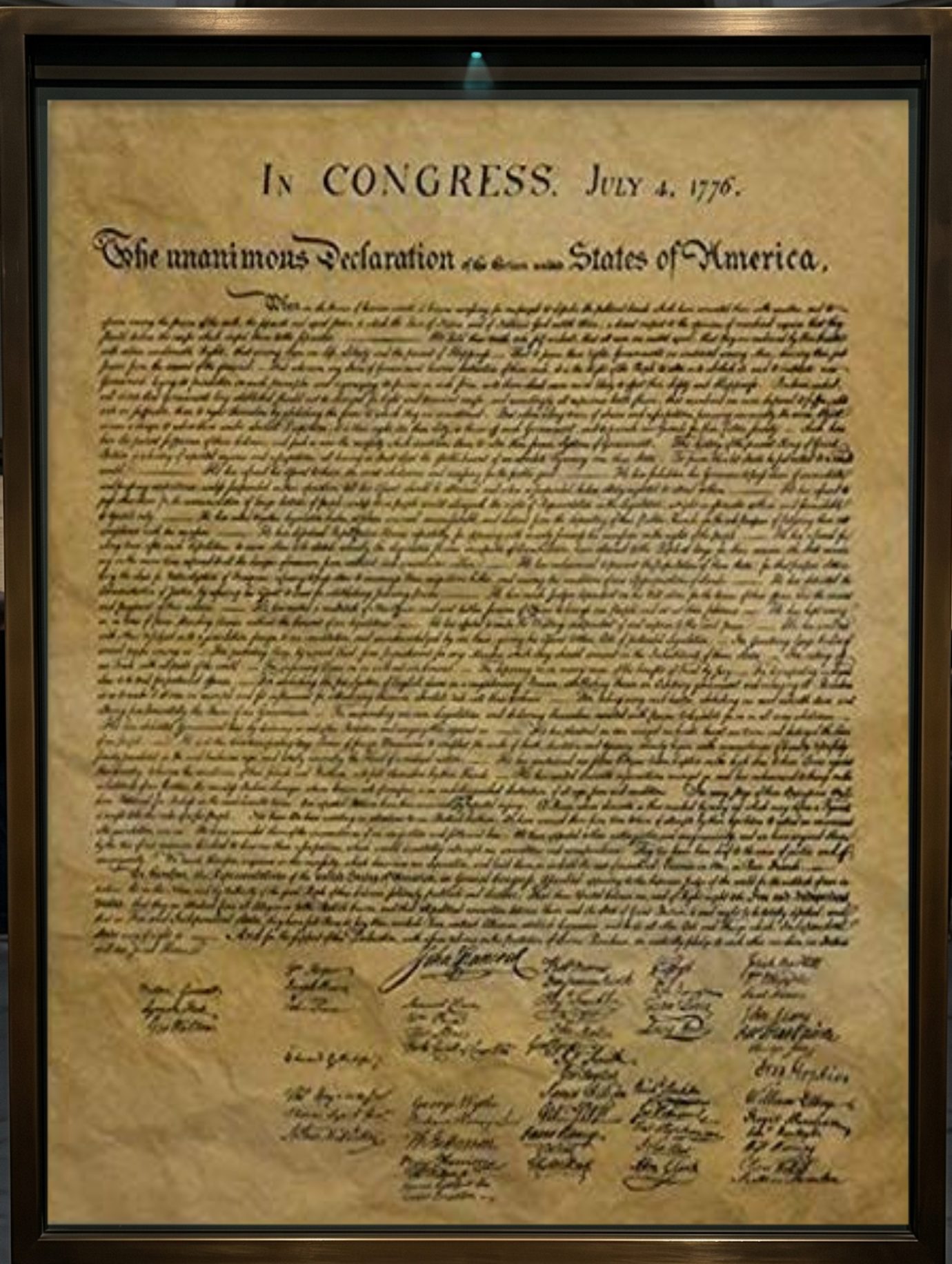
Reading of the Declaration of Independence – July 4, 2026 from noon to 4pm on the Templeton MA Town Common
Thirteen Voices, One Common: Templeton’s Old-Fashioned Path to 2026
The squeak of a bicycle wheel, the rhythmic tap of a walker on the pavement, and the clear resonance of a neighbor’s voice carrying across the grass—these are the sounds of democracy in its most intimate form. As the United States prepares for its “Semiquincentennial,” the landmark 250th anniversary of the signing of the Declaration of Independence, it is easy to get lost in the grand scale of national monuments and massive fireworks displays. Yet, the true pulse of American heritage isn’t found in marble statues; it beats within the heart of small-town centers like Templeton, where the weight of history is grounded in the familiar soil of the town common where a reading will take place this Independence Day. Listen to the Chair Man and the Chair Lady discuss it. CLICK PLAY.
SHORT DEEP DIVE – Reading of the Declaration The Power of Thirteen
On Saturday, July 4, 2026, the centerpiece of this historic milestone will be a rhythmic, shared recitation of the Declaration of Independence. In a deliberate nod to the nation’s origins, thirteen townspeople and local officials will take turns reading portions of the document. This choice is profoundly symbolic, with each reader standing as a living surrogate for one of the thirteen original colonies. By distributing Thomas Jefferson’s words among the community, the town transforms a static, 250-year-old text into a vibrant performance. It is a reminder that the document does not belong to the archives in Washington, but to the people gathered on the grass in the afternoon sun.
Here’s a short video about this occasion:
A Long-Awaited Return to the Common
This performance marks a poignant homecoming for a community that cherishes its rituals. The annual reading was last held in 2019, hosted by the First Church of Templeton, before the shadows of the COVID-19 pandemic forced a multi-year silence. Now, the Templeton Cultural Council is bringing the tradition back with renewed vigor, shifting the stage from the church steps directly onto the Templeton Common. Scheduled from noon to 4 p.m. on that historic Saturday, the event is built around the simple, restorative atmosphere of an “old-fashioned picnic.” The resilience of this tradition, returning just in time for the national anniversary, underscores how local social fabrics are mended through shared presence and public celebration.
Continuity in Motion: From Doll Carriages to Senior Walkers
History is often viewed as a look backward, but Templeton’s celebration ensures the entire timeline of the town is in motion. One of the day’s most evocative features is the parade of decorated doll carriages, bicycles, and senior walkers. This is inclusivity in its most radical, heartfelt form. When a toddler on a tricycle follows a senior citizen with a decorated walker, the “low-barrier” nature of the event creates a bridge across generations. It is a visual representation of the continuity of the American experiment—showing that the responsibility of carrying our shared history passes seamlessly from the eldest residents to the very youngest, all marching together on the same path.
A Sacred Training Ground
The choice of the Templeton Common as the venue adds a profound layer of gravity to the day’s festivities. This is not merely a public park; it is a “historic spot” where the town’s militia once stood in formation, training for the very conflict that the Declaration of Independence set in motion. To hear the grievances against the Crown read aloud on the same ground where local defenders prepared for war creates a “layered history” that a modern stadium could never replicate. With the Narragansett Historical Society open to the public and a genealogist from the Daughters of the American Revolution (DAR) on hand, attendees are invited to dig into their own roots while standing on the literal foundation of the town’s revolutionary past.
The Old-Fashioned Community Ecosystem
The celebration thrives on a diverse ecosystem of local contributions that make the day feel like a town-wide embrace. From the ice cream social hosted by the First Church to the presence of colonial re-enactors and the hum of live music, the event is a tapestry of local flavor. There are raffles to enter and archives to explore at the historical society, yet the overarching spirit is one of accessibility and open invitation. “Bring your lunch and enjoy an old-fashioned picnic on the common! All welcome. FREE.”
Preserving History on a Human Scale
As we look toward the 250th anniversary of the United States, Templeton’s planned celebration serves as a vital reminder: national identity is most effectively preserved at the local level. While massive monuments provide a sense of scale, it is these small-scale, “old-fashioned” traditions that provide a sense of belonging. As the voices of thirteen neighbors echo across the common where the militia once marched, we must ask ourselves: could the simple act of reading our founding document together, under the shade of our own town trees, be a more powerful way to safeguard our history than any monument ever built?
- Hotline Radio 5-23-26 (5/23/2026)
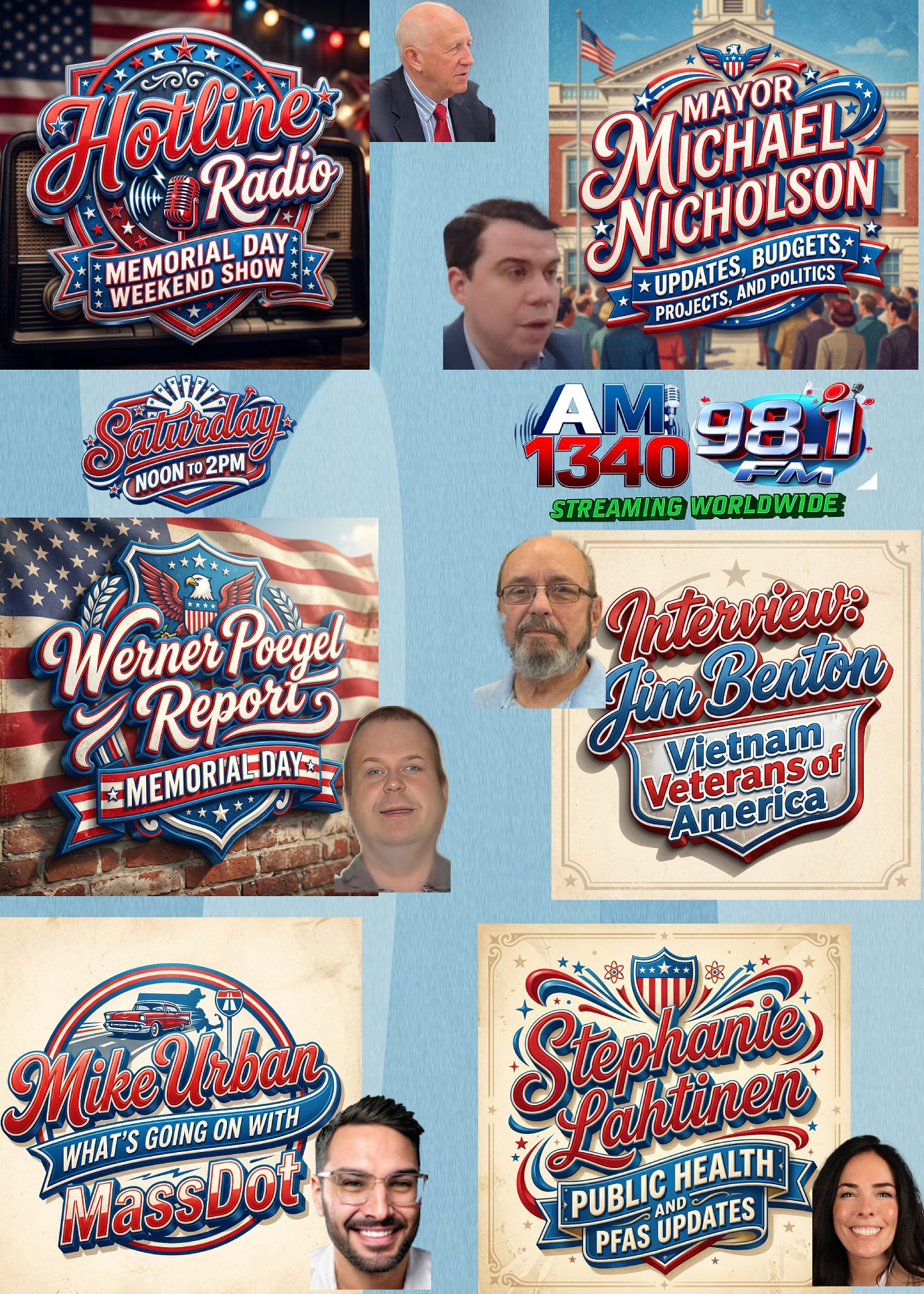
WGAW Hotline Radio Memorial Day Weekend Show
The WGAW Memorial Day Weekend Show of Saturday May 23, 2026 had its share of updates and Memorial day themed segments. Listen on any device, CLICK PLAY.
WGAW Hotline Radio 5-23-26 Gardner Mayor Michael Nicholson appeared on the program and spoke about the progress in the State Legislature on Chapter 70 and Chapter 90 funding, stating that the Senate voted on the budget this week, but had higher numbers than the House so a conference committee will be needed. School Budget was approved unanimously by the School Committee and was part of the budget submitted to the City Council.
There was a discussion about the decision of the Kendall Pond Betterment Association not to have fireworks this year due to cost. The Mayor stated that no plans have been finalized yet for the 250th celebration and no funding has so far been allocated. Other topics included the Greenwood Memorial Pool and Summer Recreation. Memorial Day is Monday with a ceremony at Monument Park at 10am (weather permitting), if rain, there will be an indoor event at Perry Auditorium.
Memorial Day segments included an interview with Jim Benton who is Vice President of the Vietnam Veterans of America State Council who spoke of the May 24th Memorial Ride, and a special report by Werner Poegel which included a comprehensive history of Memorial Day and its emergence as a Monday holiday.
There was a commentary by Mike Urban which featured Channel 25 segments on an investigation into fraudulent overtime by MassDot workers.
There were highlights from the Town Crier podcast #26 hosted by Westminster Town Administrator Stephanie Lahtinen. – Lahtinen speaks about heading in to summer safety and making sure residents have information about the June 1st PFAS meeting.
Steve Wendell commented on a number of topics: Playing the National Anthem every day on WGAW at 6:06am and his commitment to continue playing it until he dies, the young whippersnappers who are dumbasses and Steve played a portion of the “You’are a Dumbass” song, Steve’s lament about the audits sought by the State Auditor, but blocked by the legislature and the Governor.
- Lits Beach Club 2026 (5/22/2026)

Lits Beach Club 2026 Summer Concerts
Opening day for the 2026 Season is Friday, May 22nd with the first concert being June 6th.
The Lits Beach Club membership structure is as follows: Full and Associate memberships are just $50 for the entire season. For those looking for the ultimate value play, the Seasonal Family membership is $60, while Senior and Veteran families can join for $50. Individual seasonal rates sit at $45 (or $35 for Seniors/Veterans), and the club even offers a $10 Family Day Pass or $5 Individual Day Pass for those just passing through.
The Summer Concert Series consists of 5 different dates in 2026: Location: 23 Airport Rd, Gardner, MA
Band Name Date Time Slot Moonshine Band Saturday, June 6 7:00 PM – 10:00 PM Kidd Hurricane Saturday, June 13 7:00 PM – 10:00 PM Litz Blitz Saturday, July 25 1:00 PM – 11:00 PM Neon Alley Saturday, August 15 7:00 PM – 10:00 PM Steel Wolf Saturday, August 22 2:00 PM – 5:00 PM
- PACC Bands 2026 (5/22/2026)

We are looking at a masterclass in community curation. Here is why the upcoming PACC season is the biggest—and most welcome—surprise of the year.
PACC Friday Night Bands Begin Friday May 22nd with Ben Cote
Once again the Polish American Citizens Club at 171 Kendall Pond Road in Gardner has a great season of Friday Night Bands. Performances are every Friday from 7pm to 10pm and admission is FREE! Listen to the Chair Man and the Chair Lady discuss the upcoming season on any device, CLICK PLAY.
DEEP DIVE – PACC 2026 Season More Than Just Music: 5 Reasons the 2026 Gardner PACC Lineup is the Summer’s Biggest Surprise
There’s a specific kind of magic that settles over 171 Kendall Pond W. as the work week winds down. You can feel it in the air—the way the humidity of a Central Massachusetts afternoon breaks just as the first classic cars begin to roll in. There’s the low rumble of a vintage V8 engine, the gleam of polished chrome catching the orange hue of a Kendall Pond sunset, and that unmistakable sound of a drum kit being tested in the distance. For those of us who live for the Friday night ritual, the “Bruno Starzynski Memorial Cruise Nights” aren’t just events; they are the heartbeat of our summer.
A Marathon Schedule: 19 Weeks of Uninterrupted Rhythm
Most local concert series are sprints—four or five weeks of music squeezed into the height of July. The Gardner PACC, however, is running a marathon. Starting May 22nd with Ben Cote and stretching all the way to September 25th, this is a staggering 19-week commitment to the local arts.
From a curatorial perspective, the logistical stamina required to pull this off is immense. To program nearly five months of consecutive weekly entertainment, rain or shine (weather permitting), speaks to a deep institutional dedication to the Gardner community. It provides a rare, reliable anchor for our summer lives. You don’t have to check the calendar; if it’s Friday, you know where the party is from 7PM – 10PM. This consistent three-hour window ensures that from the first blooms of May to the crisp, jacket-weather evenings of late September, the rhythm of the City of Gardner (Model City for America) remains unbroken.
The “Price Tag” Paradox: High-Value Entertainment for Zero Dollars
We live in an era of “dynamic pricing” and skyrocketing “convenience fees” that make stadium tours feel like a luxury reserved for the few. When a standard night out can cost a family hundreds of dollars, the PACC’s “Free Admission Open to the Public” model isn’t just a nice gesture—it’s a powerful community builder.
In this economic climate, removing the financial barrier to entry is an act of radical inclusivity. It transforms a professional-grade concert series into a shared public square where neighbors of all backgrounds can mingle. If you find it hard to believe that 19 weeks of high-caliber music won’t cost you a dime at the gate, you can verify the details yourself at gardnerpacc.com or by calling 978-632-9729. It’s a rare instance where the best things in life truly are free.
The “Double-Down” Strategy: Why Certain Bands are Returning for Seconds
A savvy curator knows when they’ve found a “sure thing,” and the 2026 schedule leans into this with a “Double-Down” booking strategy. Three specific acts—Down Daizy (June 5 and August 14), Whiskey Johnson (July 10 and September 18), and Alive – N – Kickin’ (May 29 and August 28)—have been booked for two appearances each. These are the pillars of the season, the fan-favorites whose return sets a benchmark for the summer’s energy.
But the lineup’s strength also lies in its diversity. We see the grit of the Rusty Truck Saloon Band on June 26, the local edge of The Phukovs on July 24, and the intimate, craft-focused performance of Dan Leblanc on September 11. Perhaps the most anticipated outlier is the Phantom Fears (Rush Tribute) on August 21. Placing a high-concept tribute to progressive rock in the heart of August is a bold move that elevates the series from a “local jam” to a destination for serious music aficionados.
A Sensory Ecosystem: Cruise Nights and Food Trucks
The music might be the heartbeat, but the atmosphere is the soul. The “Bruno Starzynski Memorial Cruise Nights” create a multi-sensory “lifestyle” event that transcends a simple concert. There is something deeply nostalgic about watching a live band while wandering through rows of impeccably maintained classic cars—it’s a living museum of Americana.
To round out the experience, the PACC has ensured that your taste buds are as engaged as your ears. With Food Trucks Every Week, the venue becomes a mobile dining destination. The smell of gourmet street food mingling with the summer breeze makes it easy to arrive at 7 PM and stay until the final note at 10 PM. It’s an ecosystem designed for lingering, making it the ultimate low-stress Friday night out.
The “TBD” Mystery: The Anticipation of the Unknown
One of the most intriguing elements of the 2026 lineup is the presence of two “TBD” (To Be Determined) slots on September 4 and the season finale on September 25. While a casual observer might see these as gaps, a curator sees them as opportunities for mystery and community engagement.
Will these slots be used for a “fan-favorite” vote-back, giving the community the chance to see their preferred June act one last time? Or is the PACC holding space for a surprise high-profile headliner to close out the year with a bang? Leaving the bookends of the season finale open keeps the conversation alive all summer long, fueling anticipation right up until the autumn leaves begin to turn.
A Legacy in Motion
The Bruno Starzynski Memorial series at the Gardner PACC is a testament to the power of tradition and the importance of a well-curated community life. It’s a celebration of cars, chords, and the simple joy of standing in a field with your neighbors. As we look ahead to 19 weeks of Friday night magic, the 2026 season isn’t just a schedule—it’s a promise of a summer well-spent.
The only question left is: with nineteen incredible Fridays to choose from, which one are you marking on your 2026 calendar first?
- AM-FM and WGAW (5/21/2026)
AM-FM and WGAW – Why one of the City’s Oldest Media Choices is Still So Dominant.
Gardner Magazine compiled facts from many sources and the results were very clear: 96% of car owners view built-in radio as essential and 89% actually won’t buy a car without it. Local News/Talk radio station WGAW is on AM 1340, 98.1 FM, and streams worldwide. Here’s the station website, CLICK HERE.
Gardner Magazine has a complete page of reports on why AM-FM Radio is still on top, featuring a “Deep Dive” podcast, a “Debate”, and a short video. CLICK HERE for the page.
Listen to a “Deep Dive” podcast on why Automakers Can’t Kill AM Radio – It’s important to the public.
DEEP DIVE – Why Automakers Can’t Kill AM Radio Listen to this “Debate” podcast on radio.
DEBATE – Radio Jump to various sections on the AM/FM page: Enduring Dominance of AM/FM Radio in the Automotive Landscape. —- Analysis of Listening by Demographics and Manufacturer — The Dashboard Rebellion: Why the Future of the Car is Unexpectedly Analog —-Fact Sheet: The American Dashboard—Modern vs. Traditional Audio Habits —- Market Analysis Report: The In-Vehicle Audio Landscape and the Strategic Primacy of AM/FM Radio
- Gardner Drought 5-21-26 (5/21/2026)
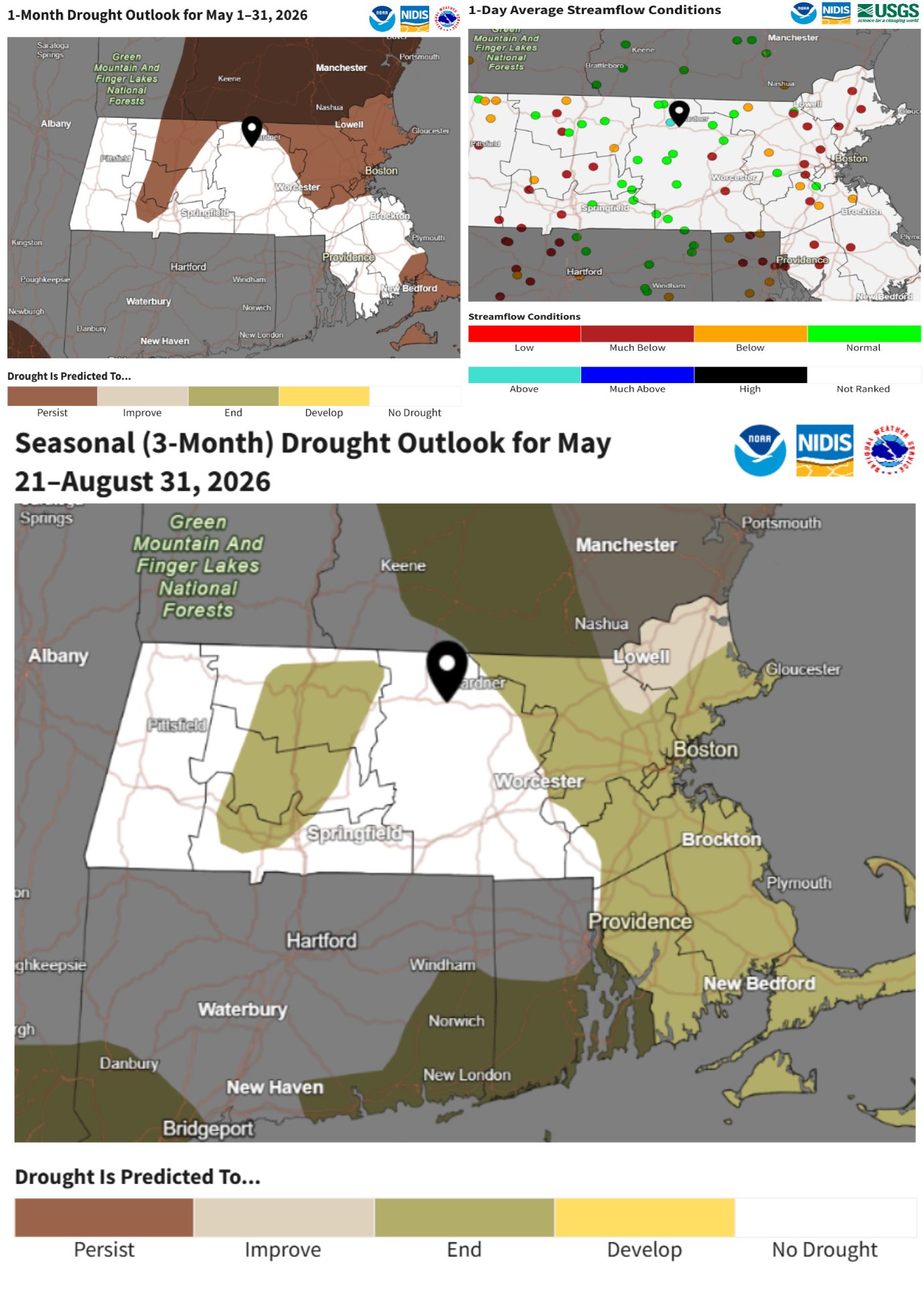
Gardner MA Dry But Not Expected to Develop Drought Now Through August
Gardner May be Dry, but drought will not be a problem at least through August, 2026 according to Drought.Gov. The Map shows drought persisting in Western MA and in Eastern MA including Boston. Right now, only 7% of people in Worcester County are affected by drought. However, it was the 16th driest April on record over the past 132 years and the 9th driest year to date over the past 132 years with just over 4 inches less than the usual precipitation. Currently, the City of Gardner has a non-essential water ban in place from 9am to 5pm daily.
Background on the Drought Monitor: The U.S. Drought Monitor (2000–present) depicts the location and intensity of drought across the country. Every Thursday, authors from NOAA, USDA, and the National Drought Mitigation Center produce a new map based on their assessments of the best available data and input from local observers. The map uses five categories: Abnormally Dry (D0), showing areas that may be going into or are coming out of drought, and four levels of drought (D1–D4) Look up drought information anytime at Drought.gov, CLICK HERE.
- Westminster Town Crier Episode 26 (5/21/2026)

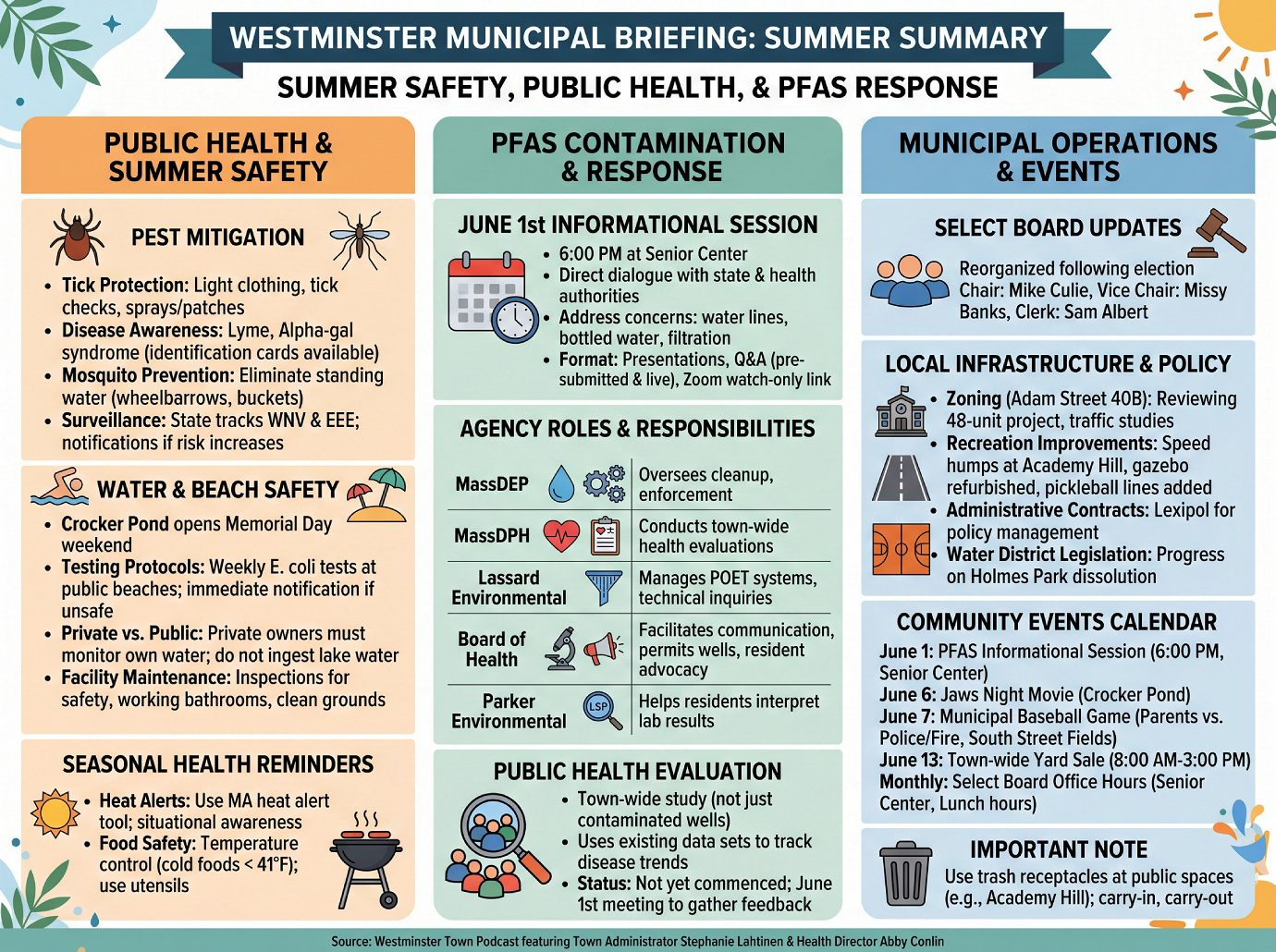
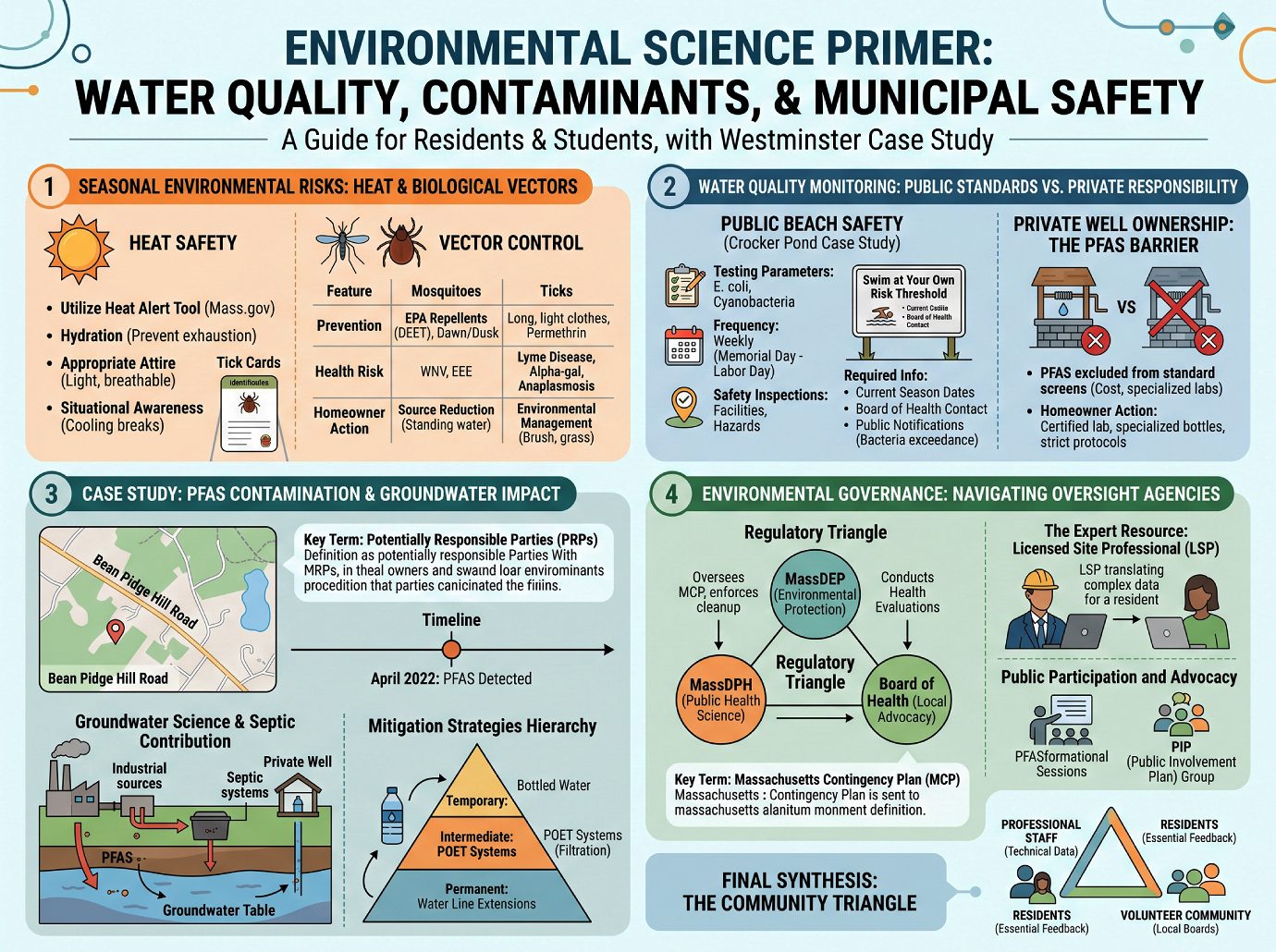
Additional information is in the infographics below. CLICK IMAGE for larger view.
Westminster Town Crier Episode 26 – Summer Safety and PFAS Updates
The latest Town Crier Podcast Episode with Westminster Town Administrator Stephanie Lahtinen
provides a comprehensive update on municipal affairs and local events heading into the summer season. Listen on any device, CLICK PLAY.A primary focus of the discussion is public health, featuring Health Director Abby Conlin, who shares essential advice on preventing mosquito and tick-borne illnesses and ensuring water safety at local beaches. The program also details an upcoming informational session regarding PFAS contamination, aimed at clarifying the roles of state agencies and providing residents with direct access to experts. Beyond health concerns, the episode recaps recent Select Board actions and highlights community activities such as a town-wide yard sale, a local baseball game, and a movie night. Throughout the recording, officials emphasize the importance of resident engagement and transparent communication between the local government and the community.
Municipal Primer – May 2026
Westminster Summer Safety
Environment Science Primer

- Public Service 5-21-26 (5/21/2026)
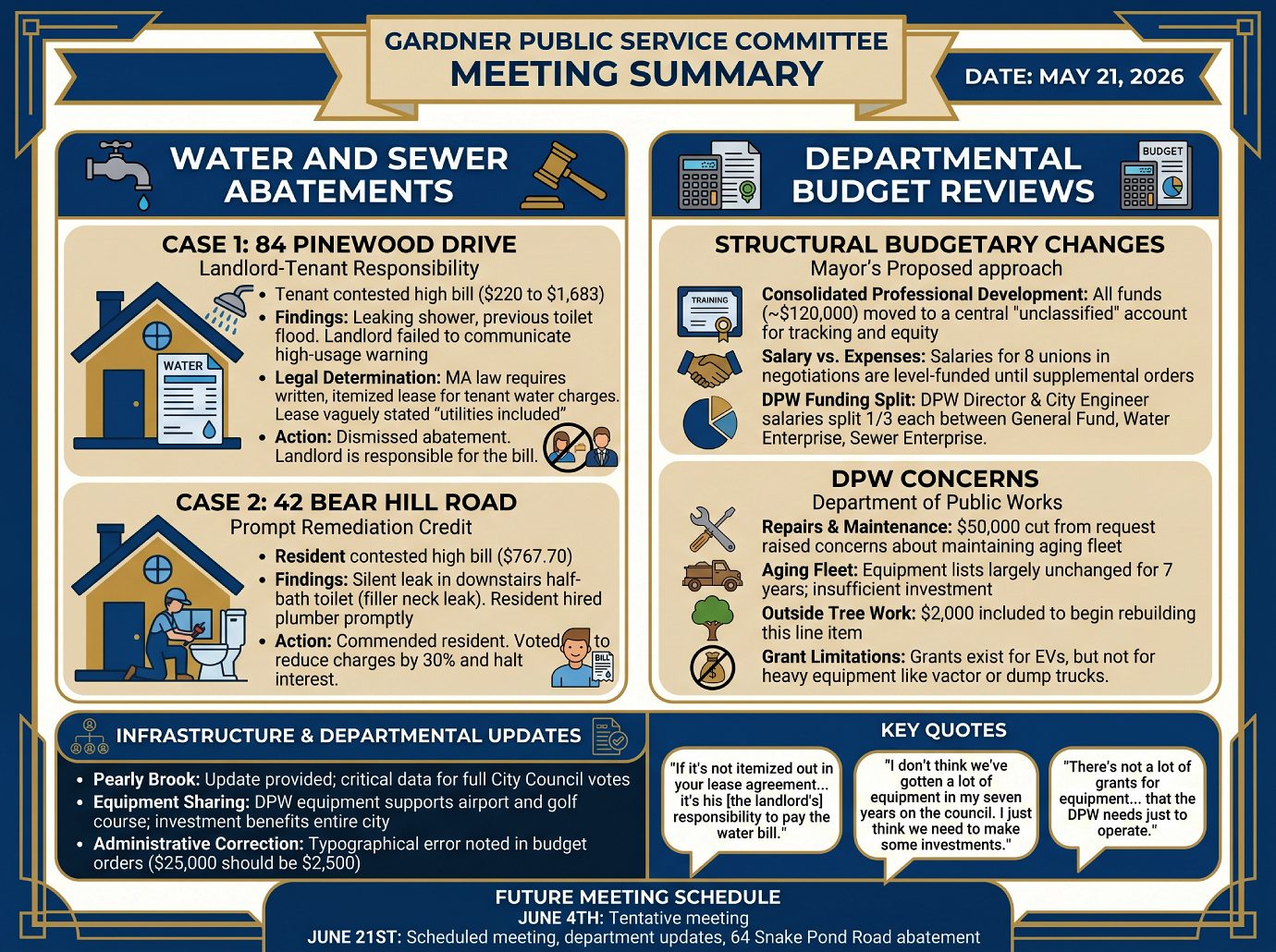
Further meeting coverage is provided through the infographics below. CLICK IMAGE for larger view.
Who Pays the Bill? – Abatements – Budget Reviews Focus of Public Service Committee
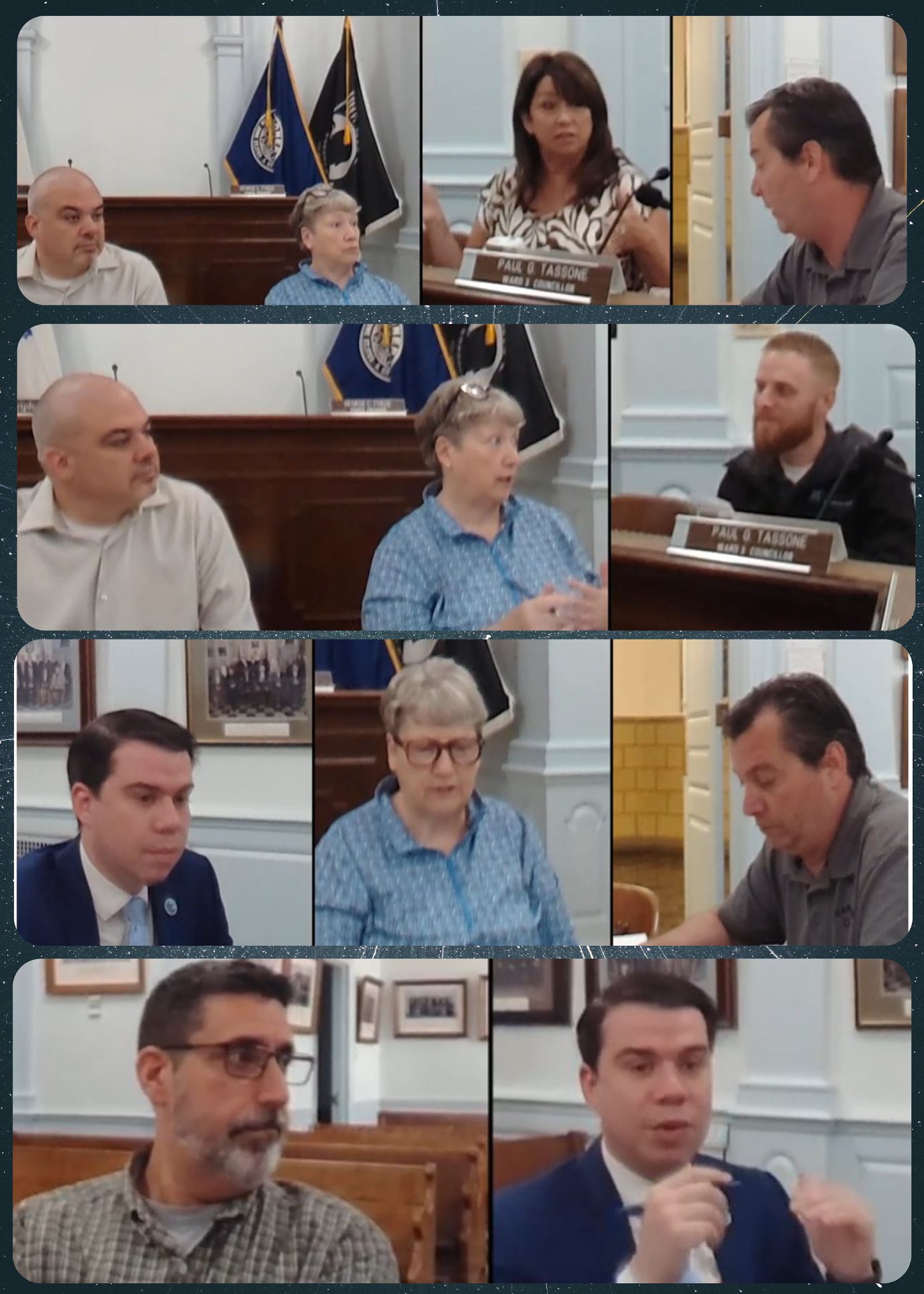
The Gardner Public Service Committee met on Thursday, May 21, 2026. Listen to the entire meeting on any device, CLICK PLAY.
ZBA 5-19-26
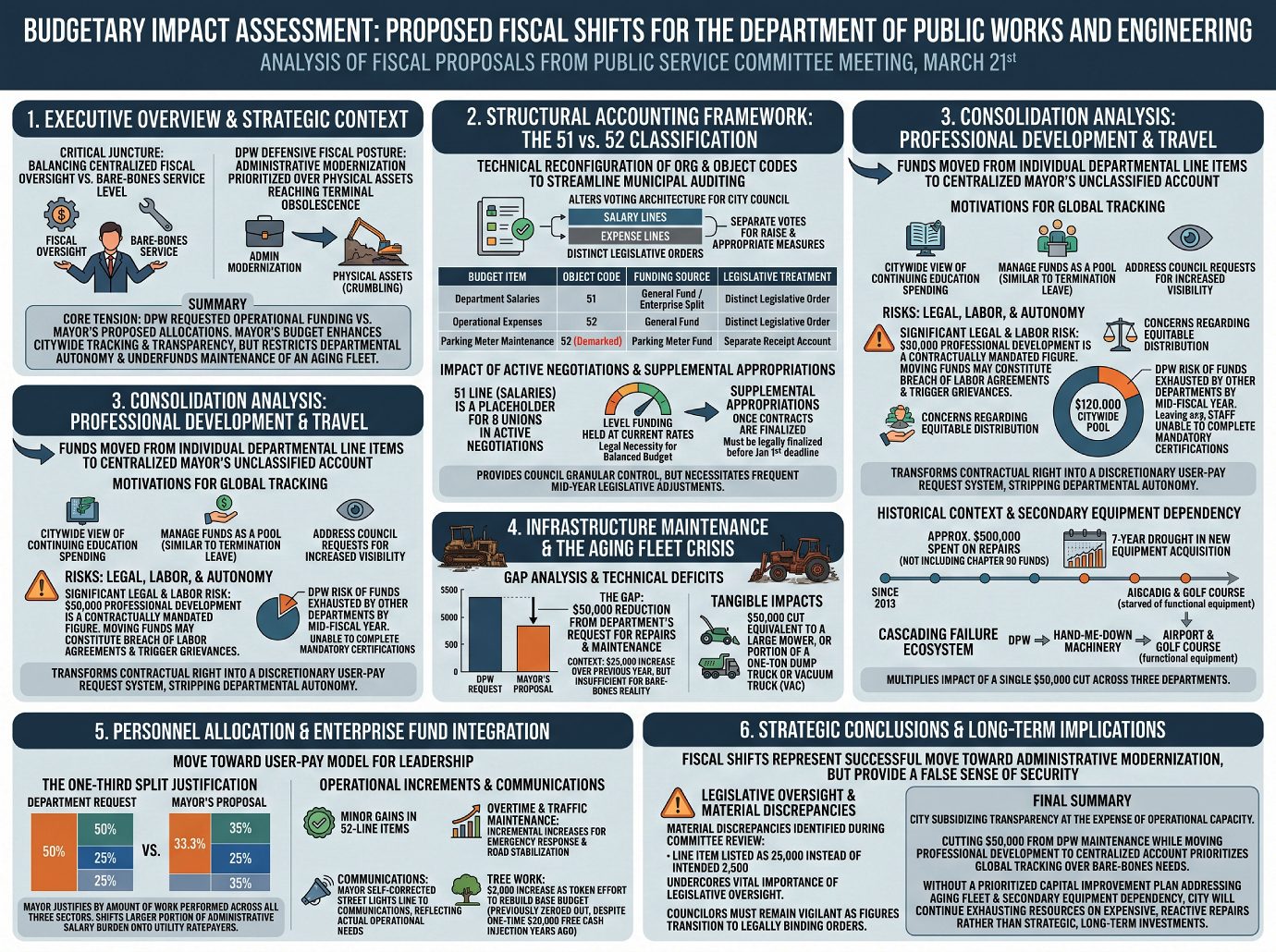
The meeting primarily focused on utility abatement requests and budget reviews. The first segment addresses a resident’s disproportionately high water bill, revealing a dispute over whether the landlord or tenant is responsible for payment based on state law and lease terminology. A second case involves a high bill caused by a leaking toilet, resulting in the committee granting a thirty percent reduction as a gesture of fair play. The meeting concludes with the Mayor presenting the department budget, highlighting consolidated funds for professional development and the ongoing need to upgrade aging equipment. Throughout the session, officials emphasize the importance of proper documentation and clear communication between property owners and the city.Meeting Summary
The $1600 Toilet
Fiscal Proposals

- ZBA 5-19-26 (5/21/2026)
Cell Tower and Multi-Family Focus of ZBA
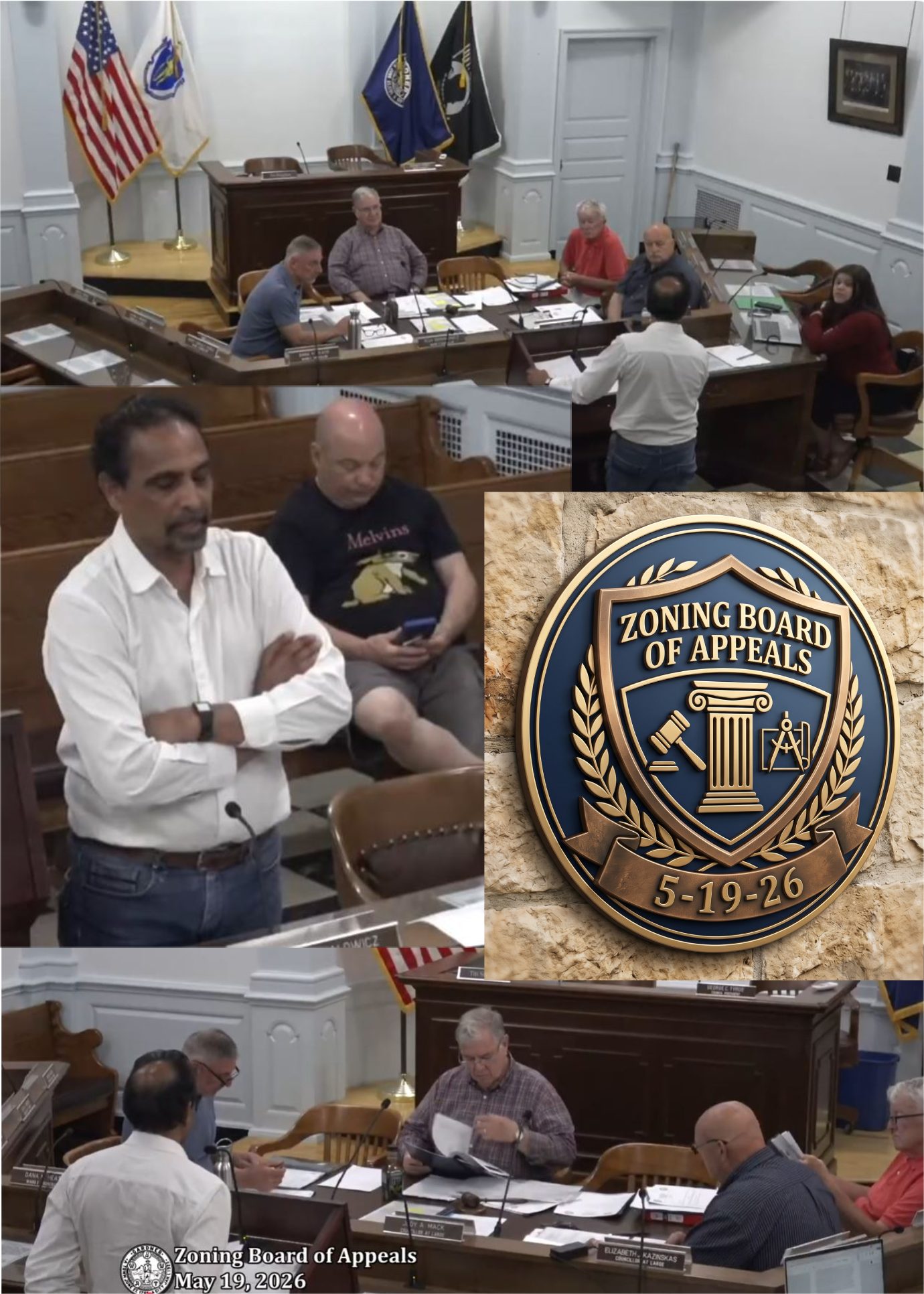
The Gardner Zoning Board of Appeals (ZBA) meeting held on May 19, 2026, focused on two primary cases: a continuance for a cellular tower installation and a special permit application for a residential property conversion. Listen to the meeting on any device, CLICK PLAY
ZBA 5-19-26 The meeting was characterized by a rigorous adherence to city ordinances regarding parking dimensions and professional documentation.
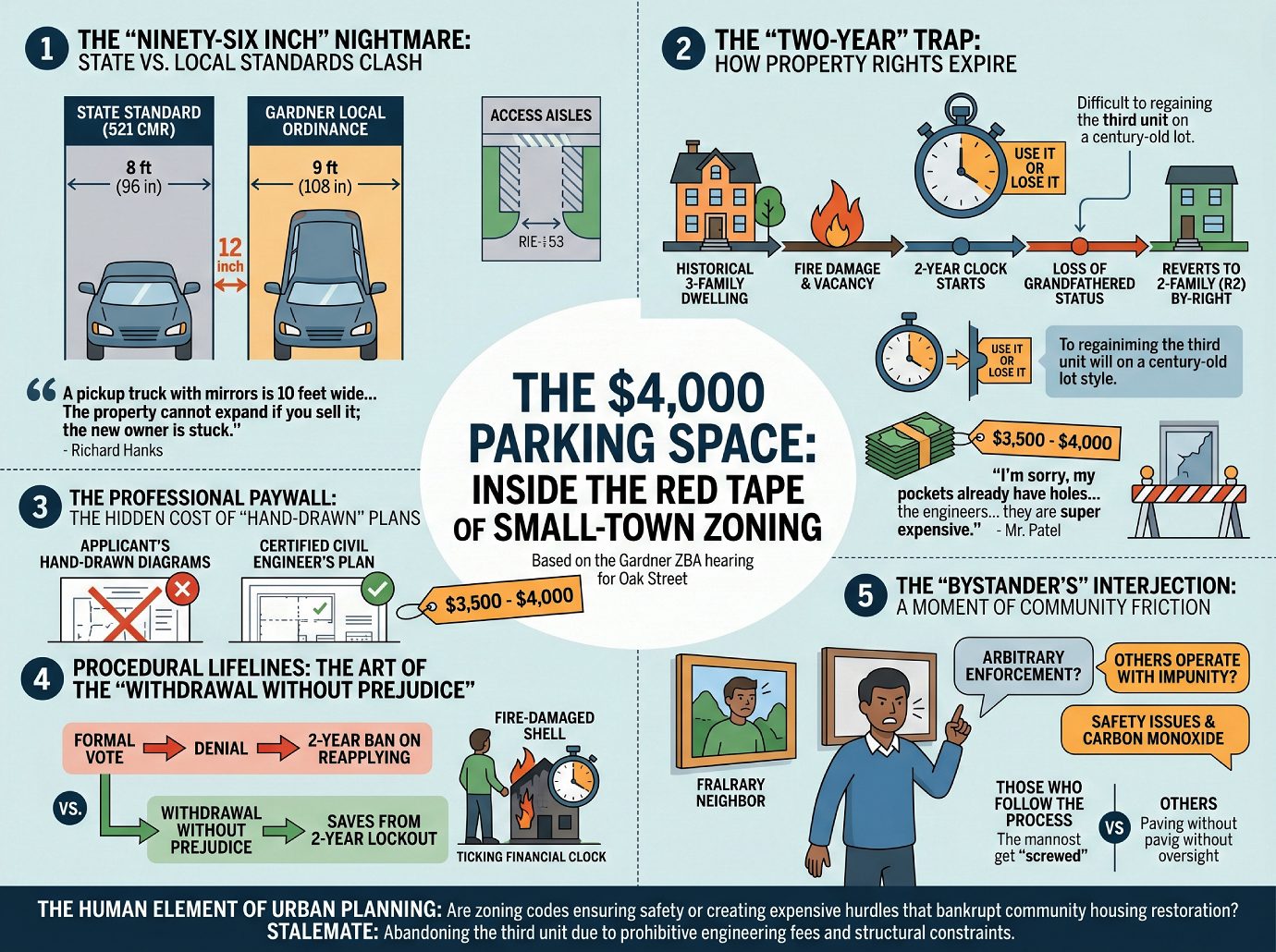
The most critical takeaway is the board’s refusal to accept informal, non-professional diagrams for high-density residential special permits. Case 2025-12-01 (the Patel case) illustrated the tension between small-scale developers and municipal regulatory requirements. The applicant ultimately chose to withdraw his application “without prejudice” to pursue a two-family renovation—which does not require ZBA intervention—while reserving the right to reapply for a three-family permit once professional engineering plans are obtained.
The applicant expressed significant frustration regarding the costs and delays of the regulatory process including timeline delays as the case had been active since November of the previous year. The applicant lamented the monthly $150 continuance fees and the ongoing interest payments on his loan. In addition, the applicant noted that hiring a professional engineer could cost between $3,500 and $4,000 per day, which he described as a significant financial hardship. The case is illustrated further in the infographic below.
- MWCC Graduation 2026 (5/20/2026)
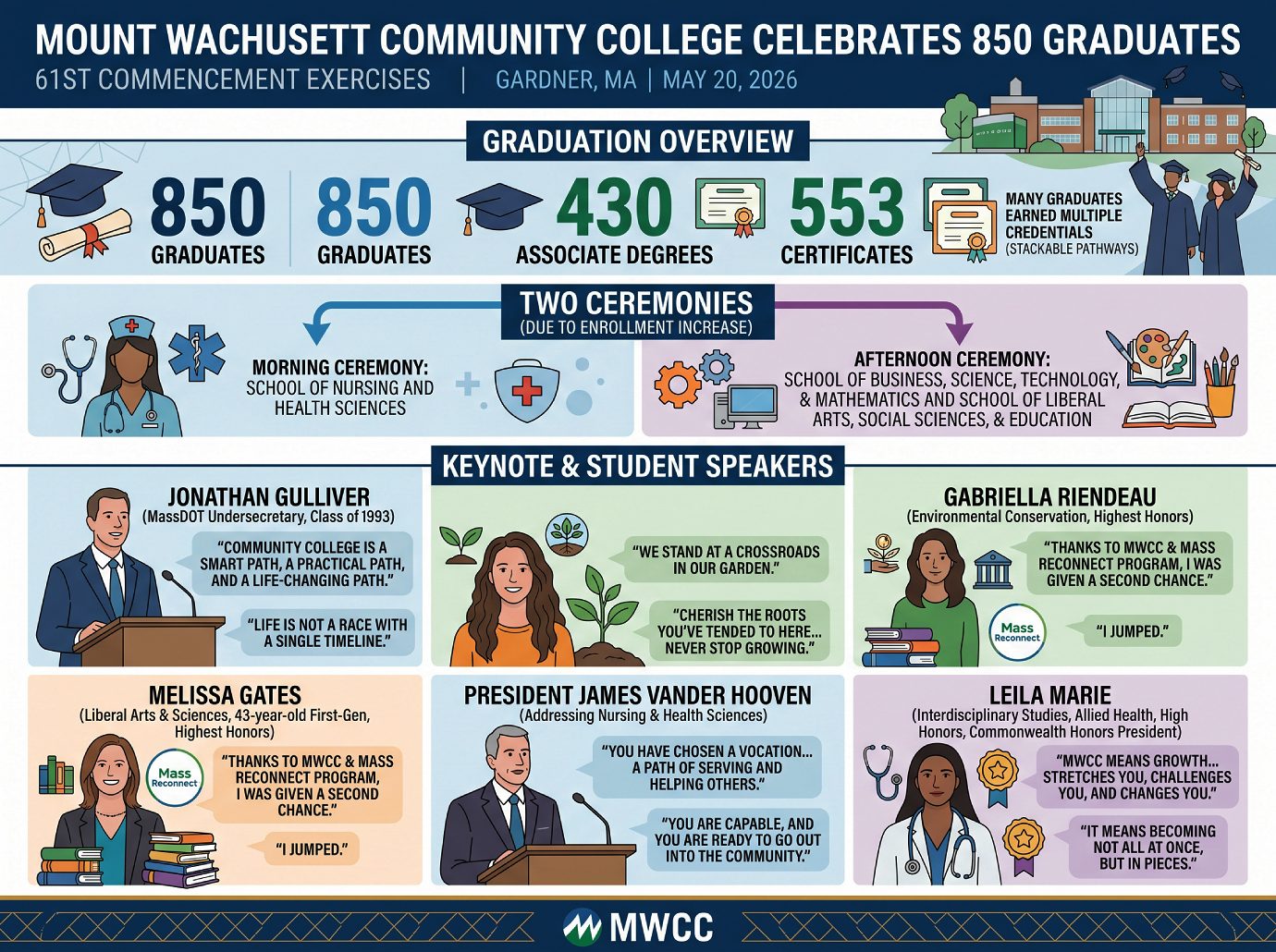
61st Commencement Exercises at Mount Wachusett Community College – 850 Graduates
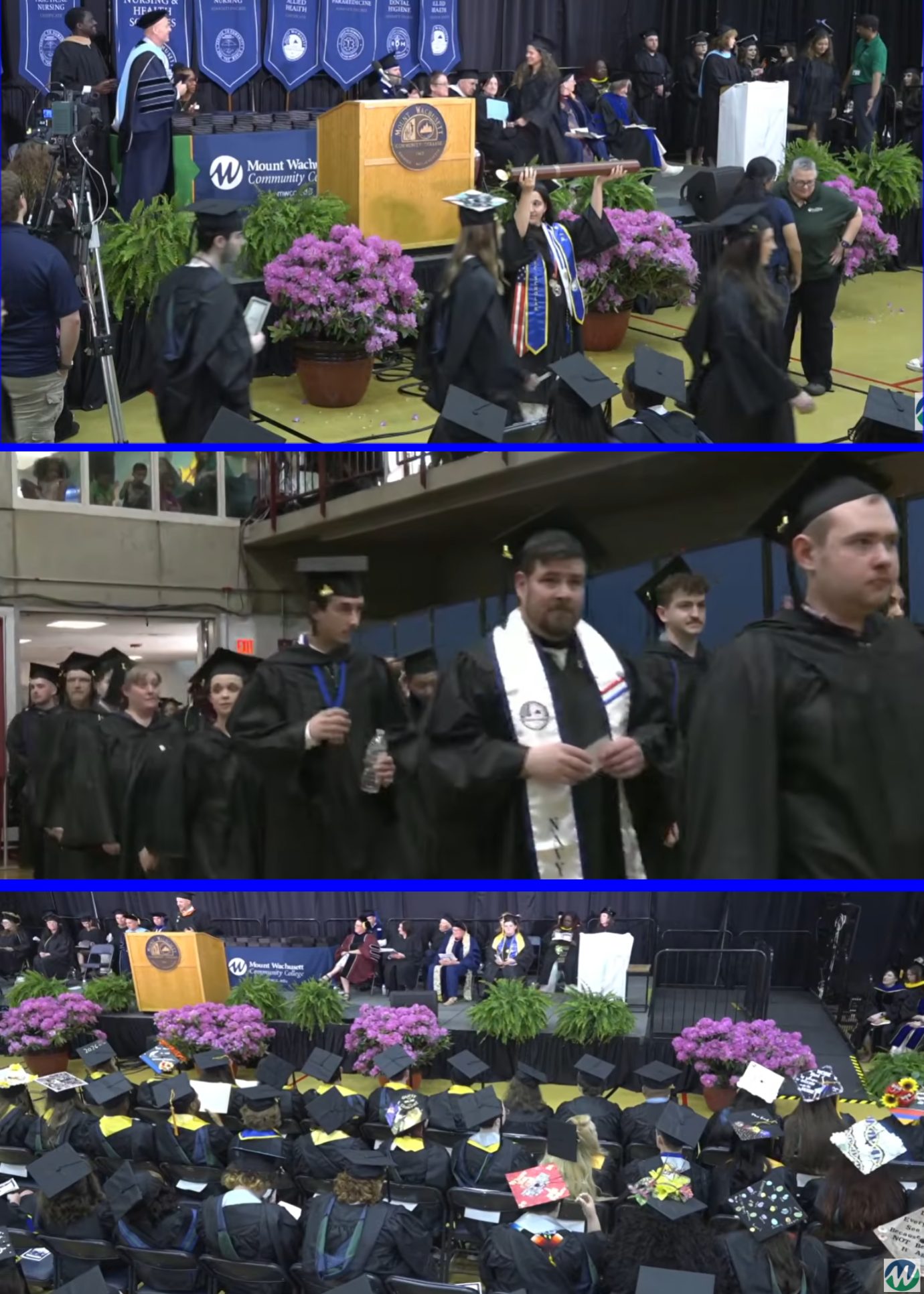
Mount Wachusett Community College (MWCC) celebrated the academic achievements of its 61st graduating class on May 20, 2026 at the college’s Gardner campus.
A total of 850 students graduated, with 430 associate degrees and 553 certificates conferred. Many graduates earned multiple credentials, reflecting the college’s emphasis on stackable pathways and workforce-ready education.
As a result of the significant increase in enrollment over the past two years, the commencement was split into two ceremonies, the School of Nursing and Health Sciences ceremony was held in the morning, while the School of Business, Science, Technology, and Mathematics and the School of Liberal Arts, Social Sciences, and Education ceremony was held in the afternoon.
Complete Press Release with the names of all graduates, CLICK HERE.
- Memorial Day 2026 (5/20/2026)
From the City of Gardner: “The City of Gardner will commemorate Memorial Day with a parade and ceremony featuring the Gardner High School Band. Beginning at the American Legion 22 Elm Street 9:30 a.m. Ceremonies at Monument Park. In case of rain, proceed to City Hall Auditorium.”

On this Memorial Day, let us mourn those who have fallen in service to our country. And even more than that, let us remember them all with great gratitude and solemn thanks.
Celebrating Memorial Day 2026 – and the History of the Holiday
Memorial Day is Monday May 25, 2026. Gardner Magazine is showing you a beautiful American Flag which we noticed in Downtown Gardner and thought it fitting to show as a part of this article.
In the words below, we cover the history of Memorial Day. And in a podcast the Chair Man and the Chair Lady speak about Memorial Day. Listen on any device. CLICK PLAY.
DEEP DIVE – Memorial Day Beyond the Barbecue: The History of Memorial Day
For many, the final Monday of May is a pastel-colored blur of backyard barbecues, department store sales, and the “unofficial start of summer.” It is a day defined by leisure, yet it was forged in the bone-deep exhaustion of a divided nation. From the wreckage of the American Civil War—a conflict that claimed 620,000 lives, a staggering 2% of the population—a new liturgy of grief emerged. By 1870, the logistics of this mourning were monumental; the remains of nearly 300,000 Union dead had been painstakingly reinterred across 73 new national cemeteries.
To Truly Understand Memorial Day
To truly understand Memorial Day is to look beneath the charcoal smoke and see a history that is, at turns, grassroots, subversive, and deeply sacred. We must look past the “day off” to the counter-intuitive truths of a tradition that began not with a government mandate, but as an act of liberation.
The Subversive Sanctuary: Charleston, 1865
While many Northern and Southern towns claim the title of “first,” one of the most visceral precursors to the holiday occurred in the very cradle of the Confederacy. On May 1, 1865, in Charleston, South Carolina, a group of formerly enslaved people performed an act of radical reclamation.
During the war, the Washington Race Course—a site of elite Southern leisure—had been converted into a brutal Confederate prison camp. At least 257 Union soldiers died there, buried in unmarked, shallow mass graves. Once the city fell, the recently freed population spent weeks unearthing the fallen, giving them proper burials, and erecting a white fence around the new cemetery, which they inscribed with the words “Martyrs of the Race Course.”
On that May morning, a procession of 10,000 people erupted into the streets. Led by 3,000 Black school children carrying armfuls of flowers and singing “John Brown’s Body,” they marched around the track. This was the first “Memorial Day” in practice: a subversive act where those once owned as property honored their liberators on a site formerly reserved for the sport of their oppressors.
A Messy Map of Memory: Waterloo and the Southern Precedents
History is rarely a straight line; it is often a landscape of localized traditions that the government later attempts to codify. In 1966, President Lyndon B. Johnson signed a proclamation naming Waterloo, New York, as the “official” birthplace of the holiday. Waterloo earned its crown through a century-old commitment to silence and ceremony, specifically for its community-wide closing of businesses starting May 5, 1866.
Yet, this official status erases a more complex reality. In the South, a parallel movement was stirring, led not by political decree but by the mourning of widows. In Columbus, Georgia, Mary Ann Williams, secretary of the Ladies Memorial Association, issued a call to the press on March 11, 1866, to set aside a day for the “debt we owe” the fallen.
“Let the soldiers’ graves, for that day at least, be the Southern Mecca, to whose shrine her sorrowing women, like pilgrims, may annually bring their grateful hearts and floral offerings…” — Mary Ann Williams, March 1866
While Williams’ vision was initially tied to the “Confederate Memorial Day” on April 26, the impulse was the same across the map. In Columbus, Mississippi, women famously decorated both Confederate and Union graves in a gesture of reconciliation that moved the national heart. Meanwhile, in the North, towns like Boalsburg and Gettysburg, Pennsylvania, were already tending to “passionless mounds” by late 1864.
The Botanical Logic of May 30th
The transition from local mourning to “National Decoration Day” came through General John A. Logan’s General Order No. 11 in 1868. Logan, commander of the Grand Army of the Republic, selected May 30 for reasons that were both tactical and poetic.
Crucially, the date was chosen because it was not the anniversary of any particular battle. Logan sought a neutral ground that would focus the nation’s attention on the soldier rather than the strategy, the sacrifice rather than the victory. Beyond this tactical neutrality was a seasonal necessity: according to Logan’s wife, late May was simply the optimal time for the “choicest flowers” to be in full bloom in the North.
“…Gather around their sacred remains and garland the passionless mounds above them with the choicest flowers of Springtime; let us raise above them the dear old flag they saved from dishonor…” — General John A. Logan, May 5, 1868
Though the term “Memorial Day” was used as early as 1882, the holiday retained its “Decoration Day” identity for nearly a century, not becoming officially renamed until 1967.
The Noon-Time Ritual: A Metaphorical Sunrise
For the modern observer, Memorial Day is often a static holiday, but its protocol suggests a dynamic, time-bound ritual of mourning and renewal. The American flag follows a unique choreography: it is first raised briskly to the top of the staff, then solemnly lowered to half-staff. It remains there until exactly noon, at which point it is raised once more to full-staff.
The symbolism is profound. The morning hours at half-staff represent the nation’s collective mourning for the more than one million men and women who have died in service. The noon-time rise to full-staff serves as a metaphorical sunrise—a sign of the nation’s persistence and a tribute to the living who continue the fight.
To anchor this in the modern world, the National Moment of Remembrance Act of 2000 asks for a pause at 3:00 p.m. local time. These time-bound rituals are essential “interrupts”—friction in our leisure that forces us to reconcile the comfort of our present with the cost of our past.
The Red Poppy: A Baptism of Blood
The red poppy, the global emblem of remembrance, was born not from the Civil War, but from the industrial slaughter of World War I. Inspired by Lieutenant Colonel John McCrae’s 1915 poem “In Flanders Fields,” which described poppies blooming between the crosses of the dead in Belgium, the flower became a symbol of life persisting in the wake of destruction.
Moina Michael, an American secretary, made it her mission to distribute silk poppies to honor the “baptism of blood” on the battlefield. By 1920, the American Legion adopted the poppy, cementing a tradition that connects modern remembrance to the mud and trenches of the Great War.
Memorial Day as Monday Holiday:
The Uniform Monday Holiday Act of 1971 officially moved Memorial Day from its traditional May 30th date to the last Monday in May. While this created the three-day weekend we recognize today, it also sparked a lasting tension. Organizations like the VFW have long argued that this shift diluted the holiday into a “nonchalant observance,” turning a day of “memory and tears” into a retail event.
Yet, Memorial Day persists as a pillar of our “secular civil religion”—a time when the nation attempts to make sense of its history through the lens of sacrifice. As President John F. Kennedy observed in 1963: “A nation reveals itself not only by the men it produces but also by the men it honors, the men it remembers…”
In our busy, modern world, the challenge is to ensure that these “shines” do not go untended. We must decide if the holiday is merely a gateway to summer, or if we can still find the time to pause—to allow the noon-time flag and the 3:00 p.m. silence to remind us that the greatest casualty is being forgotten. On this Memorial Day, let us mourn those who have fallen in service to our country. And even more than that, let us remember them all with great gratitude and solemn thanks.
- City Council 5-18-26 (5/19/2026)
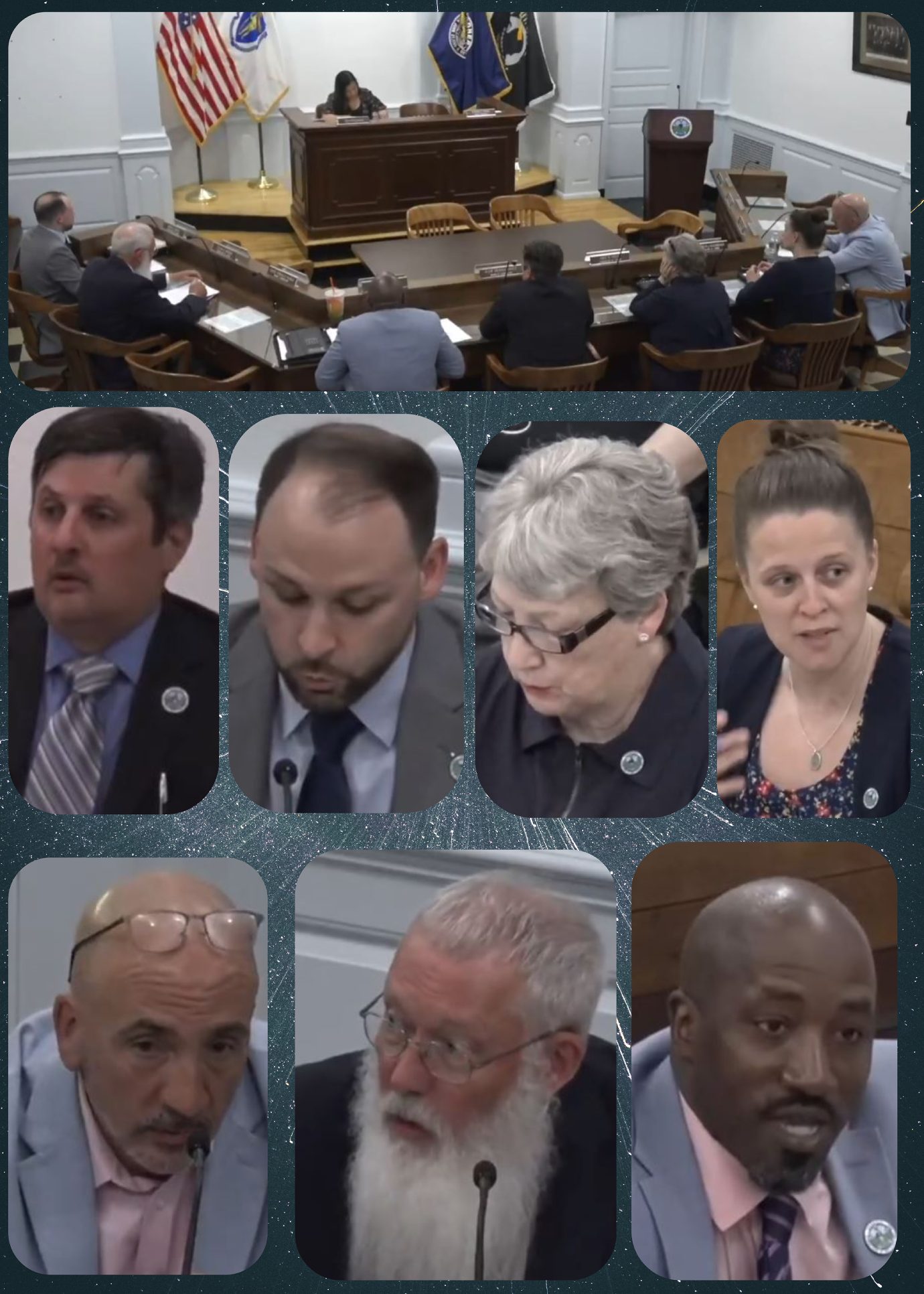
Councilors wished Councilor Karen Hardern well who has been absent due to a back problem. Get well soon, Councilor Hardern.
City Council Holds Meeting with 7 of 11 Councilors Present
Alek Dernalowicz was elected City Council President Pro-Tem to lead the meeting in the absence of City Council President George Tyros. Listen to the entire meeting on any device, CLICK PLAY
City Council 5-18-26
Key actions included the unanimous approval of an order to reappropriate over $1 million in unexpended bond proceeds to cover budget shortfalls in several capital projects, most notably the Gardner Middle School roof. The Council also advanced a modified ordinance to increase water rates by 15% for Fiscal Year 2027—a reduction from the Mayor’s proposed 20% increase. This move was characterized as a necessary “catch-up” measure to prevent the water enterprise fund from reaching a deficit by FY27. Additionally, the Council officially closed the investigation into the Maki Park project following notification of full compliance from the Architectural Access Board.
- Templeton 5-18-26 Results (5/19/2026)
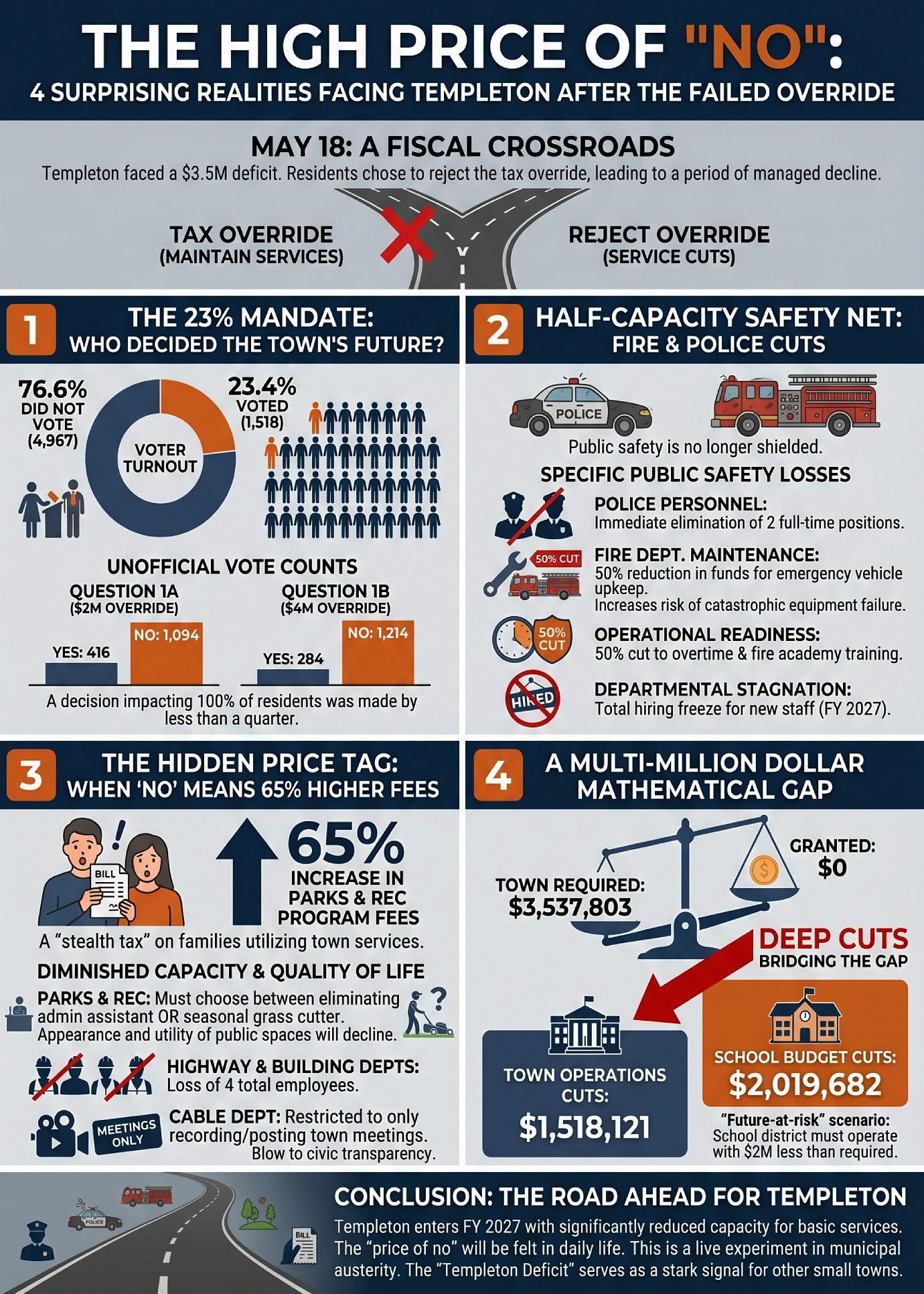
The High Price of “No” – Overrides Defeated in Templeton, Now the Pain Begins
The Chair Man and the Chair Lady discuss the results in this podcast. Listen on any device, CLICK PLAY.
DEEP DIVE – Templeton MA Results On May 18, 2026 Templeton reached a fiscal crossroads that will redefine the community for years to come. Facing a staggering $3.5 million deficit, town officials presented residents with a stark choice: approve a tax override or dismantle the current standard of municipal service. The electorate delivered a stinging rebuke, effectively choosing the latter.
This result captures the quintessential tension of modern municipal governance—the “unstoppable force” of rising operational costs meeting the “immovable object” of voter resistance. While the residents have made their preference for lower taxes clear, the reality of a $0 solution to a multi-million dollar problem is about to set in. The town now enters a period of managed decline where every “No” vote has a concrete, service-level consequence.
The 23% Mandate: Who Decided the Town’s Future?
The most striking aspect of this fiscal pivot was the lack of participation. Despite the massive stakes of the Annual Town Election, only 1,518 out of 6,485 registered voters cast a ballot. This represents a turnout of just 23.41%, a remarkably low figure for a decision with such high-impact gravity.
It is a counter-intuitive reality of local democracy: a decision that will impact 100% of residents was determined by less than a quarter of the population. The margin of defeat suggests that voters weren’t just being frugal; they were sending a message of total non-intervention. This was particularly evident in the failure of the larger $4 million request, which faced even steeper opposition than the smaller measure.
Unofficial Vote Counts:
- Question 1A ($2 Million Override): 416 Yes | 1,094 No
- Question 1B ($4 Million Override): 284 Yes | 1,214 No
The Half-Capacity Safety Net: Fire and Police Cuts
Public safety is the core promise of municipal government, yet it is no longer shielded from Templeton’s fiscal contraction. The Fire and Police departments are facing immediate, severe operational restrictions that go beyond simple belt-tightening. These aren’t just budget lines; from a policy perspective, they represent a significant “deferred liability” for the town.
The Fire Department is being forced to slash maintenance and training funds by 50%. Cutting truck maintenance in half does not actually save money in the long run; rather, it increases the risk of catastrophic equipment failure during an emergency. Furthermore, the loss of police personnel and training funds signals a fundamental shift toward a reactive, rather than proactive, public safety model.
Specific Public Safety Losses:
- Police Personnel: Immediate elimination of two full-time personnel positions.
- Fire Department Maintenance: 50% reduction in funds for emergency vehicle upkeep.
- Operational Readiness: 50% cut to overtime coverage and fire academy training funds.
- Departmental Stagnation: A total hiring freeze on all new staff or personnel for Fiscal Year 2027.
The Hidden Price Tag: When “No” Means 65% Higher Fees
Voters often view a “No” vote as a way to protect their wallets, but in Templeton, this has triggered an immediate “user-end penalty.” To keep essential services operational without tax revenue, the Parks and Recreation department must implement a staggering 65% increase in program fees. This is essentially a “stealth tax” on families who utilize town services.
The quality of life in Templeton will also take a visible hit through a choice of “diminished capacity.” The town must now choose between eliminating the part-time administrative assistant who runs the Parks department or the seasonal grass cutter who maintains the fields. Regardless of the choice, the appearance and utility of public spaces will decline as the Highway and Building and Grounds departments lose four total employees.
Even civic transparency is on the chopping block. The Cable department will be restricted to only recording and posting town meetings, a significant blow to the “civic transparency” necessary for a healthy local democracy. When tax revenue is denied, the cost of participation spikes, and the visibility of government operations fades.
A Multi-Million Dollar Mathematical Gap
The math facing Templeton is unforgiving and absolute. The town required $3,537,803 to maintain its current trajectory; following the election, it was granted exactly $0. This gap is now being bridged through deep cuts that disproportionately impact the town’s youngest residents.
Of the total cuts, approximately $1,518,121 will be stripped from town operations, while $2,019,682 will be gutted from the school budget. This “future-at-risk” scenario means the school district must operate with two million dollars less than what is required for standard operations. The fact that the $4 million override failed by a wider margin than the $2 million measure proves that voters rejected even the idea of a “bridge-gap” compromise.
The Road Ahead for Templeton
As Templeton enters Fiscal Year 2027, it does so with a significantly reduced capacity to provide the basic services residents expect. From reduced police patrols and hazardous equipment maintenance to unmaintained parks and soaring recreation fees, the “price of no” will be felt in the daily lives of every citizen. This is no longer a theoretical debate about tax rates; it is a live experiment in municipal austerity.
Publisher’s Editorial Note: The outcome of this election leaves us with a difficult question: What is the true balance between tax sensitivity and the essential nature of municipal services? The “Templeton Deficit” serves as a stark signal for other small towns facing similar crossroads. It proves that when a budget gap remains unbridged, the resulting cuts are not just numbers on a ledger—they are a fundamental rollback of the community’s quality of life.

Election Results: Municipal Boards and Commissions
- Select Board: April Cover (958 votes) and Timothy Toth (795 votes) were elected to the two available seats.
- Board of Assessors: George Barnes, Jr. (1,148 votes).
- Board of Health: Cynthia Cadoret (1,102 votes).
- Cemetery Commission: Matthew McDonald (1,123 votes).
- Community Preservation Committee: John Henshaw (1,166 votes).
- Light & Water Commission: Dana Blais (1,137 votes).
- Sewer Commission: Mark Moschetti (1,001 votes).
- Housing Authority: Louise Chaffee (1,081 votes).
- Planning Board: Michael Caruso was elected to a 4-year unexpired term (1,032 votes).
- Moderator: John Graves (1,078 votes).
Election Results: Narragansett Regional School District (NRSD)
- NRSD-Templeton: Shawn Case (965 votes) and Yasmine Khdeer (778 votes) were elected to the two available seats.
- NRSD-Phillipston: Several unexpired terms and a full term saw no formal candidates, with votes distributed among write-ins and blanks.
- Drug Bust 5-18-26 (5/18/2026)
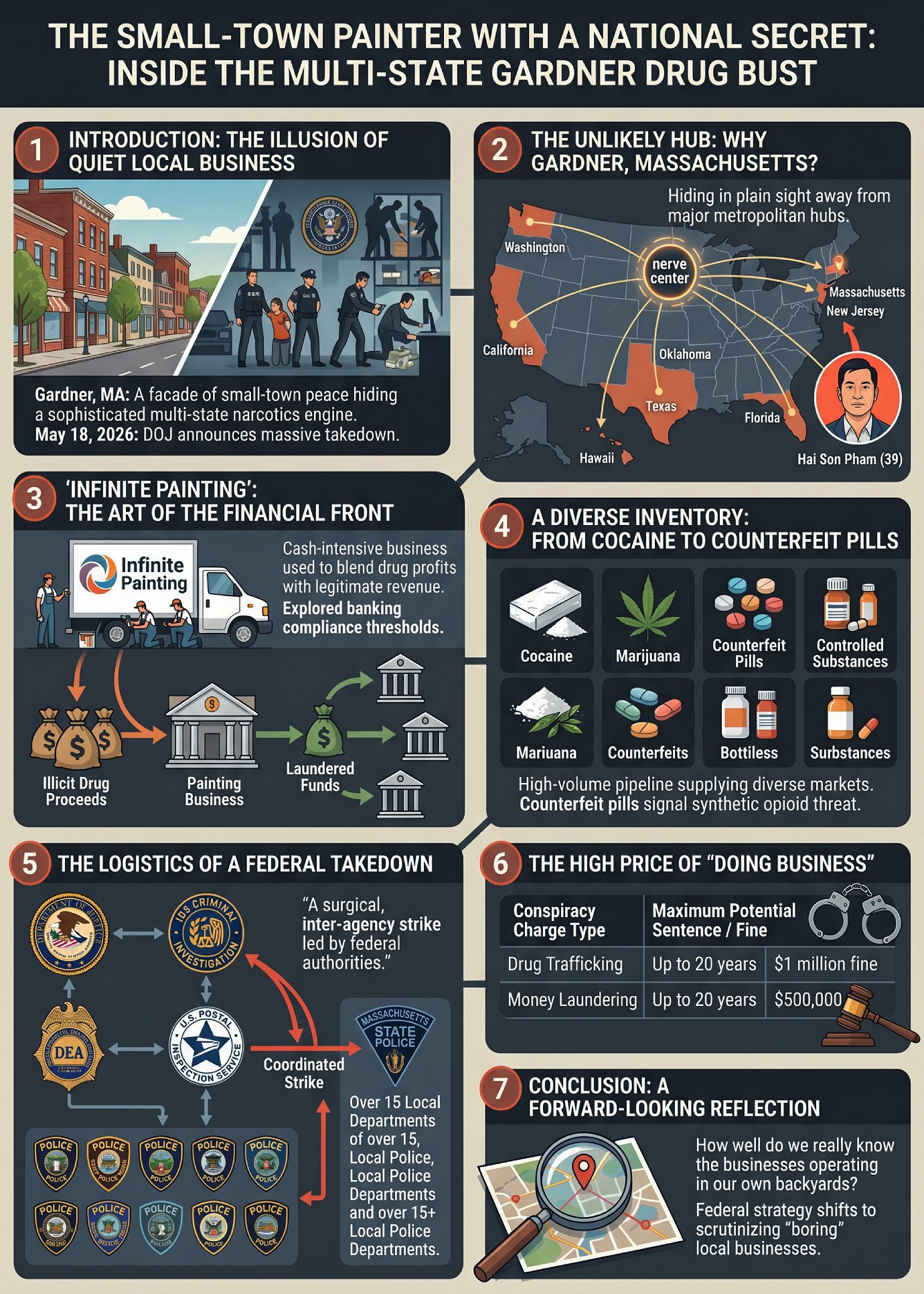
Feds Nab 18 in Multi-State Gardner MA Drug Bust
An unusual Federal Bust has nabbed18 Defendants on various charges in conjunction with an alleged drug trafficking and money laundering scheme including 9 from North Central MA. According to the Press Release, the scheme was coordinated by a man in Gardner. See Press Release from the U.S. Department of Justice.
Gardner is a landscape of brick facades and quiet residential streets that suggest a slow, predictable rhythm of life. But according to federal investigators, that mask hid a sophisticated multi-state narcotics engine. On May 18, 2026, the Department of Justice shattered this image of small-town peace with the announcement of a massive takedown: 18 individuals arrested across seven states, all linked to a narcotics trafficking and money laundering syndicate. This was not a street-corner operation; it was a sprawling criminal enterprise that allegedly utilized a local trade business to bridge the gap between small-town North Worcester County and the distant shores of Hawaii.The Unlikely Hub: Why Gardner, Massachusetts?
In the world of high-stakes drug trafficking, major urban ports and border cities are the expected nodes of power. Yet, federal authorities allege that the “nerve center” of this conspiracy was nestled in the heart of Gardner. At the center of the indictment stands Hai Son Pham, a 39-year-old Gardner resident who allegedly directed a network that metastasized across the country.
The reach of this organization was counter-intuitive, proving that in the digital and logistics-heavy modern era, a kingpin can operate from a quiet suburb as easily as a skyscraper. According to the charging documents, the network managed logistics and distribution across eight different states: “Massachusetts, New Jersey, Florida, Oklahoma, California, Texas, Washington and Hawaii.” By centering operations in North Worcester County, the organization likely sought to exploit the lower profile of a small community, effectively “hiding in plain sight” away from the high-intensity federal task forces that saturate major metropolitan hubs.
To the neighbors, it was likely just another local service provider—a commercial and residential painting company. But federal investigators allege that Infinite Painting, a business registered and controlled by Hai Son Pham, served a far more cynical purpose. The company is accused of being the primary vehicle for laundering drug proceeds through multiple financial institutions.
In the analytical view of a financial crimes investigator, a painting company is a brilliant, albeit “boring,” choice for a front. These businesses are cash-intensive, have fluctuating material costs, and utilize a rotating labor force—variables that provide the perfect cover for blending illicit drug profits with legitimate revenue. This was not a simple “cash-under-the-mattress” scheme; it was a calculated attempt to exploit the banking system’s compliance thresholds by masking the origin of millions of dollars in narcotics transactions.
Diverse Inventory: From Cocaine to Counterfeit Pills
The scale of the “inventory” allegedly moved by the Pham organization suggests a high-volume pipeline capable of supplying diverse markets across the country. The Department of Justice alleges the conspiracy was responsible for distributing “large quantities” of substances that reflect both traditional demands and modern synthetic threats.
The identified substances include: Cocaine, Marijuana, Counterfeit pills, and other controlled substances. The presence of counterfeit pills is particularly telling. In today’s illicit market, these pills are often the delivery mechanism for high-potency synthetic opioids, signaling that the Gardner-based organization was tapped into the most dangerous and profitable sectors of the national drug trade.
The investigation was a masterclass in jurisdictional cooperation, led by the U.S. Attorney’s Office, the IRS Criminal Investigation unit, and the DEA. The sheer complexity of the takedown was illustrated by the involvement of the U.S. Postal Inspection Service, the Massachusetts State Police, and a coalition of over 15 local police departments—including Worcester, Gardner, Leominster, Fitchburg, Clinton, Lunenburg, Hopkinton, Westminster, Ashburnham, Winchendon, Templeton, Phillipston, Boylston, Sterling, and Weymouth.
“United States Attorney Leah B. Foley; Thomas Demeo, Special Agent in Charge of the Internal Revenue Service, Criminal Investigation, Boston Field Office; and Jarod A. Forget, Special Agent in Charge of the Drug Enforcement Administration, New England Field Division made the announcement today.”
- Boudreau 5-17-26 (5/18/2026)
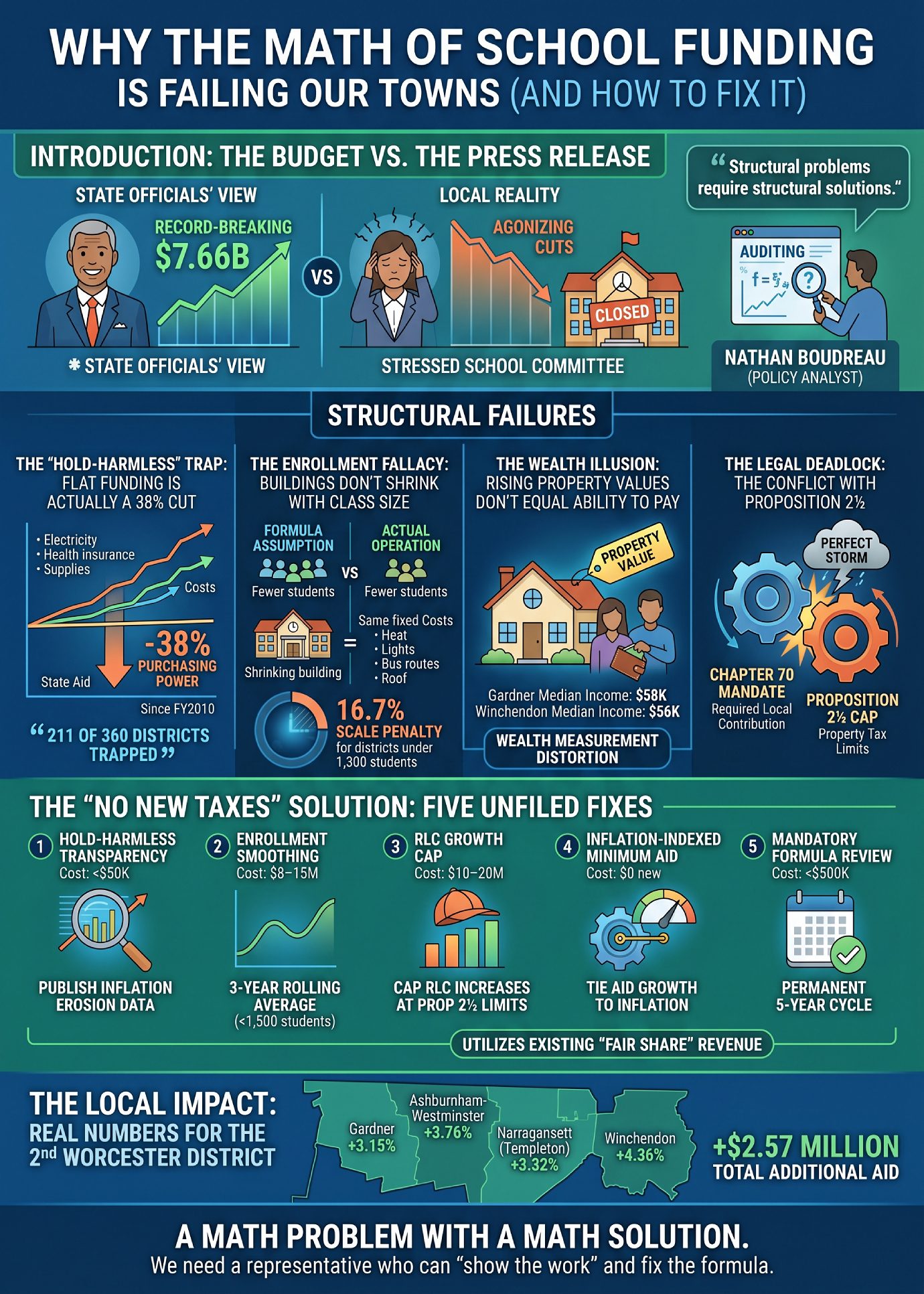
Boudreau Proposes Specific Fixes to Chapter 70 Funding Formula
Former Gardner City Councilor, former Hubbardston Town Administrator, and Public Logic Founder Nathan Boudreau hasn’t won the seat in the 2nd Worcester District yet. In fact, the primary is not until September. But, Boudreau is positioning himself to hit the ground running should he win with very specific proposals to help fix some funding issues in the 2nd Worcester District. Read the Press Release of May 17, 2026, CLICK HERE. Note that in our graphic, Westminster is shown – it is in a School District with Ashburnham, but not part of the 2nd Worcester District itself.
Gardner Magazine’s Max and Maxine Rogers debate the finer points of Boudreau’s proposal and their discussion explains things in a way we can all understand. Listen on any device, CLICK PLAY.
DEBATE – Nathan Boudreau Policy Proposals State officials often celebrate “record-breaking” education investments, pointing to a statewide appropriation that has reached approximately $7.66 billion. But in the 2nd Worcester District, those press-release victories feel like a different language. While the capital celebrates, our local school committees are forced to make agonizing cuts to staff and programs.
This disconnect isn’t a matter of local mismanagement; it is a structural failure written into the code of the state’s Chapter 70 funding formula. Nathan Boudreau, a candidate for State Representative and a public policy analyst, recently went through the formula line by line to audit its impact on our specific towns. His conclusion is clear: “Structural problems require structural solutions.” To fix a system that is mathematically designed to leave small-city and rural districts behind, the person we send to Boston must be a worker-candidate who can “show the work” on day one.
Boudreau has drafted five specific, unfiled amendments that address the formula’s core failures. Crucially, these require no new taxes and do not take money away from other districts; instead, they utilize existing “Fair Share” revenue—the millionaire’s tax surtax already earmarked for education in the state budget.
- Hold-Harmless Transparency (Cost: <$50K): Amends c.70, s.6 to require the state to publish the inflation-adjusted erosion data it already calculates, making the 38% loss of purchasing power a visible part of the budget debate.
- Enrollment Smoothing (Cost: $8–15M): Amends c.70, s.3 to use a three-year rolling enrollment average for districts under 1,500 students, preventing sudden budget shocks when a handful of families move away.
- RLC Growth Cap (Cost: $10–20M): Amends c.70, s.3 to cap required local contribution increases at the legal limits set by Proposition 2½, ending the “Perfect Storm.”
- Inflation-Indexed Minimum Aid (Cost: $0 new): Restructures the existing $52.2M Fair Share supplement to ensure that minimum aid growth is tied to actual inflation.
- Mandatory Formula Review (Cost: <$500K): Amends c.70, s.4 to force the Foundation Budget Review Commission into a permanent five-year cycle with a mandatory 180-day legislative response requirement.
The Local Impact: Real Numbers for the 2nd Worcester District
These aren’t just abstract policy goals; they represent a combined $2.57 million in additional aid for the schools. Gardner Magazine has offered to interview Nathan Boudreau about his plans and we will make that interview available to you as soon as we do it.
- Vision Zero 5-13-26 (5/18/2026)
Update 5-20-26: This is the link to the Gardner Safety Action Plan page. It is loaded with information and Gardner Magazine highly recommends viewing it, CLICK HERE. Also, here is the form to sign up for the Mailing List, CLICK HERE.
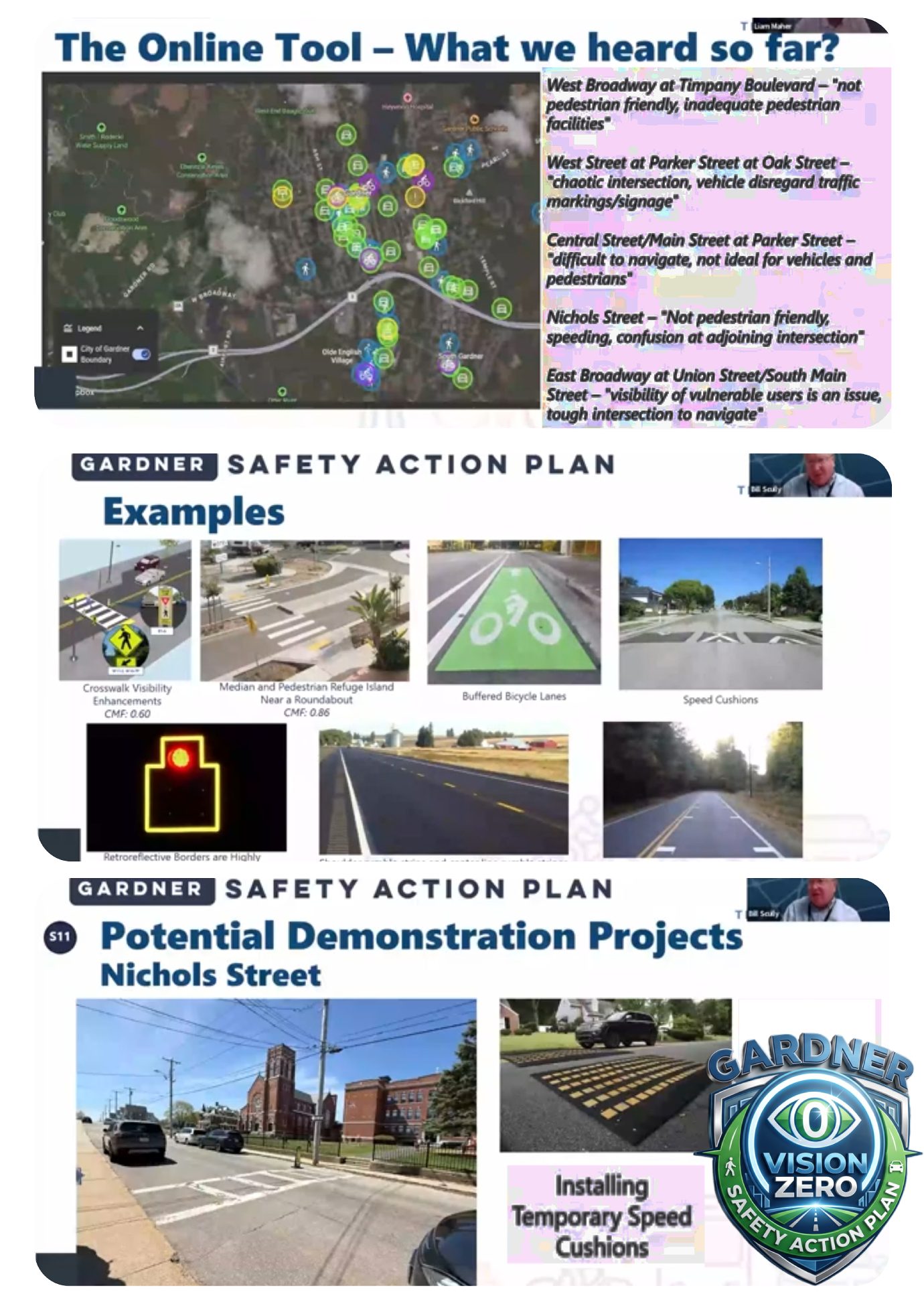
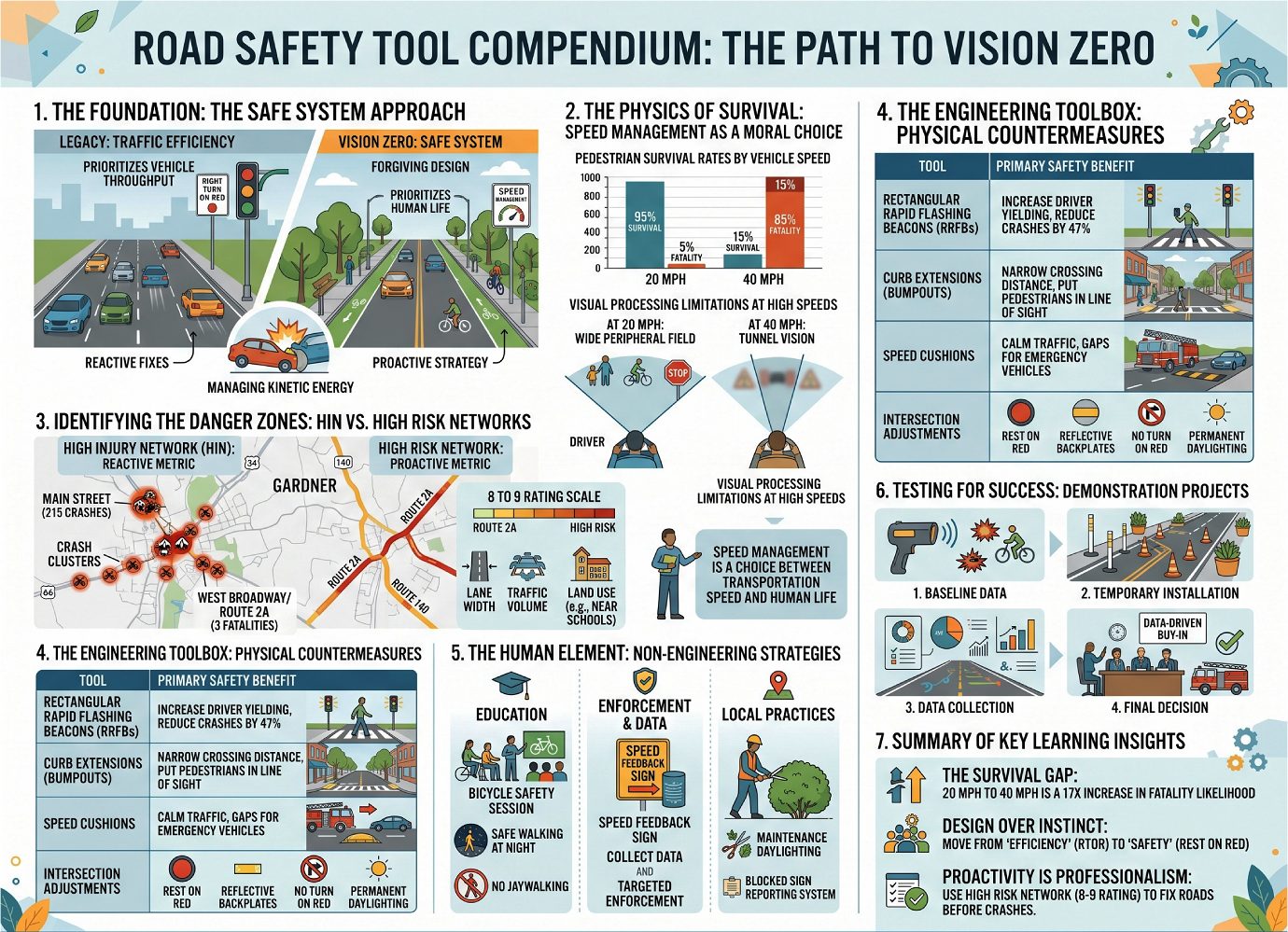
Road Safety Tool Compendium – CLICK IMAGE for larger view Committee Transitions from Data Analysis to Identification of Safety Countermeasures
The Gardner Vision Zero Action Committee meeting on May 13, 2026 made the transition from simply analyzing past data to proactive future safety measures. Listen to the meeting on any device, CLICK PLAY.
Vision Zero Meeting 5-13-26 Central to the project is the development of a High Injury Network (HIN), which identifies specific roadway segments and intersections where fatal and serious injury crashes are concentrated.
Key findings indicate that speed is the primary factor affecting crash severity in Gardner, with data showing that a pedestrian’s survival rate drops from 95% at 20 mph to only 15% at 40 mph. Public outreach efforts have successfully garnered over 120 comments, highlighting critical safety concerns at intersections like Parker Street and West Broadway.
Moving forward, the committee aims to implement “demonstration projects”—specifically temporary speed cushions—to test the effectiveness of traffic calming measures before permanent installation.
The project is on track to produce a final Safety Action Plan by the end of the year.

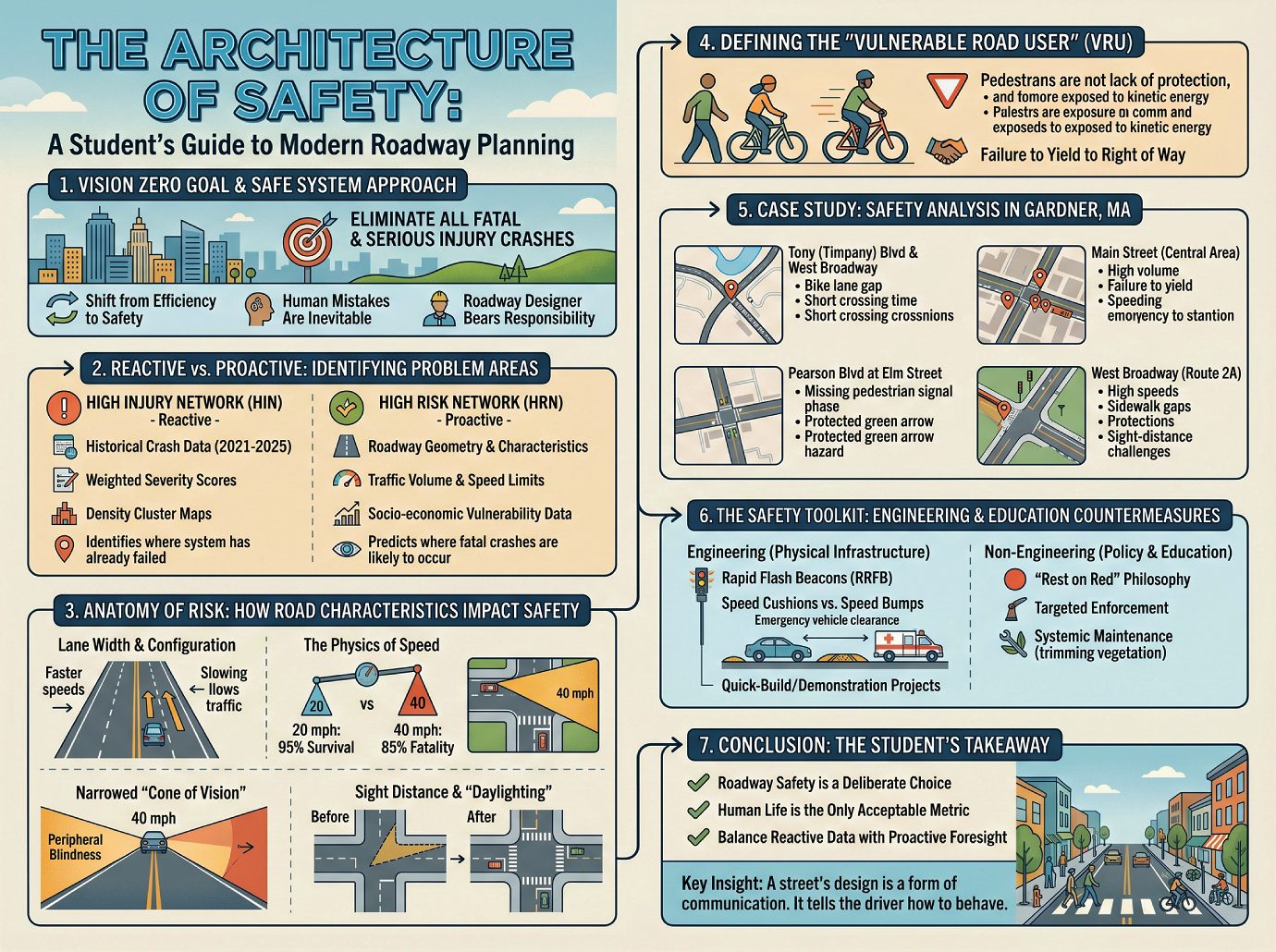
Architecture of Safety – CLICK IMAGE for larger view 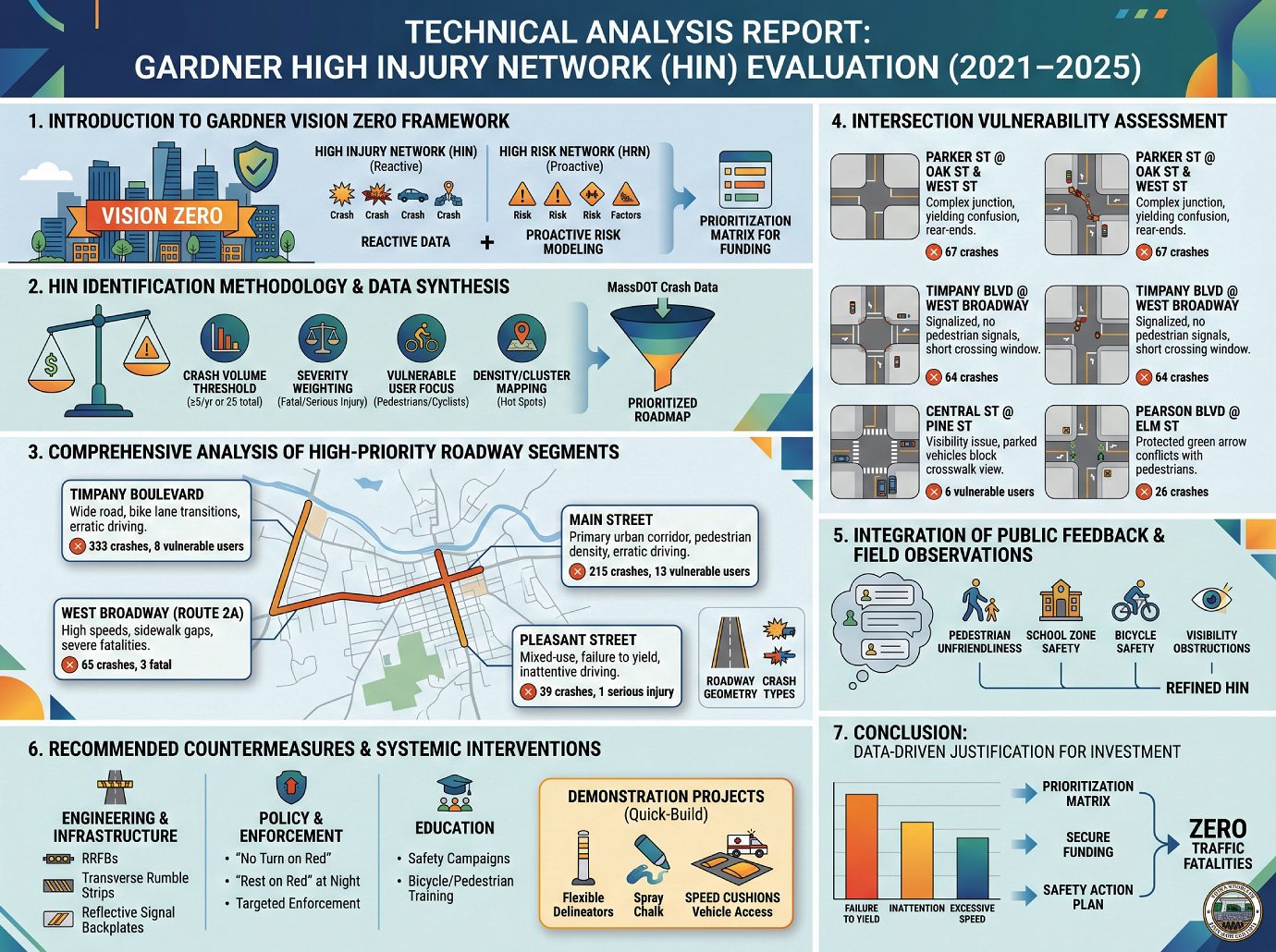
Technical Analysis Report – CLICK IMAGE for larger view. Key Public Concerns
- Route 2: Cited as unfriendly for bicyclists.
- Speeding: Specifically noted along Pearl Street (near schools) and Chestnut Street.
- Pedestrian Facilities: Lack of adequate crossings at West Broadway and Timpany Boulevard.
- Driver Behavior: Confusion regarding yielding at the intersection of West, Parker, and Oak Streets.
Primary Roadway Segments of Concern
Segment Crash Statistics Key Contributing Factors Timpany Blvd 333 total crashes; 8 vulnerable users Wide roads, failure to yield, improper lane use. Main Street 215 total crashes; 13 vulnerable users High pedestrian volume, careless operation, speeding. West Broadway 65 total crashes; 3 fatal injuries Sight distance issues, sidewalk gaps, speeding. Pleasant Street 39 total crashes; 5 vulnerable users Inattention, disregard for traffic signals. Critical Intersections
- Parker, Oak, and West Streets: 67 crashes, including 3 serious injuries. Issues include rear-end collisions near crosswalks and challenging geometry.
- Timpany Blvd at West Broadway: 64 crashes. Identified lack of pedestrian signal heads and insufficient “protected” crossing time (only 15–20 seconds).
- Pearson Blvd at Elm Street: Concerns regarding a “protected” green arrow that may lead to driver inattention toward exiting vehicles and pedestrians.
- Central St at Pine St: 17 crashes; 6 involving vulnerable users. Proximity to bus stops and visibility issues due to parked cars were noted.
Additional Resources
- SS4A Program https://www.transportation.gov/grants/SS4A
- Safe System Approach https://www.transportation.gov/NRSS/SafeSystem
- Comprehensive Regional Safety Action Plan https://www.mrpc.org/safetyactionplan
- VisionZeroNetwork https://visionzeronetwork.org/about/what-is-vision-zero/
- City of Gardner Safety Action Plan Page: https://www.gardner-ma.gov/1512/Gardner-Safety-Action-Plan
- To Contact City Engineer Rob Olivia directly via email: roliva@gardner-ma.gov
- Top Movies – 100 Years (5/18/2026)

View our complete report page, CLICK HERE which contains a comprehensive analysis, identifies 7 Surprising Truths that defined cinema history, and an analysis of genre evolution. We also include infographics and a short VIDEO.
Gardner Magazine Reports – The Top Movies of the Last 100 Years
Our complete report page, CLICK HERE, examines various aspects of movies. If you love movies, this is for you. From the age of Silent Films to the age of Artificial Intelligence, movie making has evolved over the last 100 years.
Jump to a section: A Comprehensive Analysis of Cinematic Landmarks: From Silent Era Foundations to 21st-Century Classics — More Than Just Movies: 7 Surprising Truths That Defined Cinema History —-A Century of Cinema: A Decadal Analysis of Genre Evolution and Commercial Success (1920–2020)
Listen to this “Deep Dive” podcast with the Chair Man and the Chair Lady on any device.
DEEP DIVE – Top Movies of the Last 100 Years Listen to this “Debate” with Max and Maxine Rogers on any device.
DEBATE: Movie Mass Appeal vs. Artistic Innovation
- Weekly Briefing 5-17-26 (5/17/2026)
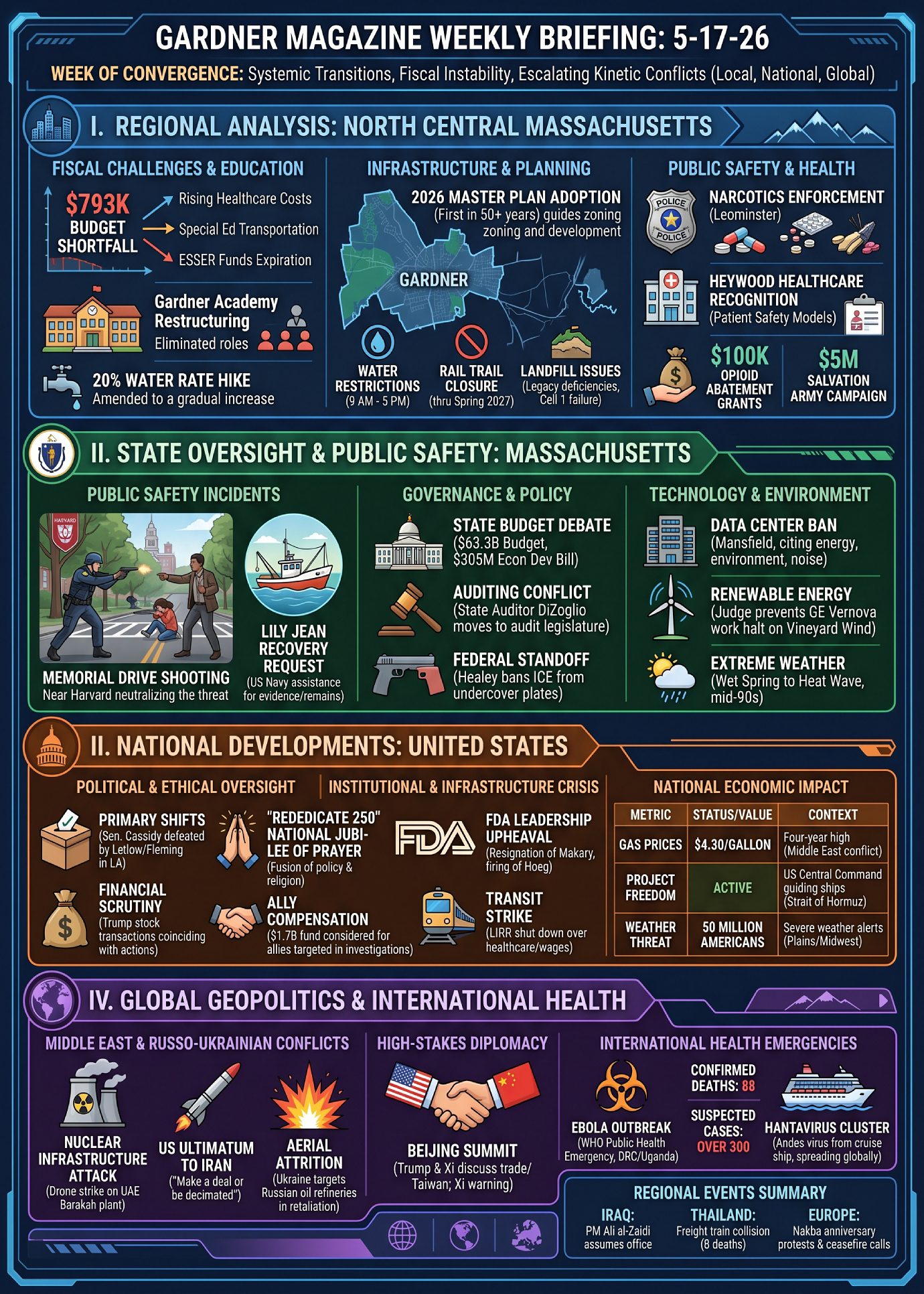
A Weekly Briefing from Gardner Magazine – May 17, 2026
The Chair Man and the Chair Lady discuss the news of the week including Greater Gardner MA, North Central MA, the State of Massachusetts, National News, and World News. They tie it all together in a great podcast. Listen on any device, CLICK PLAY.
DEEP DIVE – Weekly Briefing 5-17-26 Gardner Magazine has 4 separate additional sections covering North Central MA News, a Massachusetts News Roundup, U.S. National News, and World News, all updated on May 17, 2026, this week with some additional infographics
JUMP TO SECTION: North Central MA News — State News of the Week —- National News of the Week — World News of the Week
- Public Safety 5-15-26 (5/16/2026)
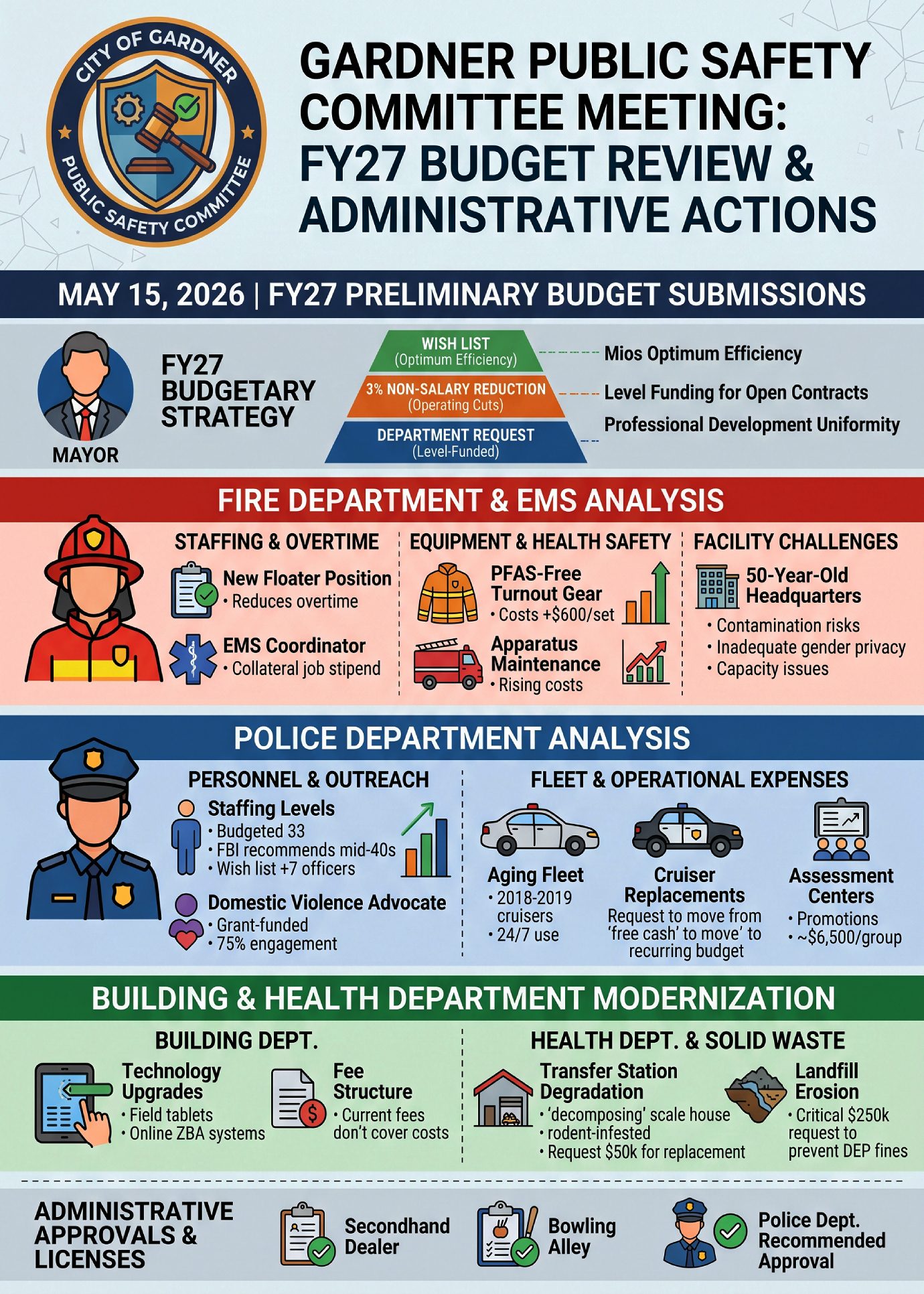
Fire, Police, Building, and Health Department Budgets and Initiatives Discussed at Public Safety Meeting
The Gardner Public Safety Committee met on May 15, 2026. Listen on any device, CLICK PLAY.
Public Safety 5-15-26
The Fire Chief highlighted the need for a new “floater” position to mitigate rising overtime costs and discussed critical facility repairs. Meanwhile, the Police Chief advocated for increasing the force to reach recommended staffing levels while addressing aging vehicle fleet concerns. Building and Health department heads also presented their funding requests, focusing on modernization through technology and necessary maintenance for the city’s landfill and public structures.
Budgetary Framework: The Mayor’s office utilized a three-tier budget request system (Wish List, 3% Non-Salary Reduction, and Level-Funded) to identify both operational necessities and ideal growth paths.
Personnel & Staffing: The Fire Department is proposing a new “floater” position to reduce long-term overtime, while the Police Department is seeking to move closer to FBI-recommended staffing levels.
Infrastructure Deficiencies: The Fire Department’s 50-year-old headquarters faces significant space, contamination, and gender-privacy issues. Similarly, the Health Department reported that the transfer station facilities are “decomposing” and rodent-infested.
Equipment & Modernization: There is a strong emphasis on transitioning to PFAS-free protective gear for firefighters and a request from the Police Department to shift cruiser replacements from sporadic “free cash” funding to a predictable annual budget item.
Environmental Liability: A high-priority request of approximately $250,000 was made to address erosion at the capped landfill to prevent accruing daily fines from the Department of Environmental Protection (DEP).Gardner Mayor Michael Nicholson provided an overview of the preliminary FY27 budget process. Key financial principles guiding the current cycle include:
- Level Funding for Open Contracts: Departments with active collective bargaining negotiations are level-funded for those specific line items. Appropriations will be adjusted once contracts are signed.
- Professional Development Uniformity: The city is working toward a consistent system across all departments for professional development and travel line items to ensure equity and oversight.
- Three-Tier Submission: Department heads were required to submit three scenarios:
- Wish List: Funding required for optimum efficiency and effectiveness.
- 3% Non-Salary Reduction: Potential cuts to operating expenses.
- Department Request: A level-funded budget necessary to maintain current FY26 operations.
Fire Department and EMS Analysis: The Fire Department’s submission emphasized a shift toward proactive staffing and the remediation of hazardous facility conditions.
- New Floater Position: The Mayor and Fire Chief Greg Lagoy proposed funding a “group floater” (private-level firefighter). Historical data from a 2013-2014 study suggests this position pays for itself by reducing the need for overtime to cover sick leave and vacancies.
- EMS Coordinator: Currently a “collateral job” stipend position, the Chief and Mayor agree this should eventually become a full-time role to manage reporting requirements. However, the Mayor is deferring this change until the next ambulance contract is finalized to ensure revenue stability.
- Overtime Realities: The department requested $400,000 for overtime, which is considered the minimum required to backfill short-term leave, assuming no long-term vacancies or injuries occur.
- PFAS Remediation: The department has successfully disposed of PFAS-containing foam. New turnout gear orders are now “PFAS-free” to reduce carcinogen exposure, though this adds approximately $600 in cost per set.
- Apparatus Maintenance: Repair costs are rising due to increased labor rates and parts costs for aging vehicles.
- The 50-year-old fire headquarters was identified as inadequate in several areas.
- Contamination Risks: Lack of dedicated decontamination zones forces firefighters to store gear in living quarters, increasing the risk of cross-contamination.
- Gender Inclusivity: The facility lacks adequate private bathroom and shower facilities for female employees, with only one shared multi-bay bathroom on the second floor.
- Capacity: The department still utilizes the deteriorating South Gardner station for storage because the main headquarters cannot house all apparatus and trailers.
Police Department: The Police Department’s budget focus remains on addressing a long-term staffing deficit and modernizing fleet management.
- Staffing Levels: The department is currently budgeted for 33 officers. Police Chief Eric McAvene noted that FBI recommendations suggest the city should have in the mid-40s. A “wish list” request for seven additional officers was made to reach a total of 40.
- Domestic Violence Advocate: This position is funded by a year-to-year grant. The Chief highlighted its criticality, noting that the advocate has a 75% engagement rate with victims, a level of follow-up that uniformed officers cannot provide.
- Recruitment: The department has seen a recent uptick in highly qualified and diverse applicants for open academy slots.
- Aging Fleet: The department is operating cruisers from 2018 and 2019 that run 24/7.
- Funding Shift: The Chief requested that cruiser replacements (averaging 80,000–90,000 per outfitted vehicle) be moved to a recurring budget line item rather than relying on irregular “free cash” appropriations.
- Assessment Centers: Since moving out of Civil Service, the department utilizes assessment centers for promotions to ensure a fair, “double-blind” process, costing approximately $6,500 per group.
Building Department Modernization
- Structural Separation: A long-term goal is to separate the Building Department from Public Building Maintenance to improve operational focus.
- Technology Upgrades: The department is pushing for field technology (tablets) and online systems for the Zoning Board of Appeals (ZBA) to reduce paper costs and streamline resident interactions.
- Fee Structure: Building Commissioner Melissa MacDonald noted that current permitting fees do not adequately cover inspectional and administrative costs, suggesting a future proposal for fee adjustments.
Health Department and Solid Waste
- Transfer Station Degradation: Health Director Lauren Saunders described the current scale house as “decomposing” and rodent-infested. A request for $50,000 was made to replace dilapidated sheds with a single container-office to provide basic climate control and hygiene for staff.
- Landfill Erosion: A critical request for $250,000 was submitted to repair significant erosion at the capped landfill. This project was deferred last year to handle an emergency pump repair. The DEP is currently monitoring the site, and further delays could lead to daily fines.
- Administrative Anomaly: The Director noted that it is a “rarity” for a Health Department to oversee a capped landfill, a task typically handled by the Department of Public Works (DPW).
- Hubbardston Select Board Votes on Administrator (5/16/2026)
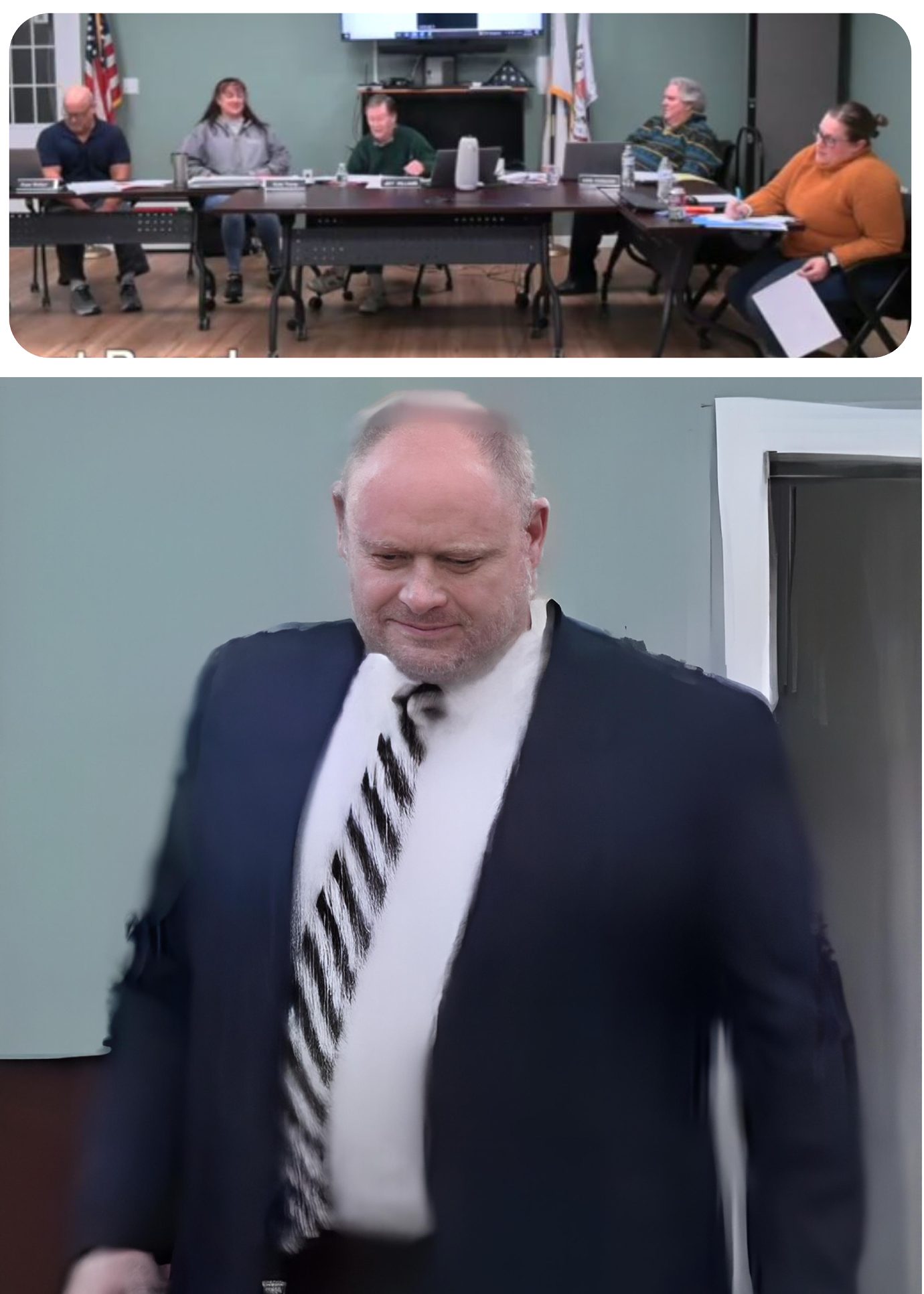
Listen to the meeting of May 15, 2026 on any device, CLICK PLAY.
Hubbardston Select Board 5-15-26 If you wish to listen to the interviews with all 3 candidates, here is the meeting of May 11, 2026, ,CLICK PLAY.
Hubbardston Select Board 5-11-26 Hubbardston Select Board Chooses Alex MaGee for Town Administrator
At the Hubbardston Select Board meeting of May 15, 2026, The Board voted 3-1 to offer the position to Alex MaGee, (pictured) subject to contract negotiations and a comprehensive background check.
The Board rejected a prior motion for Gardner City Councilor Elizabeth Kazinskas (1-3) who was one of the three final candidates from an original field of over 70 applicants.
Regarding Alex McGee, The Board highlighted his Master of Public Administration, his experience as a Finance Director (Hamilton), and his roles in larger municipalities like Andover, Arlington, and Lowell as positive factors in making the choice.
Negotiation Strategy:
- a conditional offer was sent via email immediately following the vote offering the position of Town Administrator to Alex McGee.
- The Board will use historical TA contracts as a template for negotiations.
- The Board rejected a proposal to have a subcommittee negotiate, opting instead for a full Board executive session to ensure transparency and consensus on salary (advertised range: $130,000–$150,000) and benefits.
- Hotline 5-16-26 (5/16/2026)

The WGAW Hotline Show of May 16, 2026 featured a commentary by Werner Poegel on the Gardner Landfill. It is provided separately for your convenience.
WGAW Hotline Radio May 16, 2026
Listen to the entire show on any device, CLICK PLAY.
WGAW Hotline Radio 5-16-26 First up: Gardner Mayor Michael Nicholson’s FULL May Update –
“The Dump” – Commentary by Werner Poegel featuring the $10 sticker deal going on right now through the end of June and a complete report on the Gardner Landfill and how it all works.
—Community Event Announcement with Steve Wendell – –Host Steve Wendell interviewed Steve Schultze from the Berkshire Veterans Outreach Center, Schultz is a retired marine who served from 1997 to 2019 and then retired. Upon retirement, Schultze founded the Berkshire Veterans Outreach Center. Website, CLICK HERE.
Mike Urban Commentary on the State Audit Issue —-An Interview with Mayor Michael Nicholson from the May 9th Show. —Mike Urban on Overrides from past show.
Here’s that commentary on “The Dump” with Werner Poegel, listen on any device, CLICK PLAY.
THE DUMP – Commentary from Werner Poegel 5-16-26
- One Hit Wonders (5/15/2026)

An interesting experiment. What are the 1 Hit Music Wonders going back 300 years? Visit the complete page of reports covering the period of 1702 to 2026, CLICK HERE.
One Hit Music Wonders – 1702 to 2026 – A Gardner Magazine Report and Experiment
The One Hit Music Wonder: Does it Date Back to Before Recorded Music? Gardner Magazine went back 300 years to before the American Revolution and has a complete page of reports by time period, infographics, a Deep Dive, a Debate, and a Video. It’s a cool, interesting topic.
Listen to a “Deep Dive” podcast with the Chair Man and the Chair Lady on any device, CLICK PLAY.
DEEP DIVE – One Hit Wonders Listen to a “Debate” with Max and Maxine Rogers on what constitutes a “One Hit Wonder” on any device, CLICK PLAY.
DEBATE – Defining One Hit Wonders Defining a one-hit wonder requires a rigorous analysis of chart data. While the general public often uses the term colloquially, music historians and analysts utilize specific—and sometimes conflicting—technical criteria to categorize these artists. Visit the complete page of reports covering the period of 1702 to 2026, CLICK HERE.
- Rail Trail Closures Effective 5-18-26 (5/15/2026)
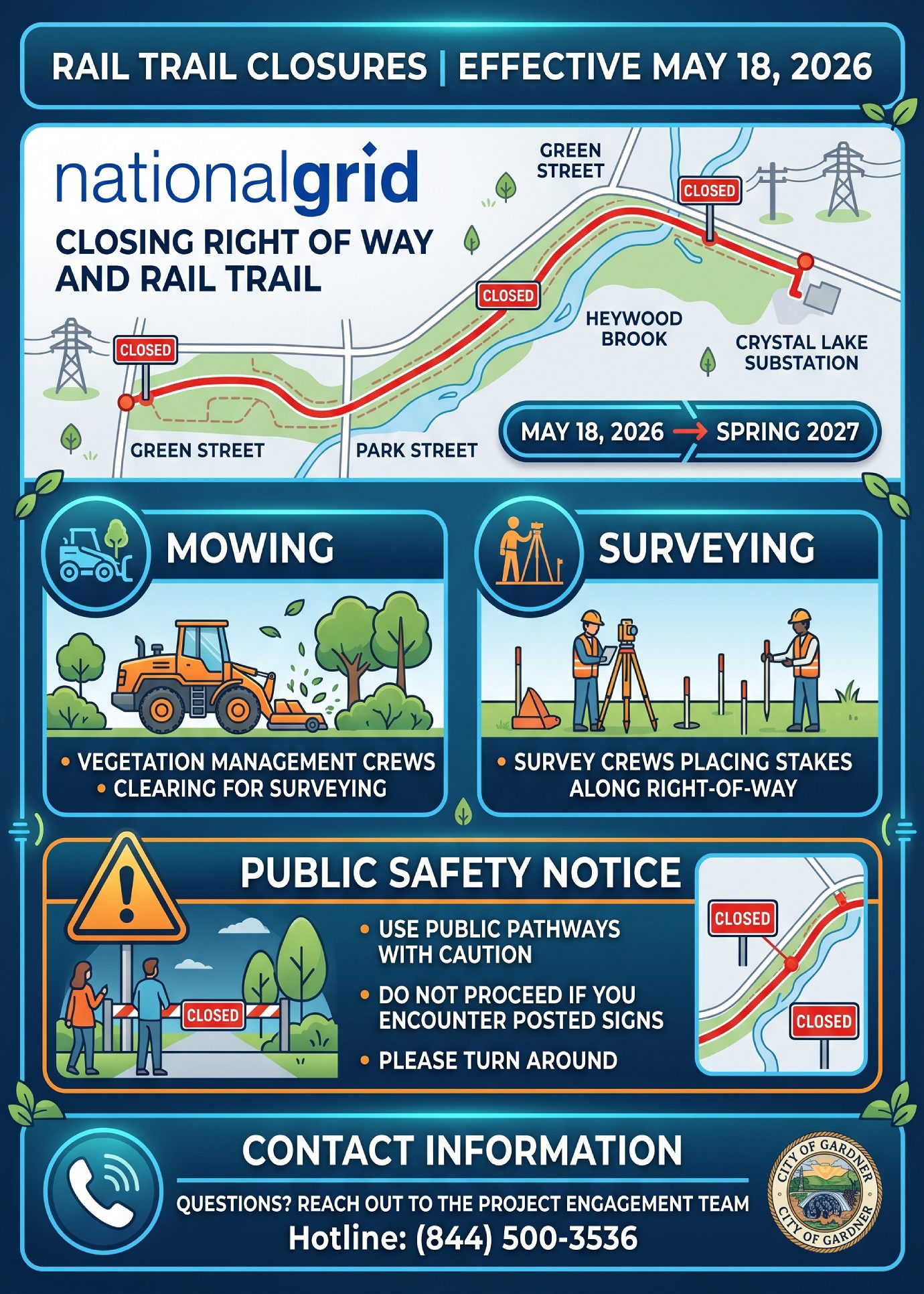
National Grid Closing Right of Way and Rail Trail
The City of Gardner announced that National Grid will be closing the right-of-way and the rail trail located within it beginning Monday, May 18, 2026. The public is advised to avoid the Heywood Brook and Rail Trail, beginning at Green Street and continuing through Park Street to the Crystal Lake Substation, for the duration of the closure. The closure is expected to remain in effect through Spring 2027. Additional information about the work being performed and updates on the closure timeline will be shared as it becomes available.
Upcoming work beginning May 18, 2026:
Mowing: Vegetation management crews will be working within the National Grid right-of-way using large equipment to clear vegetation in preparation for surveying. Surveying: Survey crews will place stakes along the right-of-way.
Public Safety Notice: For your safety, please use public pathways with caution. If you encounter posted signs indicating you are approaching the close right-of-way, do not proceed – please turn around. While there are many trails in the wooded areas of Gardner, the public is advised to avoid the Heywood Brook and Rail Trail, beginning at Green Street and continuing through Park Street to the Crystal Lake Substation, for the duration of the closure.
Contact Information: If you have any questions or would like additional information, please reach out to the project engagement team by calling this toll-free Hotline: (844) 500-3536.
- Heywood Safety (5/14/2026)
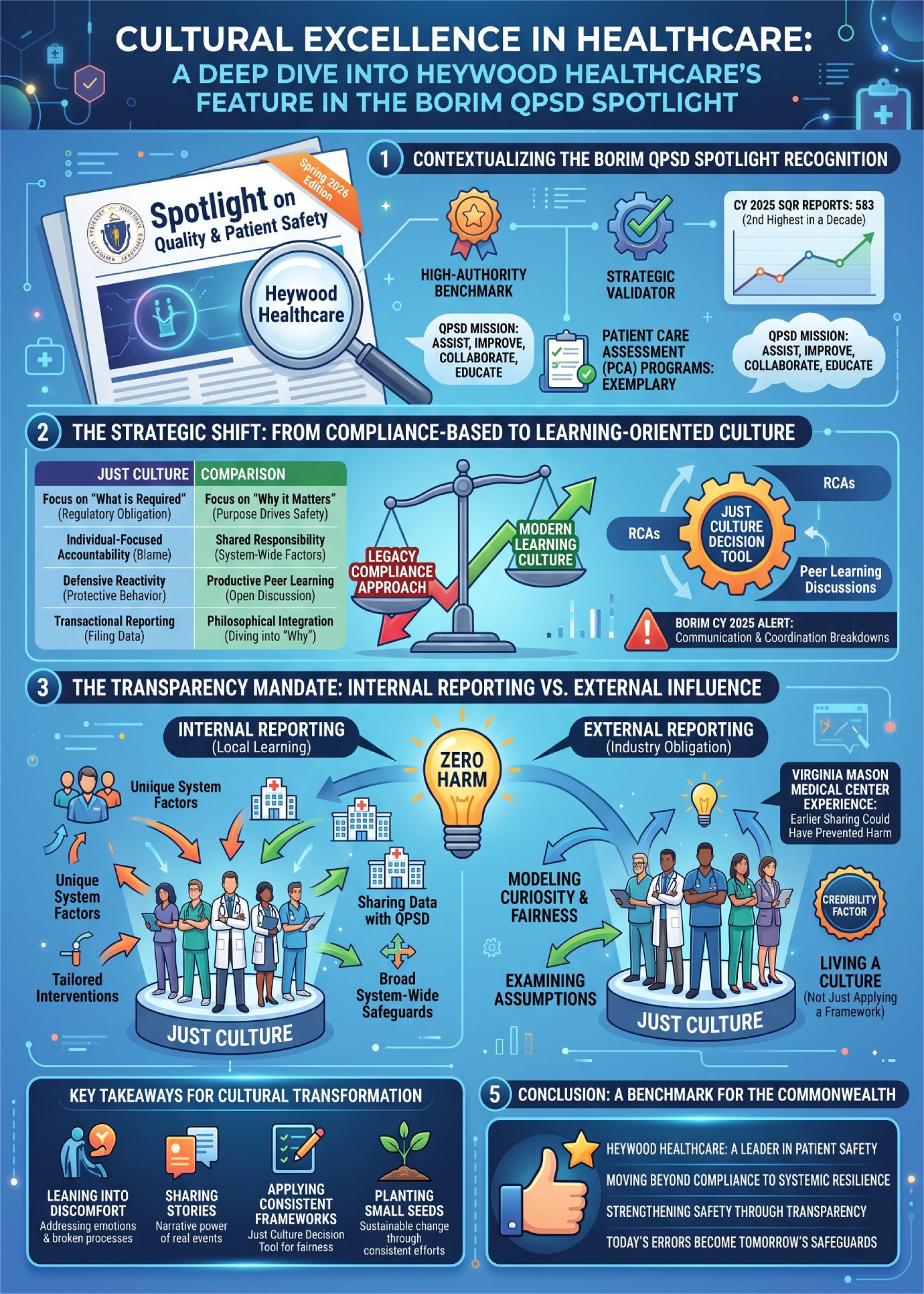
Once again, another accolade contributing to Gardner’s distinction as the “Model City for America” as Heywood Healthcare is featured as a great model for patient safety by the Massachusetts Board of Registration in Medicine. Congratulations, Heywood Healthcare! Copy of above graphic in printable letter size, CLICK HERE.
Heywood Healthcare Featured for Quality and Safety
The Chair Man and the Chair Lady speak of Heywood’s culture of excellence in healthcare in the context of Heywood being featured in the Massachusetts Board of Registration in Medicine’s Spring 2026 Quality and Patient Safety Newsletter. Listen on any device, CLICK PLAY.
DEEP DIVE – Heywood – Excellence in Safety – Spring 2026 Here’s a copy on PDF of the State Newsletter in which Heywood is so prominently featured, CLICK HERE.
Heywood Healthcare posted: “We’re proud to share that Heywood Healthcare has been featured in the Massachusetts Board of Registration in Medicine’s Spring 2026 Quality and Patient Safety Newsletter! This issue highlights important work across the Commonwealth, including our contribution, “From Compliance to Learning: Strengthening Safety through Transparency.” It reflects our continued commitment to building a strong safety culture, fostering transparency, and learning from every experience to improve patient care.”
The “Spotlight on Quality & Patient Safety,” issued by the Massachusetts Board of Registration in Medicine (BORIM) Quality & Patient Safety Division (QPSD), represents the high-authority benchmark for clinical excellence within the Commonwealth. More on this below.
Purpose of the State Report: This report from the Massachusetts Board of Registration in Medicine examines patient safety data collected throughout 2025 to improve healthcare quality across the state. The findings highlight that while most reported incidents resulted in temporary harm, critical issues remains regarding surgical complications, diagnostic delays, and medication errors. Analysis reveals a concerning demographic disparity, noting that while minority populations often face higher risks, they are frequently underrepresented in voluntary safety reporting. The document also identifies communication breakdowns as a primary driver of adverse events and advocates for increased transparency and safety culture within medical facilities. By sharing these trends and specific case data, the Board aims to foster a collaborative environment where providers can learn from mistakes to prevent future medical errors.Why Heywood’s Inclusion is so Prestigious
The “Spotlight on Quality & Patient Safety,” issued by the Massachusetts Board of Registration in Medicine (BORIM) Quality & Patient Safety Division (QPSD), represents the high-authority benchmark for clinical excellence within the Commonwealth. For healthcare leadership, a feature in this publication is a significant strategic validator, signaling that an organization’s Patient Care Assessment (PCA) programs—spanning quality assurance, peer review, and risk management—are not merely functional, but exemplary.
The QPSD’s role is to provide the “ground truth” for safety standards, serving as both a regulator and a collaborative partner in clinical improvement.
“QPSD Mission is to assist Massachusetts healthcare facilities in maintaining and improving systems for patient care that are evidence and team-based, sustainable, safe, and inclusive. We achieve this by reviewing data, listening, collaborating, and educating teams in healthcare facilities throughout the state.”
The prestige of Heywood Healthcare’s feature in the Spring 2026 edition is contextualized by a high-stakes, high-volume data landscape. In CY 2025, the QPSD managed 583 Safety & Quality Review (SQR) reports documenting 692 unexpected events. Critically, these 583 reports—which notably exclude aggregate patient falls and pressure injuries—mark the second-highest volume of reporting in nearly a decade, surpassed only by the 589 reports filed in 2019. In an environment of such high clinical volatility, Heywood Healthcare has distinguished itself not just by reporting data, but by providing a strategic blueprint for cultural evolution.
The Heywood Culture of Excellence Revealed in Detail
Heywood Healthcare’s evolution reflects a transition from rigid accountability to a sophisticated model of shared responsibility:
Legacy Compliance Approach Modern Learning Culture Focus on “What is Required”: Viewing reporting solely as a regulatory obligation. Focus on “Why it Matters”: Emphasizing the purpose behind the standard to drive safety. Individual-Focused Accountability: Identifying a person to blame for clinical deviations. Shared Responsibility: Integrating “Just Culture” to explore system-wide factors. Defensive Reactivity: Protective behavior during event reviews and investigations. Productive Peer Learning: Open discussions focused on identifying system vulnerabilities. Transactional Reporting: Filing data points to meet state-mandated deadlines. Philosophical Integration: Diving into the “why” behind the safety philosophy. This cultural shift is operationalized through the Just Culture Decision Tool. By integrating this framework into Root Cause Analyses (RCAs) and Peer Learning Discussions, Heywood has successfully neutralized the fear of retribution. This is a direct strategic response to the current clinical climate; as BORIM’s CY 2025 Patient Safety Alert highlights a statewide trend in communication and coordination breakdowns, Heywood’s move to lower defensive barriers serves as a prerequisite for solving the very transparency issues currently challenging the Commonwealth.
Heywood as a Benchmark for the Commonwealth in the “Model City for America”
Heywood Healthcare’s feature in the Spring 2026 Spotlight reinforces its status as a leader in patient safety within Massachusetts. In an era where SQR reporting volumes are at near-historic highs, Heywood’s decision to dive into the “why” behind their safety philosophy distinguishes them from the hundreds of other facilities merely reporting data. They have moved beyond the baseline of compliance to provide a roadmap for true systemic resilience.Another positive development at Heywood
Life Flight will be landing much closer to the Heywood ER with the new helipad at the hospital in Gardner. The goal is to improve response times and streamline critical patient transfers. In the past, Life Flight has landed at MWCC and the Gardner Municipal Airport. Operational start date will be announced soon.
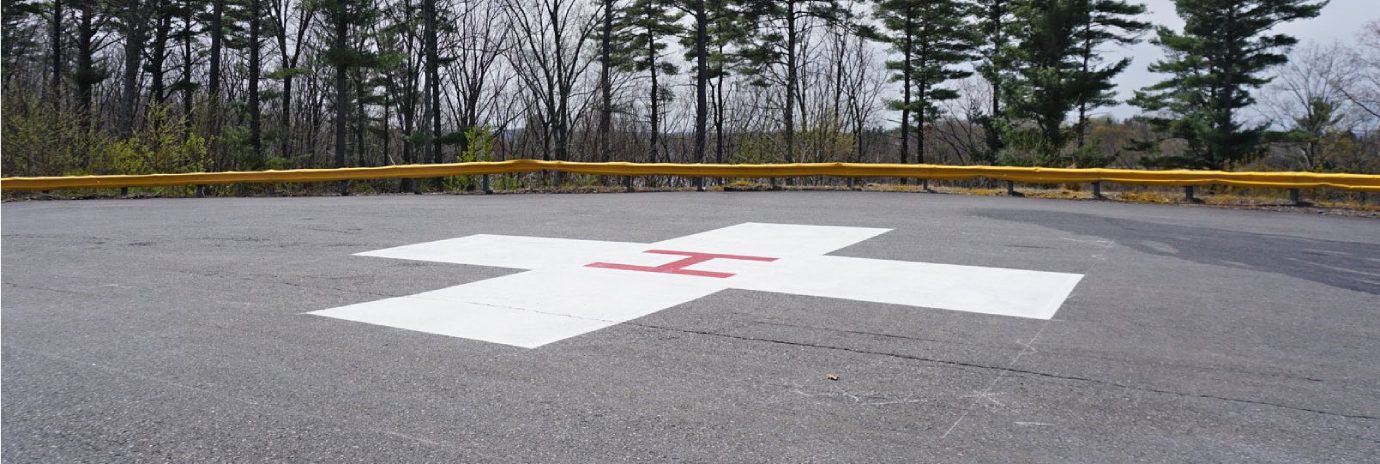
- Planning 5-12-26 (5/14/2026)
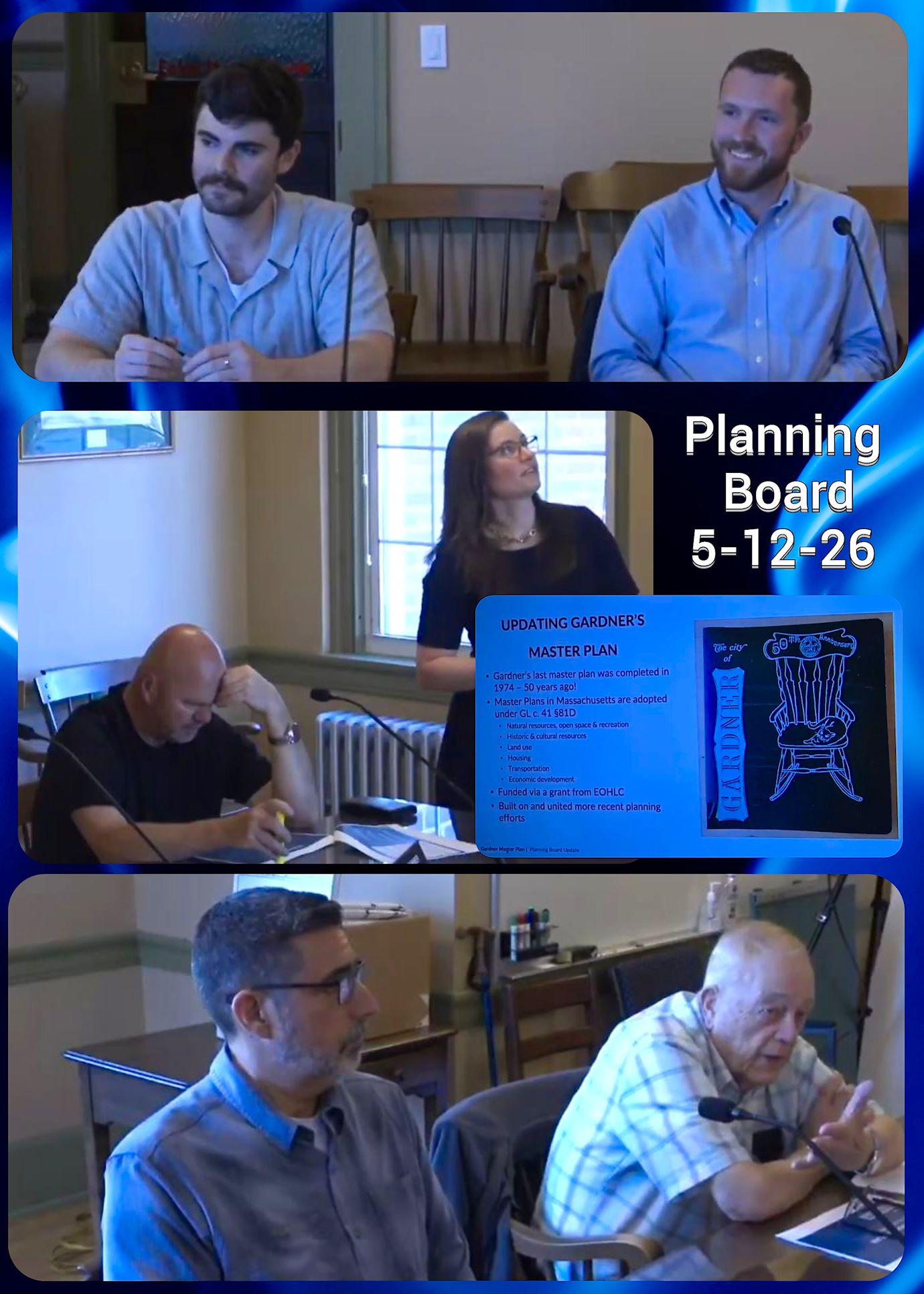
Master Plan Adopted by Planning Board After a Year of Work
The Gardner Planning Board officially voted to adopt a new Master Plan at the May 12, 2026 meeting, replacing the previous document dated from 1974/1975. The plan was facilitated by the Barrett Planning Group and funded by a grant from the Executive Office of Housing and Livable Communities. Development of the plan began in April 2025. Listen to the entire meeting on any device, CLICK PLAY.
Planning Board 5-12-26 The Master Plan was developed utilizing staff – board – and committee interviews, community surveys, public workshops, drop- in events, and public comments. The Master Plan is centered on a 20-year vision for the City of Gardner emphasizing a sense of community in maintaining the existing social fabric, natural resources -protecting open spaces and recreation areas, affordable housing in addressing the need for diverse housing options, and balancing growth with preservation such as revitalizing the Downtown Gardner area and encouraging new business while protecting Gardner’s historical architecture and “sense of place.”
The Master Plan identifies several challenges and opportunities that transcend specific departments:
- Economic Transition: Acknowledging the loss of the industrial core and the need to replace “missing pieces of previous employment opportunities.”
- Demographic Shifts: Addressing an aging population and a decrease in new families moving to the area.
- Sustainability and Resilience: Integrating modern environmental standards into city planning.
- Outside Funding: A continued reliance on state and federal grants for project implementation.
Other meeting topics and actions: Officials approved a site plan for a new convenience store and gas station at 677 Timpany Boulevard, (Walmart) contingent upon specific environmental and drainage requirements. . Additionally, the board appointed a representative to a regional transportation committee and announced the upcoming review of a five-year housing production plan.
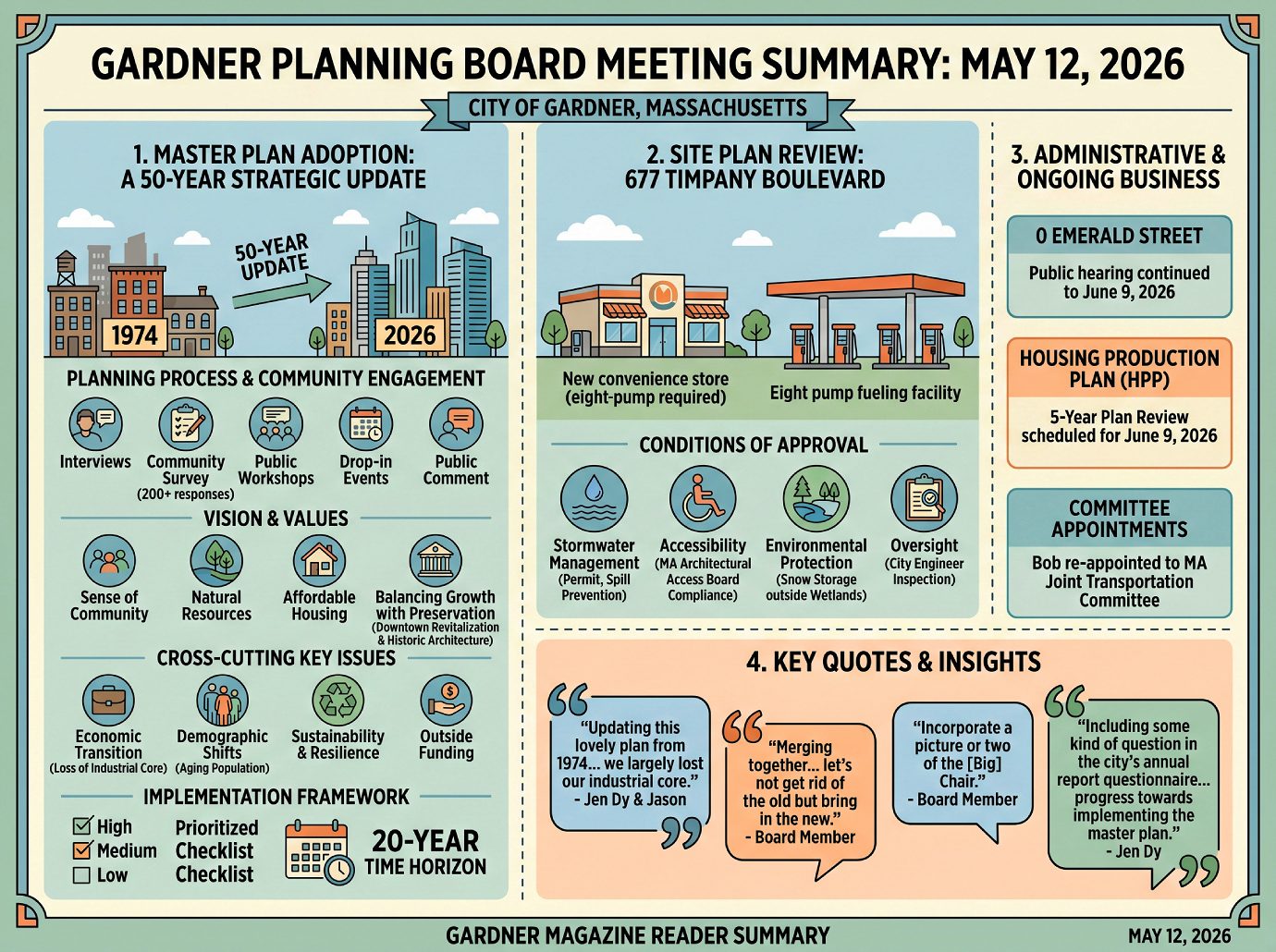
- Economic Development 5-13-26 (5/13/2026)
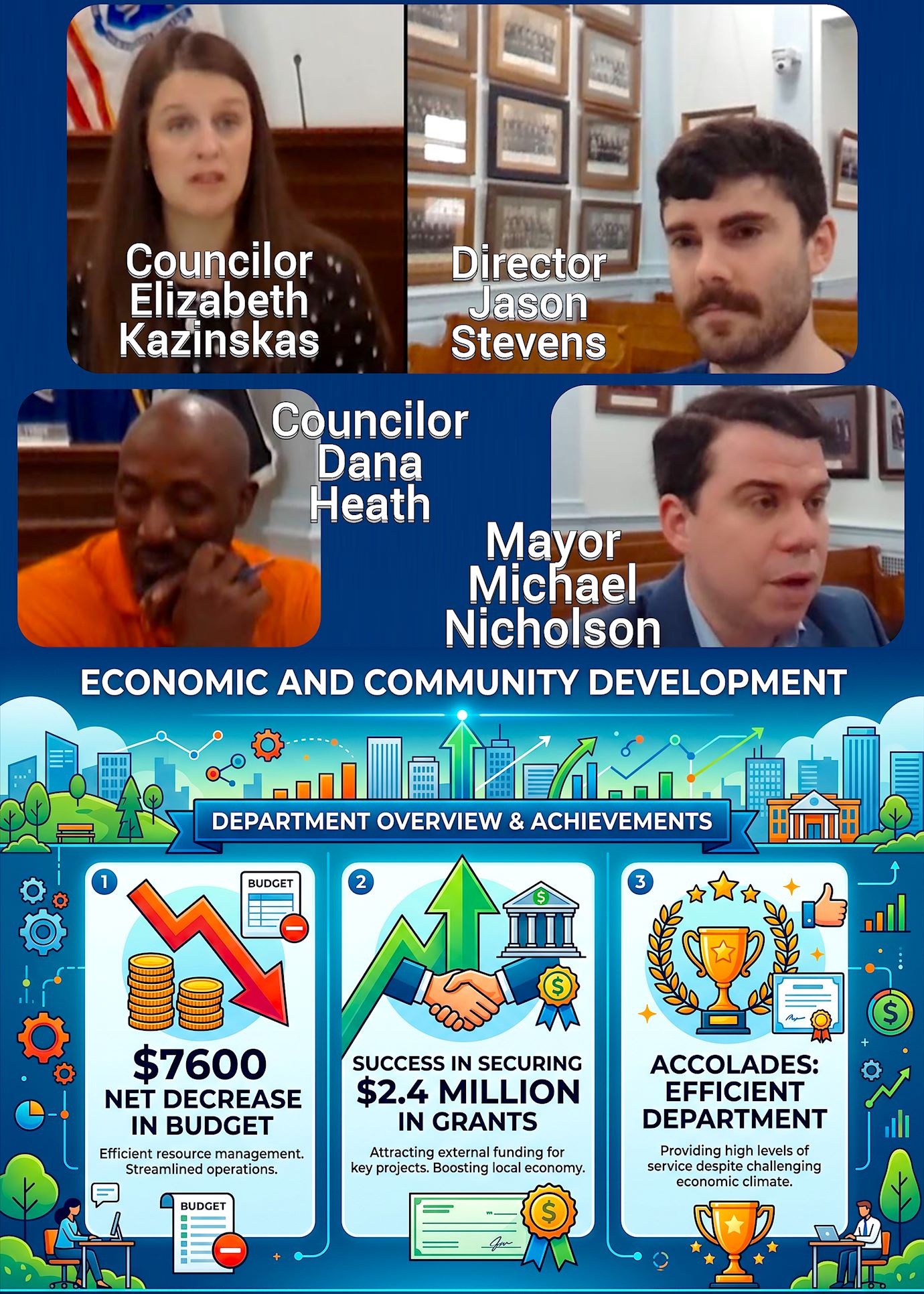
The Department of Community Development and Planning directed by Jason Stevens received considerable praise at this meeting.
Department Praised for Efficiency and Success
Listen to the entire meeting on any device. (Note AUDIO drops out at about the 3 minute marked due to a technical glitz) CLICK PLAY.
The Gardner Economic and Community Development meeting on May 13, 2026 focused on the fiscal year 2027 budget and major local infrastructure updates. City officials celebrate a $7,600 net decrease in the department’s budget, attributed to a strategic restructuring of staff and creative management of termination leave funds.Key project updates include the official resolution of compliance issues at Maki Park and the progress of the Rear Main Street revitalization, which aims to improve downtown parking and utility access. The discussion highlights the department’s success in securing over $2.4 million in grants, effectively bringing in ten times more revenue than its operating costs.
Additionally, the committee reviewed social service achievements funded by CDBG grants, such as providing essential aid to low-income residents and victims of domestic abuse. The meeting concludes with praise for the department’s efficiency and its ability to maintain high levels of service despite a challenging economic climate.
- Finance 5-12-26 (5/13/2026)

Listen to the entire meeting on any device, CLICK PLAY.
Finance Committee 5-12-26 Finance Committee Meets on Budget Matters
The Gardner Finance Committee meeting held on May 12, 2026 primarily focused on reviewing departmental budget proposals for fiscal year 2027. City leadership, including the Mayor and various Department Heads including Director of Purchasing Joshier Cormier, HR Director Amanda Morse, Assessor Christine Kumar, and DPW Director Dane Arnold, discussed specific fiscal needs such as staffing changes, equipment acquisitions, and the management of employee salary increases amidst ongoing union negotiations.Key administrative adjustments were proposed, including the consolidation of professional development funds to improve transparency and a plan to level-fund certain line items until contracts are finalized. The committee also evaluated capital improvement projects, such as roof repairs and accessibility upgrades at municipal buildings, utilizing unexpended bond proceeds.
Additionally, the session addressed proposed water rate hikes, resulting in an amendment to implement more gradual increases to alleviate the financial impact on residents. Finally, the members reviewed routine administrative matters, including unpaid bills and compliance filings, before recommending several measures for full city council approval.
- To Bee or Not to Bee (5/13/2026)


View our complete article page with complete narrative, infographics, and more. Listen here to the “Deep Dive” podcasts and watch the short produced video. Bees are important.
BEE Populations in Decline – What’s Being Done
Gardner Magazine has a complete report on the critical role of pollinators. Bee populations in the U.S. are in steep decline with bee keepers losing 30% of colonies since 2006. The State of Massachusetts is taking action. Gardner Director of Public Health Lauren Saunders has informed us of Gardner actions. —- CLICK FOR OUR COMPLETE PAGE.
Listen to this “Deep Dive” regarding the declining Bee population on any device, CLICK PLAY.
DEEP DIVE – Bee Population in the United States Listen to this “Deep Dive” regarding the preservation of Bees in the State of Massachusetts. “Saving Bees with Lazy Lawns.” CLICK PLAY.
DEEP DIVE – Saving Bees with Lazy Lawns This produced Gardner Magazine video “To Bee or Not to Bee” covers the issue and the solutions being implemented in the State of Massachusetts.
This article examines critical role of pollinators and the concerning decline of their populations across the United States. These animals, including managed honey bees and thousands of native species, contribute billions of dollars to the economy by supporting the production of fruits, nuts, and vegetables. Researchers have identified several primary stressors responsible for these losses, such as habitat destruction, pesticide exposure, climate change, and the spread of pathogens. In response, federal agencies and academic institutions are developing conservation strategies, including clean stock certification programs and habitat restoration initiatives. These efforts are essential to protecting food security and maintaining the health of diverse natural ecosystems. Ultimately, the texts emphasize that community involvement and scientific research are vital to ensuring these indispensable species thrive in the future.Key Actions Taken in Massachusetts
Pesticide Restrictions (2021): The Massachusetts Department of Agricultural Resources restricted the consumer sale and use of certain neonicotinoids on lawns, gardens, and ornamental plants, becoming one of the first states to take this action.
Encouraging Native Plantings: State programs emphasize planting native flowers, trees, and shrubs that provide nectar and pollen throughout the entire growing season to support at-risk species.
Municipal Action Plans: Nearly half of Massachusetts’ municipalities are implementing pollinator-friendly policies, such as changing lawn management to “lazy mowing” (allowing clover/dandelions to grow) and creating designated pollinator spaces.
Update 5-15-26 11:30am: What’s Being Done Locally
Gardner Director of Public Health Lauren Saunders has informed Gardner Magazine that she is on the board of Keep MA Beautiful. Saunders stated: “We actually have an initiative around this exact issue. We award grant money to chapters and organizations that apply. The money awarded supports the planting of pollinator-friendly plants and tress in public spaces. Locally, Keep Gardner Beautiful has been a recipient of this grant, I believe in 2024 we were awarded and we built the pollinator garden May 2025, right at the Woodland and Green St. intersection. Dianne LeBlanc from KGB also has a plan to do little mini pollinator Garden kits to hand out this spring.”
Saunders also gave us some information regarding mowing: “As far as mowing, many municipalities throughout MA (Gardner included) prohibit grass, weeds or other vegetation from growing taller than 12 inches in residential areas, as exceeding this height can be considered a nuisance. My recommendation is to create a bee-friendly space without letting your yard turn into something the neighbors complain about. Design a controlled intentional pollinator zone that looks tidy, while still giving the bees a place to gather nectar, pollen and water as needed. A win for yourself, your neighbors, and the bees!“
Plant Some Bee-eautiful
Keep Mass Beautiful has a dedicated web page on this issue, CLICK HERE. 12 Grantees received Plant Something Bee-eautiful grants in 2025. “These grants support the planting of pollinator-friendly plants and trees in public spaces. Our goal is not only to beautify public spaces, but also to restore critical habitats for pollinators.”
- City Council 5-12-26 (5/13/2026)

Gardner City Council Hears Budget Presentation
The Gardner City Council met on May 12, 2026 and heard the School Budget presentation in a lengthy meeting. Listen to the meeting on any device, CLICK PLAY.
Gardner City Council 5-12-26
Superintendent Dr. Mark Pellegrino and financial officials outline a significant $793,000 funding gap driven by rising healthcare costs, special education transportation, and the loss of one-time federal ESSER funds. To address this deficit, the school department has implemented $1.5 million in cuts, including the restructuring of Gardner Academy and the elimination of various teaching and administrative roles. While the district is outperforming state averages relative to its high-need student population, leadership warns that continued minimum state funding will eventually decimate educational systems.City Council members expressed concerns regarding long-term financial forecasting and the sustainability of recent staffing increases amidst declining student enrollment.
The meeting concludes with a call for increased collaboration and proactive planning to prevent future fiscal crises. Specifically, Council President George Tyros called for joint sessions between the City Council and School Committee to establish proactive structural solutions before the next budget cycle.
- Board of Health 5-11-26 (5/13/2026)
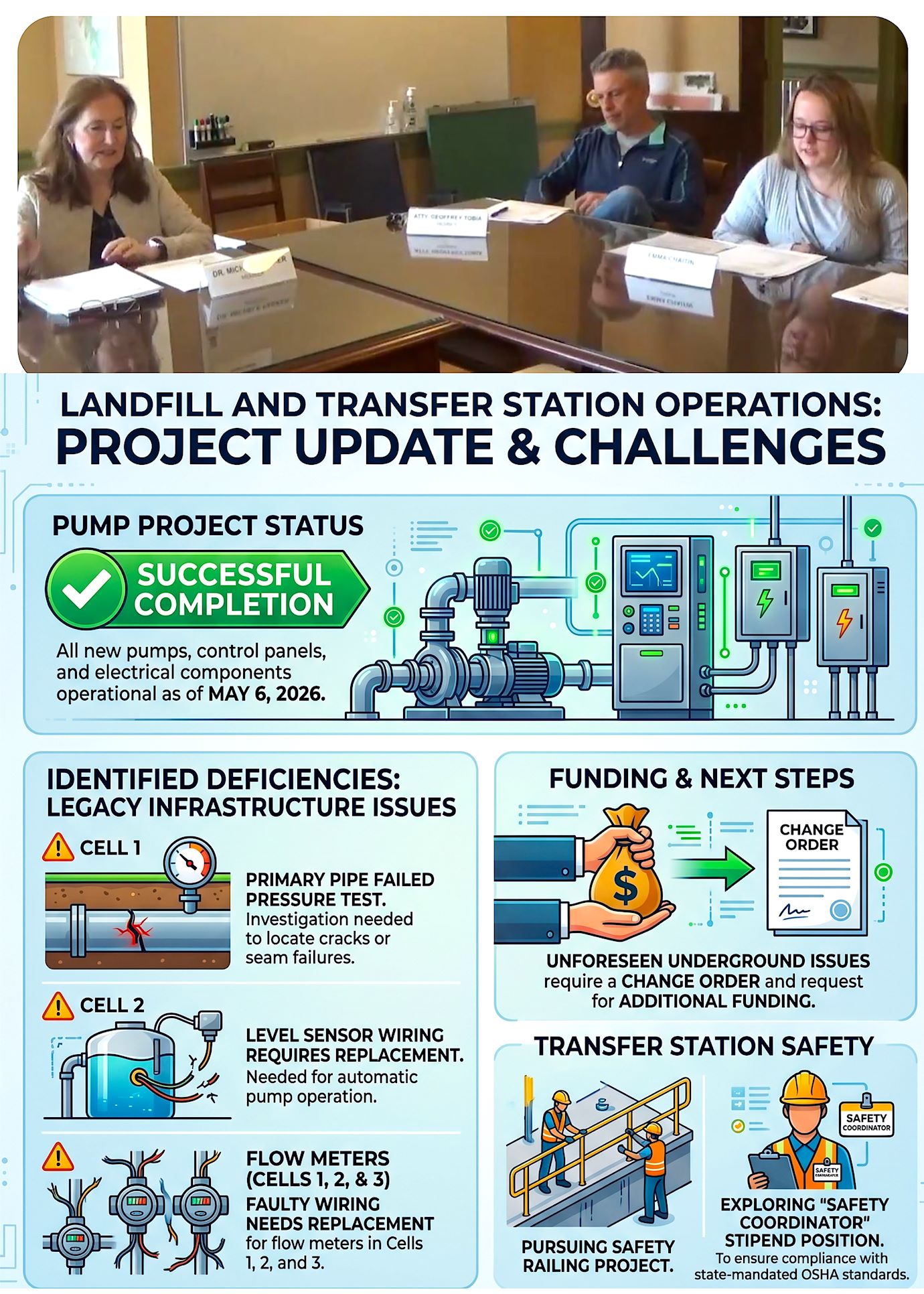
Board of Health Discusses “Presby System” and Landfill Challenges During Meeting
The **Gardner Board of Health convened on May 11, 2026, to address several municipal infrastructure and public health matters. A significant portion of the meeting involved approving a local upgrade for a failing septic system on Otter River Road, utilizing a specialized Presby system to manage groundwater constraints on a narrow lot.Department updates highlighted ongoing landfill repairs, including pump installations and necessary electrical overhauls, alongside the successful collection of over 37,000 liquor nips during the Keep Gardner Beautiful city litter cleanup.
The board also discussed the upcoming opening of Joy Bakery and Market in Union Square, recent tobacco control violations, and progress on staff training certifications. Finally, the members formalized their leadership by electing Dr. Michelle Parker as Vice Chair and scheduled their next session for late June.
Listen to the entire meeting on any device, CLICK PLAY.
What is a Presby System – An Explanation
A Presby septic system is an innovative, passive, onsite wastewater treatment system that uses special, geotextile-covered pipes surrounded by sand to treat effluent, often requiring a smaller footprint than conventional systems. These systems are highly efficient—removing up to 99% of contaminants—and operate without electricity, pumps, or motors
Landfill and Transfer Station Operations
Progress on the landfill pump project has been met with both success and the discovery of legacy infrastructure issues.
- Pump Project Status: All new pumps, control panels, and electrical components were operational as of May 6, 2026.
- Identified Deficiencies:
- Cell 1: The primary pipe failed a pressure test; further investigation is required to locate potential cracks or seam failures.
- Cell 2: Level sensor wiring requires replacement to enable automatic pump operation.
- Flow Meters: Wiring for flow meters in Cells 1, 2, and 3 is faulty and needs replacement.
- Funding: These unforeseen underground issues will necessitate a change order and a request for additional funding.
- Transfer Station Safety: The department is pursuing a safety railing project and exploring the creation of a “Safety Coordinator” stipend position to ensure compliance with state-mandated OSHA standards.
- License Commission 5-12-26 (5/13/2026)

Licenses Approved and Loopholes Discussed
The Gardner License Commission met on May 12, 2026 and approved a seasonal license for Home Fruit Wine to participate in the local farmers market and authorized managerial changes at Hannaford Supermarket.
Additionally, the commission finalized a license transfer for the South Gardner Hotel and granted a one-day permit to Moon Hill Brewing for a recurring community event.
The members also discussed the pending status of a liquor license for Sawa Asian Cuisine, which remains under state review.
Listen to the meeting on any device, CLICK PLAY.
License Commission 5-12-26 The “$50 Loophole”: Why Farmers’ Markets Use “One-Day” Licenses
A fascinating display of pro-business local navigation surfaced during a hearing for Home Fruit Wine, a vendor based in Orange, MA, looking to join the farmers’ market at 62 Waterford Street. On paper, a seasonal vendor should typically hold a seasonal license. However, the commission opted for a series of six “one-day” licenses for the upcoming dates of May 16, June 20, July 18, August 15, September 19, and October 17.
This isn’t a clerical error—it is a strategic maneuver to circumvent a state-level fee bottleneck. The Massachusetts Department of Agricultural Resources (MDAR) mandates a statute that caps certain license fees at $50. By issuing multiple one-day licenses rather than a single seasonal permit, the commission effectively sides with the small business, keeping costs at $50 instead of the $300 that a different permitting process might trigger.
The “Sample, Don’t Stroll” Rule at Farmers’ Markets
In a moment that revealed even regulators must occasionally learn the nuances of the law in real-time, one commission member admitted to having “never seen that before” while inquiring about alcohol handling at the Waterford Street market. The resulting clarification established a sharp line between retail sales and public consumption.
The commission confirmed that while Home Fruit Wine is authorized to provide small samples at their booth and sell sealed bottles “to go,” the market is not a licensed “roped-off area for drinking.” The rule is precise: customers may sample the product at the point of sale but are strictly prohibited from “walking around with a glass of wine” through the market aisles.
- Conservation 4-27 and 5-11 (5/12/2026)
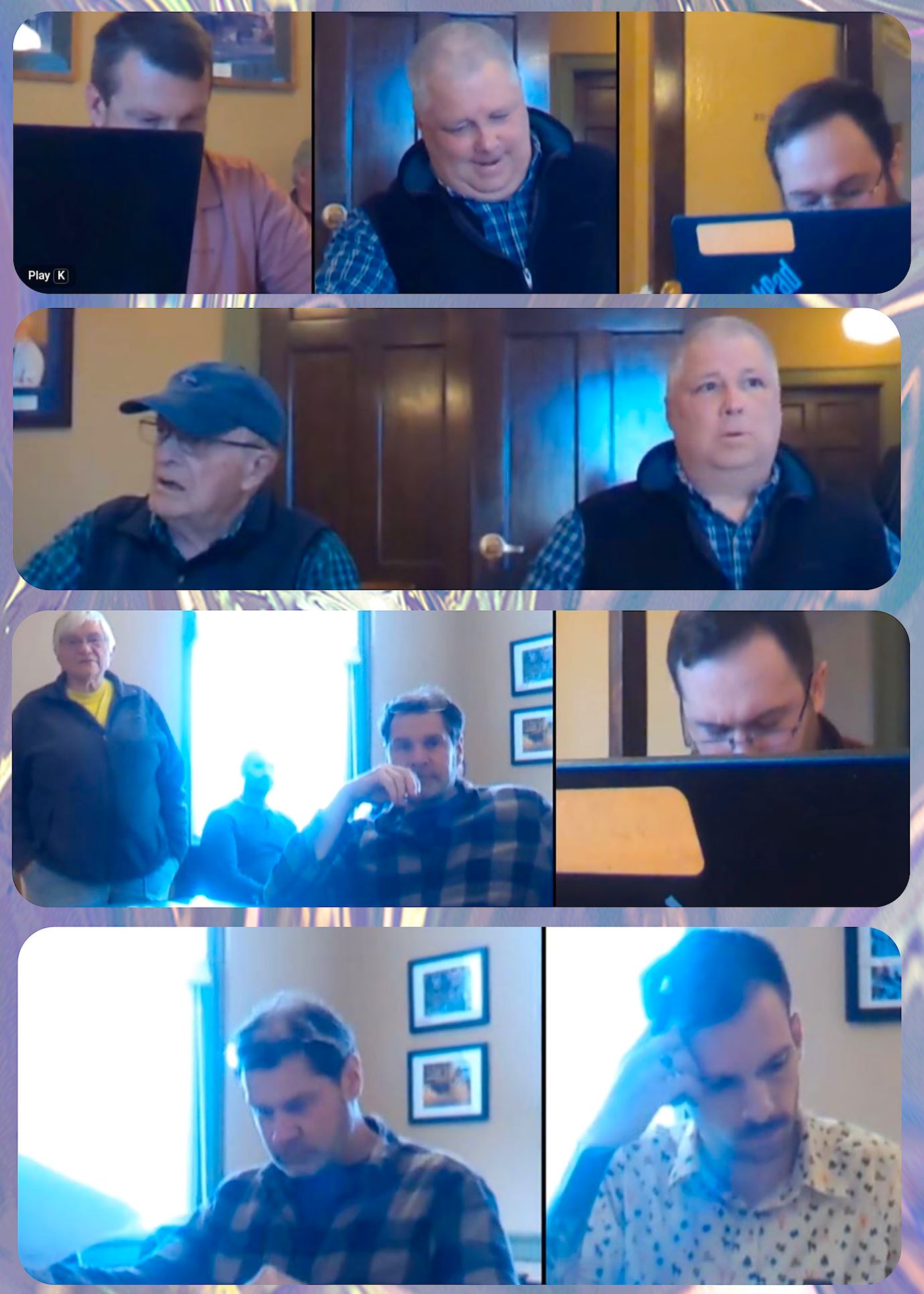
Listen to the April 27th meeting on any device, CLICK PLAY.
Conservation 4-27-26 Listen to the May 11th meeting on any device, CLICK PLAY.
Conservation 5-11-26 Two Meetings: Conservation Commission Gardner MA
April 27th:
At the April 27th meeting, the Conservation Commission updated hearing dates for several local projects, including the sludge landfill and properties on Linwood and Crawford Streets. Significant discussion involved the certificate of compliance for a property on Watkins Road, where members noted that historical utility work had naturally integrated back into the environment over two decades. An agent report provided updates on erosion control measures at the North County Land Trust and the monitoring of potential vernal pools and invasive species. Additionally, the board acknowledged local Earth Day volunteer efforts, specifically the massive collection of litter by the Keep Gardner Beautiful group.May 11th:
The Gardner Conservation Commission meeting on May 11th revolved around ongoing environmental and land-use projects within the city. Key discussions involved remediation efforts at 36 Nicole Terrace, where members debated the slow pace of manual log removal from a sensitive wetland area. The commission also reviewed a revised duplex construction plan on Conan Street, focusing on protecting the 60-foot no-build zone through improved staking and erosion controls. Additionally, representatives for a Green Street property presented plans for a new public water supply well, seeking a procedural amendment to their existing permits.
- Sicko Teens Throw Spikes (5/12/2026)

SICKO Teens Throw Railroad Spike, Almost Killing Driver, But Get Away
A pair of Sicko Teens on e-bikes were apparently throwing railroad spikes from the side of the road on Route 2 last week in Gardner MA. One railroad spike went through the windshield of a vehicle, almost killing the driver, who is from Royalston. The incident is under investigation by Gardner Police and State Police. Anyone with information on the identity or whereabouts of these criminal individuals are urged to call local or State Police. Someone could have been killed. According to various reports, the teens are known troublemakers who ride their e-bikes in the area.
The teens fled from the scene of the crime prior to police arrival. The driver was quoted as saying: “I look behind me and there are these two kids about 80 feet behind me, behind the guard rail, and they were still throwing stuff around. So I knew instantly it was them,” The victim was covered in glass but had no major injuries.
The driver told WBZ-TV that he has a message for the two teens: “Stop. You’re going to get someone killed. It’s not worth getting in trouble. If my son or my wife were in the vehicle, things could have been a lot worse,”
Publisher’s Note: Gardner Magazine will update you when there is an official update from the Gardner PD or State PD. Attention: Parents, neighbors, friends of these 2 individuals: Turn them in before they kill someone with their reckless actions, please.
- School Committee 5-11-26 (5/12/2026)
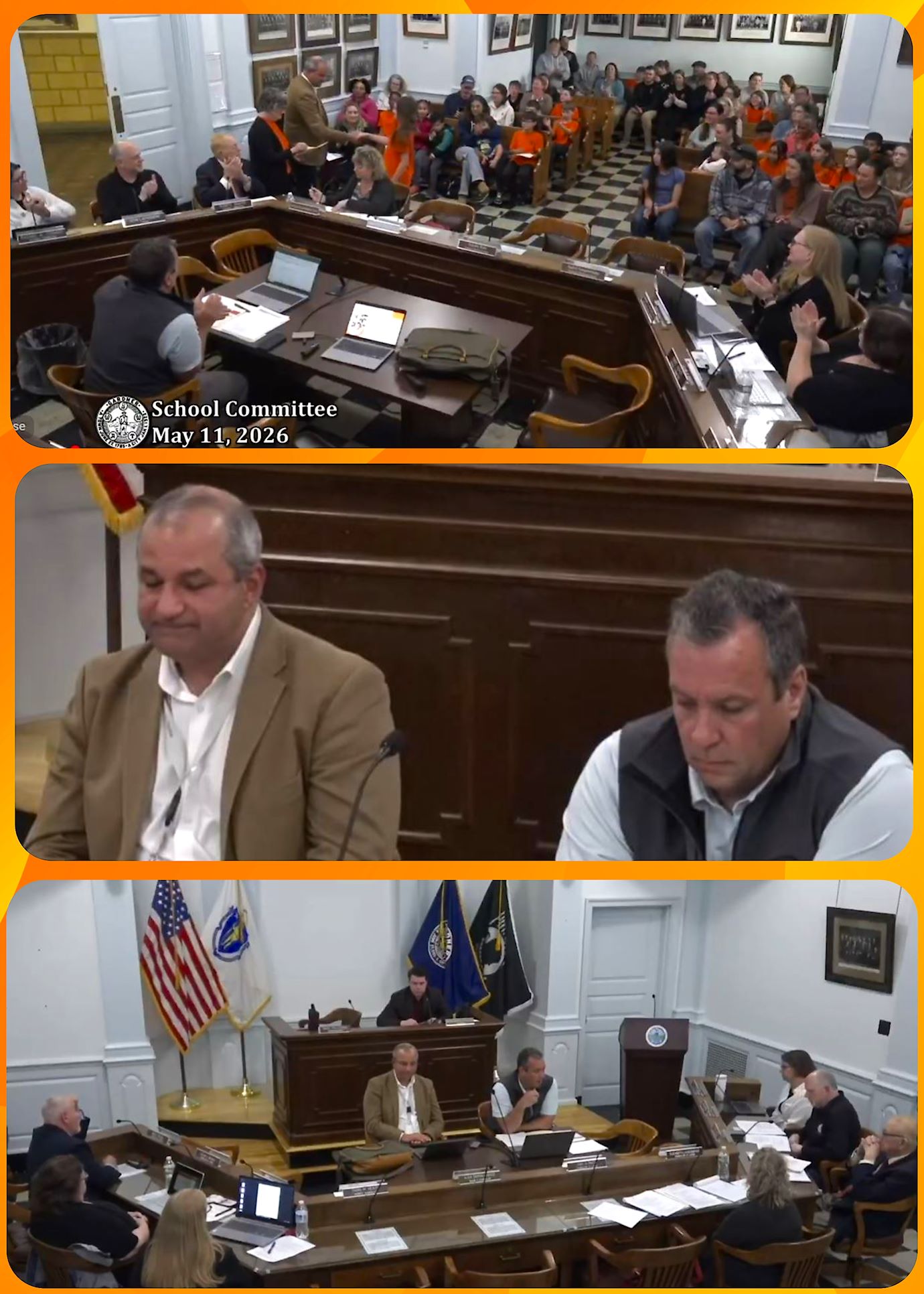
Listen to the School Committee Final Comments from the May 11th meeting on any device, CLICK PLAY.
FINAL Comments 5-11-26 We also have a separate article on the recognition of 4th grade students, CLICK HERE.
School Budget passed at School Committee Meeting – Now on to City Council
Listen to the entire meeting on any device, CLICK PLAY.
The Gardner School Committee meeting held on May 11, 2026, primarily focused on the presentation and unanimous approval of the FY2027 school budget. The district finds itself in a paradoxical position: it is achieving “outlier” academic success—particularly at the high school level—while operating on one of the leanest budgets in the Commonwealth. Gardner currently ranks 14th from the bottom out of 215 districts in terms of funding, spending only 101.3% of the state-mandated minimum net school spending, compared to a statewide average of 139%.
Despite significant increases in “high needs” student populations (low income, disabilities, and English Language Learners), the district faces a $793,669 revenue shortfall for FY2027. To address this, the administration has implemented a drastic reorganization, including the closure of Gardner Academy as a standalone entity and its relocation to Gardner High School. This move, along with other personnel reductions, resulted in the cutting of 18 positions (reduced to 10 actual staff losses through attrition) to offset skyrocketing costs in transportation (up 220% since 2024) and health insurance (up 62% since 2024).
- 4th Graders Praised in Gardner (5/12/2026)
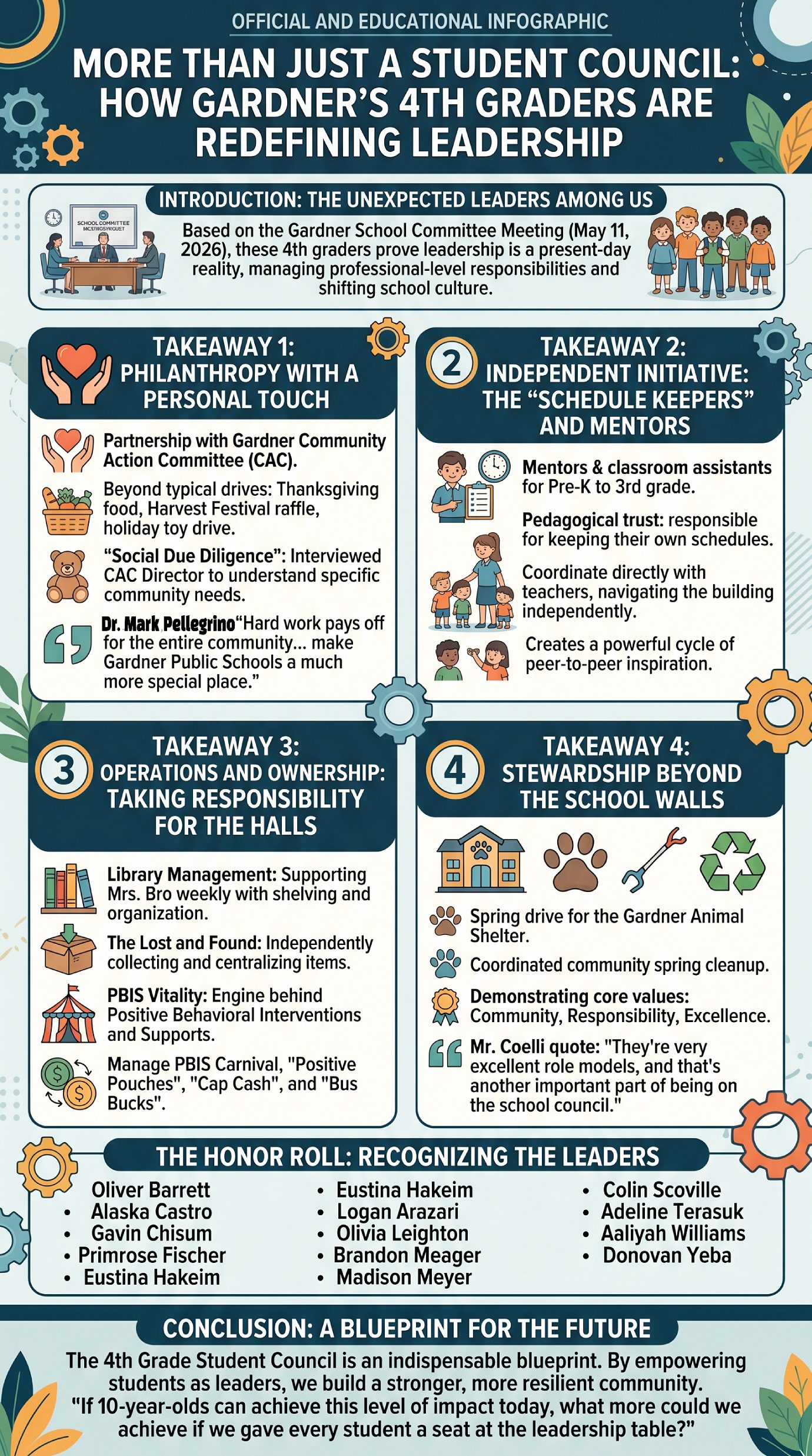
4th Graders Redefining Leadership in Gardner MA
4th Graders were recognized at the School Committee meeting of May 11, 2026. Here the comments on any device, CLICK PLAY.
4th Graders Recognition 5-11-26 In the world of education, we often speak of students as “future leaders,” as if their capacity to impact the world is a dormant seed waiting for a high school diploma or a college degree to bloom. However, watching the 4th Grade Student Council stand before the committee, it became clear that leadership in Gardner isn’t a future milestone—it is a present-day reality.
These ten-year-olds aren’t just participating in a school club; they are managing professional-level responsibilities that have fundamentally shifted the school’s culture and its relationship with the city.
The 4th Grade Student Council’s partnership with the Gardner Community Action Committee (CAC) is a masterclass in meaningful civic engagement. Their work went far beyond the typical “canned food drive” seen in many elementary schools. While they did coordinate a Thanksgiving food drive, sold raffle tickets during the GES Harvest Festival, and organized a holiday toy drive, it was the method of their service that stood out.
The students performed “social due diligence.” They didn’t just drop off boxes; they interviewed the director of the CAC to understand the specific needs of their neighbors. This intentionality ensures that their service isn’t just a chore, but a deeply understood mission. As Superintendent Mark Pellegrino noted during the meeting: “Appreciation is something that they’re doing every day just by showing up and working hard. That hard work pays off for the entire community and you make Gardner Public Schools a much more special place.”
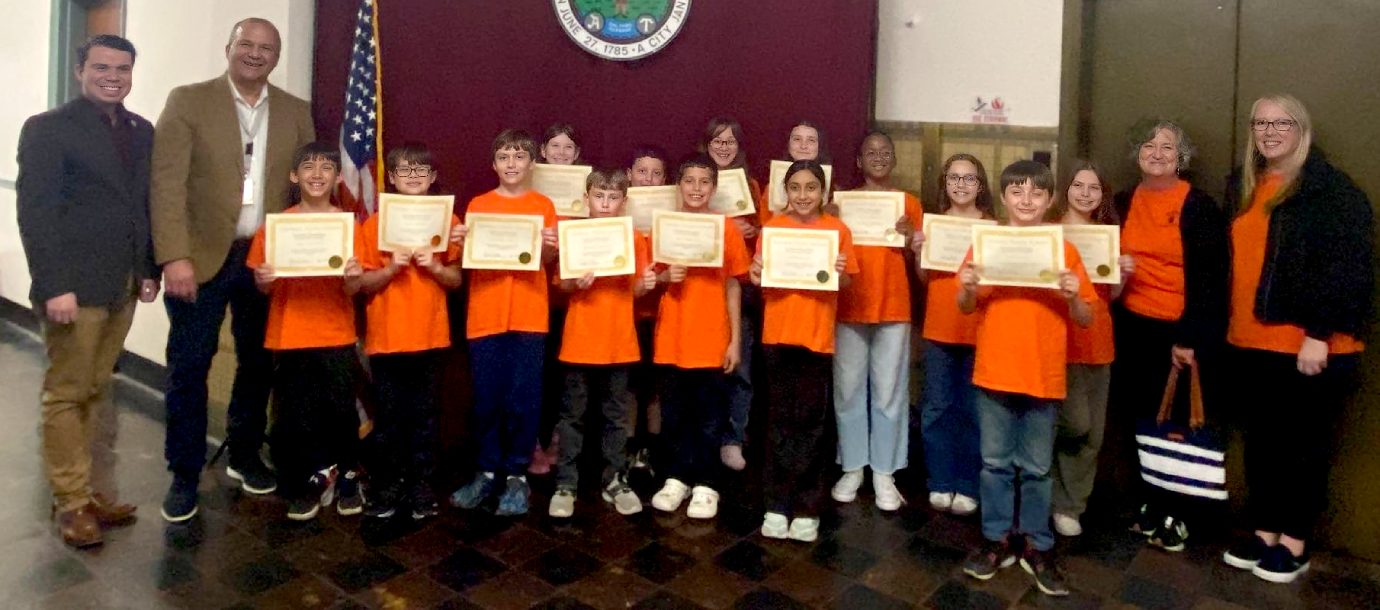
Listen to the short AUDIO or view the infographic for more details on these exceptional 4th graders in the Gardner Public Schools
- Water Ban 2026 (5/11/2026)
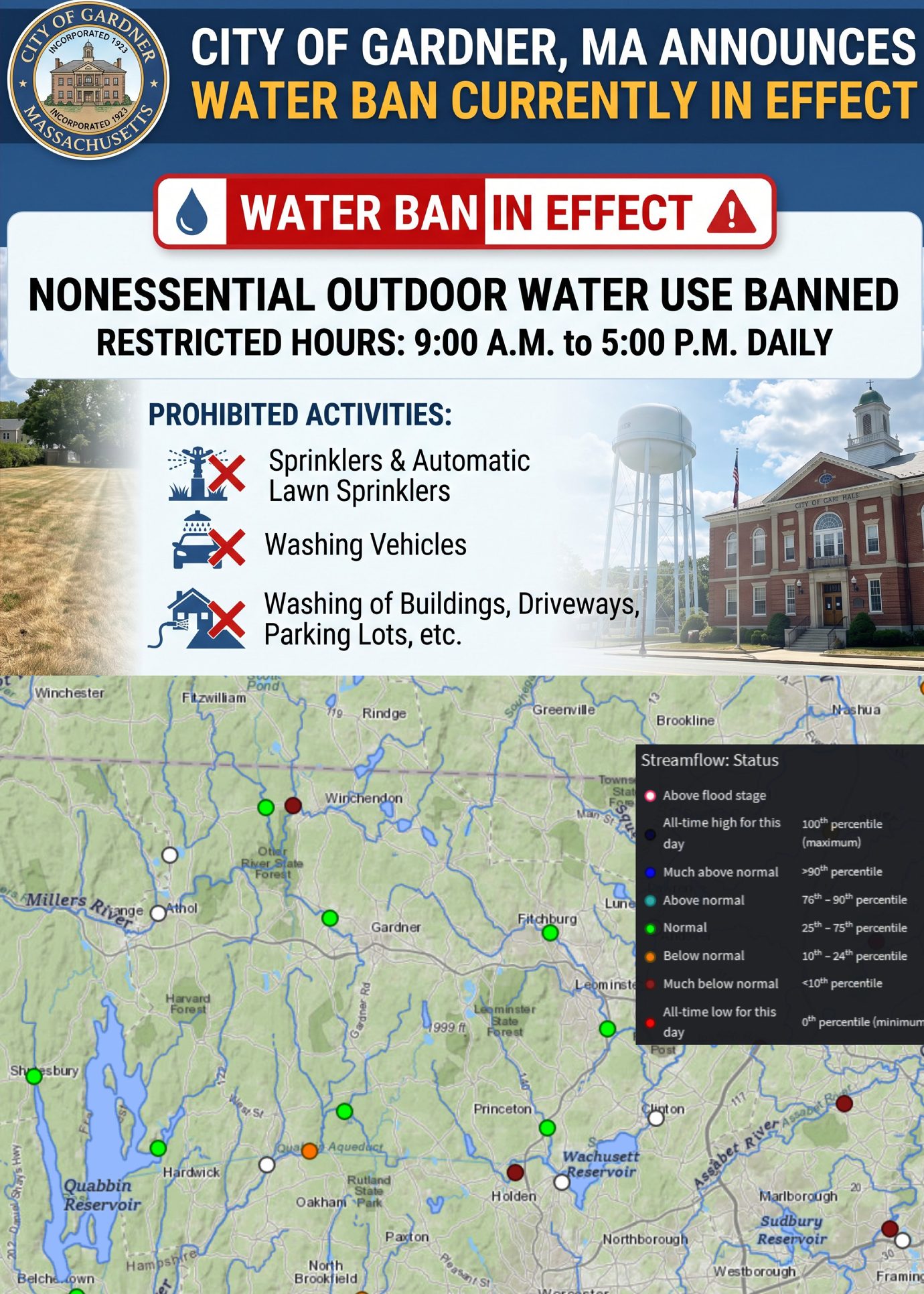
Gardner MA Nonessential Outdoor Water Use is Banned Again
The City of Gardner has announced that a nonessential outdoor water use ban is in effect from 9am to 5pm daily. That means that you can still operate a lawn sprinkler, wash your car, or even wash your building or parking lot, but you must do it before 9am or after 5pm.
The water ban is based on streamflow readings. If you’d like to check on streamflow measurements for anywhere in the lower 48 United States, here is the link for the USGS National Water Dashboard, CLICK HERE. The National map shows a huge variance in status. Red or yellow dots would trigger a water ban in the affected areas.
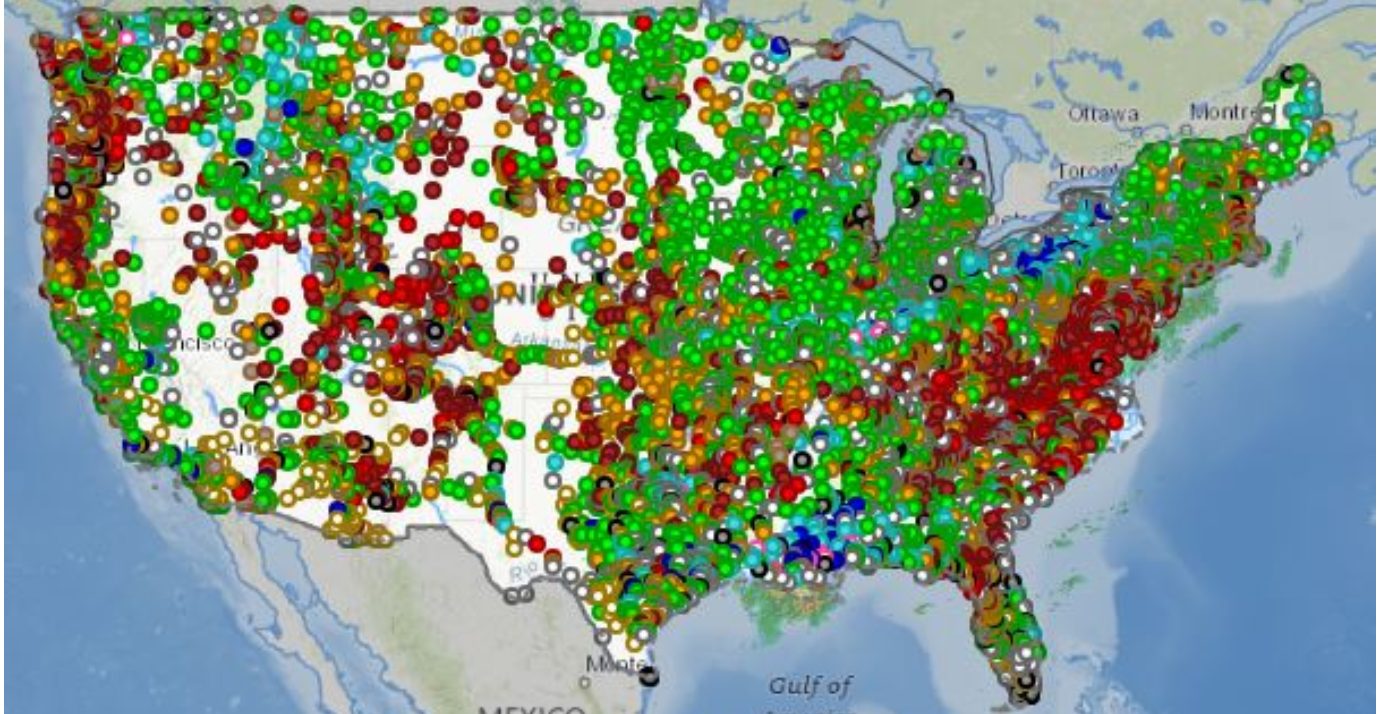
- Weekly Briefing 5-10-26 (5/10/2026)
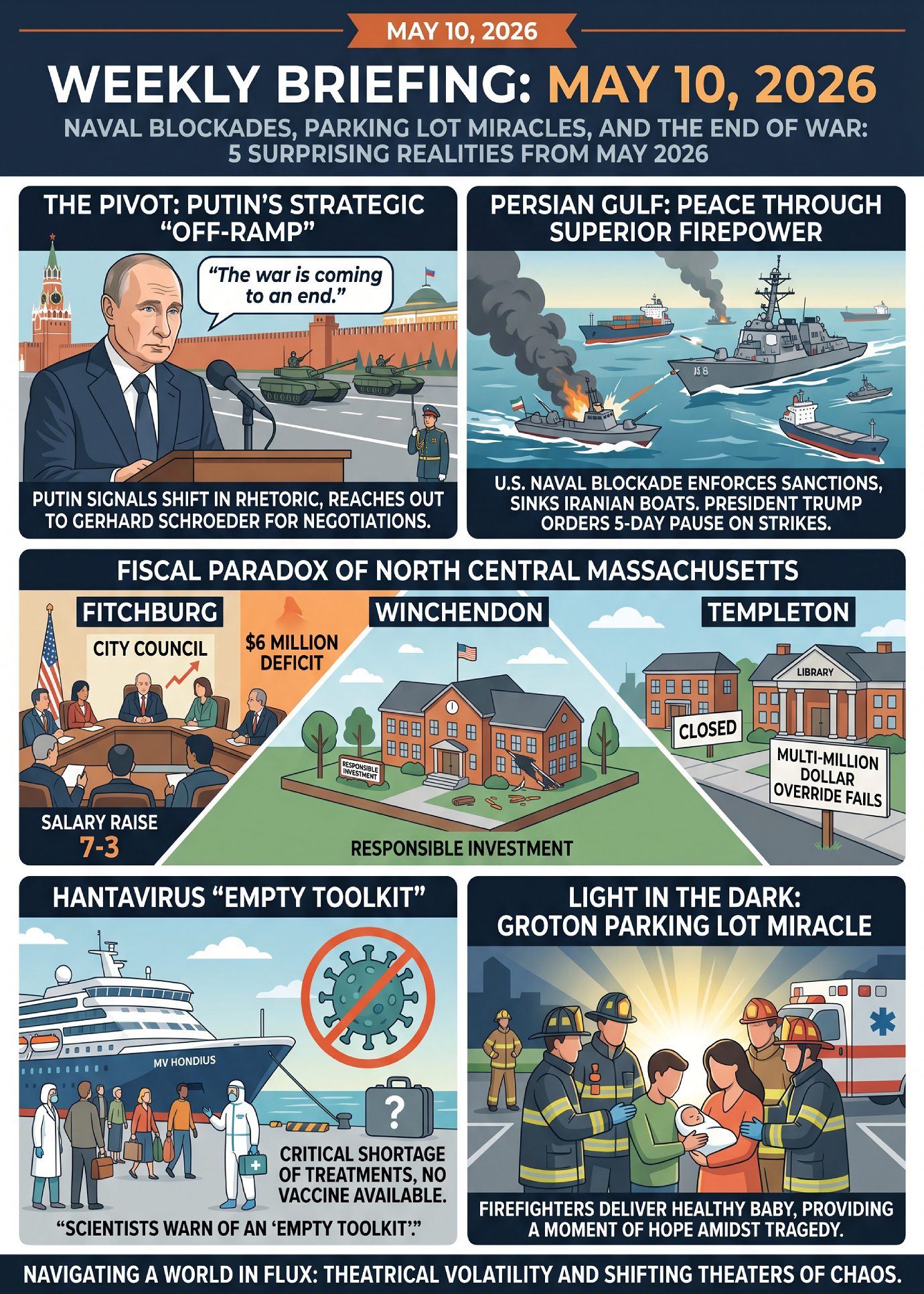
A Weekly Briefing from Gardner Magazine – May 10, 2026
The Chair Man and the Chair Lady discuss the news of the week including Greater Gardner MA, North Central MA, the State of Massachusetts, National News, and World News. They tie it all together in a great podcast. Listen on any device, CLICK PLAY.
Weekly Briefing – 5-10-26 Gardner Magazine has 4 separate additional sections covering North Central MA News, a Massachusetts News Roundup, U.S. National News, and World News, all updated on May 10, 2026
JUMP TO SECTION: North Central MA News — State News of the Week —- National News of the Week — World News of the Week
- Gardner Transfer Station May 2026 (5/10/2026)
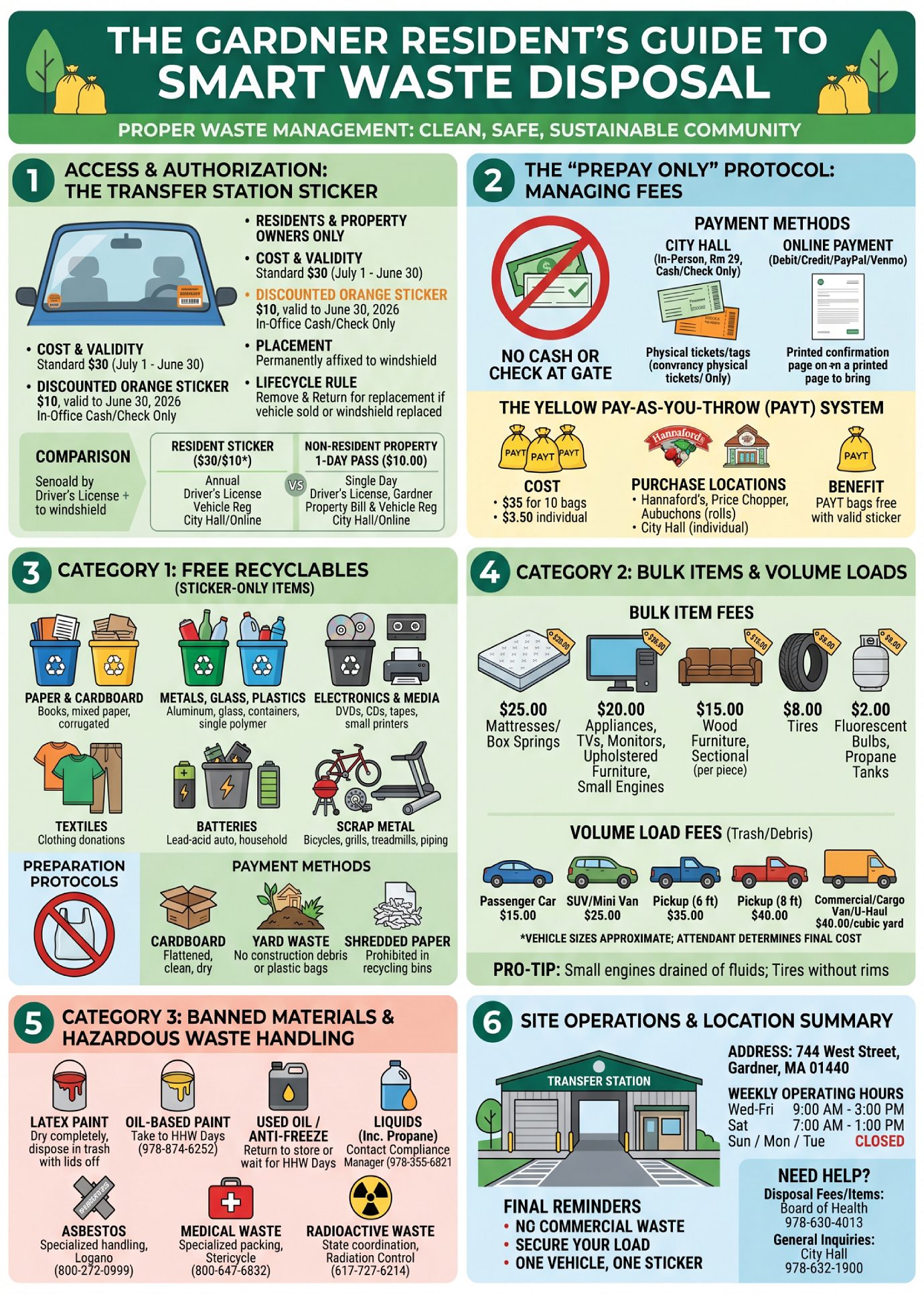
For a printable letter size version of the article graphic above, CLICK HERE.
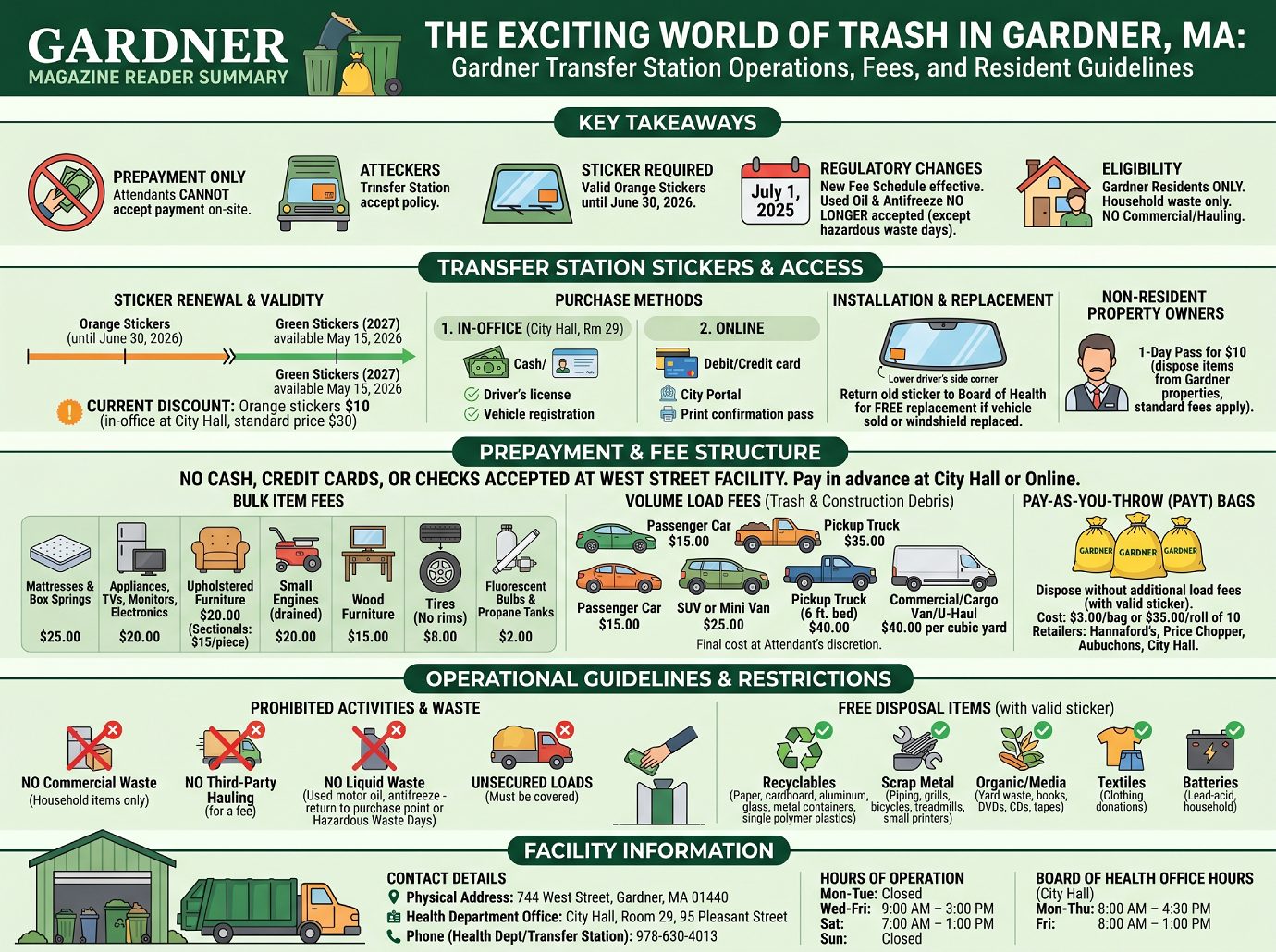
Discounted Gardner Landfill Stickers: Orange Transfer Station Stickers are currently discounted to $10 and cover the period of now through the end of June, 2026. For more information from the City of Gardner website, CLICK HERE.
Listen to the original song about the Gardner Landfill – “The Dump” on any device, CLICK PLAY.
CLASSIC ROCK – FUNK – The Dump Talking Trash – 2 Months of Dump Use for the Price of 1 Day in Gardner MA
Gardner Magazine has a “Deep Dive” podcast with the Chair Man and the Chair Lady giving you a guide to Smart Waste Disposal in Gardner MA. Listen on any device, CLICK PLAY.
DEEP DIVE – Transfer Station Guide Gardner MA Orange Transfer Station Stickers are currently discounted to $10 and cover the period of now through the end of June, 2026. For more information from the City of Gardner website, CLICK HERE. It’s a great time to do that basement cleanout!
Residents must obtain an annual permit sticker for $30, which allows for the free disposal of recyclables like paper, glass, and yard waste. However, disposing of household trash and bulk items such as appliances, furniture, and mattresses requires prepayment of specific fees. Crucially, the facility does not accept any payments on-site; instead, users must pay via the online portal or with cash or check at City Hall. Those who pay online are required to bring a printed receipt to present to the station attendant. The guidelines emphasize that the site is strictly for residential use, prohibiting any waste generated by commercial activities.Board of Health Office Hours (City Hall):
- Monday – Thursday: 8:00 AM – 4:30 PM
- Friday: 8:00 AM – 1:00 PM
The Gardner Landfill: 744 West Street, Gardner, MA Weekly Operating Hours
Day Hours Wednesday 9:00 AM – 3:00 PM Thursday 9:00 AM – 3:00 PM Friday 9:00 AM – 3:00 PM Saturday 7:00 AM – 1:00 PM Sun / Mon / Tue CLOSED
- Westminster Update 5-9-26 (5/9/2026)

More details on the Town Crier Episodes 23, 24, and 25 plus the Westminster Town Meeting of May 2, 2026 are provided in the infographics below. CLICK on either image for a larger view.
Westminster Update: Town Meeting Results, Town Crier Episodes 23, 24, and 25.
Listen to the episodes starting with the latest episode 25 on any device, CLICK PLAY.
Town Crier Episodes 25, 25, and 23 Westminster Town Administrator Stephanie Lahtinen covers Strategic Preparations, Governance, fiscal stewardship, municipal outcomes and summer operations during 3 episodes of the podcast “Town Crier”
On May 2, 2026, Westminster residents convened for the Annual and Special Town Meetings to chart a definitive fiscal and operational trajectory for the community. With the approval of a budget exceeding $30 million, the meeting served as more than a routine administrative gathering; it provided a roadmap for how the town will balance its deep-rooted local traditions with the pressing demands of modern infrastructure. These votes represent a calculated investment in the town’s future, prioritizing both human capital and technological modernization to sustain Westminster’s high quality of life.
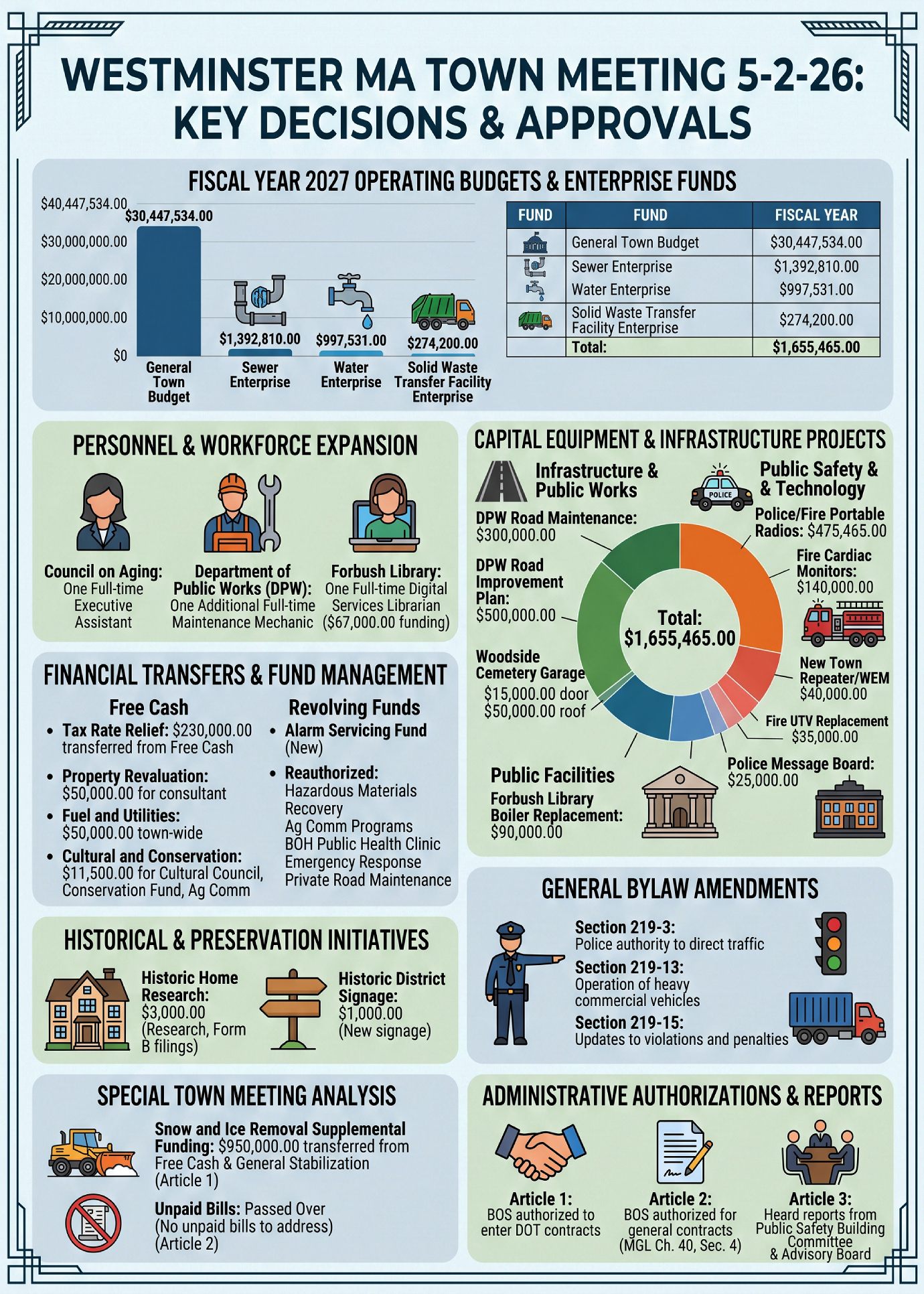
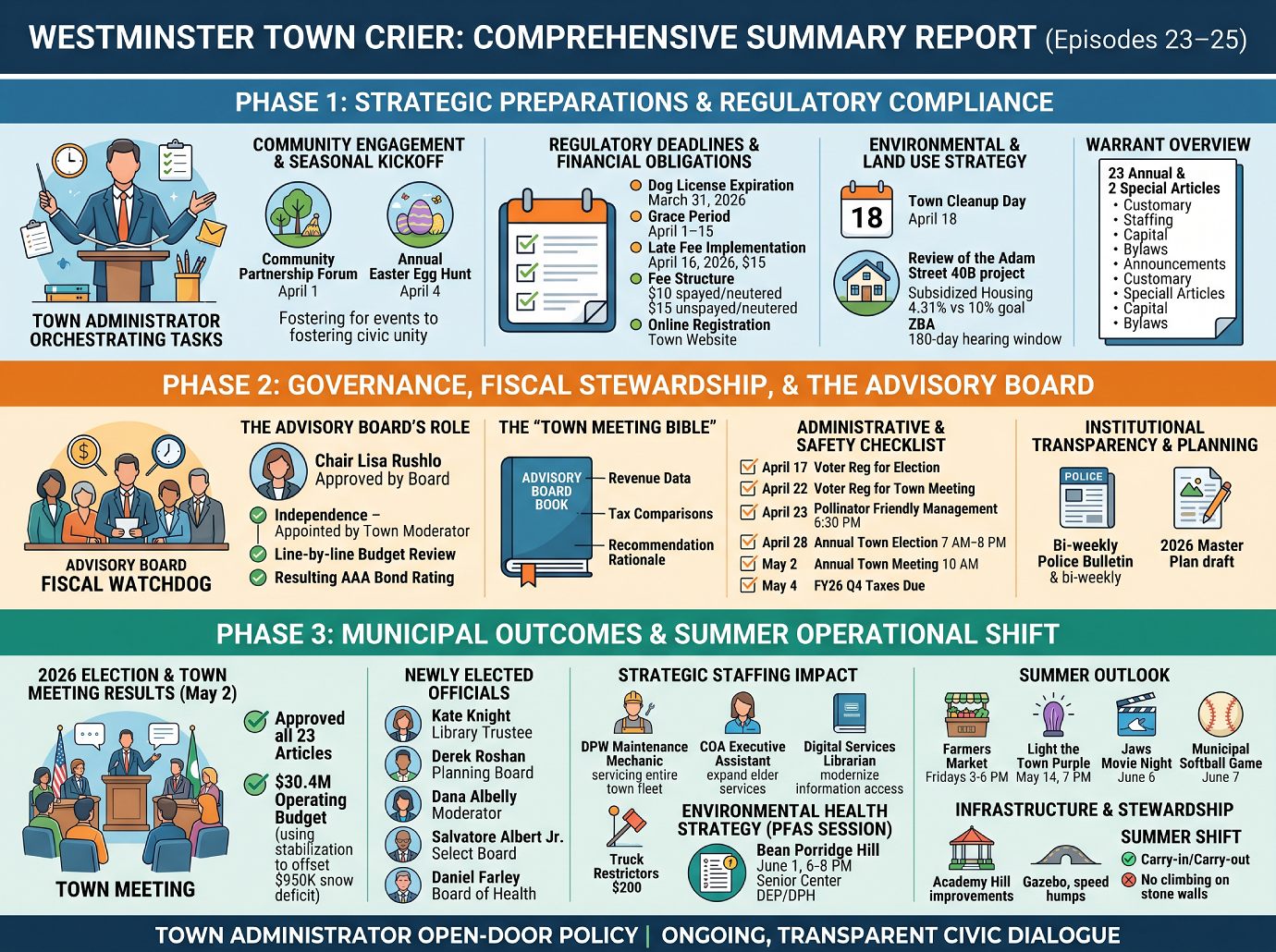
- Hotline Radio 5-9-26 (5/9/2026)
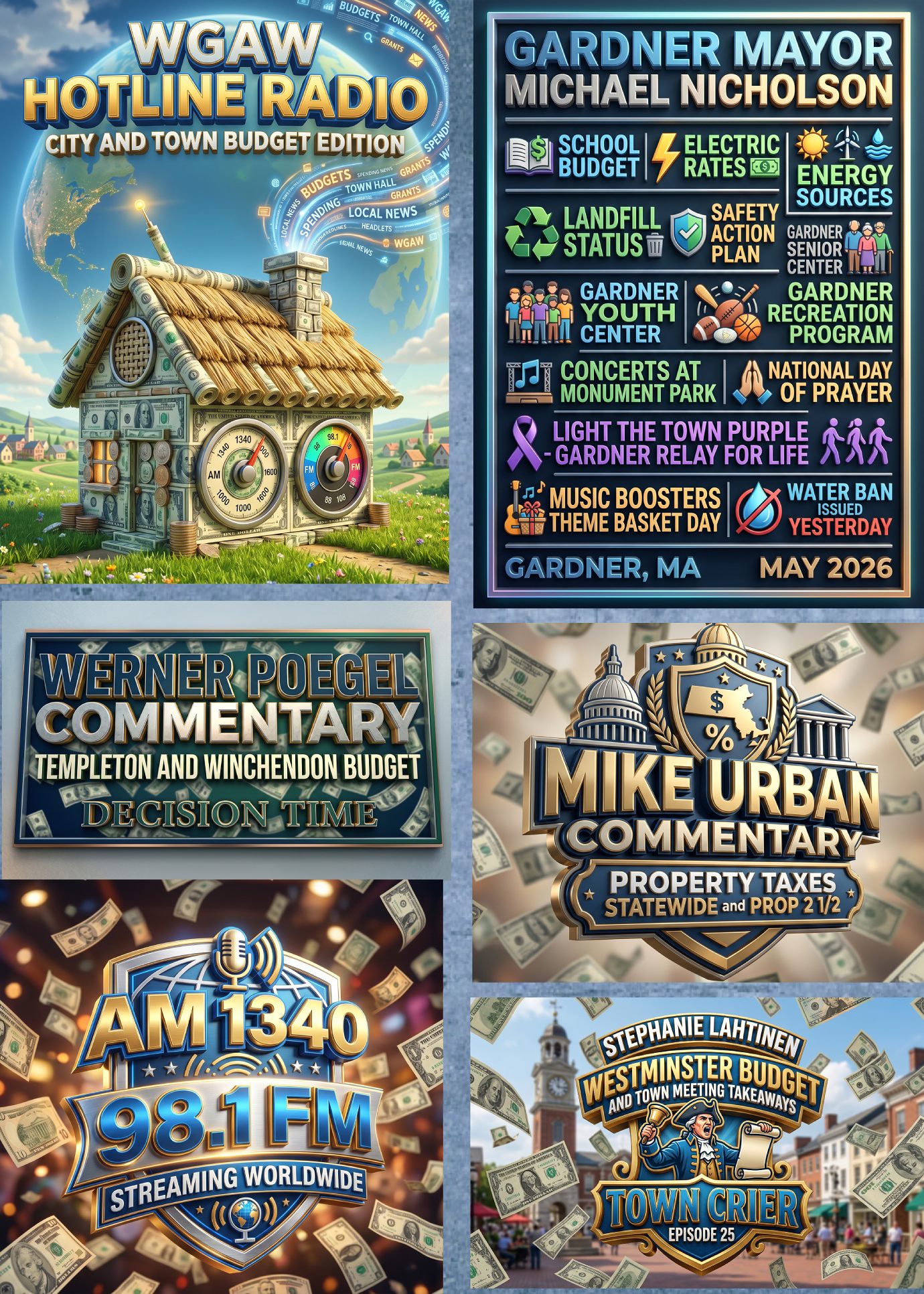
City and Town Budgets Focus of Hotline Radio Show of May 9, 2026
Listen to the entire show on any device, CLICK PLAY.
Hotline Radio 5-9-26 First up on the show: Gardner Mayor Michael Nicholson. Topics covered: School Budget is finalized, public hearing Monday 6pm in City Council Chambers. The Mayor noted that Gardner has a single tax rate for residential, business, and industrial property to encourage business to come to Gardner. —-The electric rate in Gardner — A discussion of energy including nuclear and nuclear fusion — Status of the Landfill — Safety Action Plan to Reduce Traffic Fatalities — Gardner Senior Center — Gardner Youth Center – Gardner Recreation Program — Concerts at Monument Park — National Day of Prayer — Light the Town Purple Event – Gardner Relay for Life — Music Boosters Theme Basket Day — Water Ban Issued Yesterday
Other segments on Hotline: Mike Urban – Overrides in Massachusetts and Proposition 2 ½ Law — Werner Poegel Report and Commentary: Templeton and Winchendon Budget Decision Time – Override and Debt Exclusion Discussion. —-Stephanie Lahtinen, Westminster Budget and Town Meeting Takeaways, Town Crier Episode 25 Lahtinen gave a full recap of Town Meeting and covered municipal items and upcoming town events.
- Gardner CAC 5-9-26 (5/9/2026)
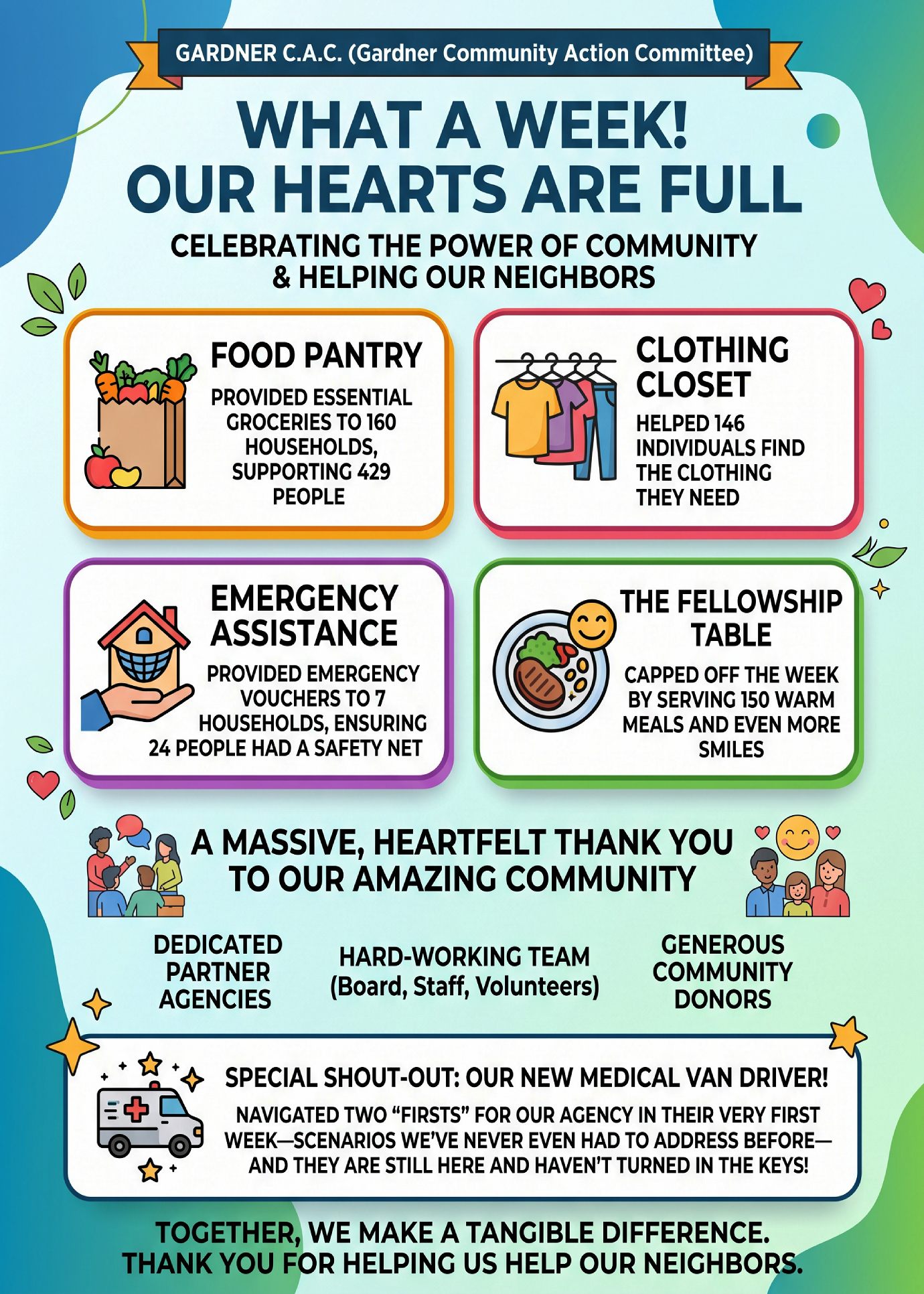
The Gardner CAC – Lessons From a Week of Dedicated Community Compassion
In the quiet corners of Gardner MA, a rhythm of service often hums along unnoticed until the week’s end when the tally is finally taken. This past week at the Gardner Community Action Committee was far from routine; it was a high-octane demonstration of what happens when a community decides to stand in the gap for its neighbors. While the rest of us navigated our daily commutes and personal errands, a dedicated network of volunteers and staff moved with urgent purpose, fueled by a mission to provide a lifeline to those living on the edge.
The scale of local need is often invisible, tucked away behind closed doors or masked by the standard bustle of small-town life. Yet, a single seven-day snapshot reveals a staggering level of activity that challenges our assumptions about “hidden” poverty. How does one organization touch the lives of hundreds in such a short span? The answer lies at the intersection of logistical grit and deep, dedicated compassion.
As we pull back the curtain on these seven days, we see more than just a distribution of goods. We see a new driver facing an immediate trial by fire behind the wheel of a medical van, and we feel the literal warmth of 150 meals served at the Fellowship Table. By looking closely at the data, we move past abstract statistics and begin to see the breathing, human stories that define our collective social fabric.
429 Neighbors: The Staggering Logistics of Local Hunger
The most striking figure from the past week is the sheer volume of individuals seeking basic sustenance. The Food Pantry provided essential groceries to 160 households—a logistical feat that ensured 429 of our neighbors did not go hungry.
To visualize the intensity of this effort, consider the rhythm of that labor: nearly 60 people served every single day, or one neighbor assisted every few minutes of the operating day. This is not merely a matter of “stocking shelves.” It is a constant, physical motion of heavy crates, meticulous sorting, and the intense coordination of resources to ensure that every family left with a full bag. These 429 individuals represent a cross-section of our community whose weekly stability was secured through a single, vital point of contact.
The Trial by Fire: Two ‘Firsts’ and a Medical Van
Community advocacy is rarely predictable, and the frontline of service often demands an immediate “trial by fire” mentality. This week, that grit was personified by the agency’s new Medical Van driver. In their very first week on the job, the driver was met with two unprecedented scenarios—agency “firsts” that had never been encountered before.
In the world of social impact, these are the moments where the weight of responsibility can feel overwhelming. Yet, the resilience required for this work prevailed. Despite these daunting obstacles, the driver remained steadfast. The keys remained in their hand—a silent, powerful promise to the community that they aren’t going anywhere.
“A huge round of applause for our new Medical Van driver! After navigating two ‘firsts’ for our agency in their very first week—scenarios we’ve never even had to address before—they are still here and haven’t turned in the keys!”
Restoring Dignity: A Multi-Layered Lifeline
A robust safety net must be multi-layered to be effective, because poverty is rarely a singular problem. It is a complex web that impacts everything from physical health to personal self-worth. Over these seven days, the committee addressed these layers with precision:
- The Clothing Closet: 146 individuals found more than just shirts and coats; they found the dignity that comes with having the right attire for an interview, a school day, or a cold morning.
- Emergency Assistance: Beyond the pantry, emergency vouchers were issued to 7 households, providing a critical safety net for 24 people facing immediate, destabilizing crises.
- The Fellowship Table: The week culminated with the serving of 150 warm meals. Here, the impact transcended nutrition—it was about the smiles and the social connection that remind those in need that they are seen and valued.
By offering this holistic range of aid, the organization ensures that the support provided is as diverse and nuanced as the lives of the people walking through the door.
The Pulse of Compassion: Beyond the Calculation
At the heart of this high-volume week is a core philosophy: data must never obscure the individual. While it is necessary to track households and vouchers, the organization operates on the belief that the true value of the work lies in the connection between the server and the served. This “pulse of compassion” is what transforms a simple transaction of goods into a transformative act of community.
When an organization prioritizes the person behind the number, the work becomes sustainable. It shifts from a logistical burden into a shared mission that connects the entire ecosystem—from the board of directors and donors to the volunteers standing on the front lines.
“This work isn’t just about numbers; it’s about the people behind them and the compassion that connects us all. We truly couldn’t do this without you. Whether you donated your time, your resources, or your support—thank you for helping us help our neighbors.” – Gardner CAC
A Reflection on the Quiet Heroes
The achievements of this single week are a testament to the collective power of community action. This impact is the result of a dedicated ecosystem involving partner agencies, staff, tireless volunteers, and generous donors. It is a living proof that when resources and empathy are aligned, the effect on local lives is both immediate and tangible. Congratulations to the Gardner CAC in all that you do. For those who wish to contribute to their efforts in a financial way, here’s a link to the donation page, CLICK HERE.
This is an organization worthy of your support. Werner Poegel – Publisher
- UFO Files Released (5/8/2026)

Here’s a link to our complete page with multiple reports on this topic, CLICK HERE.
Gardner Magazine reports on Flying Saucers – Aliens – Extra-Terrestrials, Unexplained Aerial Phenomena
The U.S. Government has released many thousands of files related to UFOs and other mysterious related phenomena. Gardner Magazine used 5 separate file dumps from the U.S. Government to generate these reports: (Section 2,3,4,5,and 10) To download the original material yourself and hundreds more files, visit the official site, CLICK HERE.
The Chair Man and the Chair Lady explain as much of it as they can in this podcast, Listen on any device, CLICK PLAY.
DEEP DIVE – Extraterrestrials and UFOs Max and Maxine Rogers debate whether the evidence proves the existence of extraterrestrials in this Debate, Listen on any device, CLICK PLAY.
DEBATE – Do Extraterrestrials Exist? Jump to various reports on the complete page: FBI Briefing: Synthesis of Investigative Records on Unidentified Flying Discs (1947–1948) —- The Hoover Files: 5 Surprising Takeaways from the FBI’s Early “Flying Disc” Archives —Aviation Observation Guide: Identifying Early Aerial Phenomena (1947–1948) —- Intelligence Synthesis Report: 1947-1948 Aerial Phenomenon and Official Intelligence Responses —-Evidence Evaluation Primer: The 1947–1948 “Flying Disc” Files —-Administrative Case Narrative: The Bureaucratic Architecture of FBI File 62-HQ-83894 (1947-1948) —- Technical Assessment of the 1947–1948 “Flying Disc” Phenomenon: Evidence and Counter-Explanations
- GPS Budget Preview (5/7/2026)
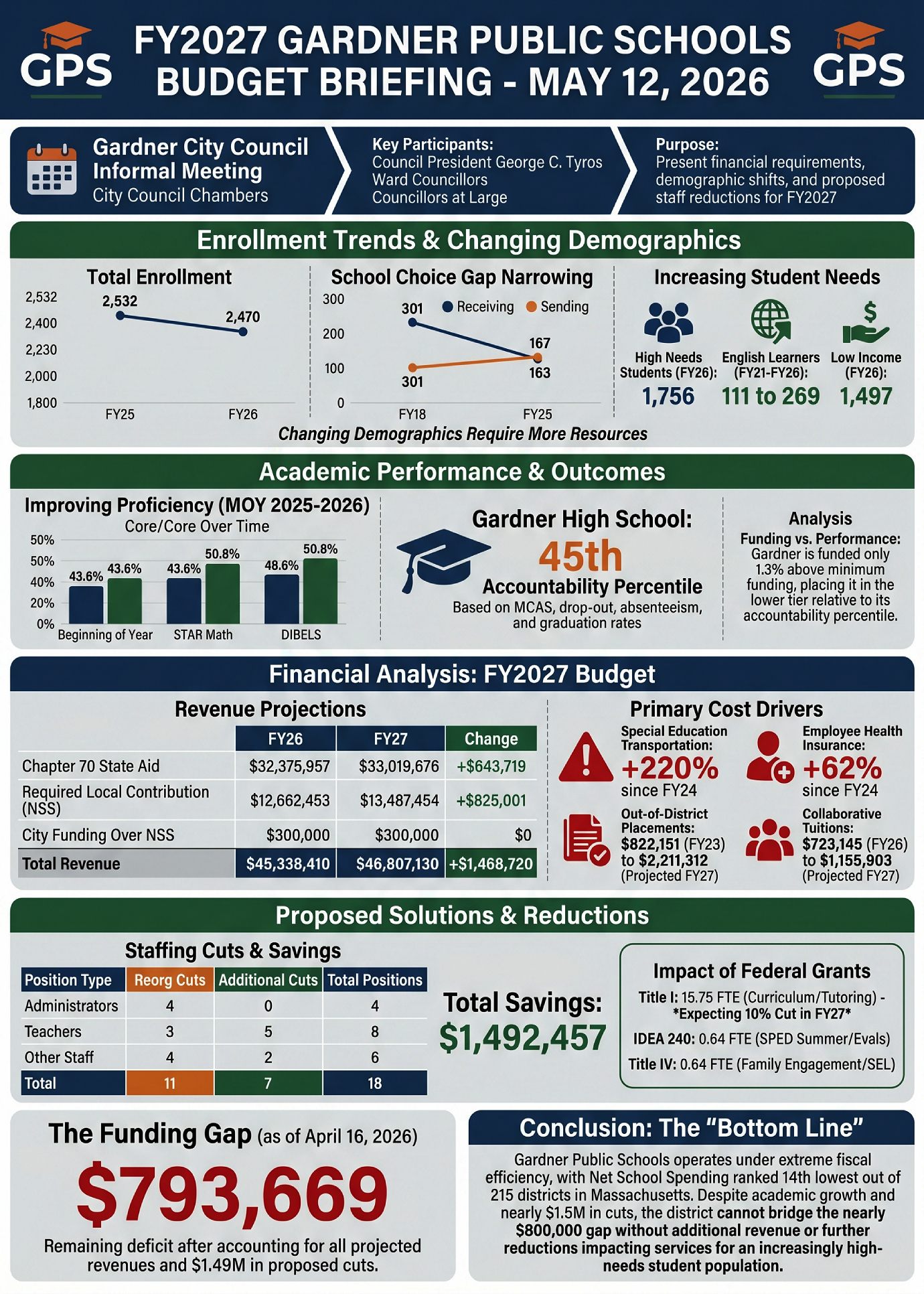
Gardner School Budget Review – Timetable for the Week Ahead
The Gardner School Committee will meet on Monday May 11, 2026 at 6pm in the City Council Chambers. There is open time for the General Public to speak and a Public Hearing on the FY2027 School Budget. Public Comments are solicited in the agenda for the posted meeting. Following input from the public, there will be a vote on the School Budget. Agenda and packet.
The Gardner City Council will meet informally on the School Budget the following day, Tuesday, May 12, 2026 at 7:30pm in the City Council Chambers. There will be a School Budget presentation. Time is not allotted for the general public. Public input is reserved for the day before. Agenda and packet.
The Gardner City Council meets again in a regular meeting on Monday, May 18th at 7:30pm in the City Council Chambers. It is expected that reports of the subcommittees which have been meeting regarding various Department budgets will be heard and the overall budget will be discussed. Agenda and packet for this meeting would usually be posted on May 14th.
GPS BUDGET EXPLAINED on VIDEO
Gardner Magazine has prepared this 6 minute PREVIEW VIDEO for you to watch prior to attending the School Committee meeting. It will give you a concise, but very clear and easy-to-understand picture of the GPS Financial issues despite very prudent spending practices.
The Gardner Public Schools (GPS) FY2027 budget presentation will outline a critical intersection between rising student needs and severe fiscal constraints. While the district reports improving academic outcomes and stabilizing school choice numbers, it faces a projected $793,669 funding shortfall for the upcoming fiscal year. This gap persists despite a proposed reorganization and reduction of 18 total positions (including administrators and teachers) intended to save approximately $1.49 million. The district’s financial challenges are driven by systemic cost increases—specifically a 220% rise in Special Education transportation and a 62% increase in employee health insurance since FY24—compounded by the fact that Gardner’s Net School Spending (NSS) remains the 14th lowest among 215 Massachusetts school districts. Total Enrollment: After a peak of 2,532 students in FY25, enrollment for FY26 stands at 2,470. Gap between “receiving” and “sending” students has narrowed significantly over the last decade, moving from a high of 301 sending students in FY18 to nearly equal numbers in FY25 (167 receiving vs. 163 sending).
- Public Service 5-7-26 (5/7/2026)
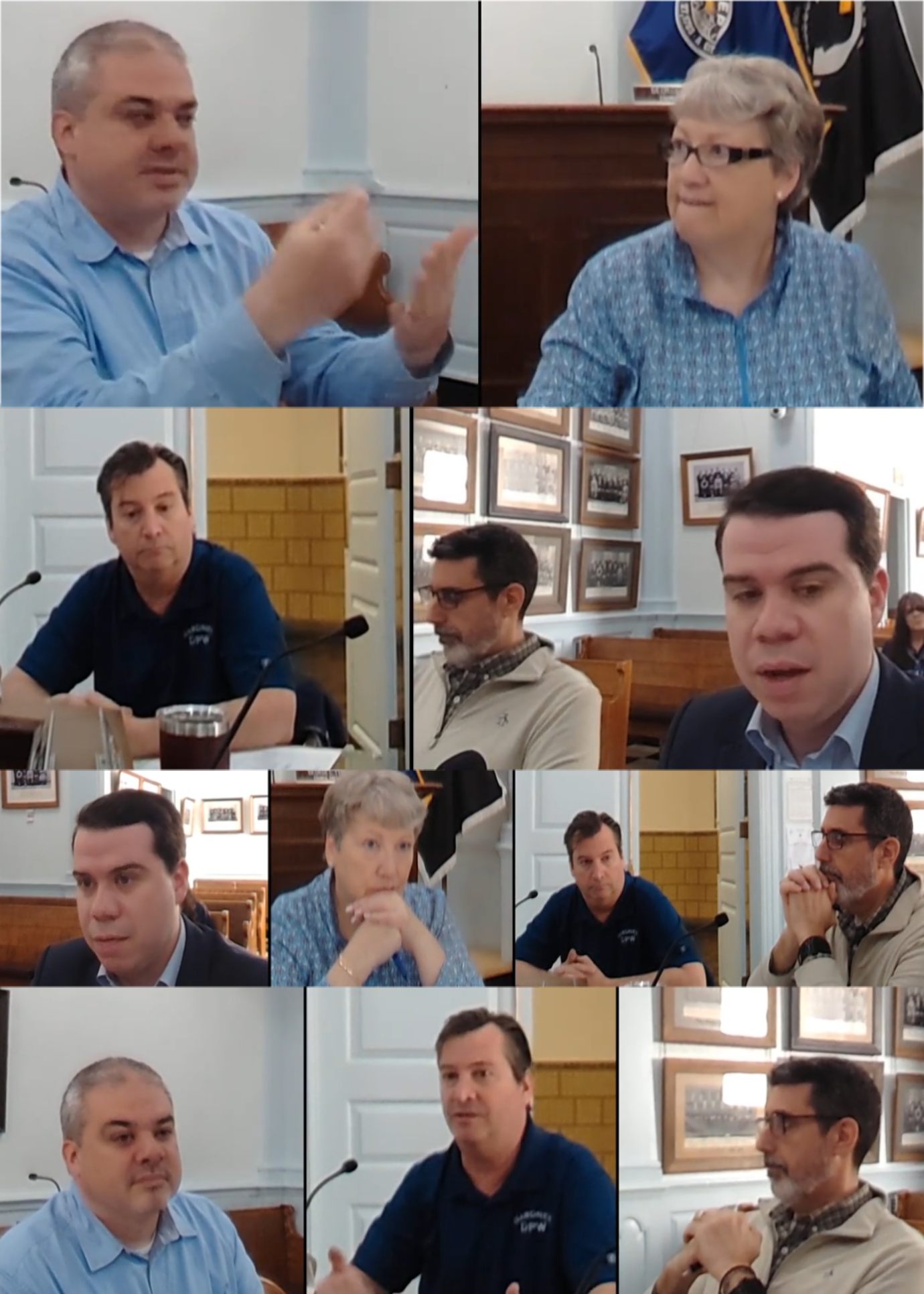
Budget Discussions Dominate Public Service Committee Meeting
The Gardner Public Service Committee met on May 7, 2026 and spent a considerable amount of time discussing DPW and infrastructure. Listen to the meeting on any device, CLICK PLAY.
Public Service 5-7-26
The focus was on preliminary FY2027 department budgets and infrastructure updates. Committee members discussed a proposed 20% water rate increase intended to fund emergency repairs and address long-deferred maintenance for the city’s aging water system. Gardner Mayor Michael Nicholson outlined his budgetary process, explaining the distinction between departmental “wish lists,” realistic operating needs, and mandated reduction scenarios. Significant dialogue centered on the Department of Public Works, specifically regarding the high costs of maintaining an aging vehicle fleet and the legal complexities of budgeting for snow and ice removal. Additionally, City Engineer Rob Oliva provided updates on federal environmental mandates related to storm water and the ongoing efforts to sell surplus municipal land to boost local tax revenue.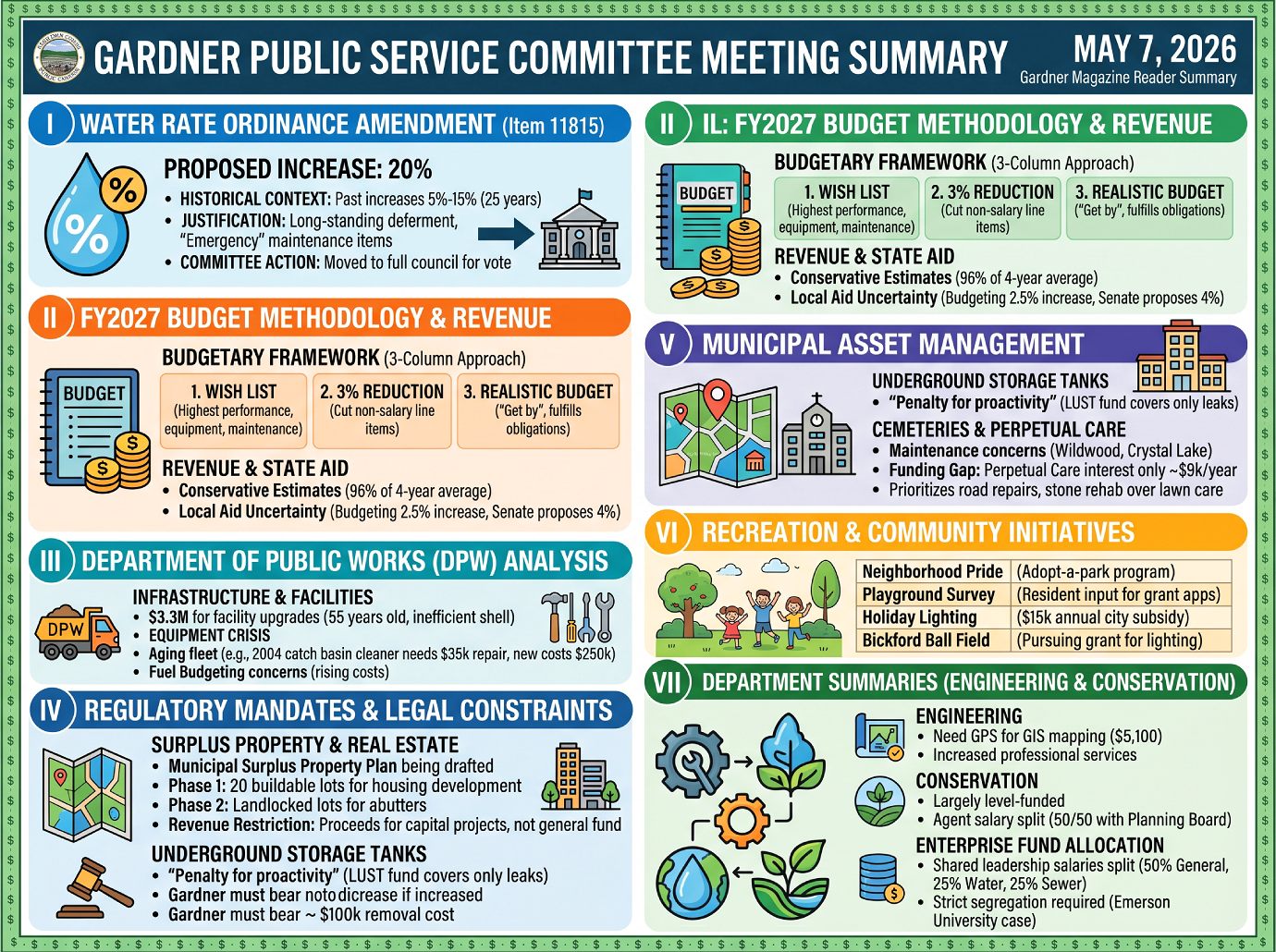
- City Clerk Search (5/7/2026)
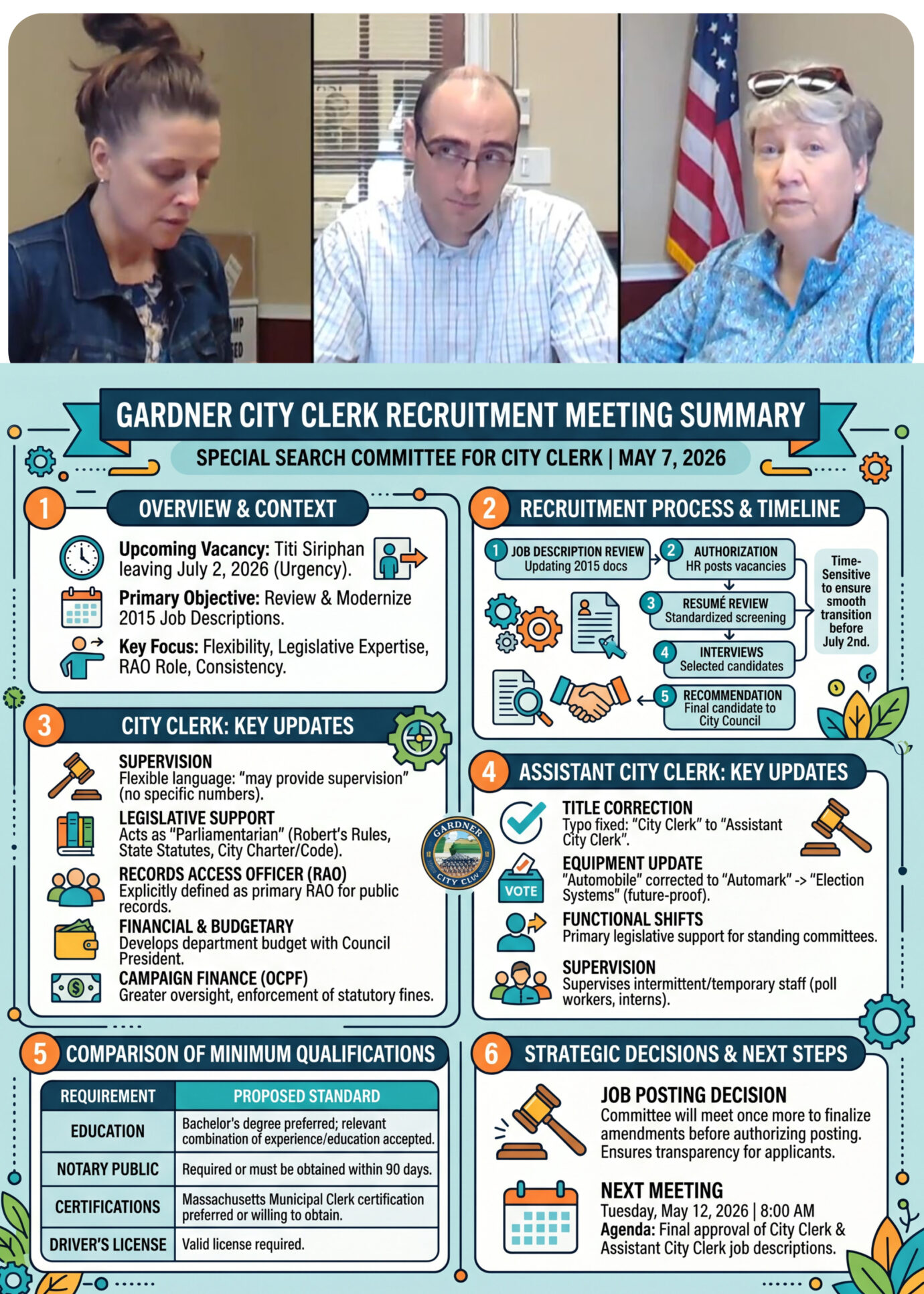
Next Meeting is Tuesday, May 12th at 8am to finalize the City Clerk and Assistant City Clerk job descriptions.
Recruitment to Replace Outgoing Gardner City Clerk Underway
The Gardner City Clerk Recruitment Committee met on May 7, 2026. Listen to the meeting on any device, CLICK PLAY.
City Clerk Recruitment Meeting 5-7-26 On May 7, 2026, the Gardner Special Search Committee for the City Clerk convened to initiate the recruitment process for a new City Clerk and Assistant City Clerk. The urgency of this committee is driven by the upcoming departure of the current Clerk, Titi Siriphan, effective July 2, 2026.
The primary objective of this meeting was the detailed review and modernization of job descriptions originally established in 2015. Key takeaways include a move toward more flexible supervisory language, the formalization of the Clerk’s role as the Records Access Officer (RAO), and the inclusion of legislative expertise—specifically Robert’s Rules of Order and state statutes—as a core competency. The committee emphasized the need for consistency between the Clerk and Assistant Clerk roles regarding educational requirements and professional certifications, such as Notary Public status and Massachusetts Municipal Clerk certification.
- Airport 5-6-26 (5/7/2026)
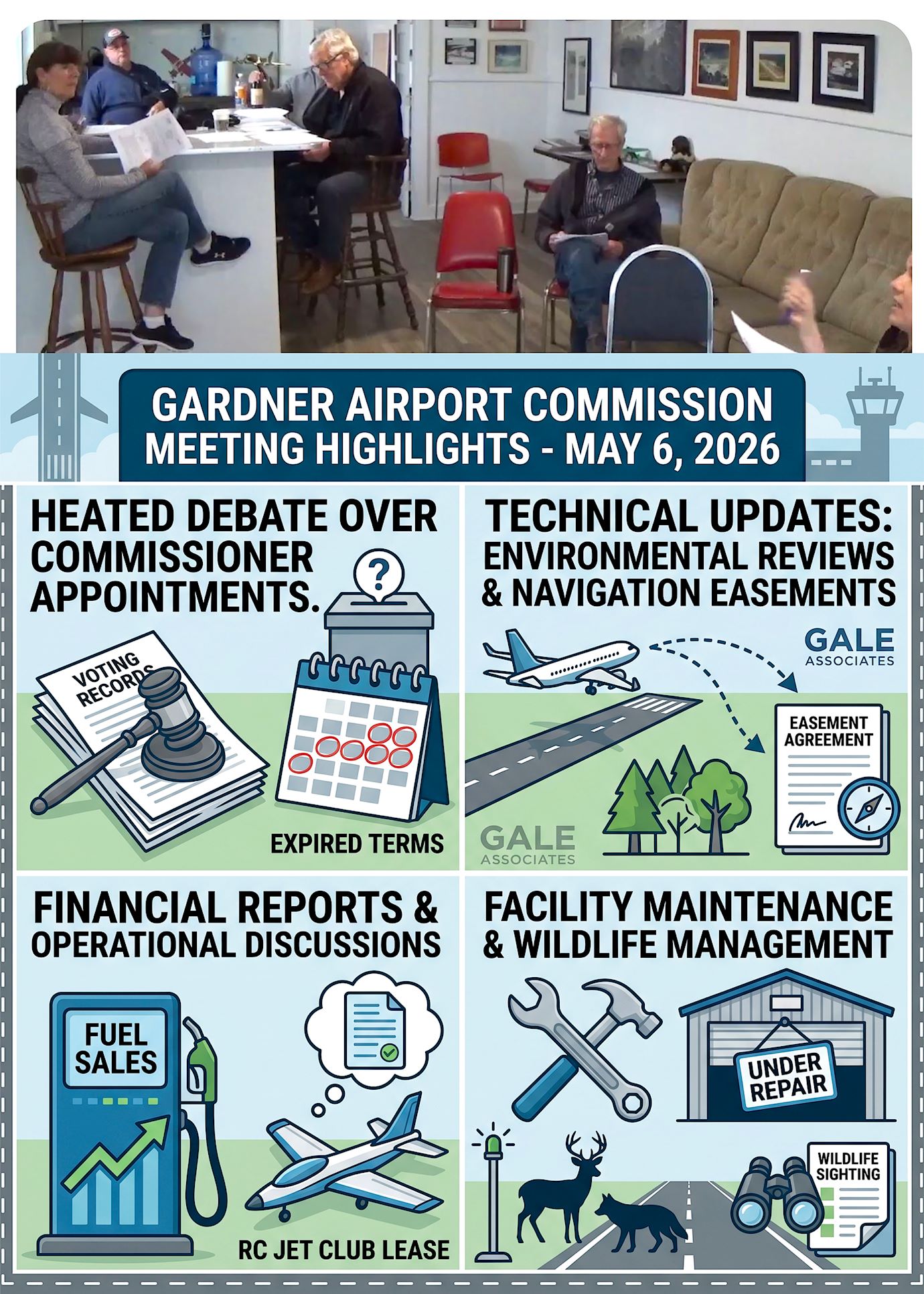
Administrative Disputes, Projects, Agreements, Finances, and Maintenance Topics of Airport Commission
The Gardner Airport Commission met on May 6, 2026. Listen to the meeting on any device, CLICK PLAY.
Airport Commission 5-6-26 - Governance Crisis: Evidence was presented suggesting that two sitting commissioners have been voting without valid appointments since March 2025, potentially rendering a year’s worth of Commission actions illegal.
- Project Status: Federal environmental reviews for airport improvements are nearing completion, and a 100% state-funded Vegetation Management Plan (VMP) is being initiated to streamline future maintenance and permitting.
- Contractual Disputes: Negotiations with the Boston RC Jet Club have stalled over “bailout” clauses and payment structures, with commissioners expressing frustration over the club’s perceived lack of commitment.
- Operational Health: Fuel sales for April 2026 resulted in a net return of $2,664.44 to the city, while essential equipment maintenance (mowers and hangar doors) was completed to prepare for the summer season.

The Gardner Magazine Wildlife Cartoon is presented here due to some very real wildlife sightings on or near the airfield. The Gardner Airport Commission emphasized the need for continued monitoring due to the following:
- Bear: Spotted via camera near the fuel farm at 9:00 PM.
- Bobcat: Sighted on the south end of the field.
- Snapping Turtle: A “giant” turtle was removed from the runway.
Wildlife commonly spotted at municipal airports around the country includes birds—specifically gulls, geese, starlings, and raptors like hawks and owls—along with mammals such as deer, coyotes, rabbits, and foxes. These animals are attracted to the expansive open, grassy spaces and, in some cases, coastal locations that resemble habitats
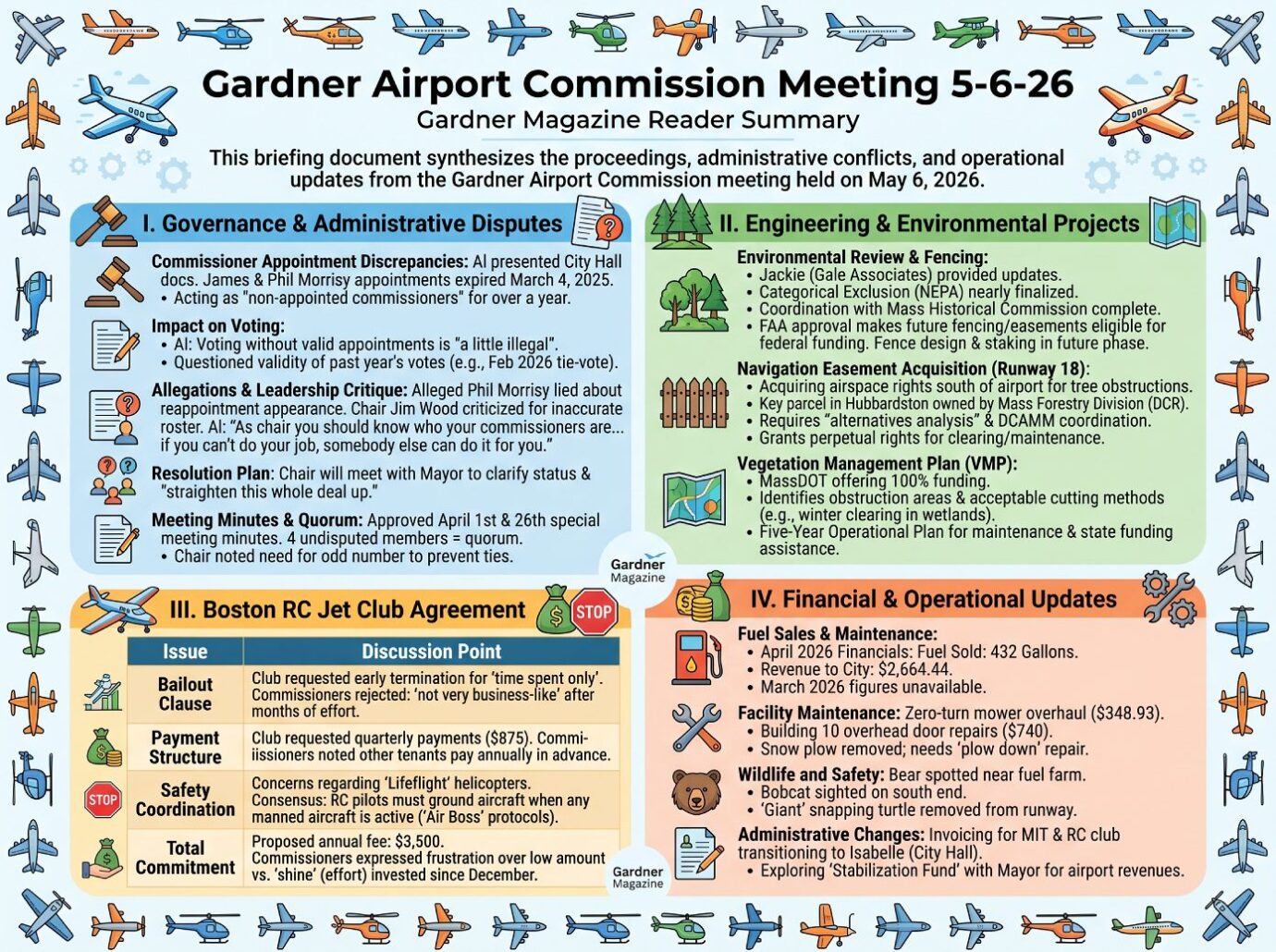
- Gardner PD Adds Team Member 5-7-26 (5/7/2026)
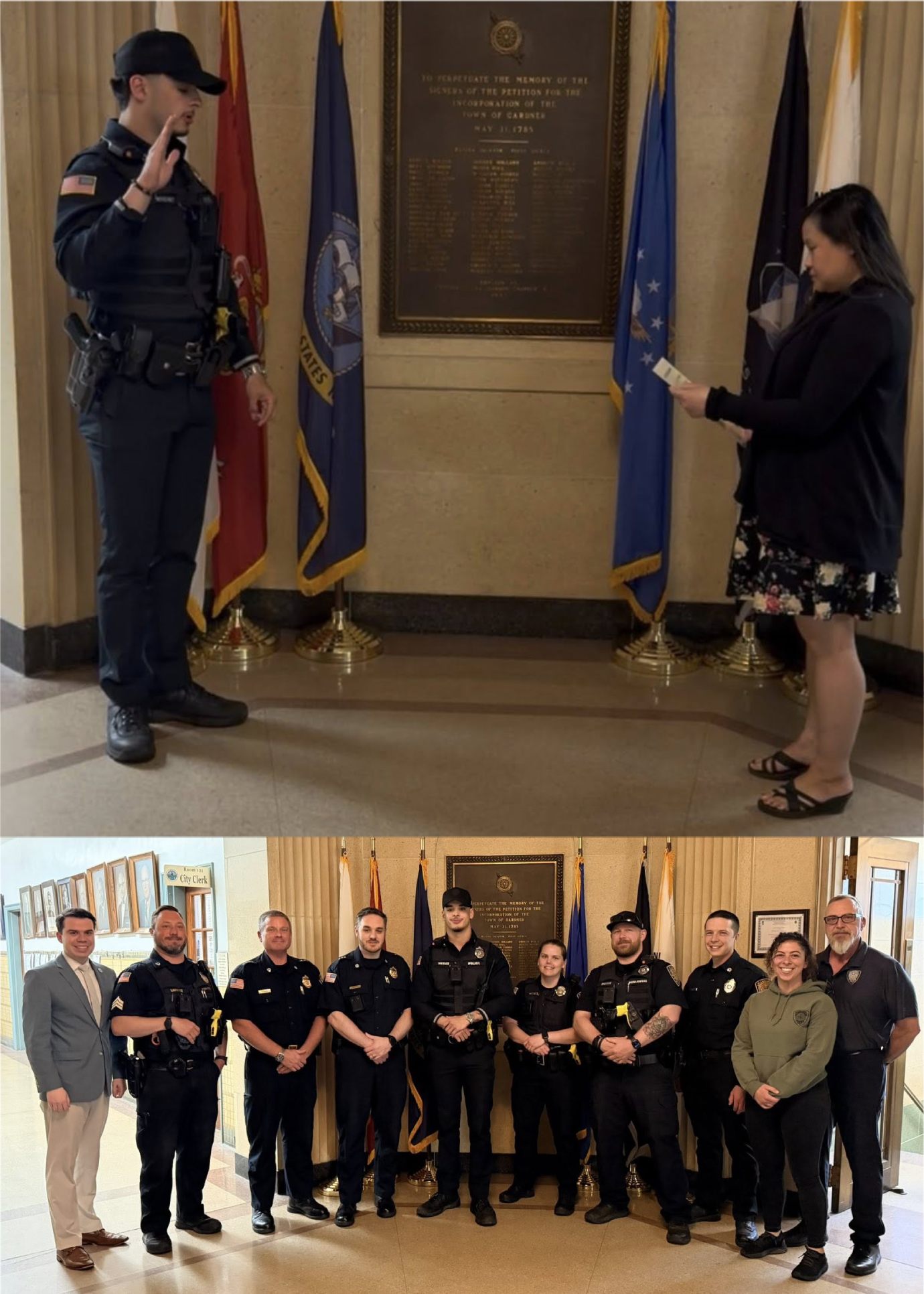
Officer Derek Wight Sworn in to the Gardner PD on May 7, 2026 Gardner Police Department Adds Team Member – Mayor and Other Officers Show Support.
The newest member of the Gardner Police Department is Officer Derek Wright. Both Gardner Police Chief Eric McAvene, Deputy Chief Nicholaus Maroni, and other officers were on hand for the swearing in which took place at Gardner City Hall. The oath of office was administered by City Clerk Titi Siriphan. Gardner Mayor Nicholson posted photos and stated: “Congratulations to Officer Derek Wight on being sworn in as the newest member of the Gardner Police Department!”
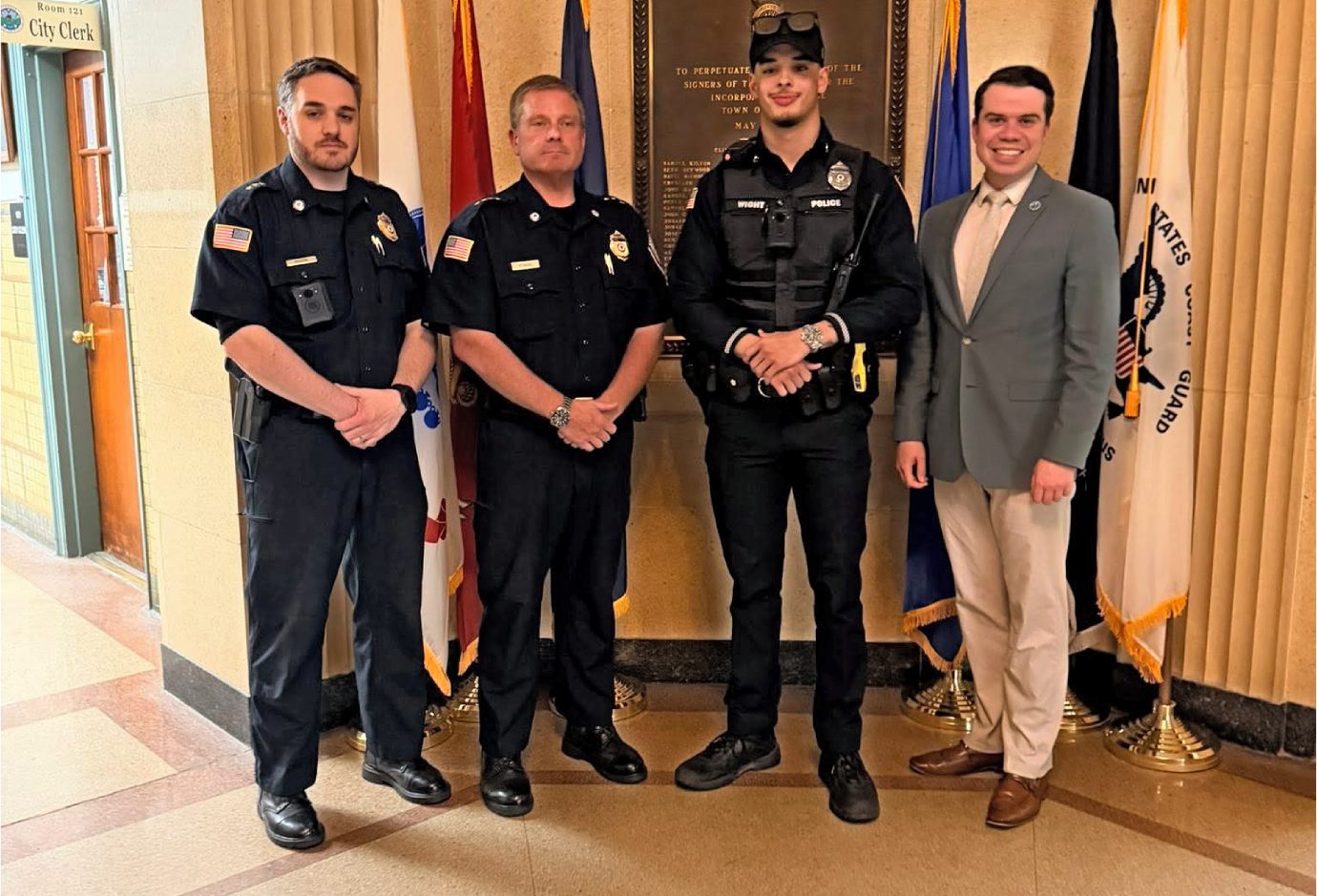
- Gardner Senior Center May 2026 (5/7/2026)

Chair Man and Chair Lady Recognize Gardner Senior Center Fulfilling
“Connection and Purpose” MissionThe May 2026 Gardner Senior Center Newsletter is covered. Listen to this “Deep Dive” on any device, CLICK PLAY.
Deep Dive – Gardner Senior Center May 2026 For this month’s newsletter on PDF CLICK HERE. Bookmark this website link as you can sign up for automatic email delivery of the monthly Newsletter link, CLICK HERE.
The Gardner Senior Center, operating under the mission of “Connection & Purpose,” has established a robust May 2026 schedule centered on holistic wellness, civic engagement, and community building. This period is characterized by a strategic move “Beyond the Medical Model,” highlighted by a cornerstone workshop on “Soul Care” led by Sarah Gaer, MA.A Vital Hub: The center continues to serve as a vital hub for Gardner’s aging population, providing a diverse array of services ranging from nutritional support (SNAP/HIP) and health advocacy (SHINE, Medicare advising) to innovative recreational programming like the 3rd Annual Patriotic & Summer Sing-A-Long and the “Great Hobby Horse Derby.”
The Gardner Senior Center maintains a dedicated focus on veterans and national heritage through social and musical events.
- Vet-to-Vet Café: A recurring program (e.g., Tuesday, May 19) providing a light lunch and a forum for veterans to share information and conversation.
- 3rd Annual Patriotic & Summer Sing-A-Long: Scheduled for the Wednesday preceding the July 4th holiday, featuring “The Gardner Area Strummers and Friends.”
- Memorial Day Observance: The center will be closed on May 25, 2026, in observance of the holiday.
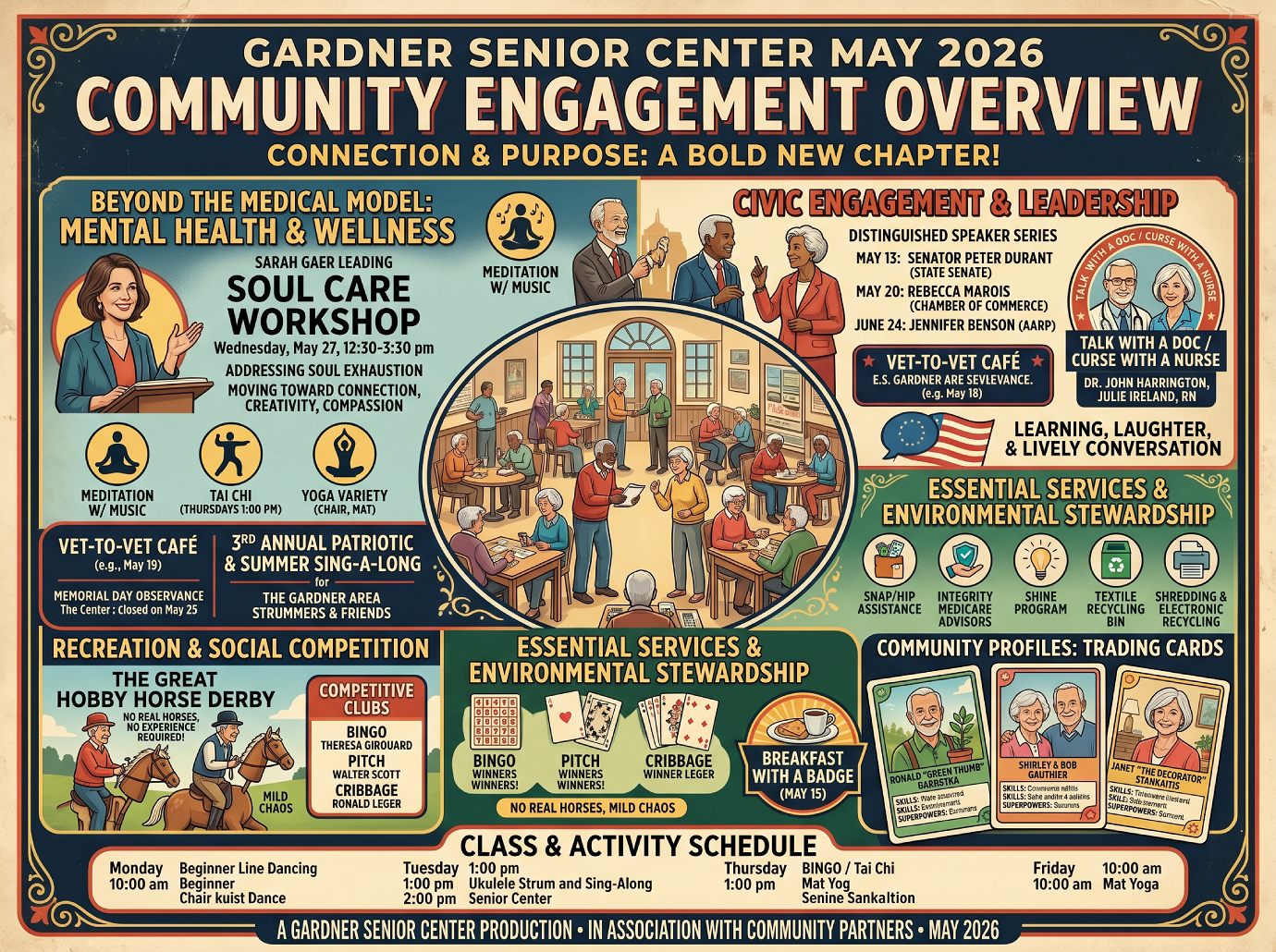
- Gardner Graham St. Fire (5/6/2026)
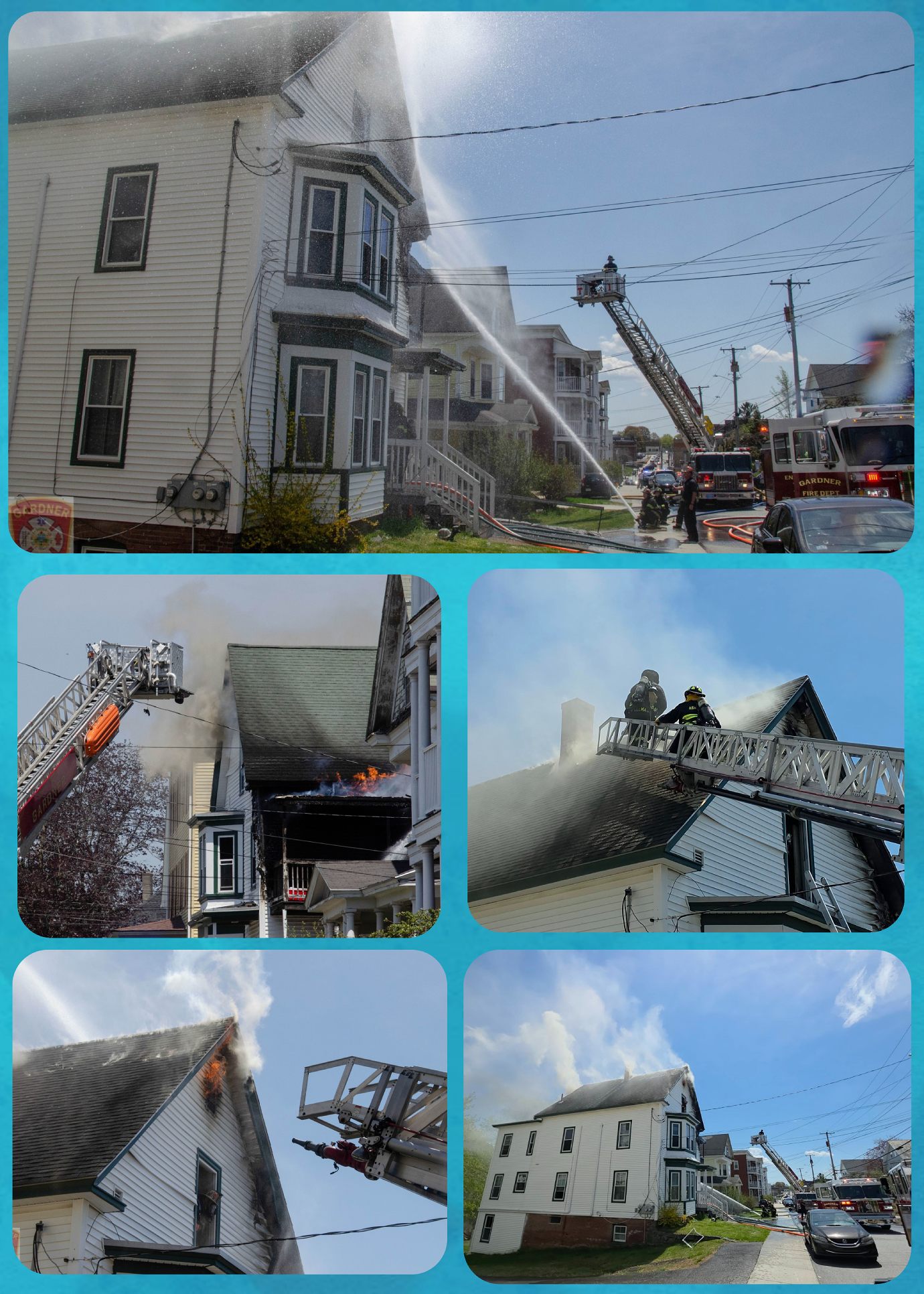
Fire Crews Spent Just Under 5 Hours at Graham Street Fire
A fire shortly after noontime on May 5, 2026 caused considerable damage to a building at 45 Graham Street in Gardner. According to the Gardner Fire Department, “Crews arrived to find heavy fire on the second floor, extending to the third and attic. Crews made an aggressive interior attack to knock down the fire in the upper stories. Flying embers started a small fire between two garages on Vernon St. that was quickly handled. Cover companies responded to several calls , including a small brush fire at Pearly Brook Reservoir. All companies cleared the scene at 17:12 hours.”
Mutual aid to the scene: Ashburnham, Hubbardston, Templeton, Westminster, Winchendon, Athol, Fitchburg and Leominster. Devens, Rutland and Sterling covered Gardner HQ.
All building occupants made it out safely without injury. However, 2 pet cats were not located. Cause of fire is under investigation and was not immediately determined.
- MWCC HS Art 40th (5/6/2026)

MWCC Hosts 40th Annual Exhibition of High School Art at the East Wing Gallery
According to Joyce Miller, Chair of the Art Department and Gallery Director at MWCC, “This exhibition is one of our most popular and meaningful community events. For 40 years, it has provided an opportunity to celebrate the work of high school students and recognize the dedication of their teachers, families, and supporters.“
The 40th Annual Regional Exhibition of High School Art held in the East Wing Gallery showcased exceptional student work from eight area high schools, highlighting the creativity, dedication, and artistic achievement of young artists across the region. The exhibition featured a diverse collection of two- and three-dimensional works, including ceramics, painting, drawing, and mixed media.
Participating schools included Athol High School, Contoocook Valley Regional High School, Fitchburg High School, Leominster High School, Quabbin Regional High School, Ralph C. Mahar Regional High School, Shepherd Hill Regional High School, and Wachusett Regional High School.During the exhibition’s awards ceremony, ten students received cash awards for outstanding artistic achievement. Works were evaluated based on originality, technical skill, and creative expression.
2026 Award Winners: Aidan Marony, ConVal Regional High School — Wheel-thrown ceramic bottle — Lucy Morris, ConVal Regional High School — Ceramic lidded vessel —Erin Sargent, Leominster High School — Narrative watercolor illustration — Brynn Dunphy, Quabbin Regional High School — Geometric assemblage wall piece — Romelle Romey, Shepherd Hill Regional High School — Still life painting — Alaiza Wijangco, Shepherd Hill Regional High School — Collage (grizzly bear and salmon) —Julia Daly, Wachusett Regional High School — Carved ceramic vase — Bianka Mazierkowski, Wachusett Regional High School — Portrait — Dahlia Vargas, Wachusett Regional High School — Charcoal drawing — Allison DeLeire, Wachusett Regional High School — Painting (girl in pink dress) — The MWCC Art Club also selected Alaiza Wijangco for its special Art Club Award.
MWCC extended its appreciation to Chrystal Voorheis, administrative assistant, and Kevin Oxford, gallery assistant and MWCC alum, for their contributions to organizing and installing the exhibition. “The quality of work in this year’s show was exceptional,” Miller added. “We are continually inspired by what students and educators accomplish, often with limited resources. We hope this experience encourages students to continue pursuing their artistic passions.”

- Crabby Old Man Syndrome (5/5/2026)
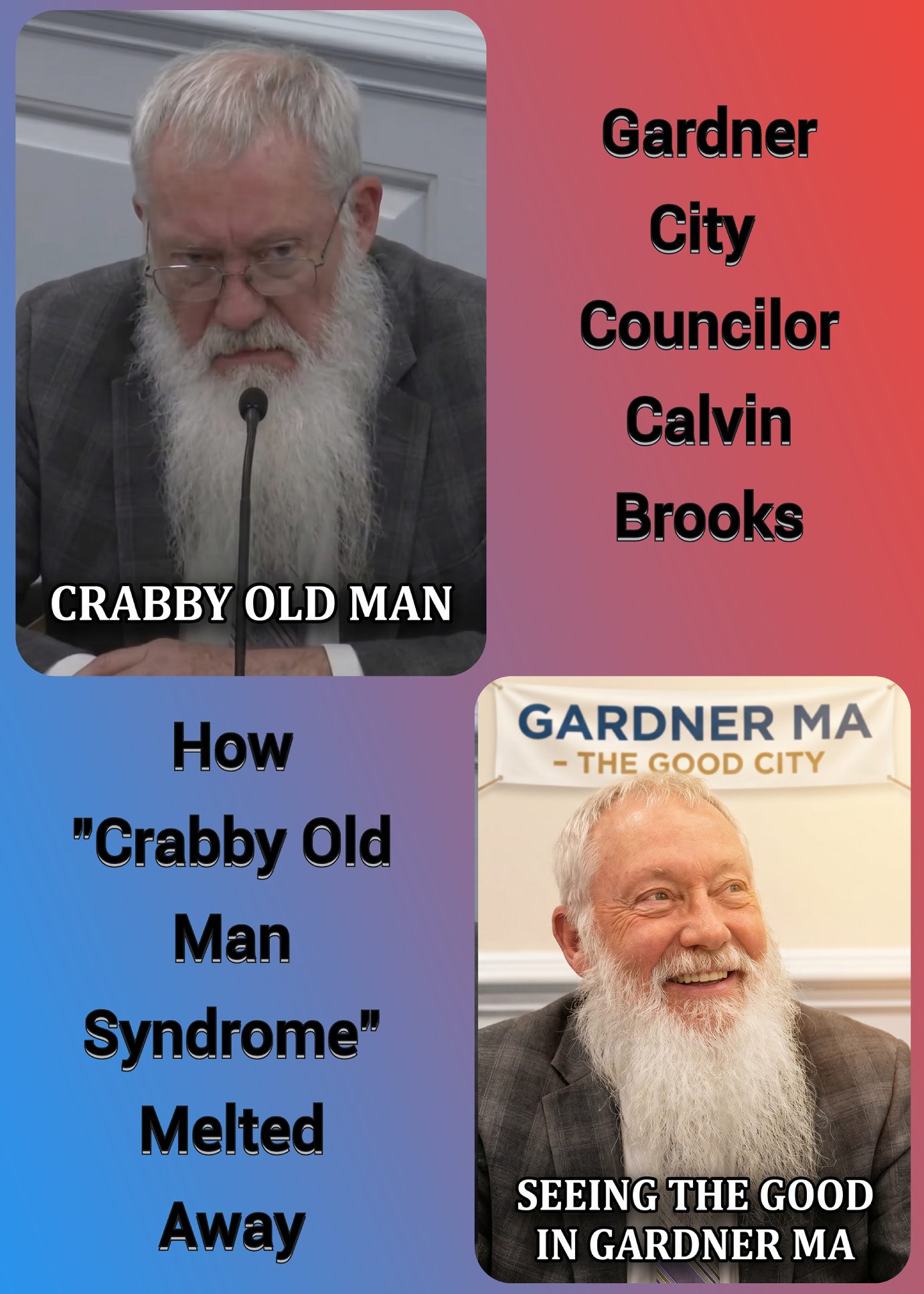
How Councilor Calvin Brook’s Crabby Old Man Syndrome Melted Away
These are the comments of Councilor Brooks during the City Council meeting of May 4, 2026. Listen on any device, CLICK PLAY.
Calvin Brooks Comments 5-4-26 Thank you, Mr. President. I’m just thinking that there’s a lot going on in the world today. We’ve got wars in Iran, Gaza, Ukraine, dysfunctional Congress, gas prices, sports. We can talk about the Bruins, the Celtics, and the Red Sox. Personally, the construction on Elm Street that seems to be all happening at the end of my driveway. And all these thoughts were going through my head a week ago, Saturday, while picking up beer cans and bottles, Dunkin’ Coffee cups and nips on about 100 yards on West Street next to the transfer station. I kept thinking, why do people from Templeton have to throw their trash out their car windows? As a kid, I remembered the public service campaign against litter. Litter bug, litter bug, shame on you. My crabby old man syndrome was kicking in.
So as I drove away from the cleanup day at the transfer station, I began to think about why I was there. Not the why answer of my picking up litter, but the why answer of someone in this community who thought the litter should be picked up and so organized the event. They did it to make this community better. A couple of days later, I saw a story in the Gardner News about the efforts to bring back the baseball diamond at Stone Field for Babe Ruth play. I remember the years of care that Steve Zoldack gave to that field, and I started to feel good about my community. Tonight we shared, in the kickoff for the Relay for Life, another locally organized event that is successful because of the hard work of the organizers and the participants. Here in this room are people spearheading things like the downtown flower pot program, assisting with overdose awareness in August, and helping youth sports programs in the city. The more I thought about all this volunteer work, all the people who stepped forward to fill a need, the more my crabby old man syndrome melted away.
In many communities, members are only too willing to step back, take it easy, and to complain. We here in Gardner are all extremely fortunate to live in a community like this one, where members are willing to step forward, to do some work, and to give back. That spirit of giving back, of looking out for each other, is what makes this community so special. Thank you to everyone who has taken the time to do just that. I applaud your work and am proud to live in Gardner. Thank you. – Gardner City Councilor Calvin Brooks
- Upcoming Winchendon Town Meeting 2026 (5/5/2026)
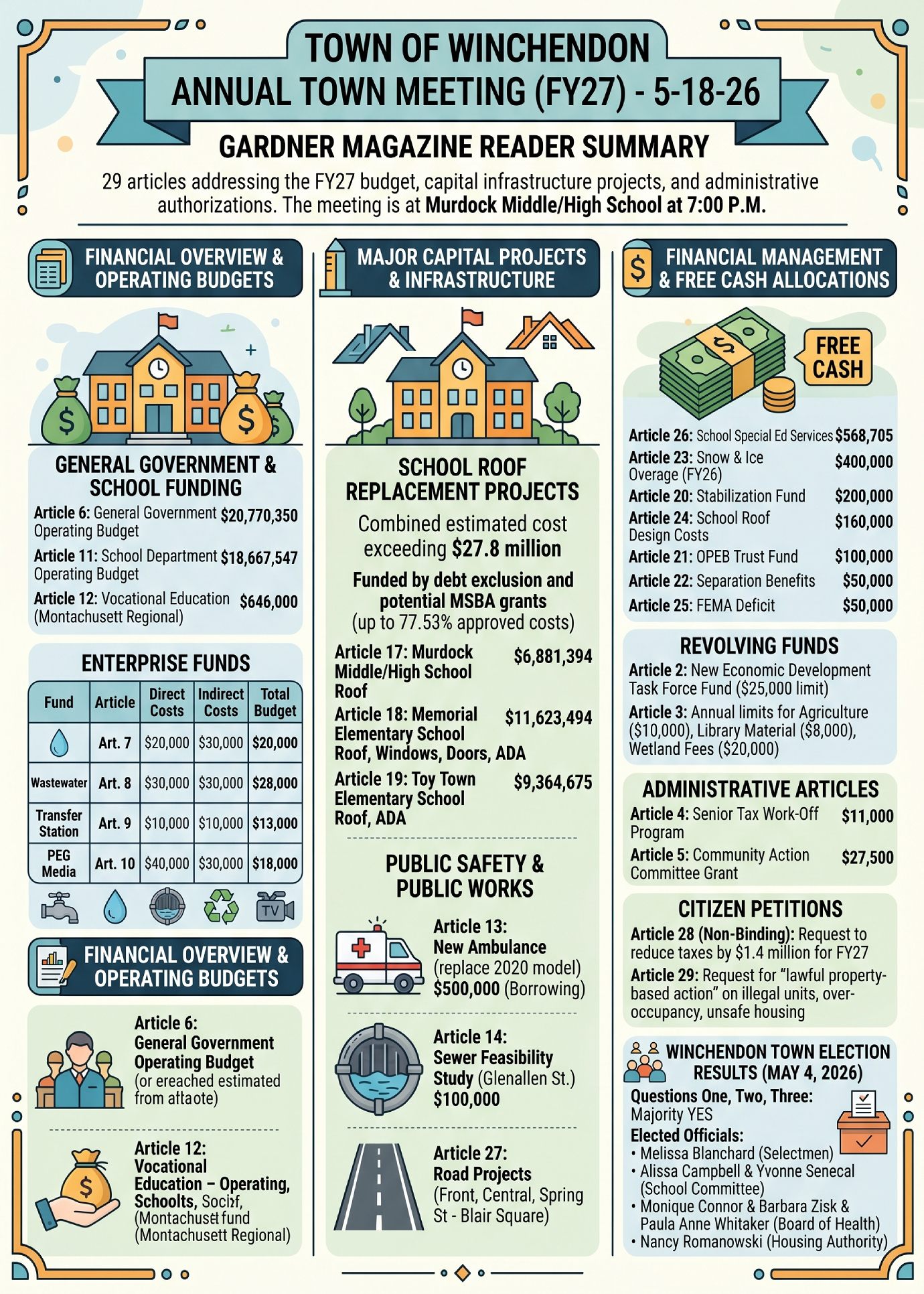
A Discussion and Review of the Upcoming Winchendon Town Meeting May 18th
The Chair Man and the Chair Lady discuss the upcoming Winchendon Town Meeting to be held on May 18, 2026. Listen on any device. CLICK PLAY.
Discussion re Winchendon Upcoming Town Meeting The Town of Winchendon’s Annual Town Meeting, scheduled for May 18, 2026, encompasses 29 articles addressing the fiscal year 2027 (FY27) budget, significant capital infrastructure projects, and administrative authorizations.
The primary financial highlights include a General Government operating budget of $20,770,350 and a School Department budget of $18,667,547. A critical focus of this warrant is the proposed replacement of roofs at three major educational facilities—Murdock Middle/High School, Memorial Elementary, and Toy Town Elementary—with a combined estimated cost exceeding $27.8 million, largely funded through debt exclusion and potential Massachusetts School Building Authority (MSBA) grants which may pay for about 70 percent of the cost.
Other significant items include a $500,000 appropriation for a new ambulance, the utilization of Free Cash to address FY26 deficits (specifically $400,000 for snow and ice), and two citizen petitions aimed at tax reduction and stricter property-based code enforcement.
- City Council 5-4-26 (5/5/2026)
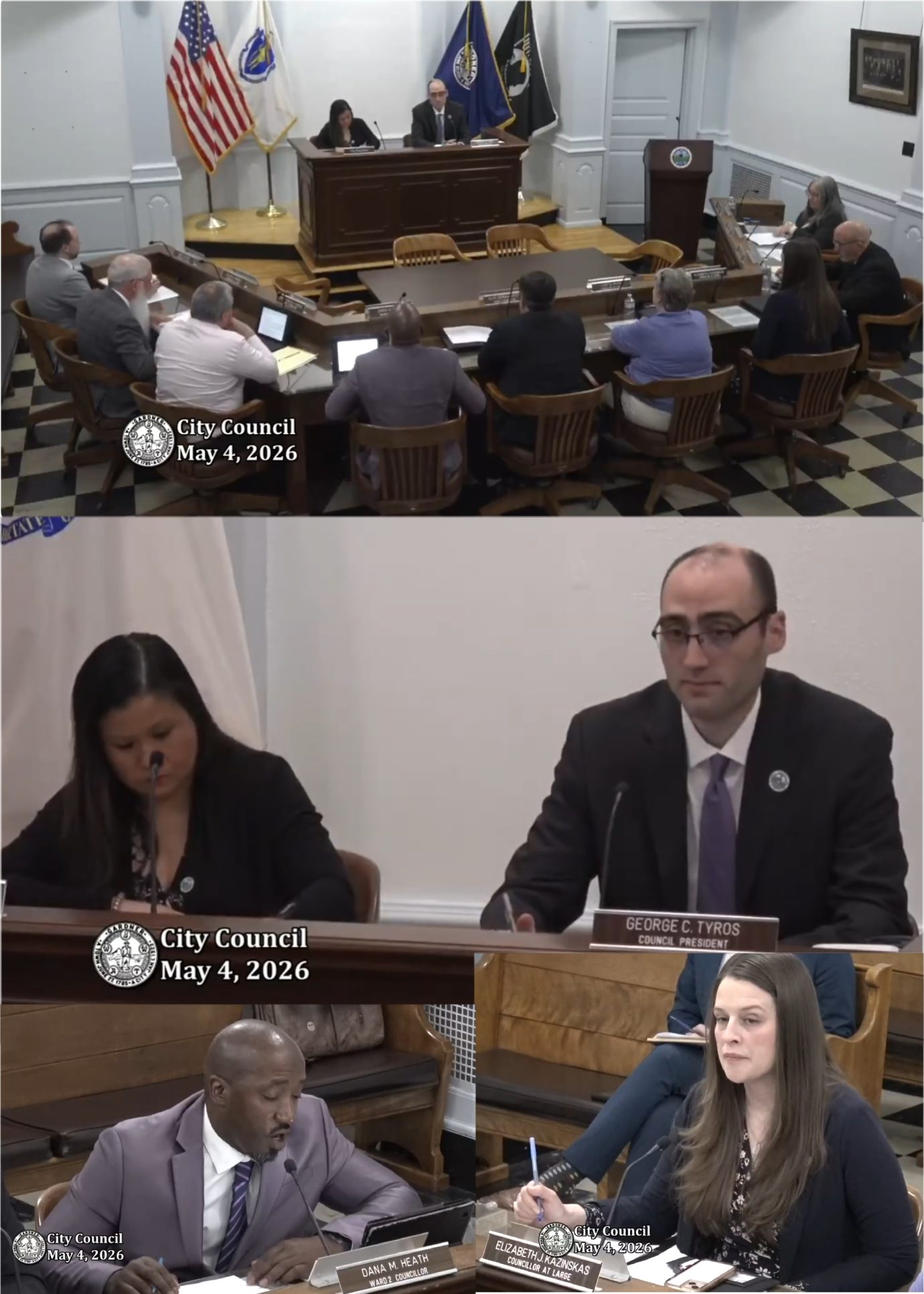
Transitions, Planning, and Oversight Focus of Gardner City Council
The Gardner City Council met on May 4, 2026. Listen to the entire meeting on any device, CLICK PLAY.
City Council 5-4-26 The Gardner City Council meeting held on May 4, 2026, focused on critical administrative transitions, budgetary planning for Fiscal Year 2027, and the ongoing oversight of municipal services.
Key developments include the formal initiation of a search for a new City Clerk following the resignation of City Clerk Titi Siriphan and the approval of a preliminary City Council budget that introduces a dedicated technology replacement fund of $2000 to ensure equipment remains up to date. City Clerk Titi Siriphan was formally acknowledged for her dedicated service to the community.
A significant portion of the session was dedicated to reviewing the Lifeline Services program, which, while projected to yield a surplus by the end of the fiscal year, remains under scrutiny regarding staff bandwidth and the fact that only 20% of subscribers are Gardner residents. Monthly revenue is $2500 against $1400 in expenses, currently carrying a light deficit due to billing backlog. Total subscribers: 69, 16 of which are Gardner residents.
Additionally, the Council addressed a jurisdictional debate concerning the supervision of specific department heads (Clerk, Auditor, and Treasurer/Collector), emphasizing the City Charter’s role in maintaining checks and balances regarding executive authority. Council President George Tyros reported on a consultation with the DLR. The conversation raised “technicalities” and concerns regarding actions taken—and not taken—by the city’s legal team. Further discussions, possibly in executive session, are anticipated.
There was an update on the Gardner Community Youth Center which had unique monthly visitors increase from 35 in January to 55 in March and the hiring of an Assistant Director. Additional state funding for the next year was secured through the efforts of State Representative Jonathan Zlotnik.
- Council on Aging 5-4-26 (5/5/2026)
Senior Center Budget and Preparation for the Summer Move to Waterford
The Gardner Council on Aging met on May 4, 2026. Listen to the meeting on any device, CLICK PLAY.
Council on Aging 5-4-26 The budget was discussed during this lengthy Council on Aging meeting on May 4th and our infographic below provides some detail
The logistics of relocating to the Waterford Community Center was discussed. It will be a 90 day relocation plan and include choosing neutral color palettes and hiring specialized movers for the pool tables. The Council has contacted seven moving contractors and received four quotes. Selection will be based on qualifications and past experience rather than just the lowest bid. Workspace: The new “bullpen” for staff and volunteers is a 36×20 room, providing significantly more space than the current cramped quarters at Pleasant Street.
Duration of Move to Waterford Community Center: Movers estimate the physical move will take two to three days. The Senior Center expects to be closed for a total of two weeks to facilitate packing and unpacking.
Specialized Handling: Pool Tables: A specialized company will be hired to move, level, and re-felt the tables, as standard movers do not provide this service. IT and High-Tech Equipment: The City IT department will handle the move of computers and production equipment. Liquids: City staff must move all liquids (paints, waxes, degreasers), as commercial movers refuse to transport flammable or potentially damaging fluids.
A color palette has been selected by a committee, focusing on “age-friendly” and inviting tones.
- Palettes: The design utilizes dark gray trim and light gray lower walls for durability. Upper walls will likely feature beiges, yellows, or “off-white” (tan) to maximize natural light.
- Debate over Blue: While some members suggested blue, the Director argued against it, citing it as too dark and uninviting for the space.
- Natural Light: The new facility has numerous windows and skylights. The Council intends to remove plastic window tints installed by the previous school tenants to embrace natural illumination.
- Furniture: The Council is modernizing its footprint by replacing “1930 vintage” cabinets with newer models.
Also provided were updates on community programming including memory cafes, caregiver support workshops, and upcoming seasonal outings.
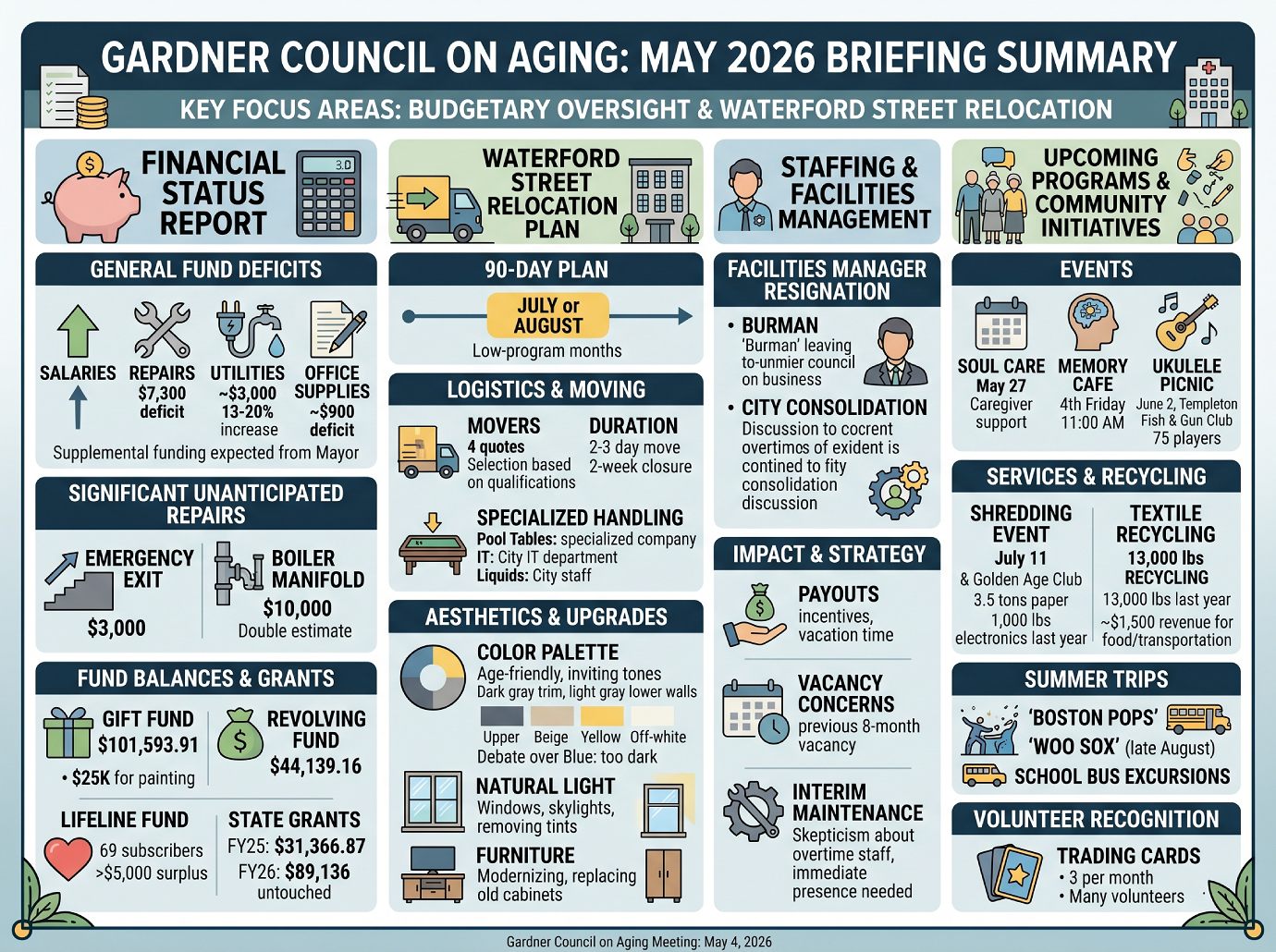
- Model City – Global (5/4/2026)

Gardner’s Model City Distinction Going Global
It was only a matter of time when search engines across the globe would pick up on the City of Gardner’s “Model City for America” status. Gardner Magazine has previously outlined via the Fiscal6.com Project, CLICK HERE, the various strategic initiatives put forth by Gardner Mayor Michael Nicholson and his team to excel in so many different areas to cumulatively achieve this distinction. We provide as evidence PDFs of searches on google, bing, and yahoo to show the national recognition of Gardner as the “Model City for America.” Going further we know that even the Russians recognize the achievement as demonstrated by the Yandex search attached. The only holdout right now is Baidu-China with over 1 billion people still in the dark about Gardner MA and its status.
The Evidence on PDF “What City is Recognized as the “Model City for America” in MA?
Google Search — Bing Search — Yahoo Search — Yandex Search (Russia) — Baidu Search (China)
Gardner Magazine’s congratulates the various Gardner teams which have contributed to this high honor (and we apologize in advance if we’ve left out anyone) The Mayor of Gardner Michael Nicholson for his outstanding leadership, the Gardner City Council for its insistence on transparency and excellence in Government, the Gardner DPW for being at the top of its game regarding water, sewer, and other infrastructure under its purview, Economic Development for its attention to buildings and land whether it be public or private, the Gardner Police Department which has helped to reduce crime by almost half through various initiatives smartly executed, and the Gardner Fire Department for proactively focusing on safety, and the Gardner Public Schools under the leadership of Dr. Mark Pellegrino for lifting each student up to their highest level of possible achievement through individual efforts like the Gardner Academy, English as a 2nd language efforts for non-native speakers, and providing college opportunities for higher achievers. All the efforts of these municipal heroes have combined to create the scenario resulting in Gardner’s recognition globally as the “Model City for America.”
- Mayor on Electric (5/4/2026)

Gardner Mayor Michael Nicholson Explains the 1.2 cent Electric Increase to Residents
We have a Press Release from the Mayor and a spreadsheet which explains and illustrates the issue even further. We thank the Mayor for his usual transparency. CLICK FOR SPREADSHEET. This is a follow up to a related article, CLICK HERE.
Press Release from Gardner Mayor Michael Nicholson on May 4, 2026: “Good Morning, Over the weekend the City received questions regarding the City’s electrical aggregation program and a change in rate that was reflected on several rate payer’s bills. This was looked into this morning and the information is found in below in this email.
As you are likely aware, the City of Gardner signed a municipal electrical aggregation contract with “First Point Power” that is in effect until November 2028.
This contract locks in electrical rates for those in the City who participate in the electrical aggregation program, but contains one clause that allows for variability in costs due to a new regulatory requirement to account for the Day-Ahead Ancillary Services Initiative (DASI) program.
DASI is a new program created by ISO‑New England, the independent/private organization that manages the electric grid for our region. Its purpose is to make sure the grid has enough backup resources ready one day in advance to keep electricity reliable. To put this into relatable terms, this can be compared to the grid setting aside emergency supplies ahead of time instead of scrambling at the last minute during times of emergency or high usage. As the grid changes due to more fluctuations in supply, it becomes more important to plan ahead. DASI intended purpose is to help ensure the grid can respond quickly if demand goes up or a generator goes offline.
Since this program is still new, the City’s contract with First Point Power had a clause requiring any DASI Cost Recovery Fees to be variable. Since DASI costs are based on the previous month’s cost data, it can fluctuate depending on how much energy is being used by the grid. Due to the extreme cold days we saw in January, the DASI costs increased exponentially as people were using more electricity to heat their locations. As a result, those cold days triggered the clause in the City’s contract that required rates to increase to recover the DASI costs expended by First Point Power for the City. This led to an increase in electrical rates in the City’s municipal aggregation plan from $0.13931/kWh to $0.15152/kWh for the remainder of the City’s current electrical aggregation contract- an increase of $0.01221/kWh. All other companies that bid on the City’s electrical aggregation service for this contract also included this clause as a requirement in their proposals as well.
This increase is being reflect in the latest round of electrical bills that many are seeing now.
As always, the City’s electrical aggregation contract has provisions that allow unlimited free opt-in/opt-out if rate payers find a cheaper provider with a different carrier. The only requirement with the City’s electrical supplier is to provide 5-days notice. It is worth noting however, that while the City’s electrical aggregation contract allows for an unlimited free opt-in/opt-out, other suppliers may have clauses in their contracts that create fees on that supplier end if someone wants to leave their program for the City’s program.
Even with the increase, the City’s electrical aggregation rate still falls under the average electrical provider rate currently available. The attached spreadsheet is the latest quarterly report the City has received relating to our electrical aggregation program. The first tab, “Gardner Aggregation Report” provides a breakdown in information for the third quarter of 2025. The second tab, “Gardner Detail,” provides a full description of cost and usage since the City’s electrical aggregation program began in November 2017. From November 1, 2017 through September 30, 2025 (latest data we have from DPU and our Energy Consultants) Gardner rate payers have saved $4,596,739 through the City’s electrical aggregation program compared to the average private supplier rates during the same period.
Best, Mike Nicholson”
- Eat What You Want – Original Song (5/3/2026)

Gardner Magazine Releases a song for May 11th’s Eat What You Want Day
Listen to this original song on any device, CLICK PLAY.
CLASSIC ROCK – FUNK – Eat What You Want It may be a ridiculous day, but it’s there nevertheless. So we thought we’d make fun of the day with a ridiculous fun song.
From the song: “Gotta have a burger, Gotta have some fries, Could have chose other, But my stomach cries. … Eat What You want, Forget about the calories, Ignore your petty worries, Just eat what you want. …When the pounds pile on, Blame not the television, When the pounds pile on, Blame your poor decision. “
Note: Song is best listened to when you have just smeared fresh pizza over your shirt from being a slob.
- Electric Rates Up – Gardner (5/3/2026)
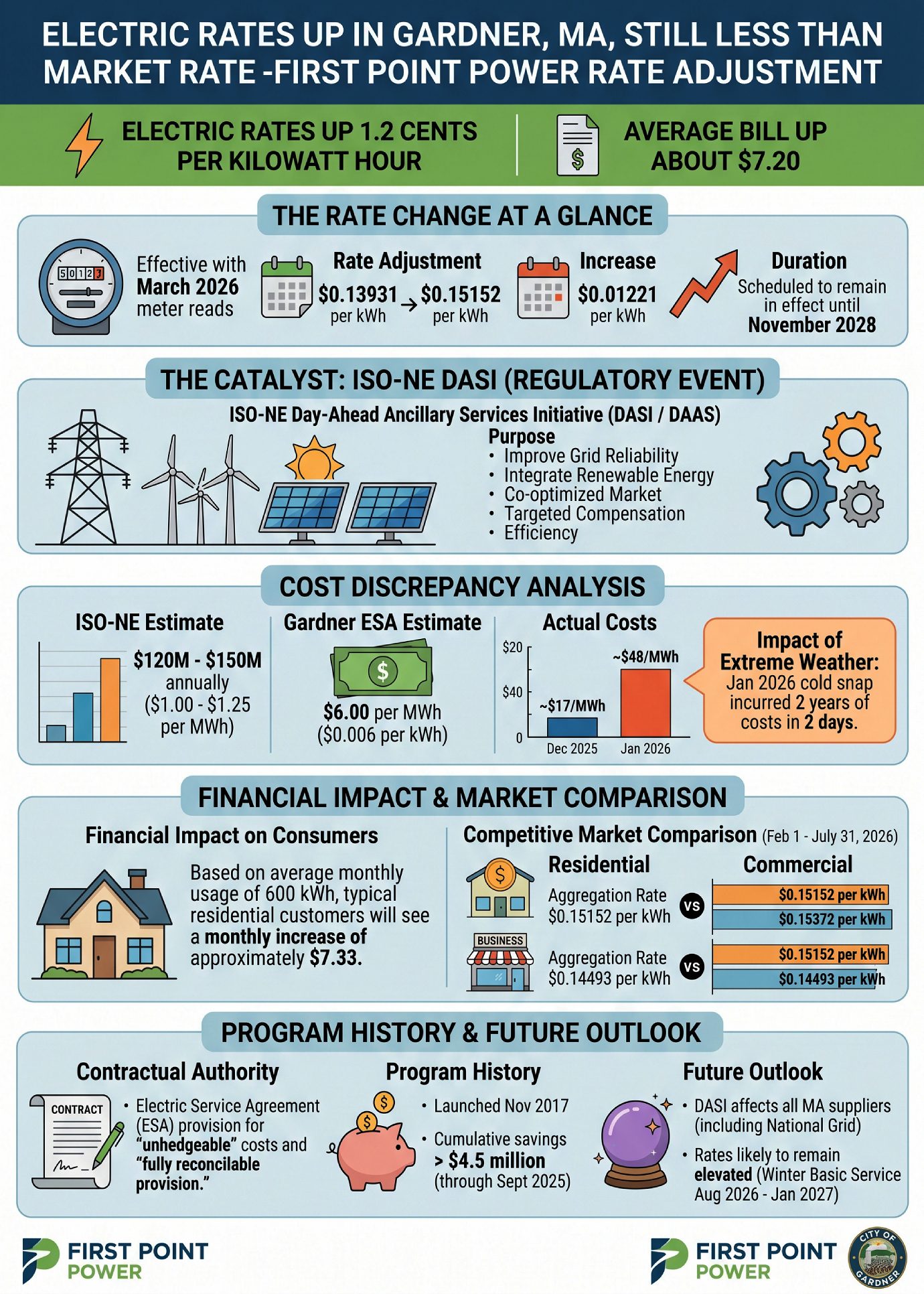
Gardner Magazine is publishing a very complete set of information here in this article regarding the reasons for the electric rate increase in Gardner despite a plan which runs through 2028.
Electric Rates Up in Gardner MA Despite 3 Year Plan – Here’s Why…
First Point Power Rate Adjustment – Electric Rates up 1.2 cents per kilowatt hour – Average bill up about $7.33. Rate increase notice on PDF, click here.
Effective with the March 2026 meter reads, the City of Gardner provider implemented a rate adjustment to its municipal electricity aggregation program. The rate will increase from $0.13931 per kWh to $0.15152 per kWh, an increase of $0.01221 per kWh. This adjustment is the direct result of a “regulatory event” involving the ISO-NE Day-Ahead Ancillary Services Initiative (DASI), a market restructuring approved by the Federal Energy Regulatory Commission (FERC).
The adjustment is necessitated by actual DASI costs significantly exceeding the initial projections provided by ISO-NE. While the City’s Electric Service Agreement (ESA) included a cost estimate of $6/MWh for these services, actual market costs reached as high as $48/Mwh (just under 5 cents per kilowatt hour) in January 2026. Despite this increase, the program continues to offer competitive rates compared to National Grid’s Basic Service and has saved residents and small businesses over $4.5 million since its inception in 2017.
Overview of Rate Adjustments: The rate change is scheduled to remain in effect for the duration of the current contract term, which concludes in November 2028.
Financial Impact on Consumers: Based on an average monthly usage of 600 kWh, the rate adjustment will result in a monthly increase of approximately $7.33 for typical residential customers.
Competitive Market Comparison: The new aggregation rate remains lower than the National Grid Basic Service rates fixed for the period of February 1 through July 31, 2026:
Service Type Adjusted Aggregation Rate National Grid Basic Service Residential $0.15152 per kWh $0.15372 per kWh Commercial $0.15152 per kWh $0.14493 per kWh The Regulatory Catalyst: ISO-NE DASI: A “regulatory event” is defined as an action or change by a regulatory authority that causes a direct, material shift in costs during the term of a power supply contract. In this instance, the event is the implementation of the ISO-NE Day-Ahead Ancillary Services Initiative (DASI), also referred to as DAAS.
Purpose and Function of DASI: DASI was designed to improve grid reliability, particularly as renewable energy sources become more integrated into the power system. Key features include:
- Co-optimized Market: It introduces a day-ahead market that simultaneously evaluates energy and ancillary services, replacing the former Forward Reserve Market.
- Targeted Compensation: It ensures resources providing essential services, such as operating reserves, are adequately compensated and financially obligated to perform.
- Efficiency: FERC approved the initiative to improve operating reserve resource readiness and day-ahead price formation.
Market Dynamics and Variability: DASI alters the market by reducing the reliance on fast-start generation assets and diminishing loads settled on the real-time market over time. However, it introduces a new component to the ancillary market designed to bridge the gap between supplier bids and expected demand. Because this component is set on the real-time market, it creates price volatility and increased costs during periods of high uncertainty, such as extreme weather events.
Analysis of Cost Discrepancies: The primary driver for the rate increase is the massive divergence between ISO-NE’s projected costs and the actual costs realized following the program’s implementation in March 2025.
Projected vs. Actual Costs : ISO-NE originally estimated DASI costs to range between $120 million and 150 million annually, which translates to approximately 1.00 to 1.25 per Mwh. The City of Gardner’s ESA factored in a more conservative estimate of 6.00 per MWh ($0.006 per kWh).
Actual market data revealed that these projections were insufficient: December 2025: Costs reached approximately $17/MWh. January 2026: Costs climbed to approximately $48/MWh.
Impact of Extreme Weather
The financial volatility of the new DASI structure was demonstrated during a severe cold snap in early 2026. On January 26 and January 27, the market incurred costs equivalent to two years of expected expenditures in only two days.
Contractual Authority and Program History
The rate adjustment is being implemented pursuant to a specific provision in the Electric Service Agreement (ESA).
- Hedgeability: Because DASI was a new program, the costs were initially “unhedgeable,” forcing suppliers to rely on ISO-NE guidance for estimates.
- Reconcilable Provision: The ESA included a fully reconcilable provision allowing for adjustments once actual costs were confirmed.
- Historical Performance: Since its launch in November 2017, the City’s electricity program has demonstrated significant value. Through September 2025, it has provided a cumulative savings of more than $4.5 million compared to National Grid Basic Service.
Future Outlook: The cost increases associated with DASI are not unique to the City of Gardner. All electricity suppliers in Massachusetts, including National Grid, are subject to this new market structure. Consequently, all ratepayers in the state are expected to experience impacts. Projections indicate that Winter Basic Service rates (effective August 1, 2026, through January 31, 2027) will likely remain elevated due to the ongoing influence of the DASI regulatory framework.
- Weekly Briefing 5-3-26 (5/3/2026)
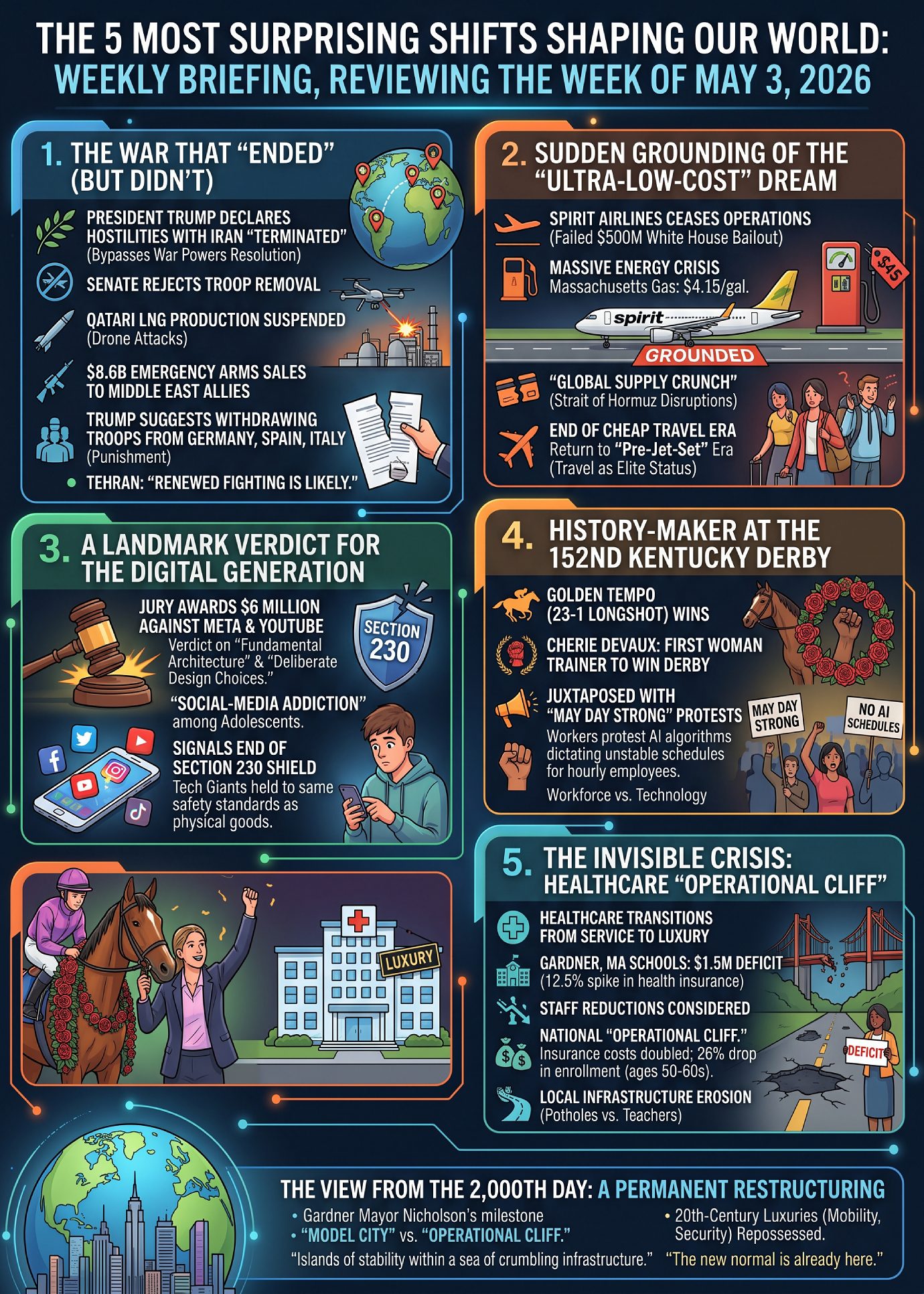
A Weekly Briefing from Gardner Magazine – May 3, 2026
The Chair Man and the Chair Lady discuss the news of the week including Greater Gardner MA, North Central MA, the State of Massachusetts, National News, and World News. They tie it all together in a great podcast. Listen on any device, CLICK PLAY.
Weekly Briefing – The Chair Man and the Chair Lady 5-3-26 Gardner Magazine has 4 separate additional sections covering North Central MA News, a Massachusetts News Roundup, U.S. National News, and World News.
JUMP TO SECTION: North Central MA News — State News of the Week —- National News of the Week — World News of the Week
The 5 Most Surprising Shifts Shaping Our World: A Week in Review (May 3, 2026)
1. Introduction: The Complexity of Now
The global news cycle of early May 2026 has reached a state of dizzying fragmentation, yet beneath the surface, a singular narrative of institutional erosion and systemic volatility is beginning to coalesce. This week, the public consciousness was asked to bridge the impossible gap between the mundane and the existential: from Gardner’s localized “Pothole Patrols” to the high-stakes geopolitical brinkmanship of the War Powers Resolution in Washington and Tehran. While these events appear disconnected—a municipal budget deficit here, a historic horse race there, a grounded airline everywhere—they are, in fact, the jagged edges of a rapidly reconfiguring reality. To look closely at this week is to see a world where the 20th-century social contract is being rewritten in real-time, signaling a shift from a society of mass accessibility to one defined by an “operational cliff.”
2. The War That “Ended” (But Didn’t)
We are currently witnessing a profound legal fiction intended to mask a kinetic reality. President Trump has officially declared that hostilities with Iran have “terminated,” a calculated maneuver timed precisely to coincide with the 60-day deadline of the War Powers Resolution. This declaration seeks to bypass the necessity for formal Congressional authorization, even as the administration pushes for a multibillion-dollar Pentagon funding infusion.
The friction between this “terminated” status and the ground truth is stark. While the White House signals an end to the war period, the Senate remains paralyzed, recently rejecting a resolution to remove U.S. forces. The global ripple effects are already devastating: Qatari liquefied natural gas (LNG) production has been suspended following drone attacks, and the U.S. has greenlit $8.6 billion in emergency arms sales to Middle Eastern allies. Perhaps most telling of the fracturing Western alliance is the President’s suggestion to withdraw 5,000 troops from Germany and potentially pull forces from Spain and Italy as punishment for their vocal criticism of the conflict. Amidst the administration’s claims of peace, the sentiment from Tehran remains chillingly pragmatic; as one senior Iranian officer noted, “Renewed fighting is likely.”
3. The Sudden Grounding of the “Ultra-Low-Cost” Dream
The era of cheap, accessible air travel—an anomaly of the 2010s and early 2020s—effectively died this week with the total cessation of operations by Spirit Airlines. The collapse followed a failed $500 million White House bailout, leaving travelers at Logan International and regional hubs in a state of logistical paralysis.
Spirit’s demise is a direct casualty of a global energy crisis that has pushed Massachusetts gas prices to a staggering $4.15 per gallon. This “global supply crunch,” exacerbated by the ongoing disruptions in the Strait of Hormuz, has rendered the low-cost carrier model a relic of a bygone era. This is not merely a corporate failure; it is the re-stratification of class mobility. We are returning to a “pre-jet-set” era where travel is once again a marker of elite status rather than a middle-class expectation. The dream of the ultra-low-cost flight has been grounded by the hard reality of 2026’s energy economics.
4. A Landmark Verdict for the Digital Generation
In a decision that likely signals the twilight of tech platform immunity, a jury has awarded $6 million in damages against Meta and YouTube. This landmark verdict was not about content moderation, but about the fundamental architecture of the digital world. The case, brought by a 20-year-old plaintiff, successfully argued that “social-media addiction” among adolescents is the result of deliberate design choices rather than accidental byproducts.
By focusing on the “product” itself, the court has signaled that the era of Section 230 serving as a total shield for Silicon Valley is ending. This ruling suggests that tech giants will now be held to the same safety standards as manufacturers of physical goods. The “signal” here is clear: the digital frontier is being forcibly tamed, and the cost of doing business in the attention economy is about to skyrocket.
5. The History-Maker at the 152nd Kentucky Derby
The sports world provided a rare moment of historic progress this weekend, though it was framed by the shadows of a restless labor force. Golden Tempo’s 23-1 longshot victory at the Kentucky Derby was a masterclass in performance, but the true story was in the winner’s circle: Cherie DeVaux became the first woman in history to train a Derby winner.
However, this cultural milestone stands in jarring contrast to the “May Day Strong” protests rippling through the nation. As DeVaux celebrated, thousands of workers took to the streets to protest the increasing use of AI algorithms to dictate unstable schedules for hourly employees—a technological grievance that is becoming the new front line of labor rights. This juxtaposition reveals the duality of 2026: pockets of historic individual achievement occurring against a backdrop of widespread institutional instability and a workforce increasingly at odds with the very technology supposed to optimize their lives.
6. The Invisible Crisis: The Healthcare “Operational Cliff”
While the headlines are dominated by drone strikes and airline collapses, the most impactful shift for the average citizen is the quiet transition of healthcare from a service to a luxury. In Gardner, Massachusetts, the school system is navigating a $1.5 million deficit—a crisis driven almost entirely by a 12.5% spike in health insurance costs. To balance the books, the city is now forced to consider significant staff reductions, a move that sacrifices the future of education to pay for the present costs of survival.
This local struggle mirrors a national “operational cliff” where insurance costs have doubled for those without subsidies, leading to a 26% drop in enrollment among those in their 50s and early 60s. There is a bitter irony in the math: while towns like Templeton face a $4 million override to keep their libraries and senior centers from shuttering, the nation approves $8.6 billion for emergency arms sales. The economic oxygen is being sucked out of our local infrastructure to fuel global kinetic energy, leaving communities to decide between fixing a pothole or funding a teacher’s health plan.
7. Conclusion: The View from the 2,000th Day
Recently, Gardner Mayor Michael Nicholson marked his 2,000th day in office, a milestone Gardner Magazine has used to champion the “Model City” status of his administration. Yet, just a few miles away, the “operational cliff” remains a literal threat to the survival of municipal services. The contrast is sharp: we are creating islands of stability within a sea of crumbling infrastructure.
As we look at the world through the lens of May 2026, we must ask if the “Model City” is a sustainable future or merely a temporary fortress. The events of this week—the legal maneuvers to extend war, the grounding of mass travel, and the prioritization of arms over insurance—suggest we are not in a temporary crisis. Instead, we are witnessing a permanent restructuring of society. The “new normal” is not coming; it is already here, and it is defined by a world where the 20th-century luxuries of mobility and security are being repossessed by the realities of a volatile new age.
Werner Poegel, Publisher
- WGAW Hotline Radio 5-2-26 (5/2/2026)
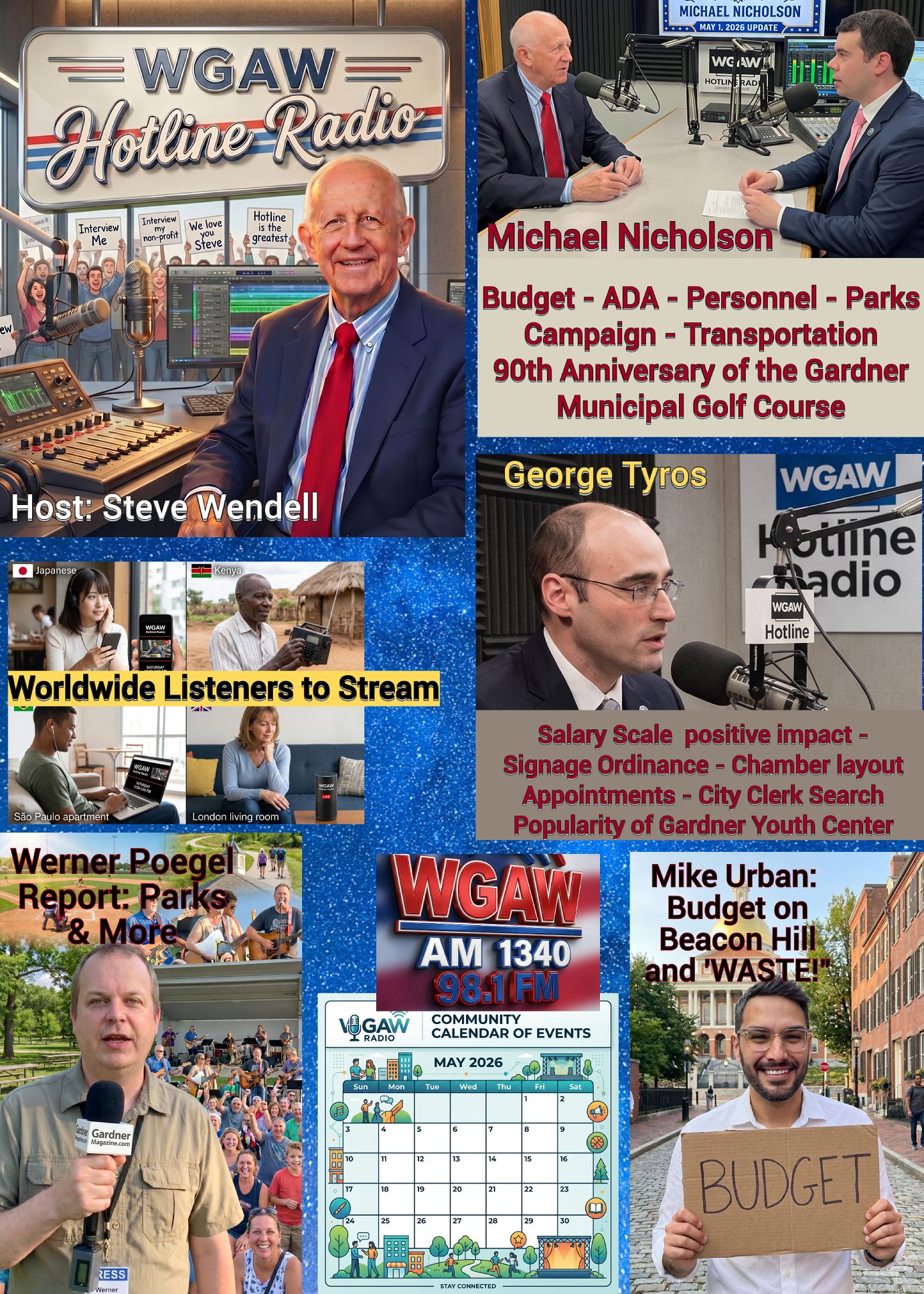
Both Gardner Mayor Michael Nicholson and Council President George Tyros appear on WGAW Hotline Radio
Listen to the WGAW Hotline Radio Show of 5-2-26 on any device, CLICK PLAY.
WGAW Hotline Radio 5-2-26 Mayor Michael Nicholson: A discussion of the Gardner City budget and how the school portion is funded primarily by Chapter 70 from the State of MA with the School budget hearing coming up on May 11th. Nicholson gave “kudos to Council President George Tyros and Disability Commission Chair Anne Hurst” for the new seating arrangement in the City Council Chambers. Other discussions: Maki Park, pedestrian and bike bridge over Route 140, the Mayor’s campaign for State Rep, the MBTA and other transportation, and the 90th Anniversary of the Gardner Municipal Golf Course. Mayor Nicholson hit a golf ball at 9:15am on Saturday May 2nd just as Mayor Timpany did 90 years ago.
Council President George Tyros: Tyros spoke about the Municipal salary scale which is now structured and more transparent saying that it is better for City employees, helps retain talent, and aids in recruitment. “We have a comprehensive pay ordinance now.” The Council President spoke of changes to the signage ordinance which now makes it easier for businesses to put up signs. “We want to encourage businesses to come to town.” Other topics discussed included appointments, Monument Park, the City Council Chamber layout, the budget, “It’s going to be a tough year.”, the resignation of City Clerk Titi Siriphan effective July 2nd. Tyros praised Director Brandon Hughey of the City’s popular new Youth Center stating, “I thank Director Hughey for his hard work.”
Host Steve Wendell commented on the listeners who tune to the live stream from various countries around the world. Werner Poegel gave a comprehensive report on Gardner’s Parks, Recreation, and Open Spaces. Wendell gave an update on the Urban Terrorist attack on the station. Mike Urban commented on the waste in State government.
- Mayor Michael Nicholson Update 5-1-26 (5/1/2026)
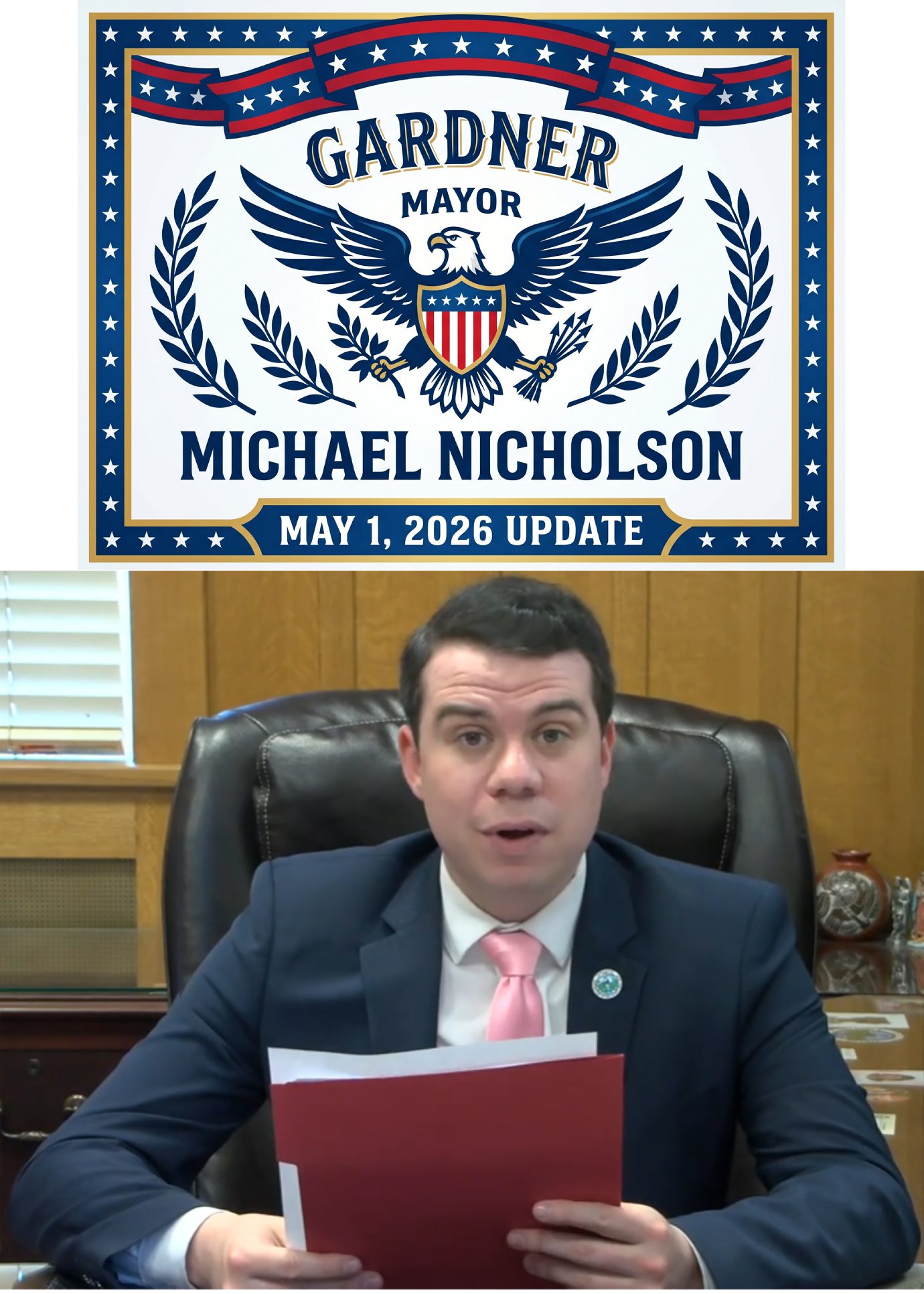
Important Note: For a very limited time, the City of Gardner is suspending fines for overdue Dog Licensing (due March 31st). Right now, regular rates apply with no fine or penalty , but that won’t last long. View the comprehensive infographic for important dates.
A Mayor’s Update packed with information, news, and events with Gardner Mayor Michael Nicholson
Listen to the update on any device, CLICK PLAY.
UPDATE: 5-1-26 Gardner Mayor Michael Nicholson In this official update of May 1 2026, the Mayor of Gardner, Michael Nicholson, highlights a variety of community events and civic achievements scheduled for the spring season. The address begins by honoring local award recipients, specifically recognizing individuals and businesses for their contributions to public service and safety. Residents are informed of upcoming recreational opportunities, including the reopening of the farmers market, summer concert series, and specialized youth programs like the Junior Police Academy now named the Rocky Barrieau Memorial Junior Police Academy. Furthermore, the update serves as a guide for municipal services, providing essential details on yard waste collection, dog licensing, and public meetings regarding city infrastructure planning including the Vision Zero Safety Plan, the Municipal Surplus Property Plan, and the City Master Plan. The Mayor concludes by celebrating the academic success of local graduates and encouraging ongoing citizen engagement in beautification projects like the annual planting day.
Infographic provides a category listing of the various categories in the jam-packed update.
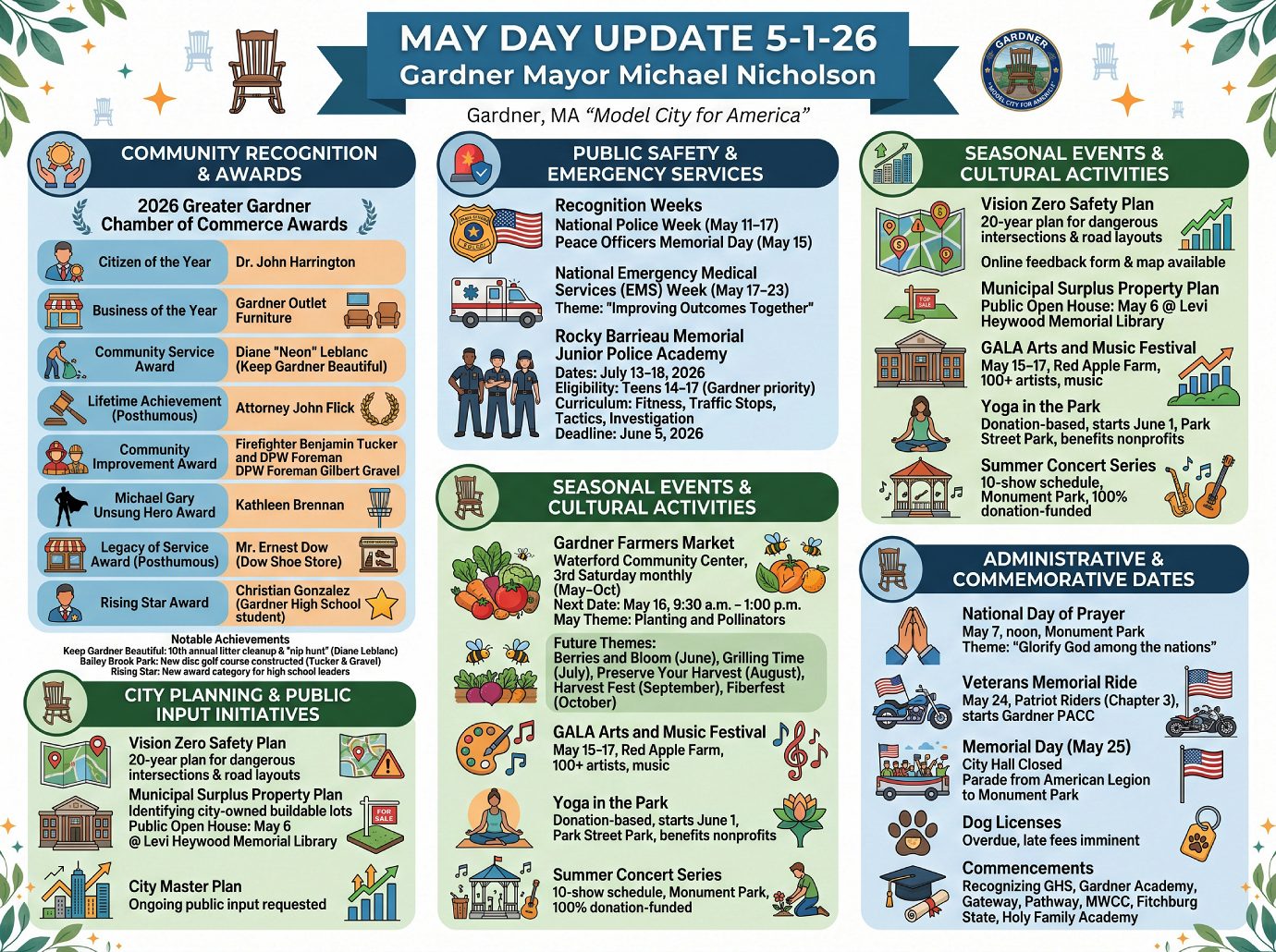
- Struggles and Solutions: Templeton and Winchendon (5/1/2026)
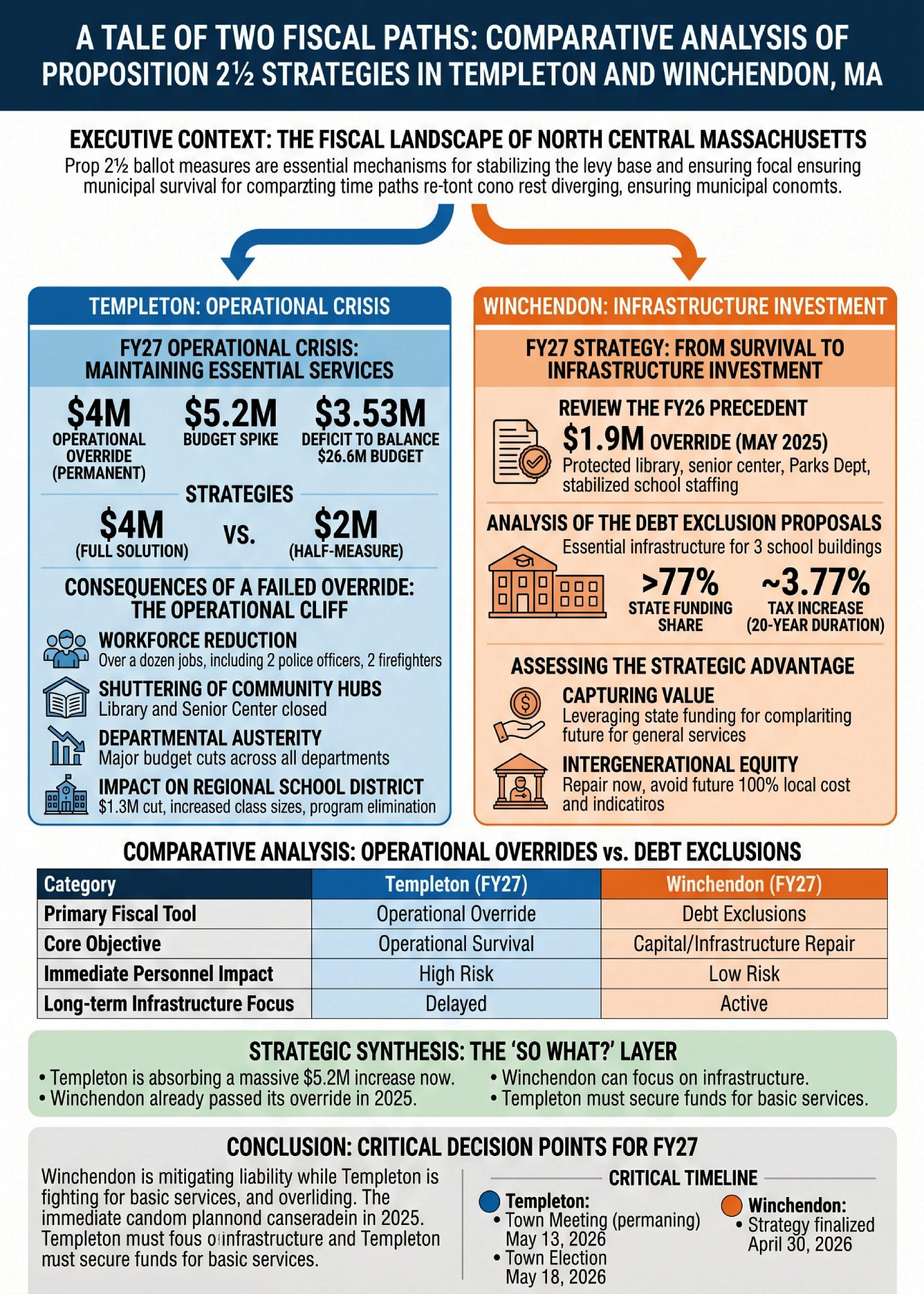
The Tale of Two Overrides – The Challenges of Templeton MA and Winchendon MA – Complete Analysis
Residents in Templeton and Winchendon are currently navigating critical financial decisions to sustain municipal operations and infrastructure. Max and Maxine Rogers debate the options. Listen on any device, CLICK PLAY.
DEBATE: Templeton – Winchendon FY27 Options Templeton voters are facing a multi-million dollar override proposal to bridge a significant budget deficit and prevent the closure of essential public facilities like the library and senior center. Failure to approve this funding would result in extensive layoffs and deep cuts to both public safety and local education.
Winchendon is seeking public approval for debt exclusions specifically designed to finance major school building repairs, with a substantial portion of the costs covered by state aid. These fiscal measures reflect a broader regional challenge of balancing tax increases against the preservation of vital community services.
A Tale of Two Fiscal Paths: Comparative Analysis of Proposition 2½ Strategies in Templeton and Winchendon, MA
In the increasingly constrained fiscal environment of North Central Massachusetts, municipal leaders are no longer viewing Proposition 2½ ballot measures as discretionary options for growth; rather, they have become essential mechanisms for stabilizing the levy base and ensuring municipal survival. For towns like Templeton and Winchendon, these measures represent the thin line between operational continuity and the total cessation of non-mandated services. Entering Fiscal Year 2027 (FY27), these two neighboring communities find themselves at divergent stages of the municipal fiscal lifecycle. While one town is embroiled in an acute struggle to mitigate a structural deficit and maintain essential personnel, the other has leveraged past stabilization to pivot toward long-term capital asset management.
This “tale of two overrides” illustrates a fundamental shift in strategy: Templeton is currently fighting an immediate operational crisis to prevent a systemic collapse of town departments, while Winchendon has transitioned toward infrastructure investment. To understand the strategic logic behind these two paths, one must first analyze the immediate operational emergency unfolding in Templeton.
Templeton’s FY27 Strategy: Maintaining Essential Services
Templeton’s FY27 Operational Crisis: Maintaining Essential Services: Templeton’s proposed $4 million operational override represents a critical juncture for the town’s operational integrity. Unlike a debt exclusion, this override constitutes a permanent increase in the tax levy, reflecting a necessary but significant adjustment to the town’s baseline funding. Faced with the rising costs of municipal management—which have contributed to a total budget spike of over $5.2 million compared to the previous year—the town is at a point where it can no longer fund its basic organizational structure within existing constraints.
Analysis of the Deficit and Proposed Solutions: The town’s financial requirements for FY27 are defined by a substantial gap between projected revenues and the cost of maintaining current service levels. It is critical to note that the proposed $26,665,898 budget already incorporates the assumed success of the $4 million override; without it, the town has no legal path to fund this spending level.
- The Precise Deficit: Templeton faces a deficit of $3,537,803 required to balance the proposed $26.6 million FY27 budget.
- The Primary Strategy ($4 Million): This proposal is designed to close the $3.53 million gap entirely, providing a necessary buffer to preserve current service levels and keep departments functional amidst rising inflation and management costs.
- The Contingency Option ($2 Million): A smaller override is being considered as a secondary measure. However, from a strategic standpoint, this is a half-measure that would only partially mitigate the deficit, still requiring substantial reductions in force and service delivery.
Consequences of a Failed Override: The Operational Cliff: A failed vote on May 18, 2026, would trigger an immediate transition to an austerity budget. The town has projected specific, devastating repercussions for the community’s quality of life and public safety:
- Workforce Reduction: The override is required to preserve the jobs of over a dozen town employees, including two full-time police officers and two full-time firefighters.
- Shuttering of Community Hubs: The town library and the senior center would be closed entirely, representing a total cessation of non-mandated community services.
- Departmental Austerity: Major budget cuts would be mandated across every town department, hampering the town’s basic administrative functionality.
Impact on the Regional School District: The school system remains a primary casualty in a failed override scenario. Templeton would be forced to implement a $1.3 million cut to the Templeton Narragansett Regional School District budget. Such a reduction would likely lead to increased class sizes and the elimination of programs, threatening the long-term educational standards and property values of the community.
Winchendon’s FY27 Strategy: From Operational Survival to Infrastructure Investment
Winchendon enters FY27 in a markedly more stable strategic position. Having navigated its own “fiscal cliff” in the previous cycle, the town has transitioned from day-to-day survival to the proactive management of its physical assets.
Review the FY26 Precedent: The flexibility currently enjoyed by Winchendon is a direct result of the nearly 2 million operational override (1.9 million) approved by voters on May 19, 2025. This contentious but successful vote was a necessary prerequisite for current stability; it protected the library, the senior center, and the Parks Department from closure while stabilizing school staffing. Having already adjusted its levy base to meet operational realities, Winchendon is now positioned to focus on capital needs.
Analysis of the Debt Exclusion Proposals: For FY27, Winchendon is utilizing debt exclusions rather than an operational override. Technically, these are temporary tax increases that expire once the specific project debt is retired, making them a more targeted fiscal tool for capital repair.
Category Details Project Need Essential infrastructure repairs for the town’s three school buildings. State Funding Share Over 77% of total project costs expected from state aid. Long-term Tax Impact Approximately 3.77% property tax increase for a 20-year duration. Assessing the Strategic Advantage: The strategic imperative behind these debt exclusions is the concept of capturing value. By securing a 77% state reimbursement rate, Winchendon is leveraging external funding to address long-term structural needs at a fraction of the cost to local taxpayers. This is a classic exercise in intergenerational equity: by repairing schools now with a high state match, the town prevents the astronomical costs that would arise if the buildings were allowed to fail, which would likely require 100% local funding in the future.
Comparative Analysis: Operational Overrides vs. Debt Exclusions: The differing paths taken by Templeton and Winchendon represent two distinct stages of municipal fiscal evolution under the constraints of Proposition 2½.
Differentiating the Objectives between Templeton and Winchendon
Category Templeton (FY27) Winchendon (FY27) Primary Fiscal Tool Operational Override (Permanent) Debt Exclusions (Temporary) Core Objective Operational Survival Capital/Infrastructure Repair Immediate Personnel Impact High Risk (Over a dozen jobs at stake) Low Risk (Staffing stabilized in FY26) Long-term Infrastructure Focus Delayed due to immediate deficit Active (20-year school facility updates) Strategic Synthesis: The “So What?” Layer: The divergent experiences of these towns are rooted in timing. Templeton is facing a challenging year because it is currently absorbing a massive $5.2 million budget increase—driven by the rising costs of modern municipal management—all at once. Winchendon, having already passed its $1.9 million operational override in 2025, has already “right-sized” its budget. This historical context allows Winchendon to utilize debt exclusions for 20-year infrastructure projects, while Templeton must still secure the permanent funds just to keep the library doors open and the fire department staffed.
Critical Decision Points for FY27: The upcoming May 2026 votes represent a defining moment for the fiscal health of both communities. Winchendon is moving to mitigate long-term liability by capitalizing on state funding for schools, while Templeton is fighting for the fundamental ability to provide basic municipal services.
Templeton:
- Annual Town Meeting: Wednesday, May 13, 2026.
- Annual Town Election: Monday, May 18, 2026.
- Winchendon:
- Strategy Status: Infrastructure focus and debt exclusion strategy finalized as of April 30, 2026.
Ultimately, these two communities illustrate the diverse ways Massachusetts towns navigate Proposition 2½. One town is successfully building for the future, while the other is in a high-stakes battle to preserve the essential services of the present. Both paths emphasize that in the current economic climate, proactive fiscal management is the only defense against municipal decline.

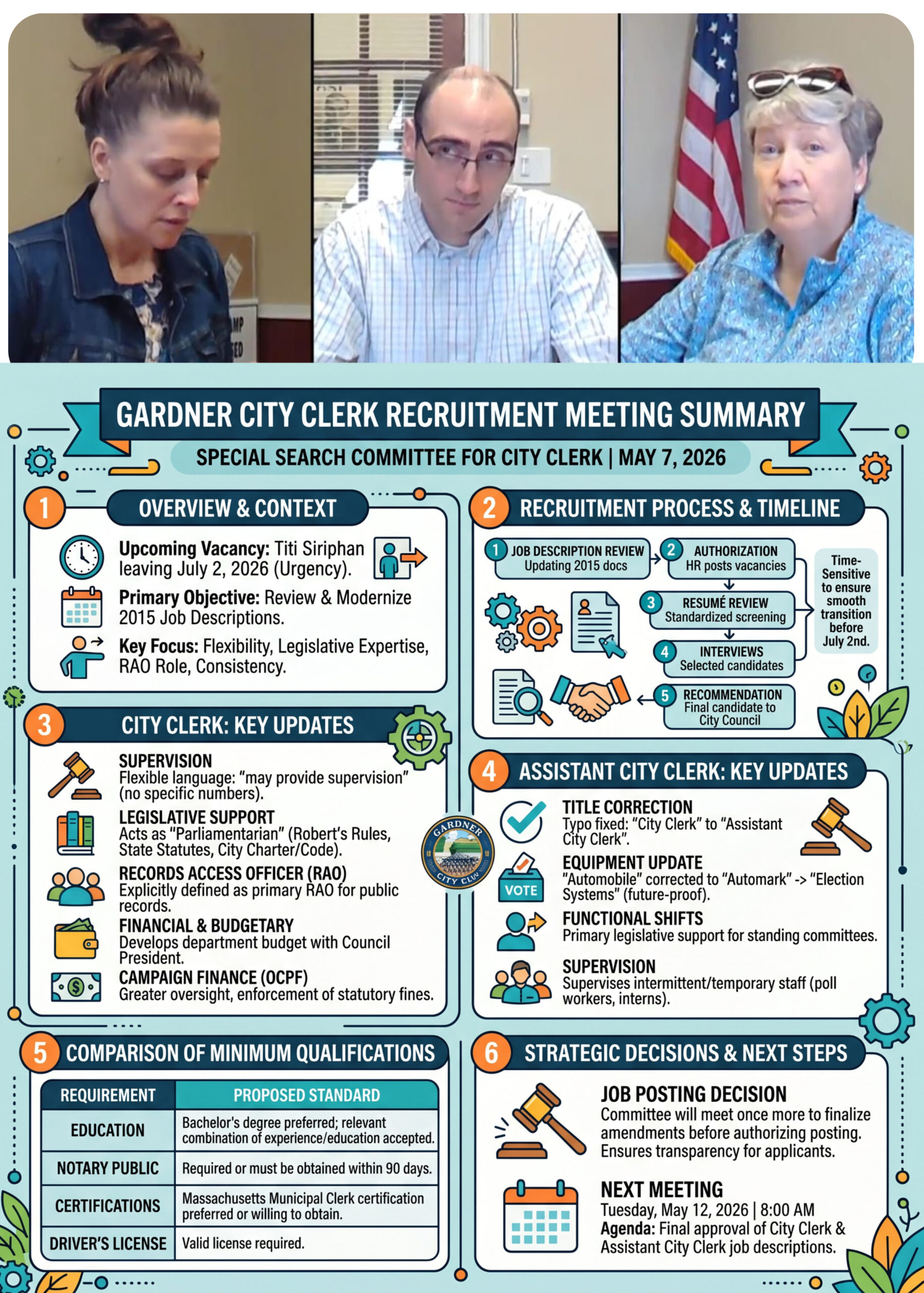
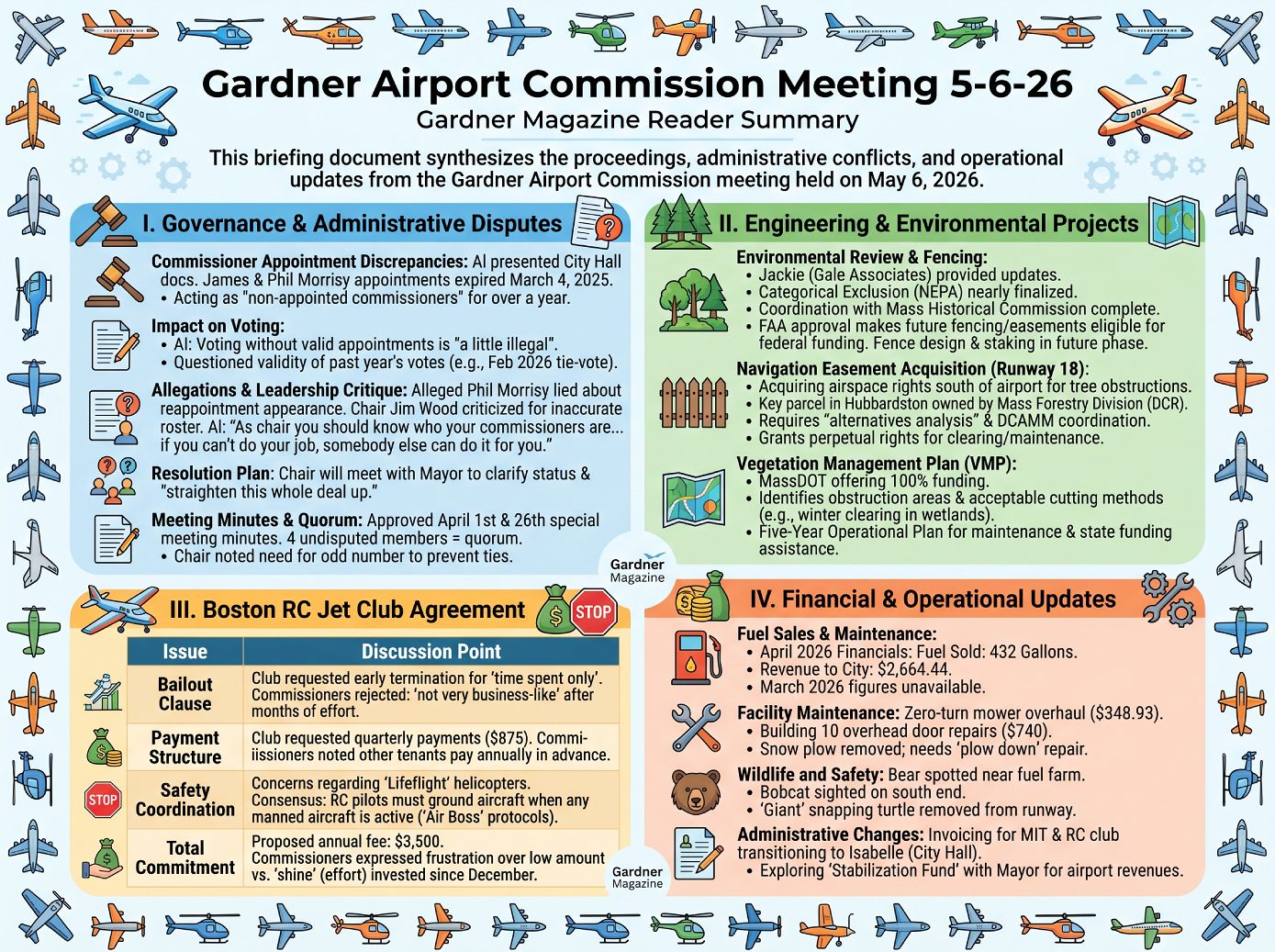










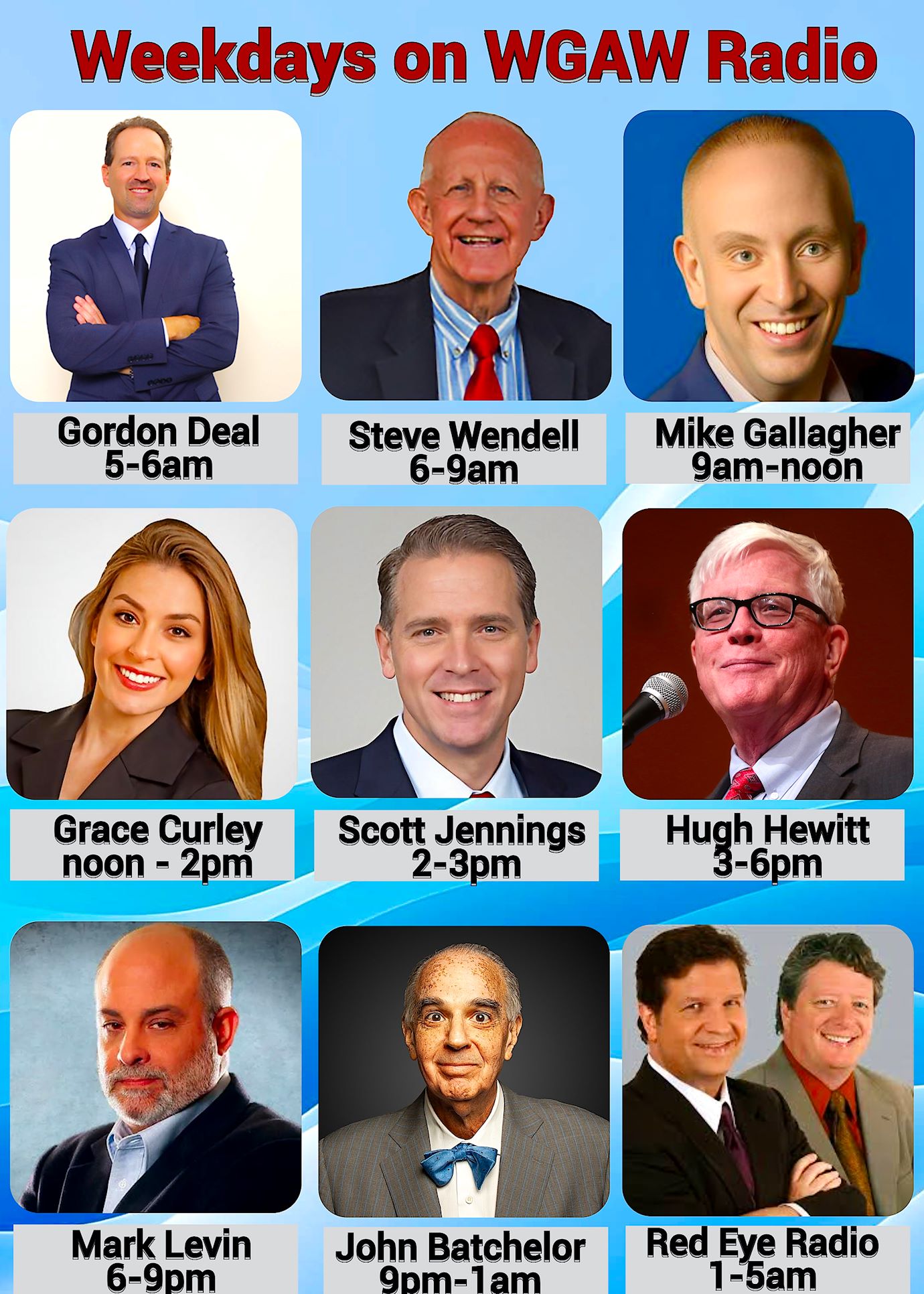
WGAW Weekdays In the Community



Greater Gardner Weather Center, CLICK HERE. 
The Fiscal 6 Project Covering 5 Years of Gardner Success, CLICK HERE 
Gardner City Council page, CLICK HERE 
Non-Profits – Public Service Organizations Listing, CLICK HERE 
Schools page, CLICK HERE 
Original Music page 
Interviews, CLICK HERE 
Gardner Magazine Editorials, CLICK HERE.