
Rutland MA – History and Profile
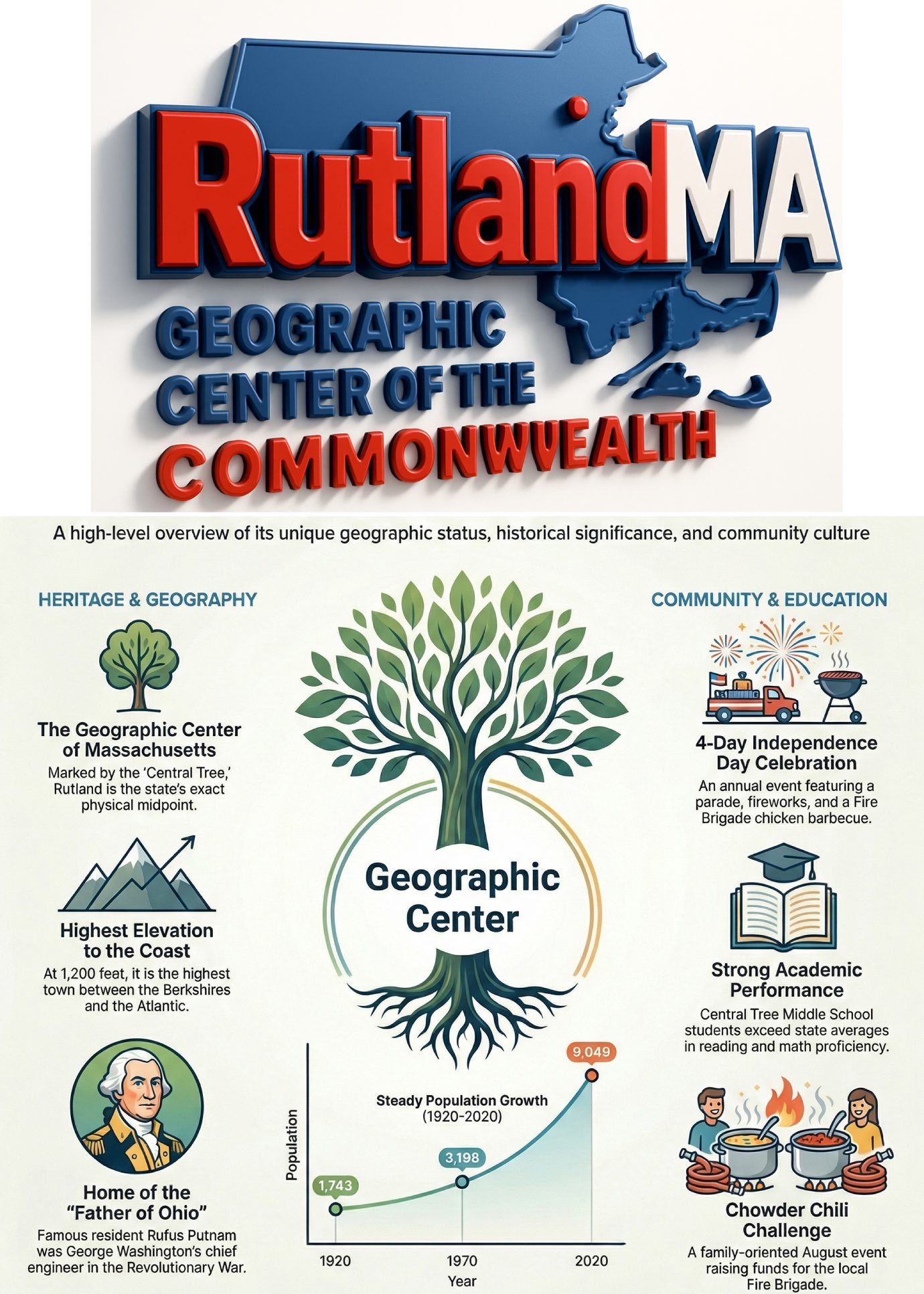
Rutland MA is the Geographic Center of the Commonwealth of Massachusetts. Here we cover the History of Rutland MA and offer a comprehensive community profile.
Listen to a “Deep Dive” podcast about Rutland on any device, CLICK PLAY.
Community Profile: Rutland, Massachusetts
Rutland, Massachusetts: A History from Frontier Settlement to the Heart of the Commonwealth
A Beginner’s Snapshot of Rutland MA
Community Profile: Rutland, Massachusetts
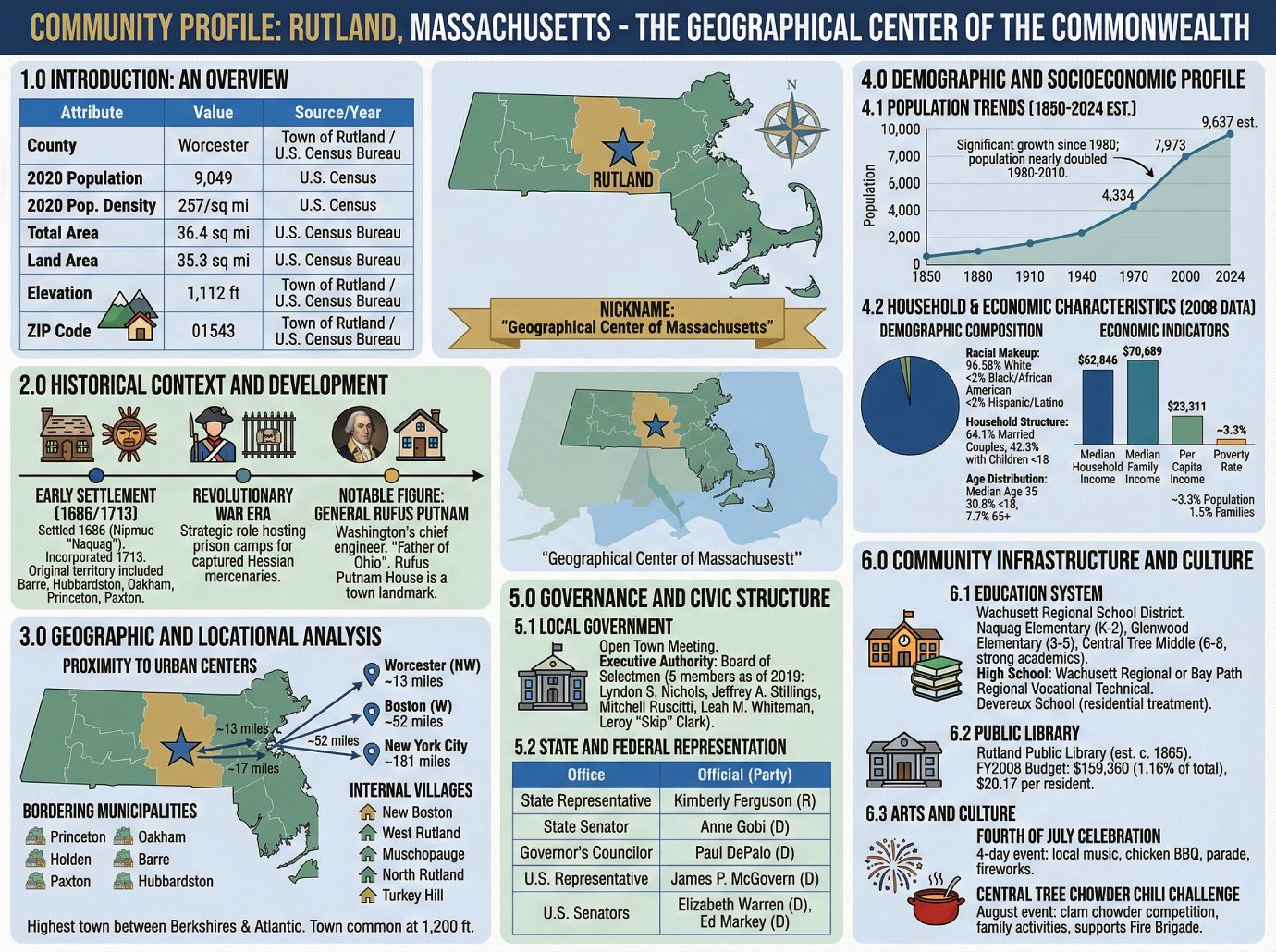
Community Profile: Rutland, Massachusetts
1.0 Introduction: An Overview of Rutland
Located in Worcester County, Rutland, Massachusetts, holds the unique distinction of being the geographical center of the Commonwealth. This central positioning, combined with its rich history and growing community, defines its character. As of the 2020 U.S. Census, the town had a population of 9,049 residing within a total area of 36.4 square miles. This profile provides a formal overview of Rutland’s key historical, geographic, demographic, and civic characteristics to inform strategic analysis for municipal planning and development.
| Attribute | Value | Source/Year |
|---|---|---|
| County | Worcester | Town of Rutland / U.S. Census Bureau |
| Nickname | “Geographical Center of Massachusetts” | Town of Rutland |
| 2020 Population | 9,049 | U.S. Census |
| 2020 Population Density | 257/sq mi | U.S. Census |
| Total Area | 36.4 sq mi | U.S. Census Bureau |
| Land Area | 35.3 sq mi | U.S. Census Bureau |
| Elevation | 1,112 ft | Town of Rutland / U.S. Census Bureau |
| ZIP Code | 01543 | Town of Rutland / U.S. Census Bureau |
From this high-level statistical snapshot, a deeper understanding of the community requires an examination of the town’s historical foundations.
2.0 Historical Context and Development
To appreciate Rutland’s present-day character, it is essential to understand its history, which stretches from its indigenous roots through its significant role in the nation’s founding. This historical evolution has shaped the town’s identity and physical landscape.
Early Settlement
The area was first settled by Europeans in 1686, though its history extends much further back under the Nipmuc name “Naquag.” The town was officially incorporated in 1713 with a much larger territory than it occupies today; its original boundaries included lands that would later become the towns of Barre, Hubbardston, Oakham, Princeton, and the northern half of Paxton.
Revolutionary War Era
During the American Revolutionary War, Rutland served a strategic purpose, hosting prison camps for captured Hessian mercenaries who had been hired by the British forces. This chapter of its history underscores its early involvement in the formation of the United States.
Notable Figures
Rutland’s most famous citizen is General Rufus Putnam, who served as George Washington’s chief engineer during the Revolutionary War. A prominent local figure, Putnam held various town offices and served as a Representative to the General Court. His influence extended far beyond Massachusetts, as he later led a group of veterans to settle the Northwest Territory, earning him the title “Father of Ohio.” The historic Rufus Putnam House remains a town landmark and is featured prominently on the official town seal.
The town’s historical development provides the context for its current geographic layout and strategic location within the state.
3.0 Geographic and Locational Analysis
Rutland’s geography is a defining strategic asset. Its elevation as the highest town between the Berkshires and the Atlantic, with the town common situated at 1,200 feet above sea level, combined with its formal designation as the geographical center of Massachusetts, gives it a unique locational identity that is a key consideration for regional planning and development.
The town’s specific locational attributes include:
• Proximity to Urban Centers:
◦ Approximately 13 miles northwest of Worcester.
◦ Approximately 52 miles west of Boston.
◦ Approximately 181 miles northeast of New York City.
• Bordering Municipalities: Rutland is bordered by Princeton, Holden, Paxton, Oakham, Barre, and Hubbardston.
• Internal Villages: The town encompasses five distinct villages within its limits: New Boston, West Rutland, Muschopauge, North Rutland, and Turkey Hill.
This physical setting provides the backdrop for the demographic and socioeconomic profile of the population that resides within its borders.
4.0 Demographic and Socioeconomic Profile
A detailed analysis of demographic and socioeconomic data is critical to understanding the community’s composition, workforce characteristics, and overall economic health. This section examines Rutland’s population trends over time as well as key household and economic indicators.
4.1 Population Trends
Rutland has experienced consistent and, at times, rapid population growth over its history, particularly in recent decades. The following table illustrates this trend from 1850 to a 2024 estimate.
| Year | Population |
|---|---|
| 1850 | 1,223 |
| 1860 | 1,076 |
| 1870 | 1,024 |
| 1880 | 1,059 |
| 1890 | 980 |
| 1900 | 1,334 |
| 1910 | 1,743 |
| 1920 | 1,743 |
| 1930 | 2,442 |
| 1940 | 2,181 |
| 1950 | 3,056 |
| 1960 | 3,253 |
| 1970 | 3,198 |
| 1980 | 4,334 |
| 1990 | 4,936 |
| 2000 | 6,353 |
| 2010 | 7,973 |
| 2020 | 9,049 |
| 2024 (est.) | 9,637 |
The data reveals a period of particularly significant growth beginning in 1980. From 1980 to 2010, the town’s population nearly doubled, growing from 4,334 to 7,973 residents, indicating a sustained period of residential development and appeal.
4.2 Household and Economic Characteristics (2008 Data)
The following data is based on information from the year 2008. It provides a snapshot of the town’s household and economic composition from that period.
Demographic Composition:
• Households: There were 2,253 households, of which 1,721 were families.
• Racial Makeup: The town was predominantly White, at 96.58% of the population. Other racial and ethnic groups, including Black or African American and Hispanic or Latino, each constituted less than 2% of the population.
• Household Structure: 42.3% of households had children under the age of 18, and 64.1% were married couples living together.
• Age Distribution: The median age was 35 years, with 30.8% of the population under 18 and 7.7% aged 65 or older.
Economic Indicators:
• Median Household Income: $62,846
• Median Family Income: $70,689
• Per Capita Income: $23,311
• Poverty Rate: Approximately 3.3% of the population and 1.5% of families were below the poverty line.
These population characteristics are governed by a well-defined civic structure at the local, state, and federal levels.
5.0 Governance and Civic Structure
Rutland’s system of local governance and its representation in state and federal government provide the framework for public administration and community decision-making. This section outlines the town’s political structure.
5.1 Local Government
Rutland operates under an Open town meeting style of government, a form of direct democratic rule common in New England. Executive authority is vested in a Board of Selectmen. As of 2019, the five members of the Board of Selectmen were:
• Lyndon S. Nichols
• Jeffrey A. Stillings
• Mitchell Ruscitti
• Leah M. Whiteman
• Leroy “Skip” Clark
5.2 State and Federal Representation
The town is represented by officials at the state and federal levels, ensuring its interests are addressed in broader legislative and policy contexts.
| Office | Official (Party) |
|---|---|
| State Representative | Kimberly Ferguson (R) |
| State Senator | Anne Gobi (D) |
| Governor’s Councilor | Paul DePalo (D) |
| U.S. Representative | James P. McGovern (D) |
| U.S. Senators | Elizabeth Warren (D), Ed Markey (D) |
This formal structure of government supports a wide range of community services and cultural activities that define life in Rutland.
6.0 Community Infrastructure and Culture
A town’s quality of life is heavily influenced by its community infrastructure, including its educational system, public amenities, and cultural events. These elements are essential for attracting and retaining residents and businesses.
6.1 Education System
Rutland is a member of the Wachusett Regional School District. The town hosts several public schools serving its younger residents.
• Naquag Elementary School: Serves students in grades K-2. For the 2024-2025 school year, it had 344 students and 22 full-time teachers.
• Glenwood Elementary School: Serves students in grades 3-5.
• Central Tree Middle School: Serves students in grades 6-8. The school has 365 students and 25 full-time teachers. Its students demonstrate strong academic performance, with a reading proficiency of 53% and a math proficiency of 41%, both above the state average.
For secondary education, residents attend Wachusett Regional High School in Holden or may attend Bay Path Regional Vocational Technical High School in Charlton. Additionally, Rutland is home to the Devereux School, a residential treatment facility providing educational and psychological services for youth aged 6-21.
6.2 Public Library
The Rutland Public Library, founded circa 1865, is a cornerstone of the community. In fiscal year 2008, the town allocated $159,360 to the library, representing 1.16% of its total budget. This amounted to a spending of $20.17 per resident for library services during that year.
6.3 Arts and Culture
Rutland fosters a strong sense of community through its vibrant annual events.
• Fourth of July Celebration: This four-day-long event is a major town tradition, featuring performances by local musicians, a chicken barbecue hosted by the Fire Brigade, a parade with community floats, and a large fireworks display.
• Central Tree Chowder Chili Challenge: Held in August and hosted by the Rutland Fire Brigade, this event, despite its name, primarily features a competition for the area’s best clam chowder. The family-oriented day includes pony rides, face painting, and other activities, with proceeds supporting the Fire Brigade’s restoration projects and equipment purchases.
In summary, Rutland presents itself as a town with deep historical significance, a strategic central location, and a record of sustained population growth. These attributes, combined with a strong community infrastructure and a rich cultural life, form the foundation of its identity and provide a framework for its future development. ————————
Rutland, Massachusetts: A History from Frontier Settlement to the Heart of the Commonwealth
Rutland, Massachusetts: A History from Frontier Settlement to the Heart of the Commonwealth
Introduction: Forging a New England Town
The story of Rutland, Massachusetts, is a narrative woven deeply into the fabric of American history. It is a journey that begins with the land’s indigenous stewards, traverses the hardships of colonial settlement, and reflects the patriotic fervor of a nascent nation. From its origins as a vast frontier territory to its pivotal role in the American Revolution and its enduring identity as the geographical heart of the Commonwealth, Rutland’s history is a microcosm of the New England experience—a testament to the resilience, civic duty, and pioneering spirit that shaped a town and helped define a country.
——————————————————————————–
1. The Genesis of Rutland: From Naquag to an Incorporated Town
In the raw, unforgiving landscape of 18th-century Massachusetts, planting a new town was an act of audacious ambition and sheer will. These frontier settlements were strategic endeavors, essential for expansion and defense, but they faced immense challenges, from navigating relations with native populations to carving a society out of the wilderness. Rutland’s origin story is a classic example of this process, marking the transformation of indigenous land into an incorporated colonial town with ambitions as vast as its original territory.
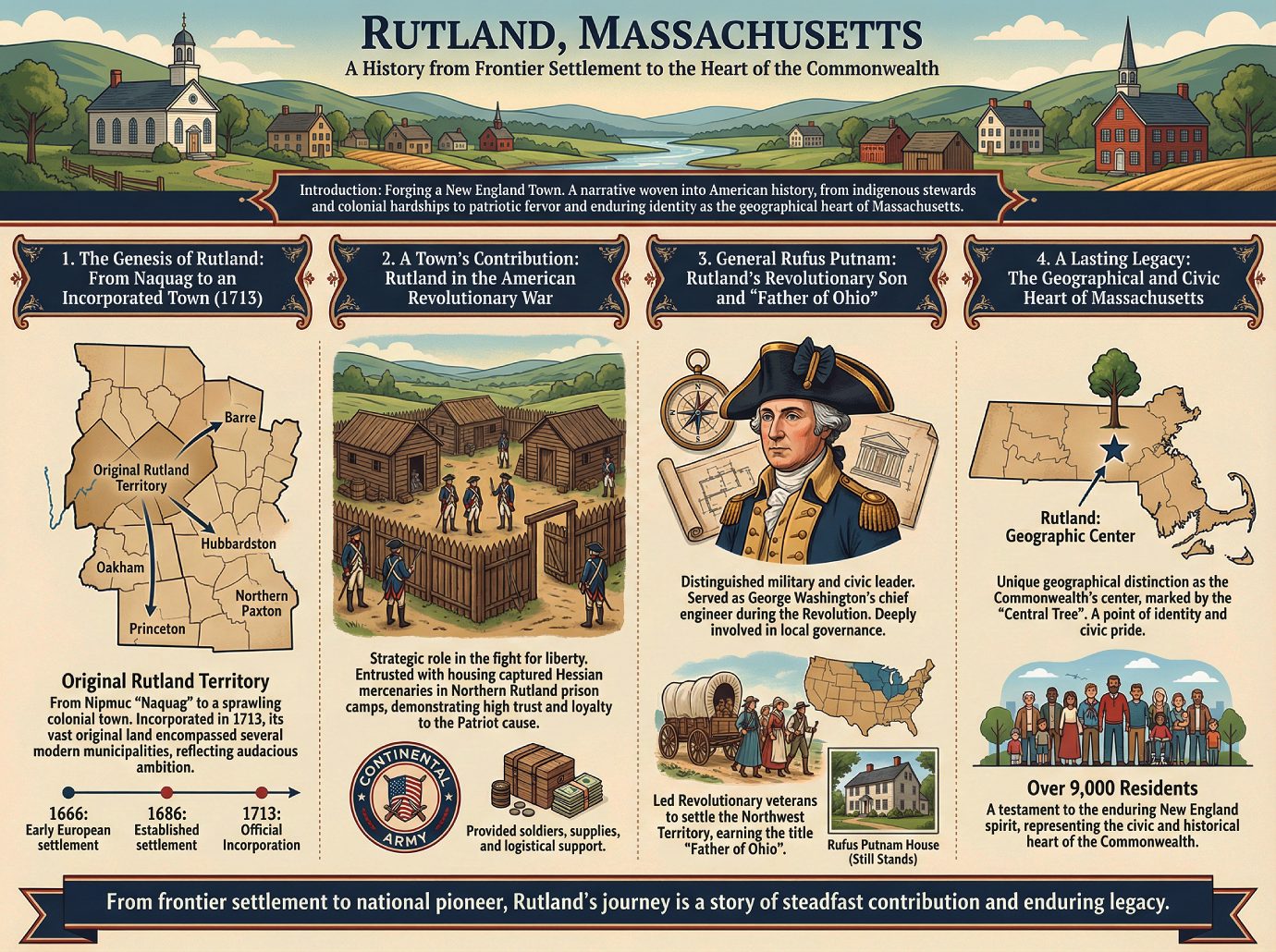
The town’s earliest history is rooted in its Nipmuc origins, when the area was known as “Naquag.” While records suggest European settlement began as early as 1666, with more established settlement noted by 1686, the town was not officially incorporated until 1713. At its inception, the Town of Rutland was a sprawling territory that encompassed the lands of several modern municipalities.
The scale of the original Rutland settlement included the land that would eventually become:
• Barre
• Hubbardston
• Oakham
• Princeton
• The northern half of Paxton
This period of bold establishment laid the groundwork for a community whose resolve would soon be tested on a national stage.
——————————————————————————–
2. A Town’s Contribution: Rutland in the American Revolutionary War
While grand battles and the actions of famous generals often dominate historical accounts of the American Revolution, the success of the independence movement was profoundly dependent on the collective contributions of small towns across New England. These communities provided soldiers, supplies, and logistical support, forming the bedrock of the war effort. Rutland serves as a key example of this local commitment, demonstrating how a rural town could play a significant and strategic role in the fight for liberty.
During the war, Rutland was entrusted with a critical military function: housing captured enemy combatants. Prison camps were established in Northern Rutland specifically to hold Hessian mercenaries hired by the British. For a small, rural town to be tasked with such a national security function was an immense responsibility. This charge reveals the high degree of trust the Continental leadership placed in Rutland’s loyalty to the Patriot cause and speaks to the town’s maturity and integration into the broader logistical network of the Continental Army, proving itself a secure and capable partner in the revolutionary cause.
The same spirit of duty that defined the town during the war also shaped its most distinguished leader, a man whose influence would stretch far beyond New England.
——————————————————————————–
3. General Rufus Putnam: Rutland’s Revolutionary Son and “Father of Ohio”
No single figure embodies Rutland’s spirit of civic duty and frontier ambition more completely than General Rufus Putnam. His life’s work reflects a deep commitment to both local governance and national progress, making him the town’s most famous citizen and a figure of historical importance whose impact reached from the battlefields of the Revolution to the new frontiers of the American west.
General Putnam’s career was marked by distinguished military and civic service. During the American Revolutionary War, his expertise was indispensable as he served as George Washington’s chief engineer, shaping the strategic landscape of the conflict. His dedication to public service was equally evident at home, where he was deeply involved in local governance, holding various town offices and serving as Rutland’s Representative to the General Court.
Putnam’s most profound legacy, however, was forged after the war, in an act that seemed to mirror the town’s own expansive origins. He demonstrated remarkable vision and leadership by guiding a group of fellow Revolutionary War veterans to settle the vast Northwest Territory. This pioneering achievement was so significant that it earned him the esteemed title, the “Father of Ohio.” The town of Rutland continues to honor its most famous son; the historic Rufus Putnam House still stands today as a bed and breakfast and is proudly depicted on the official town seal, a permanent symbol of his lasting importance to Rutland’s identity.
Just as Putnam’s life gave Rutland a connection to the nation’s westward expansion, its very location gives it a unique and permanent place within its home state.
——————————————————————————–
4. A Lasting Legacy: The Geographical and Civic Heart of Massachusetts
A town’s identity is often shaped by a unique combination of its history, its people, and its physical place in the world. For Rutland, this connection between geography and civic pride is especially profound, linking its colonial past to its modern character. The town’s location is not merely a point on a map but a central element of its distinction within the Commonwealth.
Rutland holds the unique geographical distinction of being the geographic center of Massachusetts. This fact is more than a piece of trivia; it is a point of identity celebrated within the community. A landmark known as the Central Tree, located on Central Tree Road, marks the general spot, symbolizing the town’s position at the very core of the state.
From the Nipmuc territory of Naquag to a Revolutionary-era stronghold and the home of a national pioneer, Rutland’s journey is a story of steadfast contribution. Today, as a community of over 9,000 residents, it does more than occupy a central point on a map. It stands as a testament to the enduring New England spirit, representing the civic and historical heart of the Commonwealth it helped to build
. ——————–
A Beginner’s Snapshot of Rutland, Massachusetts
A Beginner’s Snapshot of Rutland, Massachusetts
Introduction: Welcome to the Heart of the Commonwealth
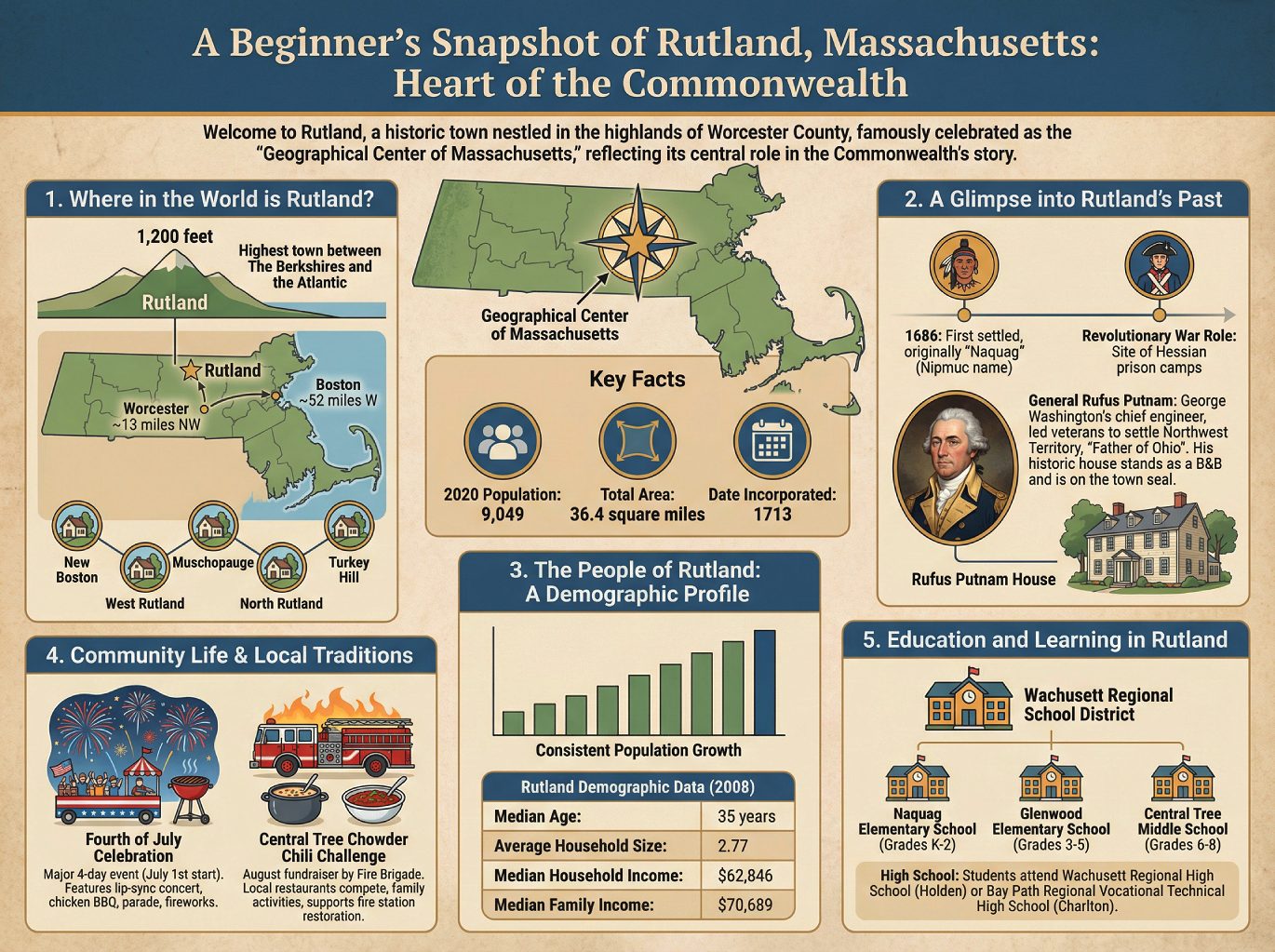
Welcome to Rutland, a historic town nestled in the highlands of Worcester County, Massachusetts. Best known for its unique geographical distinction, Rutland holds a special place in the state’s landscape and history. It is famously celebrated as the “Geographical Center of Massachusetts,” a title that reflects its central role in the story of the Commonwealth.
It is famously celebrated as the “Geographical Center of Massachusetts,” a title that reflects its central role in the story of the Commonwealth.
Here are a few key facts to get you started:
• 2020 Population: 9,049
• Total Area: 36.4 square miles
• Date Incorporated: 1713
——————————————————————————–
1. Where in the World is Rutland?
Rutland’s geography is as significant as its central location. With its town common situated at an elevation of 1,200 feet, it holds the distinction of being the highest town between The Berkshires and the Atlantic. This elevated perch offers a unique perspective on the surrounding region. The town is conveniently located approximately 13 miles northwest of Worcester and 52 miles west of Boston, making it a quiet retreat with access to major urban centers. Within its borders, Rutland encompasses five distinct villages: New Boston, West Rutland, Muschopauge, North Rutland, and Turkey Hill.
This central and elevated location has shaped the town’s development throughout its long history.
——————————————————————————–
2. A Glimpse into Rutland’s Past
Rutland’s story is deeply rooted in American history, from its indigenous origins to its role in the nation’s founding. The area was first settled by Europeans in 1686 and was originally known by its Nipmuc name, “Naquag.” The town was officially incorporated in 1713.
Rutland played a direct role in the Revolutionary War, not only as the home of its most famous citizen, General Rufus Putnam, but also as the site of prison camps for captured Hessian mercenaries. General Putnam served as George Washington’s chief engineer, and after the war, he led a group of veterans west to settle the Northwest Territory, an achievement that earned him the title “Father of Ohio.” Today, his legacy is a core part of the town’s identity; the historic Rufus Putnam House still stands as a bed and breakfast and is proudly featured on the official town seal.
The legacy of these early settlers and notable figures provides a backdrop for the community that thrives in Rutland today.
——————————————————————————–
3. The People of Rutland: A Demographic Profile
According to the 2020 U.S. Census, the population of Rutland is 9,049. The town has shown a consistent trend of population growth over the decades. While the most recent comprehensive demographic data is from 2008, it provides a valuable snapshot of the community’s household characteristics from that period.
Rutland Demographic Data (2008)
| Statistic | Value |
|---|---|
| Median Age | 35 years |
| Average Household Size | 2.77 |
| Median Household Income | $62,846 |
| Median Family Income | $70,689 |
This growing population is brought together by a strong sense of community, celebrated through various local traditions.
——————————————————————————–
4. Community Life & Local Traditions
Rutland is a town that cherishes its community spirit, which is on full display during its beloved annual events. These gatherings bring residents together to celebrate, socialize, and support local causes.
• Fourth of July Celebration This is a major four-day event that begins on July 1st. The celebration is a highlight of the summer, featuring a lip-sync concert, a chicken barbecue hosted by the local Fire Brigade, a Historical Society Lemonade Social, a town parade with floats from local organizations, and a spectacular fireworks display.
• Central Tree Chowder Chili Challenge Held in August, this event is a popular fundraiser hosted by the Rutland Fire Brigade. Local restaurants compete for the title of best clam chowder, while families enjoy pony rides, face painting, and other activities. The proceeds help fund the restoration of the town’s original fire station and purchase necessary equipment for the Fire Department.
These community gatherings support a family-oriented atmosphere, which is further reinforced by the town’s commitment to education.
——————————————————————————–
5. Education and Learning in Rutland
Education in Rutland is managed as part of the Wachusett Regional School District, a well-regarded system serving several towns in the area. The schools located within Rutland itself serve the town’s younger students from kindergarten through middle school.
The public schools located within the town are:
• Naquag Elementary School (Grades K-2)
• Glenwood Elementary School (Grades 3-5)
• Central Tree Middle School (Grades 6-8)
For their high school education, students from Rutland attend either Wachusett Regional High School in the neighboring town of Holden or Bay Path Regional Vocational Technical High School in Charlton.
————————-
More Than a Map Dot: The Unexpected History of Rutland, MA
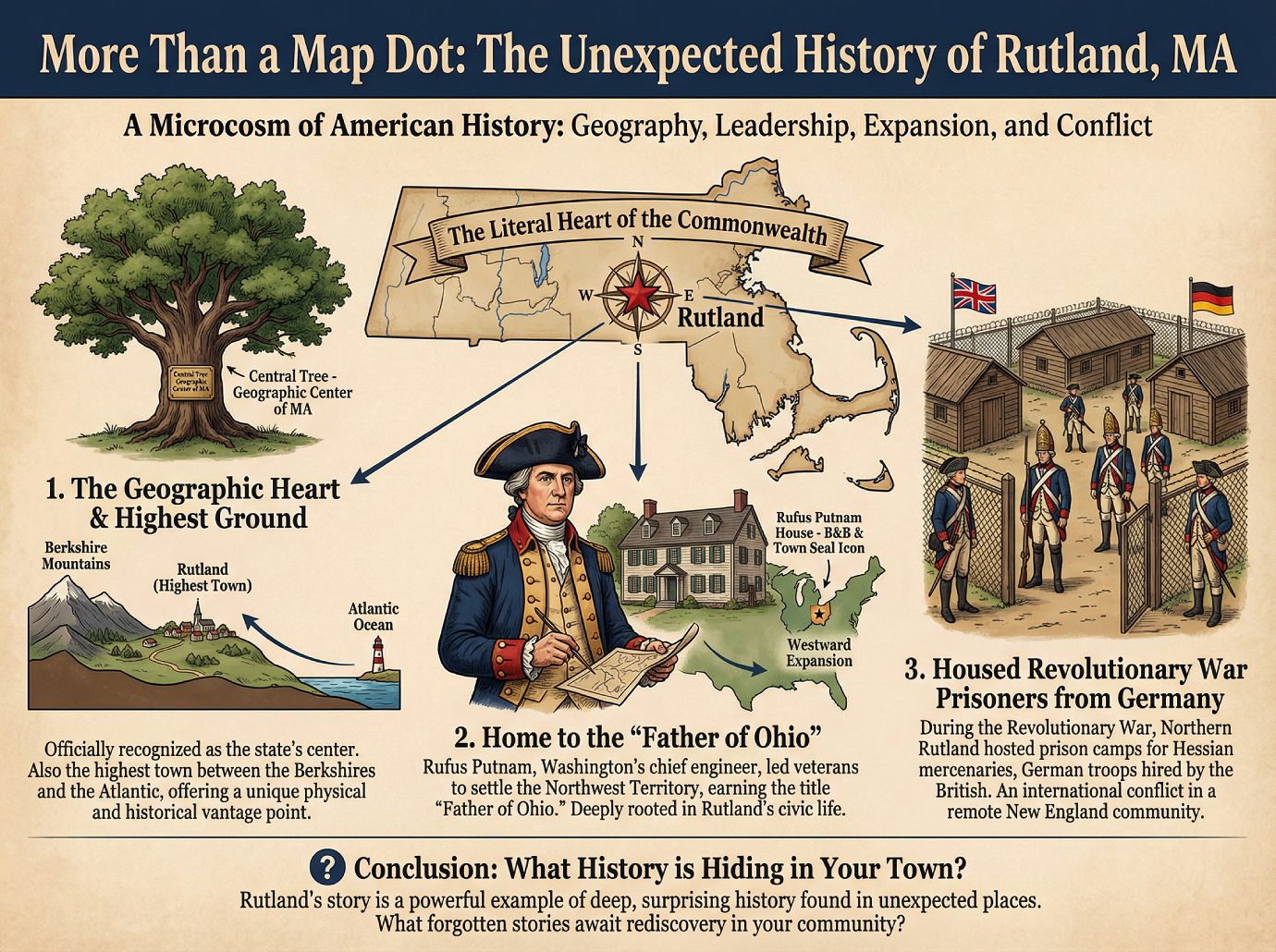
More Than a Map Dot: The Unexpected History of Rutland, MA
Introduction: More Than Just a Map Marker
When we think of small towns, we often picture quiet streets and a peaceful, perhaps uneventful, existence. They are the dots on the map we pass through on our way to somewhere else. But sometimes, these unassuming places hold the most fascinating stories, hiding layers of history just beneath the surface. Rutland, Massachusetts, is a perfect example. Its most common claim to fame is being the geographical center of the state, a unique but seemingly simple fact.
However, this central location is just the beginning. Rutland’s story is a microcosm of American history itself—a tale of geographical identity, revolutionary leadership, national expansion, and even international conflict. This article will explore three surprising facts that prove Rutland is much more than just the heart of the Commonwealth.
1. It’s the Literal Heart of the Commonwealth
Rutland’s claim to fame is etched into the very map of Massachusetts. It is officially recognized as the geographic center of the state, a designated point marked by the “Central Tree” on Central Tree Road. But its unique geography doesn’t stop there. The source of local pride is also a point of elevation: Rutland is the highest town between the Berkshire Mountains and the Atlantic Ocean.
This combination of centrality and height gives the town a unique physical and historical vantage point. What does it mean for a small, quiet community, perched on the highest ground between the mountains and the sea, to be the physical ‘heart’ of its state? For Rutland, this geographical fact is deeply intertwined with its identity, giving it a permanent and central place in the story of Massachusetts.
2. It Was Home to the “Father of Ohio”
But Rutland’s central role in history isn’t just geographical; it also produced one of the key architects of America’s westward expansion. Rufus Putnam, a man of immense national importance, served as George Washington’s chief engineer during the Revolutionary War. After the war, his influence only grew. Putnam led a group of veterans west to settle the vast Northwest Territory, a monumental undertaking that earned him the distinguished title “Father of Ohio.”
Crucially, Putnam wasn’t just a resident of Rutland; he was a product of its community. He held various town offices and served as its Representative to the General Court, embedding himself in the town’s civic life. This deep local connection makes his national legacy even more remarkable. A tangible link to this history remains today, as the Rufus Putnam House—so significant it is depicted on the town seal—still stands in Rutland and now operates as a B&B. It’s a powerful reminder of how a figure who helped shape the nation was forged in the heart of this small Massachusetts town.
3. It Housed Revolutionary War Prisoners from Germany
But if you think that’s surprising, dig a little deeper. You’ll find a story that stretches across the Atlantic and places this tiny town at the center of a global conflict. During the Revolutionary War, prison camps were established in Northern Rutland to hold captured soldiers.
These were not just any enemy combatants; they were Hessian mercenaries, German troops hired by the British to fight against the American colonists. This fact is startling because it places an international war right in the backyard of a seemingly remote New England community. It reveals the hidden layers of history that exist in the most unexpected places. In this one small town—the geographical heart of the state that produced a national founder—the consequences of a world-altering war were felt firsthand, proving that even the most local stories can have a global reach.
Conclusion: What History is Hiding in Your Town?
From its position as the state’s literal and topographical center, to being the home of the “Father of Ohio,” to serving as a holding place for Hessian prisoners, Rutland’s history is a powerful microcosm of the American experience. It serves as a powerful example of how deep and surprising stories can be found anywhere, if we only take a moment to look.
It leaves one to wonder: What forgotten stories and surprising historical figures might be waiting to be rediscovered in your own community’s past?
Who Represents Rutland? A Student’s Guide to Government
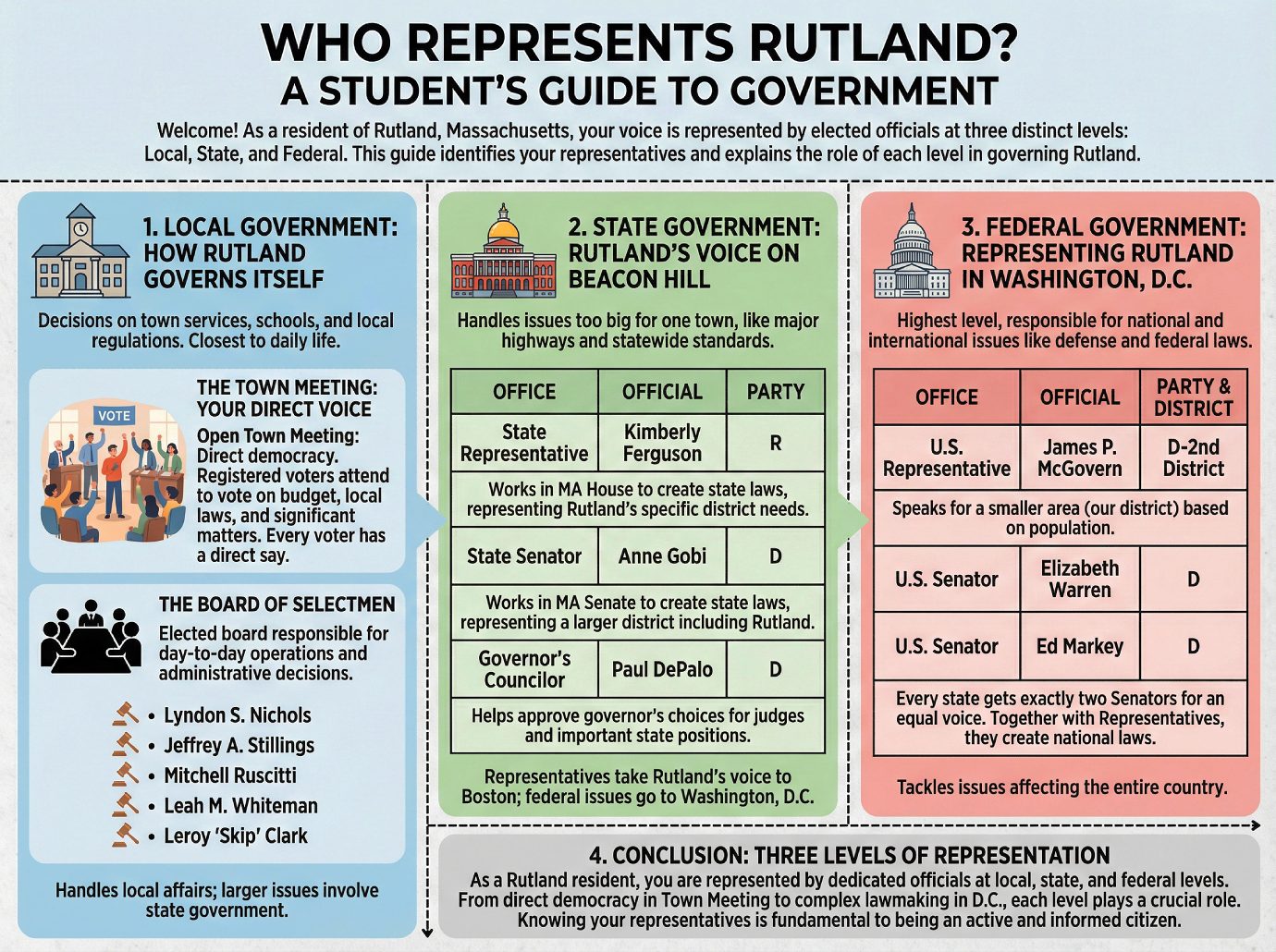
Who Represents Rutland? A Student’s Guide to Government
Introduction: Understanding Your Government
Welcome! As a resident of our town of Rutland, Massachusetts, your voice is represented in government by a team of elected officials. These individuals work at three distinct levels: the local level right here in town, the state level on Beacon Hill in Boston, and the federal level in Washington, D.C. This guide is designed to clearly identify who these representatives are and what each level of government does, providing a clear picture of how Rutland is governed.
1. Local Government: How Rutland Governs Itself
The most direct level of government is local. This is where decisions about town services, schools, and local regulations are made. It’s the government closest to the daily lives of Rutland’s citizens.
The Town Meeting: Your Direct Voice
Rutland uses an “Open town meeting” style of government. This is a powerful and direct form of democracy where registered voters can attend meetings to vote on the town’s budget, local laws, and other significant matters. Unlike in cities that elect a mayor and council, Rutland’s Open Town Meeting gives every voter a direct say in decisions.
The Board of Selectmen
A key part of Rutland’s internal governance is the Board of Selectmen. This elected board is responsible for the town’s day-to-day operations and for making important administrative decisions. According to information from 2019, the five members of the Board of Selectmen were:
• Lyndon S. Nichols
• Jeffrey A. Stillings
• Mitchell Ruscitti
• Leah M. Whiteman
• Leroy “Skip” Clark
While the Board of Selectmen and the Town Meeting handle local affairs, some issues are too big for one town to manage alone. That’s when our state government gets involved.
2. State Government: Rutland’s Voice on Beacon Hill
When an issue is too big for just Rutland—like building a major highway or setting statewide school standards—the state government on Beacon Hill in Boston takes charge. Rutland is represented in the state legislature and on the Governor’s Council by several elected officials who ensure our town’s needs are considered.
| Office | Official | Party |
|---|---|---|
| State Representative | Kimberly Ferguson | R |
| State Senator | Anne Gobi | D |
| Governor’s Councilor | Paul DePalo | D |
Here is a simple breakdown of what these officials do:
• State Representative: Works in the Massachusetts House of Representatives to create state laws and represents the specific needs of Rutland’s local district.
• State Senator: Works in the Massachusetts Senate to create state laws, representing a larger district that includes Rutland and other towns.
• Governor’s Councilor: Helps approve the governor’s choices for judges and other important state positions.
Just as our state representatives take Rutland’s voice to Boston, our federal representatives carry it to the nation’s capital, Washington, D.C., to tackle issues that affect the entire country.
3. Federal Government: Representing Rutland in Washington, D.C.
Rutland, like every community in the country, is also represented in the U.S. Congress in Washington, D.C. This is the highest level of government, responsible for national and international issues like defense, trade, and federal laws that apply to all Americans.
| Office | Official | Party & District |
|---|---|---|
| U.S. Representative | James P. McGovern | D-2nd District |
| U.S. Senator | Elizabeth Warren | D |
| U.S. Senator | Ed Markey | D |
The main difference between the House and the Senate is how they represent us. A U.S. Representative, like James P. McGovern, speaks for a smaller area—our specific district—so representation is based on population. The Senate is different: every state, big or small, gets exactly two Senators, like Elizabeth Warren and Ed Markey, to ensure each state has an equal voice. These officials work together to create the laws of the nation.
4. Conclusion: Three Levels of Representation
As a resident of Rutland, you are represented by this dedicated group of officials working at the local, state, and federal levels. From the direct democracy of the Open Town Meeting to the complex lawmaking in Washington, D.C., each level of government plays a crucial role in civic life. Knowing who your representatives are is a fundamental part of being an active and informed citizen.
———————-