



Orange MA – Complete History and Profile
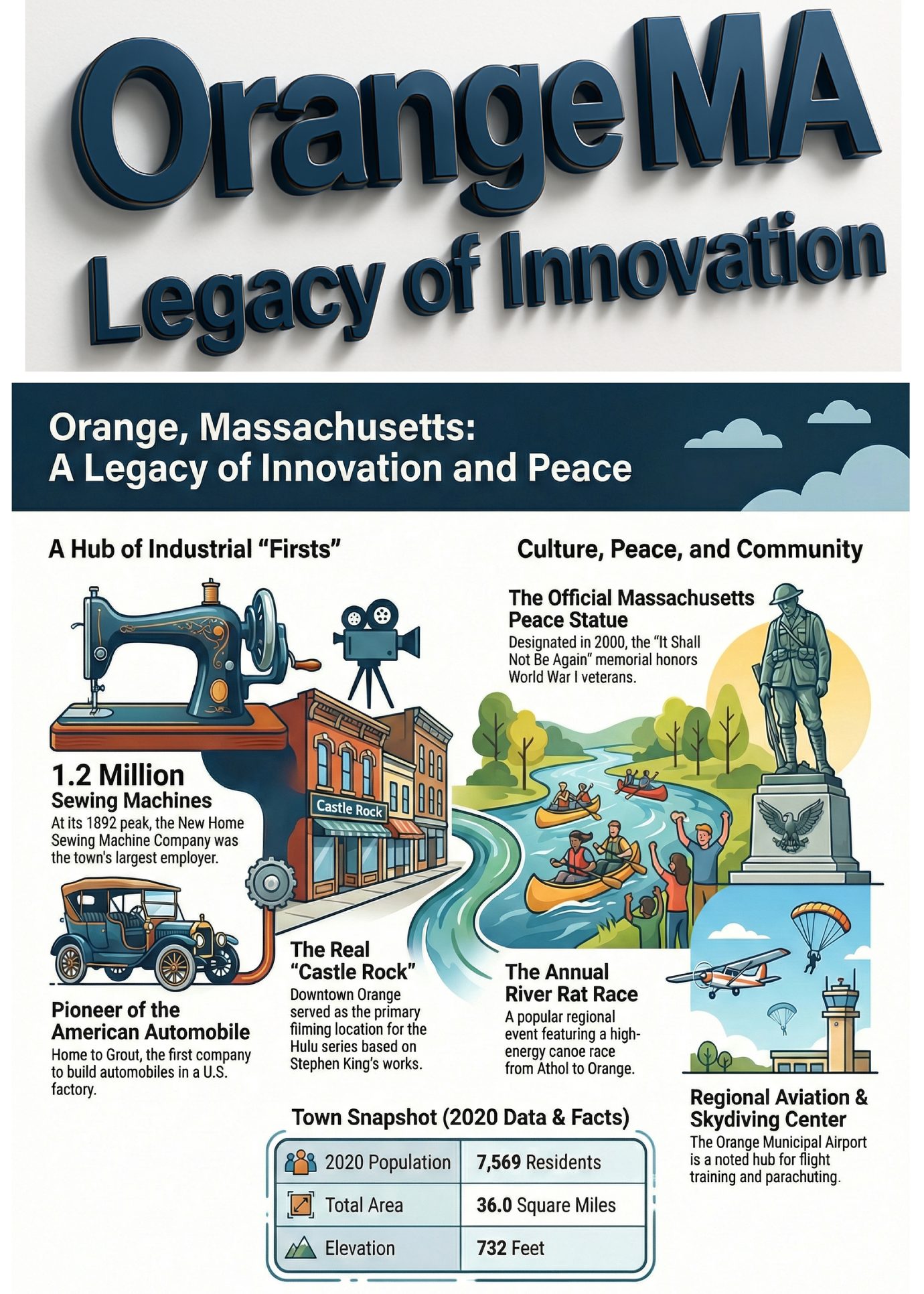
Orange, MA – Legacy of Innovation – Complete History and Community Profile
Listen to a “Deep Dive” about Orange MA on any device, CLICK PLAY.
Community Profile: Town of Orange Massachusetts
Understanding a Town Through Data: A Beginner’s Guide to Orange MA
From Factory-built cars to Stephen King: The Secret History of Orange, MA
Community Profile: Town of Orange, Massachusetts
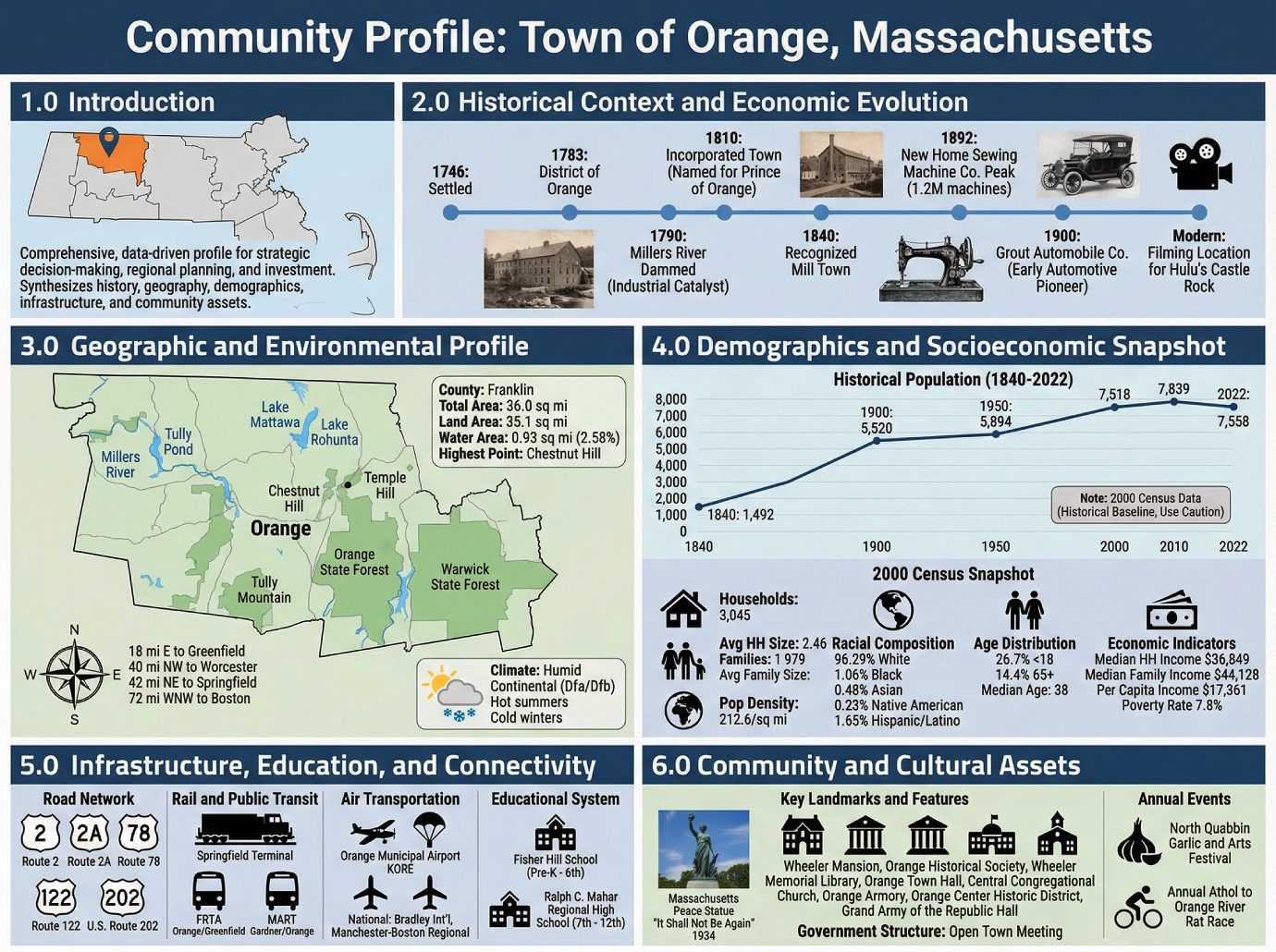
Community Profile: Town of Orange, Massachusetts
1.0 Introduction
This document provides a comprehensive, data-driven profile of the Town of Orange, Massachusetts. It is designed to serve as a foundational resource for strategic decision-making by government officials, regional planners, community stakeholders, and potential investors. By synthesizing key information on the town’s history, geography, demographics, infrastructure, and community assets, this profile provides a strategic lens for identifying development opportunities, addressing community needs, and guiding public and private investment.
2.0 Historical Context and Economic Evolution
Understanding the history of Orange is essential for contextualizing its present-day character and economic opportunities. The town’s narrative is one of significant transformation, evolving from a small agrarian settlement into a notable 19th-century industrial hub. This evolution has profoundly shaped its physical layout, community identity, and development trajectory.
• Founding and Incorporation: The area was first settled by Europeans in 1746, formed from lands belonging to the neighboring towns of Royalston, Warwick, and Athol. It was officially established as the District of Orange in 1783 and was finally incorporated as a town in 1810. The town was named in honor of William, Prince of Orange.
• Industrialization: The town’s economic focus began to shift following the damming of the Millers River in 1790. This pivotal infrastructure project catalyzed the growth of local industry, and by 1840, Orange was widely recognized as a mill town rather than a primarily farming community.
• Manufacturing Peaks: During the late 19th and early 20th centuries, Orange became a center for advanced manufacturing. The New Home Sewing Machine Company was the town’s largest industrial enterprise, reaching a peak output of 1.2 million machines in 1892. In 1900, the town became home to the Grout automobile company, a pioneer in the automotive industry often considered the builder of the first automobile in a factory in the United States.
• Modern Cultural Significance: More recently, the town has gained visibility as the primary filming location for the Hulu streaming series Castle Rock, based on the works of Stephen King, with many downtown businesses adapted for the production.
This rich historical foundation is deeply connected to the physical landscape that first enabled and continues to define the town’s development.
3.0 Geographic and Environmental Profile
The geography of Orange—its regional location, topography, and natural resources—represents a critical set of factors for land use planning, infrastructure development, and environmental management. The town’s physical setting offers both distinct advantages and important considerations for future growth.
| Geographic Attribute | Details |
|---|---|
| County | Franklin |
| Total Area | 36.0 sq mi (93.3 km²) |
| Land Area | 35.1 sq mi (90.9 km²) |
| Water Area | 0.93 sq mi (2.4 km²), or 2.58% of total |
| Highest Point | Chestnut Hill |
The town’s primary drainage feature is the Millers River, which flows directly through the town center. Other significant water bodies include Tully Pond, Lake Mattawa, and a portion of Lake Rohunta. The northern half of the town is characterized by numerous swamps and is home to Temple Hill and Tully Mountain. Key protected areas include the Orange State Forest and a section of the Warwick State Forest.
As the easternmost town in Franklin County, Orange is bordered by Royalston to the northeast, Athol to the southeast, New Salem to the south, Wendell to the southwest, a small portion of Erving to the west, and Warwick to the northwest. Its strategic location places it within reach of several major regional centers:
• 18 miles east of Greenfield
• 40 miles northwest of Worcester
• 42 miles northeast of Springfield
• 72 miles west-northwest of Boston
The town’s climate is classified under the Köppen system as humid continental (Dfa/Dfb), characterized by hot, humid summers and cold, snowy winters. Spring and fall are typically mild.
The town’s physical environment provides the setting for the community and population detailed in the following section.
4.0 Demographics and Socioeconomic Snapshot
Demographic and socioeconomic data are vital for strategic planning, offering crucial insights into the town’s labor force, housing needs, consumer base, and overall economic health. This section analyzes population trends, which indicate strong growth through the late 20th century followed by a plateau and slight decline post-2010—a key consideration for future planning.
Historical Population of Orange, MA (1840-2022)
| Year | Population | Change |
|---|---|---|
| 1840 | 1,492 | — |
| 1850 | 1,701 | +14.0% |
| 1860 | 1,622 | -4.6% |
| 1870 | 2,091 | +28.9% |
| 1880 | 3,169 | +51.6% |
| 1890 | 4,568 | +44.1% |
| 1900 | 5,520 | +20.8% |
| 1910 | 5,282 | -4.3% |
| 1920 | 5,393 | +2.1% |
| 1930 | 5,365 | -0.5% |
| 1940 | 5,611 | +4.6% |
| 1950 | 5,894 | +5.0% |
| 1960 | 6,154 | +4.4% |
| 1970 | 6,104 | -0.8% |
| 1980 | 6,844 | +12.1% |
| 1990 | 7,312 | +6.8% |
| 2000 | 7,518 | +2.8% |
| 2010 | 7,839 | +4.3% |
| 2020 | 7,569 | -3.4% |
| 2022 | 7,558 | -0.1% |
According to the 2020 census, the population of Orange was 7,569, with a 2022 estimate of 7,558.
Note: The following detailed socioeconomic statistics are from the 2000 U.S. Census. While they provide an essential historical baseline, they should be interpreted with caution as they do not reflect the economic conditions of the past two decades. More recent data from sources like the American Community Survey would be required for current policy-making and investment analysis.
• Household & Family Structure: The town contained 3,045 households and 1,979 families. The average household size was 2.46, and the average family size was 3.02.
• Population Density: The population density was 212.6 inhabitants per square mile. The housing unit density was 93.4 per square mile.
• Racial Composition: The racial makeup was predominantly White at 96.29%, with 1.06% Black or African American, 0.48% Asian, 0.23% Native American, 0.01% Pacific Islander, 0.59% from other races, and 1.34% from two or more races. Hispanic or Latino of any race constituted 1.65% of the population.
• Age Distribution: The population was distributed across age groups, with 26.7% under the age of 18 and 14.4% aged 65 or older. The median age was 38 years.
• Economic Indicators (2000): The median household income was $36,849, and the median family income was $44,128. The per capita income for the town was $17,361. Approximately 7.8% of the population was below the poverty line.
This population is supported by a network of infrastructure and community services that are essential for daily life and economic function.
5.0 Infrastructure, Education, and Connectivity
Effective infrastructure provides the logistical and human capital frameworks that are prerequisites for sustainable economic growth and community well-being. This section assesses Orange’s transportation networks and educational institutions as foundational elements for business investment and community development.
Road Network
Orange is well-served by several major state and federal highways, ensuring strong regional connectivity.
• Massachusetts Route 2: This major east-west artery across northern Massachusetts runs through Orange as a limited-access highway.
• Route 2A: This route follows the former path of Route 2, passing near the town center and connecting to Athol.
• Route 78: The southern terminus of this state route is located in Orange.
• Route 122: The northern terminus of this route is located in Orange.
• U.S. Route 202: The western end of the highway’s concurrency with Route 2 is located within the town.
Rail and Public Transit
The town is situated along an active freight rail corridor and is served by regional public transit.
• Rail: The Springfield Terminal railway passes through town, providing freight service. While passenger rail service was once provided by the Fitchburg Railroad and later the Boston and Maine Railroad, it has since been discontinued.
• Public Transit: Two local bus routes provide service to the town: the Franklin Regional Transit Authority’s (FRTA) Orange/Greenfield Route and the Montachusett Regional Transit Authority’s (MART) Gardner/Orange Route.
Air Transportation
Orange possesses a significant local aviation asset and is located within a reasonable distance of two national airports.
• Orange Municipal Airport (KORE): This town-owned airport features a small airstrip and serves as a center for flight training and parachuting.
• National Air Service: The nearest airports for national flights are Bradley International Airport to the south and Manchester-Boston Regional Airport to the northeast.
Educational System
The town provides public education from pre-kindergarten through high school.
• Fisher Hill School: Serves students from Pre-K through 6th grade.
• Ralph C. Mahar Regional High School: Serves students in grades 7 through 12.
These functional systems of infrastructure and education support the vibrant community life and cultural identity of the town.
6.0 Community and Cultural Assets
A community’s cultural assets and civic infrastructure are critical drivers of “placemaking.” These elements not only enrich the quality of life for current residents but also serve as key attractors for new talent, tourism, and investment. This section highlights Orange’s notable landmarks, events, and historical features that contribute to its unique character.
Key Landmarks and Features
• Massachusetts Peace Statue: Formally titled “It Shall Not Be Again”, this bronze statue was erected in Memorial Park in 1934 to honor veterans of World War I. In 2000, the state legislature designated it the official peace statue of the Commonwealth of Massachusetts.
• Historic Buildings & Sites: The town’s long history is preserved in its architecture and historic districts. Notable sites include the Wheeler Mansion, Orange Historical Society, Wheeler Memorial Library, Orange Town Hall, Central Congregational Church, Orange Armory, the Orange Center Historic District, and the Grand Army of the Republic Hall.
• Government Structure: The Town of Orange operates under an Open town meeting form of government, allowing for direct participation by its citizens in local governance.
Annual Events
Orange hosts popular annual events that draw visitors from across the region and foster a strong sense of community.
• North Quabbin Garlic and Arts Festival
• Annual Athol to Orange River Rat Race
In summary, the Town of Orange presents the profile of a community shaped by its industrial heritage and river-based geography. Its modern trajectory is defined by its strategic location within regional transportation networks, a stable population base, and a distinct collection of cultural assets that provide a foundation for future economic development and placemaking initiatives. NotebookLM can be inaccurate; please double check its responses.
————–
Understanding a Town Through Data: A Beginner’s Guide to Orange, Massachusetts
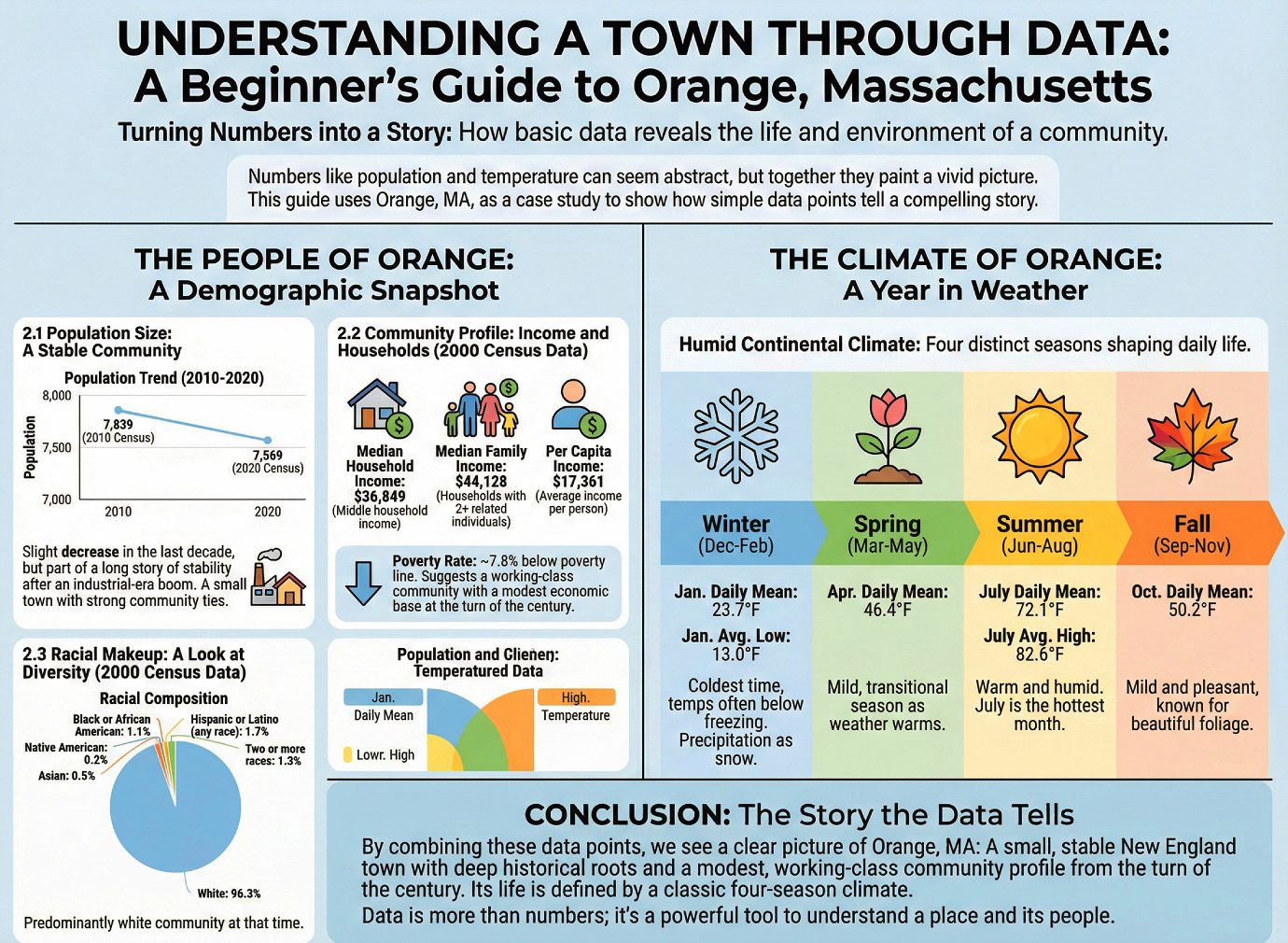
Understanding a Town Through Data: A Beginner’s Guide to Orange, Massachusetts
1. Introduction: Turning Numbers into a Story
Welcome to a beginner’s guide on how to read the story of a town through its data. Numbers like population counts and temperature averages can seem abstract, but when we look at them together, they paint a vivid picture of a community’s life and environment.
This guide will use the town of Orange, Massachusetts, as a case study. We will explore basic demographic and climate data to see what it reveals. By the end, you will understand how simple data points about people, income, and weather can come together to tell a compelling story about a place.
Let’s begin by looking at the people who call Orange home.
2. The People of Orange: A Demographic Snapshot
“Demographics” is simply the study of a population’s characteristics. This data helps us understand who lives in a community, giving us a foundational snapshot of the town’s social and economic fabric.
2.1 Population Size: A Stable Community
The most recent population figure for Orange is 7,569, according to the 2020 census. This number tells us that Orange is a small town, a place where community ties can be strong. By looking at the population over time, we can see how the town is changing.
• 2010 Population: 7,839
• 2020 Population: 7,569
This data shows a slight decrease in the last decade, but this recent trend is part of a much longer story of stability. After a massive population boom during the industrial era—fueled by employers like the New Home Sewing Machine Company in the late 1800s—the town’s population has remained remarkably consistent for over a century. This pattern is characteristic of an established small town with deep historical roots.
2.2 Community Profile: Income and Households
To explore a more detailed economic and social snapshot, we can look at the comprehensive data provided by the 2000 census. Economic data provides a fascinating window into a community’s life, and these figures serve as a historical time capsule, showing us Orange’s economic profile at the turn of the century.
• Median Household Income: $36,849
◦ This represents the income of the middle household in the town—half of all households earned more, and half earned less.
• Median Family Income: $44,128
◦ This metric focuses only on households with two or more related individuals, often providing a different perspective on the economic landscape than the broader household measure.
• Per Capita Income: $17,361
◦ This is the average income per person in the town, calculated by dividing the town’s total income by its total population.
At that time, about 7.8% of the population lived below the poverty line. Together, these figures from 2000 suggest a working-class community with a modest economic base.
2.3 Racial Makeup: A Look at Diversity
The racial composition of a town is a key part of its demographic story. The 2000 census data provides the following snapshot of the community’s makeup:
• White: 96.3%
• Black or African American: 1.1%
• Native American: 0.2%
• Asian: 0.5%
• Two or more races: 1.3%
• Hispanic or Latino (of any race): 1.7%
Based on these 2000 figures, the data indicates that Orange was a predominantly white community at that time.
Now that we have a basic understanding of the people of Orange, let’s explore the physical environment they live in.
3. The Climate of Orange: A Year in Weather
Orange has a humid continental climate. This technical term means the town experiences four distinct seasons, with noticeably warm summers and cold, snowy winters. This classic New England weather pattern shapes daily life, from recreation on Lake Mattawa to the vibrant tourism brought by the region’s notable fall foliage.
3.1 A Four-Season Summary
The best way to understand the climate is to look at a typical year. The table below summarizes the weather you can expect during each season, using data from 1996-2020.
| Season | Seasonal Averages (Fahrenheit) | What to Expect |
|---|---|---|
| Winter (Dec-Feb) | Jan. Daily Mean: 23.7°F / Jan. Avg. Low: 13.0°F | This is the coldest time of year, with temperatures regularly dropping well below freezing. Precipitation often falls as snow. |
| Spring (Mar-May) | Apr. Daily Mean: 46.4°F | A mild, transitional season as the weather warms up from the winter cold. |
| Summer (Jun-Aug) | July Daily Mean: 72.1°F / July Avg. High: 82.6°F | Summers are typically warm and humid. July is the hottest month, bringing the highest temperatures of the year. |
| Fall (Sep-Nov) | Oct. Daily Mean: 50.2°F | Another mild and pleasant season, known for its comfortable temperatures and beautiful fall foliage. |
4. Conclusion: The Story the Data Tells
By combining these simple data points, we can begin to see a clearer picture of Orange, Massachusetts. The data paints a portrait of a small New England town defined by its classic four-season climate and a long history of population stability. Its demographic and economic profile from the turn of the century suggests a modest, working-class community with deep roots—a place that grew rapidly with industry and then settled into the steady character it holds today.
This exercise shows that data is more than just a list of numbers. When organized and interpreted, even the most basic statistics can create a powerful and understandable story about a place and the people who live there.
——————–
From Factory-Built Cars to Stephen King: The Secret History of Orange, Massachusetts
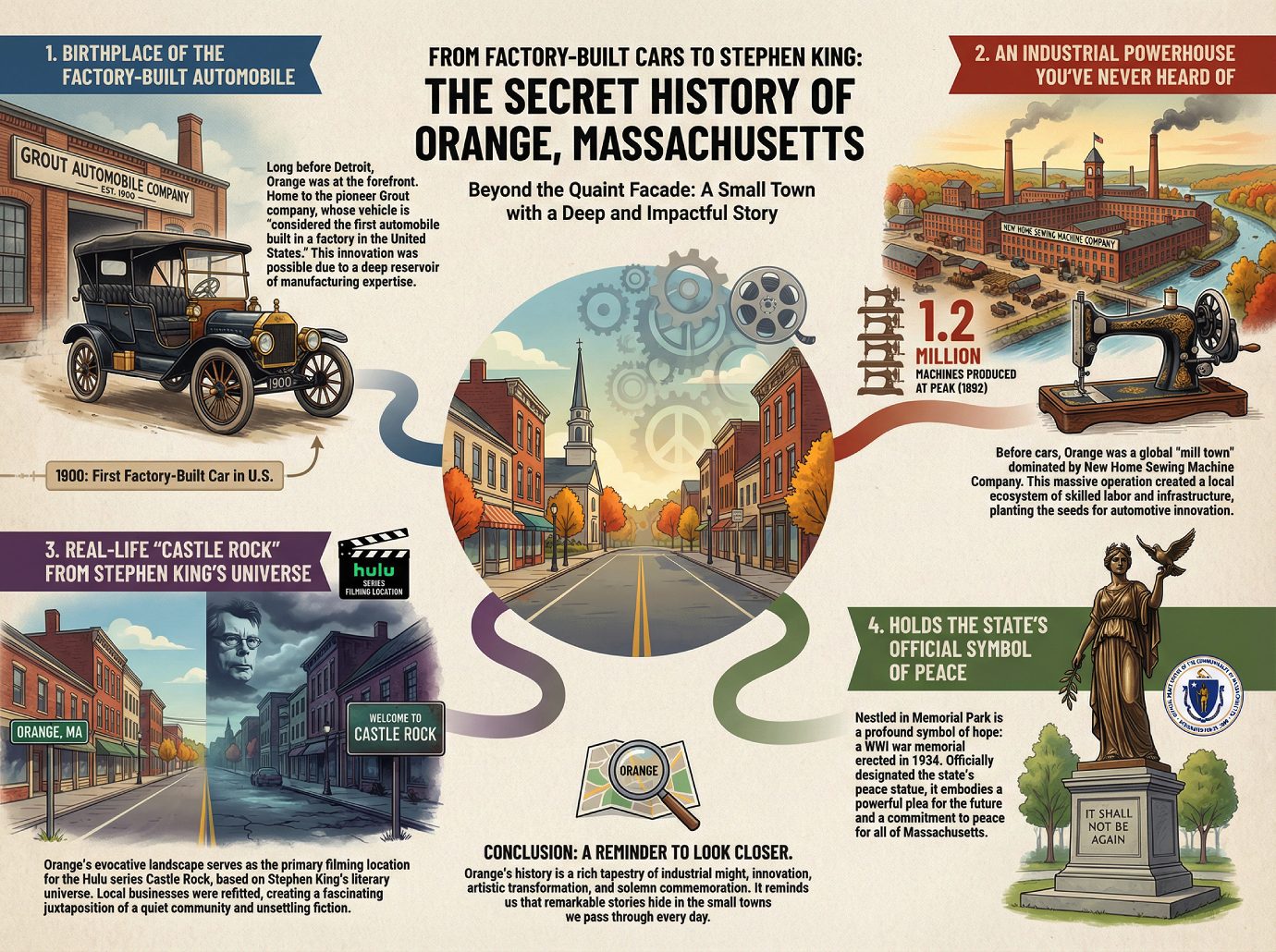
From Factory-Built Cars to Stephen King: The Secret History of Orange, Massachusetts
Introduction: Beyond the Quaint Facade
We often drive through quiet New England towns, admiring the historic town halls and peaceful main streets, without giving a second thought to the stories hidden just beneath the surface. It’s easy to assume that their most eventful days are long past. But some of these unassuming places have histories so rich and surprising they could change the way you see them forever. Orange, Massachusetts, is a perfect example—a small town with a deep and impactful story. Here are some of the most fascinating facts you never knew about it.
1. It Was the Birthplace of the Factory-Built Automobile
Long before Detroit became the “Motor City,” a small town in Massachusetts was at the forefront of the automotive revolution. This extraordinary feat didn’t happen in a vacuum. In 1900, Orange was home to the pioneer automobile company Grout, whose vehicle is “considered the first automobile built in a factory in the United States.” That a quiet New England town, and not a major industrial city, was helping to pioneer the American auto industry seems counter-intuitive. But this innovation was only possible because Orange already possessed a deep reservoir of manufacturing expertise.
2. It’s an Industrial Powerhouse You’ve Never Heard Of
Before it was building cars, Orange was a quintessential “mill town” with a global reach. The town’s economy was dominated by the New Home Sewing Machine Company. To understand the sheer scale of its operation, consider this: at its peak in 1892, the company produced 1.2 million machines. This industrial dominance created a local ecosystem of skilled labor and manufacturing infrastructure, planting the seeds for the automotive innovation that would follow. It was this foundation that made the later feat of factory-built cars possible.
3. It’s the Real-Life ‘Castle Rock’ from Stephen King’s Universe
While the hum of factories has faded, Orange’s evocative landscape has found a new purpose in the 21st century—not as a center for manufacturing, but as a canvas for storytelling. If the downtown streets look strangely familiar, there’s a good reason. The town was used as the primary filming location for the Hulu series Castle Rock, which is based on the interconnected literary universe of Stephen King. To create the show’s specific milieu, several local businesses in the downtown area were refitted and transformed, creating a fascinating juxtaposition: a real, quiet New England community serving as the living backdrop for some of modern fiction’s most unsettling stories.
4. It Holds the State’s Official Symbol of Peace
Beyond the fictional darkness portrayed on screen, Orange is also home to a very real and profound symbol of hope. Nestled in the town’s Memorial Park is the Massachusetts Peace Statue, a bronze war memorial erected in 1934 to honor the veterans of World War I. On February 25, 2000, the state legislature officially designated it the “official peace statue of the Commonwealth of Massachusetts.” The statue carries a profound and simple inscription, a powerful plea for the future:
It Shall Not Be Again
It is a remarkable testament to the town’s character that this small community is home to such a significant, state-level designation—a monument that embodies a commitment to peace for all of Massachusetts.
Conclusion: A Reminder to Look Closer
Orange, Massachusetts, tells a story of surprising diversity. Its history is a rich tapestry of industrial might, technological innovation, artistic transformation, and solemn commemoration. It serves as a powerful reminder that history is not just confined to big cities and famous landmarks. What remarkable stories might be hiding in the small towns we pass through every day?
————–
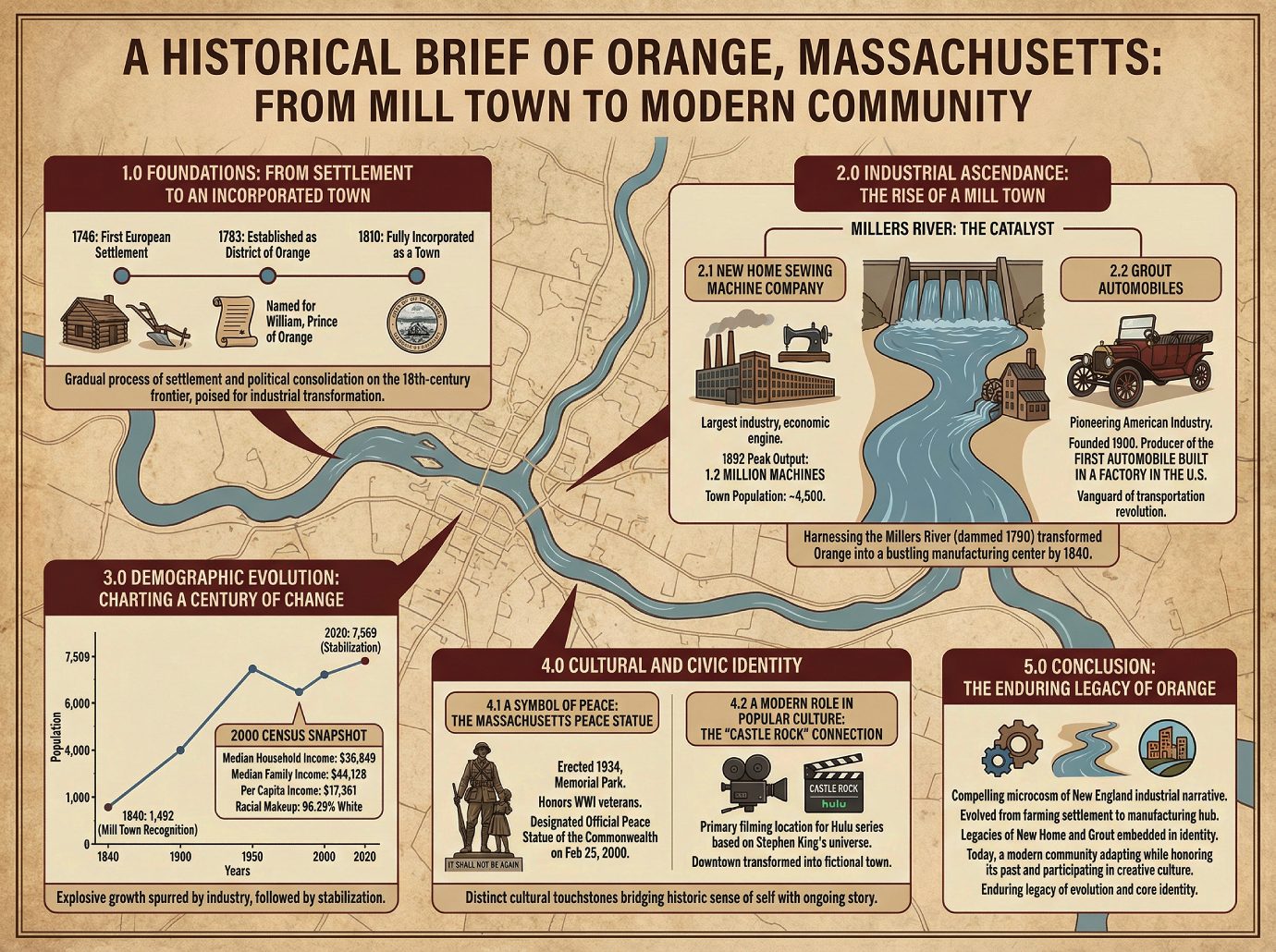
A Historical Brief of Orange, Massachusetts: From Mill Town to Modern Community
A Historical Brief of Orange, Massachusetts: From Mill Town to Modern Community
1.0 Foundations: From Settlement to an Incorporated Town
To understand the character of any community, one must first examine its foundations. The story of Orange, Massachusetts, begins not in a single moment, but through a gradual process of settlement and political consolidation on the 18th-century frontier. Its origins provide the essential context for the industrial powerhouse it would become and the resilient community it is today.
The narrative of Orange’s establishment is marked by several key chronological milestones. The first European settlement occurred in 1746, established on lands carved from the existing towns of Royalston, Warwick, and Athol. As the population grew, the settlement gained a distinct identity, and in 1783 it was officially established as the District of Orange, a name chosen in honor of William, Prince of Orange. This period of growth culminated in 1810 when Orange was fully incorporated as a town.
This quiet, agrarian existence, however, was poised for a dramatic shift, as the latent power of the Millers River would soon be harnessed, fueling an industrial transformation that would redefine the community for the next century.
2.0 Industrial Ascendance: The Rise of a Mill Town
At the heart of Orange’s industrial story is the Millers River. While the Industrial Revolution transformed countless New England communities, in Orange, the river was the central character, its current the catalyst that turned a modest farming settlement into a bustling manufacturing center. This harnessing of natural resources did more than change the town’s economy; it fundamentally reshaped its identity for generations.
The initial shift from agriculture to industry began in earnest in 1790 with the damming of the river. This foundational infrastructure enabled the growth of mills and factories, and by 1840, the transformation was so complete that Orange was primarily considered a mill town. This industrial base was anchored by two particularly significant and contrasting enterprises: one a titan of mass production, the other a pioneer of revolutionary technology.
2.1 The New Home Sewing Machine Company: A Manufacturing Powerhouse
By the late nineteenth century, the New Home Sewing Machine Company had emerged as the town’s largest and most influential industry. The impact of its scale on the community was profound. As the primary employer, it was the economic engine that shaped daily life and secured the town’s regional prominence. At its zenith in 1892, the factory’s output reached a staggering 1.2 million machines. For a town with a population of just over 4,500 people, this level of production was a testament to its manufacturing prowess and its central role in the national economy.
2.2 Grout Automobiles: Pioneering an American Industry
Beyond its dominance in established industries, Orange was also a surprising site of technological innovation. The Grout automobile company, founded in 1900, was a pioneer in a nascent American industry defined by workshop inventors and burgeoning mass production. The firm holds the distinction of being considered the producer of the first automobile built in a factory in the United States. This significant claim places Orange at the vanguard of the transportation revolution, a remarkable role for a small Massachusetts mill town that demonstrates its capacity for forward-looking enterprise.
This period of sustained industrial growth directly fueled a significant expansion of the town’s population, a demographic story told clearly in its census records.
3.0 Demographic Evolution: Charting a Century of Change
This industrial boom is vividly reflected in the town’s census records, which provide a tangible measure of its economic health and social development. The demographic history of Orange is a story of explosive growth spurred by the success of enterprises like the New Home Sewing Machine Company, followed by a period of stabilization characteristic of New England towns as their industrial might waned in the 20th century.
The town’s population surged alongside its industrial fortunes. Census records show a population of 1,492 in 1840, the year it was first recognized as a mill town. By the peak of its manufacturing era, this figure had dramatically increased. Over the next century and a half, the population stabilized, reaching 7,569 according to the 2020 census. A snapshot of the community at the turn of the 21st century, based on the 2000 census, reveals the following socioeconomic profile:
• Median Household Income: $36,849
• Median Family Income: $44,128
• Per Capita Income: $17,361
• Racial Makeup: 96.29% White
Beyond the quantitative story told by this data lies the qualitative identity of the town, expressed through its civic landmarks and cultural contributions.
4.0 Cultural and Civic Identity
A town’s identity is shaped not only by its industrial history and population trends but also by the unique cultural landmarks it creates and its engagement with broader national culture. Orange possesses a distinct character, reflected in both a solemn monument to peace and a recent, prominent role in popular entertainment.
4.1 A Symbol of Peace: The Massachusetts Peace Statue
In the heart of Memorial Park stands the Massachusetts Peace Statue, a bronze war memorial formally titled “It Shall Not Be Again.” Erected in 1934, the statue was created to honor the veterans of World War I, serving as a powerful plea for global peace. In recognition of its profound message and historical importance, the monument was officially designated the peace statue of the Commonwealth of Massachusetts on February 25, 2000.
4.2 A Modern Role in Popular Culture: The “Castle Rock” Connection
More recently, Orange has gained national attention through its connection to popular culture. The town’s classic New England downtown became the primary filming location for the Hulu streaming series Castle Rock, based on the literary universe of author Stephen King. To create the series’ distinctive milieu, production crews refitted several local businesses, temporarily transforming Orange into the eponymous fictional town and showcasing its architecture to a wide audience.
These distinct cultural touchstones bridge the town’s historic sense of self with its ongoing story in the 21st century.
5.0 Conclusion: The Enduring Legacy of Orange
The history of Orange, Massachusetts, serves as a compelling microcosm of the New England industrial narrative. From its origins as a small farming settlement, it evolved into a powerful manufacturing hub driven by the waters of the Millers River. The legacies of the New Home Sewing Machine Company and the pioneering Grout automobile factory are embedded in its identity, representing a golden era of American innovation and production. Yet, its story did not end when that era waned. Today, Orange is a modern community that continues to build upon its rich history, demonstrating a remarkable capacity for adaptation. Its enduring civic symbols, like the state’s official peace statue, and its recent transformation into the fictional town of Castle Rock, reveal a community that both honors its past and actively participates in the creative culture of the present. This ability to evolve while retaining a core sense of identity is the enduring legacy of Orange.
——————-
A Student’s Guide to Orange, Massachusetts
A Student’s Guide to Orange, Massachusetts
Introduction: Welcome to Orange!
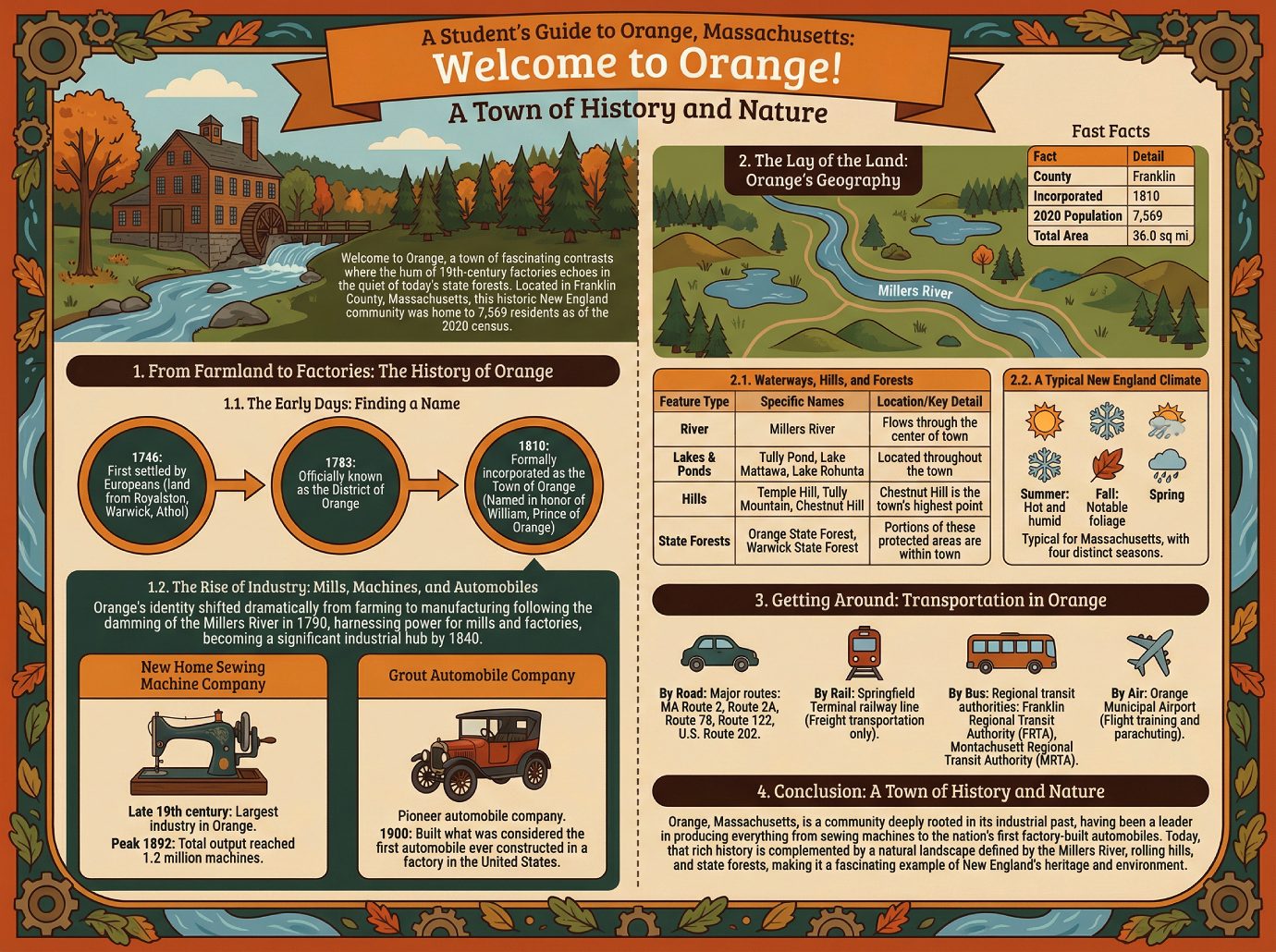
Welcome to Orange, a town of fascinating contrasts where the hum of 19th-century factories echoes in the quiet of today’s state forests. Located in Franklin County, Massachusetts, this historic New England community was home to 7,569 residents as of the 2020 census.
| Fact | Detail |
|---|---|
| County | Franklin |
| Incorporated | 1810 |
| 2020 Population | 7,569 |
| Total Area | 36.0 sq mi |
The town’s story is one of transformation, from quiet farmland to a bustling center of American industry.
1. From Farmland to Factories: The History of Orange
1.1. The Early Days: Finding a Name
Like many New England towns, Orange didn’t appear overnight. Its journey from a small settlement to an official town unfolded over more than 60 years.
1. 1746: The area was first settled by Europeans, with land taken from the surrounding towns of Royalston, Warwick, and Athol.
2. 1783: As the population grew, it became officially known as the District of Orange.
3. 1810: The district was formally incorporated as the Town of Orange.
The town was named in honor of William, Prince of Orange.
1.2. The Rise of Industry: Mills, Machines, and Automobiles
Orange’s identity shifted dramatically from farming to manufacturing following the damming of the Millers River in 1790. This event harnessed the river’s power and paved the way for the growth of mills and factories, turning Orange into a significant industrial hub by 1840.
Two industries in particular came to define the town’s innovative spirit:
• New Home Sewing Machine Company: In the late 19th century, this was the largest industry in Orange. At its peak in 1892, the company’s total output reached 1.2 million machines.
• Grout: This pioneer automobile company cemented Orange’s place in transportation history. In 1900, Grout built what was considered the first automobile ever constructed in a factory in the United States.
While industry shaped the town’s economy, its soul has always been tied to the quintessentially New England landscape that cradles it.
2. The Lay of the Land: Orange’s Geography
2.1. Waterways, Hills, and Forests
Orange’s landscape is defined by its waterways, hills, and forests, all of which are drained by the Millers River. The surrounding area is a diverse mix of rolling hills, dense forests, and clear ponds.
| Feature Type | Specific Names | Location/Key Detail |
|---|---|---|
| River | Millers River | Flows through the center of town |
| Lakes & Ponds | Tully Pond, Lake Mattawa, Lake Rohunta | Located throughout the town |
| Hills | Temple Hill, Tully Mountain, Chestnut Hill | Chestnut Hill is the town’s highest point |
| State Forests | Orange State Forest, Warwick State Forest | Portions of these protected areas are within town |
2.2. A Typical New England Climate
The climate in Orange is typical for Massachusetts, with four distinct seasons. The town experiences hot and humid summers, while its winters are characteristically cold and snowy, with the fall season marked by notable foliage.
This geography not only defines the climate but also shapes the network of routes that connect Orange to the rest of the region.
3. Getting Around: Transportation in Orange
Orange has several transportation options that connect it to neighboring communities by road, rail, bus, and air.
• By Road: Several major routes pass through town, making it accessible by car. These include Massachusetts Route 2, Route 2A, Route 78, Route 122, and U.S. Route 202.
• By Rail: The Springfield Terminal railway line passes through Orange, but it is now used exclusively for freight transportation.
• By Bus: Two regional transit authorities provide local bus service: the Franklin Regional Transit Authority (FRTA) and the Montachusett Regional Transit Authority (MRTA).
• By Air: The town owns and operates the Orange Municipal Airport, a small airstrip that serves as a center for flight training and parachuting.
This network of routes ensures that while Orange is nestled in nature, it remains well-connected to the wider region.
4. Conclusion: A Town of History and Nature
Orange, Massachusetts, is a community deeply rooted in its industrial past, having been a leader in producing everything from sewing machines to the nation’s first factory-built automobiles. Today, that rich history is complemented by a natural landscape defined by the Millers River, rolling hills, and state forests, making it a fascinating example of New England’s heritage and environment.
———–