
Hubbardston MA – Legacy of Industry – History
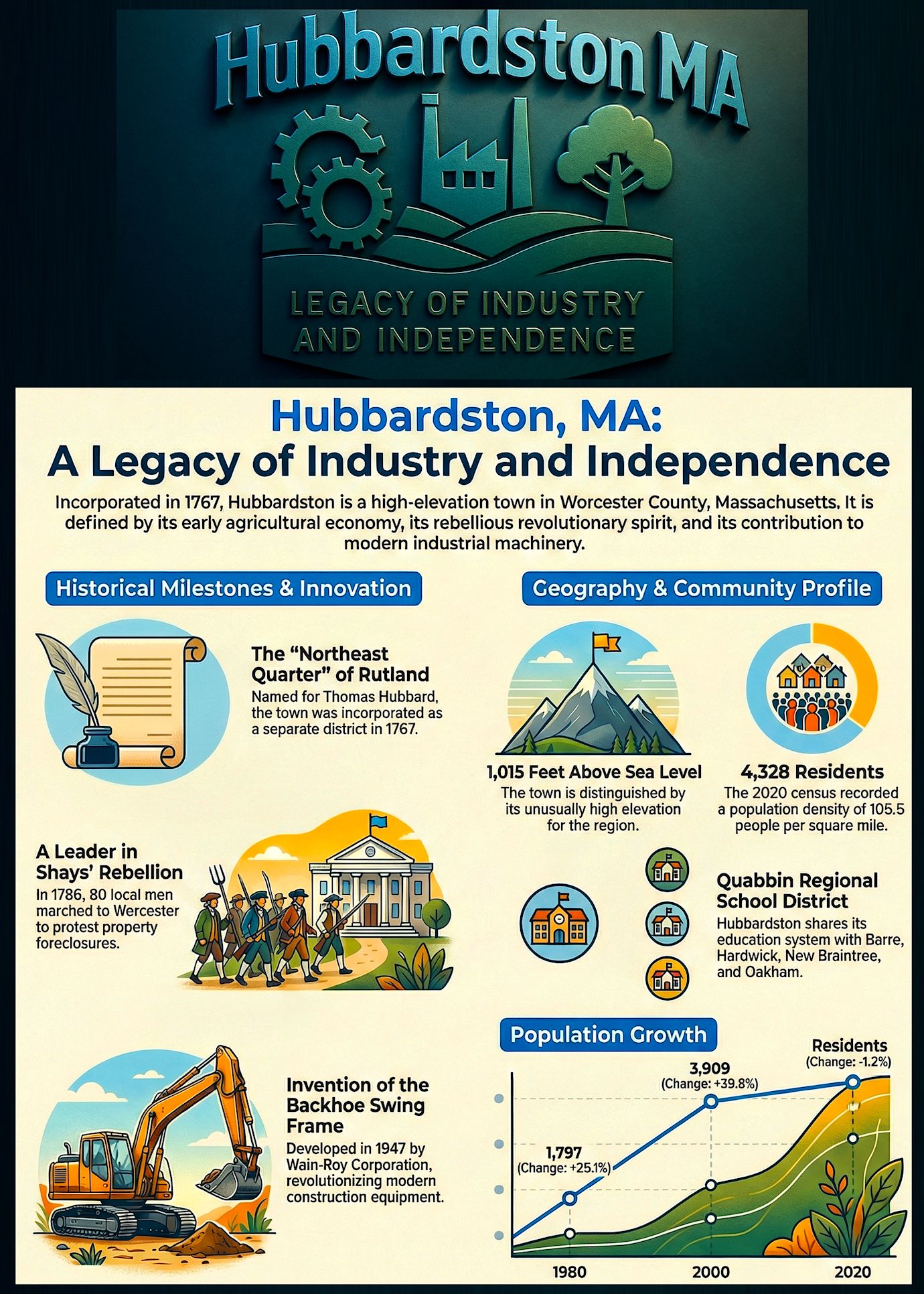
Hubbardston, Massachusetts – a Legacy of Industry and Independence.
Listen to a “Deep Dive” on any device, CLICK PLAY.
The History of Hubbardston MA
Community Profile: Hubbardston MA
A Historical Brief of Hubbardston, Massachusetts – Settlement to the Modern Era
Community Profile: Hubbardston, Massachusetts
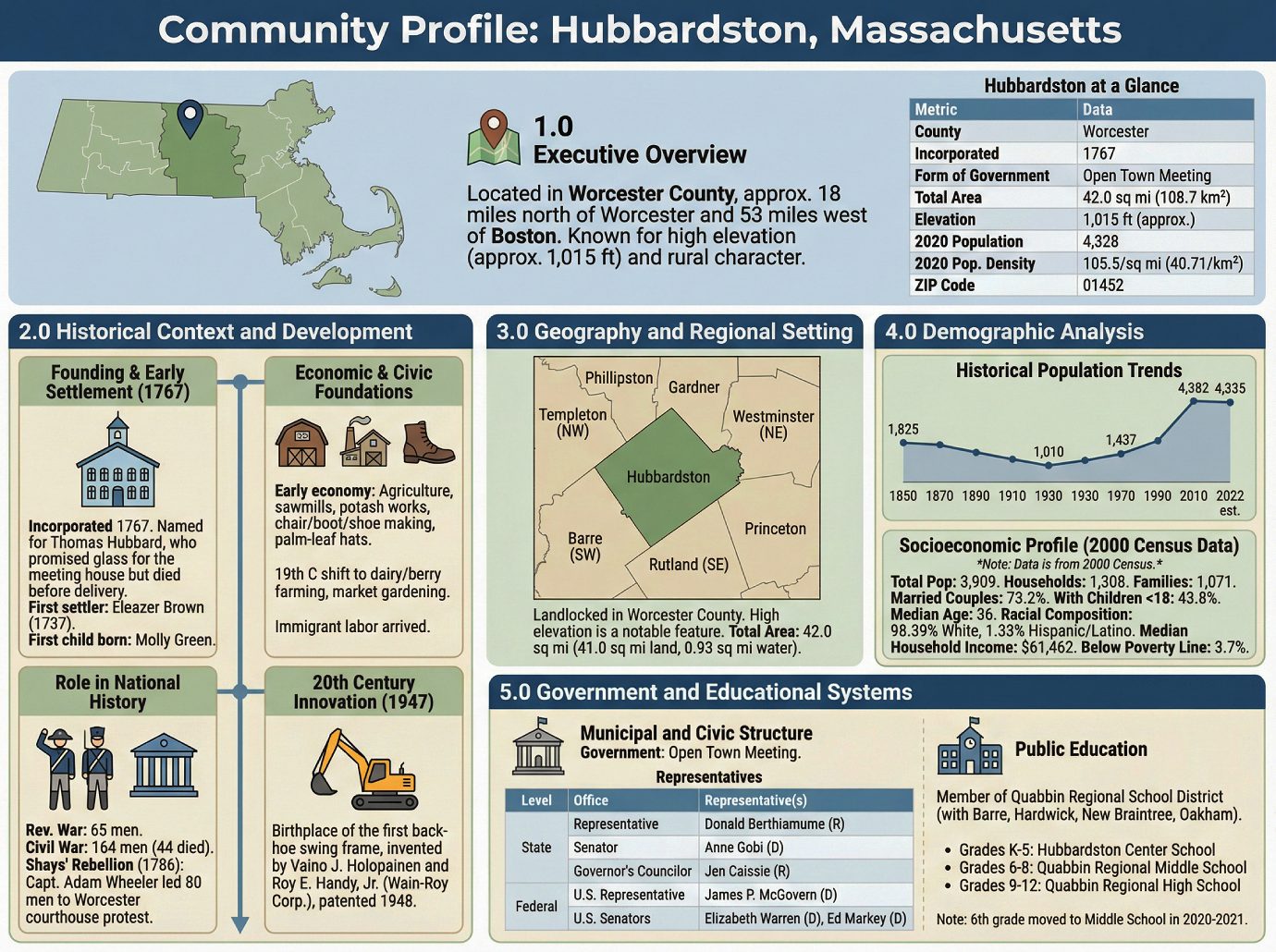
Community Profile: Hubbardston, Massachusetts
1.0 Overview
Hubbardston is a town located in Worcester County, Massachusetts, approximately 18 miles north of Worcester and 53 miles west of Boston. Established in a region characterized by its high elevation, the town center sits at a high altitude, noted as approximately 1,015 feet, distinguishing it within the state (though other sources note an average elevation of 994 feet). With a total area of 42.0 square miles and a 2020 population of 4,328, Hubbardston maintains a rural character defined by its unique history, geography, and community structure.
Hubbardston at a Glance | Metric | Data | | :— | :— | | County | Worcester | | Incorporated | 1767 | | Form of Government | Open Town Meeting | | Total Area | 42.0 sq mi (108.7 km²) | | Elevation | 1,015 ft (approx.) | | 2020 Population | 4,328 | | 2020 Pop. Density | 105.5/sq mi (40.71/km²) | | ZIP Code | 01452 |
——————————————————————————–
2.0 Historical Context and Development
Hubbardston’s present-day character is a direct product of its distinct history, from its origins as a remote 18th-century settlement to its contributions to national events and industrial innovation. This section traces the key milestones that have shaped the town’s identity and development trajectory.
Founding and Early Settlement
Hubbardston was officially incorporated as a separate district in 1767, having previously been known as the “Northeast Quarter” of Rutland. It was named in honor of Thomas Hubbard, the Commissary General of the Province and Treasurer of Harvard College. Local history recounts that in exchange for the honor, Hubbard promised to supply the glass for the town’s first meeting house. The townspeople, anticipating his generosity, designed the building with extra windows. However, Hubbard passed away in 1773 with a complicated estate, and the promised glass never materialized, forcing the town to cover the expense itself.
The area’s first settler was Eleazer Brown, who arrived in 1737 and established a farm and public inn. For nearly a decade, he and his wife were the sole inhabitants. Following his death, Mrs. Brown continued to operate the inn alone for several years until the arrival of Israel Green in 1749. Green would become the first chairman of the board of selectmen, and his daughter, Molly, is recognized as the first child born in the new settlement.
Economic and Civic Foundations
The town’s early economy was almost entirely agricultural, supported by small-scale manufacturing and cottage industries. Sawmills, potash works, and the production of chairs, boots, and shoes provided supplemental income. The making of palm-leaf hats was also a common home-based enterprise. By the 19th century, the economy had shifted toward dairy farming, berry farming, and market gardening. This period saw the arrival of immigrant laborers from Ireland, French Canada, England, Sweden, and Finland, who came to work on local farms.
Role in National History
Hubbardston residents played a role in several key moments in American history. The town contributed 65 men to the Revolutionary War. Decades later, it furnished 164 men for the Civil War, with 44 of them killed or dying from illness during the conflict.
The town also has a direct connection to Shays’ Rebellion, the post-Revolutionary War uprising against property seizures and debt collection. Captain Adam Wheeler of Hubbardston was a prominent leader in the rebellion. In 1786, he led a contingent of eighty men from the town to Worcester, where they joined hundreds of other protesting farmers to take control of the courthouse and halt foreclosure proceedings.
20th Century Innovation
In July 1947, Hubbardston became the birthplace of a significant piece of modern construction equipment. Vaino J. Holopainen and Roy E. Handy, Jr., founders of the Wain-Roy Corporation, invented the first backhoe swing frame. This innovation was patented in 1948 and fundamentally changed excavation technology.
The town’s rich history, from its agricultural beginnings to its role in national events and industry, is deeply connected to the physical landscape that has shaped its settlement and growth.
——————————————————————————–
3.0 Geography and Regional Setting
Hubbardston’s distinct geographical character—defined by its high elevation and rural, landlocked position in north-central Massachusetts—directly shapes its land use patterns, regional connectivity, and development constraints.
Physical Characteristics
According to the U.S. Census Bureau, Hubbardston has a total area of 42.0 square miles (108.7 km²), of which 41.0 square miles (106.3 km²) is land and 0.93 square miles (2.4 km²), or 2.19%, is water. The town’s high elevation is one of its most notable physical features, setting it apart from many other communities in the state.
Location and Adjacency
Hubbardston is a landlocked town in Worcester County, sharing borders with seven other municipalities:
• Northwest: Phillipston and Templeton
• Northeast: Gardner and Westminster
• Southeast: Princeton and Rutland
• Southwest: Barre
This physical geography provides the setting for the population that inhabits the town.
——————————————————————————–
4.0 Demographic Analysis
Demographic data provides a quantitative lens through which to understand Hubbardston’s population dynamics, community needs, and development trajectory. This analysis examines the town’s historical population trends and presents a detailed socioeconomic profile that serves as a baseline for contemporary assessment.
Historical Population Trends
The population of Hubbardston has experienced distinct periods of decline and growth over the past two centuries. An early peak in the mid-19th century was followed by a prolonged decline that lasted until the 1930s. The town then entered a period of steady growth, which accelerated significantly between 1970 and 2010, when the population more than tripled.
| Year | Population | % Change |
|---|---|---|
| 1850 | 1,825 | — |
| 1860 | 1,621 | -11.2% |
| 1870 | 1,654 | +2.0% |
| 1880 | 1,380 | -16.6% |
| 1890 | 1,346 | -2.5% |
| 1900 | 1,227 | -8.8% |
| 1910 | 1,073 | -12.6% |
| 1920 | 1,045 | -2.6% |
| 1930 | 1,010 | -3.3% |
| 1940 | 1,022 | +1.2% |
| 1950 | 1,134 | +11.0% |
| 1960 | 1,217 | +7.3% |
| 1970 | 1,437 | +18.1% |
| 1980 | 1,797 | +25.1% |
| 1990 | 2,797 | +55.6% |
| 2000 | 3,909 | +39.8% |
| 2010 | 4,382 | +12.1% |
| 2020 | 4,328 | -1.2% |
| 2022 est. | 4,335 | +0.2% |
Socioeconomic Profile (2000 Census)
The following detailed breakdown is based on data from the U.S. Census of 2000. It is critical to note that this detailed socioeconomic data is from the 2000 Census and, while historically relevant, does not reflect the town’s current composition. More recent, granular data from the American Community Survey would be necessary for modern analysis.
• Total Population (2000): 3,909 residents.
• Household & Family Structure: 1,308 households and 1,071 families. Of these, 73.2% were married couples living together, and 43.8% had children under 18.
• Age Distribution: Median age of 36 years (31.1% under 18, 4.8% from 18-24, 34.6% from 25-44, 22.6% from 45-64, and 6.9% age 65+).
• Racial Composition: Predominantly White at 98.39%. Hispanic or Latino of any race constituted 1.33% of the population.
• Economic Indicators: Median household income of $61,462 and median family income of $66,058. The per capita income was $23,072, with 3.7% of the population below the poverty line.
This demographic profile provides insight into the population that is served by the town’s civic and educational structures.
——————————————————————————–
5.0 Government and Educational Systems
The town’s governance and educational infrastructure are the foundational systems for public administration and community well-being. Hubbardston employs a traditional New England Open Town Meeting government and partners with neighboring communities in a regional school district to serve its students.
Municipal and Civic Structure
Hubbardston’s local government operates under the Open Town Meeting format, a form of direct democratic rule where registered voters act as the town’s legislature. For state and federal representation, the town falls within the following districts:
| Level | Office | Representative(s) |
|---|---|---|
| State | Representative | Donald Berthiamume (R) |
| State | Senator | Anne Gobi (D) |
| State | Governor’s Councilor | Jen Caissie (R) |
| Federal | U.S. Representative | James P. McGovern (D) |
| Federal | U.S. Senators | Elizabeth Warren (D), Ed Markey (D) |
Public Education
Hubbardston is a member of the Quabbin Regional School District. It shares this district with the neighboring towns of Barre, Hardwick, New Braintree, and Oakham. Students from Hubbardston attend the following schools based on their grade level:
• Grades K-5: Hubbardston Center School
• Grades 6-8: Quabbin Regional Middle School
• Grades 9-12: Quabbin Regional High School
Beginning with the 2020-2021 school year, the 6th grade was moved from the elementary school to the Quabbin Regional Middle School.
A Historical Brief of Hubbardston, Massachusetts – Settlement to the Modern Era
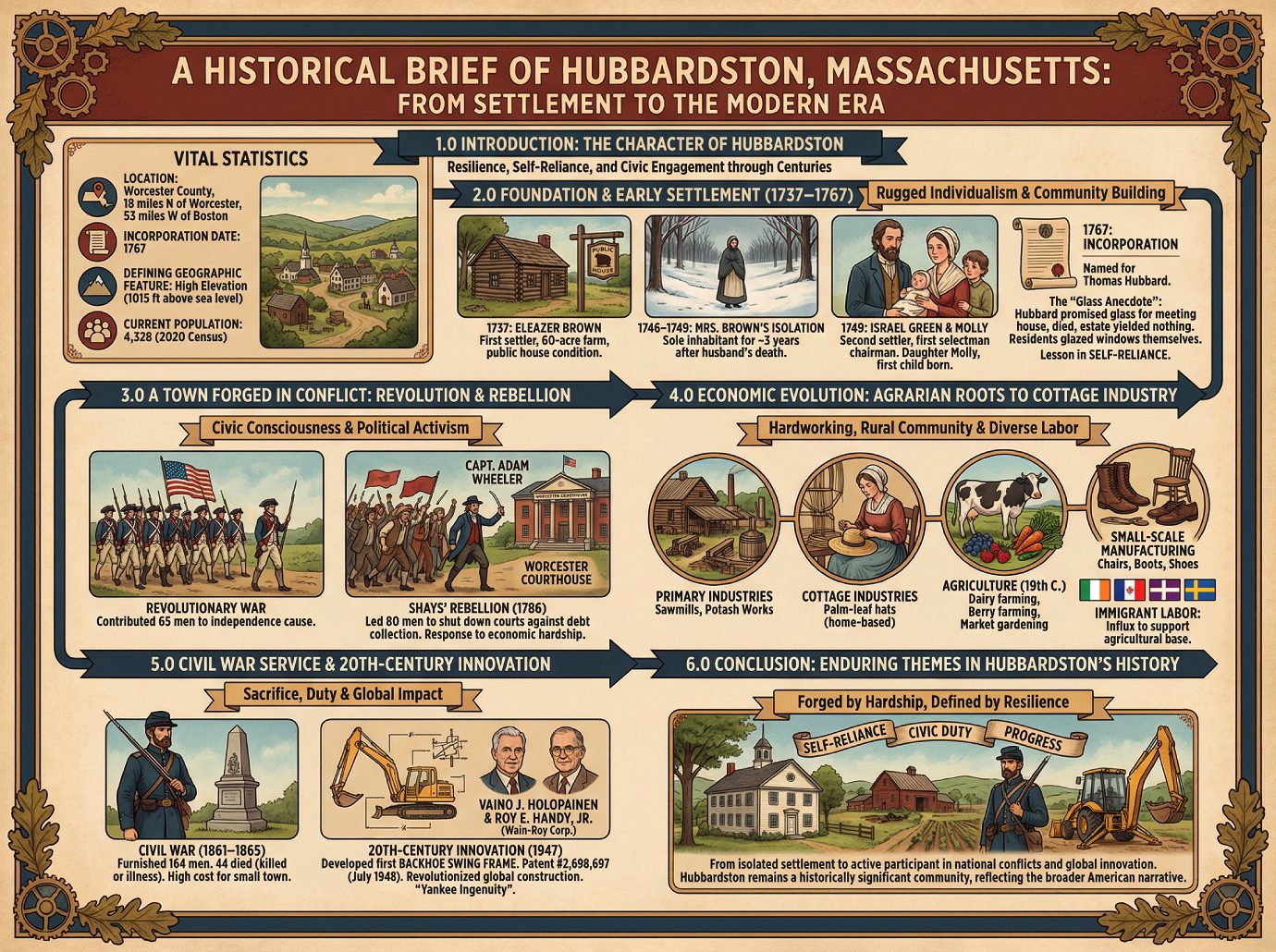
A Historical Brief of Hubbardston, Massachusetts: From Settlement to the Modern Era
1.0 Introduction: The Character of Hubbardston
This brief traces the key milestones that have shaped the town of Hubbardston, Massachusetts. From its origins as a remote and sparsely populated settlement in the Rutland wilderness to its participation in the nation’s founding conflicts and its contribution to 20th-century industrial technology, Hubbardston’s documented trajectory is one of resilience, self-reliance, and civic engagement. To ground this historical analysis, the town’s vital statistics provide a clear contemporary snapshot.
• Location: Hubbardston is located in Worcester County, 18 miles north of Worcester and 53 miles west of Boston.
• Incorporation Date: 1767
• Defining Geographic Feature: The town is distinguished by its unusually high elevation of 1015 feet above sea level.
• Current Population: 4,328 (as of the 2020 U.S. census).
These foundational details set the stage for a deeper exploration of the town’s unique historical journey, beginning with the challenges and triumphs of its earliest settlers.
2.0 Foundation and Early Settlement (1737–1767)
Understanding the circumstances of a town’s founding is essential to appreciating its subsequent development. The initial challenges, the character of its first inhabitants, and the political context of its incorporation established precedents that would influence Hubbardston’s identity for centuries. These formative years were defined by rugged individualism and the gradual establishment of a small but determined community.
The settlement’s story begins when the area was known simply as the “Northeast Quarter” of Rutland. In 1737, the first inhabitant, Eleazer Brown, established a 60-acre farm on the condition that he operate a public house for travelers. Until 1746, Brown and his wife were the only settlers in the territory. After Eleazer’s death, a period of profound isolation began for his widow. For approximately three years, from 1746 until 1749, Mrs. Brown was the single human being occupying the land that would become Hubbardston, a powerful symbol of the fortitude required of the region’s pioneers.
In 1749, Israel Green arrived, becoming the second settler. Green would become a foundational civic leader, serving as the first chairman of the board of selectmen. The birth of his daughter, Molly, marked another milestone as the first child born in the nascent community.
The settlement was formally incorporated as a district in 1767 and named Hubbardston in honor of Thomas Hubbard, the Commissary General of the Province of Massachusetts and Treasurer of Harvard College. An anecdote from this period reveals much about the town’s early character. In exchange for the honor, Hubbard promised to provide the glass for the first meeting house. The townspeople, perhaps ambitiously, planned for extra windows. However, Hubbard died in 1773, and his complicated estate yielded nothing for the town. The residents were forced to glaze the windows at their own expense. For a new town in a cash-poor economy, this slight by its wealthy namesake was a formative lesson, cementing an ethos of self-reliance not as a virtue but as a necessity. From these humble beginnings, the newly established town would soon find itself enmeshed in the major political upheavals of the late 18th century.
3.0 A Town Forged in Conflict: Revolution and Rebellion
The late 18th century was a period of profound political and social turmoil in America, and the identity of New England towns was often shaped by their response to these crises. Despite its small size and remote location, Hubbardston was an active participant in the era’s defining conflicts—the American Revolution and Shays’ Rebellion. This engagement demonstrates a deep-seated civic consciousness and a willingness to defend local interests against perceived injustices, solidifying the town’s political character.
During the Revolutionary War, Hubbardston contributed 65 men to the cause of independence, a significant commitment for a small agricultural community.
The town’s role in Shays’ Rebellion was even more direct and notable. This post-revolutionary uprising was a response to the severe economic depression and aggressive debt collection practices that threatened farmers across Massachusetts. Captain Adam Wheeler, a Hubbardston resident, emerged as a prominent leader of the rebellion. In 1786, Wheeler led a contingent of 80 men from Hubbardston in a march on the Worcester courthouse. Joining with hundreds of other farmers, their objective was to forcibly shut down the courts to prevent the widespread foreclosures and seizures of property that were devastating the agrarian population. This dramatic action highlights the severe economic hardships faced by the town’s residents and their resolve to take matters into their own hands when they felt their livelihoods were at stake. This legacy of political activism was rooted in the town’s underlying economic and social structure.
4.0 Economic Evolution: From Agrarian Roots to Cottage Industry
A town’s economic foundations dictate its growth, social fabric, and demographic patterns. Hubbardston’s 19th-century economy was a direct evolution of its colonial origins, characterized by a persistent reliance on agriculture, supplemented by the growth of local manufacturing and the influence of immigrant labor. This period saw the town solidify its identity as a hardworking, rural community.
Historians describe early Hubbardston as a “poor town,” sparsely settled and almost wholly agricultural. As it developed, its economy diversified, though it remained modest in scale. Key economic activities included:
• Primary Industries: Sawmills and potash works were among the earliest enterprises.
• Cottage Industries: The making of palm-leaf hats emerged as a notable home-based manufacturing pursuit.
• Agriculture: By the 19th century, dairy farming, berry farming, and market gardening were major pursuits.
• Small-Scale Manufacturing: Local workshops produced chairs, boots, and shoes.
This evolving economy attracted new residents. To support its agricultural base, Hubbardston became home to immigrants from Ireland, French Canada, England, Sweden, and Finland, all of whom moved to the area to work on local farms. This influx of diverse nationalities added to the town’s cultural makeup while reinforcing its agrarian character. The town’s economic life, centered on farm and small workshop, provided the backdrop for its continued contributions to major national events.
5.0 Civil War Service and 20th-Century Innovation
Hubbardston’s history in the mid-19th and 20th centuries reflects broader national themes of conflict, sacrifice, and technological progress. The town’s significant contribution to the Civil War underscored its enduring civic duty, while a moment of post-World War II ingenuity demonstrated its capacity for innovation that reshaped civil engineering. These events show a community connected to and influential within the wider American story.
During the Civil War, Hubbardston furnished 164 men for the Union cause. The cost was high, as 44 of these soldiers were either killed in action or died of illness, a substantial loss for a town of its size.
Nearly a century later, Hubbardston became the site of an invention that would have a global impact. In July 1947, Vaino J. Holopainen and Roy E. Handy, Jr., founders of the local Wain-Roy Corporation, developed the first backhoe swing frame. They filed a patent for their invention in July 1948 (Patent # 2,698,697), fundamentally changing construction and excavation technology. This local achievement stands as a prime example of post-war Yankee ingenuity. It demonstrated that a small, rural machine shop could produce an innovation that revolutionized global construction, democratizing the power of heavy machinery and creating a striking contrast between the town’s agrarian roots and its sudden, high-tech contribution. This journey from agrarian rebellion to mechanical innovation was mirrored in the town’s demographic shifts, as generations adapted to new economic realities.
6.0 Conclusion: Enduring Themes in Hubbardston’s History
The historical trajectory of Hubbardston, Massachusetts, is a testament to the enduring character of a New England town forged by hardship, self-reliance, and a strong sense of civic duty. From its origins as an isolated settlement in the Rutland hills, the community distinguished itself through active participation in the nation’s formative conflicts, including the Revolutionary War and Shays’ Rebellion. Its economy, while consistently modest and rooted in agriculture, evolved to include cottage industries and small-scale manufacturing, sustained by generations of hardworking residents and immigrant families. In the 20th century, the town proved its capacity for invention with the backhoe swing frame, a development with lasting global impact. Throughout its history, Hubbardston has remained a small but historically significant community within Worcester County, its story reflecting the broader narrative of American resilience and progress.
Brief Guide to Hubbardston, Massachusetts
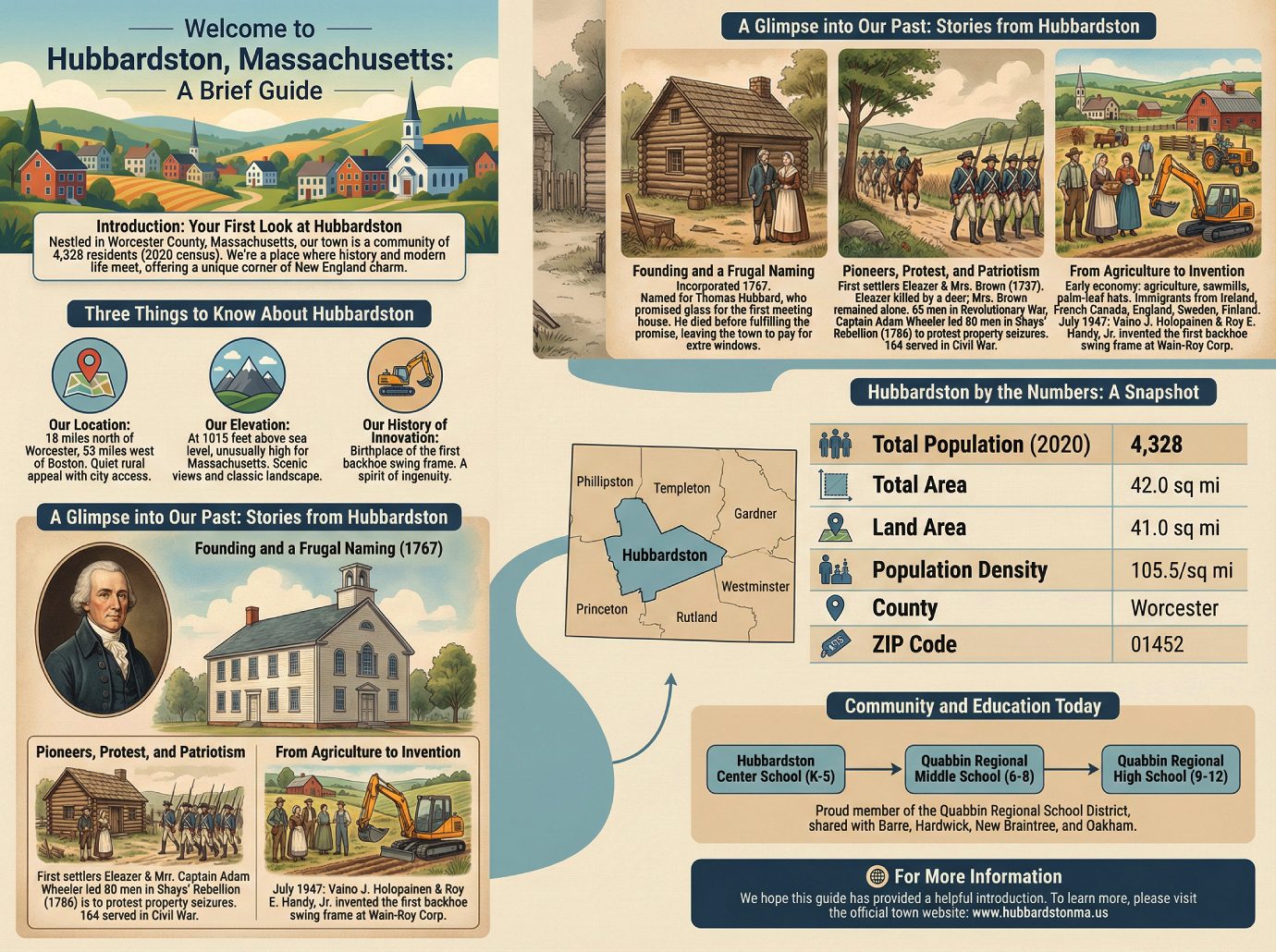
Welcome to Hubbardston, Massachusetts: A Brief Guide
1. Introduction: Your First Look at Hubbardston
Welcome to Hubbardston! Nestled in Worcester County, Massachusetts, our town is a community of 4,328 residents as of the 2020 census. We’re a place where history and modern life meet, offering a unique corner of New England charm. To help you get acquainted, here are a few key things that define our town.
Three Things to Know About Hubbardston
• Our Location: Hubbardston is situated 18 miles north of Worcester and 53 miles west of Boston. This prime location offers the quiet appeal of rural life with convenient access to the amenities and opportunities of major cities.
• Our Elevation: At 1015 feet above sea level, our town is unusually high for Massachusetts. This distinctive elevation contributes to our scenic views and classic New England landscape.
• Our History of Innovation: Hubbardston is the birthplace of the first backhoe swing frame, an invention that revolutionized construction. This unique piece of our modern history highlights a spirit of ingenuity.
These facts offer a glimpse into our town, but to truly understand Hubbardston, it’s worth exploring the stories from our rich past.
2. A Glimpse into Our Past: Stories from Hubbardston
Our town’s history is a fascinating journey through early settlement, principled protest, and industrial creativity.
2.1. Founding and a Frugal Naming
Hubbardston was officially incorporated as a district in 1767. It was named in honor of Thomas Hubbard, the Commissary General of the Province and Treasurer of Harvard College. According to local lore, Mr. Hubbard promised to provide the glass for the windows of our first meeting house. In anticipation of his generosity, the townspeople planned for extra windows. However, when Hubbard passed away in 1773, his estate was too complicated to fulfill the promise, and the town of Hubbardston was obliged to pay for the windows itself.
2.2. Pioneers, Protest, and Patriotism
The story of Hubbardston begins with our first settlers, Eleazer Brown and his wife, who arrived in 1737 to operate an inn. For a time, they were the only inhabitants of the area. After Eleazer was reportedly killed by a deer—a memorable piece of local lore—Mrs. Brown remained the town’s sole occupant for several more years, continuing to keep the public house for travelers.
This spirit of resilience carried into the nation’s founding, with Hubbardston providing 65 men for the Revolutionary War. A decade later, the town played another notable role in American history during Shays’ Rebellion. In 1786, Captain Adam Wheeler of Hubbardston led 80 local men on a march to Worcester. There, they joined hundreds of other farmers to take control of the courthouse, protesting the widespread seizure of property from indebted farmers. The town’s commitment to service continued through the Civil War, during which 164 men served and 44 lost their lives.
2.3. From Agriculture to Invention
The town’s early economy was built on agriculture and small-scale manufacturing. It was a community of sawmills, potash works, and cottage industries like the making of palm-leaf hats. As our farming community grew in the 19th century, we welcomed immigrants from Ireland, French Canada, England, Sweden, and Finland who moved here to work on local farms, adding to the rich fabric of our town. This agricultural foundation contrasts sharply with a major 20th-century achievement: the invention of the first backhoe swing frame. This pivotal piece of construction technology was developed right here in July 1947 by Vaino J. Holopainen and Roy E. Handy, Jr. of the local Wain-Roy Corporation.
From these historical roots, Hubbardston has grown into the community we see today, as reflected in its current facts and figures.
3. Hubbardston by the Numbers: A Snapshot
Here is a quick look at the key statistics that define our town.
| Fact | Figure |
|---|---|
| Total Population (2020) | 4,328 |
| Total Area | 42.0 sq mi |
| Land Area | 41.0 sq mi |
| Population Density | 105.5/sq mi |
| County | Worcester |
| ZIP Code | 01452 |
Hubbardston is bounded by the neighboring towns of Phillipston, Templeton, Gardner, Westminster, Princeton, Rutland, and Barre.
These numbers provide a framework for our town’s size, and our educational system is the foundation for its future.
4. Community and Education Today
Hubbardston is a proud member of the Quabbin Regional School District, which we share with the neighboring towns of Barre, Hardwick, New Braintree, and Oakham. Our students begin their educational journey at the Hubbardston Center School for grades K-5. They then advance to Quabbin Regional Middle School for grades 6-8 and complete their secondary education at Quabbin Regional High School for grades 9-12.
5. For More Information
We hope this guide has provided a helpful introduction to our town. To learn more, please visit the official town website.
• Official Town Website: www.hubbardstonma.us
5 Wildly Unexpected Facts About the Tiny Town Of Hubbardston
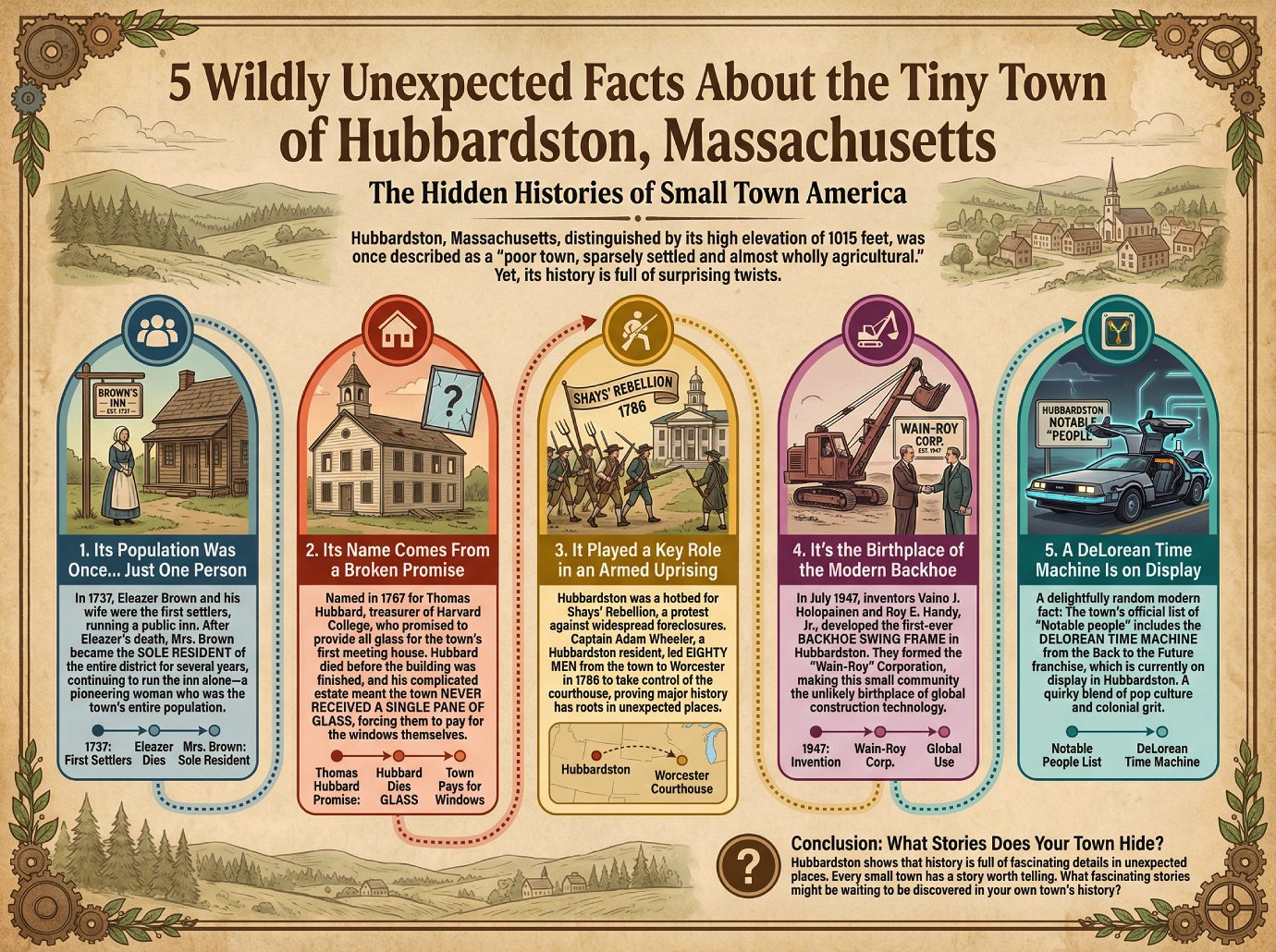
5 Wildly Unexpected Facts About the Tiny Town of Hubbardston, Massachusetts
The Hidden Histories of Small Town America
It’s easy to assume that the smallest, most unassuming towns are just quiet places to pass through. But tucked away in their archives and local lore are often incredible stories you’d never expect. Hubbardston, Massachusetts, a town distinguished by its unusually high elevation of 1015 feet, is a perfect example. Described in its early days as a “poor town, sparsely settled and almost wholly agricultural,” with little more than sawmills and cottage industries, it seems an unlikely place for history-making events—which is exactly what makes its story so fascinating.
——————————————————————————–
1. Its Population Was Once… Just One Person
The story of Hubbardston’s settlement is a testament to incredible resilience. In 1737, its first settler, Eleazer Brown, was given 60 acres on the condition that he operate a public inn for travelers. For nearly a decade, he and his wife were the only inhabitants. After Eleazer was reportedly killed by a deer, Mrs. Brown became the sole resident of the entire district. Incredibly, she remained for several years, honoring the original agreement by continuing to run the public house all by herself—a pioneering woman who, for a time, was the entire population of Hubbardston.
2. Its Name Comes From a Broken Promise
When the town was finally incorporated in 1767, it was named in honor of Thomas Hubbard, a prominent provincial figure and treasurer of Harvard College. In return for the honor, Hubbard made a grand promise: he would provide all the glass for the town’s first meeting house. Eager to make the most of this generosity, the townspeople planned for an abundance of extra windows. But in an ironic twist of fate, Hubbard died before the building was finished, and his estate was so complicated that the town never received a single pane of glass, forcing them to pay for the windows themselves.
3. It Played a Key Role in an Armed Uprising
This small agricultural community was a hotbed for one of early America’s most famous uprisings: Shays’ Rebellion. The rebellion was a protest against the widespread foreclosures and seizures of property by creditors that plagued the cash-poor 18th century, and Hubbardston’s farmers felt the sting. One of the rebellion’s key leaders, Captain Adam Wheeler, was a Hubbardston resident. In 1786, he led a company of eighty men from the town to Worcester where they joined hundreds of others to take control of the courthouse, proving that major national history can have its roots in the most unexpected of places.
4. It’s the Birthplace of the Modern Backhoe
Jumping forward more than 150 years, Hubbardston’s next surprise wasn’t one of rebellion, but of invention. By the 19th century, the town’s economy had evolved to include dairy and berry farming, attracting immigrants from across Europe. Yet it was here, amidst this rural backdrop, that a major 20th-century industrial innovation was born. In July 1947, inventors Vaino J. Holopainen (pronounced “Waino”) and Roy E. Handy, Jr., developed the first-ever backhoe swing frame. They formed the “Wain-Roy” Corporation right there in town, making this small community the unlikely birthplace of a piece of construction technology used all over the world today.
5. A DeLorean Time Machine Is on Display
Perhaps the most delightfully random fact about Hubbardston is a modern one. Tucked into its official list of “Notable people” is a non-person: the DeLorean Time Machine. According to the town’s records, the iconic vehicle from the Back to the Future film franchise is currently on display in Hubbardston. It’s the perfect, quirky capstone to a town history full of surprises, blending pop culture with colonial grit.
——————————————————————————–
Conclusion: What Stories Does Your Town Hide?
From broken promises and armed rebellions to modern inventions and movie props, Hubbardston shows that history is full of fascinating details in the places you’d least expect them. It’s a powerful reminder that every small town has a story worth telling. What fascinating stories might be waiting to be discovered in your own town’s history?