



Publisher’s Note: We have elevated this to a front-page story rather than just having it appear on the Athol page because it is a case study which could very well be replicated in the region as other decisions are made.
Athol’s Recent Election and Ramifications
Recent election results in Athol show that residents overwhelmingly rejected two tax override proposals that were intended to fund municipal staff and infrastructure. In addition to these fiscal decisions, voters selected Russell Raymond and Alex Blake, Jr. to fill vacancies on the local Select Board. The regional elections also saw Mitch Grosky secure a position on the school committee.
The Cost of “No”: 4 Surprising Takeaways from Athol’s Recent Election
Introduction: The Small-Town Budget Paradox
Municipalities across the country struggle with a persistent paradox: residents expect high-functioning infrastructure and robust public safety, yet remain deeply resistant to the tax increases required to maintain them. In Athol, this tension recently transitioned from abstract debate to a hard fiscal reality at the ballot box. By deciding the town’s financial future through a direct vote, residents have forced a pivot from growth to contraction. The results offer a stark look at the trade-offs modern towns face when the “cost of no” is finally tallied.
Takeaway 1: The Resounding Rejection of Growth
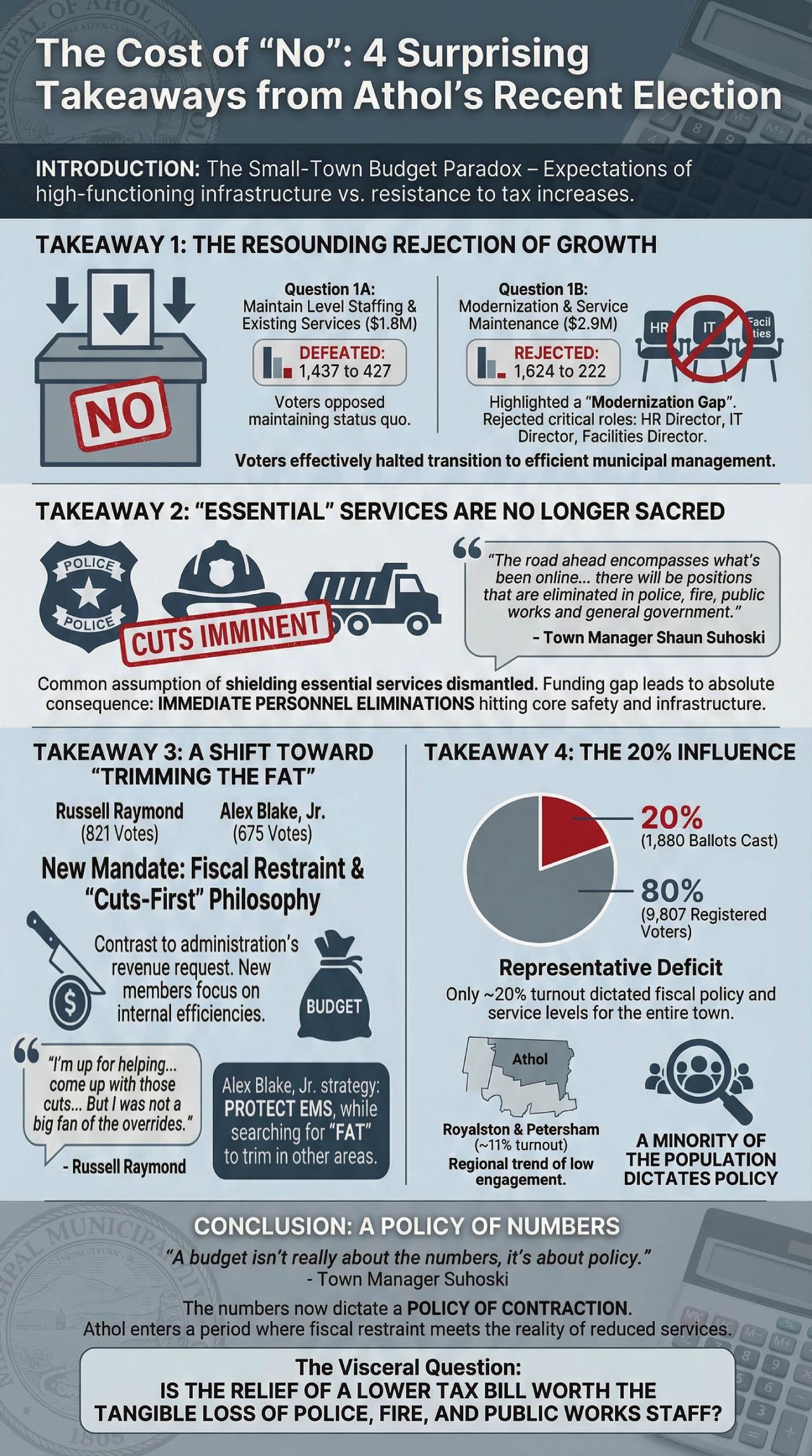
The most immediate takeaway from the election is the decisive defeat of two Proposition 2 ½ override questions. The margins suggest that voters were not merely skeptical, but fundamentally opposed to the proposed expansions of the municipal tax levy.
Question 1A: Requested $1.8 million to maintain level municipal staffing and existing services. Defeated 1,437 to 427.
Question 1B: Requested $2.9 million for modernization and service maintenance. Rejected 1,624 to 222.
While Question 1A was aimed at maintaining the status quo, the failure of Question 1B highlights a significant “modernization gap.” This measure would have funded critical, professionalized roles: a Human Resources Director, an IT Director, and a Director of Facilities. By rejecting these positions, the electorate has effectively halted the town administration’s efforts to transition toward a more efficient, modern municipal management structure, signaling a preference for leaner, traditional operations over administrative modernization.
Takeaway 2: “Essential” Services are No Longer Sacred
The common assumption that police, fire, and public works are shielded from budget cuts was dismantled by the election results. Town Manager Shaun Suhoski has clarified that the consequence of the funding gap is absolute. Without the override revenue, the town must move immediately into a phase of personnel eliminations that hit the very core of community safety and infrastructure.
The specific departments facing imminent reductions include: Police, Fire, Public Works, and General Government
The administration’s stance reflects a shift from “requesting” to “executing,” as the funding shortfall leaves no room for administrative maneuvering. As Shaun Suhoski stated: “The road ahead encompasses what’s been online and shared publicly for the last eight weeks, in that there will be positions that are eliminated in police, fire, public works and general government.”
Takeaway 3: A Shift Toward “Trimming the Fat”
The election did more than settle the override questions; it established a new Selectboard mandate centered on fiscal restraint. In a crowded five-way race for two seats, Russell Raymond (821 votes) and Alex Blake, Jr. (675 votes) emerged victorious. Both candidates campaigned on a “cuts-first” philosophy that stands in sharp contrast to the town administration’s request for more revenue.
While the Town Manager and his team have already begun the sobering task of structuring the FY27 budget plan to accommodate these defeats, the new Selectboard members are focused on identifying internal efficiencies. Alex Blake, Jr. has indicated a strategy specifically aimed at protecting Emergency Medical Services (EMS) while searching for “fat” to trim in other areas of the budget.
Russell Raymond acknowledged the gravity of the upcoming fiscal year while remaining firm on the voters’ mandate: “I knew this was going to be a tough part of this job if elected… But I’m up for helping Shaun and the rest of the Selectboard come up with those cuts and present a budget that will help us be successful and help out the town. But I was not a big fan of the overrides.”
Takeaway 4: The 20% Influence
From a policy perspective, the election highlights a significant “representative deficit.” While the outcome will fundamentally alter daily life in Athol—affecting everything from emergency response times to road maintenance—only a small fraction of the community participated in the decision.
Out of 9,807 registered voters in Athol, only 1,880 cast ballots. This roughly 20% turnout means a minority of the population has dictated the fiscal policy and service levels for the entire town. This participation crisis was even more evident in the neighboring towns of Royalston and Petersham, where turnout hovered near 11%. This regional trend suggests a disconnect in civic engagement; even when “essential” services are on the chopping block, the vast majority of the electorate remains absent, leaving the town’s fiscal trajectory in the hands of a highly motivated few.
Conclusion: A Policy of Numbers
As Town Manager Suhoski noted, “A budget isn’t really about the numbers, it’s about policy.” The numbers in Athol now dictate a policy of contraction. As the town moves forward with an FY27 budget designed to do “the least harm” while absorbing significant cuts, it serves as a critical case study for other municipalities approaching their own fiscal cliffs.
Athol is entering a period where the theory of fiscal restraint meets the reality of reduced services. It leaves residents with a visceral question to ponder: Is the relief of a lower tax bill worth the tangible loss of the police officers, firefighters, and public works staff who sustain the community’s safety and infrastructure?