
Earth Day 2026 – Gardner Magazine Reports
Jump to a report, CLICK a LINK: Earth Day: Origins, Global Evolution, and Environmental Impact —- The $2,000 Gamble That Saved the World: 7 Surprising Truths About the Birth of Earth Day —- Our Planet, Our Power: A Guide to Protecting the Earth —The Story of Earth Day: From a Campus Idea to a Global Movement —- Strategic Communications Plan: Scaling Environmental Stewardship Through Thematic Mobilization — The Evolution of United States Environmental Policy: From Resource Utilization to Regulatory Oversight
Listen to a “Deep Dive” podcast on any device providing an in-depth analysis.
Listen to a “Debate” podcast on any device with a critical discussion about Earth Day.
View a short Earth Day video:
Earth Day: Origins, Global Evolution, and Environmental Impact
Earth Day: Origins, Global Evolution, and Environmental Impact
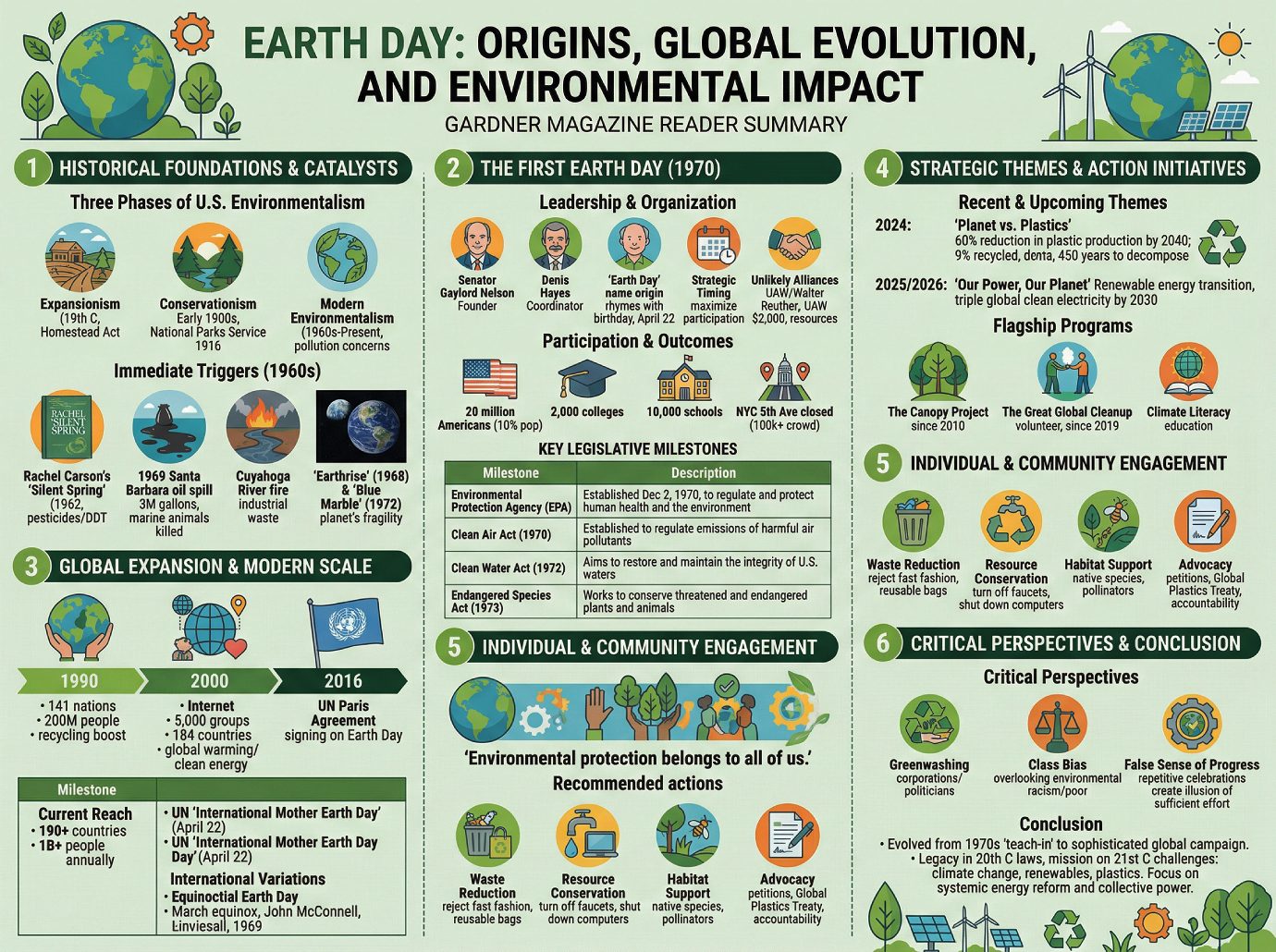
Earth Day, observed annually on April 22, is the world’s largest secular civic event, engaging over one billion people across more than 190 countries. Founded in 1970 by U.S. Senator Gaylord Nelson and organized by activist Denis Hayes, the movement emerged as a “national teach-in” to address catastrophic pollution and resource depletion. The first celebration mobilized 20 million Americans—10% of the U.S. population at the time—and directly precipitated the creation of the Environmental Protection Agency (EPA) and the passage of landmark legislation including the Clean Air, Clean Water, and Endangered Species Acts.
The movement underwent a significant transformation in 1990, expanding into an international campaign that paved the way for the 1992 United Nations Earth Summit. Today, Earth Day serves as a critical platform for global climate policy, notably hosting the signing of the Paris Agreement in 2016. Modern observances focus on systemic challenges such as plastic pollution (2024 theme: “Planet vs. Plastics”) and the transition to renewable energy (2025/2026 theme: “Our Power, Our Planet”). Despite its successes in raising awareness and fostering stewardship, the movement faces ongoing criticism regarding “greenwashing” by corporate interests and the need for more aggressive action to halt accelerating environmental degradation.
Historical Foundations and Catalysts
The Three Phases of U.S. Environmentalism
The establishment of Earth Day is viewed as the culmination of three distinct phases in American environmental policy:
- Expansionism (19th Century): Policies like the Homestead Act (1862) encouraged resource utilization and westward cultivation.
- Conservationism (Early 1900s): Rising concerns over resource depletion led to the creation of the National Parks Service in 1916.
- Modern Environmentalism (1960s-Present): Public health concerns regarding unchecked pollution and toxic waste drove a demand for regulatory oversight.
Immediate Triggers
Several key events in the 1960s acted as a “call to arms” for the public:
- Literature: Rachel Carson’s 1962 bestseller Silent Spring alerted the nation to the disastrous effects of pesticides (specifically DDT) on biodiversity.
- Industrial Disasters: The 1969 Santa Barbara oil spill, which leaked over 3 million gallons and killed thousands of marine animals, and the Cuyahoga River fire in Cleveland, highlighted the lack of legal consequences for industrial waste.
- Visual Impact: The 1968 “Earthrise” and 1972 “Blue Marble” photographs from space provided a new perspective on the planet’s fragility.
The First Earth Day (1970)
Leadership and Organization
Senator Gaylord Nelson (D-WI) envisioned a large-scale grassroots demonstration to force environmental issues onto the national agenda. He recruited Denis Hayes, a Harvard student activist, to serve as national coordinator.
- The Name: Advertising executive Julian Koenig coined the name “Earth Day” because it rhymed with “birthday” (which fell on April 22).
- Strategic Timing: April 22 was chosen to maximize student participation, falling on a weekday between spring break and final exams.
- Unlikely Alliances: The United Auto Workers (UAW), led by Walter Reuther, was the most instrumental financial and operational supporter, providing $2,000 (roughly $15,500 today) and the resources to mail literature and coordinate demonstrations.
Participation and Immediate Outcomes
The 1970 event saw 20 million Americans take to the streets, including demonstrations at 2,000 colleges, 10,000 primary/secondary schools, and hundreds of communities. In New York City, Mayor John Lindsay closed Fifth Avenue to traffic, attracting a crowd of over 100,000.
| Key Legislative Milestone | Description |
|---|---|
| Environmental Protection Agency (EPA) | Established Dec 2, 1970, to regulate and protect human health and the environment. |
| Clean Air Act (1970) | Established to regulate emissions of harmful air pollutants. |
| Clean Water Act (1972) | Aims to restore and maintain the integrity of U.S. waters. |
| Endangered Species Act (1973) | Works to conserve threatened and endangered plants and animals. |
Global Expansion and Modern Scale
While initially a U.S.-centric event, Earth Day became a global phenomenon through key milestones:
- 1990: Denis Hayes organized events in 141 nations, involving 200 million people and boosting global recycling efforts.
- 2000: The movement leveraged the burgeoning internet to coordinate 5,000 environmental groups in 184 countries, focusing on global warming and clean energy.
- 2016: The United Nations symbolically chose Earth Day for the signing of the Paris Agreement, the most significant international climate accord in history.
- Current Reach: Earth Day is now observed in over 190 countries, with participation estimated at 1 billion people annually.
International Variations
- United Nations: Officially designates April 22 as “International Mother Earth Day.”
- Equinoctial Earth Day: A separate observance, sanctioned by the UN, occurs on the March equinox to mark astronomical spring. This version was originally proposed by peace activist John McConnell in 1969.
Strategic Themes and Action Initiatives
Earth Day organizers assign annual themes to focus global activism on specific priorities.
Recent and Upcoming Themes
- 2024: “Planet vs. Plastics” – A call for a 60% reduction in plastic production by 2040. Data shows that only 9% of plastic discarded daily is recycled, while a plastic bottle can take 450 years to decompose.
- 2025/2026: “Our Power, Our Planet” – Focuses on the transition to renewable energy and the goal of tripling global clean electricity generation by 2030.
Flagship Programs
- The Canopy Project: Since 2010, this initiative has planted tens of millions of trees worldwide to combat deforestation (which claims approximately 18 million acres of forest annually).
- The Great Global Cleanup: A worldwide volunteer program launched in 2019 that coordinates cleanups of beaches, rivers, and parks.
- Climate Literacy: A movement to ensure students worldwide receive a high-quality environmental education to foster future stewardship.
Individual and Community Engagement
The movement emphasizes that “environmental protection belongs to all of us.” Recommended actions for participants include:
- Waste Reduction: Rejecting “fast fashion,” using reusable bags (one bag can prevent the use of 600 plastic bags), and repurposing cardboard and plastic items.
- Resource Conservation: Turning off faucets while brushing teeth (saves 8 gallons of water/day) and shutting down computers when not in use (cuts energy consumption by 85%).
- Habitat Support: Planting native species to attract pollinators like bees and hummingbirds.
- Advocacy: Signing petitions, such as the Global Plastics Treaty, and holding elected officials accountable for green initiatives.
Critical Perspectives
Despite its massive scale, Earth Day faces various criticisms:
- Greenwashing: Critics and activists, including Greta Thunberg, argue that the day is used cynically by corporations and politicians to promote environmental credentials without making substantive policy changes.
- Class Bias: Some claim the movement has historically focused on middle-class conservation politics while overlooking “environmental racism” and the needs of the poor who are disproportionately affected by pollution.
- False Sense of Progress: Observers like Yvo de Boer (former UN climate chief) warn that repetitive celebrations can create an illusion that current efforts are sufficient to prevent future environmental disaster, despite rapidly worsening indicators.
Conclusion
Earth Day has evolved from a 1970s “teach-in” into a sophisticated global campaign that serves as a yearly accountability check for environmental health. While its legacy is cemented in the foundational environmental laws of the 20th century, its current mission is increasingly centered on the urgent challenges of the 21st century: climate change, renewable energy transition, and the elimination of plastic waste. As the 2025/2026 theme “Our Power, Our Planet” suggests, the movement’s focus has shifted toward systemic energy reform and the collective power of an informed global citizenry.
——————–
The $2,000 Gamble That Saved the World: 7 Surprising Truths About the Birth of Earth Day
The $2,000 Gamble That Saved the World: 7 Surprising Truths About the Birth of Earth Day
We’ve all been there: slumped on the couch, illuminated by the cold blue light of a smartphone, “doom-scrolling” through an endless feed of melting glaciers, plastic-choked oceans, and record-breaking heatwaves. It’s easy to feel like the environmental movement is a losing battle fought with hashtags and hope. But as an environmental historian, I want to take you back to a moment when the movement wasn’t about “awareness”—it was about a calculated, high-stakes political explosion that rattled the highest halls of power.
Earth Day wasn’t born from a peaceful circle of flower children. It was a strategic, “open-source” revolution designed as a massive “teach-in” to shake the establishment. It was gritty, it was angry, and it was brilliantly marketed. To understand where we are going in 2025 and 2026, we have to look back at the mechanics of this unlikely victory. Here are the seven most surprising takeaways from the birth of the world’s largest secular movement.
1. The Day the River Caught Fire: A 3rd Phase Revolution
To understand 1970, you have to understand the two phases of environmentalism that came before it. In Phase 1, the young United States focused on utilization—passing laws like the Homestead Act of 1862 to encourage citizens to “tame” the wilderness. Phase 2 shifted to conservation in the early 1900s, giving us the National Park Service to protect what was left.
But by the late 1960s, a “Third Phase” emerged from a place of visceral fear. Industrialization had turned the American dream into a smog-filled nightmare. Factories were legally allowed to treat the sky and sea as private sewers. As the EPA later reflected:
“It may be hard to imagine that before 1970, a factory could spew black clouds of toxic smoke into the air or dump tons of toxic waste into a nearby stream, and that was perfectly legal. They could not be taken to court to stop it.”
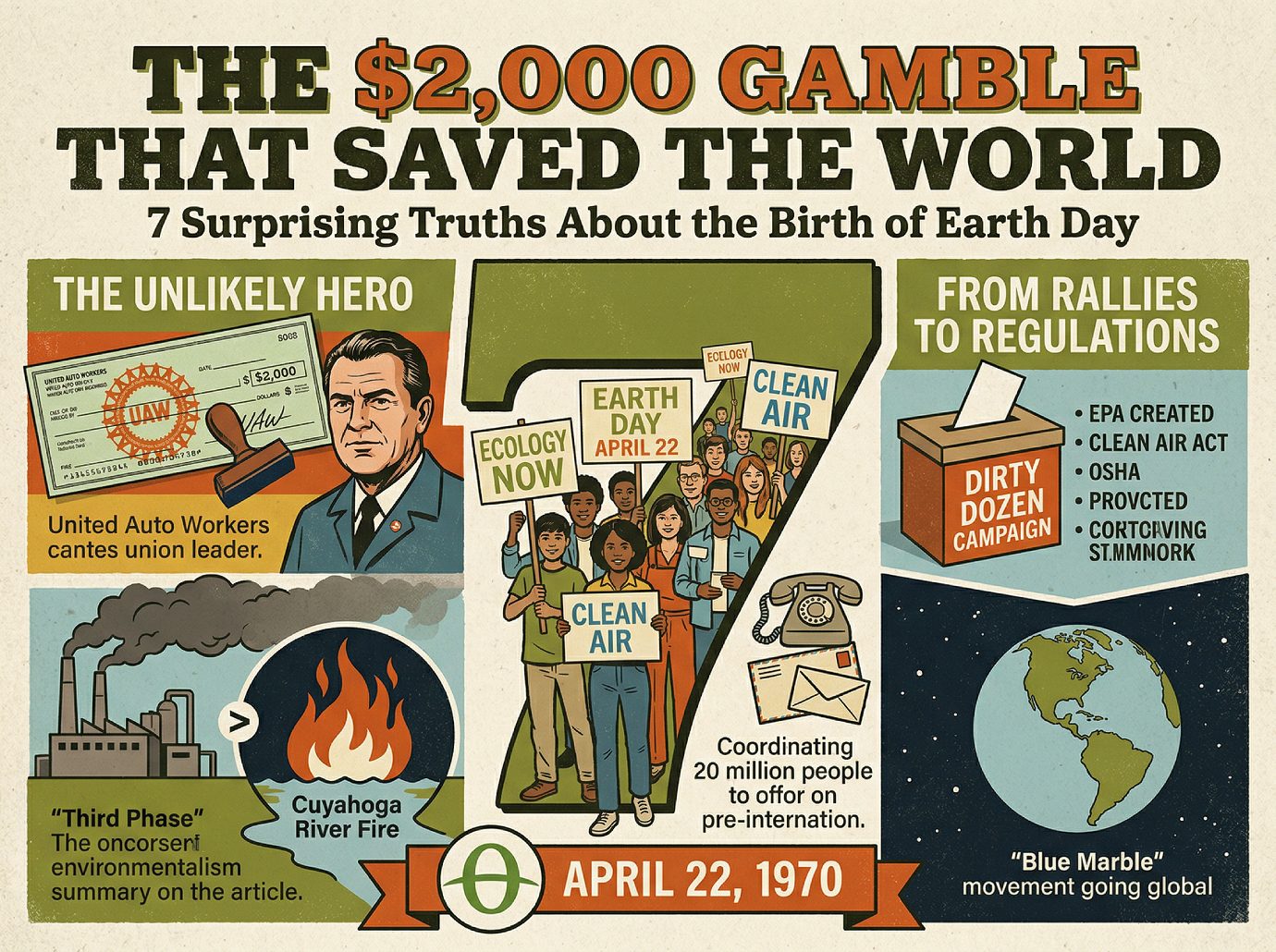
The “call to arms” came in two waves: Rachel Carson’s 1962 masterpiece Silent Spring, which exposed the lethal reality of pesticides, and the 1969 Cuyahoga River fire, where the water in Cleveland literally ignited from chemical waste. Suddenly, the smoke billowing from factory stacks was no longer seen as a sign of prosperity and a steady paycheck; it was recognized as a sign of danger.
2. Madison Avenue Magic: Why We Don’t Call it “E-Day”
Senator Gaylord Nelson, the movement’s founder, initially called his idea a “National Environmental Teach-In.” Unsurprisingly, the academic title failed to spark a fire. Enter Julian Koenig, a titan of the “Madison Avenue” advertising era and the genius behind the legendary “Think Small” Volkswagen campaign.
Koenig volunteered his expertise and pitched several names: “Ecology Day,” “Environment Day,” and “E-Day.” He pushed for “Earth Day” for a reason that was both visually arresting and endearingly selfish: it rhymed with “birthday,” and April 22nd happened to be his own birthday. Koenig created a series of ads that included a small coupon soliciting funds, effectively turning the movement into a modern crowdfunding campaign before the internet existed.
The real stroke of genius, however, came from national coordinator Denis Hayes. He made the calculated decision not to trademark the name. By leaving “Earth Day” as an open-source brand, he allowed every local community to own it, transforming a central office’s idea into a universal, grassroots identity.
3. The Power of 10%: A Pre-Digital Logistical Miracle
In 1970, there were no viral tweets, no TikTok mobilizations, and no email lists. Yet, Earth Day achieved a scale of participation that remains staggering: 20 million Americans—10% of the U.S. population at the time—took to the streets.
Coordinating 10,000 primary and secondary schools and 2,000 colleges was a feat of raw human labor. A lean staff of roughly 85 people and thousands of volunteers relied on landlines and physical mailers to reach every corner of the country. This massive domestic turnout was the leverage needed to take the movement global in 1990; today, that engagement has swelled to 1 billion people in nearly 200 countries.
4. The Unlikely Hero: A $2,000 Gamble by Organized Labor
The history books often paint Earth Day as a student-led uprising, but the movement had a secret weapon: the United Auto Workers (UAW). While campus activists provided the energy, the UAW and its president, Walter Reuther, provided the backbone.
The UAW’s contribution was the definition of “putting your money where your mouth is”:
- A $2,000 donation in 1970 (equivalent to over $15,500 today).
- The use of UAW telephone capabilities for national coordination—a resource more valuable than cash in a pre-digital era.
- The printing and mailing of almost all the movement’s literature.
As Denis Hayes famously put it: “Without the UAW, the first Earth Day would have likely flopped!” Reuther’s presence at the first press conference gave the “hippy” movement instant, working-class credibility.
5. The “Communist Trick” and J. Edgar Hoover’s Intrigue
Choosing a date is never just about the weather. Organizers selected April 22nd because it was the “sweet spot” in the academic calendar—wedged perfectly between Spring Break and final exams to maximize student presence.
However, this date happened to coincide with the 100th anniversary of Vladimir Lenin’s birth. This sent groups like the Daughters of the American Revolution into a frenzy, claiming Earth Day was a “Communist trick” designed to subvert American children. Even FBI Director J. Edgar Hoover found the connection “intriguing,” and his bureau conducted surveillance on the 1970 demonstrations. In reality, the “revolution” was far more interested in the spring semester schedule than Soviet history.
6. From Rallies to Regulations: The “Dirty Dozen” Campaign
Earth Day didn’t just result in pretty posters; it developed political “teeth” almost immediately. After the 1970 rallies, the original non-profit staff resigned to form a more aggressive activist group called Environmental Action.
They launched the “Dirty Dozen” campaign, specifically targeting 12 powerful politicians with abysmal environmental records. By weaponizing the Earth Day network, they successfully unseated seven of them. This political bloodletting forced the hand of President Richard Nixon and Congress, leading to a legislative “green wave” in late 1970:
- The creation of the Environmental Protection Agency (EPA).
- The National Environmental Education Act.
- The Occupational Safety and Health Act (OSHA).
- The Clean Air Act.
Within three years, the Clean Water and Endangered Species Acts followed, fundamentally altering American law.
7. Global Symbols and the World as One Family
As the movement went global, it needed a visual language. John McConnell created the Earth Flag, which evolved to feature the iconic “Blue Marble” photograph taken by the Apollo 17 crew.
But perhaps the most poetic symbol is the “Earth Anthem” written by diplomat Abhay Kumar. Translated into over 150 languages, the anthem is rooted in the ancient Indian philosophy of Vasudhaiva Kutumbakam—”The World Is One Family.” This global focus differentiates April 22nd from the “Equinox Earth Day” (March 20), where the Japanese Peace Bell is rung at the UN to signify nature’s balance.
Looking Ahead: Our Power, Our Planet
Earth Day remains the largest secular observance in the world, but the “doom-scrolling” of today requires the same calculated energy of 1970. The theme for 2025 and 2026, “Our Power, Our Planet,” is a multi-year call to action focusing on tripling renewable energy generation by 2030.
We are also facing a new “Cuyahoga River moment” with the “Planet vs. Plastics” initiative, which demands a 60% reduction in plastic production by 2040. The history of this movement proves that change doesn’t happen when we scroll; it happens when we organize, market, and vote.
The founders of Earth Day proved that a small group of people can change the law of the land. As we look toward 2026, the question remains: What personal commitment will you make to ensure that for you, Earth Day is every day? ———————–
Our Planet, Our Power: A Guide to Protecting the Earth
Our Planet, Our Power: A Guide to Protecting the Earth
1. Welcome to the Movement: What is Earth Day?
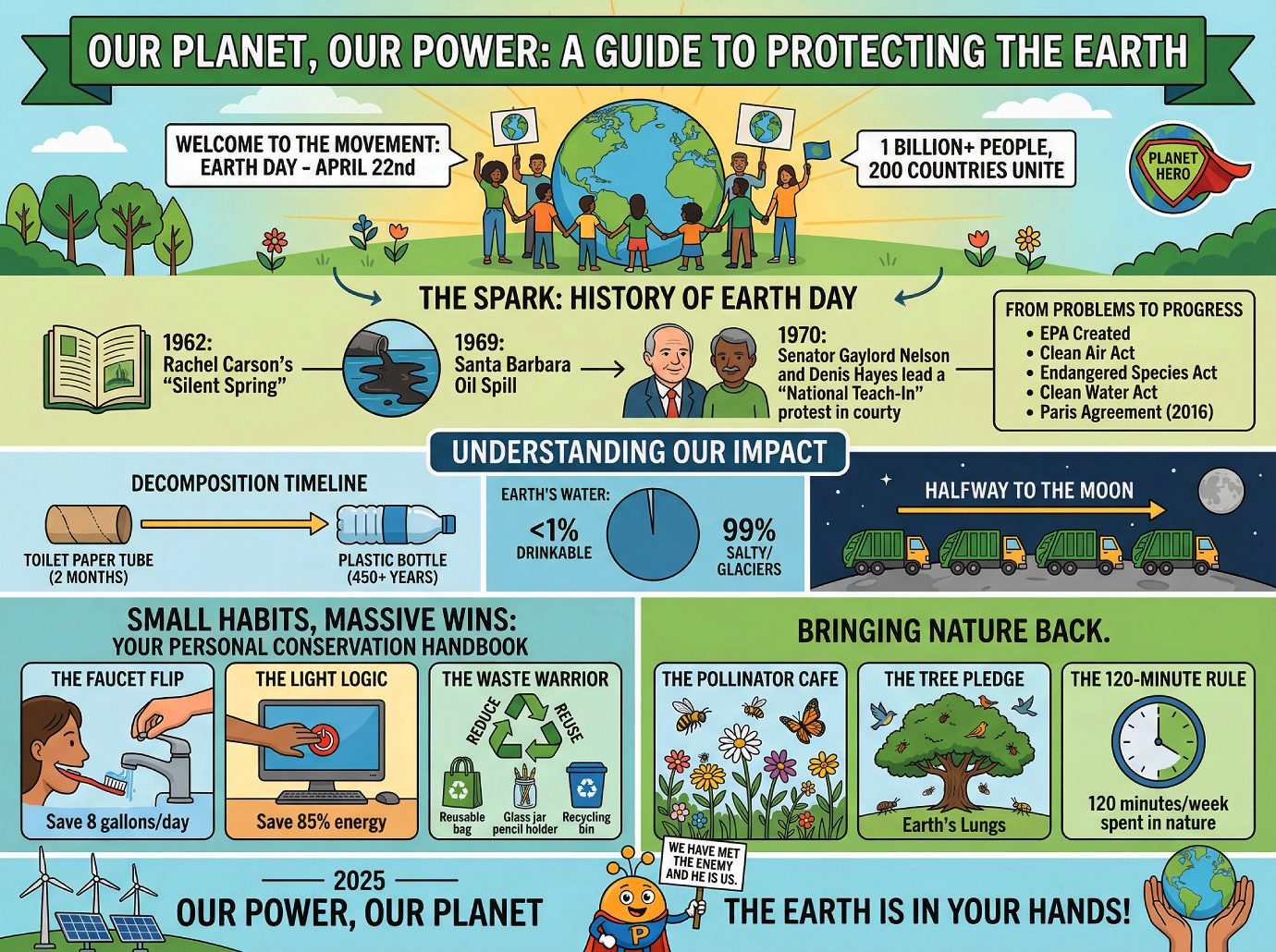
Welcome, future steward of the Earth! Every year on April 22nd, more than 1 billion people in nearly 200 countries unite for Earth Day. It is a massive global movement dedicated to sustainability, wildlife protection, and taking a stand against climate change.
As a “Planet Hero,” your mission is to protect the amazing world we call home. Earth isn’t just a place where we live; it is a connected system of forests, oceans, and animals that we must guard for the future. By joining in, you are part of a team of activists who believe that small actions, when done by millions of people, can change the world.
Did You Know? Earth Day is the largest secular movement in the world! It is the planet’s biggest annual civic event, proving that when people unite for a cause, they have the power to create a healthier, brighter future.
While Earth Day is now a worldwide celebration, it actually began as a bold, student-led protest during a time when the world was facing a major wake-up call.
——————————————————————————–
2. The Spark that Changed Everything: The History of Earth Day
The movement started in the United States in 1970. Back then, there were very few laws to stop factories from pumping black clouds of smoke into the sky or dumping toxic waste into rivers. Two major events helped wake people up:
- A Groundbreaking Book: In 1962, Rachel Carson wrote Silent Spring, which alerted the public to how chemical pesticides were hurting birds and wildlife.
- A Devastating Disaster: In 1969, a massive oil spill off the coast of Santa Barbara, California, killed thousands of seabirds, dolphins, and seals.
Witnessing this disaster inspired Senator Gaylord Nelson to take action. He teamed up with a young activist named Denis Hayes to organize a “national teach-in” to educate people about the environment. They chose April 22nd because it fell between spring break and final exams, making it the perfect time for students to lead the charge.
But the movement would have flopped without help from all kinds of people. The United Auto Workers (UAW) union was one of the biggest supporters, donating money and organizing workers to join the protest. Because students and workers stood together, the first Earth Day was a massive success, leading to the creation of the Environmental Protection Agency (EPA).
From Problems to Progress
The first Earth Day transformed how we protect the planet.
| The World Before 1970 | Results of the Earth Day Movement |
|---|---|
| Factories legally dumped toxic waste into streams and rivers. | Creation of the Environmental Protection Agency (EPA). |
| Smog and black clouds were seen as signs of economic progress. | Passage of the Clean Air Act to stop air pollution. |
| There were no federal rules to protect vanishing animals. | Passage of the Endangered Species Act. |
| Industrial pollution in water was almost completely unregulated. | Passage of the Clean Water Act and Safe Drinking Water Act. |
| Global leaders didn’t have a shared plan for the climate. | The Paris Agreement (signed on Earth Day 2016). |
While these big laws helped stop factories from polluting, today’s biggest challenges often come from the “hidden” waste in our own homes and daily habits.
——————————————————————————–
3. The ‘Why’ Behind the Work: Understanding Our Impact
To be a true Planet Hero, you need to understand the “technical” side of trash. For a long time, people have been using up the Earth’s treasures—like water and land—as if they would never run out. But everything we use leaves a “footprint.”
When we throw things away, they don’t just “disappear.” Most items end up in landfills or oceans, where they take a very long time to break down. Furthermore, we must protect our most precious resource: water.
Shocking Survival Times
Understanding how long common items last shows why we must choose carefully:
- Plastic Bottles (450+ Years): Plastic is a man-made material that nature doesn’t know how to “eat” or break down. This means a bottle you use today could still be in the ocean when your great-great-great-grandchildren are born!
- Toilet Paper Tubes (2 Months): Cardboard breaks down much faster than plastic, which is why it’s a better choice. Still, we produce so much trash that the garbage trucks Americans fill each year would stretch halfway to the moon!
- The 1% Rule: Clean, drinkable water is a rare treasure. Less than 1% of Earth’s water is drinkable for humans; the other 99% is either salty ocean water or “locked away” in glaciers and ice.
These facts aren’t meant to be scary—they are a call to action! Every resource you save is a victory for the planet.
——————————————————————————–
4. Small Habits, Massive Wins: Your Personal Conservation Handbook
You have the power to help nature bounce back! Here are the three most impactful “Hero Actions” you can take every single day:
I. The Faucet Flip
Since drinkable water is so rare, we can’t afford to waste it. By simply turning off the water while you brush your teeth, you can save 8 gallons of water a day. That is enough to fill a giant fish tank!
II. The Light Logic
Most of our electricity comes from burning fossil fuels, which creates the pollution that causes climate change. When you save energy, you keep the air clean. Shutting down your computer instead of leaving it on sleep mode cuts its energy use by 85%.
III. The Waste Warrior
Become a master of the “3 Rs”: Reduce, Reuse, and Recycle.
- Reduce: Buy less “fast stuff” that breaks easily.
- Reuse: Turn an old glass jar into a pencil holder or a flower pot.
- Recycle: This is high-impact! Recycling just one soda can saves enough energy to power a television for three hours.
While these actions help from inside your home, the next step is to head outside and support the living things in your neighborhood.
——————————————————————————–
5. Bringing Nature Back: Gardens, Trees, and Pollinators
Nature is a giant web where every plant and animal has a job. You can help by turning your backyard or school into a sanctuary for wildlife.
- The Pollinator Cafe: Plant native wildflowers to attract bees and butterflies. These “super-pollinators” move pollen from plant to plant, which allows nature to grow the seeds and food we need to survive.
- The Tree Pledge: Trees are the “Earth’s lungs.” They breathe in carbon dioxide and breathe out the oxygen we need! Planting one Oak Tree is a major win because a single oak can support more types of birds and insects than a whole yard of non-native plants.
- The 120-Minute Rule: Spending just 120 minutes per week (about 20 minutes a day) in nature helps you stay healthy, happy, and connected to the world you are protecting.
——————————————————————————–
6. The Earth Day Challenge: Planet Power Check
Test your hero knowledge! Can you answer these five questions based on what you’ve learned?
- Only what percentage of the plastic we throw away every day is actually recycled?
- What is the official Earth Day theme for 2025? (Hint: It’s about renewable energy!)
- How much of the world’s edible food is wasted each year just because it looks “less than perfect”?
- How many plastic bags can a single reusable bag replace over its lifetime?
- What landmark international climate treaty was signed on Earth Day in 2016?
——————————————————————————–
Answer Key
- Only 9%. This is why it is so important to Reduce and Reuse before we even think about recycling.
- Our Power, Our Planet. This theme focuses on the urgent need to switch to renewable energy like wind and solar.
- 25% (or 1/4). Food waste is a huge problem that wastes water, energy, and labor.
- 600 bags. Switching to one reusable bag keeps 600 pieces of plastic out of our oceans!
- The Paris Agreement. More than 175 nations committed to working together to reduce pollution.
——————————————————————————–
7. Beyond April 22nd: Making Every Day Earth Day
Earth Day is more than a date on the calendar; it is a way of living. The 2025 theme, “Our Power, Our Planet,” reminds us that we must invest in renewable energy to protect our future. Your voice and your habits are the engines that keep the environmental movement moving forward.
There is a famous 1970 Earth Day poster by artist Walt Kelly featuring a character named Pogo who says: “We have met the enemy and he is us.” While it’s true that human habits have caused many problems, we have the power to flip that message. We are also the solution!
Quick Tips for the Road
- Walk or Bike: For every mile you walk instead of drive, you keep one pound of pollution out of the air.
- Unsubscribe from Paper: Ask companies to stop mailing you paper catalogs to save trees.
- Use Reusable Bags: You can save 600 plastic bags in your lifetime with just one reusable one!
Every day is an opportunity to protect our “Spaceship Earth.” Are you ready to take the lead? The Earth is in your hands! —————————————
The Story of Earth Day: From a Campus Idea to a Global Movement
The Story of Earth Day: From a Campus Idea to a Global Movement
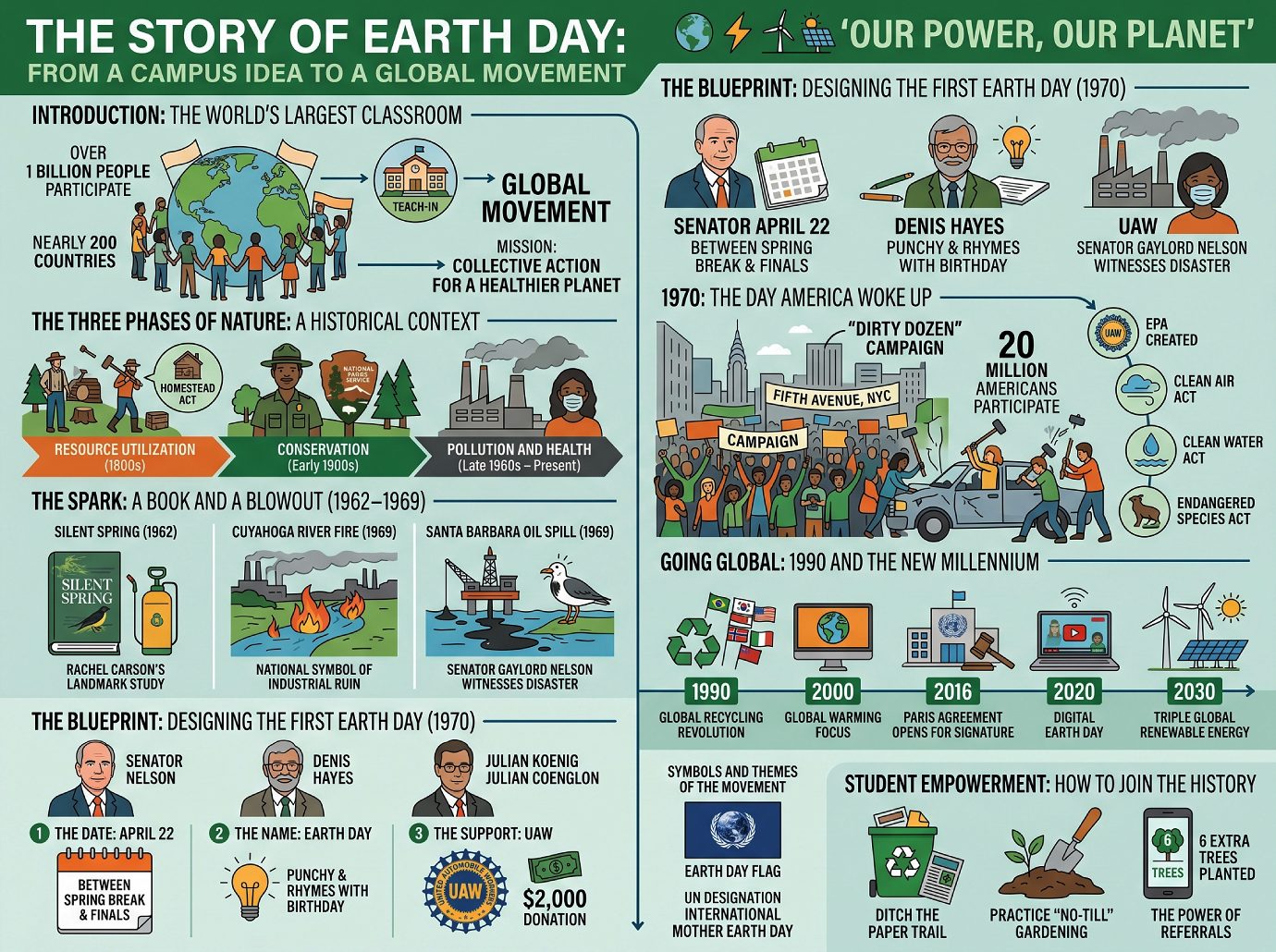
1. Introduction: The World’s Largest Classroom
Earth Day is more than just a date on the calendar; it is a monumental global event recognized by over one billion people across nearly 200 countries. What began as a localized “teach-in” on American college campuses has blossomed into the world’s largest secular civic observance, a day when the entire world stops to listen to the needs of the environment. It serves as a powerful reminder that every one of us acts as a steward for our only home.
The official mission of Earth Day is to encourage collective action for a healthier planet and a brighter, more sustainable future for all living things.
To understand how this massive movement took flight, we have to look back at a time when “pollution” wasn’t a problem to be solved—it was actually seen as a sign of success.
——————————————————————————–
2. The Three Phases of Nature: A Historical Context
The road to Earth Day was paved by a shift in how we viewed our relationship with the land. In the United States, historians identify three distinct phases of environmental policy that moved us from using resources to protecting them.
| Phase | Timeframe | Primary Focus | Key Examples |
|---|---|---|---|
| Phase 1: Resource Utilization | Young Country (1800s) | Encouraging westward settlement and using every resource available. | The Homestead Act (1862) and the Timber Culture Act (1873). |
| Phase 2: Conservation | Early 1900s | Managing depleting resources and preserving land for the future. | National Parks Service (1916) and the Youth Conservation Corps. |
| Phase 3: Pollution and Health | Late 1960s – Present | Tackling the impact of industrial toxins on human health. | The Donora Air Pollution event and unhealthy air in LA and NYC. |
While policy was shifting at a snail’s pace, it took a thunderous “call to arms” from a courageous scientist and a series of ecological disasters to finally wake up the public.
——————————————————————————–
3. The Spark: A Book and a Blowout (1962–1969)
In the 1960s, factories could legally spew black smoke into the sky and dump chemical waste into rivers. For many, this “haze of gray” was a sign of industrial achievement. That perspective was shattered by three major catalysts:
- Silent Spring (1962): Biologist Rachel Carson published this landmark study on the devastating effects of chemical pesticides. It sold over 500,000 copies, changing the public’s awareness of biodiversity and the environment forever.
- The Cuyahoga River Fire (1969): In a shocking display of neglect, a river in Cleveland, Ohio, was so saturated with oil and chemical waste that it actually caught fire, becoming a national symbol of industrial ruin.
- The Santa Barbara Oil Spill (1969): A massive blowout at an offshore well spilled over 3 million gallons of oil. Senator Gaylord Nelson witnessed the horrifying 800-square-mile oil slick from an airplane. Inspired by the sight and the “Declaration of Environmental Rights” being drafted by local activists like Rod Nash, Nelson decided it was time for a national “teach-in.”
Senator Nelson realized that if he could harness the energy of the era’s student-led anti-war protests, he could “shake up the political establishment” and force the environment onto the national agenda.
——————————————————————————–
4. The Blueprint: Designing the First Earth Day (1970)
Building a movement required a master plan. Senator Nelson recruited a visionary team, including national coordinator Denis Hayes and Madison Avenue giant Julian Koenig, to design a strategy that would resonate across the country.
- The Date: Organizers chose April 22 specifically to maximize student involvement. It was a weekday that fell perfectly between Spring Break and Final Exams, ensuring campuses would be full of active participants.
- The Name: Originally called the “National Environmental Teach-In,” Julian Koenig suggested “Earth Day” because it was punchy and rhymed with “birthday” (which happened to be his birthday as well). Around this same time, activist John McConnell had proposed an “Earth Day” for the Spring Equinox at a UNESCO conference, but Nelson’s April 22nd date gained the most national traction.
- The Support: The movement’s survival was secured by Walter Reuther and the United Automobile Workers (UAW). The UAW provided the 2,000 donation (equivalent to over15,500 today) that prevented the first event from flopping, while also handling the massive printing and mailing efforts needed to coordinate the nationwide rallies.
The result of this careful planning was a massive, nationwide explosion of activity that the world had never seen before.
——————————————————————————–
5. 1970: The Day America Woke Up
On April 22, 1970, an estimated 20 million Americans—roughly 10% of the U.S. population at the time—took to the streets. In New York City, Mayor John Lindsay shut down Fifth Avenue, and over 100,000 people gathered in Union Square. College students famously used sledgehammers to demolish cars to protest air pollution.
However, the movement didn’t just shout; it acted. Activists launched the “Dirty Dozen” campaign, targeting 12 members of Congress with terrible environmental records. By defeating seven of them at the polls, the movement gained “political teeth,” leading to an unstoppable wave of legislation:
- The creation of the Environmental Protection Agency (EPA) in 1970.
- The Clean Air Act (1970) and Clean Water Act (1972).
- The Endangered Species Act (1973).
The fire ignited in 1970 was too bright to be contained by a single border; it was time for the world to join the circle.
——————————————————————————–
6. Going Global: 1990 and the New Millennium
In 1990, Denis Hayes took the movement international, shifting the focus toward recycling and global mobilization. As technology evolved, so did the movement’s reach, transitioning from mail and telephones to the digital frontier.
- [x] 1990: Earth Day reaches 141 nations and 200 million people, sparking a global recycling revolution.
- [x] 2000: The movement leverages the internet to coordinate 5,000 environmental groups across 184 countries, focusing on the emerging threat of Global Warming.
- [x] 2016: In a historic moment, the United Nations chooses Earth Day as the date to open the Paris Agreement for signature.
- [x] 2020: Marking the 50th anniversary, the first “Digital Earth Day” reaches 100 million people via livestream due to the COVID-19 pandemic.
- [ ] 2030: The ongoing mission to triple global renewable energy capacity and continue the “Climate Action” movement.
——————————————————————————–
7. Symbols and Themes of the Movement
Earth Day has developed a unique visual and thematic language that unites activists across every continent.
Earth Day Identity
| Feature | Meaning/Origin |
|---|---|
| The Earth Day Flag | Created by John McConnell; features the “Blue Marble” photo taken by the Apollo 17 crew. |
| UN Designation | In 2009, the UN officially renamed the holiday “International Mother Earth Day.” |
| 2024 Milestone | Malaysia hosted the largest cleanup in history, with a goal of planting 1 million trees. |
| Current & Future Theme | “Our Power, Our Planet” (2025-2026 Focus) – A global call to triple renewable energy by 2030. |
With these themes in mind, the historical timeline concludes and shifts toward the most important part of the story: your role in it.
——————————————————————————–
8. Student Empowerment: How to Join the History
The history of Earth Day is still being written, and you are the next author. You don’t need a senator’s platform to make a difference; you just need to start where you are.
- Ditch the Paper Trail: Contact companies to stop receiving printed seed or plant catalogs. Removing your name from these lists saves countless trees and reduces the energy used in shipping.
- Practice “No-Till” Gardening: If you have a garden at home or school, try not tilling the soil. Leaving the soil undisturbed helps it retain organic matter and keep carbon locked in the ground where it belongs.
- The Power of Referrals: Use digital tools like Planet Wild to refer friends to conservation causes. In some programs, one successful referral can result in 6 extra trees being planted in reforestation missions!
The first Earth Day started with a small group of students who believed they could “shake up the world.” Today, you are part of a billion-person team. Every little bit counts, and every action you take adds a new, green page to our planet’s history. ——————————————
Strategic Communications Plan: Scaling Environmental Stewardship Through Thematic Mobilization
Strategic Communications Plan: Scaling Environmental Stewardship Through Thematic Mobilization
1. Strategic Vision: The Evolution of Global Environmental Engagement
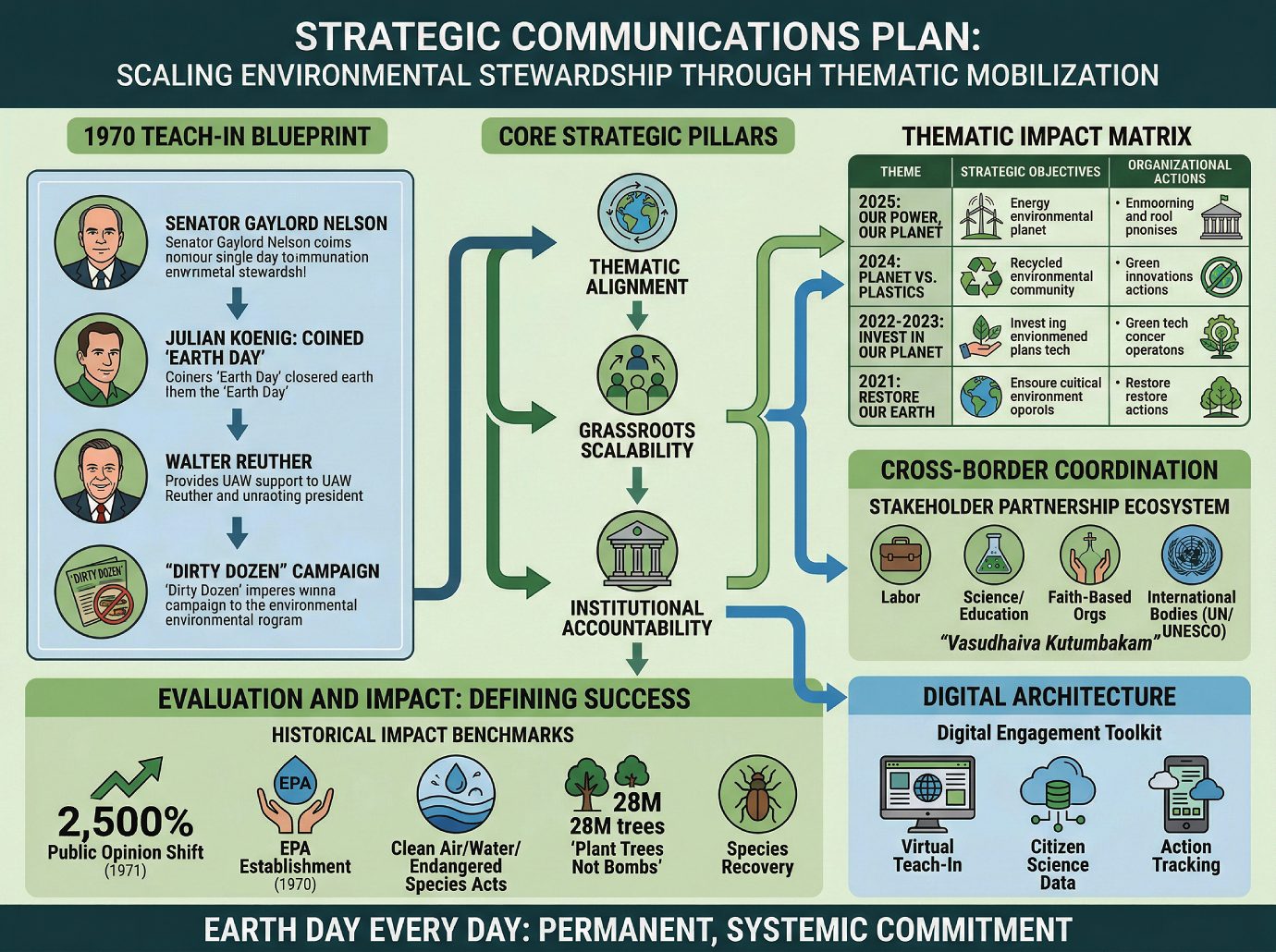
In the modern landscape of corporate and social responsibility, the transition from “single-day observance” to a “sustained model of stewardship” is no longer a peripheral goal; it is a critical requirement for organizational resilience. For leadership, Earth Day must evolve from a symbolic gesture into a systemic framework that mitigates reputational risk and reinforces stakeholder trust. By aligning communications with the “Triple Bottom Line”—prioritizing people, planet, and profit through verifiable action—organizations can transform an annual event into a year-round engine of accountability. This strategy leverages the maturity of a movement that has scaled from a 1970 “teach-in” into a global mobilization of over 1 billion participants across 190+ countries, moving beyond awareness toward measurable ESG (Environmental, Social, and Governance) impact.
The mission of this strategy is to institutionalize environmental stewardship within the core operational DNA of the organization. The vision is to harness decentralized grassroots energy to drive global policy shifts and infrastructure transitions. This plan is anchored by three Core Strategic Pillars:
- Thematic Alignment: Synchronizing local engagement with global directives to amplify impact and ensure a unified “call to arms.”
- Grassroots Scalability: Empowering autonomous local participation while maintaining a cohesive, non-hierarchical global message.
- Institutional Accountability: Transitioning from public relations-driven participation to verifiable restorative commitments in policy and investment.
By analyzing the movement’s architectural origins, we can extract the blueprint for scaling these pillars in a modern, digitally connected world.
2. Historical Foundation: The ‘Teach-In’ Model as a Blueprint for Success
The 1970 “Environmental Teach-In,” envisioned by Senator Gaylord Nelson, remains the definitive blueprint for large-scale mobilization. Nelson recognized that to force environmental issues onto the national agenda, he needed to capture the “exuberance” of the 1960s student anti-war movements. However, the movement’s rapid scale was equally a triumph of strategic marketing and professional branding. Julian Koenig, the Madison Avenue legend behind the iconic “Think Small” Volkswagen campaign, volunteered to brand the movement. He famously coined the name “Earth Day” because it rhymed with “birthday” (his own), providing a simple, rhythmic, and universal brand identity that catalyzed global recognition.
The success of the inaugural mobilization was driven by three primary strategic factors:
- Infrastructure Support from Organized Labor: Under Walter Reuther, the United Auto Workers (UAW) provided the most critical financial and operational backbone. Reuther contributed a $2,000 donation (equivalent to over $15,500 today) and mobilized UAW networks to print and mail literature, effectively “saving” the first Earth Day from potential failure.
- Strategic Timing and Demographics: Organizers selected April 22 specifically to maximize student participation, as it fell on a weekday between spring break and final exams, ensuring a captive audience on university campuses.
- The ‘Dirty Dozen’ Campaign: This was a masterclass in political accountability. The movement targeted twelve incumbents with poor environmental records who had won their previous seats by narrow margins and were on the wrong side of high-stakes local issues. By defeating seven of them, the movement proved environmentalism was a potent electoral force.
This historical model demonstrates that providing the tools for a “spontaneous response at the grassroots level” is superior to top-down mandates. Modern organizations must replicate this by providing the infrastructure for autonomy while maintaining a unified strategic identity.
3. Thematic Synchronization: Aligning Organizational Goals with Global Agendas
Thematic alignment serves as a bridge between local activity and international policy, creating a concentrated focus for media and legislative advocacy. Specific themes do not merely suggest action; they provide measurable objectives that synchronize global efforts.
Thematic Impact Matrix
| Global Theme | Strategic Objective | Organizational Implementation Action |
|---|---|---|
| Our Power, Our Planet (2025) | Triple global generation of clean electricity by 2030. | Direct investment in renewable energy infrastructure and fossil-fuel-free operations. |
| Planet vs. Plastics (2024) | Achieve a 60% global reduction in plastic production by 2040. | Advocate for the Global Plastics Treaty and eliminate single-use plastics from supply chains. |
| Invest In Our Planet (2022-2023) | Support sustainability and environmental literacy as economic drivers. | Fund green technologies and establish long-term CSR restoration partnerships. |
| Restore Our Earth (2021) | Focus on natural restorative processes and emerging green tech. | Participate in global reforestation via the Canopy Project and the Great Global Cleanup. |
The ultimate example of thematic synchronization occurred on Earth Day 2016, when the United Nations opened the Paris Agreement for signature. This alignment demonstrated that the momentum of a public movement could be directly translated into the most significant international climate accord in history.
4. Cross-Border Coordination: The Stakeholder Partnership Ecosystem
The strength of the stewardship movement lies in its multi-sectoral approach, embodying the philosophy of Vasudhaiva Kutumbakam (“The World Is One Family”).
- Labor and Trade Unions: Modeled on the UAW 1970 precedent, labor organizations provide the operational scale to link environmental health to worker safety and economic stability.
- Scientific & Educational Institutions: Institutions like the University of Michigan and UNESCO provide the data-driven foundation for advocacy, ensuring messaging is grounded in climate literacy.
- Faith-Based Organizations: Initiatives like “Global Warming in the Pulpit” frame environmental protection as a moral and spiritual obligation, reaching diverse community networks.
- International Bodies: The UN and UNESCO serve as formal validators. Strategic communicators must navigate the 2009 UN designation of International Mother Earth Day to ensure cultural relevance in global diplomacy while using “Earth Day” for US-based initiatives.
Coordinating these diverse groups ensures that the movement remains a broad coalition rather than a niche interest, fostering a global culture of shared responsibility.
5. Digital Architecture: Utilizing Connectivity for Grassroots Participation
Digital platforms have revolutionized the ability to scale actions by allowing groups to bypass traditional gatekeepers. A major turning point occurred in 2000, when 5,000 environmental groups used the internet to coordinate across 184 countries, fulfilling Senator Nelson’s vision of a movement that “organizes itself.”
Digital Engagement Toolkit
- The Virtual Teach-In: Utilizing livestreams (e.g., “Earth Day Live” 2020/2021) to speak directly to a billion-person audience, bypassing traditional media filters.
- Citizen Science Data Collection: Platforms like the “Global Earth Challenge” and NOAA’s citizen science portals empower the public to contribute to world-class research and monitoring.
- Action Tracking: Tools like the “Billion Acts of Green” and “Plastics Pollution Calculators” allow individuals to quantify their personal and local impact toward global goals.
This digital connectivity allows for a spontaneous, resistant, and rapid grassroots response that is essential for modern mobilization.
6. Sustained Stewardship: Transitioning from Observance to Year-Round Responsibility
The primary risk in environmental communications is “Greenwashing”—using Earth Day as a cynical marketing shield without substantive policy change. In 2022, Greta Thunberg warned that the day has often become an opportunity for those in power to post “love” for the planet while destroying it at “maximum speed.” To avoid this “false sense of progress,” organizations must adopt a three-stage Stewardship Roadmap:
- Awareness & Education: Utilizing the “Teach-In” phase to build deep climate literacy among all stakeholders.
- Direct Restorative Action: Engaging in measurable programs such as “The Great Global Cleanup” or “The Canopy Project,” which has planted tens of millions of trees globally.
- Policy & Infrastructure Shift: Adopting “Earth Day Every Day” by investing in zero-emissions mobility, rejecting fast fashion, and shifting to sustainable supply chains.
The Canopy Project and The Great Global Cleanup serve as excellent models for year-round CSR, providing verifiable outcomes rather than mere participation metrics.
7. Evaluation and Impact: Defining Success Beyond Participation
Strategic success is measured by legislative and environmental shifts, not just attendance numbers. The ultimate KPI for a communications director is the shift in public consciousness and policy reality.
Historical Impact Benchmarks (Strategic KPIs):
- Public Opinion Shift: A 2,500% increase in the percentage of the US public identifying environmental protection as an important goal within just 13 months of the first Earth Day (by May 1971).
- Regulatory Foundation: The establishment of the Environmental Protection Agency (EPA) in December 1970.
- Legislative Milestones: The passage of the Clean Air, Clean Water, and Endangered Species Acts.
- Global Reach: The “Plant Trees Not Bombs” campaign in Afghanistan, which saw 28 million trees planted as a benchmark of hope in conflict zones.
- Biological Recovery: The successful recovery of 26 species at risk of extinction in Australia and the broader recovery of species protected under the Endangered Species Act.
By transforming the 1970 historical model into a digitally connected, sustained strategy, we can move from symbolic observance to global leadership. The objective is clear: transform the momentum of a single day into a permanent, systemic commitment to the planet’s future. —————–
The Evolution of United States Environmental Policy: From Resource Utilization to Regulatory Oversight
The Evolution of United States Environmental Policy: From Resource Utilization to Regulatory Oversight
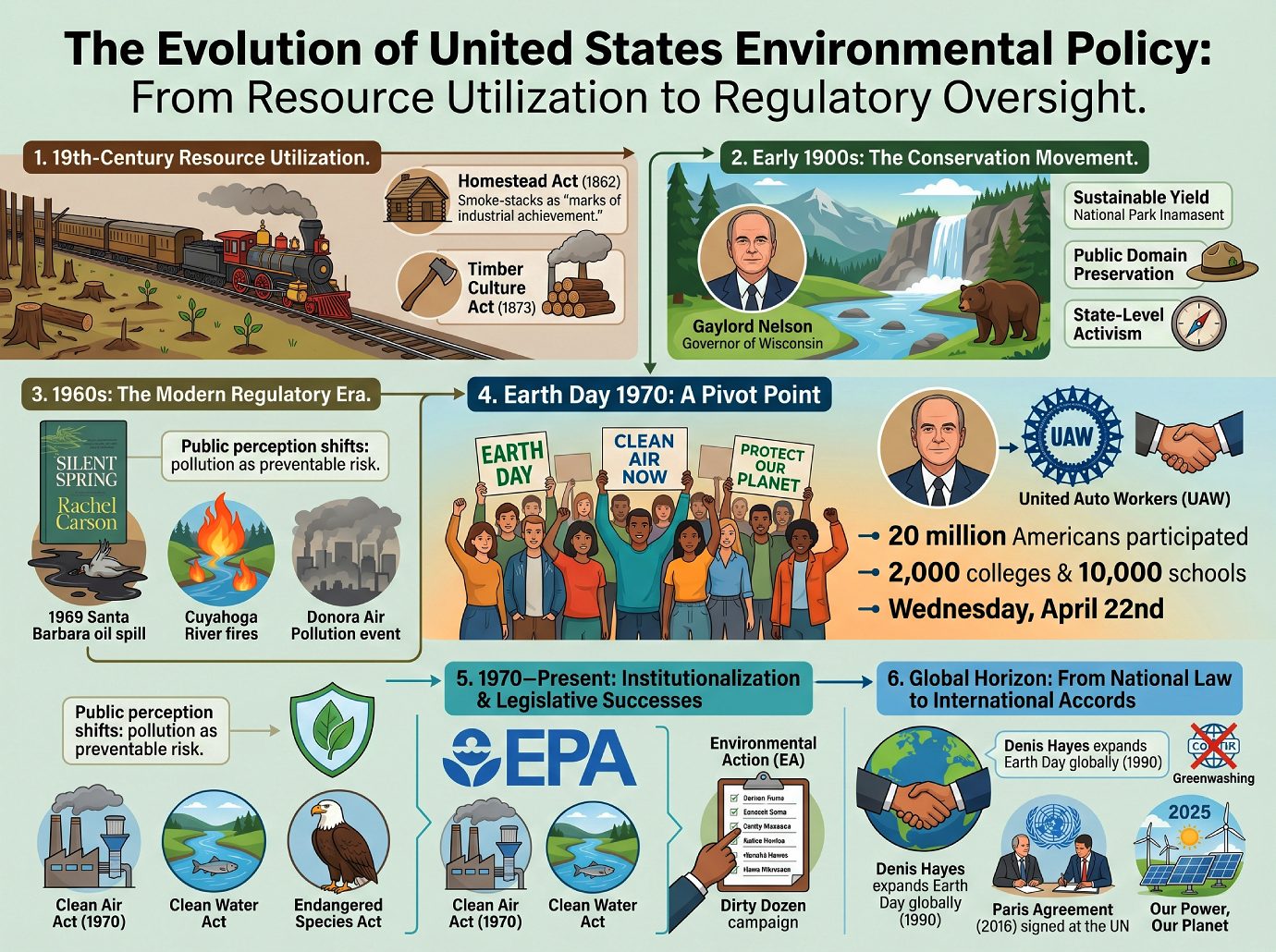
1. The Genesis of Federal Land Management: 19th-Century Resource Utilization
During the 19th century, the prevailing American regulatory mindset regarding the environment was rooted in “utilization.” Policy was not designed for ecological preservation but served as a strategic tool for nation-building, westward expansion, and aggressive economic growth. Within this framework, the vast wilderness was perceived as a dormant asset, and early federal policy focused almost exclusively on transferring public land into private hands. Crucially, during this phase, industrial pollution was not viewed as a regulatory failure; rather, smoke-stacks and smog were often celebrated as “marks of industrial achievement” and visible signs of national prosperity.
This era was defined by legislative mechanisms designed to incentivize the extraction of resources and the “improvement” of land as a civic duty. The Homestead Act of 1862 turned the wilderness into a decentralized engine for agricultural production, while the Timber Culture Act of 1873 viewed forestry as a crop to be managed for extraction. These policies effectively mandated the disruption of native ecosystems to serve the immediate needs of the young republic.
Primary Legislative Drivers of the Utilization Phase
| Policy Name | Legislative Intent | Legislative Mechanism | Environmental Impact |
|---|---|---|---|
| Homestead Act (1862) | Accelerate Western settlement and agricultural output. | 160-acre grants provided to citizens who “improved” the land through cultivation. | Widespread conversion of native prairies and disruption of existing biodiversity. |
| Timber Culture Act (1873) | Expand timber availability for fuel and building materials on the Great Plains. | Grants of an additional 160 acres for planting and maintaining 40 acres of trees. | Encouraged aggressive timber extraction and introduced non-native species to western landscapes. |
By the late 19th century, the unchecked depletion of forests and the closing of the frontier signaled the limits of the utilization model. This exhaustion of the public domain necessitated a strategic shift toward conservationist ideals, as leaders recognized that unregulated resource extraction threatened the long-term economic stability of the nation.
2. The Conservation Movement: Institutionalizing Resource Management (Early 1900s)
The early 20th century marked a transition from unfettered utilization to a disciplined framework of “preservation” and institutional management. Growing national anxiety regarding the depletion of timber and water led to the realization that long-term stability required federal oversight. This “Second Phase” of policy moved the government into a new role: the permanent steward of the public domain, establishing a template for resource management that balanced extraction with sustainability.
A pivotal moment was the passage of the National Parks Organic Service Act of 1916, which established the National Park Service and mandated the conservation of landscapes for future generations. This era was characterized by the “Conservation Governor” model, most notably championed by Gaylord Nelson in Wisconsin. Before his tenure in the U.S. Senate, Nelson institutionalized environmental policy at the state level by establishing a single Department of Resource Development, creating a Youth Conservation Corps, and allocating $50 million for a massive land-buy program to convert private acreage into public wilderness.
The three most critical tenets of this institutional phase were:
- Sustainable Yield: The application of scientific management to resources like forests and fisheries to ensure they could be harvested indefinitely without depleting the base stock.
- Public Domain Preservation: The permanent withdrawal of specific lands from the private market to be held in trust by the federal government for ecological and public value.
- State-Level Activism: The development of robust state agencies to manage local resources, creating a localized administrative template for what would eventually become federal law.
While this era successfully protected swaths of “wilderness,” the mid-century surge in industrialization soon revealed that preserving remote forests was insufficient if industrial toxins posed a direct, lethal threat to human health in urban centers.
3. The Modern Regulatory Era: Literature, Disaster, and the Call to Arms
By the 1960s, the United States entered a “Third Phase” of environmentalism, shifting focus from rural conservation to urban health and industrial accountability. This era marked a psychological break from the previous century; the public began to reject the notion that pollution was a sign of prosperity, viewing it instead as a preventable risk to human biology. “Ecology” moved from a niche scientific discipline to a mainstream political “call to arms.”
The primary catalyst for this shift was the 1962 publication of Rachel Carson’s Silent Spring, which exposed the catastrophic impact of chemical pesticides on biodiversity and human health. This literary wake-up call was amplified by a series of high-profile disasters: the 1969 Santa Barbara oil spill, which leaked over 3 million gallons of oil and created an 800-square-mile slick; the Cuyahoga River fires, where industrial waste caused an Ohio river to ignite; and the Donora Air Pollution event, where toxic smog caused dozens of fatalities.
The “So What?” of these events was the transformation of public perception regarding industrial byproducts. For the first time, Americans collectively understood that unchecked industrial toxins presented a direct risk of cancer and other serious health issues. This cultural pressure and growing civic anger paved the way for the single largest secular day of protest in history: Earth Day.
4. Earth Day 1970: A Pivot Point in Civic and Political Will
Earth Day 1970 was a strategic “environmental teach-in” designed to force ecological issues onto a national political agenda dominated by the Vietnam War. Founder Senator Gaylord Nelson and co-chair Congressman Pete McCloskey recognized the need to harness youth energy to create a bipartisan mandate. To move beyond campus activism, Nelson recruited a young strategist, Denis Hayes, as the national coordinator to scale the event into a massive national mobilization.
The movement achieved institutional legitimacy and cross-sectoral leverage through the instrumental role of the United Auto Workers (UAW). Under Walter Reuther, the UAW provided the operational and financial backbone for the movement, including a critical $2,000 donation (worth over $15,500 today) and the use of their telephone capabilities for national coordination. This partnership between labor and environmentalists was essential; as Hayes noted, without the UAW, the first Earth Day would likely have flopped.
- 1970 Mobilization Summary:
- Total Turnout: 20 million Americans (10% of the total U.S. population).
- Participation: 2,000 colleges and 10,000 primary and secondary schools.
- Strategic Timing: Held on Wednesday, April 22nd—a masterstroke in student mobilization, specifically chosen to fall between spring break and final exams to maximize attendance.
This massive show of public will left the federal government with no choice but to institutionalize environmental protection through centralized federal authority.
5. Institutionalization and Legislative Successes (1970–Present)
The energy of Earth Day was immediately transformed into durable federal law. In December 1970, the Environmental Protection Agency (EPA) was established, marking a fundamental shift from a landscape where a factory could spew toxic smoke with no legal consequences to an era of centralized enforcement. The EPA provided the first unified regulatory mechanism to protect human health, contrasting with the fragmented oversight of the past.
This triggered a “Golden Age” of environmental legislation that provided the regulatory teeth necessary to prosecute polluters:
- Clean Air Act (1970): The first comprehensive federal law to regulate air emissions from stationary and mobile sources.
- Clean Water Act: Established the structure for regulating pollutant discharges and gave the EPA authority to implement pollution control programs.
- Endangered Species Act: Provided a framework to protect threatened species, prioritizing biodiversity over immediate commercial interest.
To sustain this progress, Earth Day staff formed Environmental Action (EA), a lobbyist arm that launched the “Dirty Dozen” campaign. By targeting and successfully unseating seven of the twelve incumbents with the worst environmental records—including George Fallon, the powerful chairman of the House Public Works Committee—activists proved that anti-environment stances were now a political liability. This success soon resonated globally as the movement expanded its reach.
6. The Global Horizon: From National Law to International Accords
As the movement matured, it transitioned from a domestic concern to a planetary imperative. In 1990, Denis Hayes expanded the scope of Earth Day to a global event, mobilizing 200 million people in 141 nations. This globalization acknowledged that issues like climate change and ozone depletion required international treaties, moving the “Third Phase” of environmentalism onto the world stage.
A significant milestone was the Paris Agreement (2016), which was opened for signature at the United Nations on Earth Day. This symbolic choice represented the culmination of decades of advocacy, linking grassroots action to global diplomacy. The trajectory continues with the 2025 theme, “Our Power, Our Planet,” which explicitly aligns with the COP28 pledge to triple global renewable energy capacity by 2030 to address the escalating climate crisis.
Despite these successes, the movement faces modern challenges, including critiques of “middle class” bias and the rise of “greenwashing,” where corporations utilize the ethos of sustainability for gain without substantive operational changes. Nevertheless, the progression from 19th-century resource utilization to modern global climate action illustrates the profound power of civic movements to drive the institutional and legal evolution necessary for planetary survival. ————————–