
Great American Speeches – Gardner Magazine Reports

Speeches in American History
Jump to a particular report, CLICK a LINK
The Echoes of Liberty: A Chronological Anthology of America’s Defining Oratory —-The Echo of History: A Milestone Map of 20th-Century American Discourse —–Voices of Freedom: A Student’s Guide to the Themes of American Oratory
View this short VIDEO:
Listen to this DEBATE about which speeches were the most impactful on any device, CLICK PLAY.
Listen to this “Deep Dive” discussion about speeches in American History on any device, CLICK PLAY.
–
The Echoes of Liberty: A Chronological Anthology of America’s Defining Oratory
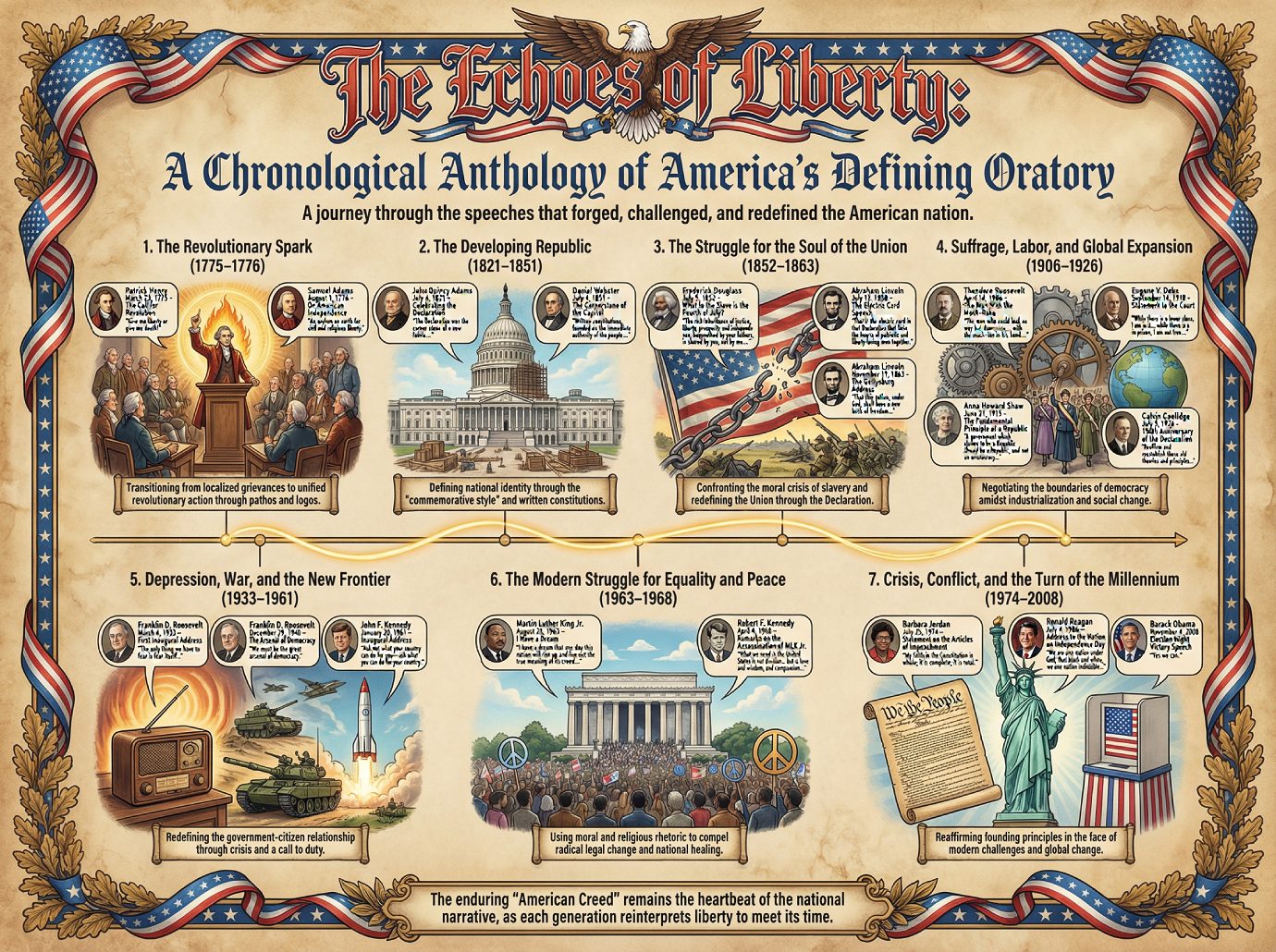
The Echoes of Liberty: A Chronological Anthology of America’s Defining Oratory
1. The Revolutionary Spark (1775–1776)
In the mid-1770s, the American colonies inhabited a precarious kairos—a defining moment of opportunity that demanded a fundamental shift in the colonial psyche. The strategic necessity of public oratory during this period was to transition a disparate population from localized grievances against British policy to a unified commitment to revolutionary action. Oratory was the primary engine of this metamorphosis, providing the emotional urgency and philosophical justification required to dismantle the traditional bonds of monarchical loyalty and replace them with the radical concept of popular sovereignty.
The rhetorical landscape was defined by the dialectical tension between Patrick Henry’s pathos-heavy calls for armed resistance and Samuel Adams’ logos-centered defense of self-government. While Henry utilized vivid imagery and urgent appeals to the “God of Hosts” to persuade the Virginia Convention that reconciliation was a siren song leading to “beasts,” Adams constructed a sophisticated intellectual scaffolding for independence. Adams framed the conflict not merely as a rebellion, but as the deliberate formation of a social compact, an “asylum for civil and religious liberty” that would serve as a model for mankind. Their combined impact provided both the sword and the shield for the decision to declare independence.
Speech 1.1: Patrick Henry – March 23, 1775 – The Call for Revolution
Biography: Patrick Henry, a legendary trial lawyer and premier opponent of British taxation, was the unrivaled master of the American jeremiad—a rhetorical form that laments the state of society and calls for a return to virtue through sacrifice. By the 1775 Virginia Convention, Henry’s reputation as an orator who could sway a crowd through sheer vocal power and dramatic gesture was unparalleled in the colonies.
Excerpts:
“For my own part, I consider it as nothing less than a question of freedom or slavery… It is natural to man to indulge in the illusions of hope. We are apt to shut our eyes against a painful truth, and listen to the song of that siren till she transforms us into beasts.”
“We have petitioned; we have remonstrated; we have supplicated; we have prostrated ourselves before the throne… Our petitions have been slighted; our remonstrances have produced additional violence and insult; our supplications have been disregarded.”
“If we wish to be free… we must fight! I repeat it, sir, we must fight! An appeal to arms and to the God of Hosts is all that is left us!… Why stand we here idle?… Is life so dear, or peace so sweet, as to be purchased at the price of chains and slavery? Forbid it, Almighty God! I know not what course others may take; but as for me, give me liberty or give me death!”
Speech 1.2: Samuel Adams – August 1, 1776 – On American Independence
Biography: Often called the “Father of the American Revolution,” Samuel Adams was a master of political organization and a sophisticated theorist of the Enlightenment. A delegate to the Continental Congress and a Signer of the Declaration, Adams’ intellectual genealogy was rooted in the radical Whig tradition, drawing heavily upon the works of John Hampden, John Locke, and Algernon Sidney to justify the “voluntary” social compact.
Excerpts:
“Courage, then, my countrymen; our contest is not only whether we ourselves shall be free, but whether there shall be left to mankind an asylum on earth for civil and religious liberty.”
“The people of this country, alone, have formally and deliberately chosen a government for themselves, and with open and uninfluenced consent bound themselves into a social compact. Here no man proclaims his birth or wealth as a title to honorable distinction… He who has most zeal and ability to promote public felicity, let him be the servant of the public. This is the only line of distinction drawn by nature. Leave the bird of night to the obscurity for which nature intended him, and expect only from the eagle to brush the clouds with his wings and look boldly in the face of the sun.”
The revolutionary sentiments forged in these fires of public debate transitioned from the rhetoric of the battlefield to the formal institutionalization of the new republic, as the language of protest was codified into the language of governance. This shift marked the beginning of a long tradition where the “Spirit of ’76” would be invoked to navigate the growing pains of a young nation.
——————————————————————————–
2. The Developing Republic (1821–1851)
By the second decade of the 19th century, American oratory underwent a strategic shift toward the “commemorative style.” As the Founding generation passed away, speakers faced the necessity of defining a coherent national identity that could bind an expanding and diversifying populace to a shared heritage. These orations were designed to transform the abstract ideals of the Revolution into a permanent “cornerstone” of institutional stability, ensuring that the legacy of the Declaration served as a unifying rather than a disruptive force.
John Quincy Adams and Daniel Webster used the memory of the Declaration to provide a moral and legal framework for American expansion. Adams emphasized the “voluntary” nature of the social compact, celebrating the Declaration as the demolition of all governments founded upon “conquest.” Webster, utilizing the “New England Grand Style,” focused on the unique American reliance on written constitutions to restrain government power. Both men sought to present the American experiment as a “finished fabric” of liberty, though they did so while the internal contradictions of that very fabric were beginning to unravel over the question of human bondage.
Speech 2.1: John Quincy Adams – July 4, 1821 – Celebrating the Declaration of Independence
Biography: The son of a Founder and the sixth U.S. President, John Quincy Adams was a bridge between the Revolutionary and the Antebellum eras. His commitment to the Declaration’s principles would eventually lead him to defend the Amistad captives before the Supreme Court, framing the American cause as an “unconquerable desire to be the master of his own destiny.”
Excerpts:
“Thus was a social compact formed upon the elementary principles of civil society, in which conquest and servitude had no part. The slough of brutal force was entirely cast off; all was voluntary; all was unbiased consent; all was the agreement of soul with soul.”
“[The Declaration] was the corner stone of a new fabric, destined to cover the surface of the globe. It demolished at a stroke the lawfulness of all governments founded upon conquest. It swept away all the rubbish of accumulated centuries of servitude. It announced in practical form to the world the transcendent truth of the unalienable sovereignty of the people.”
Speech 2.2: Daniel Webster – July 4, 1851 – The Cornerstone of the Capitol
Biography: Known as the “Great Expounder of the Constitution,” Daniel Webster was the preeminent legal orator of his day. His “Second Reply to Hayne” remains the classic defense of the Union, and his rhetorical mastery helped define the constitutional stability of the 19th-century American state.
Excerpts:
“Every man’s heart swells within him… as he remembers that seventy-five years have rolled away, and that the great inheritance of liberty is still his; his undiminished and unimpaired; his in all its original glory; his to enjoy; his to protect; and his to transmit to future generations.”
“Another most important part of the great fabric of American liberty is, that there shall be written constitutions, founded on the immediate authority of the people themselves, and regulating and restraining all the powers conferred upon Government.”
While Webster celebrated the “fabric of liberty” and the “inheritance” of the Founders, the very “written constitutions” he praised were increasingly being utilized as legal shields for the property rights of slaveholders. This tension between the “fabric” and the reality of the Union ensured that the 19th-century stability Webster craved was rapidly approaching a terminal breaking point.
——————————————————————————–
3. The Struggle for the Soul of the Union (1852–1863)
In the decade leading to the Civil War, American rhetoric became the primary arena for an existential moral crisis. Oratory was used to address the widening gulf between the egalitarian creed of 1776 and the oppressive reality of chattel slavery. This era saw a strategic reclamation of the Declaration of Independence, with speakers attempting to decide whether the nation’s “cornerstone” could sustain a house divided against itself.
The period was defined by a profound rhetorical contrast. Frederick Douglass delivered a searing abolitionist jeremiad, identifying the Declaration as the “ring-bolt” of the nation’s destiny while indicting the hypocrisy of a white republic that denied its “rich inheritance” to the enslaved. Abraham Lincoln, responding to the “popular sovereignty” of Stephen Douglas, developed his “Electric Cord” theory. Lincoln strategically used the Declaration to create a “civic ancestry” for immigrants—Germans, Irish, and Scandinavians—who lacked blood ties to the Founders, arguing that the “moral sentiment” of equality was the spiritual link that held the Confederacy of states together.
Speech 3.1: Frederick Douglass – July 5, 1852 – What to the Slave is the Fourth of July?
Biography: Frederick Douglass, the nation’s most prominent abolitionist, was a master of the prophetic rhetorical tradition. In his 1852 address, he praised the “fathers of this republic” as men who “preferred revolution to peaceful submission,” using their memory as a tool to shame a “degenerate” present that failed to uphold the “saving principles” of the founding.
Excerpts:
“They were statesmen, patriots and heroes, and for the good they did, and the principles they contended for, I will unite with you to honor their memory… They believed in order; but not in the order of tyranny. With them, nothing was ‘settled’ that was not right.”
“The rich inheritance of justice, liberty, prosperity and independence, bequeathed by your fathers, is shared by you, not by me… [But] I do not despair of this country… I, therefore, leave off where I began, with hope. While drawing encouragement from the Declaration of Independence… my spirit is also cheered by… the Constitution [as a] GLORIOUS LIBERTY DOCUMENT.”
Speech 3.2: Abraham Lincoln – July 10, 1858 – The Electric Cord Speech
Biography: Delivered in Chicago, this speech represented Lincoln’s effort to ground the Republican cause in the “moral sentiment” of the Declaration. He sought to define American identity not through ancestry, but through adherence to the “great principle” that kept the Confederacy of states together: the equality of man.
Excerpts:
“I have often inquired of myself, what great principle or idea it was that kept this Confederacy so long together. It was not the mere matter of the separation of the Colonies from the motherland; but that sentiment in the Declaration of Independence which gave liberty, not alone to the people of this country, but, I hope, to the world… [When immigrants] look through that old Declaration of Independence they find that those old men say that ‘We hold these truths to be self-evident, that all men are created equal,’ and then they feel that that moral sentiment… evidences their relation to those men… as though they were blood of the blood, and flesh of the flesh of the men who wrote that Declaration… That is the electric cord in that Declaration that links the hearts of patriotic and liberty-loving men together.”
Speech 3.3: Abraham Lincoln – November 19, 1863 – The Gettysburg Address
Biography: Lincoln delivered this address during the dedication of the Soldiers’ National Cemetery at Gettysburg, Pennsylvania. It is widely considered the “second founding” of the United States, a moment where the nation’s creed was purged of its original compromises.
Excerpts:
“Four score and seven years ago our fathers brought forth on this continent, a new nation, conceived in Liberty, and dedicated to the proposition that all men are created equal. Now we are engaged in a great civil war, testing whether that nation, or any nation so conceived and so dedicated, can long endure… It is rather for us to be here dedicated to the great task remaining before us—that from these honored dead we take increased devotion to that cause for which they gave the last full measure of devotion—that we here highly resolve that these dead shall not have died in vain—that this nation, under God, shall have a new birth of freedom—and that government of the people, by the people, for the people, shall not perish from the earth.”
This “new birth of freedom” redefined the American creed for the industrial and globalized era to follow. By centering the Union on a “proposition” rather than a racial heritage, Lincoln’s oratory paved the way for the later expansions of citizenship that would dominate the Progressive and Civil Rights eras.
——————————————————————————–
4. Suffrage, Labor, and Global Expansion (1906–1926)
As the United States transitioned from a domestic agrarian society to a global industrial power, oratory was used to navigate the profound social tensions of the early 20th century. This era demanded an expansion of the definition of “the people.” Strategic rhetoric was employed to negotiate the boundaries of democracy, as women sought the franchise and the working class sought protection from the “industrial dungeons” created by the growth of unprecedented wealth.
The rhetorical strategies of this era varied by ideological objective. Theodore Roosevelt utilized a sharp allusion to Bunyan’s “Pilgrim’s Progress” to construct a moral framework for investigative journalism, warning against a “muck-rake” mentality that ignored the “celestial crown” of national progress. Anna Howard Shaw used the strategy of “democratic consistency,” shaming American men by arguing that a republic excluding women was a fraudulent “aristocracy.” In contrast, Eugene V. Debs employed “class consciousness,” using his statement to the court to declare a radical kinship with the “lower class” and the “soul in prison.” Meanwhile, Calvin Coolidge sought to stabilize the era by reaffirming “old theories and principles,” trusting in the “firm and unshaken” charters of the past.
Speech 4.1: Theodore Roosevelt – April 14, 1906 – The Man with the Muck-Rake
Biography: Theodore Roosevelt significantly expanded the federal government’s sphere of action. In this address, he sought to balance the era’s reformist zeal with national optimism, warning that relentless negativity could blind the nation to its own potential for greatness.
Excerpts:
“In Bunyan’s ‘Pilgrim’s Progress’ you may recall the description of the Man with the Muck Rake, the man who could look no way but downward, with the muck rake in his hand; who was offered a celestial crown for his muck rake, but who would neither look up nor regard the crown he was offered, but continued to rake to himself the filth of the floor.”
Speech 4.2: Anna Howard Shaw – June 21, 1915 – The Fundamental Principle of a Republic
Biography: A leader in the suffrage movement, Anna Howard Shaw was an expert in using democratic principles to highlight the hypocrisy of disenfranchisement. She argued that the suffrage movement was not seeking new rights, but merely asking the Republic to be “true to our ideals.”
Excerpts:
“The only thing that woman’s enfranchisement means at all is that a government which claims to be a Republic should be a Republic, and not an aristocracy… We ought at least be true to our ideals.”
Speech 4.3: Eugene V. Debs – September 14, 1918 – Statement to the Court
Biography: A socialist leader of the working class, Eugene V. Debs was prosecuted under the Espionage Law. His rhetoric was defined by a rejection of the industrial status quo and a call for a fundamental change in the social system through peaceable and orderly means.
Excerpts:
“While there is a lower class, I am in it, and while there is a criminal element I am of it, and while there is a soul in prison, I am not free… I am thinking of the women who for a paltry wage are compelled to work out their barren lives; of the little children… forced into the industrial dungeons.”
Speech 4.4: Calvin Coolidge – July 5, 1926 – 150th Anniversary of the Declaration
Biography: Calvin Coolidge restored integrity to the executive branch following the Harding scandals. His oratory was marked by a trust in the “spiritual event” of the founding, and a belief that the nation’s security lay in the “unerring logic” of its original principles.
Excerpts:
“It is not so much, then, for the purpose of undertaking to proclaim new theories and principles… but rather to reaffirm and reestablish those old theories and principles which time and the unerring logic of events have demonstrated to be sound… those two great charters of freedom and justice remain firm and unshaken.”
The stability of the 1920s soon collapsed under the weight of the Great Depression, necessitating a new era of presidential rhetoric that would bridge the gap between individual liberty and collective survival.
——————————————————————————–
5. Depression, War, and the New Frontier (1933–1961)
The mid-20th century saw the strategic elevation of the “Fireside Chat” and presidential oratory as essential tools for national survival. During the Great Depression and World War II, Franklin D. Roosevelt redefined the relationship between the government and the citizen, using a direct, intimate rhetorical style to instill “candor and decision” in a nation paralyzed by “nameless, unreasoning, unjustified terror.” This era signaled the rise of a more powerful, communicative executive branch.
A fundamental shift in the “duty” of the American citizen emerged through the synthesis of FDR and John F. Kennedy. Roosevelt’s “Arsenal of Democracy” speech focused on the collective industrial and economic power of the nation as a bulwark against tyranny. Conversely, John F. Kennedy, speaking at the dawn of the nuclear age, pivoted toward a rhetoric of individual natural rights. Kennedy famously asserted that rights come “not from the generosity of the state, but from the hand of God,” and challenged the citizenry to a new level of sacrifice, asking “not what your country can do for you,” but what the individual could contribute to the preservation of liberty.
Speech 5.1: Franklin D. Roosevelt – March 4, 1933 – First Inaugural Address
Biography: Taking office at the nadir of the Great Depression, the 32nd President used his first inaugural address to instill a sense of “national consecration,” demanding that the nation face its conditions with honesty and vigor.
Excerpts:
“This is preeminently the time to speak the truth, the whole truth, frankly and boldly… So, first of all, let me assert my firm belief that the only thing we have to fear is fear itself—nameless, unreasoning, unjustified terror which paralyzes needed efforts to convert retreat into advance.”
Speech 5.2: Franklin D. Roosevelt – December 29, 1940 – The Arsenal of Democracy
Biography: In this address, Roosevelt sought to convince the American public of the necessity of supporting the Allied powers against the Axis. He framed the nation’s industrial capacity as a strategic moral asset, necessary to keep “American civilization” out of a “last-ditch war.”
Excerpts:
“We must be the great arsenal of democracy. For us this is an emergency as serious as war itself. We must apply ourselves to our task with the same resolution, the same sense of urgency, the same spirit of patriotism and sacrifice as we would show were we at war.”
Speech 5.3: John F. Kennedy – January 20, 1961 – Inaugural Address
Biography: The 35th President, John F. Kennedy, delivered one of the most famous inaugural addresses in American history, focusing on the heavy burden of leadership in a cold war world where man held “the power to abolish all forms of human poverty and all forms of human life.”
Excerpts:
“The world is very different now. For man holds in his mortal hands the power to abolish all forms of human poverty and all forms of human life. And yet the same revolutionary beliefs for which our forebears fought are still at issue… the belief that the rights of man come not from the generosity of the state, but from the hand of God… And so, my fellow Americans: ask not what your country can do for you—ask what you can do for your country.”
This era of centralized presidential power and the call to universal duty provided the rhetorical framework for the intense social activism of the 1960s. As the government called for sacrifice abroad, citizens increasingly demanded that the nation honor its promises of equality at home.
——————————————————————————–
6. The Modern Struggle for Equality and Peace (1963–1968)
In the 1960s, oratory returned to the moral and religious roots of the American experiment to compel radical legal change. Leaders of the Civil Rights Movement used the public square to bridge the gap between the nation’s founding ideals and its 20th-century reality. By utilizing the language of the pulpit and the “promissory note,” they successfully reframed the struggle for equality as a spiritual and patriotic obligation.
Martin Luther King Jr. masterfully employed the “promissory note” metaphor, arguing that the Declaration of Independence and the Constitution constituted a debt the nation had defaulted upon for its citizens of color—a “bad check” that he refused to believe the “bank of justice” could not honor. Following King’s assassination, Robert F. Kennedy utilized his own oratorical authority to call for “love and wisdom and compassion.” By quoting the ancient Greek poet Aeschylus, Kennedy sought meaning in the “awful grace of God,” attempting to heal a nation fractured by violence and grief.
Speech 6.1: Martin Luther King Jr. – August 28, 1963 – I Have a Dream
Biography: The iconic leader of the Civil Rights Movement, King used the Lincoln Memorial as a stage to demand that America “live out the true meaning of its creed.” His use of anaphora (repetition of a phrase at the beginning of sentences) and biblical metaphor transformed a protest into a national liturgy.
Excerpts:
“When the architects of our republic wrote the magnificent words of the Constitution and the Declaration of Independence, they were signing a promissory note… This note was a promise that all men, yes, black men as well as white men, would be guaranteed the ‘unalienable Rights’ of ‘Life, Liberty and the pursuit of Happiness.’ It is obvious today that America has defaulted on this promissory note… America has given the Negro people a bad check.”
“I have a dream that one day this nation will rise up and live out the true meaning of its creed: ‘We hold these truths to be self-evident, that all men are created equal.'”
Speech 6.2: Robert F. Kennedy – April 4, 1968 – Remarks on the Assassination of Martin Luther King Jr.
Biography: Robert F. Kennedy, a presidential candidate and former Attorney General, spoke spontaneously to a crowd in Indianapolis on the night of King’s death. His address is remembered for its profound empathy and its call for national unity in the face of despair.
Excerpts:
“What we need in the United States is not division; what we need in the United States is not hatred; what we need in the United States is not violence and lawlessness; but is love and wisdom, and compassion toward one another… Even in our sleep, pain which cannot forget falls drop by drop upon the heart until, in our own despair, against our will, comes wisdom through the awful grace of God.”
The fervor of the 1960s eventually transitioned into a period of political skepticism and a search for renewed national confidence. The traumatic events of the decade led to a more cautious, yet equally idealistic, pursuit of the “more perfect union” in the late 20th century.
——————————————————————————–
7. Crisis, Conflict, and the Turn of the Millennium (1974–2008)
In the late 20th and early 21st centuries, the “National Address” evolved into a strategic tool for healing political divisions and restoring faith in the American project. Following the traumas of Watergate and the Vietnam War, and as the nation entered a new millennium, oratory served to reaffirm the resilience of the nation’s founding principles in the face of domestic crisis and global change.
The rhetoric of this era moved from the “Crisis of Confidence” identified by Jimmy Carter to the “Unyielding Hope” offered by Ronald Reagan and Barack Obama. Barbara Jordan, during the Watergate inquiry, expressed a “whole, complete, total” faith in the Constitution, refusing to be an “idle spectator” to its destruction. Ronald Reagan utilized the 1986 Statue of Liberty celebration to reaffirm that Americans were “one nation under God,” regardless of partisan or racial divide. Finally, Barack Obama’s 2008 victory speech used the story of Ann Nixon Cooper, a 106-year-old voter, as a symbol of the nation’s capacity for change, concluding with the refrain “Yes We Can.”
Speech 7.1: Barbara Jordan – July 25, 1974 – Statement on the Articles of Impeachment
Biography: Barbara Jordan was a junior member of the House Judiciary Committee and a trailblazer who would become the first African American woman to deliver a keynote address at a Democratic National Convention. Her oratory was marked by a profound, formal reverence for the letter of the law.
Excerpts:
“When [the Constitution] was completed on the seventeenth of September in 1787, I was not included in that ‘We, the people.’… But through the process of amendment, interpretation, and court decision, I have finally been included… My faith in the Constitution is whole; it is complete; it is total. And I am not going to sit here and be an idle spectator to the diminution, the subversion, the destruction, of the Constitution.”
Speech 7.2: Ronald Reagan – July 4, 1986 – Address to the Nation on Independence Day
Biography: Ronald Reagan, the 40th President, was known as the “Great Communicator.” Speaking at the renovation of the Statue of Liberty, he sought to restore national pride by invoking the “courage” of the 56 signers of the Declaration of Independence.
Excerpts:
“Fifty-six men came forward to sign the parchment. It was noted at the time that they pledged their lives, their fortunes, and their sacred honors… Their courage created a nation built on a universal claim to human dignity… tonight we reaffirm that… we are one nation under God; that black and white, we are one nation indivisible; that Republican and Democrat, we are all Americans.”
Speech 7.3: Barack Obama – November 4, 2008 – Election Night Victory Speech
Biography: The 44th President, Barack Obama, rose to prominence through his ability to weave his personal narrative into the larger American story. His victory speech in Chicago’s Grant Park served as a capstone to a century of progress toward the “proposition” Lincoln had defined at Gettysburg.
Excerpts:
“Tonight we proved once more that the true strength of our nation comes… from the enduring power of our ideals: democracy, liberty, opportunity, and unyielding hope… [Ann Nixon Cooper] was born just a generation past slavery… a time when someone like her couldn’t vote for two reasons—because she was a woman and because of the color of her skin… she knows how America can change. Yes we can.”
These speeches serve as a continuous dialogue between the American people and their founding principles. They demonstrate that while the specific challenges of each era—revolution, slavery, depression, and social change—evolve, the central rhetorical pursuit of the “American Creed” remains the heartbeat of the national narrative. Through these echoes of liberty, each generation reinterprets the meaning of equality to meet the needs of their time. ——————
The Echo of History: A Milestone Map of 20th-Century American Discourse
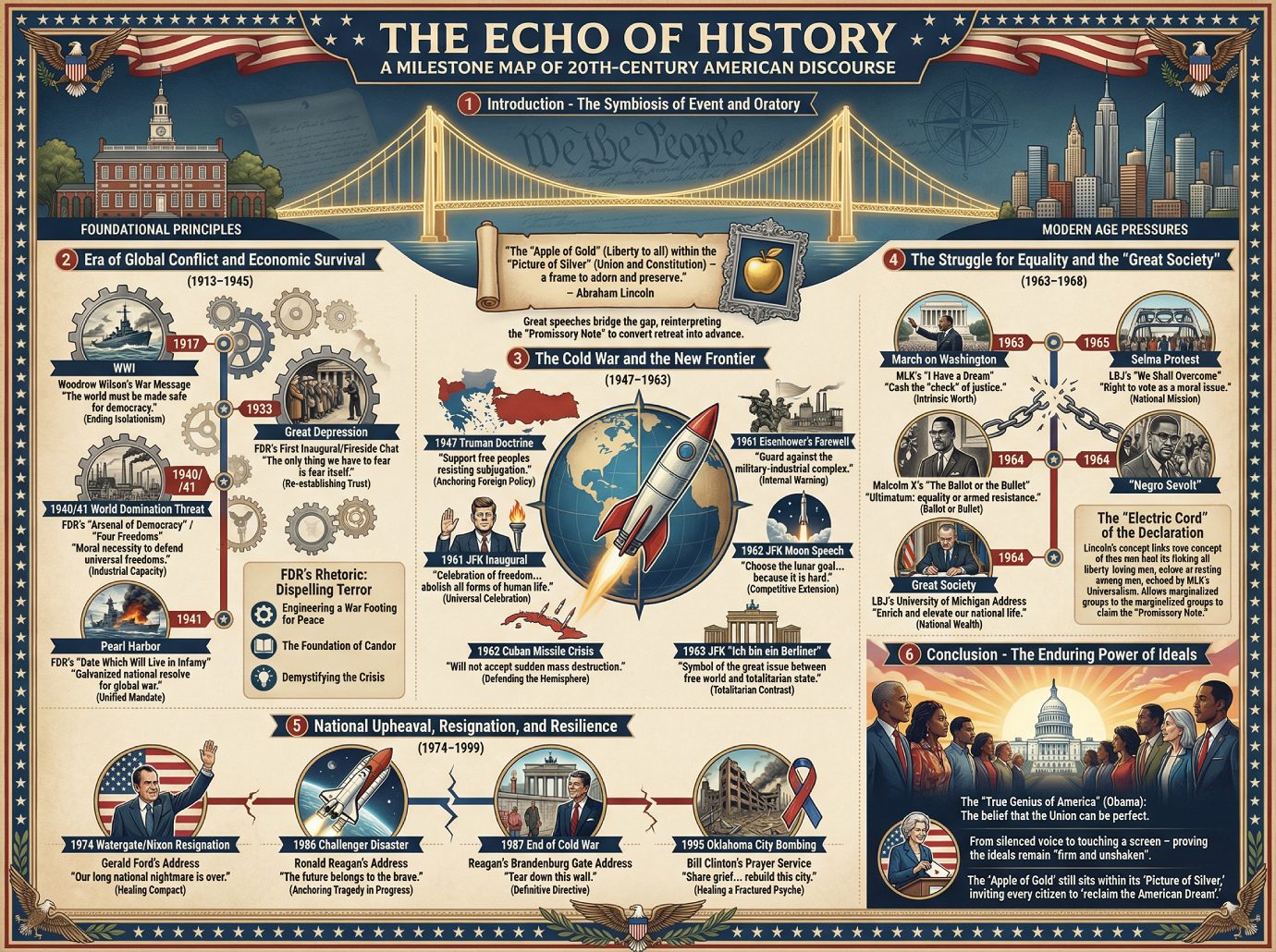
The Echo of History: A Milestone Map of 20th-Century American Discourse
1. Introduction: The Symbiosis of Event and Oratory
In the architecture of American statecraft, a great speech is not merely a reaction to a crisis; it is a bridge designed to span the distance between the foundational principles of the 18th century and the unique pressures of the modern age. Abraham Lincoln masterfully defined this functional relationship in his 1861 “Fragments,” describing the principle of “Liberty to all” in the Declaration of Independence as an “Apple of Gold.” To Lincoln, the Union and the Constitution served as the “Picture of Silver”—a frame engineered not to conceal the ideal, but to “adorn and preserve” it. The frame was made for the apple, not the apple for the frame.
As the nation entered the 20th century, this “apple” faced existential threats that required a new rhetorical blueprint. Leaders were forced to reinterpret what Martin Luther King Jr. would later call a “Promissory Note”—the sacred obligation that every American, regardless of their origin, would inherit the unalienable rights of life, liberty, and the pursuit of happiness. This map illustrates how 20th-century leaders used the power of the spoken word to “convert retreat into advance” (FDR) and to “organize and measure the best of our energies and skills” (JFK). By anchoring their arguments in 18th-century ideals, these orators navigated the transition from a fragmented agrarian republic to a globalized industrial powerhouse.
——————————————————————————–
2. Era of Global Conflict and Economic Survival (1913–1945)
During the first half of the 20th century, American rhetoric was restructured to provide stability against the twin shocks of global war and total economic collapse.
Milestones of Crisis & Response
| Historical Event | Defining Speech | The “So What?” for the Era |
|---|---|---|
| WWI / German Submarine Warfare (1917) | Woodrow Wilson’s War Message | Formally constructed the mandate that “the world must be made safe for democracy,” ending American isolationism. |
| The Great Depression / Banking Crisis (1933) | FDR’s First Inaugural/First Fireside Chat | Re-established public trust by asserting that “the only thing we have to fear is fear itself” and explaining the “mechanics” of banking. |
| The Threat of World Domination (1940/41) | FDR’s “Arsenal of Democracy” / “Four Freedoms” | Framed American industrial capacity as a moral necessity to defend universal freedoms (Speech, Worship, Want, Fear). |
| Pearl Harbor Attack (1941) | FDR’s “Date Which Will Live in Infamy” | Galvanized national resolve, transforming a sudden disaster into a unified, decisive mandate for global war. |
How FDR’s Rhetoric Dispelled “Nameless, Unreasoning, Unjustified Terror”:
• Engineering a War Footing for Peace: FDR famously addressed the economic collapse by treating it “as we would treat the emergency of a war.” By using this military metaphor, he provided the public with a sense of organized, aggressive leadership to “convert retreat into advance.”
• The Foundation of Candor: He insisted on a “leadership of frankness and of vigor,” believing that the “whole truth” was the only tool sharp enough to cut through paralyzed national effort.
• Demystifying the Crisis: In his Fireside Chats, he spoke to the “overwhelming majority” who did not understand the “mechanics of banking.” By replacing mystery with plain-language understanding, he fortified the psychological defenses of the American citizen.
As the physical struggle against totalitarianism concluded, the nation’s rhetoric shifted toward a permanent ideological standoff: the Cold War.
——————————————————————————–
3. The Cold War and the New Frontier (1947–1963)
In the post-war era, American leaders constructed a vision of the “struggle for the freedom of man.” This period saw a stylistic evolution: while President Eisenhower offered a “sobering warning” about internal institutional threats, President Kennedy constructed a “New Frontier” that challenged the nation to confront external and scientific challenges.
1. The Truman Doctrine (1947): Anchoring Foreign Policy in Free Choice. Truman established that the U.S. must support “free peoples who are resisting attempted subjugation,” specifically ensuring the survival of Greece and Turkey as free nations.
2. Farewell Address (Eisenhower, 1961): The Internal Warning. Eisenhower cautioned against the “military-industrial complex,” a misplaced power that he feared could “endanger our liberties or democratic processes” despite its necessity.
3. Inaugural Address (JFK, 1961): The Universal Celebration of Freedom. Kennedy signaled a stylistic shift, framing his victory not as a party win but as a “celebration of freedom,” warning that man now held the nuclear power to “abolish all forms of human life.”
4. The Moon Speech (JFK, 1962): The Competitive Extension of Liberty. Kennedy transformed the Space Race into a crucible to “measure the best of our energies,” choosing the lunar goal “not because [it is] easy, but because [it is] hard.”
5. Cuban Missile Crisis (JFK, 1962): Defending the Hemisphere. This address confronted the “nuclear strike capability” established in Cuba, asserting that the U.S. would not accept “sudden mass destruction” in defiance of international law.
6. “Ich bin ein Berliner” (JFK, 1963): The Totalitarian Contrast. By declaring himself a citizen of Berlin, Kennedy portrayed the city as the ultimate symbol of the “great issue” between the free world and the communist “totalitarian state.”
This global defense of liberty inevitably forced a rhetorical and moral reckoning with the lack of those same rights within American borders.
——————————————————————————–
4. The Struggle for Equality and the “Great Society” (1963–1968)
In the 1960s, activists and presidents alike reclaimed the “promissory note” of the Declaration—the 18th-century “Apple of Gold”—to demand a “new birth of freedom” for all citizens.
Civil Rights Milestones
| Milestone | Speech | Insight |
|---|---|---|
| The March on Washington (1963) | MLK’s “I Have a Dream” | Demanded that America cash the “check” of justice and recognized the “intrinsic worth” of all people. |
| The Selma Protest (1965) | LBJ’s “We Shall Overcome” | Framed the right to vote as a “moral issue” and a national mission to “right wrong.” |
| The “Negro Revolt” (1964) | Malcolm X’s “The Ballot or the Bullet” | Presented an ultimatum: either full equality through the ballot or the inevitability of armed resistance. |
| The Great Society (1964) | LBJ’s University of Michigan Address | Proposed using national wealth not just for survival, but to “enrich and elevate our national life.” |
The “Electric Cord” of the Declaration In his 1858 Chicago speech, Abraham Lincoln identified an “Electric Cord” in the Declaration that links the hearts of all liberty-loving men. He argued that while many Americans are not “descended by blood” from the founders—specifically citing German, Irish, French, and Scandinavian immigrants—they are made “blood of the blood” through the “moral sentiment” that all men are created equal. In the 20th century, Martin Luther King Jr. echoed this “Electric Cord” through his theme of Universalism, asserting that “all men” (not some) possess “intrinsic worth” because they are made in the image of God. This rhetorical bond allowed marginalized groups to claim the “Promissory Note” as their rightful inheritance.
The high hopes of the Great Society were soon followed by a period of profound institutional trauma and national mourning.
——————————————————————————–
5. National Upheaval, Resignation, and Resilience (1974–1999)
The final quarter of the century required rhetoric that could heal a fractured national psyche and navigate the collapse of the Cold War order.
• The Watergate Crisis and the Healing Compact: While Richard Nixon’s 1974 resignation focused on the pragmatic loss of his “political base,” Gerald Ford reconstructed the presidency as a “compact with my countrymen.” Acknowledging he was not elected by “ballots” but by “prayers,” Ford focused on “healing the injured” and declaring that our “long national nightmare is over.”
• The Challenger Disaster (1986): Ronald Reagan anchored a national tragedy in the tradition of progress. Addressing schoolchildren, he explained that failure is “part of the process of exploration” and that the future “belongs to the brave.”
• The End of the Cold War: In his 1987 Brandenburg Gate Address, Reagan issued the definitive directive to “tear down this wall,” framing the barrier as a symbol of the “will of a totalitarian state” that must yield to liberalization.
• The Oklahoma City Bombing (1995): Bill Clinton used a prayer service to “share grief” as a neighbor and parent. He focused on the “terrible sin” of the act and the need to “rebuild this city” while bringing justice to those who attacked the “American family.”
As the century closed, the nation looked toward a “New Dawn,” prepared to test the endurance of its foundational ideals once more.
——————————————————————————–
6. Conclusion: The Enduring Power of Ideals
The “True Genius of America,” as articulated by Barack Obama, lies in the fundamental belief that the nation can change—that the “Union can be perfect.” Obama’s rhetoric serves as a 21st-century bridge that reclaims the 18th-century “Promissory Note” for a new generation, asserting that the true strength of the nation comes not from its “wealth” or “might,” but from the “enduring power of our ideals”: Democracy, Liberty, and Opportunity.
For the student of history, the “So What?” of this rhetorical map is best seen through the life of 106-year-old voter Ann Nixon Cooper. Born just a generation after slavery, she lived through the Dust Bowl, the Great Depression, and the “Electric Cord” of the Civil Rights movement. Her journey from a time when her voice was silenced to a time when she “touched her finger to a screen” to cast a vote proves that while the nation may “default” on its promises, the ideals remain “firm and unshaken” (Coolidge). The 20th century confirms that the “Apple of Gold” still sits within its “Picture of Silver,” inviting every citizen to “reclaim the American Dream.”
—————-
Voices of Freedom: A Student’s Guide to the Themes of American Oratory
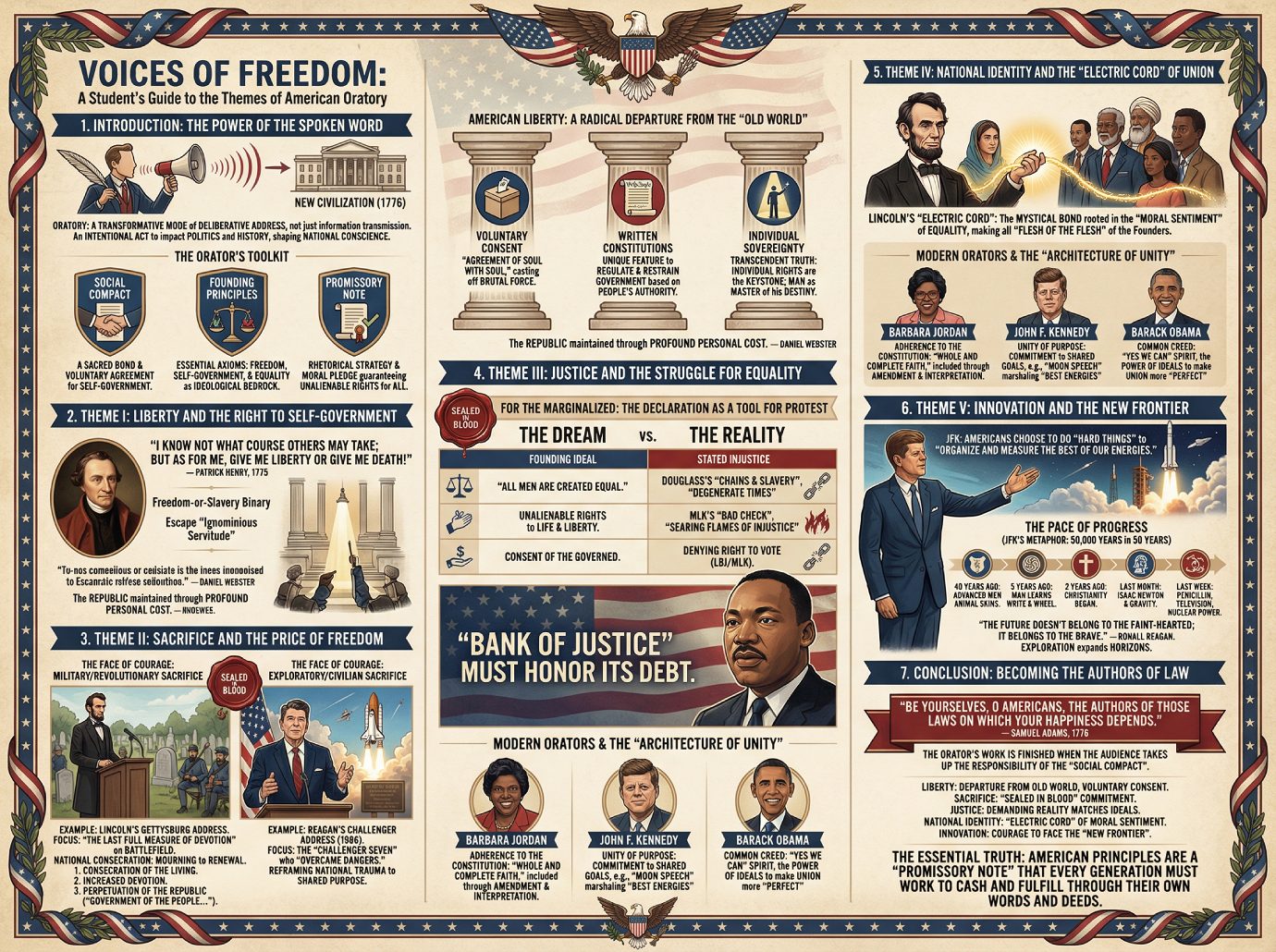
Voices of Freedom: A Student’s Guide to the Themes of American Oratory
1. Introduction: The Power of the Spoken Word
In the American tradition, oratory is far more than the mere transmission of information; it is a transformative mode of deliberative address. Within this guide, we define oratory as the intentional act of giving a speech to a live audience to directly impact the course of politics and history. From the prophetic warnings of the revolutionary era to the modern calls for exploration, the American orator serves as the architect of a “New Civilization” founded in 1776. By categorizing these milestones, students can identify the allusive power of the spoken word in shaping the national conscience and the core values that define our experience.
The Orator’s Toolkit
| Key Concept | Brief Definition |
|---|---|
| Social Compact | A sacred bond and voluntary “agreement of soul with soul” where a people choose a government for themselves rather than receiving it by force. |
| Founding Principles | The essential axioms of freedom, self-government, and equality that serve as the nation’s ideological bedrock. |
| Promissory Note | A rhetorical strategy and moral pledge ensuring that all people are guaranteed the unalienable rights of life, liberty, and the pursuit of happiness. |
As we explore these tools in action, we begin with the foundational theme of American identity: the absolute demand for liberty as a prerequisite for self-government.
——————————————————————————–
2. Theme I: Liberty and the Right to Self-Government
The earliest American orators utilized a stark freedom-or-slavery binary to persuade a skeptical public that reconciliation with a “heartless mother” country was an “illusion of hope.” Patrick Henry and Samuel Adams reframed independence not as a political preference, but as a moral imperative to escape “ignominious servitude.” For these men, the American colonies were destined to become a global “asylum” for civil and religious liberty.
“I know not what course others may take; but as for me, give me liberty or give me death!” — Patrick Henry, 1775
According to John Quincy Adams and Daniel Webster, American liberty represented a radical departure from the “Old World.” While other nations received laws from “conquerors” or “hereditary authority,” the American experiment was built on three distinct pillars:
• Voluntary Consent: This is the “agreement of soul with soul,” where citizens formally and deliberately choose their own government, casting off the “slough of brutal force” that defined former empires.
• Written Constitutions: A unique feature of the American “fabric,” these documents exist to regulate and restrain the powers of government based on the immediate authority of the people.
• Individual Sovereignty: The transcendent truth that the rights of the individual against the State are the “keystone” of the Constitution, acknowledging that man has an unconquerable desire to be the master of his own destiny.
The preservation of this “great inheritance of liberty” caused every man’s heart to swell, yet as Daniel Webster cautioned, the structure of the republic could only be maintained through the profound personal cost of those willing to protect it.
——————————————————————————–
3. Theme II: Sacrifice and the Price of Freedom
In the study of rhetoric, sacrifice is often framed as the “seal” that validates a nation’s principles. Daniel Webster articulated this by noting the Declaration was “sealed in blood,” moving the audience from abstract theory to the visceral reality of freedom’s cost. However, the American tradition also recognizes that sacrifice evolves; it is not solely the domain of the soldier but also the explorer.
The Face of Courage
| Military/Revolutionary Sacrifice | Exploratory/Civilian Sacrifice |
|---|---|
| Example: Lincoln’s Gettysburg Address | Example: Reagan’s Challenger Address (1986) |
| Focus: Those who gave “the last full measure of devotion” on the battlefield to ensure the nation might live. | Focus: The “Challenger Seven” who, aware of the dangers, “overcame them and did their jobs brilliantly.” |
Contextually, Ronald Reagan’s tribute to the Challenger crew is a testament to the impact of oratory on history; he delivered these remarks on the very day he was scheduled to give the State of the Union address, reframing a moment of national trauma into one of shared purpose. Similarly, at Gettysburg, Abraham Lincoln performed a “national consecration.” He reframed the purpose of the cemetery from a site of mourning to a site of national renewal, arguing that the sacrifice of the “honored dead” creates a “new birth of freedom” through a specific rhetorical progression:
1. Consecration of the Living: The living must be “dedicated here to the unfinished work” which the fallen have so nobly advanced.
2. Increased Devotion: By taking inspiration from those who gave everything, the nation ensures that these dead “shall not have died in vain.”
3. Perpetuation of the Republic: This collective sacrifice ensures that government “of the people, by the people, for the people” shall not perish.
This focus on the sacrifice of the few inevitably leads to the orator’s demand for justice and the fulfillment of the nation’s original promises for all.
——————————————————————————–
4. Theme III: Justice and the Struggle for Equality
For the marginalized, the Declaration of Independence was not a finished victory to be celebrated, but a potent tool for protest. Frederick Douglass and Martin Luther King Jr. both highlighted the agonizing dissonance between the American “Dream” and the “long night of captivity” endured by those in bondage.
Rhetorically, King’s greatest contribution was his use of the Promissory Note as an extended metaphor. He argued that the Founders signed a check that had come back marked “insufficient funds,” effectively demanding that the “bank of justice” finally honor its debt.
The Dream vs. The Reality
| Founding Ideal | Stated Injustice |
|---|---|
| “All men are created equal.” | Douglass’s “chains and slavery” and the “degenerate times” of the mid-19th century. |
| Unalienable rights to Life and Liberty. | MLK’s “bad check” and the “searing flames of withering injustice.” |
| Consent of the governed. | The “deadly wrong” of denying fellow Americans the right to vote (LBJ/MLK). |
In the 20th century, the demand for justice expanded through diverse perspectives on the definition of human rights:
• Malcolm X: In “The Ballot or the Bullet,” he utilized a stark ultimatum, demanding full equality for African Americans and warning that if political rights (the ballot) were not granted, the taking up of arms (the bullet) would be inevitable.
• Hillary Clinton: In her 1995 Beijing address, she insisted on the inclusion of women in the global definition of humanity, famously declaring that “Women’s Rights are Human Rights.”
• Shirley Chisholm: Advocating for the Equal Rights Amendment, she attacked gender discrimination as the most “institutionalized form of prejudice,” seeking to codify equality into the legal marrow of the nation.
As these voices sought to rectify the “deadly wrong” of exclusion, they simultaneously wove a more complex and resilient national identity.
——————————————————————————–
5. Theme IV: National Identity and the “Electric Cord” of Union
In 1858, Abraham Lincoln introduced the concept of the “Electric Cord” to describe the mystical bond of the Union. He argued that even those not descended by blood from the Founders—immigrants of German, Irish, French, and Scandinavian descent—become “flesh of the flesh” of the men who wrote the Declaration. This connection is not biological but rooted in the “moral sentiment” of equality.
Modern orators have continued to use this “Electric Cord” to bridge historical divides. Ronald Reagan, standing in New York Harbor, reaffirmed that “Jew and gentile… black and white… we are all Americans.” This unity is not a passive state but an active “Architecture of Unity” preserved in three ways:
• Adherence to the Constitution: Barbara Jordan famously expressed a “whole and complete” faith in the Constitution. Her rhetoric was particularly powerful because she acknowledged her initial exclusion from “We the People,” noting that she was only included later through the “process of amendment, interpretation, and court decision.”
• Unity of Purpose: The commitment to shared, daunting national goals, exemplified by JFK’s “Moon Speech,” which sought to marshal the “best of our energies and skills.”
• Common Creed: The “Yes We Can” spirit articulated by Barack Obama, which suggests that the Union can always be made more “perfect” through the enduring power of ideals.
This unified identity, forged through struggle and faith, provides the collective courage required to face the “vast stretches of the unknown” in the future.
——————————————————————————–
6. Theme V: Innovation and the New Frontier
By the 1960s, American oratory underwent a shift toward the “New Frontier” of progress and exploration. John F. Kennedy’s 1962 Rice University speech famously argued that Americans choose to do “hard things” like going to the moon precisely because that challenge “serves to organize and measure the best of our energies.”
The Pace of Progress
To illustrate the acceleration of human knowledge, Kennedy condensed 50,000 years of history into a 50-year metaphor:
| Condensed Timeframe | Technological/Historical Milestone |
|---|---|
| 40 Years Ago | Advanced men learn to use animal skins for clothing. |
| 5 Years Ago | Man learns to write and use the wheel. |
| 2 Years Ago | Christianity began. |
| Last Month | Isaac Newton explored the meaning of gravity. |
| Last Week | Penicillin, television, and nuclear power are developed. |
In the wake of the Challenger tragedy, Ronald Reagan distilled the primary benefit of such rapid progress, asserting that “the future doesn’t belong to the faint-hearted; it belongs to the brave.” This rhetorical legacy reminds us that while exploration brings “high cost and hardships,” it is the only way to expand man’s horizons.
——————————————————————————–
7. Conclusion: Becoming the Authors of Law
The study of American oratory reveals that the “Power of the Spoken Word” is not a closed chapter of history, but an ongoing invitation. We conclude with the exhortation of Samuel Adams in 1776: “Be yourselves, O Americans, the authors of those laws on which your happiness depends.” The orator’s work is only finished when the audience takes up the responsibility of the “Social Compact.”
• Liberty: A departure from the Old World, founded on voluntary consent and written restraints on power.
• Sacrifice: The “sealed in blood” commitment that transforms a cemetery into a site of national consecration.
• Justice: The use of the Promissory Note as a rhetorical tool to demand that the reality of the nation matches its ideals.
• National Identity: The “Electric Cord” of moral sentiment that connects every citizen, regardless of origin, to the Founders.
• Innovation: The courage to face the “New Frontier” and do “hard things” to advance human civilization.
The Essential Truth: American principles are not a static inheritance but a “promissory note” that every generation must work to cash and fulfill through their own words and deeds.