
Economy of the United States – 7 Reports from Gardner Magazine
Jump to your report of choice by clicking on one of these links:
1. The American Economic Journey: A Strategic History of Growth, Crisis, and Transformation —– 2. Comprehensive Briefing: The Evolution and Mechanics of the United States Economy —--3. From Wampum to Wall Street: 5 Surprising Realities of the American Economic Journey —– 4. U.S. Economic Resilience: A Strategic Analysis of GDP Volatility and Policy Catalysts (1790–2025)—– 5. Market Evolution: A Strategic Review of the American Economic Journey —– 6. Understanding the Engine of Choice: An Economic Concept Primer —– 7. From Wampum to the Paper Dollar —–
Listen to a “Deep Dive” podcast about the United States Economy.
Listen to a “Debate” podcast on the various issues affecting the United States Economy.
Watch a short video on the United States Economy.
The American Economic Journey: A Strategic History of Growth, Crisis, and Transformation
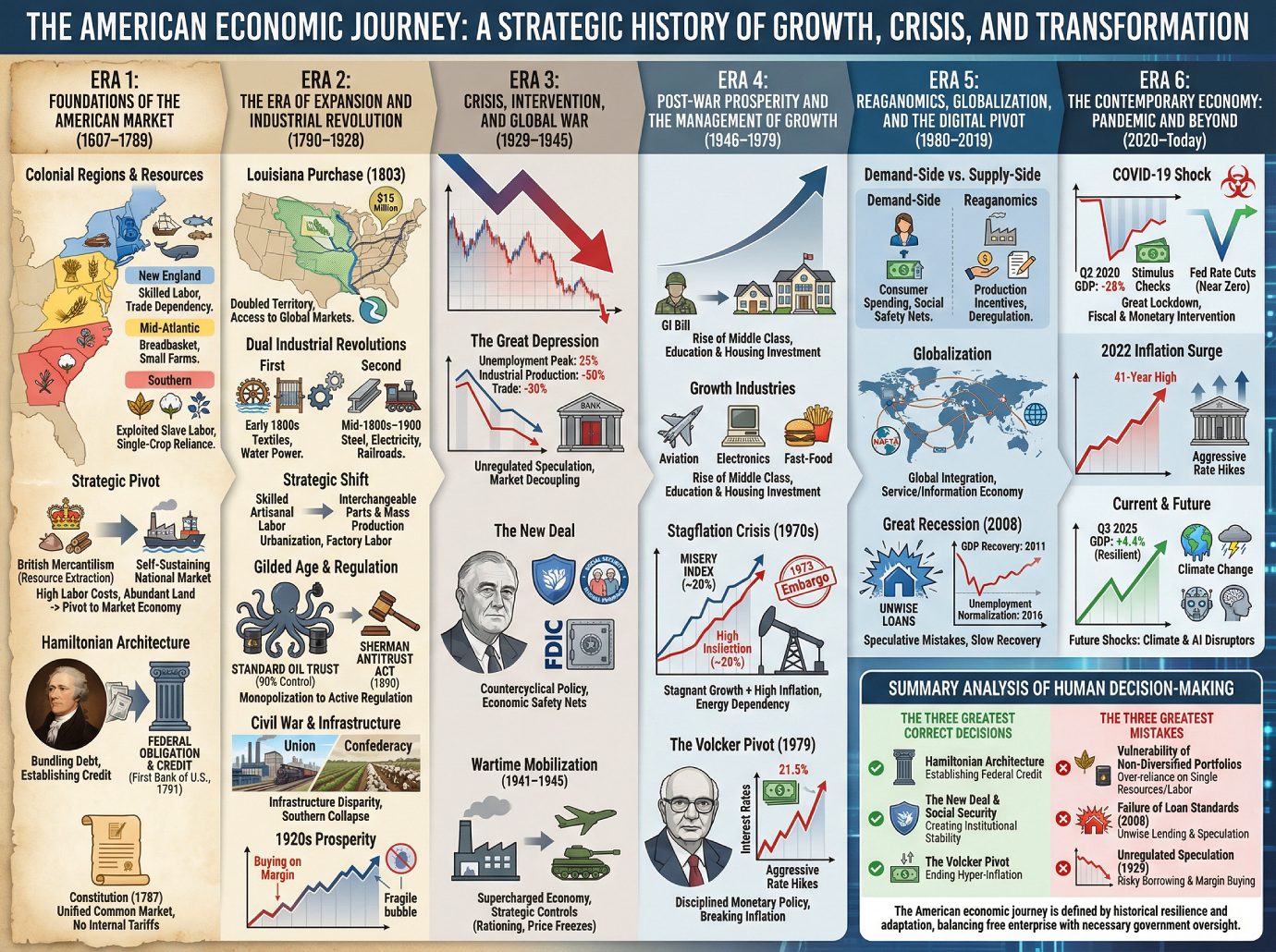
The American Economic Journey: A Strategic History of Growth, Crisis, and Transformation
1. Foundations of the American Market (1607–1789)
The genesis of the American economy was defined by a strategic transition from a British mercantilist resource-extraction model to a self-sustaining, independent national market. This evolution was dictated by the unique geographic realities of the New World: a vast abundance of natural resources and land contrasted with a severe scarcity of human resources. These conditions necessitated a pivot from subsistence farming toward a market economy capable of processing raw materials for international trade. The early architects of this system had to answer the three fundamental economic questions—what to produce, how to produce, and for whom—within a landscape where labor costs were high and land was the primary capital resource.
| Colonial Region | Primary Resources/Goods | Labor Systems & Trade Dependency |
|---|---|---|
| New England | Timber, fish, whales, and shipbuilding. | Relied on skilled human resources; high dependency on Caribbean markets and British finished goods. |
| Mid-Atlantic | Wheat, rye, and barley (the “Breadbasket”). | Managed by small farm owners; balanced between internal consumption and grain exports. |
| Southern | Tobacco, indigo, cotton, and rice. | Heavily reliant on exploited slave labor; high dependency on British and Northern textile markets. |
The Hamiltonian Architecture: Establishing Federal Credibility As the first Secretary of the Treasury, Alexander Hamilton served as the strategic visionary for the nation’s financial infrastructure. His decision to bundle state and national debts into a unified federal obligation was a masterstroke of fiscal policy. The strategic “opportunity cost” of rejecting this plan would have likely been a collection of fragmented, insolvent states vulnerable to foreign re-colonization. By establishing national credit through the First Bank of the United States (1791) and funding the debt via import tariffs and a whiskey tax, Hamilton tied the interests of private capital to the solvency of the federal government, preventing post-revolutionary bankruptcy.
Mercantilism vs. Free Enterprise The American Revolution was essentially a revolt against the structural failures of British mercantilism. Key differentiators included:
• The Navigation Act of 1660: A primary strategic mistake that prohibited the colonies from manufacturing finished goods and mandated that trade pass through British ports to ensure a trade surplus for the Crown.
• Capitalism vs. Extraction: While the British sought to amass gold and silver through restrictive trade, the emerging American model favored private ownership and the freedom for producers to determine prices based on aggregate demand.
• Fiscal Autonomy: The British imposition of taxes (Stamp Act, Tea Act) without colonial consent ignored the growing economic maturity of the American market.
The ratification of the Constitution in 1787 corrected these imbalances by creating a unified common market. By prohibiting internal tariffs and granting the federal government power over interstate commerce, the Constitution established the legal framework necessary for continental expansion.
——————————————————————————–
2. The Era of Expansion and Industrial Revolution (1790–1928)
The 19th-century transformation was driven by a radical shift in “how to produce.” The United States transitioned from an agrarian society to a global industrial power through a “transportation revolution”—a network of roads, canals, and railroads that integrated regional markets. This infrastructure allowed the economy to move from subsistence-level activity to the mass production of goods for a burgeoning consumer base.
• The Louisiana Purchase (1803): This $15 million transaction was a strategic win that doubled the nation’s economic territory. Crucially, it secured exclusive access to the Mississippi River, providing a vital artery for transporting resources from the interior to global markets via the Gulf of Mexico.
• The Dual Industrial Revolutions:
1. First Industrial Revolution (Early 1800s): Focused on textiles and water power, pioneered by Samuel Slater.
2. Second Industrial Revolution (Mid-1800s to 1900): Driven by steel, electricity, and the expansion of the railroad.
3. Strategic Shift in Human Resources: The introduction of interchangeable parts and mass production replaced the need for skilled artisanal labor with mechanized processes. This drove rapid urbanization as workers moved to cities to fulfill the demand for factory labor.
The Gilded Age: Monopolization and the Regulatory Correction The late 19th century saw the rise of “Big Business,” characterized by trusts like Standard Oil. By 1879, Standard Oil controlled 90% of U.S. oil production. The strategic “So What?” of this era was the government’s pivot from laissez-faire to active regulation. The Sherman Antitrust Act (1890) corrected market imbalances, leading to the landmark breakup of Standard Oil into competing entities—the ancestors of today’s Exxon, Chevron, and Mobil—thereby restoring the competitive vigor of the capitalist system.
The Southern Collapse and Infrastructure Disparity The Civil War highlighted the fragility of a non-diversified economy. The Confederacy’s over-reliance on a single-crop system and exploited slave labor proved catastrophic. Strategically, the Union’s robust infrastructure for trade and manufacturing was the differentiator that allowed the North to sustain mobilization while the Southern economy collapsed. Post-war reintegration required a total restructuring of the South’s labor and production models.
Transitioning into the 1920s, the U.S. enjoyed unprecedented prosperity. However, this growth was built on a fragile foundation of “buying on margin,” a speculative mistake where a reliance on borrowed money created an unsustainable market bubble.
——————————————————————————–
3. Crisis, Intervention, and Global War (1929–1945)
The 1929 stock market crash triggered a strategic pivot toward “Big Government.” As aggregate demand plummeted, the U.S. moved away from minimal intervention toward a managed economy, fundamentally altering the social contract between the state and the citizen.
The Great Depression: Anatomy of a Failure The crash was the culmination of unregulated speculation and risky spending, where market prices decoupled from actual company values.
Macroeconomic Consequences of the Collapse:
• Unemployment: Reached a historic peak of 25% by 1933.
• Industrial Production: Suffered a catastrophic 50% contraction.
• International Trade: Shrank by 30%, exacerbating the global nature of the crisis.
• Banking: Widespread “bank runs” led to thousands of failures, as the system lacked a mechanism to safeguard liquidity.
The New Deal as a Corrective Measure President Franklin D. Roosevelt’s New Deal represented a “correct decision” to implement countercyclical fiscal policy. By establishing Social Security and the Federal Deposit Insurance Corporation (FDIC), the government created the first national economic safety nets, providing institutional stability that mitigated the risk of future systemic panics.
Wartime Mobilization (1941–1945) World War II “supercharged” the economy through massive military expenditure, effectively ending the Depression. To manage this production surge without triggering hyperinflation, the government implemented strategic controls, including price, wage, and rent freezes, alongside food rationing. This transition proved the U.S. could mobilize its manufacturing prowess for total war, a capability that established the nation as a global superpower upon the return to a consumer-led economy.
——————————————————————————–
4. Post-War Prosperity and the Management of Growth (1946–1979)
The post-war era was defined by the rise of the American middle class, fueled by the GI Bill’s strategic investment in the education and housing of returning veterans. This period saw the “Modern Fed” emerge as a powerful, independent entity managing the money supply to balance growth and price stability.
• Growth Industries of the Prosperity Era:
1. Aviation: Transitioned from military application to a dominant commercial industry.
2. Electronics: The miniaturization of computers opened non-academic and commercial markets.
3. Fast-Food Franchises: Models like McDonald’s standardized brand recognition and expanded service-sector employment.
The 1970s “Stagflation” Crisis The 1970s introduced “Stagflation,” a condition where stagnant growth and high unemployment collided with high inflation. This drove a surge in the “Misery Index” (the sum of the unemployment and inflation rates), which climbed toward 20% by 1980. The 1973 oil embargo exposed the strategic mistake of a non-diversified energy portfolio, as dependency on foreign oil left the domestic economy vulnerable to geopolitical shocks.
The Volcker Pivot In 1979, Federal Reserve Chairman Paul Volcker implemented a decisive countercyclical policy to “slay the inflationary dragon.” By tightening the money supply and allowing the prime rate to peak at a historic 21.5%, the Fed intentionally triggered a short-term recession. This “correct decision” accepted immediate pain to break the inflationary cycle, successfully stabilizing the dollar’s purchasing power parity for the long term.
——————————————————————————–
5. Reaganomics, Globalization, and the Digital Pivot (1980–2019)
The 1980s marked a strategic shift toward “Supply-Side” economics, prioritizing production incentives over demand-side stimulus. This era coincided with the deepening of global economic integration.
| Traditional Demand-Side | Supply-Side (Reaganomics) |
|---|---|
| Focuses on consumer spending to drive growth. | Focuses on tax cuts and deregulation for producers. |
| Uses government transfers to stimulate the market. | Encourages private investment through reduced barriers. |
| Prioritizes social safety net expenditure. | Prioritizes defense spending and business incentives. |
The Rise of Globalization and Interdependence Trade agreements like NAFTA and technological innovations integrated the U.S. into a global marketplace, shifting the domestic base from manufacturing to a service and information economy. However, this created a state of interdependence; the 2008 housing collapse proved that U.S. financial shocks now instantly destabilized all global trading partners.
Speculative Mistakes and the Great Recession The 21st century opened with significant speculative mistakes, notably the Tech Bubble and the 2008 Housing Bubble. The latter was driven by “unwise loans” and a catastrophic lowering of loan standards by financial institutions.
• The Recovery Gap: While the government’s “correct decision” to issue bailouts prevented a total banking collapse, the recovery was slow. U.S. inflation-adjusted GDP did not return to pre-recession levels until 2011, and unemployment did not normalize until 2016.
——————————————————————————–
6. The Contemporary Economy: Pandemic and Beyond (2020–Today)
The COVID-19 recession presented an unprecedented strategic challenge: balancing public health mandates with economic viability.
The COVID-19 Shock The “Great Lockdown” resulted in a staggering -28% annualized GDP growth in Q2 2020 and massive supply chain disruptions. The response was an immediate exercise of both fiscal and monetary policy:
• Congressional Stimulus: Direct payments to maintain consumer demand.
• Federal Reserve Intervention: Interest rates were slashed to near zero to maintain credit flow.
• Labor Recovery: Unlike previous downturns, the economy returned to “full employment” within approximately two years.
The 2022 Inflation Surge By 2022, the Russian invasion of Ukraine and lingering supply chain bottlenecks triggered a 41-year inflation high. The Federal Reserve responded with aggressive interest rate hikes through 2024 to restore price stability and protect purchasing power.
Current Indicators and Future Shocks Bureau of Economic Analysis (BEA) data for Q3 2025 shows a resilient economy with annualized growth of 4.4%, the strongest since 2023, driven by robust exports and consumer spending. Looking forward, the two primary strategic factors are Climate Change, which threatens infrastructure and raw material availability (inflicting over $400 billion in damages between 2016-2019), and Artificial Intelligence (AI), the next disruptor of human resource productivity.
Summary Analysis of Human Decision-Making
1. The Three Greatest Correct Decisions:
◦ The Hamiltonian Architecture: Bundling debt to establish federal credit and prevent fragmented national failure.
◦ The New Deal and Social Security: Creating institutional stability mechanisms to prevent total social and financial collapse during downturns.
◦ The Volcker Pivot: Utilizing disciplined, countercyclical monetary policy to end the era of hyper-inflation.
2. The Three Greatest Mistakes:
◦ Vulnerability of Non-Diversified Portfolios: Specifically the over-reliance on single-crop/exploited labor in the 19th-century South and foreign energy dependency in the 1970s.
◦ Failure of Loan Standards and Oversight: Allowing the 2008 Housing Bubble to form through unwise lending and unregulated speculation.
◦ Unregulated Speculation (1929): Allowing risky borrowing and margin buying to decouple market prices from actual economic value.
The American economic journey is defined by a historical resilience and an unparalleled ability to adapt, utilizing a mixed economy that balances the vigor of free enterprise with necessary government oversight to navigate systemic shocks. ———————————–
Comprehensive Briefing: The Evolution and Mechanics of the United States Economy
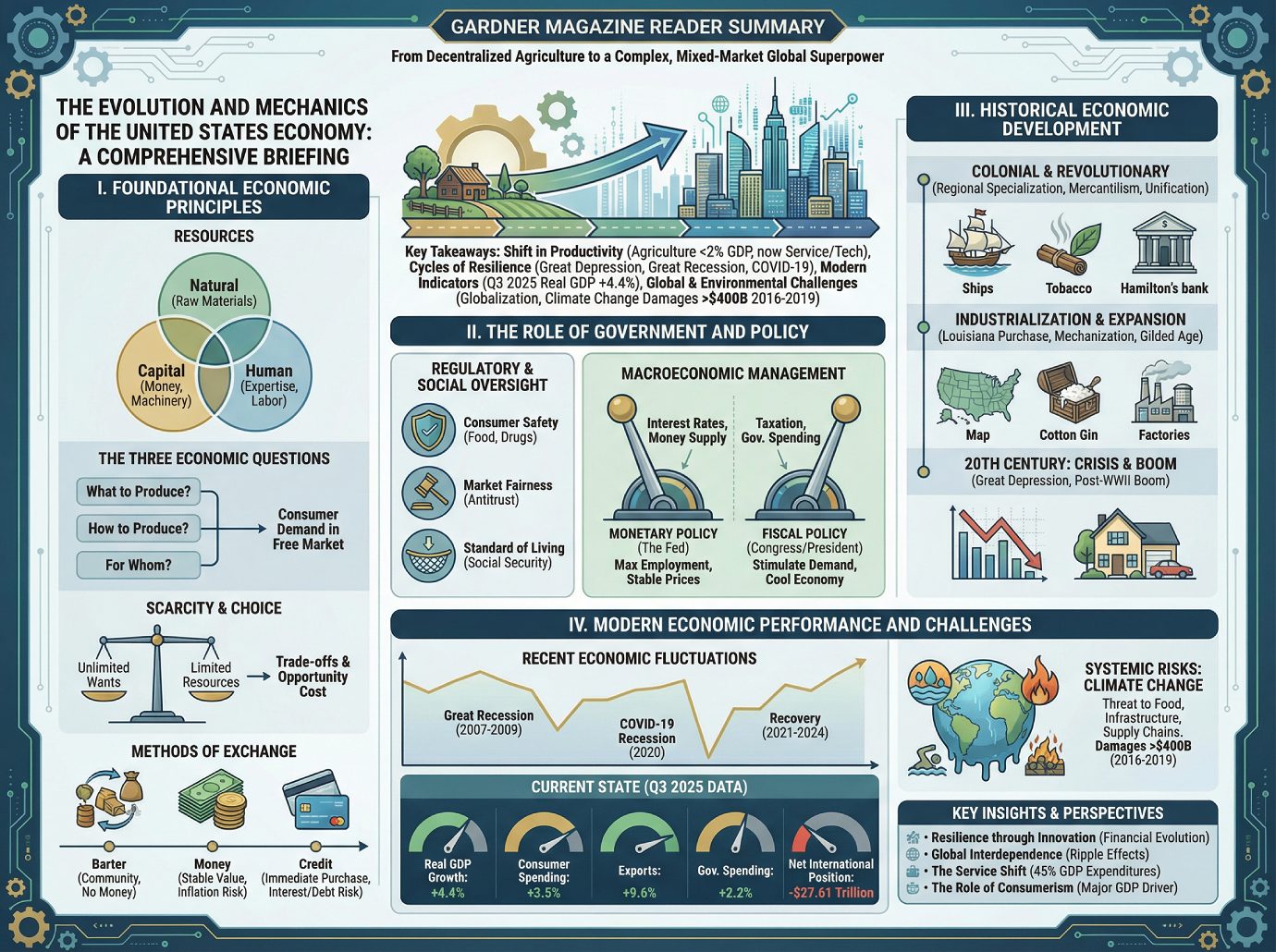
Comprehensive Briefing: The Evolution and Mechanics of the United States Economy
Gardner Magazine Reader Summary
The United States economy has evolved from a decentralized, agricultural, and barter-based colonial system into a highly complex, mixed-market global superpower. Historically defined by the principles of capitalism—where private individuals own the means of production—the U.S. system incorporates significant government intervention to ensure consumer safety, manage monopolies, and stabilize the macroeconomy through monetary and fiscal policies.
Key takeaways include:
• The Shift in Productivity: Initially dependent on agriculture (now less than 2% of GDP), the economy transitioned through two Industrial Revolutions to become a service-oriented and technology-driven powerhouse.
• Cycles of Resilience: The U.S. has navigated profound downturns, most notably the Great Depression (1929–1941) and the Great Recession (2007–2009). The COVID-19 pandemic in 2020 triggered a unique recession with simultaneous supply and demand shocks, followed by a robust recovery.
• Modern Indicators: As of the third quarter of 2025, the U.S. economy maintains strong momentum, with real GDP expanding at an annualized rate of 4.4%, driven by firm consumer spending and a surge in exports.
• Global and Environmental Challenges: Globalization has created deep international interdependence, while climate change poses a systemic threat, having already inflicted over $400 billion in damages between 2016 and 2019.
——————————————————————————–
I. Foundational Economic Principles
The American economic system is built upon the management of resources to fulfill human needs and wants under conditions of scarcity.
Core Definitions
• Resources: Categorized as Natural (raw materials like lumber/minerals), Capital (money, machinery, tools), and Human (expertise and labor).
• The Three Economic Questions: Every system must determine what to produce, how to produce it, and for whom it is produced. In the U.S. free market, these are largely shaped by consumer demand.
• Scarcity and Choice: Scarcity exists when resources cannot meet all consumer wants, driving up demand and prices. This necessitates Trade-offs, where choosing one option results in an Opportunity Cost—the value of the next best alternative sacrificed.
Methods of Exchange
The ability to trade has evolved through three primary mechanisms:
| Method | Historical Context | Advantages | Disadvantages |
|---|---|---|---|
| Barter | Central to early civilizations and Native American economies. | Builds community; no physical money needed. | Impractical; requires “double coincidence of wants”; time-consuming. |
| Money | Evolved from cowrie shells (1200 BCE) to paper (806 CE) and modern currency. | Widely accepted; stable short-term value; easy to measure. | Value can be eroded by inflation. |
| Credit | Traced to ancient Sumer (3500 BCE); formalized in Hammurabi’s Code. | Allows immediate purchase; facilitates large investments (e.g., Ford’s Model T). | Accrual of interest; risk of long-term debt. |
——————————————————————————–
II. The Role of Government and Policy
The United States operates a Mixed Economy, combining free enterprise with government regulation and social safety nets.
Regulatory and Social Oversight
Government intervention is typically triggered by concerns regarding:
• Consumer Safety: Regulations in food, drugs, and workplace environments.
• Market Fairness: Antitrust laws used to break up monopolies (e.g., the dissolution of Standard Oil in the early 1900s).
• Standard of Living: Programs like Social Security and unemployment insurance, established during the New Deal to provide economic safety nets.
Macroeconomic Management
The federal government utilizes two primary levers to stabilize the business cycle:
| Policy Type | Managed By | Primary Tools | Objective |
|---|---|---|---|
| Monetary Policy | The Federal Reserve (The Fed) | Manipulating the federal funds rate; managing money supply. | Maximizing employment; stabilizing prices/curbing inflation. |
| Fiscal Policy | Congress and the President | Taxation and government spending. | Stimulating demand during recessions; cooling overheated economies. |
——————————————————————————–
III. Historical Economic Development
The U.S. economy has undergone distinct eras of transformation, often catalyzed by conflict or technological innovation.
The Colonial and Revolutionary Eras
• Regional Specialization: New England focused on shipbuilding and fishing; the Mid-Atlantic grew grains; the South thrived on tobacco, indigo, and cotton (heavily dependent on enslaved labor).
• Mercantilism: The British system restricted colonial manufacturing to ensure a trade surplus for the Crown, eventually sparking the American Revolution over the authority to tax.
• Unification: Alexander Hamilton (First Secretary of the Treasury) established national credit by consolidating state debts and founding the First Bank of the United States in 1791.
Industrialization and Expansion
• Territorial Growth: The 1803 Louisiana Purchase doubled the nation’s size, providing vast resources and access to the Mississippi River.
• Mechanization: Innovations like Eli Whitney’s cotton gin and Oliver Evans’ automatic flour mill revolutionized production. The Second Industrial Revolution (mid-1800s) introduced mass production and transcontinental railroads.
• The Gilded Age: Characterized by the rise of “Big Business” and industrialists like Rockefeller and Carnegie, leading to the first significant anti-monopoly regulations.
The 20th Century: Crisis and Boom
• The Great Depression (1929–1941): Triggered by a stock market crash and speculative borrowing. Unemployment peaked at 25%, and industrial production fell by 50%.
• The Post-WWII Boom: Following 1945, the U.S. entered a period of unprecedented prosperity. The GI Bill created a massive middle class, and advancements in aviation, electronics, and computing established the U.S. as a global superpower.
——————————————————————————–
IV. Modern Economic Performance and Challenges
The 21st-century economy is defined by globalization and the transition to a service-based “platform economy.”
Recent Economic Fluctuations
The business cycle has remained irregular, featuring the longest expansion on record (2009–2020: 128 months) followed by a sharp COVID-19-induced contraction.
| Event | Timeframe | Key Features |
|---|---|---|
| Great Recession | 2007–2009 | Triggered by the housing market collapse; required bank bailsouts. |
| COVID-19 Recession | 2020 (2 months) | Trough in April 2020; characterized by unique supply chain disruptions. |
| Recovery Phase | 2021–2024 | Marked by surging inflation (41-year high in 2022) and Fed interest rate hikes. |
Current State of the U.S. Economy (Q3 2025 Data)
Recent data from the Bureau of Economic Analysis (BEA) indicates significant expansion:
| Indicator | Value (Q3 2025) | Notes |
|---|---|---|
| Real GDP Growth Rate | +4.4% | Strongest growth since Q3 2023. |
| Consumer Spending | +3.5% | Accounts for roughly 68% of total GDP. |
| Exports | +9.6% | Rebounded from a decline in the previous quarter. |
| Government Spending | +2.2% | Rebounded from -0.1% in Q2. |
| Net International Position | -$27.61 Trillion | Difference between foreign assets and liabilities. |
Systemic Risks: Climate Change
Climate change is identified as a significant threat to global food production, infrastructure, and supply chains. Rising temperatures and erratic weather (e.g., flooding in the Midwest, wildfires in California) disrupt economic stability. Between 2016 and 2019, the estimated damage reached $400 billion, with expectations of increased scarcity for raw materials in the future.
——————————————————————————–
V. Key Insights and Perspectives
• Resilience through Innovation: The transition from the “Curb” (open-air trading) to the American Stock Exchange, and from “greenbacks” to digital currency, illustrates a persistent drive for financial innovation.
• Global Interdependence: The “Great Recession” demonstrated that a collapse in the U.S. housing market has ripple effects across all global trading partners.
• The Service Shift: Over the last 50 years, the U.S. has moved from a manufacturing-heavy economy to a service economy, with services now accounting for 45% of GDP expenditures.
• The Role of Consumerism: Modern American society is heavily driven by consumer spending, which currently contributes 2.34 percentage points to the overall GDP growth contribution.
————————————————
From Wampum to Wall Street: 5 Surprising Realities of the American Economic Journey
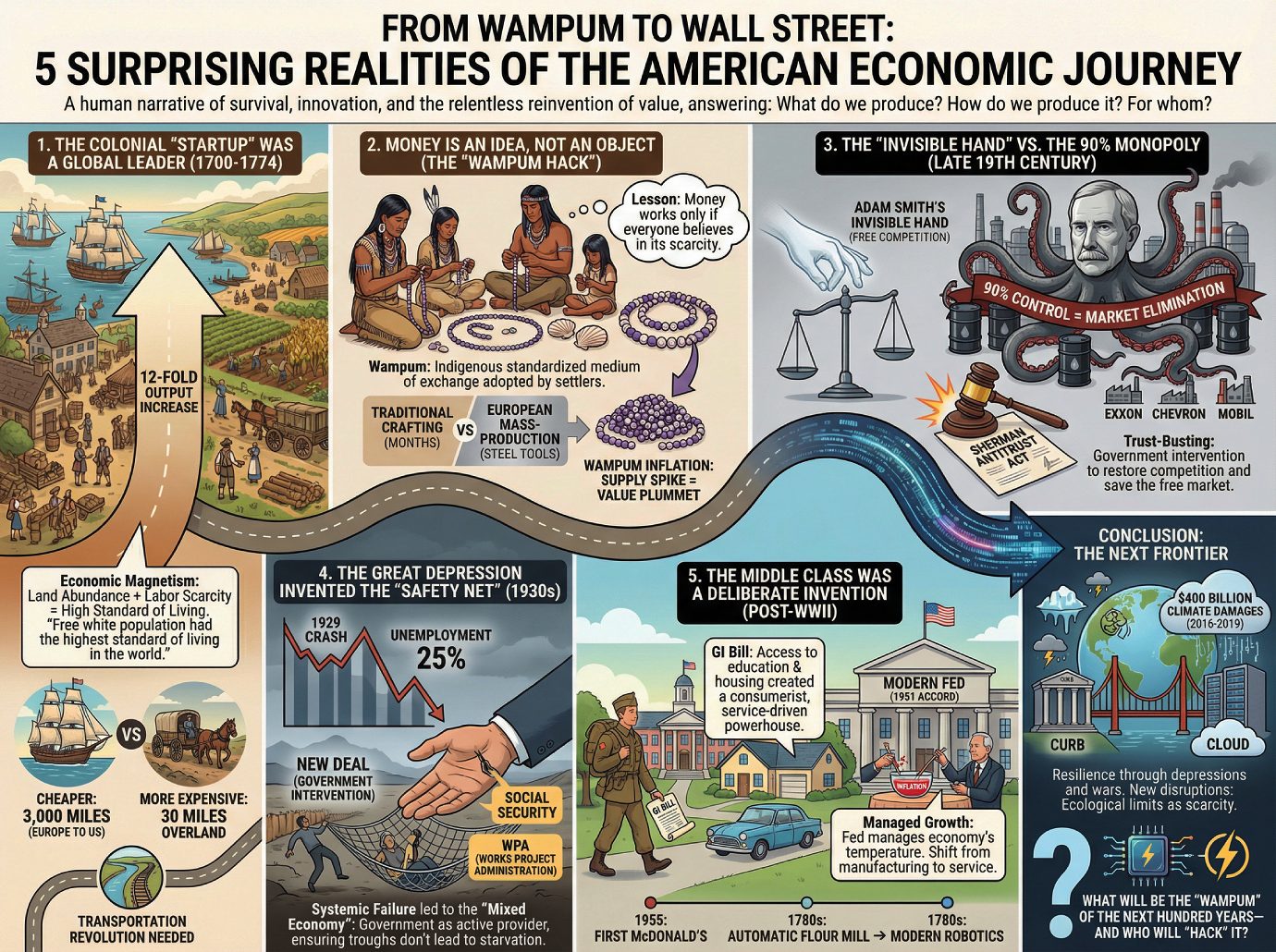
From Wampum to Wall Street: 5 Surprising Realities of the American Economic Journey
To the modern observer, “the economy” often feels like an impenetrable machine, a chaotic swirl of high-frequency trading and abstract interest rate hikes. But strip away the digital screens and the jargon, and you find a narrative that is fundamentally human. It is a story of survival, innovation, and the relentless reinvention of how we value one another’s labor.
The U.S. economy isn’t a series of static charts; it’s a living drama. It is the story of how a collection of sparse, pre-industrial outposts transformed into a global superpower by answering three ancient questions: What do we produce? How do we produce it? And for whom? As we trace the line from ancient shell-bead currencies to the modern “mixed economy,” we find that our financial reality is built on a foundation of surprising, often misunderstood, turning points.
1. The Colonial “Startup” was a Global Leader
Popular history often portrays early American settlers as impoverished survivors eking out a living in a hostile wilderness. The data, however, reveals an “economic magnetism” that was the envy of the Old World. Between 1700 and 1774, the colonial output increased a staggering 12-fold. By the time the first shots were fired at Lexington, the colonial economy was already 30% the size of Britain’s.
This prosperity was born of a unique reversal of European dynamics: an infinite abundance of land paired with a severe scarcity of labor. While Europe dealt with overpopulation and meager wages, the “Protestant Ethic” of hard work combined with the high-risk, high-reward nature of the New World to create a remarkably high standard of living.
“The free white population had the highest standard of living in the world.”
Despite this, infrastructure remained the great bottleneck. In 1816, the young nation faced a bizarre reality: it was actually cheaper to ship a ton of goods 3,000 miles across the Atlantic from Europe than it was to move that same ton just 30 miles overland in America. This inefficiency eventually forced a “transportation revolution” of canals and railroads, but it didn’t stop the early Americans from becoming an economic force that Britain could no longer control.
2. Money is an Idea, Not an Object (The Case of the “Wampum Hack”)
We often think of currency as metal or paper, but money is simply any object widely accepted as payment. Long before the first greenbacks, Indigenous nations established a sophisticated economy using wampum—stringed beads and shells—as a standardized medium of exchange.
This system was so effective that early European settlers adopted it. However, the Europeans acted as the 17th-century currency world’s first “hackers.” Using superior steel tools, they began mass-producing beads that previously required months of meticulous hand-crafting. This flooded the market, causing “Wampum Inflation.” Much like modern quantitative easing or currency devaluation, the sudden spike in supply caused the value of wampum to plummet, disrupting traditional trade. It remains a timeless lesson: money only works as long as everyone believes in its scarcity.
3. The “Invisible Hand” vs. The 90% Monopoly
The American ideal is often tied to Adam Smith’s “Invisible Hand”—the theory that free competition naturally regulates the market. But by the late 19th century, the Gilded Age proved that without a referee, the hand can easily turn into a fist.
The rise of massive “trusts” led to an extreme concentration of power. John D. Rockefeller’s Standard Oil was the definitive example: by 1879, he controlled 90% of all oil production in the U.S. This wasn’t just success; it was the elimination of the market itself. If one man dictates the price, the “Invisible Hand” stops moving.
Trust-Busting as Market Salvation: This crisis forced the government to pivot from laissez-faire (hands-off) to active regulation. The passage of the Sherman Antitrust Act was not an attack on the free market, but a move to save it. By breaking up monopolies into competing firms—like the descendants Exxon, Chevron, and Mobil—the government restored the competition required for a healthy capitalist system. Even the stock market had to be tamed; the American Stock Exchange originally began as “The Curb” because brokers were literally banned from the streets for their chaotic, unregulated trading.
4. The Great Depression Invented the “Safety Net”
The 1929 stock market crash was an existential shock. Industrial production was slashed by 50%, and unemployment hit a staggering 25%. This was no longer just a “dip” in the business cycle; it was a systemic failure that necessitated the birth of the American “mixed economy.”
Through the New Deal, the federal government transitioned from a passive observer to an active provider. Programs like Social Security and the Works Project Administration (WPA) were created to ensure that the “troughs” of the business cycle didn’t lead to starvation. This shift fundamentally redefined the U.S. system.
“Most countries around the world have some version of a mixed economy, meaning that some aspects of the economy are left to free enterprise while others are regulated or owned by the government. In the United States, private individuals and businesses own their resources and the means of production… [but] the U.S. government intervenes in the economy through various programs and policies.”
5. The Middle Class was a Deliberate Invention
The prosperity of the 1950s is often remembered as an accidental byproduct of World War II, but it was actually a masterpiece of narrative strategy and policy. The GI Bill was the catalyst, providing millions of returning soldiers with access to the education and housing they needed to move out of the factory and into the office.
This era also saw the birth of the “Modern Fed.” Following the “Accord” of 1951, the Federal Reserve gained the independence to manage the economy’s temperature without political interference. Long-serving chairman William McChesney Martin Jr. famously described the Fed’s role as the one who has “to take away the punch bowl when the party is warming up,” meaning they must raise interest rates to curb inflation when the economy grows too fast.
This managed growth shifted the U.S. from a manufacturing-heavy economy to a consumerist, service-driven powerhouse. Between 1953 and 1957, manufacturing still accounted for 31% of national income, but the seeds of our current service-based world were already being sown. From the first McDonald’s franchise in 1955 to Oliver Evans’s 1780s automatic flour mill (the spiritual ancestor of modern robotics), the trend has always been toward more production with less manual labor.
Conclusion: The Next Frontier
The American economic journey is defined by its resilience. We have moved from the “Curb” to the cloud, surviving 44-month depressions and world wars. Yet, new disruptions loom. Between 2016 and 2019 alone, climate change-related damages reached $400 billion, signaling a new era where “scarcity” may be driven by ecological limits rather than labor shortages.
As we move from a service-driven economy toward a globalized, tech-heavy future, we are forced to look back at our origins. The tools change, but the choices remain. As we navigate the volatility of the 21st century, we must ask: What will be the “wampum” of the next hundred years—and who will be the ones to “hack” it?
——————————-
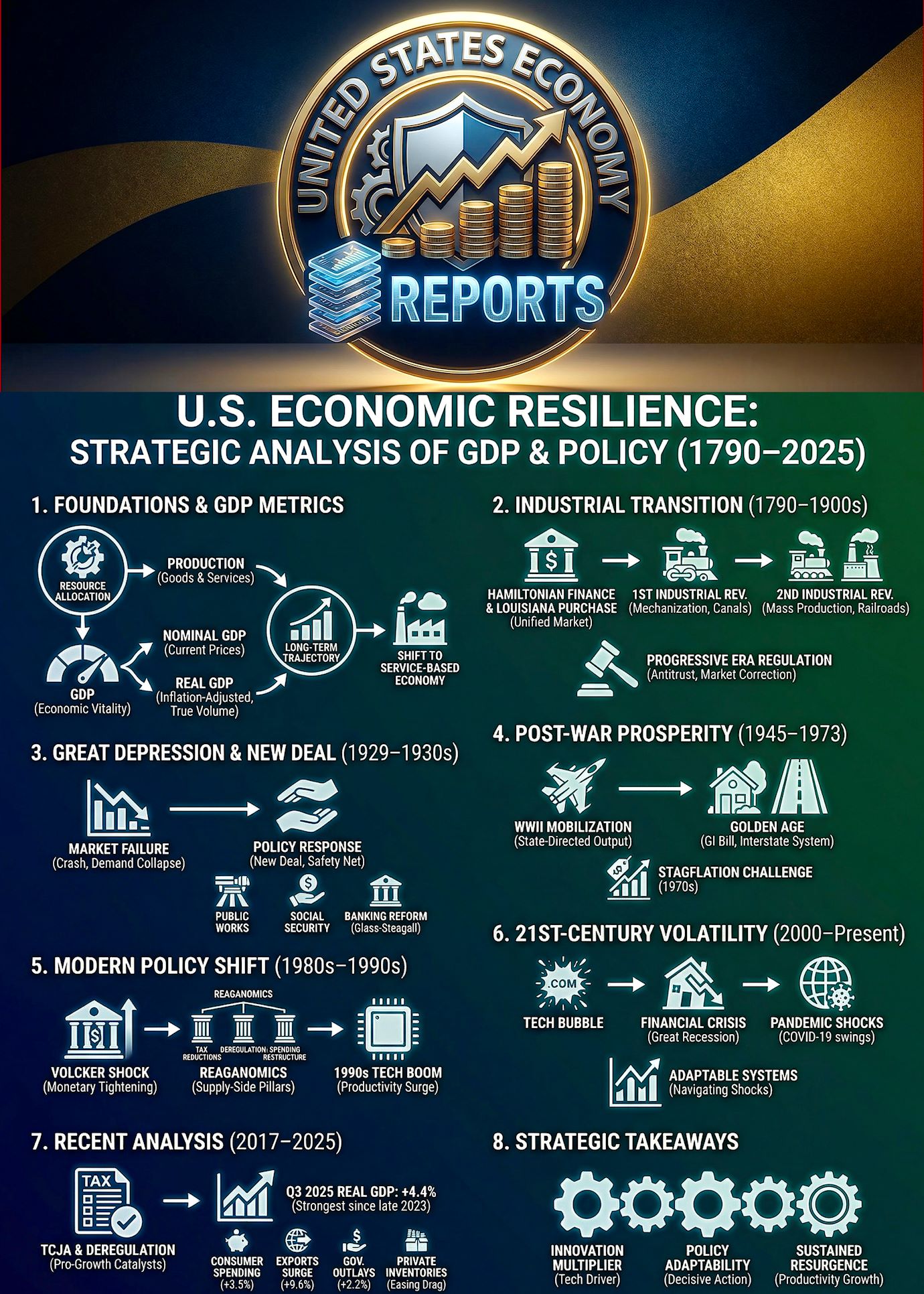
U.S. Economic Resilience: A Strategic Analysis of GDP Volatility and Policy Catalysts (1790–2025)
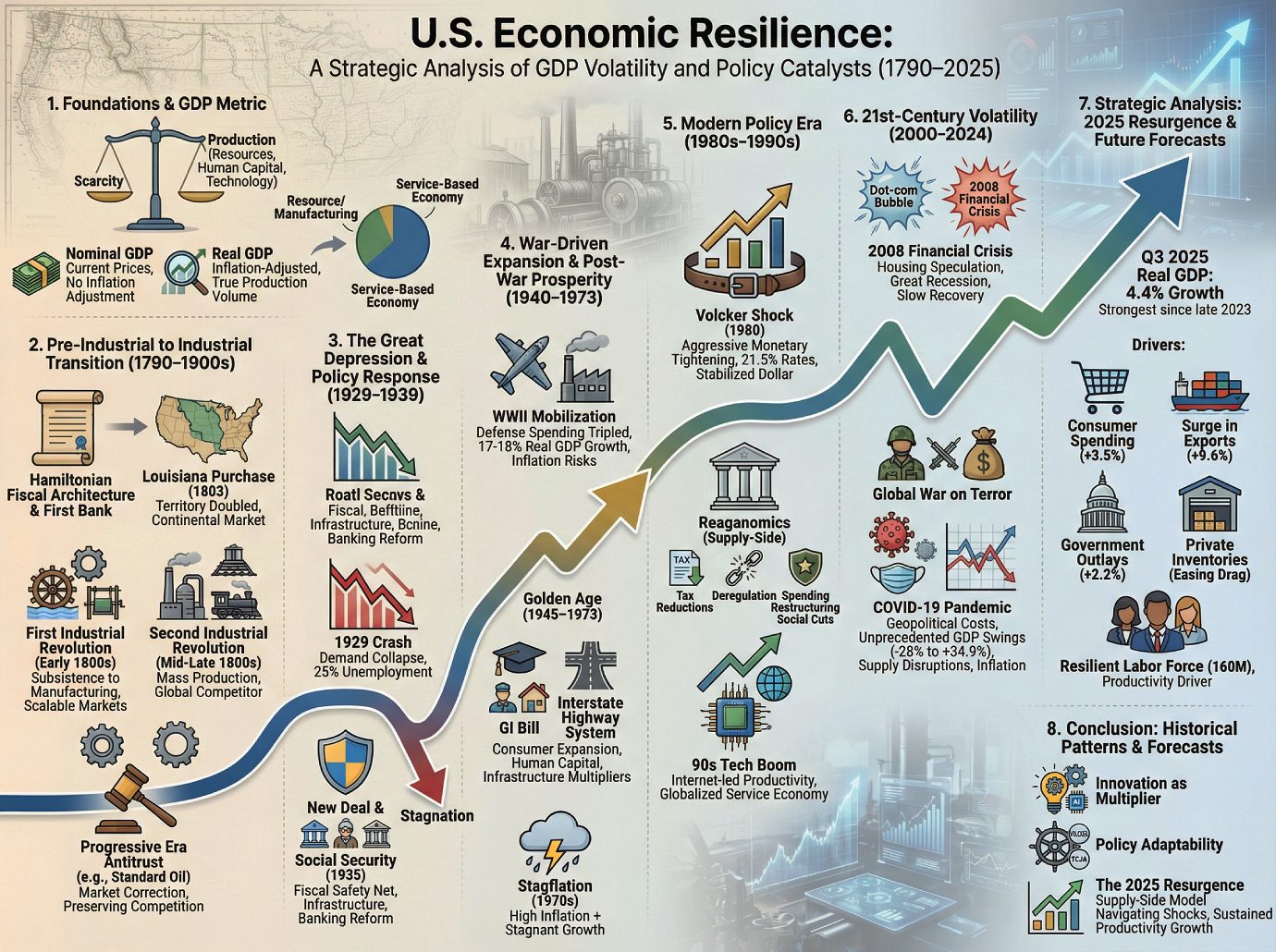
U.S. Economic Resilience: A Strategic Analysis of GDP Volatility and Policy Catalysts (1790–2025)
1. Foundations of the U.S. Economic System and GDP as a Strategic Metric
Gross Domestic Product (GDP) represents the quintessential diagnostic for evaluating national economic vitality, serving as a high-level metric to measure the efficacy of fiscal and monetary architecture. In a macroeconomic context, GDP tracks the total value of all goods and services produced, providing a scorecard for how effectively a nation manages its scarcity—the persistent gap between limited resources and the evolving spectrum of human needs (essential survival) and wants (discretionary desires). Within the American free-market framework, production is driven by the strategic interplay of natural resources, human capital, and capital resources (technology and equipment). For the state, the principle of opportunity cost dictates the strategic allocation of these resources; for example, the historical decision to prioritize infrastructure expansion over immediate debt reduction has frequently served as the primary catalyst for long-arc growth.
The technical interpretation of this growth requires a rigorous distinction between nominal and real output:
• Nominal GDP: Measured in current-dollar terms, this metric reflects total economic output at existing market prices without adjusting for inflation. It is primarily used to evaluate the scale of the economy relative to non-adjusted figures, such as total national debt.
• Real GDP: Inflation-adjusted and calculated against a base year, Real GDP eliminates price distortions to reveal true production volume. It is the authoritative metric for calculating growth rates and determining the economy’s long-term trajectory.
The sophisticated evolution of these metrics reveals a fundamental shift in the American economic identity: the transition from a resource-extraction and manufacturing-based model to a modern, high-output service-based economy, where intangible services now constitute the majority of national production.
2. The Pre-Industrial to Industrial Transition: Resource Acquisition and Infrastructure
The Republic’s transformation from a peripheral colonial actor into a global industrial competitor was not accidental; it was the result of a deliberate synchronization of Hamiltonian fiscal architecture and geographic windfall. Alexander Hamilton’s consolidation of national credit and the establishment of the First Bank of the United States provided the “financial fuel” necessary to scale the economy. This credit architecture allowed the U.S. to leverage the Louisiana Purchase (1803)—a $15 million acquisition that doubled the national territory—transforming a fragmented collection of local interests into a unified, continental common market.
The strategic transition from mechanization to mass production is detailed below:
| Era | Technological Characteristics | GDP Implications |
|---|---|---|
| First Industrial Revolution (Early-to-Mid 1800s) | Water power, textile mechanization, and the construction of canals/roads. | Shifted output from subsistence to manufacturing; established the first scalable domestic markets. |
| Second Industrial Revolution (Mid-to-Late 1800s) | Steel production, steam power, and the expansion of the transcontinental railroad. | Created a national market for mass consumption; elevated the U.S. to a global industrial competitor with high-velocity output. |
This era of unprecedented industrial concentration eventually necessitated the regulatory interventions of the Progressive Era. The implementation of antitrust laws, such as the dissolution of Standard Oil, served as a strategic “market correction,” ensuring that the competitive nature of the free-market system—which had created the wealth—was preserved from the distorting effects of monopoly.
3. The Great Depression: A Study in Market Failure and Policy Response
The 1929 Stock Market Crash represents the most severe period of recession in U.S. history, serving as a case study in systemic market failure and the subsequent necessity of policy intervention. Triggered by rampant speculation and excessive reliance on borrowed capital, the crash precipitated a catastrophic collapse in demand. The macroeconomic fallout was unparalleled: a 25% unemployment rate, a 50% contraction in industrial production, and a 30% reduction in international trade.
In response to this stagnation, the state assumed a new role as the “invisible hand of government intervention.” The New Deal and the Social Security Act of 1935 established a fiscal safety net designed to provide structural stability during market troughs. These programs utilized:
• Public Works Projects: Direct state outlays to generate employment and build national infrastructure.
• The Social Security System: A transfer payment mechanism to ensure baseline consumption for the elderly and disabled.
• Banking Reform: Regulatory frameworks like the Glass-Steagall Act to separate commercial and investment banking, restoring public trust in the financial system.
While these measures mitigated social hardship, the economy remained in a state of relative stagnation until the exogenous shock of global conflict necessitated a massive mobilization of national resources.
4. War-Driven Expansion and the Post-War Prosperity Cycle
World War II illustrated the “mobilization paradox”: a period where massive defense spending—tripling federal outlays—effectively liquidated the remnants of the Great Depression. The early 1940s saw Real GDP growth rates surge to 17–18%, fueled by state-directed industrial output. However, this growth introduced significant inflationary risks, which required temporary price freezes and rationing to manage.
The cessation of hostilities did not lead to a new depression, but rather a “Golden Age” of prosperity (1945–1973), driven by consumerist expansion and strategic human capital investment:
• The GI Bill: A policy catalyst that educated the labor force and stimulated the housing market, creating a robust middle class.
• Infrastructure Multipliers: The construction of the Interstate Highway System functioned as a long-term economic multiplier, reducing transportation costs and opening new suburban markets for durable goods.
This prosperity cycle eventually stalled in the 1970s as the economy encountered the unique challenge of “stagflation,” where high inflation and stagnant growth occurred simultaneously, prompting a total repudiation of traditional Keynesian demand-side management.
5. The Modern Policy Era: Deregulation, Volcker, and Reaganomics
The 1970s “Misery Index”—the sum of inflation and unemployment—served as the strategic catalyst for a shift toward supply-side theory. This era necessitated the “Volcker Shock,” where Federal Reserve Chair Paul Volcker initiated a period of aggressive monetary tightening, raising interest rates to a peak of 21.5% in 1980. This decisive action was required to “slay the inflationary dragon” and stabilize the dollar, despite the short-term cost of a recession.
Simultaneously, the “Reaganomics” era introduced a fiscal architecture focused on production rather than consumption. The strategy was built upon the Three Pillars of Supply-Side Economics:
1. Marginal Tax Reductions: Lowering tax rates to incentivize private investment and human effort.
2. Market Deregulation: Removing government barriers in telecommunications and energy to foster competition.
3. Selective Spending Restructuring: Attempting to curtail domestic social outlays while maintaining high defense spending to drive technological superiority.
This shift paved the way for the “sparkling economic performance” of the 1990s, characterized by the Internet-led productivity boom and the transition to a globalized, tech-heavy service economy.
6. 21st-Century Volatility: From the Great Recession to Global Shocks
The current century has been defined by exogenous shocks and the bursting of speculative “bubbles.” The transition from the 2000 Internet bubble burst to the 2008 Financial Crisis revealed the dangers of financialization and housing market over-speculation. The resulting “Great Recession” (2007–2009) was so deep that Real GDP did not recover to pre-recession levels until 2011, and the labor force did not see unemployment normalize until 2016.
The economy has also been stressed by the costs of global engagement and pandemic-driven volatility:
• Geopolitical Outlays: The Global War on Terror cost the U.S. over $828 billion, impacting federal deficits and resource allocation.
• Pandemic Volatility: COVID-19 caused unprecedented short-term GDP swings, including a record -28.0% contraction (Q2 2020) followed by a 34.9% rebound (Q3 2020).
These shocks have forced the state and the Federal Reserve to adopt highly adaptable market systems to navigate supply disruptions and inflationary pressures reaching 41-year highs.
7. Strategic Analysis: Economic Growth and the Trump Administration
The implementation of the 2017 Tax Cuts and Jobs Act (TCJA) and aggressive deregulation represented a modern return to pro-growth supply-side catalysts. These policies were strategically designed to drive domestic investment and enhance market competitiveness, resulting in a sustained economic surge prior to the pandemic shock.
The resilience of this policy trajectory is evidenced in the most recent GDP performance data. Real GDP expanded at an annualized rate of 4.4% in Q3 2025, marking a clear acceleration from the 3.8% growth in Q2 2025. This expansion signifies the strongest growth rate since late 2023.
The specific drivers of this 4.4% expansion include:
• Consumer Spending: A 3.5% increase, representing the fastest pace of the year.
• Surge in Exports: A robust 9.6% rebound, significantly contributing to the narrowing of the current-account deficit.
• Government Outlays: A 2.2% recovery in spending compared to previous quarterly declines.
• Private Inventories: A significant easing of previous drags, with inventories subtracting only 0.12 percentage points from growth.
The backbone of this performance remains the U.S. labor force of approximately 160 million people, whose productivity in sectors ranging from petroleum to high-tech services continues to drive the national output upward.
8. Conclusion: Synthesizing Historical Patterns for Future Forecasts
The historical arc of the U.S. economy (1790–2025) confirms a definitive correlation between pro-growth fiscal policy—specifically tax reform and deregulation—and high Real GDP performance. The resilience of the American system lies in its ability to pivot away from failing theories, such as the mid-century Keynesian model, toward supply-side architectures that prioritize production and investment.
The critical takeaways for future forecasts are:
1. Innovation as the Multiplier: From the steam engine to the current AI and service-economy shift, technological innovation remains the only permanent driver of long-term productivity.
2. Policy Adaptability: The “Volcker Shock” and the TCJA demonstrate that decisive policy leadership is required to break cycles of inflation and stagnation.
3. The 2025 Resurgence: The current 4.4% growth trajectory confirms that the supply-side model is effectively navigating modern global shocks, positioning the U.S. for continued leadership.
Historically, the U.S. economy has overcome every major downturn through a combination of adaptable market systems and a resilient labor force. While volatility remains an inherent risk of the global cycle, the current data suggests that the U.S. is entering a phase of sustained productivity growth, reinforced by pro-investment regulatory frameworks.
—————————————–
Understanding the Engine of Choice: An Economic Concept Primer
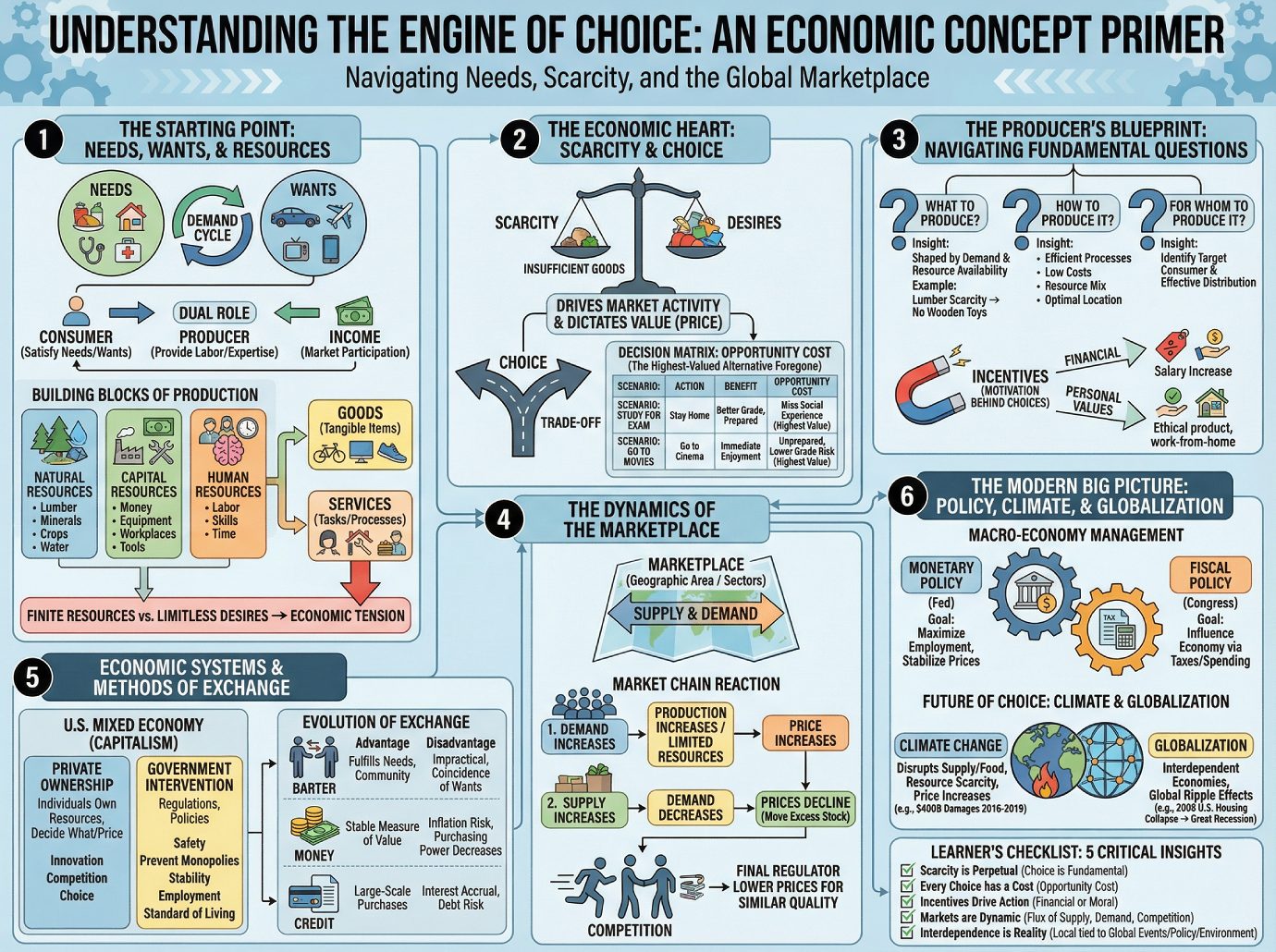
Understanding the Engine of Choice: An Economic Concept Primer
1. The Starting Point: Needs, Wants, and the Resources to Fill Them
In the study of economics, we begin with the fundamental drivers of human activity: Needs and Wants. A Need is a requirement for survival, such as food, shelter, and clothing—though in modern society, this definition has evolved to include healthcare and education. A Want is any desire for an item or experience that is not essential to sustain life.
The “So What?” for Learners: These two forces create a perpetual cycle of demand that keeps the economy in constant motion. However, a deeper understanding reveals a “dual role” for every individual: to satisfy these needs and wants, a consumer must generally also be a producer. We provide labor or expertise to earn the income necessary to participate in the marketplace. This cycle—where producers earn income to become consumers—is the fuel that powers the economic engine.
To generate the products that satisfy these desires, producers must strategically harness three categories of resources.
The Building Blocks of Production
| Resource Category | Definition | Real-World Examples |
|---|---|---|
| Natural Resources | Raw materials that occur in nature. | Lumber, minerals, crops, and water. |
| Capital Resources | The tools, machinery, and financial means used in production. | Money, equipment, workplaces, and specialized tools. |
| Human Resources | The individuals, their specialized expertise, and the time required. | Labor, professional skills, and specialized time. |
When producers harness these resources, they generate two distinct outputs:
• Goods: Tangible items sold to consumers (e.g., bicycles, computers, and shoes).
• Services: Tasks or processes performed for consumers (e.g., haircuts, roof repair, and food delivery).
While our human desires for these goods and services are virtually limitless, the resources required to create them are finite, leading us to the heart of economic tension.
——————————————————————————–
2. The Economic Heart: Scarcity and the Power of Choice
Scarcity occurs when there are insufficient goods or services to meet the desires of every consumer. It serves as the primary driver of market activity because it dictates the value of everything we trade.
The “So What?” for Learners: Scarcity is the fundamental reason things have prices. When a resource becomes scarce, supply drops, typically driving up both demand and price. This reality forces us to make constant Choices. Every choice involves a Trade-off—the reality that by choosing one path, you must sacrifice another. Economists measure this sacrifice as Opportunity Cost: the value of the highest-valued alternative foregone.
The Decision Matrix: Evaluating the Trade-off
To understand how an economist views a decision, consider the choice between studying for an exam or going to the movies:
Scenario: The Choice to Study
• The Action: Staying home to prepare for an exam.
• The Benefit: Achieving a better grade and being prepared.
• The Opportunity Cost: Missing out on a fun social experience with friends (the highest-valued alternative).
Scenario: The Choice of the Movies
• The Action: Going to the cinema with friends.
• The Benefit: Immediate social enjoyment and entertainment.
• The Opportunity Cost: Being unprepared for the test and risking a lower grade (the highest-valued alternative).
These individual trade-offs form the basis of the three fundamental questions that every producer must navigate to succeed.
——————————————————————————–
3. The Producer’s Blueprint: Navigating the Three Fundamental Questions
Producers do not operate at random; they must answer three core questions to stay viable in a competitive market:
1. What to produce?
◦ Insight: This is shaped by consumer demand. Producers must also weigh resource availability; for instance, a scarcity of lumber would naturally discourage a producer from making wooden toys.
2. How to produce it?
◦ Insight: Producers seek the most efficient processes to keep costs low. This involves selecting the right mix of natural, capital, and human resources and deciding on the optimal location for production.
3. For whom to produce it?
◦ Insight: Producers must identify their target consumer and determine the most effective distribution method to get the product into that consumer’s hands.
The Role of Incentives Incentives provide the motivation behind economic choices. Unlike scarcity, which forces a choice, incentives encourage one. These can be financial, such as a price discount or a higher salary offer. However, choices are also driven by personal values. A consumer might be incentivized to spend more on an “ethically conscious” product—such as one from a factory paying living wages—or a worker might accept a lower-paying job because it offers the incentive of working from home.
Once these production decisions are made, the goods and services enter the arena where trade is realized.
——————————————————————————–
4. The Dynamics of the Marketplace
In modern economics, the Marketplace is more than a physical shop; it is the entire geographic area—a state, a nation, or the globe—where transactions occur. It also refers to specific sectors, such as the “housing market.” The marketplace is governed by the shifting relationship of Supply and Demand.
The Market Chain Reaction
1. Demand Increases: If consumers want more of a product, producers may increase production. If resources are limited, the producer will likely increase the price.
2. Supply Increases: If a surplus is produced, demand generally decreases, often causing prices to decline as producers attempt to move excess stock.
Competition acts as the final regulator. Producers compete for consumer business, which serves as a powerful tool for the public.
• The Primary Benefit: Competition leads to lower prices for goods and services of similar quality.
While the market thrives on the freedom of producers and consumers, different economic systems provide the framework for these interactions.
——————————————————————————–
5. Economic Systems and Methods of Exchange
The United States operates as a Mixed Economy based on Capitalism. While individuals and private businesses own the means of production and set prices, the government intervenes to provide a safety net and ensure market stability.
Private Ownership vs. Government Intervention
| Feature | Role in the Economy | Reasons for Implementation |
|---|---|---|
| Private Ownership | Individuals own resources; they decide what to sell and at what price. | Encourages innovation, promotes competition, and allows for consumer choice. |
| Government Intervention | Regulations and policies that oversee and stabilize business practices. | To ensure consumer safety, prevent monopolies, stabilize prices, maximize employment, and improve the standard of living (e.g., unemployment insurance). |
As systems evolved, so did the “how” of trade—moving from direct exchange to complex credit systems.
The Evolution of Exchange
1. Barter: The direct exchange of goods or services for others of equivalent value.
◦ Advantage: Fulfills needs and builds community without requiring physical money.
◦ Disadvantage: Impractical in modern trade; requires a “coincidence of wants” between two parties.
2. Money: Any widely accepted object (coins, paper, shells) used as payment.
◦ Advantage: Provides a stable, clearly defined way to measure and compare the value of different products.
◦ Disadvantage: Purchasing power is subject to inflation; the value of money decreases when costs of goods increase rapidly over a short term.
3. Credit: Purchasing goods or services now by borrowing money to be repaid later.
◦ Advantage: Allows for essential large-scale purchases (like cars or homes) that cannot be paid for upfront.
◦ Disadvantage: Failure to pay leads to interest accrual, which raises the total cost and increases the risk of debt.
The methods we use to pay for goods are now inextricably linked to massive, large-scale forces that shape the value of every dollar we spend.
——————————————————————————–
6. The Modern Big Picture: Policy, Climate, and Globalization
Governments manage the macro-economy through two primary levers:
• Monetary Policy (The Federal Reserve):
◦ Goal: To maximize employment and stabilize prices by manipulating interest rates (the federal funds rate).
• Fiscal Policy (Congress):
◦ Goal: To influence the economy through taxation and spending to stimulate growth or cool down inflation.
The Future of Choice: Climate and Globalization
Modern economic behavior is no longer local; it is shaped by global interdependence and environmental shifts:
• Climate Change: Extreme weather disrupts supply chains and food production. Between 2016 and 2019, climate-related damages (such as flooding in the American Midwest and wildfires in California and Australia) cost over $400 billion. These events create resource scarcity, further driving up prices for the final consumer.
• Globalization: The world’s economies are interdependent. Because countries rely on one another for trade and technology, a crisis in one region creates global ripple effects. A prime example is the 2008 U.S. housing market collapse, which triggered the Great Recession and affected trading partners across the entire globe.
Learner’s Checklist: 5 Critical Insights
• [ ] Scarcity is Perpetual: There are never enough resources to satisfy all human wants; this is why choice is the fundamental act of economics.
• [ ] Every Choice has a Cost: Opportunity cost is not just a price tag; it is the value of the highest-rated alternative you gave up.
• [ ] Incentives Drive Action: Whether it is a financial discount or a personal moral value, incentives are the “why” behind every transaction.
• [ ] Markets are Dynamic: Prices and production levels are in a constant state of flux based on the balancing act of supply, demand, and competition.
• [ ] Interdependence is Reality: In a globalized world, your local economic health is tied to international events, government policy, and environmental stability. ———————————–
Market Evolution: A Strategic Review of the American Economic Journey
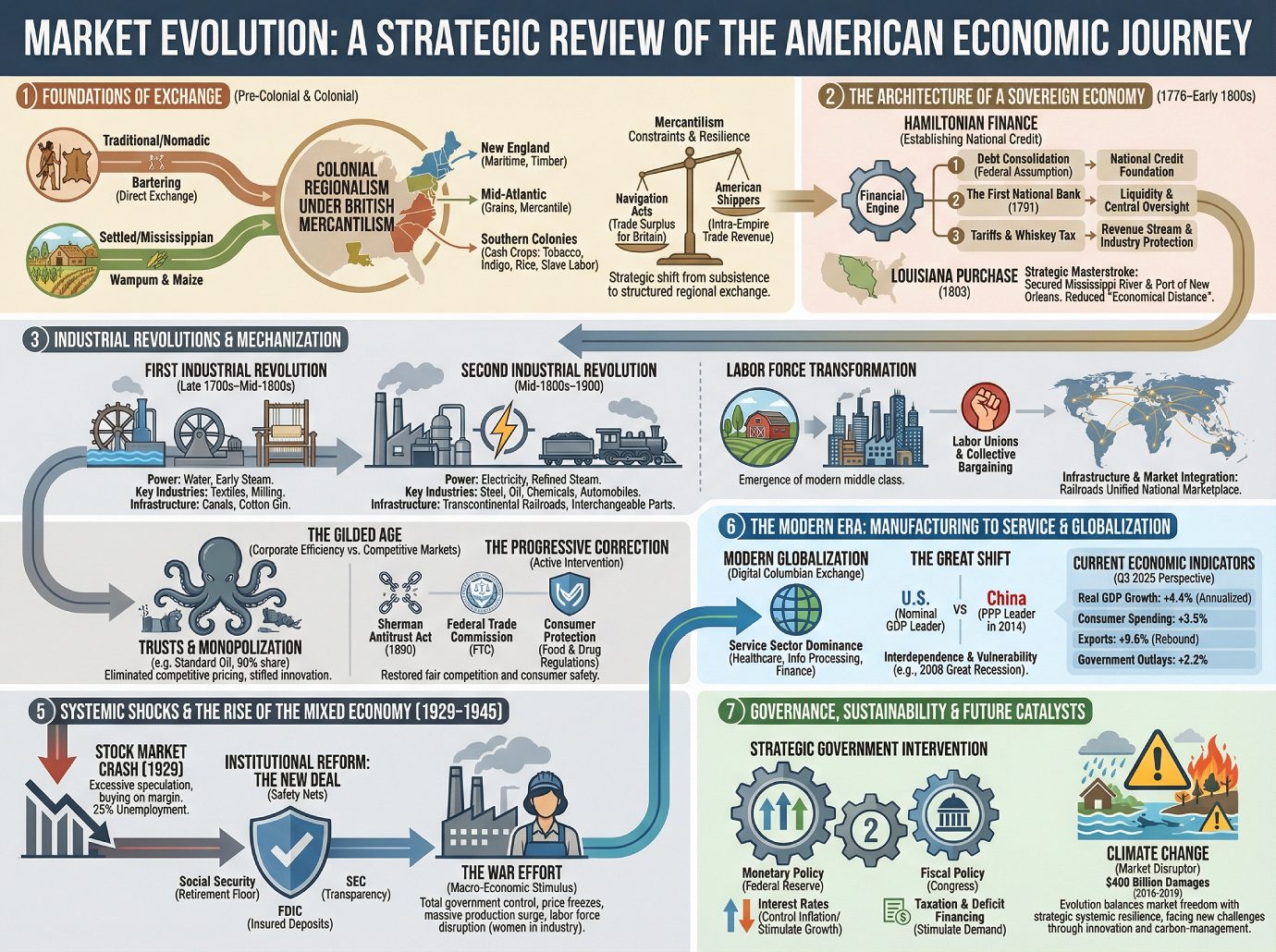
Market Evolution: A Strategic Review of the American Economic Journey
1. Foundations of Exchange: Pre-Colonial and Colonial Market Structures
The American marketplace was an engineered evolution, precipitated by a fundamental shift from subsistence living to structured regional exchange. This transition was catalyzed by the strategic realization that regional specialization could circumvent local resource scarcity. As the economy matured into a market-oriented system, the foundational DNA of American commerce—governed by the allocation of natural, capital, and human resources—began to dictate the three essential economic questions: what, how, and for whom to produce.
The First Economies
Long before European contact, Native American nations leveraged sophisticated trade networks, particularly within the Mississippian drainage basin. These were not merely “traditional” economies but complex systems of resource management and value storage.
| Economic Model | Primary Exchange Tool | Resource Management Basis |
|---|---|---|
| Traditional/Nomadic | Bartering (direct exchange of furs, grain, or livestock). | Hunting, gathering, and foraging; high-mobility tribal structures. |
| Settled/Mississippian | Wampum (standardized beads/shells) or tobacco/maize. | Agrarian; domesticated plants, irrigation, and crop rotation. |
Colonial Regionalism
By the mid-1700s, geographic resource distribution necessitated three distinct strategic roles within the British colonial system:
• New England: Specializing in maritime trades, including shipbuilding, fishing, and timber extraction, to compensate for poor agricultural soil.
• Mid-Atlantic: Operating as the “breadbasket” region, focusing on grains and mercantile industry due to fertile land and proximity to urban centers.
• The Southern Colonies: Leveraging cash crops—tobacco, indigo, and rice—through the exploitation of slave labor to fuel a thriving agricultural export base.
Mercantilism and Strategic Resilience
The growth of these colonies was structurally constrained by British mercantilism, a system designed to amass gold reserves by maintaining a trade surplus through the Navigation Acts. While these laws prohibited the manufacturing of finished goods in the colonies, the American merchant class demonstrated strategic resilience. American shippers successfully leveraged intra-empire trade to offset approximately half of the goods trade deficit through revenues earned shipping between various British ports.
The resulting tension between these regional dependencies and the restrictive British trade imbalance eventually necessitated a unified national economic vision to achieve sovereign market stability.
——————————————————————————–
2. The Architecture of a Sovereign Economy (1776–Early 1800s)
The post-Revolutionary period constituted a critical strategic window where the United States transitioned from a fragmented collection of thirteen colonies into a unified common market. The primary objective was the establishment of a robust national credit and a stable financial infrastructure to manage the significant debts precipitated by the War for Independence.
Hamiltonian Finance
Alexander Hamilton, the first Secretary of the Treasury, engineered a financial engine intended to stabilize the fledgling republic. He leveraged three critical policy pillars:
1. Debt Consolidation: The federal government assumed the collective debts of the original 13 colonies. Strategic Impact: This established a permanent “National Credit,” providing the psychological and financial foundation for a sovereign state while tying the interests of the wealthy elite to federal survival.
2. The First National Bank: Chartered in 1791, this institution provided a central mechanism for furnishing currency and supervising the banking sector. Strategic Impact: It provided the liquidity and centralized oversight required to support a growing merchant class and manage Treasury needs.
3. Tariffs and the Whiskey Tax: Hamilton implemented import tariffs and a highly controversial tax on whiskey to generate a reliable revenue stream. Strategic Impact: These levies protected infant American industries from foreign competition while providing the capital necessary to service national debt.
Territorial Expansion as Economic Catalyst
Early economic strategy also prioritized the acquisition of high-value trade arteries. The Louisiana Purchase (1803) was a strategic masterstroke that secured the Mississippi River and the Port of New Orleans. By controlling this waterway, the U.S. effectively reduced the “economical distance” for transporting commodities from the interior to global markets, guaranteeing the viability of agrarian expansion.
This era of financial stabilization and geographic leverage successfully bridged the gap between a primary agrarian society and the mechanized shifts that would define the first wave of industrialization.
——————————————————————————–
3. Industrial Revolutions and the Mechanization of America
The strategic pivot from human-centric, skilled labor to mechanized mass production disrupted the national economic structure. This mechanization enabled the production of goods at a scale and velocity that marginalized traditional craft labor, transforming the U.S. from a rural society into an industrial superpower.
The Two Waves of Industrialization
Industrialization evolved in two distinct phases, each defined by unique catalysts and structural improvements.
| Feature | First Industrial Revolution (Late 1700s–Mid-1800s) | Second Industrial Revolution (Mid-1800s–1900) |
|---|---|---|
| Primary Power Source | Water power and early steam engines. | Electricity and refined steam power. |
| Key Industries | Textiles and automated flour milling. | Steel, oil, chemicals, and automobiles. |
| Infrastructure Catalyst | Canals and the Cotton Gin (mechanized seed removal). | Transcontinental railroads and Interchangeable Parts. |
Infrastructure and Market Integration
The integration of railroads and steam power was strategically significant because it collapsed the cost of logistics. In 1816, it was noted that moving a ton of goods 3,000 miles from Europe cost the same as moving them only 30 miles inland. By the mid-19th century, railroads unified disparate regional markets into a singular national marketplace, allowing surplus goods to be exported globally at unprecedented volumes.
Labor Force Transformation
The factory system precipitated massive urbanization, drawing rural workers and immigrants into hazardous urban environments. The “so what” of this transformation was the emergence of labor unions and collective bargaining. Faced with dangerous conditions and a lack of benefits like unemployment insurance, workers organized to advocate for fair compensation, effectively engineering the modern economic middle class.
This period of rapid industrial growth eventually necessitated the emergence of regulatory oversight to counter the dominance of massive corporate entities.
——————————————————————————–
4. Corporate Innovation, Monopolization, and the Regulatory Response
As the 19th century concluded, a strategic tension intensified between corporate efficiency and the maintenance of competitive markets. The “Gilded Age” of capitalism saw industrial titans leverage corporate structures to achieve unprecedented market dominance.
The Rise of Trusts
Leaders like John D. Rockefeller utilized the “trust” structure to consolidate entire sectors. By 1879, Standard Oil controlled 90% of American oil production. While these trusts maximized output efficiency, they eliminated the competitive pricing mechanisms essential to a free market. When a single entity controls nearly all production, the market loses its ability to self-regulate, resulting in the stifling of innovation and the extraction of higher prices from consumers.
The Progressive Correction
In response to these monopolistic distortions, the government transitioned from laissez-faire passivity to active intervention. Landmark regulatory developments restored the marketplace’s “fair competition” layer:
• Sherman Antitrust Act (1890): Engineered to protect trade from unlawful restraints, this act was eventually leveraged to break Standard Oil into competing entities like Exxon and Mobil.
• Federal Trade Commission (FTC): Established to oversee business practices and prevent unfair competition.
• Consumer Protection: New federal regulations for food and drugs acknowledged that market freedom must be balanced with consumer safety.
This move toward a regulated marketplace exposed the systemic vulnerabilities that would soon be tested by the Great Depression.
——————————————————————————–
5. Systemic Shocks and the Rise of the Mixed Economy (1929–1945)
The Great Depression redefined the government’s role, shifting it from a passive observer to an active manipulator of economic forces. This era precipitated the rise of a mixed economy—a system where private individuals own the means of production, but the government intervenes to regulate the market and maintain the standard of living.
The Anatomy of a Crash
The Stock Market Crash of 1929 was precipitated by excessive speculation and a dangerous reliance on “buying on margin” (purchasing stocks with borrowed capital). When market values faltered, margin calls triggered a cascade of forced selling, erasing billions in paper wealth and leading to a 25% unemployment rate.
Institutional Reform
President Franklin D. Roosevelt’s New Deal established the first federal economic safety nets to restore public confidence.
| Program Name | Original Intent | Strategic Impact on Safety Net |
|---|---|---|
| Social Security | Provide income for the elderly/disabled. | Created a permanent federal floor for retirement security. |
| FDIC | Insure bank deposits. | Ended the cycle of “bank runs” and stabilized the banking sector. |
| SEC | Regulate stock exchanges. | Established transparency and fraud prevention in finance. |
The War Effort as Macro-Economic Stimulus
Ultimately, the mobilization for World War II ended the Depression. To manage this massive surge in production, the government exerted total control over the macro-environment, imposing freezes on prices, wages, and rents to prevent rampant inflation. This era also permanently disrupted the labor force as women entered industrial roles in record numbers, producing the weaponry required for global combat.
Post-war euphoria, supported by the GI Bill, provided the capital and education necessary to launch the modern consumer-driven era.
——————————————————————————–
6. The Modern Era: From Manufacturing to a Service-Based Global Economy
Following World War II, the United States evolved into a global superpower through technological acceleration and a strategic pivot toward the service sector. This era is defined by a transition where information and services, rather than tangible goods, drive the majority of value.
The Great Shift: Nominal vs. PPP
While the U.S. remains the world leader in Nominal GDP, the landscape of global competition has shifted. In 2014, China overtook the U.S. in terms of Purchasing Power Parity (PPP)—a measure that accounts for exchange rate differences and cost of living. Today, agriculture represents less than 2% of U.S. GDP, while the service sector (healthcare, info processing, and finance) dominates the economic profile.
Globalization and Interdependence
Modern globalization has created a “digital Columbian Exchange,” making the U.S. deeply interdependent with global partners. However, this interconnectivity breeds vulnerability to global shocks. The 2008 Great Recession, triggered by the collapse of the U.S. housing market, demonstrated that domestic failures now propagate through the global financial system with devastating speed.
Modern Economic Indicators
Current performance data reflects a resilient, consumption-heavy economy recovering from recent volatility.
| U.S. Economic Performance Data (Q3 2025 Perspective) | Growth Rate / Data Point |
|---|---|
| Real GDP Growth | +4.4% (Annualized rate) |
| Consumer Spending | +3.5% (Fastest pace in 2025) |
| Exports | +9.6% (Sharp rebound from Q2 decline) |
| Government Outlays | +2.2% (Recovery from -0.1% volatility) |
This data underscores the importance of applying historical lessons to modern market threats.
——————————————————————————–
7. Governance, Sustainability, and Future Market Catalysts
The modern marketplace requires sophisticated policy levers to navigate the business cycle. Strategic government intervention is now a permanent fixture designed to mitigate “troughs” in economic activity.
The Policy Lever
The U.S. government maintains stability through two primary mechanisms:
• Monetary Policy (The Federal Reserve): The Fed manipulates the federal funds rate to control inflation or stimulate growth. By raising rates, they “cool” an overheated market; by lowering them, they encourage the borrowing and investment needed for recovery.
• Fiscal Policy (Congress): This involves the use of taxation and deficit financing. During a recession, Congress may increase spending to supplant a drop in private sector investment and stimulate aggregate demand.
Climate Change as a Market Disruptor
Climate change represents a severe systemic threat to market stability. Morgan Stanley estimated that climate change caused over $400 billion in damages between 2016 and 2019 alone. This threat is no longer abstract; it presents specific regional risks, such as flooding in the American Midwest that threatens crop production and wildfires in California that destroy infrastructure and homes. These disruptions create scarcity in raw materials, driving up prices and forcing the market to innovate once again through carbon-management technologies.
Conclusion
The American market has evolved from a barter-based agrarian society into a complex, regulated, and globalized service powerhouse. Throughout this journey, the fundamental roles of scarcity and innovation have remained constant. From Hamilton’s engineering of national credit to the climate-driven challenges of the 21st century, the U.S. economy continues to evolve by balancing the drive for market freedom with the strategic necessity of systemic resilience. ————————————————–
From Wampum to the Paper Dollar
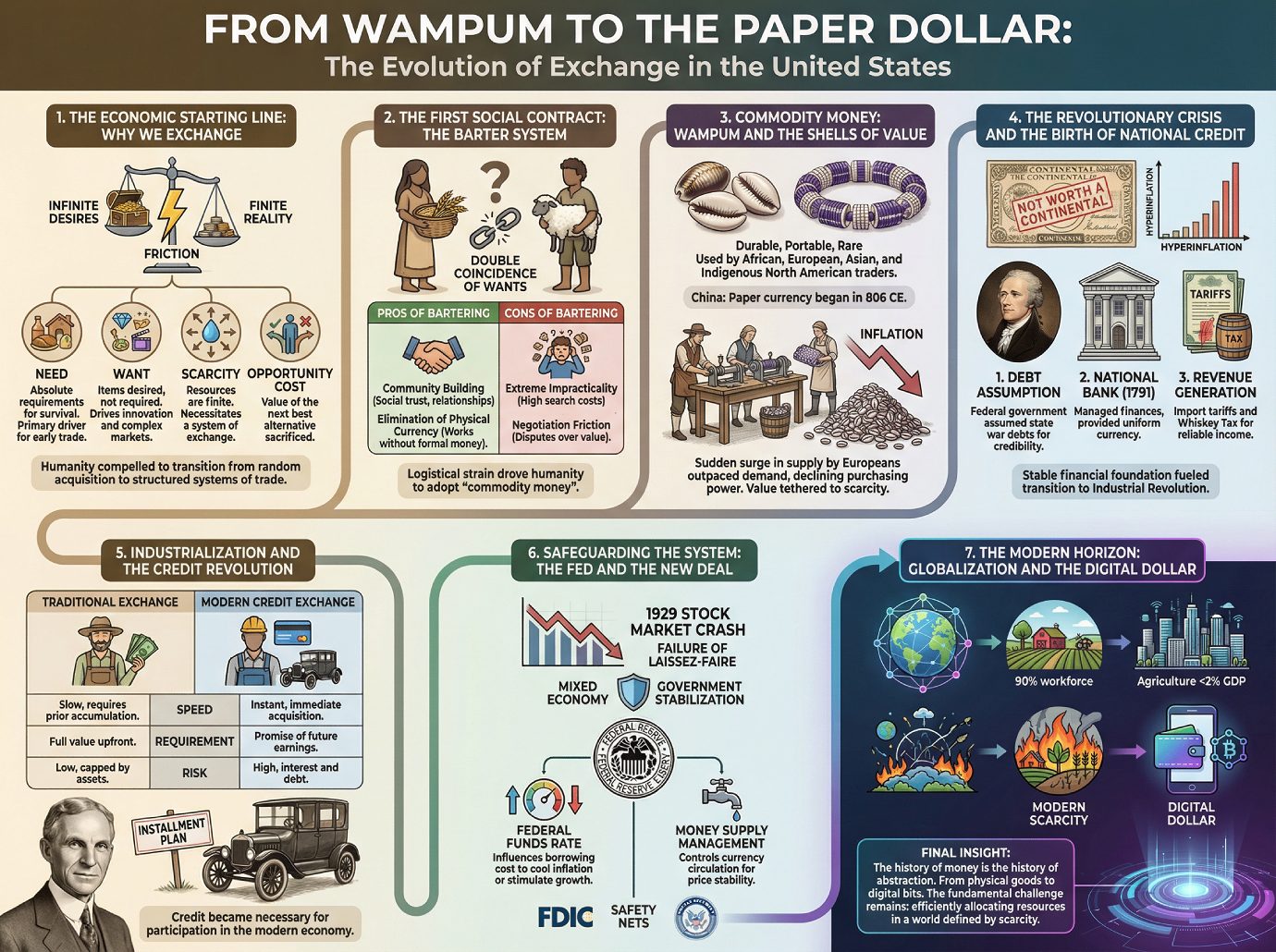
From Wampum to the Paper Dollar
1. The Economic Starting Line: Why We Exchange
Economics is the rigorous study of choices made under the pressure of limited resources. To understand the evolution of money, we must first address the friction between infinite human desires and finite reality. Every transaction in human history—from the exchange of livestock in 9000 BCE to the modern digital transfer—is a strategic response to four foundational concepts.
| Economic Term | The “So What?” (Implications for Trade) |
|---|---|
| Need | Absolute requirements for survival (food, shelter). In early economies, these were the primary drivers for trade; if you couldn’t produce it, you had to trade for it or perish. |
| Want | Items desired but not required for survival. As societies grow, “wants” expand, pushing economies to innovate beyond mere subsistence into complex luxury markets. |
| Scarcity | The reality that resources (natural, human, or capital) are finite. Because no single entity can possess everything, scarcity necessitates a system of exchange to allocate what is available. |
| Opportunity Cost | The value of the next best alternative sacrificed when a choice is made. For a business, choosing to invest profit in new equipment means the “cost” is the lost opportunity to hire or train new employees. |
As resources are inherently limited, humanity was compelled to transition from random acquisition to structured systems of trade.
——————————————————————————–
2. The First Social Contract: The Barter System
Before the standardization of currency, early civilizations—including the Phoenicians in the 900s BCE and early Native American nations—relied on barter. This system involved the direct exchange of goods or services for others of equivalent value. Between 9000 and 6000 BCE, this often took the form of livestock and crops like grain, which served as early standards of value.
However, the barter system is plagued by the “Double Coincidence of Wants.” For a successful transaction, a trader must find a partner who not only possesses the desired good but also happens to want exactly what the trader is offering.
• Pros of Bartering
◦ Community Building: Bartering requires direct negotiation and the establishment of mutual value, which fosters social trust and interpersonal relationships within traditional economies.
◦ Elimination of Physical Currency: It enables economic activity in environments where a formal government-issued currency or centralized credit system does not exist.
• Cons of Bartering
◦ Extreme Impracticality: Finding a perfect trading match becomes exponentially more difficult as markets grow and specialize, leading to high “search costs.”
◦ Negotiation Friction: Without a common unit of account, determining how many bushels of grain equal one head of cattle is time-consuming and prone to dispute.
The logistical strain of bartering eventually drove humanity to adopt “commodity money”—middle-man objects that carried intrinsic or agreed-upon value.
——————————————————————————–
3. Commodity Money: Wampum and the Shells of Value
The transition to commodity money utilized objects that were durable, portable, and rare. African, European, and Asian traders used Cowrie shells as currency as early as 1200 BCE. In North America, the Eastern Woodlands peoples utilized Wampum—intricately crafted shell beads. Wampum functioned as a standardized currency for trade and diplomacy across vast Indigenous networks.
However, even natural currencies are subject to economic volatility. When European settlers arrived, they utilized superior technology, such as lathes, to mass-produce wampum beads. This sudden surge in supply far outpaced demand, leading to the decline of its purchasing power—a classic historical example of inflation. While the West eventually shifted to metal and paper, it is worth noting that the global experiment with paper currency began in China in 806 CE, nearly a millennium before it became standard in the United States.
Key Insight: Early civilizations chose items like shells, furs, or salt as currency because they were relatively rare, easily transportable, and universally recognized as valuable. Their value, however, was always tethered to their scarcity; once the supply became easily manipulated, the currency’s power vanished.
——————————————————————————–
4. The Revolutionary Crisis and the Birth of National Credit
The early United States faced an existential economic crisis during the Revolutionary War. To fund the military, the Continental Congress issued “Continentals”—paper notes backed by nothing but a promise of future tax revenue. Because these were over-printed and lacked gold or silver backing, they suffered hyperinflation, becoming “not worth a Continental.”
Following the war, Alexander Hamilton, the first Secretary of the Treasury, recognized that a sovereign nation required national credit to survive. He transformed the fragmented state economies into a unified national system through three decisive actions:
1. Debt Assumption: Hamilton insisted the federal government assume the war debts of individual states, bundling them into a single national debt to establish credibility with domestic and international investors.
2. Creation of the National Bank (1791): He established the First Bank of the United States to manage the government’s finances and provide a stable, uniform currency for the new nation.
3. Revenue Generation: To ensure the government could meet its obligations, he implemented a system of import tariffs and the Whiskey Tax, providing the federal government with its first reliable stream of income.
This stable financial foundation provided the capital necessary to fuel the transition into the Industrial Revolution.
——————————————————————————–
5. Industrialization and the Credit Revolution
The Second Industrial Revolution shifted the American workforce from agriculture to manufacturing. While mass production lowered costs, high-ticket items remained out of reach for the average worker. Industrialist Henry Ford addressed this by normalizing installment plans for the Model T, shifting the American mindset from subsistence to a consumerist model where credit was a necessity for participation in the modern economy.
| Feature | Traditional Exchange (Pre-Industrial) | Modern Credit Exchange (Post-Industrial) |
|---|---|---|
| Speed of Transaction | Slow; requires prior accumulation of physical wealth. | Instant; allows for the immediate acquisition of goods. |
| Requirement of Physical Wealth | Must possess the full value in cash or gold upfront. | Based on “credit”—the promise of future earnings. |
| Risk to the Consumer | Low; spending is capped by current assets. | High; failure to repay results in interest and debt accumulation. |
This reliance on credit and speculation fueled the “Roaring Twenties,” but it also set the stage for a systemic collapse.
——————————————————————————–
6. Safeguarding the System: The Fed and the New Deal
The 1929 Stock Market Crash signaled a failure of laissez-faire economics—the belief that the “Invisible Hand” of the market, as described by Adam Smith in The Wealth of Nations, would always self-correct. The Great Depression proved that without oversight, the “Invisible Hand” could lead to a total standstill. Consequently, the U.S. moved toward a Mixed Economy, blending market freedom with government stabilization.
To prevent future panics, the government established “safety nets” like the FDIC and Social Security. Central to this new era was the Federal Reserve (the Fed), established in 1913, which uses Monetary Policy to stabilize the economy. Today, the Fed manages the business cycle primarily through two tools:
1. The Federal Funds Rate: By raising or lowering this interest rate for exchanges between banks, the Fed influences the cost of borrowing across the entire economy, either “cooling” inflation or stimulating growth.
2. Money Supply Management: The Fed controls the amount of currency in circulation to ensure that prices remain stable and that the economy avoids the extremes of hyperinflation or deflation.
——————————————————————————–
7. The Modern Horizon: Globalization and the Digital Dollar
Today, the U.S. has transitioned from a colonial nation of farmers (where 90% worked the land) to a technology-based superpower where agriculture represents less than 2% of GDP. In this globalized network, nations are interdependent; a housing crash in the U.S. can trigger a global recession. Furthermore, modern scarcity is increasingly driven by environmental factors; climate change now disrupts supply chains through crop failures in the Midwest and wildfires in the West, costing hundreds of billions in damages.
Final Insight for the Learner: The history of money is the history of abstraction. We have moved from physical goods (livestock) to physical representations of value (Wampum), to government promises (paper), and finally to digital bits. While the method of exchange has evolved from beads to bytes, the fundamental challenge remains: how to efficiently allocate resources in a world defined by scarcity.
Regardless of the medium—whether shell, gold, or digital code—the persistent reality of limited resources ensures that the “Invisible Hand” now works alongside a regulated digital system to keep the global engine running. ———————————————