
Gardner MA
GARDNER WEATHERCity of Gardner MA on Gardner Magazine
Gardner MA Local News and Community Information

Visit the Gardner MA Complete History page with infographics, Deep Dive, Narratives, Debate, and so much more….CLICK HERE — Complete Gardner Telephone Guide to Various Departments
Jump to: Around the Community – Gardner Map – Gardner Photos – Service pages and outside links – View the current Calendar (opens in new window)
- One Stop Awards
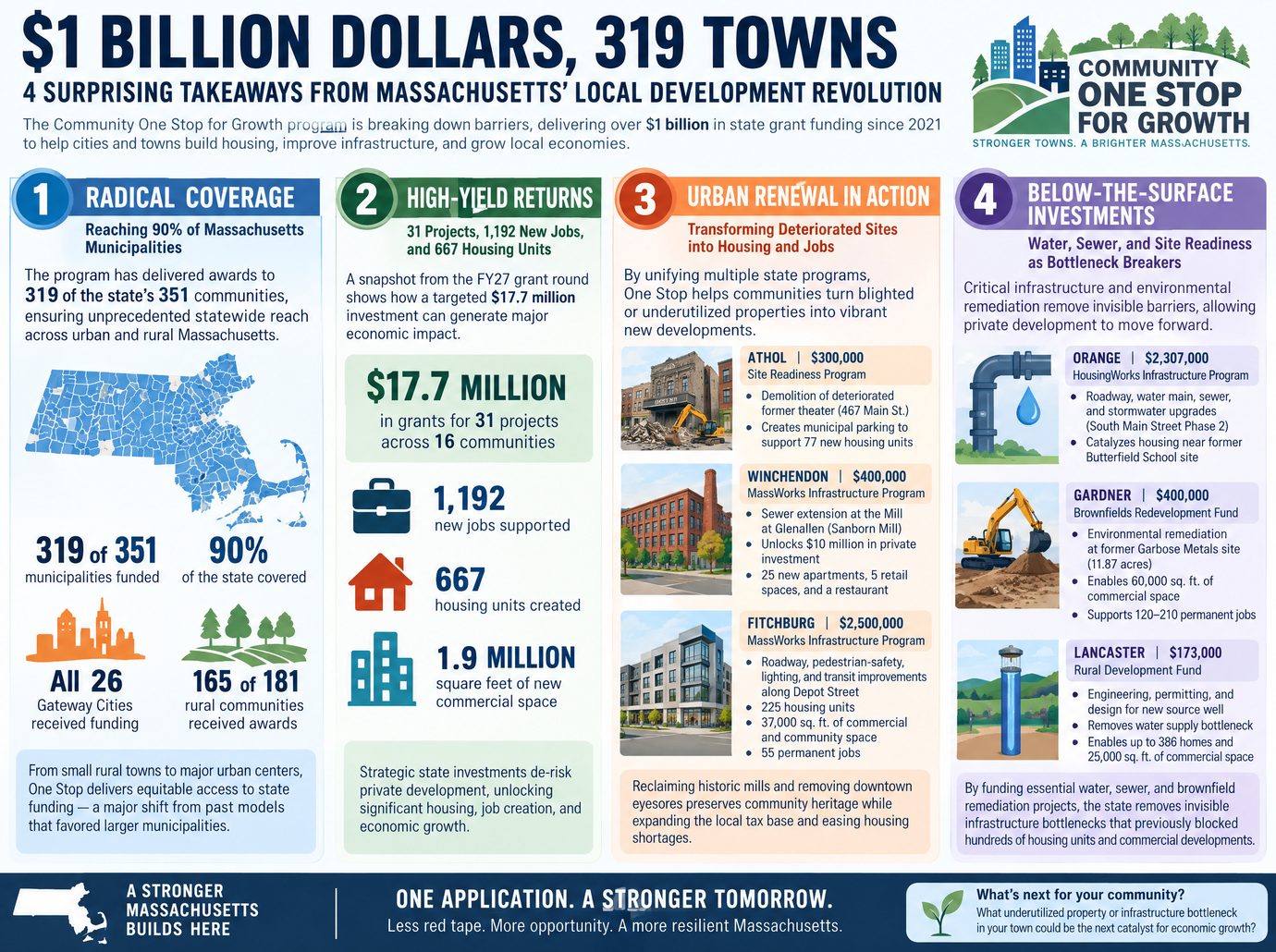
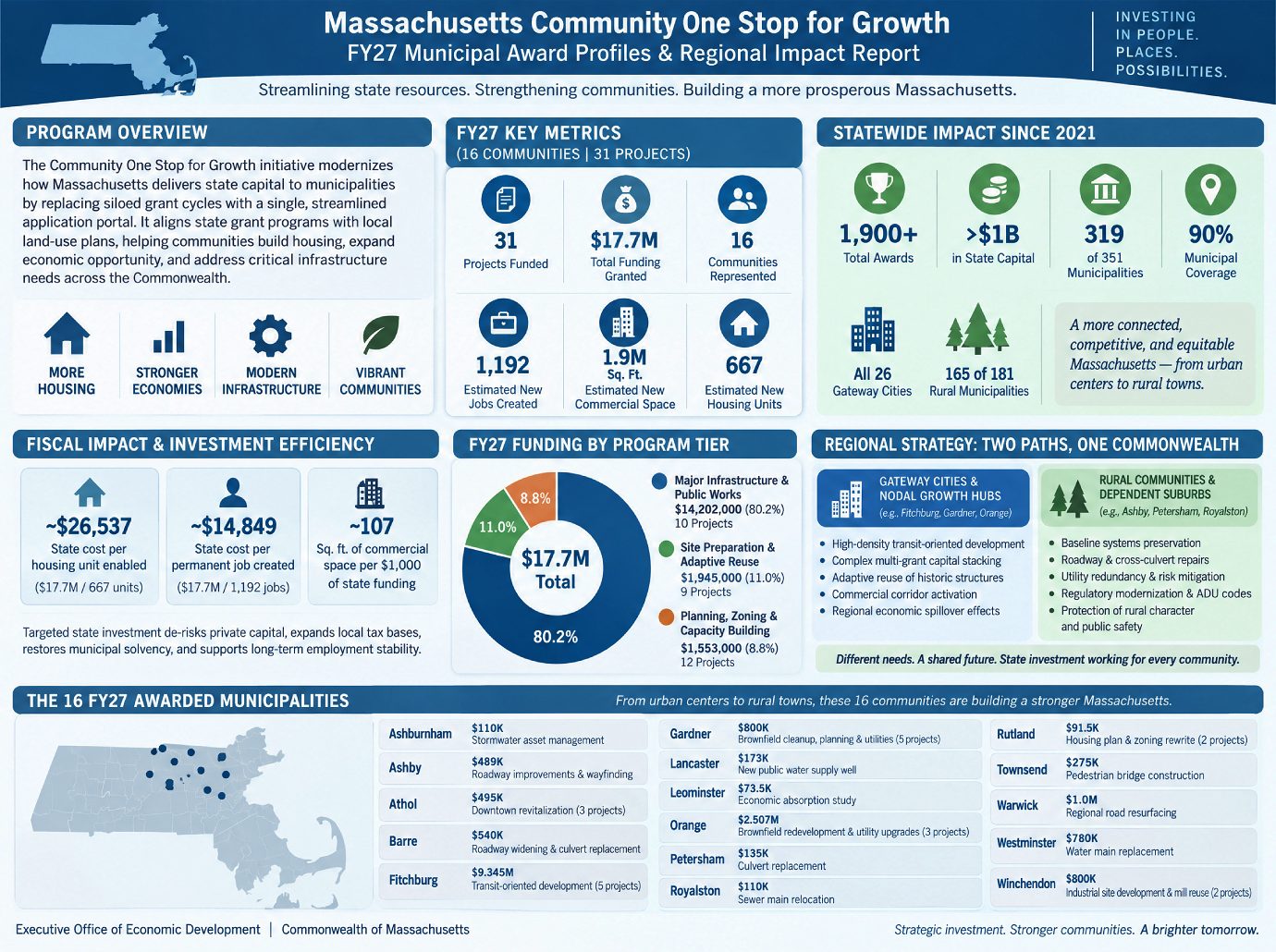
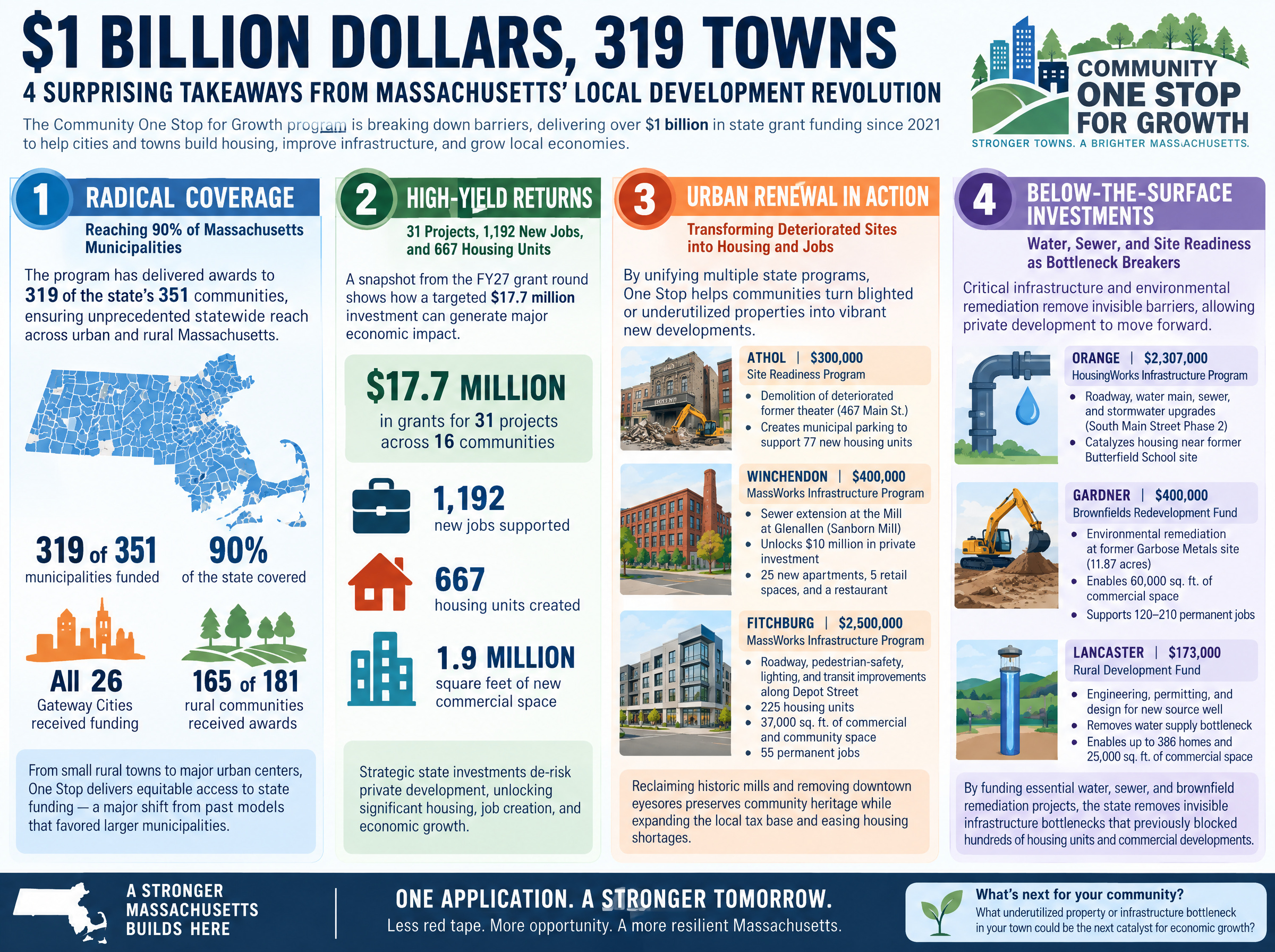
Greater Gardner and North Central MA Communities Benefit from FY27 One Stop for Growth Awards
Listen to this podcast explaining it all from the Chair Man and the Chair Lady on any device, CLICK PLAY.
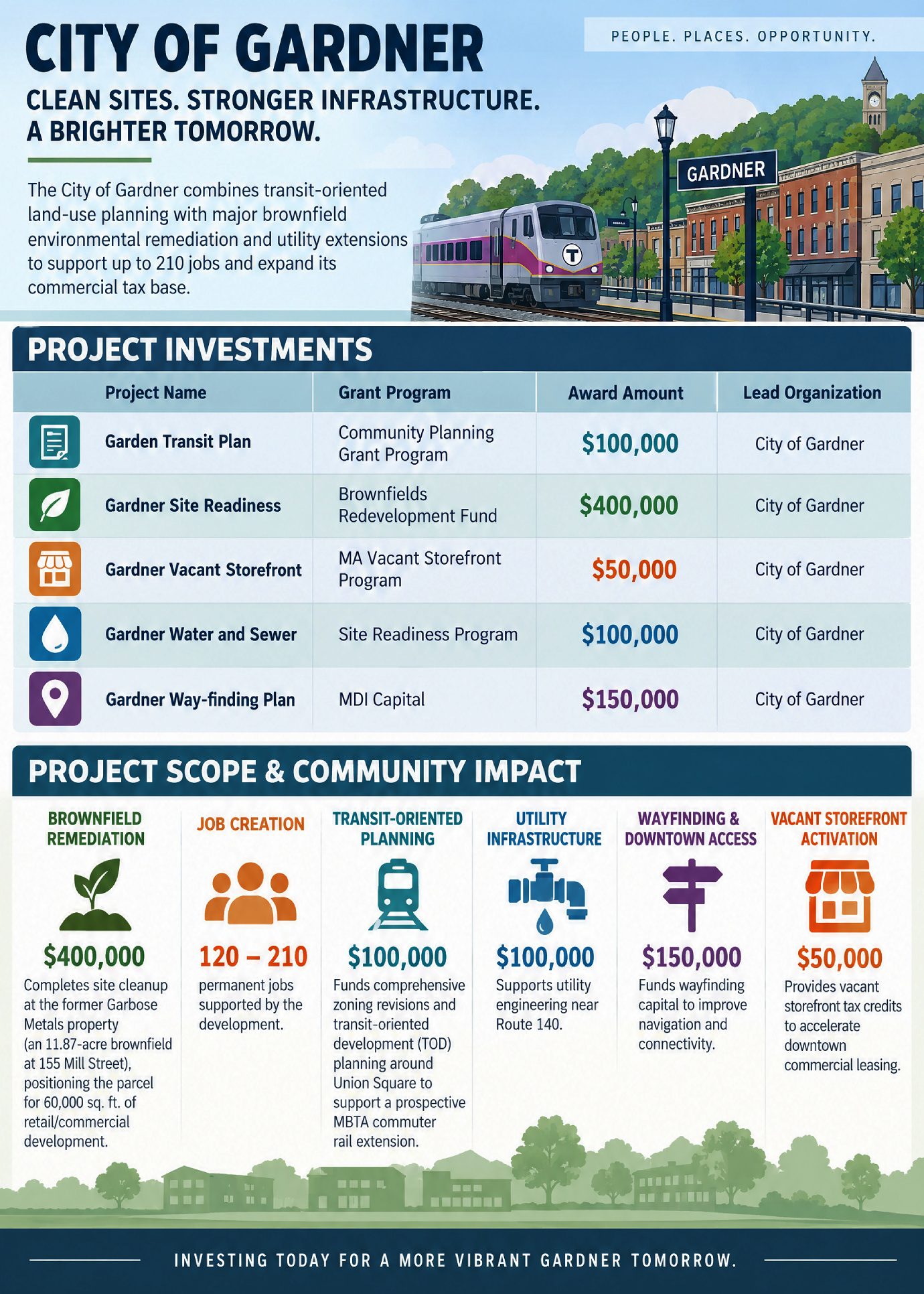
Deep Dive – One Stop Grants FY27 In the City of Gardner:The City of Gardner combines transit-oriented land-use planning with major brownfield environmental remediation and utility extensions to support up to 210 jobs and expand its commercial tax base.
Project Scope & Community Impact: Gardner links environmental remediation with long-range infrastructure capacity building. A $400,000 Brownfields award completes site cleanup at the former Garbose Metals property (an 11.87-acre brownfield at 155 Mill Street), positioning the parcel for 60,000 sq. ft. of retail/commercial development capable of creating 120 to 210 permanent jobs.
Simultaneously, a $100,000 Community Planning grant funds comprehensive zoning revisions and transit-oriented development (TOD) planning around Union Square to support a prospective MBTA commuter rail extension. Infrastructure readiness is further supported by $100,000 for utility engineering near Route 140, complemented by $150,000 in wayfinding capital and $50,000 in vacant storefront tax credits to accelerate downtown commercial leasing.
Project Name Grant Program Award Amount Lead Organization Garden Transit Plan Community Planning Grant Program $100,000 City of Gardner Gardner Site Readiness Brownfields Redevelopment Fund $400,000 City of Gardner Gardner Vacant Storefront MA Vacant Storefront Program $50,000 City of Gardner Gardner Water and Sewer Site Readiness Program $100,000 City of Gardner Gardner Way-finding Plan MDI Capital $150,000 City of Gardner Some of the grants for other Communities in the region:
Ashburnham: The Town of Ashburnham secured foundational capital to inventory and assess its municipal stormwater networks, establishing structural engineering baselines for future land-use development.
Project Name Grant Program Award Amount Lead Organization Ashburnham Stormwater AMP Rural Development Fund $110,000 Town of Ashburnham Project Scope & Community Impact: Grant funding supports the development of a comprehensive Stormwater Asset Management Plan (AMP) to perform engineering evaluations of municipal culverts, bridges, and conveyance structures. Beyond mitigating acute flood risks and addressing deferred maintenance liabilities, the AMP provides the hydraulic baseline data necessary to evaluate municipal utility capacity for future residential, commercial, and light industrial park developments.
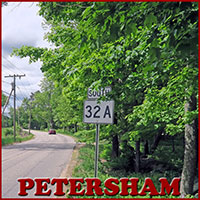
Petersham: The Town of Petersham received target infrastructure capital to address critical culvert deterioration and protect rural road network integrity.
Project Name Grant Program Award Amount Lead Organization Nichewaug Road Culvert Rural Development Fund $135,000 Town of Petersham Project Scope & Community Impact: Grant funds cover field engineering, environmental permitting, and replacement design for three severely undersized, failing cross culverts along Nichewaug Road, removing acute flood risk and securing rural travel routes.
Royalston: The Town of Royalston secured targeted funding to resolve severe environmental and public health risks associated with municipal wastewater infrastructure mounted to a compromised bridge.
Project Name Grant Program Award Amount Lead Organization Sewer Main Relocation Rural Development Fund $110,000 Town of Royalston Project Scope & Community Impact: This award supports an Alternatives Analysis and civil engineering design to relocate a municipal sanitary sewer force main away from the structurally condemned King Street Bridge, eliminating failure risks and safeguarding local river ecosystems.
Westminster: The Town of Westminster was awarded utility infrastructure funds to replace a critical municipal water main spanning a major highway overpass, restoring hydraulic redundancy to regional commercial zones.
Project Name Grant Program Award Amount Lead Organization Br. W-028-23 Waterline MassWorks Infrastructure Program $780,000 Town of Westminster Project Scope & Community Impact: Funding supports the complete replacement of the municipal water main crossing Bridge W-28-023 (Route 2A/140 over Route 2). The project eliminates structural leak risks and restores system hydraulic redundancy, ensuring uninterrupted fire protection and water delivery to the Westminster Business Park and adjacent industrial corridors.
Winchendon: The Town of Winchendon secured dual MassWorks awards to establish build-ready industrial sites while unlocking private investment for the adaptive reuse of a landmark historic mill.
Project Name Grant Program Award Amount Lead Organization Innovation Place MassWorks Infrastructure Program $400,000 Town of Winchendon Mill at Glenallen MassWorks Infrastructure Program $400,000 Town of Winchendon Project Scope & Community Impact: Winchendon balances industrial site creation with historic mill preservation:
- Innovation Place ($400,000): Delivers roadway extension, public water/sewer connections, drainage, and wetland mitigation to bring a new industrial park to pad-ready status, enabling 165,000 sq. ft. of commercial space and supporting an estimated 210 permanent jobs.
- Mill at Glenallen ($400,000): Extends municipal sanitary sewer service along Glenallen Street to facilitate the historic adaptive reuse of Sanborn Mill. Public infrastructure investment unlocks approximately $10 million in private equity, creating 25 residential apartments, 5 retail spaces, and 1 restaurant space.
- Weekly Briefing 10-4-26
Want even more detail? We have individual news sections on North Central MA, Massachusetts, National News and World News. Each has a separate podcast, narrative, and infographics for your perusal.
Weekly Briefing – Gardner Magazine for October 4, 2026
Listen to the Weekly Briefing on any device, CLICK PLAY.
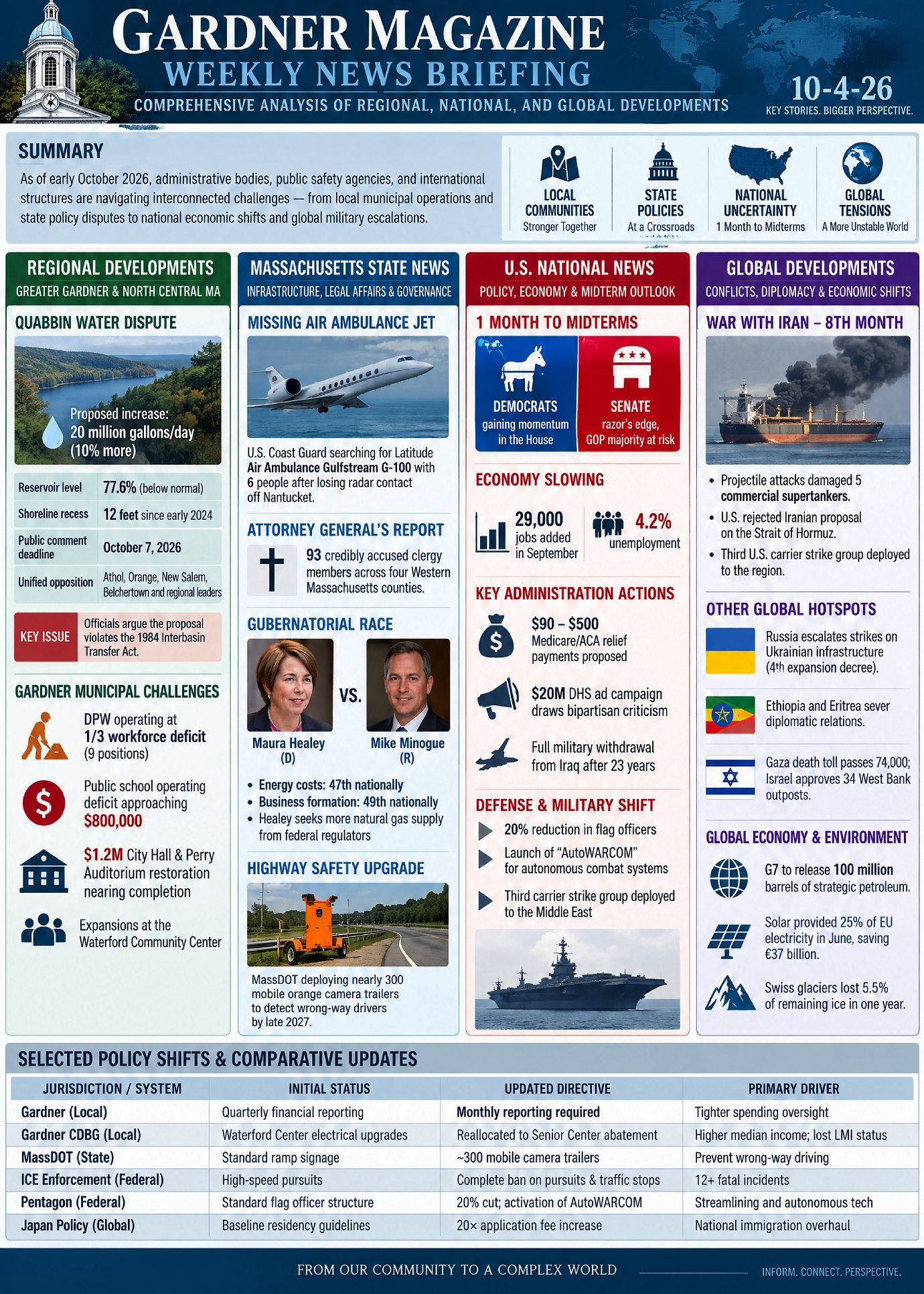
DEEP DIVE – Weekly Briefing 10-4-26 As of early October 2026, administrative bodies, public safety agencies, and international governance structures are navigating interconnected challenges across local municipal operations, state policy disputes, national economic shifts, and global military escalations.
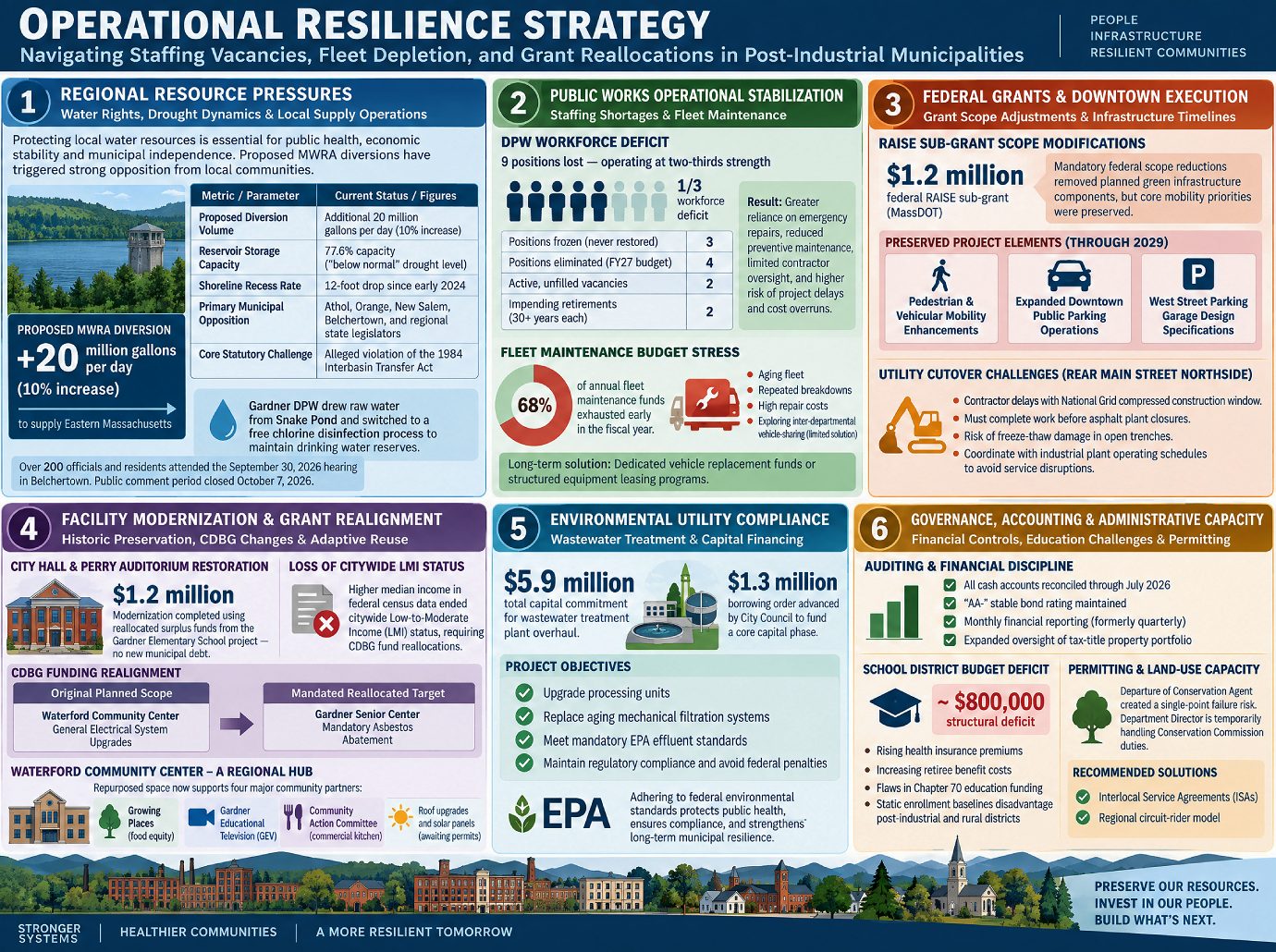
- Regional & Municipal Dynamics (Greater Gardner & North Quabbin): North Central Massachusetts faces a major resource dispute regarding a proposed 20-million-gallon daily (10%) water extraction increase from the Quabbin Reservoir by the Massachusetts Water Resources Authority (MWRA), drawing unified opposition under the 1984 Interbasin Transfer Act. Concurrently, the City of Gardner is balancing severe operational friction—including a one-third Department of Public Works (DPW) workforce deficit and an approaching $800,000 public school operating deficit—against physical infrastructure milestones such as the $1.2 million restoration of City Hall and Perry Auditorium and multi-tenant expansions at the Waterford Community Center.
- Massachusetts State Infrastructure & Public Safety: Statewide focus centers on an active U.S. Coast Guard search-and-rescue mission for a missing Latitude Air Ambulance Gulfstream G-100 jet carrying six people off Nantucket. In legal affairs, the Attorney General released a report identifying 93 credibly accused clergy members across four Western Massachusetts counties. Politically, the gubernatorial contest between Governor Maura Healey and Mike Minogue focuses on state economic rankings (47th in energy costs, 49th in business formation) and Governor Healey’s petition to federal energy regulators to increase domestic natural gas supply.
- U.S. National Policy & Midterm Landscape: Exactly one month prior to the 2026 midterm elections, federal gridlock coincides with a slowing labor market (29,000 jobs added in September; 4.2% unemployment). The Trump administration has proposed direct $90 to $500 Medicare/ACA senior relief payments, drawn bipartisan criticism for a $20 million DHS ad campaign, and completed the total military withdrawal from Iraq after 23 years. The Department of Defense has initiated a 20% reduction in flag officers, launched “AutoWARCOM” for autonomous combat systems, and deployed a third carrier strike group to the Middle East.
- Geopolitical Realignments & International Crises: The war with Iran has entered its eighth month, marked by projectile attacks damaging five commercial supertankers and the U.S. rejection of an Iranian proposal regarding the Strait of Hormuz. Elsewhere, diplomatic relations between Ethiopia and Eritrea have completely dissolved following drone strikes in Addis Ababa, Russian forces have escalated strikes on Ukrainian infrastructure alongside a fourth 2026 military expansion decree, and the G7 has ordered an emergency release of 100 million barrels of strategic petroleum.
Regional Developments in Greater Gardner & North Central Massachusetts
Regional Water Rights and the Quabbin Reservoir Extraction Dispute
A central regional controversy in North Central Massachusetts is the Massachusetts Water Resources Authority’s (MWRA) proposal to expand water diversions from the Quabbin and Wachusett Reservoir systems by 20 million gallons per day—a 10% increase—to supply municipalities in Eastern Massachusetts.
Quabbin Diversion Dispute Metric Status / Fact Proposed Diversion Volume Additional 20 million gallons per day (10% increase) Recipient Region Eastern Massachusetts municipalities Current Reservoir Level 77.6% capacity (“below normal” drought level) Shoreline Recess Receded 12 feet since early 2024 Primary Municipal Opposition Athol, Orange, New Salem, Belchertown, regional representatives Key Statutory Challenge Non-compliance with the 1984 Interbasin Transfer Act Public Comment Deadline October 7, 2026 - Public Hearing and Opposition: On September 30, 2026, over 200 municipal officials, watershed stewards, and residents attended a four-hour public hearing hosted by the state Water Resources Commission in Belchertown. Local representatives strongly denounced the extraction proposal.
- Drought Metrics and Local Friction: The Quabbin Reservoir operates at 77.6% capacity following a summer marked by Level 2 Significant Drought conditions, with its shoreline receding 12 feet since early 2024. Host communities such as New Salem maintained mandatory municipal water bans throughout the summer, heightening local friction regarding unconstrained supply transfers to eastern communities.
- Legal Arguments: Four state legislators and local leaders contend that the MWRA proposal violates the 1984 Interbasin Transfer Act. Opponents argue the request operates as an open-ended “blank check” or “slush fund” because the MWRA has not formally designated specific receiving municipalities prior to authorization.
- Local Water Systems Operations:
- Athol: Following late-September rainfall, the Athol Department of Public Works lifted mandatory water restrictions enforced since June 10, 2026.
- Gardner: To safeguard local supply during regional drought conditions, Gardner drew raw water from Snake Pond and transitioned its municipal drinking water disinfection process to free chlorine.
Gardner Municipal Infrastructure, DPW Deficits, and Capital Projects
The City of Gardner is navigating acute operational deficits within its Department of Public Works (DPW) alongside ongoing capital and utility upgrades.
DPW Workforce Breakdown & Operational Deficits
The DPW is operating at a one-third workforce deficit, down nine full positions:
[Total Staffing Deficit: 9 Positions (1/3 Workforce Loss)]
 ├── 3 Positions Frozen (Previous Fiscal Cycles)
 ├── 4 Positions Eliminated (FY27 Budget Cuts)
 ├── 2 Active Unfilled Vacancies
 └── Impending Loss: 2 Veteran Retirements (30+ Years Service Each)
Equipment failures forced the DPW to exhaust 68% of its annual fleet maintenance budget early in the fiscal year. In response, the City Council Finance Committee is evaluating inter-departmental vehicle-sharing policies.
Federal Grants, Downtown Mobility, and Capital Upgrades
- Federal RAISE Sub-Grant Modifications: Scope cuts mandated by federal regulators stripped green infrastructure and environmental sustainability elements from Gardner’s $1.2 million federal RAISE sub-grant (administered via MassDOT). Despite re-bidding requirements, planners are proceeding with multi-year downtown mobility upgrades, expanded public parking, and design specifications for the West Street garage through 2029.
- Rear Main Street Utility Delays: Contractor delays involving National Grid compressed construction schedules along the Rear Main Street Northside corridor, requiring accelerated utility cutovers prior to late-autumn asphalt plant closures and winter weather.
- Wastewater Treatment Overhaul: The City Council Finance Committee advanced a $1.3 million borrowing order to fund a portion of an EPA-mandated $5.9 million overhaul of Gardner’s wastewater treatment facility.
Facilities Modernization & Adaptive Reuse
- City Hall & Perry Auditorium: Modernization efforts totaling $1.2 million are nearing completion under Mayor Michael Nicholson’s administration. Project financing was secured by reallocating capital surplus funds carried over from the recently completed Gardner Elementary School construction project.
- CDBG Funding Reallocation: Updated census data indicated an increase in Gardner’s median income, removing its citywide Low-to-Moderate Income (LMI) status. Consequently, federal Community Development Block Grant (CDBG) funds were redirected from planned electrical upgrades at the Waterford Community Center to fund mandatory asbestos abatement at the Senior Center.
Facility / Tenant Action / Expansion Details Waterford Senior Center Reallocated CDBG funds deployed for mandatory asbestos abatement Growing Places Relocated headquarters from Leominster into 2 dedicated classrooms Gardner Educational TV (GEV) Expanded into a studio 3 times larger than its prior facility Community Action Committee (CAC) Initiated commercial kitchen construction in former administrative wing Waterford Structural/Solar Roof and solar panel installations pending National Grid permits Regional Governance, Fiscal Oversight, and School Budgets
- Financial Reconciliations: City Auditor Karen Butler confirmed that long-standing municipal accounting backlogs are cleared, with all cash accounts reconciled through July 2026. The City Council enacted monthly (formerly quarterly) financial reporting requirements to monitor city spending and tax-title properties. Gardner maintained its “AA-” stable bond rating.
- School District Deficit: The Gardner Public School District faces a structural operating deficit approaching $800,000, driven by escalating employee health insurance premiums and retiree costs, prompting community discussions regarding potential staffing adjustments.
- Regional Governance & Campaigns:
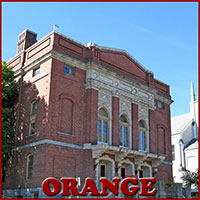
- Orange: The Selectboard is resolving three separate Open Meeting Law complaints regarding executive session procedures. Town planners are reviewing designs (parking, greenspace, recreation) for the demolished cereal factory site.
- Fitchburg: Fire Chief Dante Suarez remains on administrative leave pending a federal retaliation lawsuit filed against city leadership.
- Legislative Advocacy: State Sen. Jo Comerford hosted forums (including at Fisher Hill School in Orange) advocating for Chapter 70 education funding formula revisions to assist underfunded rural districts. State Rep. Susannah Whipps launched her reelection campaign for the 2nd Franklin District, focusing on Western Massachusetts equity, public works, and veterans.
Healthcare, Higher Education, and Regional Economic Development
- Heywood Healthcare & Athol Hospital: Operating under CEO Rozanna Penney following network cybersecurity disruptions, Heywood Healthcare continues its post-recovery restructuring. It acquired commercial property on South Main Street in Athol for clinic capacity and secured program approvals for hands-on radiologic technology and allied health training pipelines at Athol Hospital.
- Mount Wachusett Community College (MWCC): MWCC secured over $1.1 million annually in federal funding for its TRIO support programs. However, campus law enforcement and public safety leadership were placed on administrative leave pending an internal review.
- Workforce Development: The Polus Center for Social and Economic Development in Athol received a $500,000 grant from the Executive Office of Labor and Workforce Development. Effective November 2, 2026, it will launch fast-track training for special education assistants and teacher’s aides.
- Local Planning & Commercial Real Estate:
- Gardner: The 1 2 3 Grow Child Center is being rebuilt following fire damage. The Planning Board approved expanded commercial cannabis retail. Following the Conservation Agent’s departure to Marblehead, the Planning Director is directly managing Conservation Commission filings and site inspections.
- Athol: Site plans were approved for a new municipal skate park, public works engineers are planning the demolition of the York Building, and new businesses opened, including The Little Kitchen Café near the Uptown Common.
Massachusetts Statewide Infrastructure, Legal Affairs & Governance
Public Safety, Emergency Response, and Legal Proceedings
Nantucket Aircraft Emergency Search
The U.S. Coast Guard and regional units are conducting a maritime search-and-rescue operation in the Atlantic Ocean south of Nantucket following the disappearance of a corporate medical transport jet:
Latitude Air Ambulance Gulfstream G-100 (Canadian Registered)
 ├── Flight Origin: L.F. Wade International Airport, Bermuda (Departed 12:41 a.m.)
 ├── Destination: Boston, Massachusetts
 ├── Incident Time: ~2:00 a.m. (FAA Lost Radar Contact)
 ├── Emergency Declaration: Flight crew declared critical electrical failure
 ├── Flight Telemetry: Rapid descent of ~7,500 feet into Atlantic waters
 └── Manifest: 6 Individuals (4 Crew Members, 2 Passengers)
Major Reports and Investigations
- Diocese of Springfield Misconduct Report: The Massachusetts Attorney General released an investigation detailing historical clergy sexual abuse across Berkshire, Franklin, Hampden, and Hampshire counties. The report lists 93 credibly accused clergy members, records accounts from 275 survivors, cites systemic administrative failures, and mandates continued state oversight.
- Predatory Scam Alerts: Southeastern Massachusetts public safety agencies issued alerts regarding financial scams targeting grieving military families.
Criminal Justice Updates
- Sandra Birchmore Case: Pre-trial motions intensified for Matthew Farwell, a former Stoughton police officer charged in connection with the death of Sandra Birchmore.
- Lindsay Clancy Trial: Public discussion resurfaced following public interviews by the attorney representing the sole holdout juror detailing jury deliberations.
- Cambridge Police Shooting: Authorities released official footage from a fatal police shooting after investigations formally cleared the involved officers.
- Federal Prosecutions: Zachary Brodeur (37, Lynn) was charged in federal court with receiving child sexual abuse material following an undercover operation. A Hopkinton resident was sentenced for participating in a tri-state (MA, RI, CT) bank fraud ring that used counterfeit IDs to steal over $530,000.
- Winthrop Assault Case: A Stoughton man faces seven charges in East Boston District Court following a foot chase and Taser deployment stemming from assaults in Winthrop; he was transferred to Bridgewater State Hospital for psychiatric evaluation.
State Governance, Energy Policy, and Transportation
Gubernatorial Campaign & Economic Rankings
Political activity is accelerating ahead of the November election between Democratic Governor Maura Healey and Republican challenger Mike Minogue.
Economic Metric / Policy Issue Statewide Ranking / Metric Campaign & Strategic Context Energy Costs Ranked 47th Nationally Driving debate on utility costs and business retention Business Formation Ranked 49th Nationally Core challenge point against incumbent economic policies State Gas Tax 24 Cents per Gallon Analysts project tax rate remains unchanged post-election Healey FERC Petition Interstate Gas Capacity Healey petitioned FERC for more natural gas to save 600k customers ~$40M/year; opposed by Conservation Law Foundation Highway Safety & Infrastructure Initiatives
MassDOT is deploying mobile orange trailers equipped with advanced camera technology along highway ramps to combat wrong-way driving.
[Vehicle Entering Exit Ramp]
       │
       ▼
[Thermal & Optical Recognition Cameras]
       │
       ├─► Triggers High-Intensity Strobes & Trailer Alerts
       ├─► Activates Overhead Variable Message Boards (VMBs)
       └─► Directly Notifies Local Emergency Dispatch Units
Goal: Deploy nearly 300 automated detection units statewide by late 2027.
Regional Policy Briefs
- Housing Repurposing: State and regional leaders are evaluating conversions of historic sites, including the Vicksburg Square barracks at Devens, into residential units.
- Labor Relations: Brigham and Women’s Hospital faces a potential strike as union negotiations reach critical deadlines.
- Public Health: The Department of Public Health confirmed the 12th human case of West Nile virus for the season.
- Regional Events & Incidents: Marblehead High School mourned the sudden death of senior football captain and Williams College commit Owen Coyne (17) due to a non-athletic brain hemorrhage. Hanson Police are investigating violence at a Whitman-Hanson High School football game involving ejections, an assault on an officer, a head-kicking incident, and a brandished knife. The 208th Topsfield Fair recorded a state record 2,598-pound giant pumpkin grown by Woody Lancaster.
U.S. National Affairs & Domestic Policy
Midterm Electoral Climate & Executive Actions
With one month remaining until the 2026 midterm elections, public polling reflects broad voter dissatisfaction with federal legislative gridlock.
2026 MIDTERM ELECTORAL OUTLOOK ┌──────────────────────────────────┬──────────────────────────────────┐ │ HOUSE OF REPS │ U.S. SENATE │ ├──────────────────────────────────┼──────────────────────────────────┤ │ Democrats gaining momentum to │ Deadlocked on a "razor's edge"; │ │ capture the chamber majority. │ fragile Republican majority. │ └──────────────────────────────────┴──────────────────────────────────┘- Campaign Strategy: The Trump-Vance campaign has split coverage: Vice President JD Vance is deployed across the South, while President Trump focuses on Rust Belt swing states. GOP internal data shows concern over holding seats in Texas and Michigan. Senate polling shows five-term Republican Senator Susan Collins of Maine declining among independent voters following pay-to-play donation allegations.
- Insurrection Act Comments: President Trump generated debate after responding “We’ll see” when asked about invoking the Insurrection Act during the midterms.
- Executive & Administrative Actions:
- Senior Healthcare Relief: The White House proposed direct $90 to $500 payments to Medicare and ACA-enrolled seniors using executive improvement funds.
- DHS Advertising: Bipartisan criticism emerged regarding DHS spending $20 million in taxpayer funds on administration promotional ads.
- Foreign Aid MOU: A foreign aid rule went into effect October 1, requiring recipient nations to sign a Memorandum of Understanding (MOU) accepting specific political conditions to receive U.S. health and development funds.
- National Mall Arch: Proposals for a monumental arch over a traffic circle between the National Mall and Arlington National Cemetery faced protests, lawsuits, and opposition from veterans and Democratic lawmakers.
Defense Strategy, Military Restructuring, and Foreign Policy
- Complete Iraq Withdrawal: The Pentagon confirmed the total withdrawal of all U.S. military forces from Iraq 23 years after the 2003 invasion, prompting Kata’ib Hezbollah to suspend active operations against U.S. targets.
- Iran Conflict Escalation: During the eighth month of the war with Iran, senior officials (Vance, Rubio, Hegseth) held an emergency Camp David summit. The U.S. deployed the USS Theodore Roosevelt carrier strike group (a third strike group in the region) and 10,000 Marines to the Middle East, while extending the deployment of the USS George Washington. The State Department ordered the expulsion of two Iranian UN diplomats in New York.
- Defense Department Reforms:
- General Officer Reduction: Defense Secretary Pete Hegseth announced a 20% cut to general and admiral positions following promotion holds on several high-ranking Black and female officers.
- AutoWARCOM: The Pentagon activated “AutoWARCOM,” a four-star command focused on autonomous weapons systems and robotic combat. Elon Musk, Palmer Luckey, and Newt Gingrich were selected to advise a new “Future of Warfare” board.
- Internal Directives: Hegseth moved the Office of Religious Affairs directly under his oversight (“full armor of God”) and publicly criticized mainstream media during a speech at Quantico.
National Economy, Labor, Energy, and Technology
- Labor & Inflation Metrics: September job growth sharply missed forecasts, adding 29,000 jobs as national unemployment rose to 4.2%. An AP-NORC poll found 65% of adults attribute high consumer prices to administration policies. Mortgage rates reached near three-year highs.
- Manufacturing & Industrial Events: Navistar laid off ~1,400 workers at its Springfield, Ohio plant shortly before a scheduled presidential rally. Conversely, the administration highlighted the groundbreaking of a major steel facility in Iowa. East and Gulf Coast dockworkers agreed to a tentative wage deal, extending their contract deadline to January 15.
- G7 Energy Coordination: French President Emmanuel Macron and G7 partners finalized an emergency release of 100 million barrels of strategic petroleum and diesel reserves over four months. The U.S. rejected proposals for a diesel export ban.
- Artificial Intelligence Governance: President Trump announced he is transitioning the official term “artificial intelligence” to “super intelligence.” AI executives signed a voluntary self-regulation agreement at the White House, while bipartisan lawmakers introduced legislation establishing developer safety standards and civil liability for infrastructure-level hacks. In states like Wisconsin and Michigan, residents are protesting utility rate hikes associated with AI data center grid expansions.
Supreme Court Actions, Immigration, and Federal Law
- Supreme Court Rulings: The Supreme Court granted an emergency stay allowing the administration to strip Temporary Protected Status (TPS) from over 300,000 Venezuelan migrants. The Court also added mandatory migrant detention policies to its official term docket.
- ICE Policy Changes & Litigation: The family of Renee Nicole Good filed federal civil rights lawsuits against ICE Agent Jonathan Ross, DHS Secretary Kristi Noem, and advisor Stephen Miller following Good’s fatal shooting during a deportation sweep. Following 12+ fatal vehicular incidents, ICE banned high-speed pursuits and routine traffic stops.
ICE OPERATIONAL POLICY REVISION (OCTOBER 2026) ┌─────────────────────────────────────────────────────────────┐ │ High-Speed Vehicular Pursuits ───► STRICTLY PROHIBITED │ │ Routine Traffic Enforcement ───► STRICTLY PROHIBITED │ └─────────────────────────────────────────────────────────────┘ *Triggered by 12+ fatal vehicle encounters and civil suits- Legal Cases & State Matters:
- Tennessee Executions Moratorium: Governor Bill Lee halted all state executions for 2026 after a botched two-hour execution attempt on Christa Pike involved seven failed needle insertions; Pike remains on a ventilator.
- Cornell Special Prosecutor: NY Governor Kathy Hochul assigned AG Letitia James as special prosecutor in a 2024 Cornell University gang rape case.
- Airman Shooting Acquittal: Protests followed a Florida jury’s acquittal of a former deputy in the fatal home shooting of a Black U.S. Air Force airman.
- Cybercrime: Jordanian authorities detained a “ShinyHunters” hacker linked to FBI data theft.
International Military Conflicts and Geopolitical Friction
Region / Theater Core Event / Strategic Shift Geopolitical Impact Strait of Hormuz / Iran U.S. rejected Iranian Hormuz transit deal; deployed 3rd carrier strike group Direct response to projectile attacks damaging 5 commercial supertankers off Oman Iraq Coalition Exit Complete U.S. & UK troop withdrawal from Iraq Formally ends 2014 anti-ISIS coalition; Kata’ib Hezbollah suspended operations Horn of Africa Ethiopia-Eritrea diplomatic severance Peace pact collapsed following Tigrayan drone strikes targeting Addis Ababa Russia / Ukraine Russian bridge strikes in Kyiv; 4th military expansion decree of 2026 Heightened NATO tensions alongside explicit nuclear threats regarding Kaliningrad Israel / Gaza / West Bank Gaza death toll passed 74,000; Israel approved 34 West Bank outposts Largest single official recognition of unauthorized West Bank outposts - South Asia & East Asia Conflict Notes: Pakistani military jets launched airstrikes against insurgent positions in Afghanistan’s Kunar and Helmand provinces, resulting in 22 insurgent deaths. In Myanmar, resistance forces under m.CDM reported 55 junta military and police personnel surrendered or were captured in late September.
Global Politics, National Elections, and Trade Policy
- Brazil Presidential Rematch: Over 158 million voters participated in a presidential election between incumbent Luiz Inácio Lula da Silva and Flávio Bolsonaro, following a pre-election security investigation at a main voting infrastructure hub.
- Morocco Leadership Milestone: Fatima Zahra El Mansouri was appointed Prime Minister of Morocco following her party’s parliamentary election win, becoming the nation’s first female prime minister.
- Trade & Regulatory Shift:
- Sino-Brazilian Trade: China imposed a 67% tariff on Brazilian beef imports.
- Pacific Link Pipeline: Canada initiated a fast-tracked 12-month environmental review for the Pacific Link pipeline, aiming to export 1 million barrels of oil per day to the Port of Vancouver.
- Japan Immigration Overhaul: Japan passed strict immigration rules, increasing permanent residency application fees 20-fold while setting higher language and income requirements.
- Canada Border Policy: The CBSA announced that starting in early 2027, interview booking windows for conditionally approved Nexus applicants will be reduced from five years to two years.
Defense Technology, Security Incidents, and Public Health
- Inflight Terror Attempt: A FlyDubai flight bound for Tel Aviv with 182 passengers was forced to divert to Saudi Arabia after the co-pilot—previously flagged for radical views—attacked the captain with a cockpit axe mid-flight. The captain survived, subduing the attacker with help from crew members.
- Global Public Health Warnings: A World Health Organization report indicated that global life expectancy is stabilizing post-COVID, but warned of rising burdens from noncommunicable diseases (NCDs), particularly diabetes and dementia. International campaigns were also launched to address Helicobacter pylori, an asymptomatic gastric bacterium infecting nearly 50% of the world’s population.
- Environmental & Energy Metrics: A report by Solar Power Europe indicated that solar generation provided 25% of total EU electricity in June, saving an estimated €37 billion in fossil fuel costs. Conversely, Swiss glaciers lost 5.5% of their remaining ice volume over a single year, while Argentina repealed key protections for regional glaciers to expand mining operations.
Comparative Matrix of Key Administrative & Policy Shifts
The following table summarizes key strategic, policy, and operational shifts documented across local, state, federal, and international domains:
Jurisdiction / System Initial Policy or Operational Status Updated Directive / Operational Realignment Primary Driver Gardner (Local) Quarterly Financial Reporting Enacted Mandatory Monthly Reporting Tighter municipal spending oversight & tax-title management Gardner CDBG (Local) Funding Waterford Center Electrical Upgrades Reallocated to Senior Center Asbestos Abatement Higher census median income lost citywide LMI status MassDOT (State) Standard Ramp Signage & Passive Safety Deploying ~300 Mobile Orange Thermal Camera Trailers Prevention of wrong-way driving incidents across state highways ICE Enforcement (Federal) High-Speed Pursuits & Routine Traffic Stops Complete Operational Ban on Pursuits & Traffic Stops 12+ fatal vehicle incidents and pending federal civil suits Pentagon (Federal) Standard Flag Officer Structure & Manual Systems 20% Flag Officer Cut; Activation of “AutoWARCOM” Cost/command stream streamlining and autonomous tech deployment Japan Policy (Global) Baseline Permanent Residency Guidelines 20x Application Fee Increase; Stricter Income Limits Strategic national overhaul of immigration framework 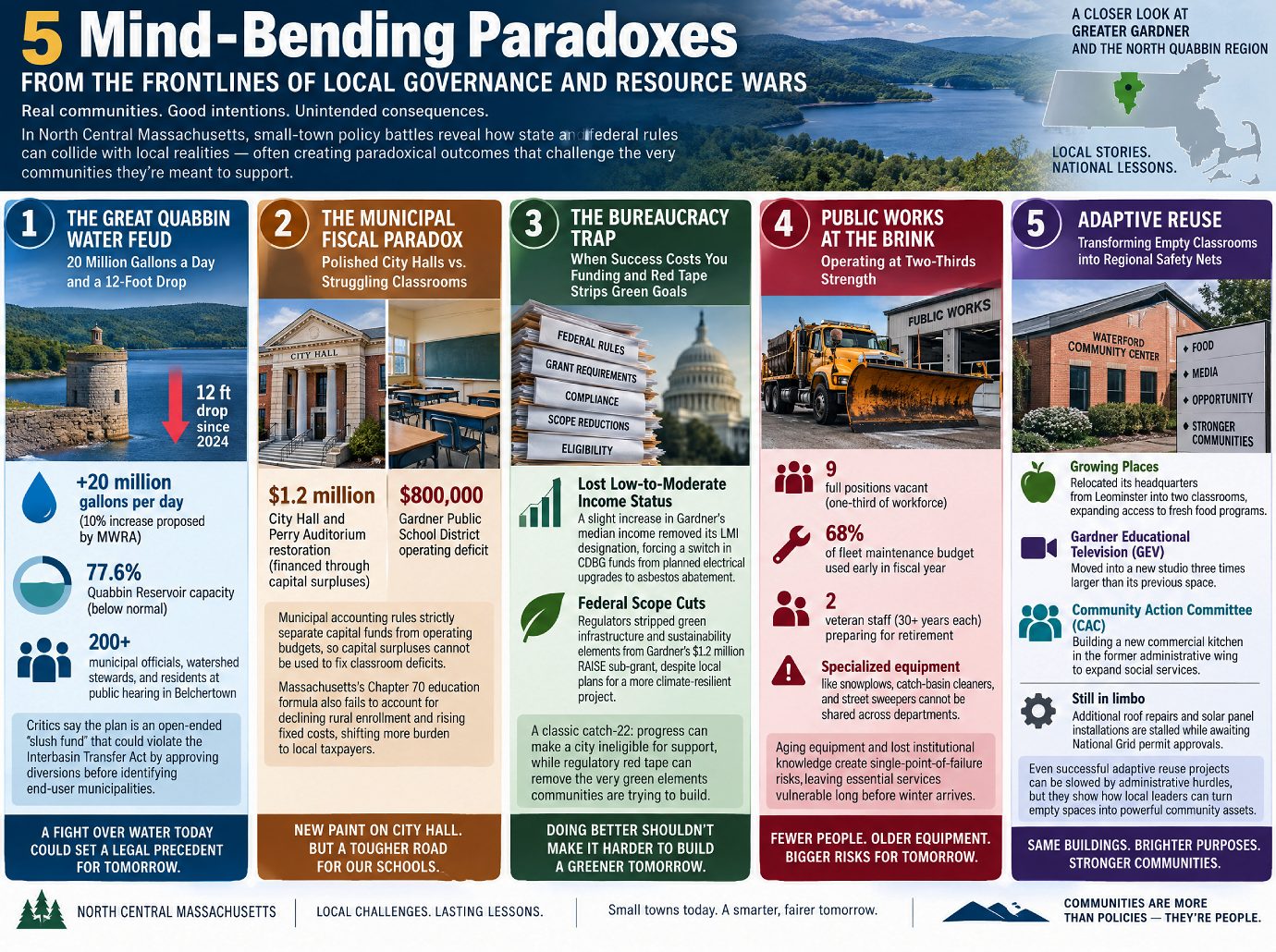
- WGAW Hotline Radio 10-3-26

WGAW Hotline Radio – October 3, 2026
Listen to the entire program on any device, CLICK PLAY.
Host Steve Wendell spoke about recreational opportunities in the area in light of the good Fall weather including State Parks and reflected on the fact that “snowburgers” going to Florida can still get WGAW via streaming.
Gardner Mayor Mike Nicholson: Topics included: Discussion of the pedestrian and bike path over 140, upgrades at the Uptown Rotary, the Ben’s Pond Dam in the Mill Street area – a grant application has been submitted to fund a feasbility study, staffing vacancies at the DPW with some positions cut from the budget while vacant, underground tanks needing removal at the DPW – state and federal funding not available because Gardner was proactive in stopping usage before a leak occurred.
Also discussed with the Mayor: Nitrogen upgrades at the wastewater treatment plant – majority is grant funded, but $1.6 million Gardner share needs to be approved by City Council, Karen Butler doing a great job as City Auditor – working with Dept. of Revenue to improve City systems, inventory being conducted of City vehicles, cost of health insurance in the City of Gardner – every municipality is being slammed with health insurance costs – working collaboratively with City Council President George Tyros on the issue, a discussion of the Mayor’s campaign for State Rep. “it’s been really fun,” – Mayor says he would like to have the State work better with cities and towns. – a discussion of possible businesses and projects.
Other Show segments:
Steve Wendell reminded listeners that all qualified candidates for office can get FREE airtime. Steve Wendell spoke about the planet Saturn being the closest to Earth – closer than any other time this year, look to the Eastern sky.
An interview with M.L. Altobelli preparing for winter – note that drought was mentioned in the interview and host Steve Wendell noted after the break that the drought is no longer in effect.
Mason Pumpkin Sale is going on right now at the Helen Mae Sauter school. Steve Wendell interviews Christopher Turcotte from the Masons. Price range is $1 to $3 for small pumpkins and large pumpkins can be $10 to $25.
Gardner Mayor Nicholson’s September Monthly Update – note that some events discussed had already taken place but most are for October and November.
Steve Wendell spoke about an assassination attempt on a Maine Wire reporter, who was almost run down by the would-be assassin who is now in custody. The reporter has been covering the illegal marijuana farms.
Oil Prices Commentary with Werner Poegel – the reasons behind the spike in home heating oil prices in Greater Gardner MA and the nation.
Illegal SNAP benefits in Massachusetts – Mike Urban reports on the EBT scam going on right now. Immigrants are opening buying food and then shipping it overseas. An undercover report
- Code Red Winter 2026

Parking Bans will be Announced via CodeRed again this Winter in Gardner MA
Never Miss an Alert: What You Need to Know About Gardner’s CodeRED System
The High Stakes of Staying in the Loop: Imagine waking up on a freezing winter morning to discover your car has been towed from the street, or setting off for your morning commute only to run directly into an unexpected road closure. In critical moments like these, timely municipal information makes all the difference. To protect residents and maintain smooth civic operations, the City of Gardner contracts with Emergency Communications Network to utilize the CodeRED high-speed notification system. CodeRED serves as the city’s vital solution for delivering real-time safety, emergency, and municipal updates directly to the community. The Chair Man and the Chair Lady explain it in this short podcast. CLICK PLAY.
DEEP DIVE – Code Red – Winter 2026
There Is No “Blanket” Winter Parking Ban—And That’s by Choice: A common misconception among local drivers is that the city enforces an automatic, city-wide parking ban whenever snow begins to fall. In Gardner, there is no automatic or “blanket” winter parking ban. Instead, any parking ban must be explicitly announced by the Mayor through the CodeRED system. While alternative proposals have been debated, the established policy remains firm:” There is no blanket parking ban… the Gardner City Council unanimously rejected any changes to the current method at the last meeting.”
Because parking bans are activated on an as-needed basis rather than automatically, registering for CodeRED is essential for anyone who parks on city streets. Without receiving these direct notifications, drivers risk unexpected parking fines or having their vehicles towed during declared bans.
Geographically-Targeted Alerts Require Your Exact Street Address: CodeRED empowers city officials to draw precise geographic boundaries around an incident to send hyper-local notifications directly to impacted neighborhood blocks rather than disrupting the entire municipality. Targeted alerts cover localized events such as: Water main breaks, Sanitary sewer overflows (SSO), and Specific road closures and detours.
Because alerts are tied directly to location, registration strictly requires a physical street address—P.O. Boxes cannot be used for location-based emergency dispatching. When registering, residents must provide their first and last name, physical street address, city, state, zip code, and primary phone number (with options to add secondary phone numbers and TDD/TTY information). By delivering targeted updates only to the specific blocks affected by an infrastructure issue or public safety event, CodeRED prevents community-wide panic while ensuring impacted residents receive actionable instructions immediately.
Modern Phone Setup? You Are Likely Not in the System Automatically – Many residents assume that their contact details are automatically included in emergency broadcast databases. However, as traditional landline telephone networks disappear, relying on automatic inclusion leaves significant communication gaps. Modern mobile and VoIP numbers are not automatically tied to traditional 911/PSAP landline databases maintained by legacy telecom monopolies. As a result, proactive manual registration is the only reliable way to guarantee you receive critical emergency alerts.
You must manually register or update your information if you belong to any of the following categories:
- Cellular-only households: Residents who rely on a mobile phone as their primary contact number.
- VoIP service users: Households using internet-based phone connections (such as Xfinity Voice from Comcast or Vonage).
- Unlisted landlines: Residents with unlisted landline numbers that are excluded from public directories.
- Recent relocations: Anyone who has changed their phone number or physical street address within the past year.
- Local business owners: Commercial operators needing critical notifications for their business properties.
Emergency Response Is Mobile and Extends Far Beyond Bad Weather: While winter parking bans are a primary concern, CodeRED covers a much broader scope of critical, life-safety communications. The system broadcasts actionable notifications for: Weather alerts and severe winter hazards, Police and Fire emergencies, Amber Alerts, Utility disruptions (water main breaks and sanitary sewer overflows)
To maintain safety on the go, residents can download the CodeRED mobile app for smartphones. The app provides real-time, location-specific alerts tailored to your current physical position, ensuring you remain informed whether you are at home, at work, or traveling across the city.
Essential Local Resources & Contacts
To register for alerts or reach municipal services, use the official contact channels below:
- Online Registration Portal: https://www.gardner-ma.gov/385/CodeRED
- CodeRED Mobile App Download: https://codered.crisis24.com/lp/mobile-alert-app-download
- Gardner Police Department (Non-Emergency): 978-632-5600 (Press 0 for Animal Control)
- Police Department Physical Address: 200 Main Street, Gardner, MA 01440
- Gardner Fire Department: 978-630-4051
- Mayor’s Office: 978-630-1490
- Gardner City Hall: 95 Pleasant Street, Gardner, MA 01440 | Phone: 978-632-1900
- Emergency Dispatch: 911
Take Control of Your Local Awareness: Taking just five minutes to register your primary phone number and physical street address in the CodeRED system is an easy, immediate win for your winter readiness and year-round safety. Keeping your contact details accurate ensures you will never be caught off guard by a sudden parking ban, a neighborhood water disruption, or a localized safety emergency. Are your current phone number and physical address registered to receive official emergency alerts before the next major winter storm hits Gardner?

- Economic Development 10-2-26
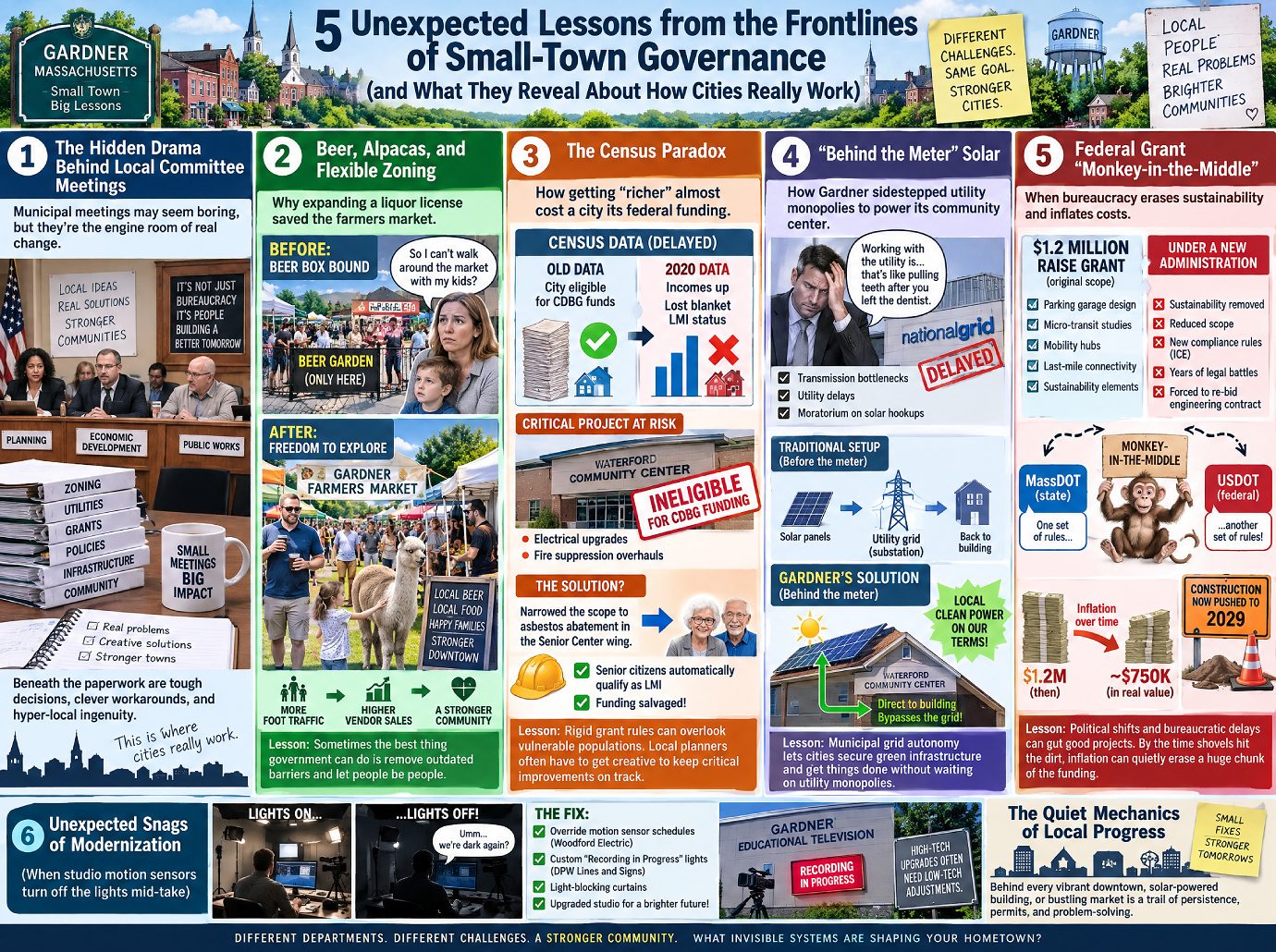
5 Unexpected Lessons from the Frontlines- CLICK on the infographic for a larger view.
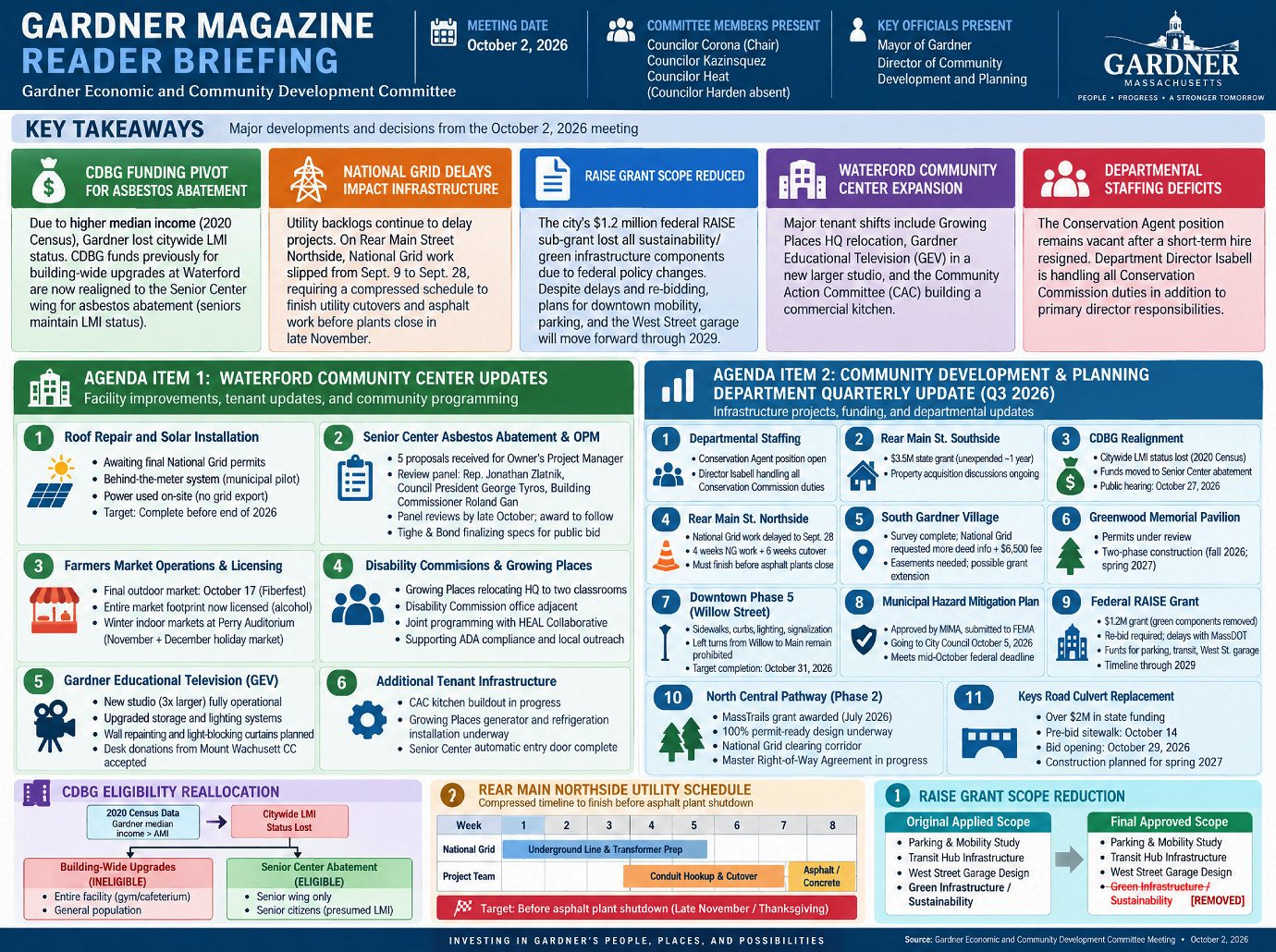
Gardner Magazine Reader Briefing – CLICK on the infographic for a larger view.
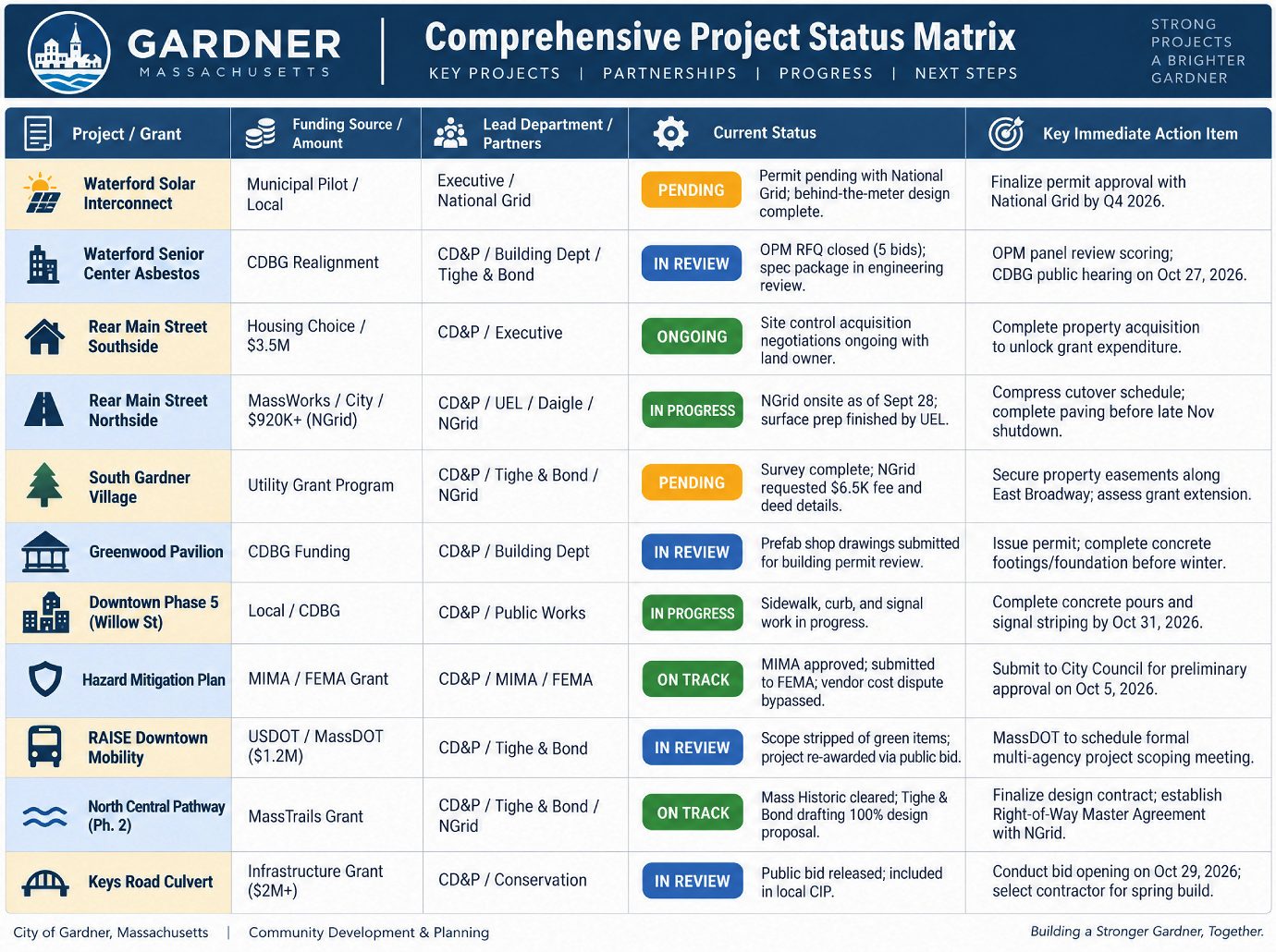
View a Comprehensive Project Status Matrix of all key projects in the City of Gardner in the infographic below. CLICK IMAGE for larger view.
Highly Informative Economic Development Meeting Turns Heads
Listen to the meeting on any device, CLICK PLAY.
Economic Development 10-2-26
- CDBG Funding Pivot for Asbestos Abatement: Following 2020 Census data that raised Gardner’s median household income above the Area Median Income (AMI), the city lost citywide Low-to-Moderate Income (LMI) status under federal HUD rules. Consequently, CDBG funds previously allocated for building-wide electrical/fire upgrades at the Waterford Community Center were ruled ineligible. The city successfully realigned these funds strictly to the Senior Center wing for asbestos abatement, as senior citizens maintain protected LMI status.
- National Grid Delays Impact Infrastructure Projects: Utility progress across multiple city projects remains hindered by National Grid backlogs and procedural requirements. On the Rear Main Street Northside project, work was delayed from September 9 to September 28, forcing a compressed coordination schedule between National Grid and city contractors to complete asphalt binder and underground utility cutovers before asphalt plants close in late November.
- RAISE Grant Scope Reduced Amid Federal Bureaucracy: The city’s $1.2 million federal RAISE sub-grant (administered via MassDOT) suffered significant scope reductions imposed by federal authorities, removing all sustainability-focused green infrastructure components. Despite administrative delays and forced public re-bidding, the city is moving forward with downtown mobility, parking, and West Street garage design plans through 2029.
- Waterford Community Center Expansion: The facility is seeing major tenant shifts, including Growing Places relocating its headquarters from Leominster into two classrooms, Gardner Educational Television (GEV) completing a transition to a studio three times larger than its former space, and the Community Action Committee (CAC) constructing a commercial kitchen in the former principal’s office.
- Departmental Staffing Deficits: The departure of the newly hired Conservation Agent (who accepted a role in Marblehead) leaves the Community Development and Planning Department without a dedicated agent. The Department Director is personally fulfilling all statutory Conservation Commission oversight, site visits, and legal filings alongside primary director responsibilities.
- Public Service 10-1-26
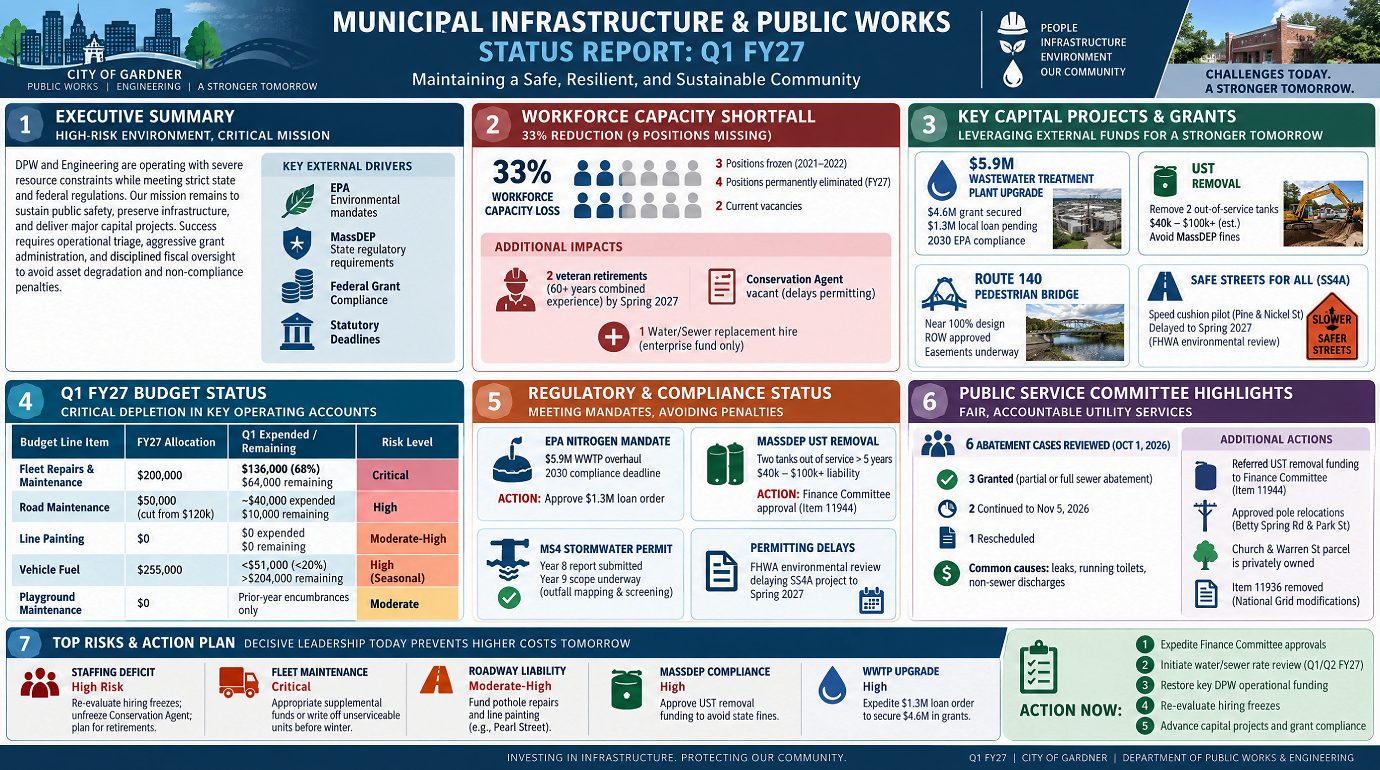
DPW is facing critical staffing deficits. Here is why: The DPW is currently down nine positions, representing one-third of its overall workforce. 3 positions frozen 4–5 years ago.4 positions eliminated entering FY27.2 active unfilled vacancies.Impending Retirements: Two veteran employees with over 30 years of dedicated service each are retiring (one between present day and April; another by May 2027).Water/Sewer Division: Down two employees, though one new hire was successfully onboarded under enterprise funding (non-city general tax funds).
The DPW completed Q1 of the fiscal year with several key operational accounts severely overspent or underfunded:Fleet Repairs and Maintenance: Budgeted at $200,000. **68% of funds have been expended** ($136,000 spent; ~$64,000 remaining). Aging fleet vehicles are driving unsustainable repair costs.“We are either going to have to start parking vehicles which is going to affect snow plowing operations or we’re going to be in a deficit for maintenance repairs… I will not have that luxury this year to be able to fund [transfers] because the positions have been cut.” — Director Arnold, DPW
- Road Maintenance: Historically funded at $120,000 annually, the line item was slashed to $50,000 for FY27. Only **$10,000 remains** for the rest of the fiscal year.
- Vehicle Fuel: Budgeted at $255,000 for the entire city fleet (Police, Fire, DPW). While Q1 spending is slightly under 20%, winter operations and high diesel fuel costs ($5–$6/gallon) are projected to push the account into a deficit.
- Playground Maintenance: $0 in funding allocated for the current fiscal year,
- Projected Shortfall: Director Arnold forecasts an unavoidable $100,000+ general DPW operational budget shortfall before accounting for winter snow and ice operations.
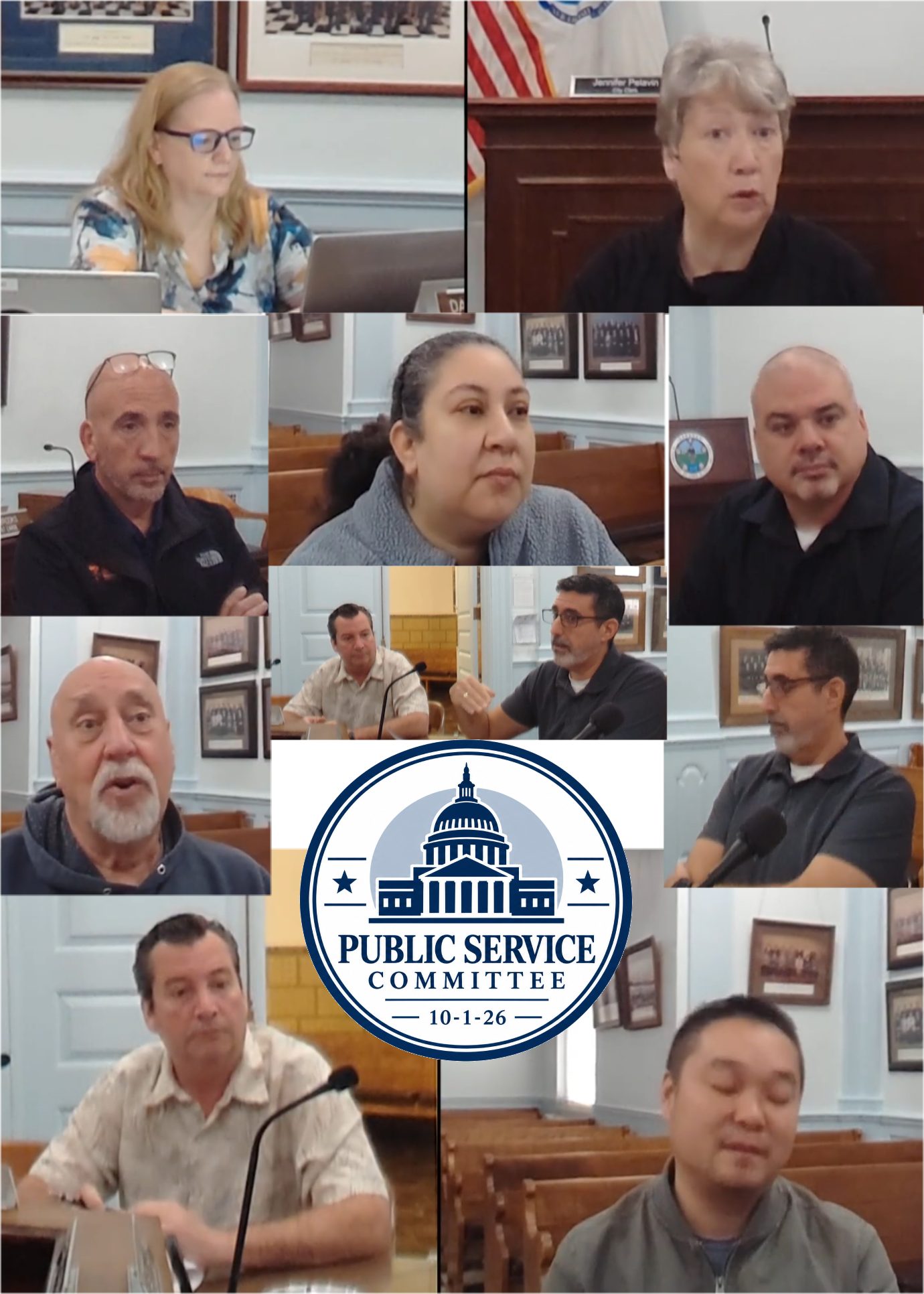
Public Service Committee Reviews Abatements, DPW Staffing Shortage, Critical Infrastructure, Engineering and City Projects
Listen to the meeting on any device, CLICK PLAY.
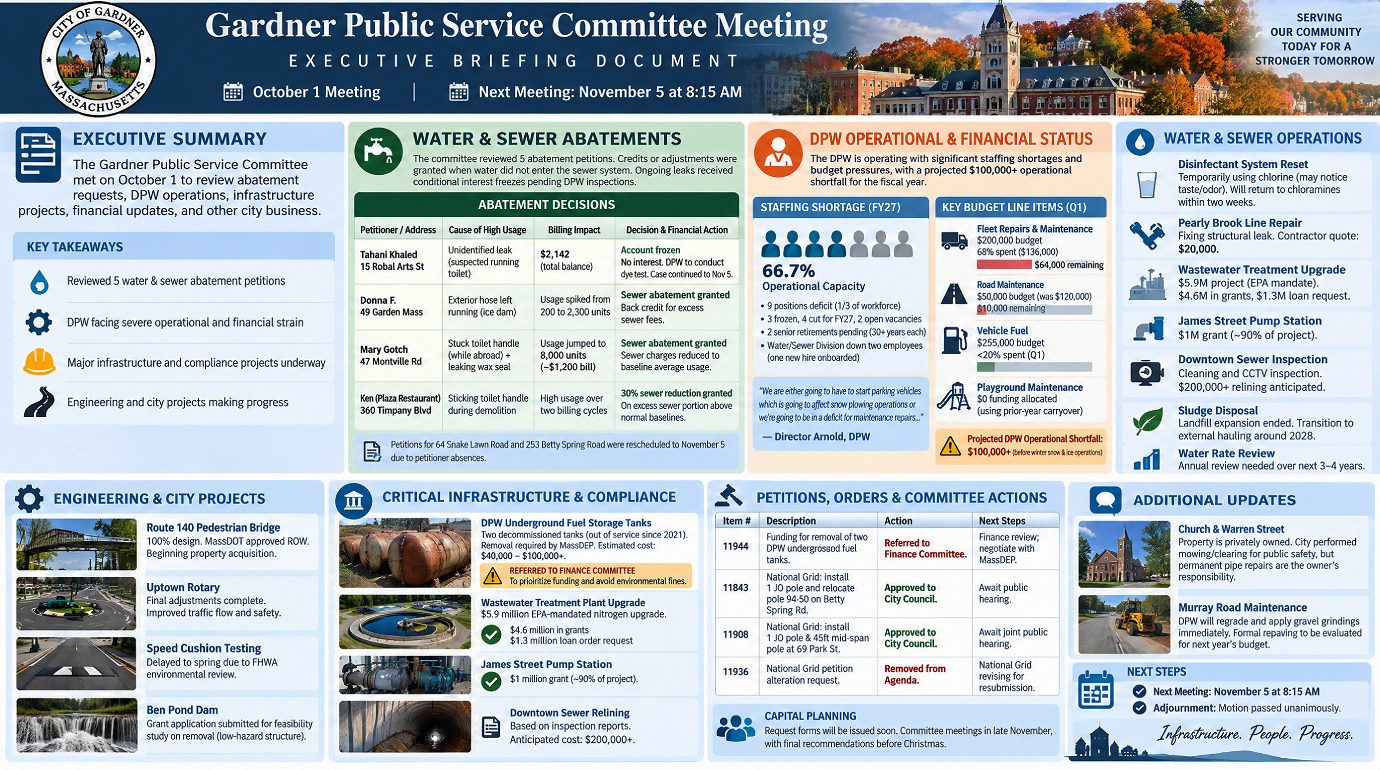
Gardner Magazine has 3 infographics below which detail items from the meeting. Here’s a summary of what went on in in the 1 hour session:
Engineering & City Projects: The Engineering Department reported progress on the Route 140 pedestrian bridge right-of-way approvals, the completion of safety modifications at the Uptown Rotary, delays on temporary speed cushion testing due to Federal Highway Administration (FHWA) environmental review processes, and the submission of a grant application for a feasibility study regarding the removal of the Ben Pond Dam.
Water and Sewer Abatements: The committee reviewed five private and commercial abatement petitions. Credits or rate adjustments were granted in cases where water leaks did not enter the municipal sewer system (e.g., severe exterior hose freezes and commercial demo-site fixture sticks), while ongoing residential leaks were given conditional interest freezes pending official Department of Public Works (DPW) diagnostic inspections.
DPW Severe Operational & Financial Strain: DPW Director Arnold presented a stark financial and operational assessment. The department is operating short by nine staff positions—representing a one-third reduction in workforce—with major retirements pending. Budget line items are heavily depleted at the end of the first quarter: 68% of the vehicle repair and maintenance budget has been spent due to aging equipment, and road maintenance funding has been reduced from $120,000 to $50,000 (with only $10,000 remaining). An overall DPW operational budget shortfall of at least $100,000 is projected for the fiscal year.
Critical Infrastructure & Compliance: Mandatory state and federal compliance actions are underway. The city faces DEP mandates to remove two decommissioned underground fuel storage tanks at the DPW facility (estimated at $40,000 to $100,000+), which has been referred to the Finance Committee. Additionally, a $5.9 million EPA-mandated nitrogen upgrade at the wastewater treatment plant is being funded through $4.6 million in grants and a requested $1.3 million loan order.
Next Scheduled Public Service Committee Meeting: November 5 at 8:15 AM.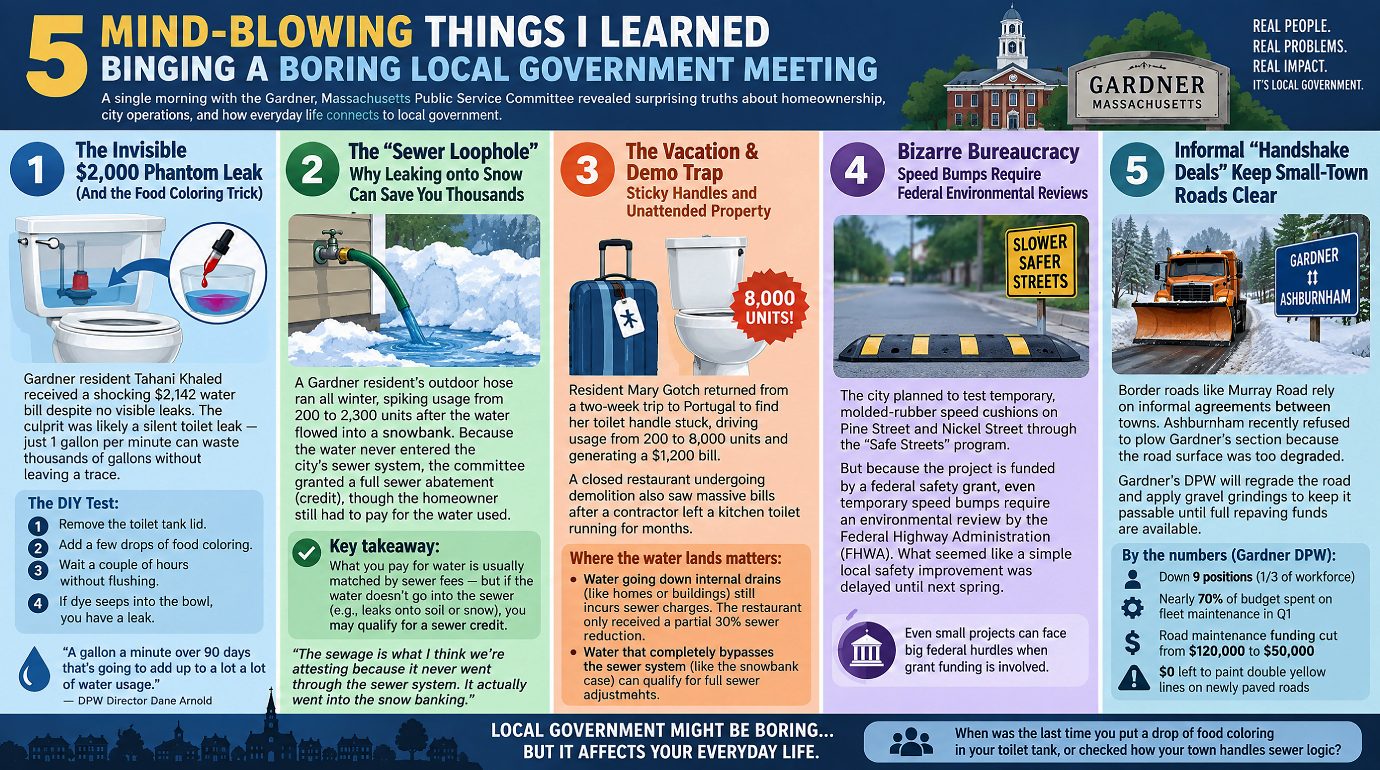
- Finance 9-29-26
Gardner Finance Committee Reviews City Fleet, Financial Policies, and Projects – DETAILED REPORT
Listen to the entire meeting on any device, CLICK PLAY.
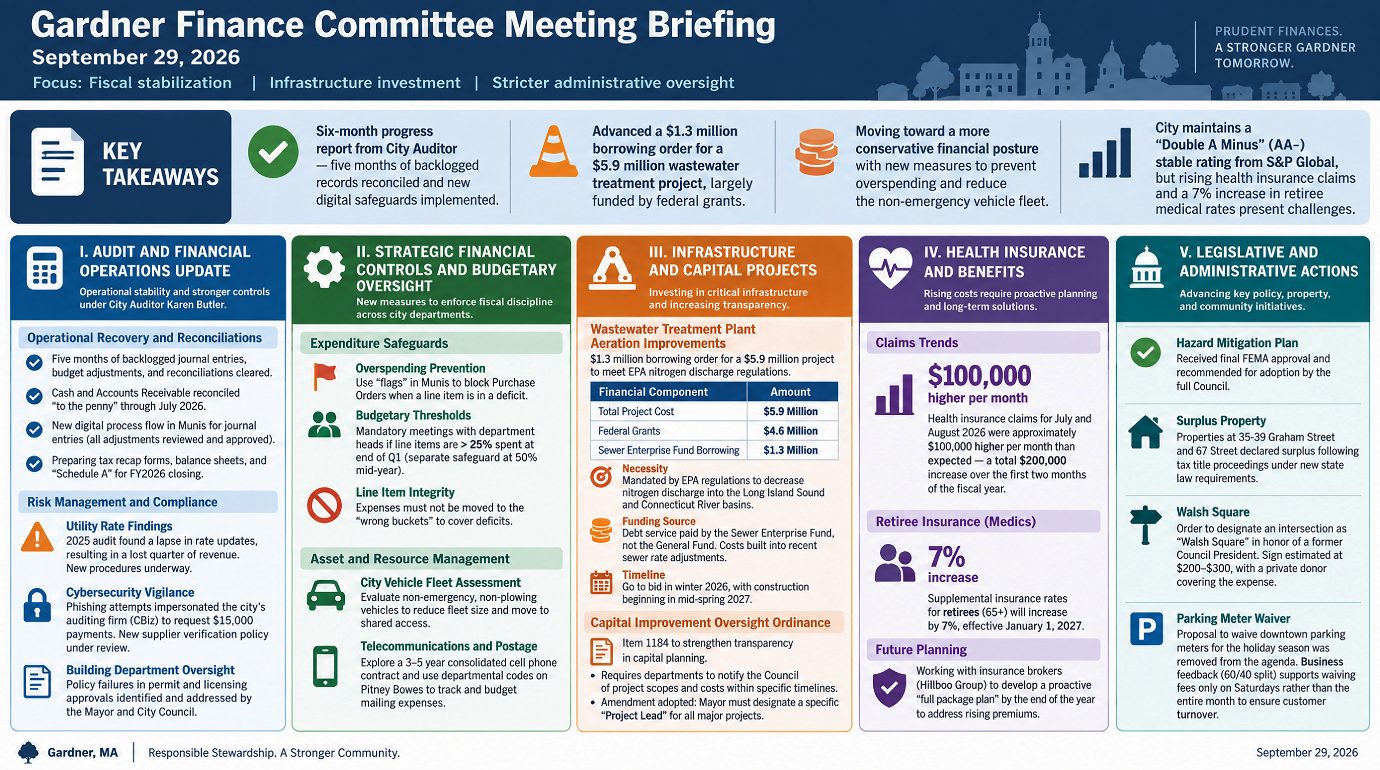
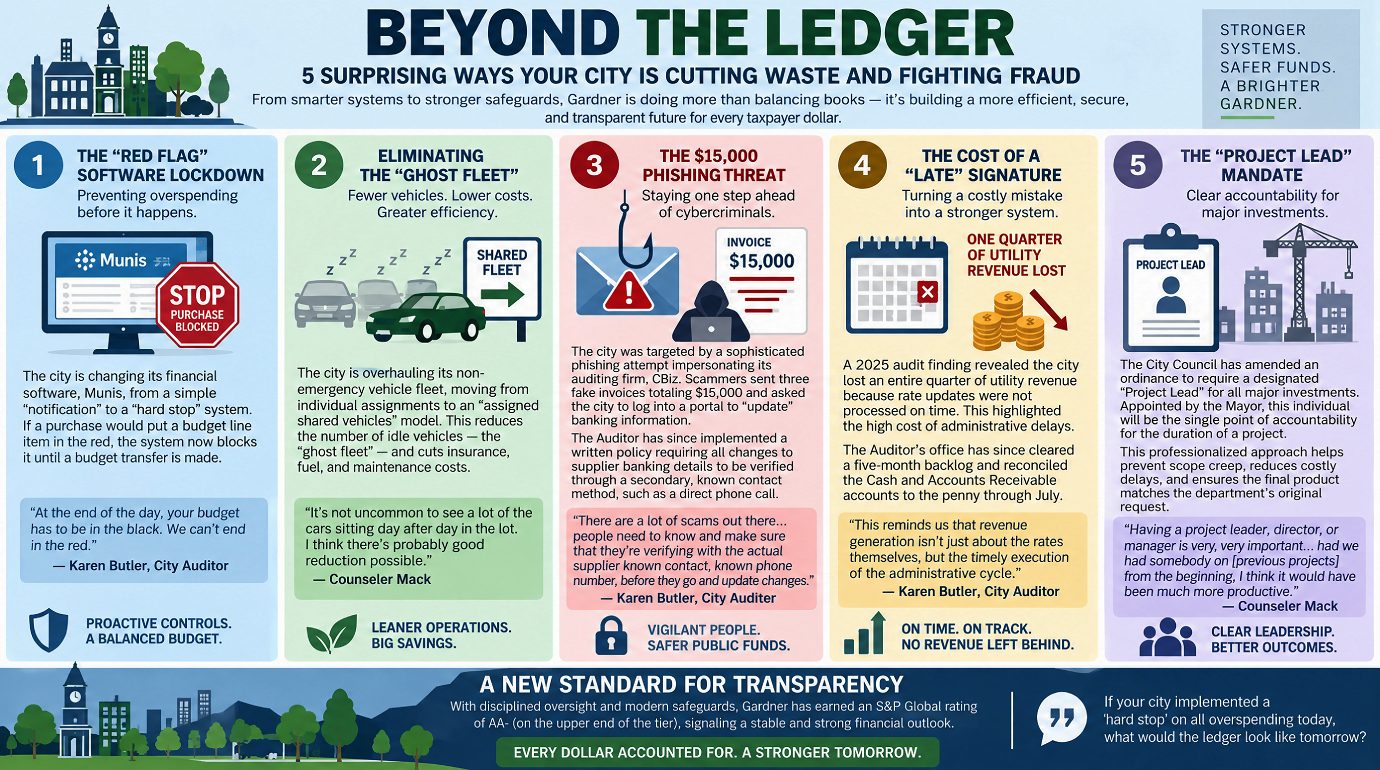
Finance Committee 9-29-26 The Gardner Finance Committee meeting held on September 29, 2026, focused on fiscal stabilization, infrastructure investment, and the implementation of stricter administrative oversight. Key takeaways include a successful six-month progress report from the City Auditor, who has reconciled five months of backlogged records and implemented new digital safeguards. The committee also advanced a $1.3 million borrowing order for a $5.9 million wastewater treatment project—largely funded by federal grants—to comply with EPA nitrogen discharge regulations.
The administration is moving toward a more conservative financial posture, introducing measures to prevent departmental overspending and launching an assessment to reduce the city’s non-emergency vehicle fleet. While the city maintains a “Double A Minus” (AA-) stable rating from S&P Global, rising health insurance claims and a 7% increase in retiree medical rates present ongoing budgetary challenges.
Audit and Financial Operations Update: City Auditor Karen Butler provided a comprehensive six-month update following her appointment in March 2026. The department has transitioned from a period of vacancy and corrective action to a state of operational stability.
Operational Recovery and Reconciliations: Backlog Clearance: Upon hiring, the department was five months behind on journal entries, budget adjustments, and reconciliations. Balance Accuracy: Cash and Accounts Receivable (AR) have been reconciled “to the penny” through July 2026.Policy Improvements: A new digital process flow has been established in the Munis system for journal entries to ensure all adjustments are reviewed and approved for accuracy. FY2026 Closing: The department is currently preparing tax recap forms, balance sheets, and “Schedule A” to determine the tax rate and “free cash” levels.
Risk Management and Compliance: Utility Rate Findings: The 2025 audit identified a lapse in utility rate updates that resulted in a lost quarter of revenue. New procedures are being implemented to ensure timeliness. Cybersecurity Vigilance: The Auditor reported a series of “phishing” attempts where scammers impersonated the city’s auditing firm (CBiz) to request fraudulent payments of $15,000 via updated banking information. A new policy for verifying supplier remittance changes is under review. Building Department Oversight: Policy failures regarding proper approvals for permits and licensing were identified and addressed by the Mayor and City Council.
Strategic Financial Controls and Budgetary Oversight: The committee and administration discussed several new measures designed to enforce fiscal discipline across city departments.
Expenditure Safeguards: — Overspending Prevention: The Auditor and Mayor discussed utilizing “flags” within the Munis system to prevent users from processing Purchase Orders (POs) when a line item is in a deficit. Budgetary Thresholds: The Mayor has implemented a new policy requiring meetings with any department head whose line items are more than 25% spent at the end of Quarter 1. A separate safeguard exists for those exceeding 50% spending mid-year. Line Item Integrity: The administration emphasized that expenses must not be moved to “wrong buckets” to cover deficits, as this undermines budgeting and forecasting accuracy.
Asset and Resource Management: — City Vehicle Fleet Assessment: The administration is conducting a needs assessment of non-emergency, non-plowing vehicles. The goal is to reduce the fleet size and shift from per-person assignments to shared vehicle access to cut insurance, gas, and maintenance costs. Telecommunications and Postage: Counselor Mack suggested a 3-to-5-year consolidated contract for city cell phones to reduce costs. Additionally, the committee is exploring the use of departmental codes on the Pitney Bowes postage machine to track and budget mailing expenses more accurately.
Infrastructure and Capital Projects: Wastewater Treatment Plant Aeration Improvements. The committee reviewed a $1.3 million borrowing order to fund critical upgrades at the wastewater treatment facility. Total Project cost is $5.9 million. Federal Grants are $4.6 million. Balance of $1.3 million is Sewer Enterprise Fund Borrowing. Necessity: The project is mandated by EPA regulations requiring decreased nitrogen discharge into the Long Island Sound and Connecticut River basins. Funding Source: The debt service will be paid by the Sewer Enterprise Fund, not the General Fund. These costs were built into the most recent sewer rate adjustments. Timeline: The project is expected to go to bid in winter 2026, with construction beginning in mid-spring 2027.
Capital Improvement Oversight Ordinance: A new ordinance (Item 1184) was discussed to strengthen transparency in capital planning. Transparency: Requires departments to notify the Council of project scopes and costs within specific timelines. Amendment: The committee adopted an amendment requiring the Mayor to designate a specific “Project Lead” (individual employee or official) for all major projects to ensure accountability and timeline adherence.
Health Insurance and Benefits: The city is facing significant upward pressure regarding health insurance costs. Claims Trends: Health insurance claims for July and August 2026 were approximately $100,000 higher per month than the base expectations, totaling a $200,000 increase over the first two months of the fiscal year. Retiree Insurance (Medics): The rates for supplemental insurance for retirees (65+) will increase by 7% for the upcoming calendar year, effective January 1, 2027. Future Planning: The administration is working with insurance brokers (Hillboo Group) to develop a proactive “full package plan” by the end of the year to address rising premiums.
Legislative and Administrative Actions: — Hazard Mitigation Plan: Received final FEMA approval and was recommended for adoption by the full Council.Surplus Property: Properties at 35-39 Graham Street and 67 Street were declared surplus following tax title proceedings under new state law requirements. Walsh Square: An order to designate an intersection as “Walsh Square” in honor of a former Council President was recommended. The cost for the sign is estimated at $200–$300, and a private donor has offered to cover the expense. Parking Meter Waiver: A proposal to waive downtown parking meters for the holiday season was removed from the agenda. Feedback from local businesses (60/40 split) suggests a preference for waiving fees only on Saturdays rather than for the entire month to ensure customer turnover.
- Council President Update 9-26
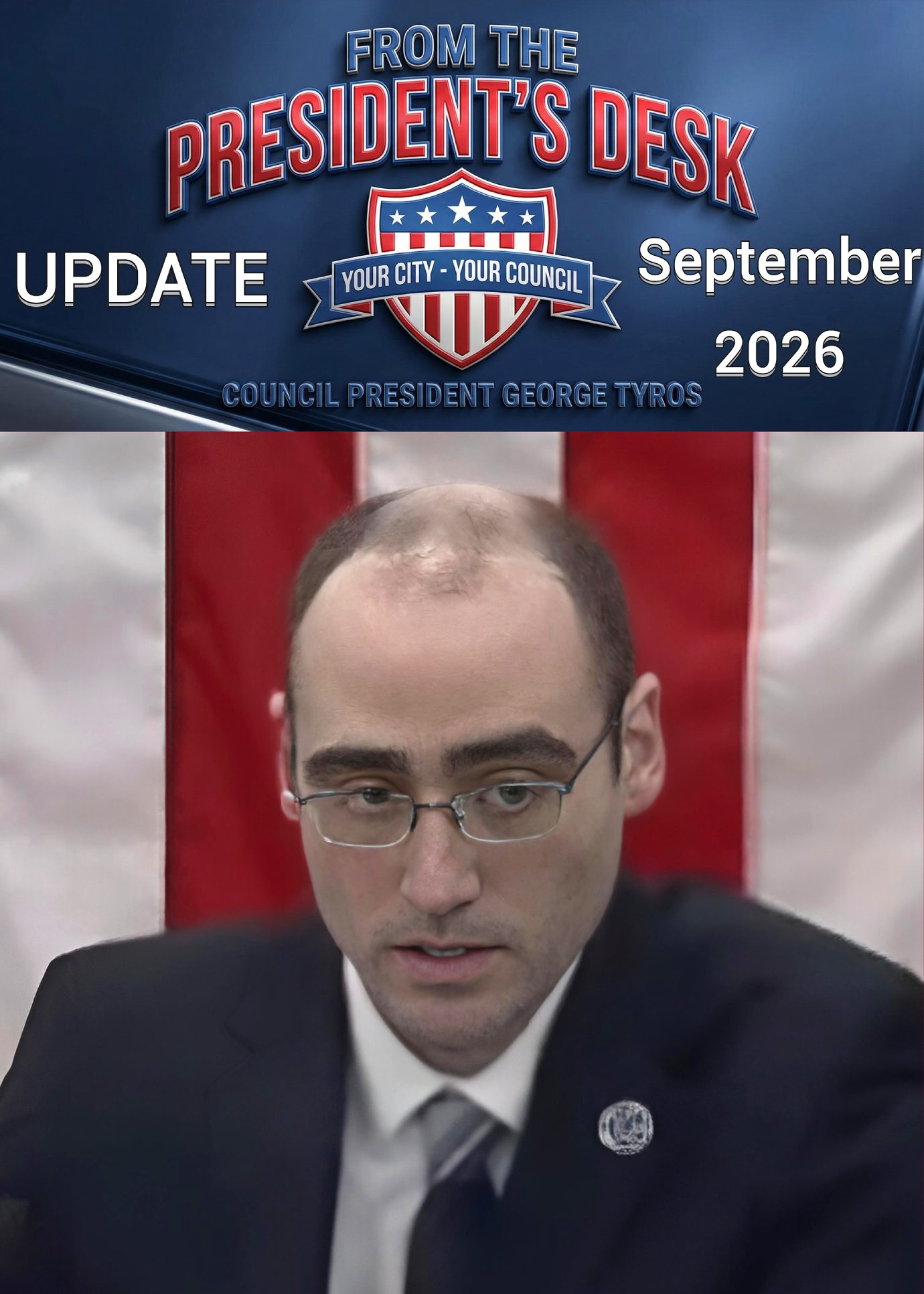
From the President’s Desk – September 2026 Update with Gardner City Council President George Tyros
Press Release from George Tyros:
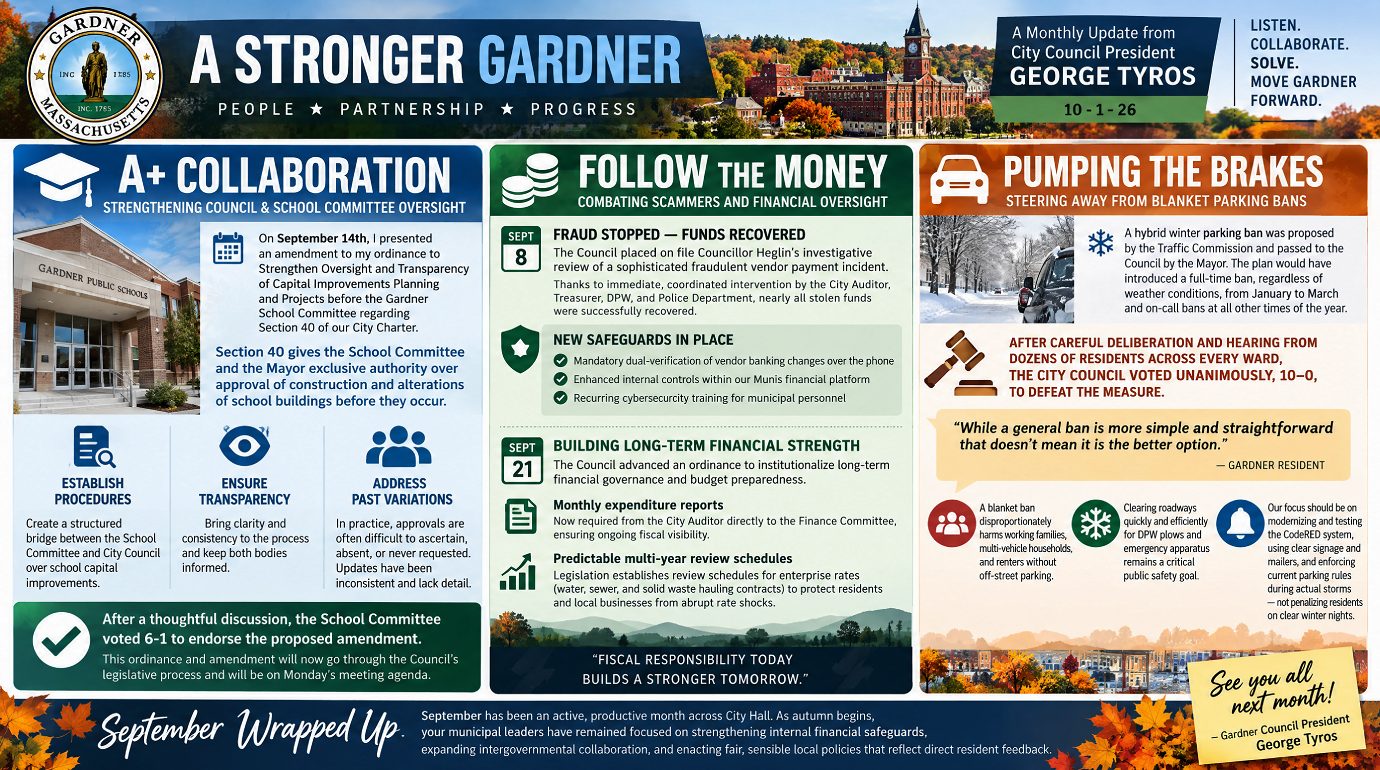
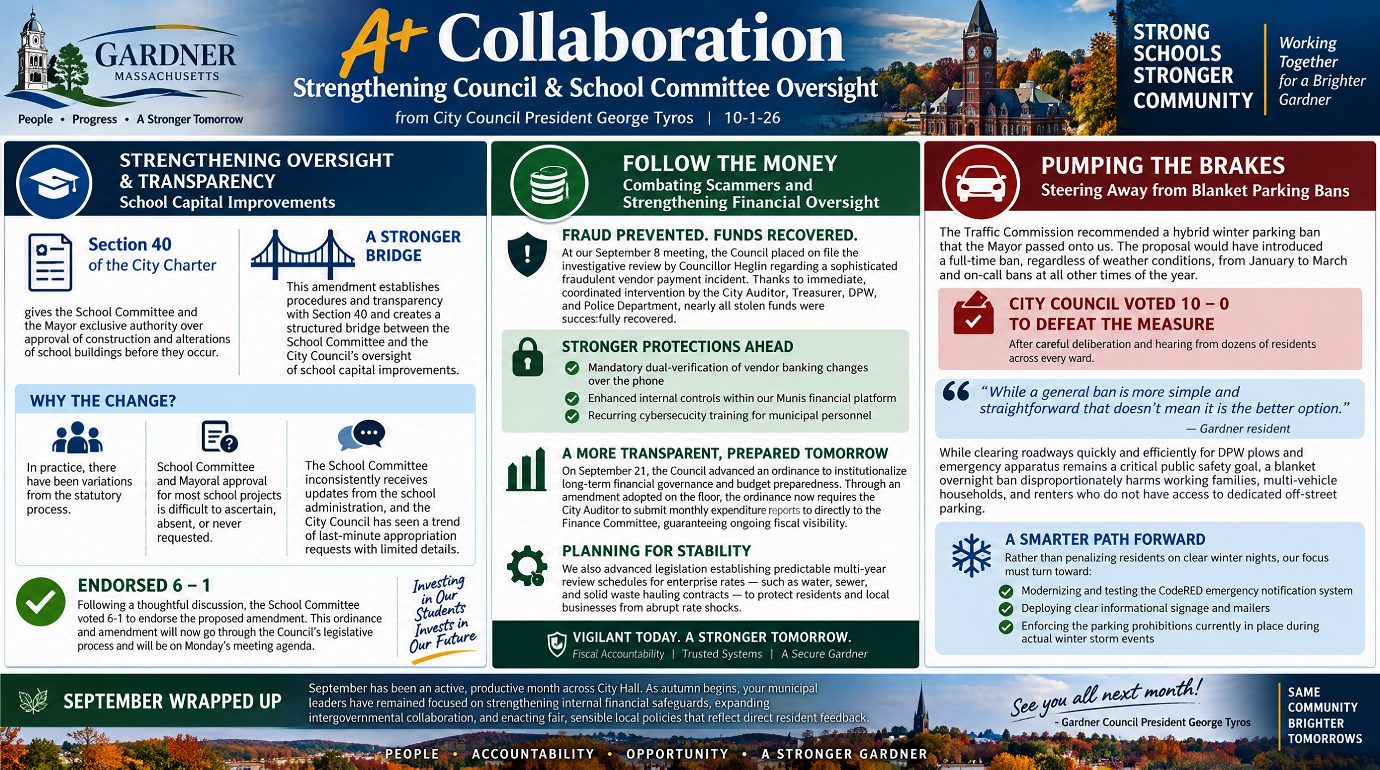
A+ Collaboration: Strengthening Council & School Committee Oversight – On September 14th, I had the privilege of presenting an amendment to my ordinance to Strengthen Oversight and Transparency of Capital Improvements Planning and Projects before the Gardner School Committee regarding Section 40 of our City Charter. That section gives the School Committee and the Mayor exclusive authority over approval of construction and alterations of school buildings before they occur.
The purpose of this amendment is to establish procedures and ensure transparency with Section 40 of the City Charter and create structured bridge between the School Committee and the City Council’s oversight regarding school capital improvements.
In practice, there have been variations from the statutory process. School Committee and Mayoral approval for most school projects is difficult to ascertain, absent, or never requested. The School Committee has inconsistently receives updates from the school administration and with a wide variation of details when updated. Similarly, the City Council has noticed a trend of requests for appropriations from the School Department coming at the last possible hour or with limited details.
Following a thoughtful discussion, the School Committee voted 6-1 to endorse the proposed amendment. This ordinance and amendment will now go through the Council’s legislative process and will be on Monday’s meeting agenda.
Follow the Money: Combating Scammers and Financial Oversight
Fiscal accountability and internal security were central themes throughout our September sessions. At our September 8 meeting, the Council formally placed on file the investigative review by Councillor Heglin regarding a sophisticated fraudulent vendor payment incident. Thanks to immediate, coordinated intervention by the City Auditor, Treasurer, DPW, and Police Department, nearly all stolen funds were successfully recovered. To protect our systems going forward, we are implementing stricter protocols, including mandatory dual-verification of vendor banking changes over the phone, enhanced internal controls within our Munis financial platform, and recurring cybersecurity training for municipal personnel.
Building on these protections, the Council advanced an ordinance on September 21 designed to institutionalize long-term financial governance and budget preparedness. Through an amendment adopted on the floor based on prior debated feedback, the ordinance now requires the City Auditor to submit monthly expenditure reports directly to the Finance Committee, guaranteeing ongoing fiscal visibility. In tandem with these reporting measures, we also advanced legislation establishing predictable multi-year review schedules for enterprise rates—such as water, sewer, and solid waste hauling contracts—to protect residents and local businesses from abrupt rate shocks.
Pumping the Brakes: Steering Away from Blanket Parking Bans
One of the most consequential debates of the month centered around a recommendation from the Traffic Commission that the Mayor passed onto us that would introduce a hybrid winter parking ban across the city. This hybrid proposal would have introduce a full-time ban, regardless of weather conditions, from January to March and on-call bans at all other times of the year. After careful deliberation and hearing from dozens of residents across every ward, the City Council voted unanimously, 10–0, to defeat the measure.
While clearing roadways quickly and efficiently for DPW plows and emergency apparatus remains a critical public safety goal, a blanket overnight ban disproportionately harms working families, multi-vehicle households, and renters who do not have access to dedicated off-street parking.
Rather than penalizing residents on clear winter nights, our focus must instead turn toward modernizing and testing the CodeRED emergency notification system, deploying clear informational signage and mailers, and enforcing the parking prohibitions that are currently in place during actual winter storm events.
September Wrapped Up
September has been an active, productive month across City Hall. As autumn begins, your municipal leaders have remained focused on strengthening internal financial safeguards, expanding intergovernmental collaboration, and enacting fair, sensible local policies that reflect direct resident feedback.
See you all next month! George.
View these infographics. CLICK IMAGE for larger view.
- Home Heating Oil – Now
Home Heating Oil Price is Way Up – Gardner Magazine Reports on the How and Why
Experts disagree on the overall cause and eventual solution to the unprecedented high home heating oil prices. Gardner Magazine’s Max and Maxine Rogers debate the issue. CLICK PLAY.
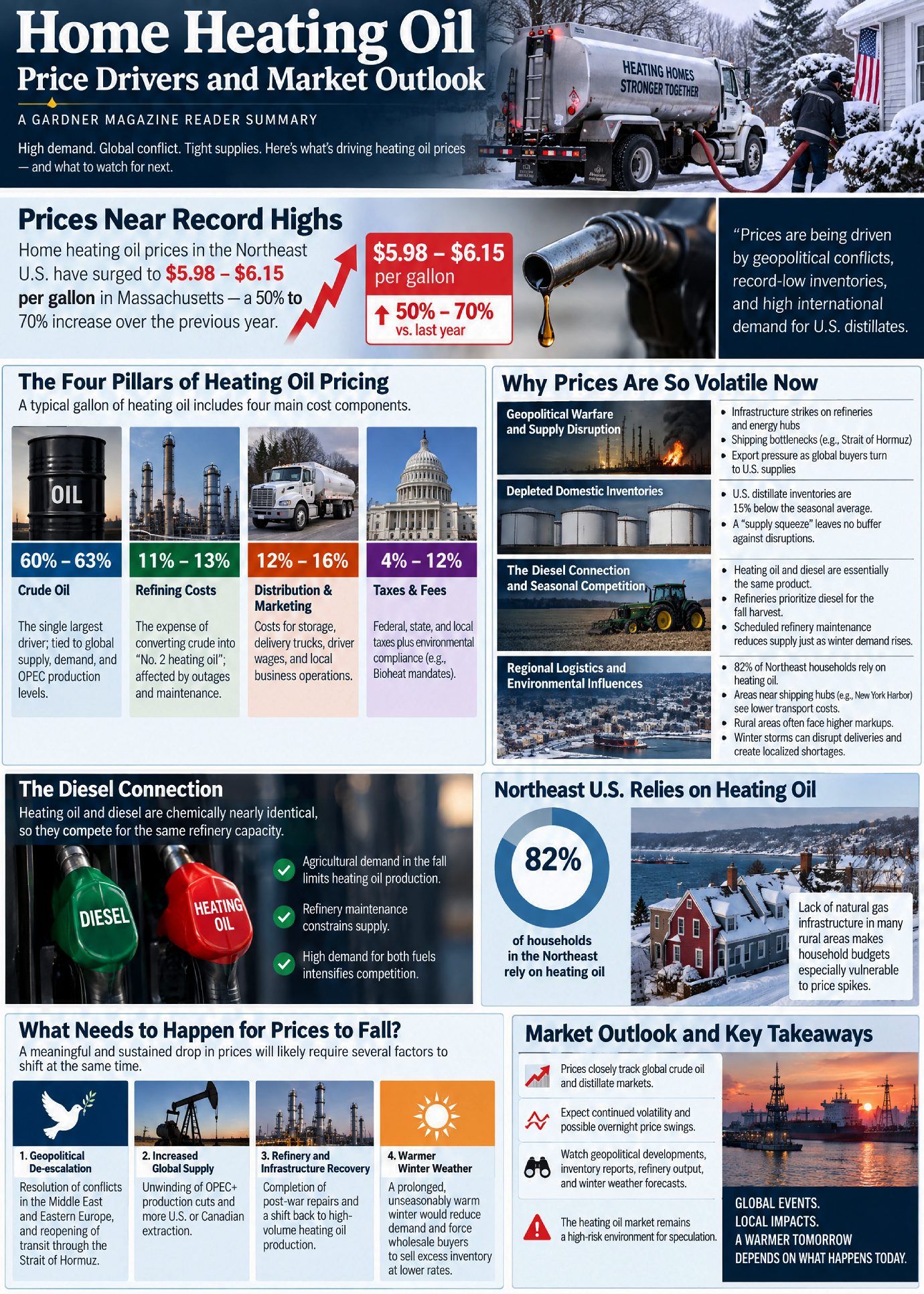
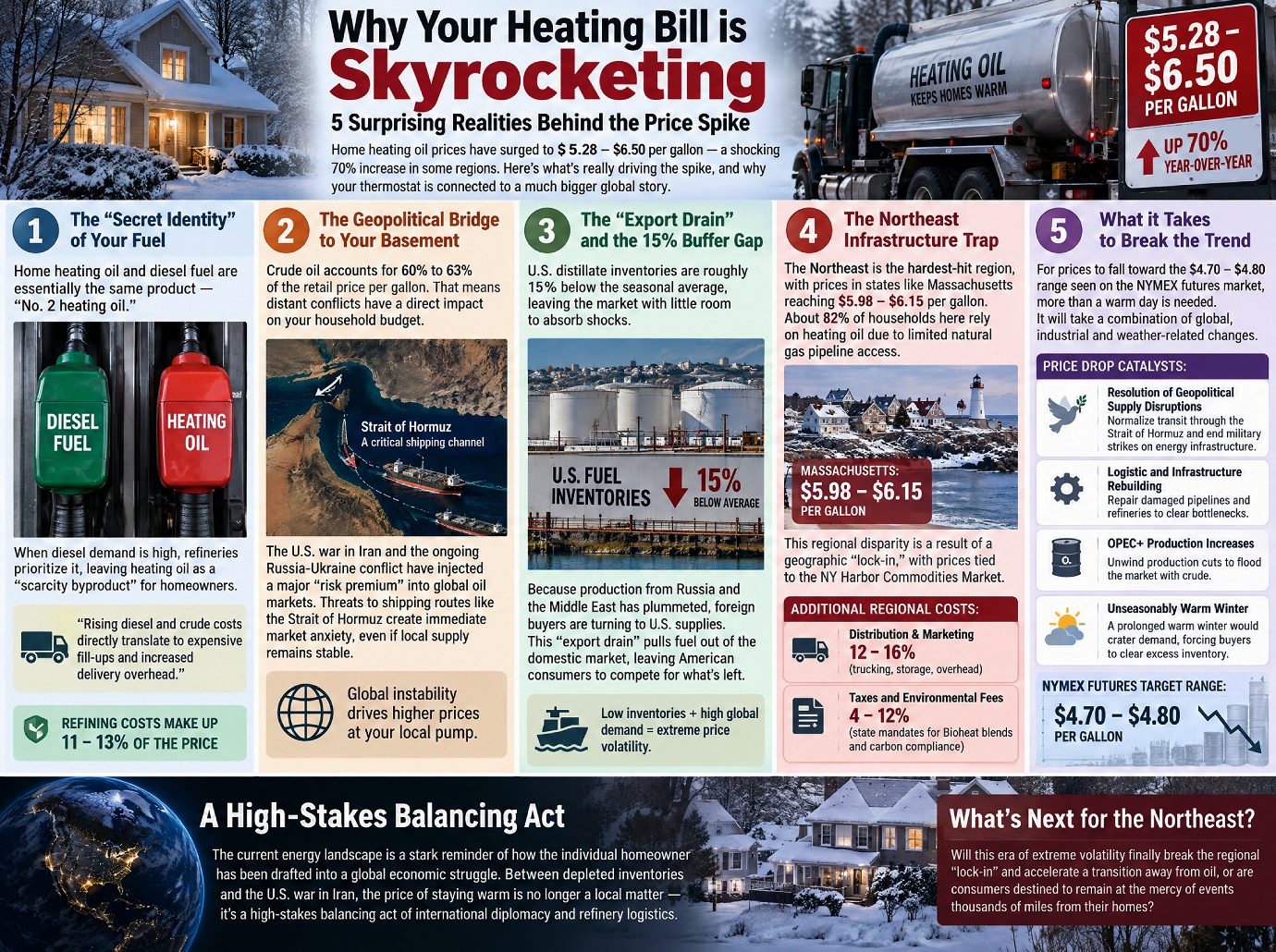
DEBATE – Home Heating Oil Prices The home heating oil market is currently experiencing significant volatility, with retail prices in regions like the Northeast United States reaching near-record highs. In Massachusetts, for example, prices have surged to between $5.98 and $6.15 per gallon—a 50% to 70% increase over the previous year. This price escalation is driven by a convergence of geopolitical conflicts, record-low domestic inventories, and high international demand for U.S. distillates.
As heating oil is chemically nearly identical to diesel fuel, its price is tethered to global diesel and crude oil benchmarks. Currently, domestic distillate inventories are roughly 15% below the seasonal average, leaving the market with no buffer against supply shocks. For prices to decline significantly, the market requires a simultaneous easing of geopolitical tensions in the Middle East and Eastern Europe, an increase in global refinery output, and potentially unseasonably warm winter weather to reduce consumer demand.
The Four Pillars of Heating Oil Pricing: The retail price of a typical gallon of heating oil is determined by four primary cost components. While these percentages fluctuate based on market conditions, they provide a baseline for understanding consumer costs.
Cost Component Percentage of Retail Price Description Crude Oil 60% – 63% The single largest driver; tied to global supply, demand, and OPEC production levels. Refining Costs 11% – 13% The expense of converting crude into “No. 2 heating oil”; affected by outages and maintenance. Distribution & Marketing 12% – 16% Costs for storage, delivery trucks, driver wages, and local business operations. Taxes & Fees 4% – 12% Federal, state, and local taxes plus environmental compliance (e.g., Bioheat mandates).
- MWCC Trio Programs
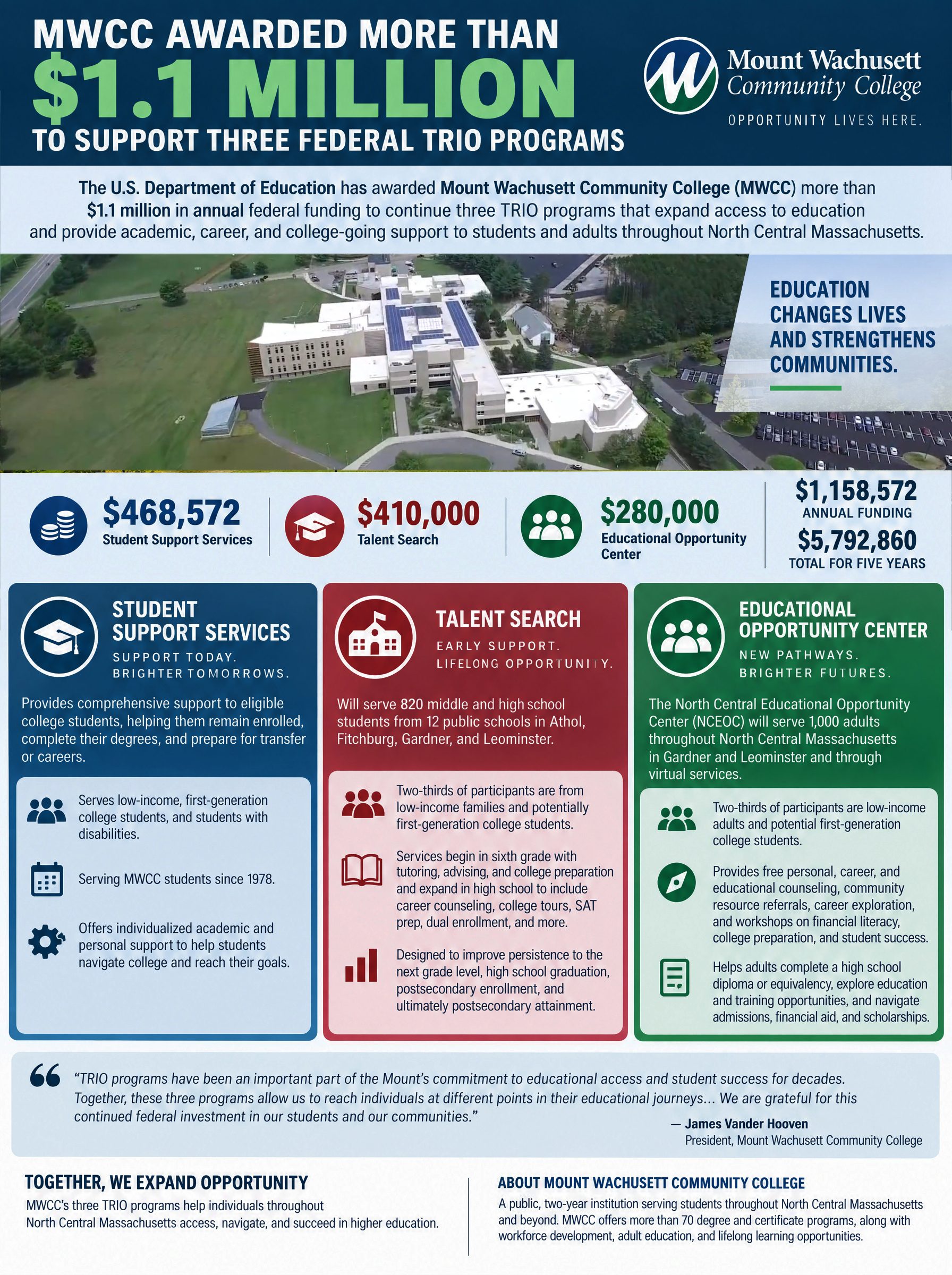
$1.1 Million Dollar Federal Grant to MWCC Supports Student Support Services, Talent Search, and the Educational Opportunity Center
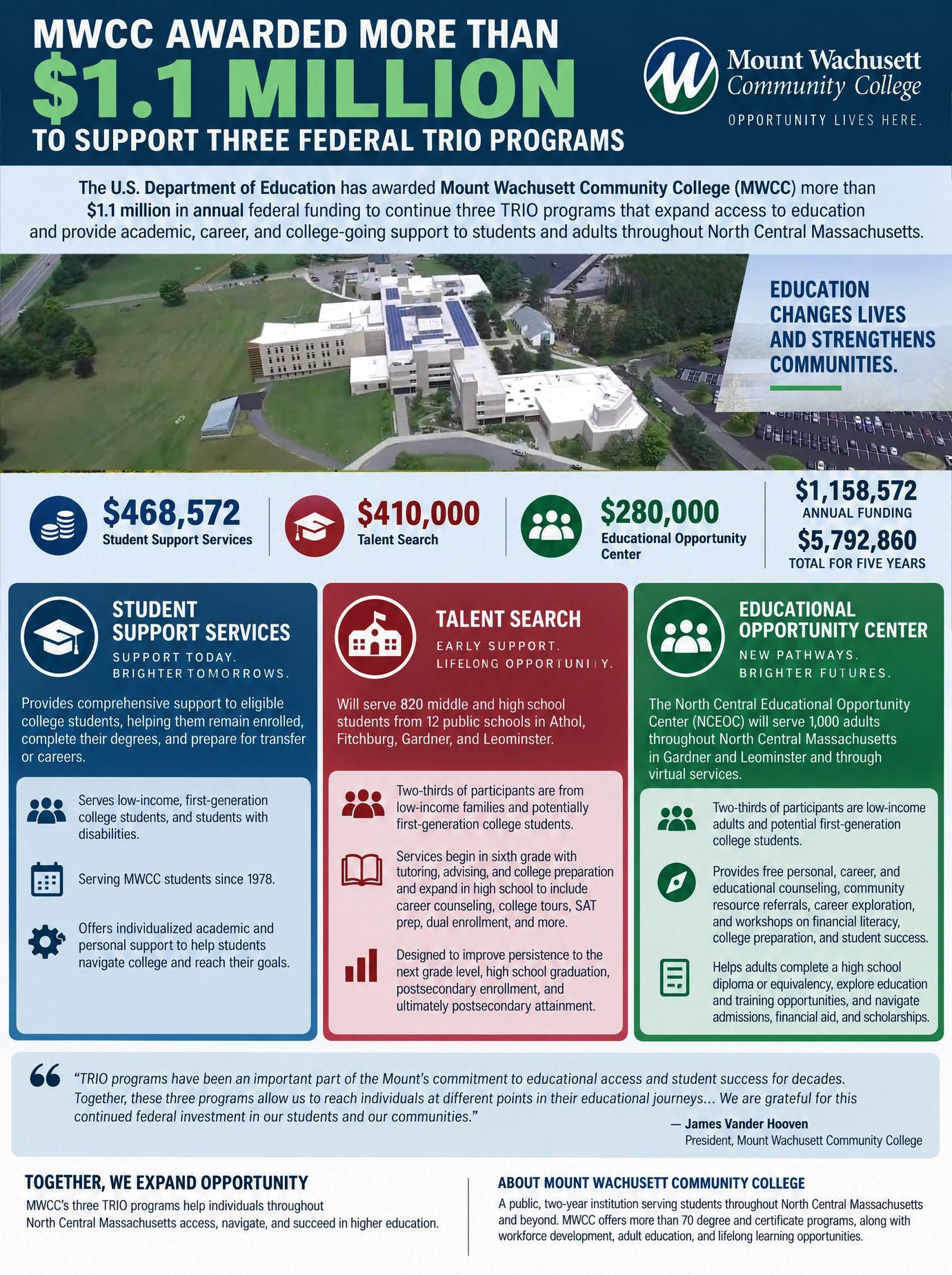
From Mount Wachusett Community College: Mount Wachusett Community College (MWCC) has been awarded more than $1.1 million in annual federal funding to continue three TRIO programs that expand access to education and provide academic, career, and college-going support to students and adults throughout North Central Massachusetts.
The U.S. Department of Education awarded MWCC $468,572 for Student Support Services, $410,000 for Talent Search, and $280,000 for the Educational Opportunity Center, for a combined $1,158,572 in annual funding and $5,792,860 total for the five-year grant period.
“TRIO programs have been an important part of the Mount’s commitment to educational access and student success for decades,” said MWCC President James Vander Hooven. “Together, these three programs allow us to reach individuals at different points in their educational journeys—from middle and high school students beginning to explore their futures, to adults seeking new educational and career opportunities, to our own students working toward a college degree. We are grateful for this continued federal investment in our students and our communities.”
MWCC’s Student Support Services program provides comprehensive support to eligible college students, helping them remain enrolled, complete their degrees, and prepare for transfer or careers. The program serves students who are low-income, first-generation college students, and students with disabilities.
MWCC has offered TRIO Student Support Services since 1978, providing generations of students with individualized academic and personal support designed to help them successfully navigate college and reach their educational goals.
MWCC’s Talent Search program will serve 820 middle and high school students from 12 public schools in Athol, Fitchburg, Gardner, and Leominster. Two-thirds of participating students will come from low-income families and families in which they would potentially be the first generation to attend college. The program is designed to improve students’ persistence to the next grade level, high school graduation, postsecondary enrollment, and ultimately postsecondary attainment.
Beginning in sixth grade, Talent Search provides participants with tutoring and academic support, course advising, early college preparation, success skills workshops, career exploration, and enrichment opportunities. Services expand during high school to include personal and career counseling, college tours and fairs, SAT preparation, dual enrollment opportunities, assistance with college admissions and financial aid, and information about apprenticeships and workforce training programs.
The North Central Educational Opportunity Center (NCEOC) at MWCC will serve 1,000 adults throughout North Central Massachusetts through locations in Gardner and Leominster and through virtual services. Two-thirds of participants will be low-income adults who are potential first-generation college students. The program’s goal is to increase the number of adults enrolling in postsecondary education and training, including distance education and apprenticeships.
Participants receive free personal, career, and educational counseling, referrals to community resources, career exploration assistance, and workshops covering financial literacy, college preparation, and student success. The NCEOC also assists adults with identifying pathways to complete a high school diploma or equivalency credential and helps those who have completed high school research education and training opportunities, complete admissions and FAFSA applications, find scholarships, and navigate financial aid.
Together, MWCC’s three TRIO programs expand educational opportunity and help individuals throughout North Central Massachusetts access, navigate, and succeed in higher education. Mount Wachusett Community College is a public, two-year institution serving students throughout North Central Massachusetts and beyond. MWCC offers more than 70 degree and certificate programs, along with workforce development, adult education, and lifelong learning opportunities.









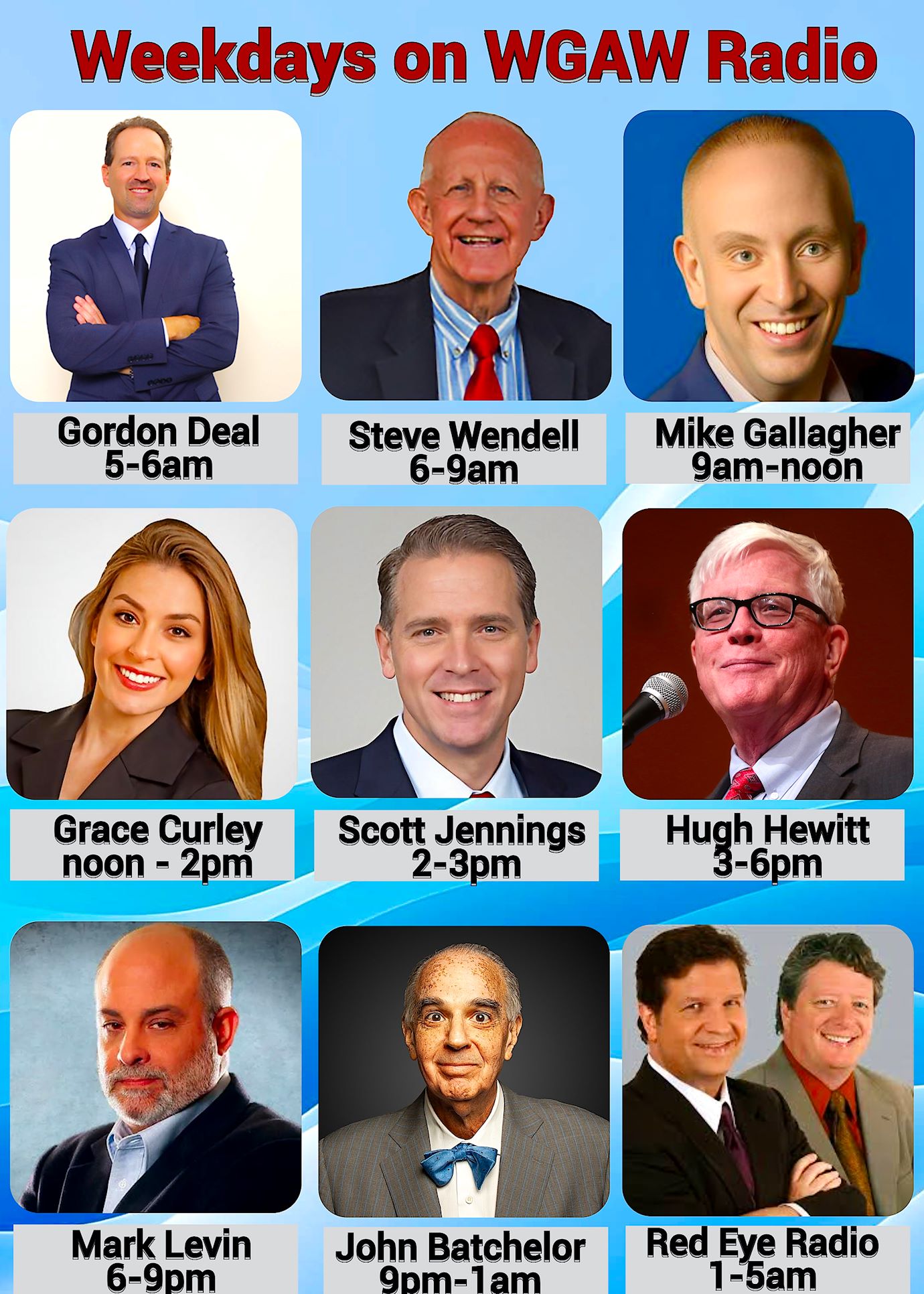
WGAW Weekdays In the Community



Greater Gardner Weather Center, CLICK HERE. 
The Fiscal 6 Project Covering 5 Years of Gardner Success, CLICK HERE 
Gardner City Council page, CLICK HERE 
Non-Profits – Public Service Organizations Listing, CLICK HERE 
Schools page, CLICK HERE 
Original Music page 
Interviews, CLICK HERE 
Gardner Magazine Editorials, CLICK HERE.









Around the Community of Gardner MA
Community Facts Go to News section
Gardner is a city in Worcester County with a population of just over 21 thousand people. It is home to Mount Wachusett Community College, Heywood Hospital, and Dunn State Park. Gardner became a city in 1923.
Schools
School District Office: (978) 632-1000
Elm Street: (978) 632-1673
Waterford Street: (978) 632-1605
Gardner Middle: (978) 632-1603
Gardner High: (978) 632-1600
Gardner Academy (978) 632-1606
Government
Mayor’s Office: (978) 632-1490
Police Department: (978) 632-5600
Fire Department: (978) 630-4051
City Clerk: (978) 630-4058
Organizations
Gardner Animal Control (978) 630-4950
Council on Aging: (978) 630-4067
Gardner CAC (978) 632-8700
Golf Course: (978) 632-9703
Gardner Museum (978) 632-3277
P.A.C.C. (978) 632-8875
Gardner Chamber (978) 632-1780
Interactive Map of Gardner MA
City of Gardner MA Photos More Gardner Photos Gardner Historical Photos
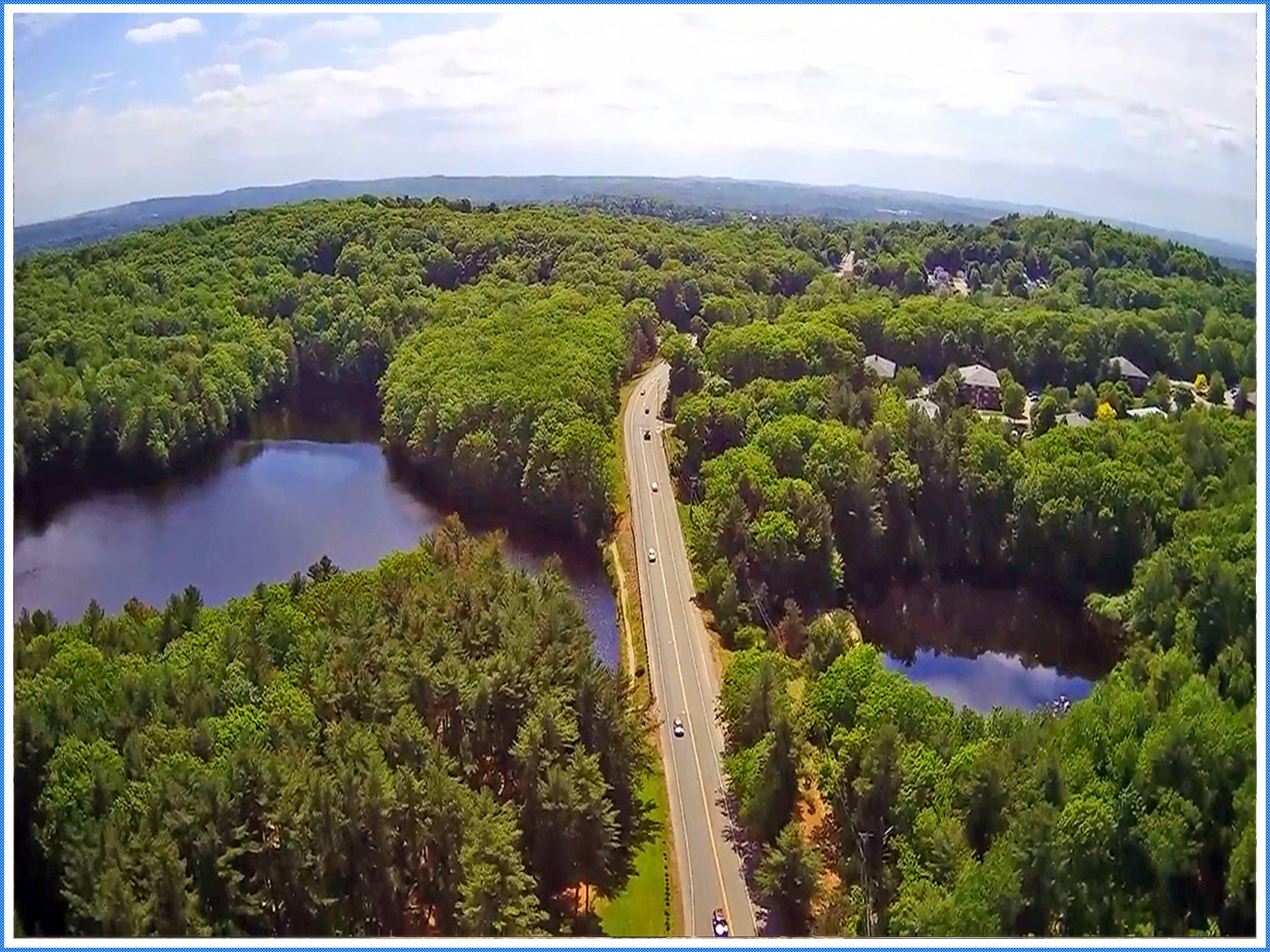


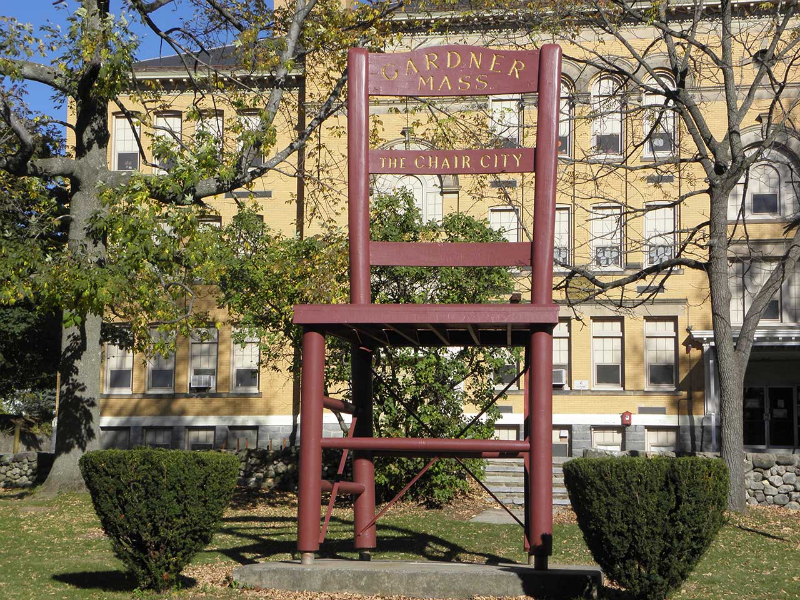
More Gardner Photos Gardner Historical Photos
Gardner Magazine Service Pages and Outside Links for Gardner MA


























Gardner Magazine Cities and Towns
Other Helpful Resources on the WebTech Online Network












Complete Gardner Telephone Guide to Various Departments
To easily print this directory, download the PDF, CLICK HERE.
