
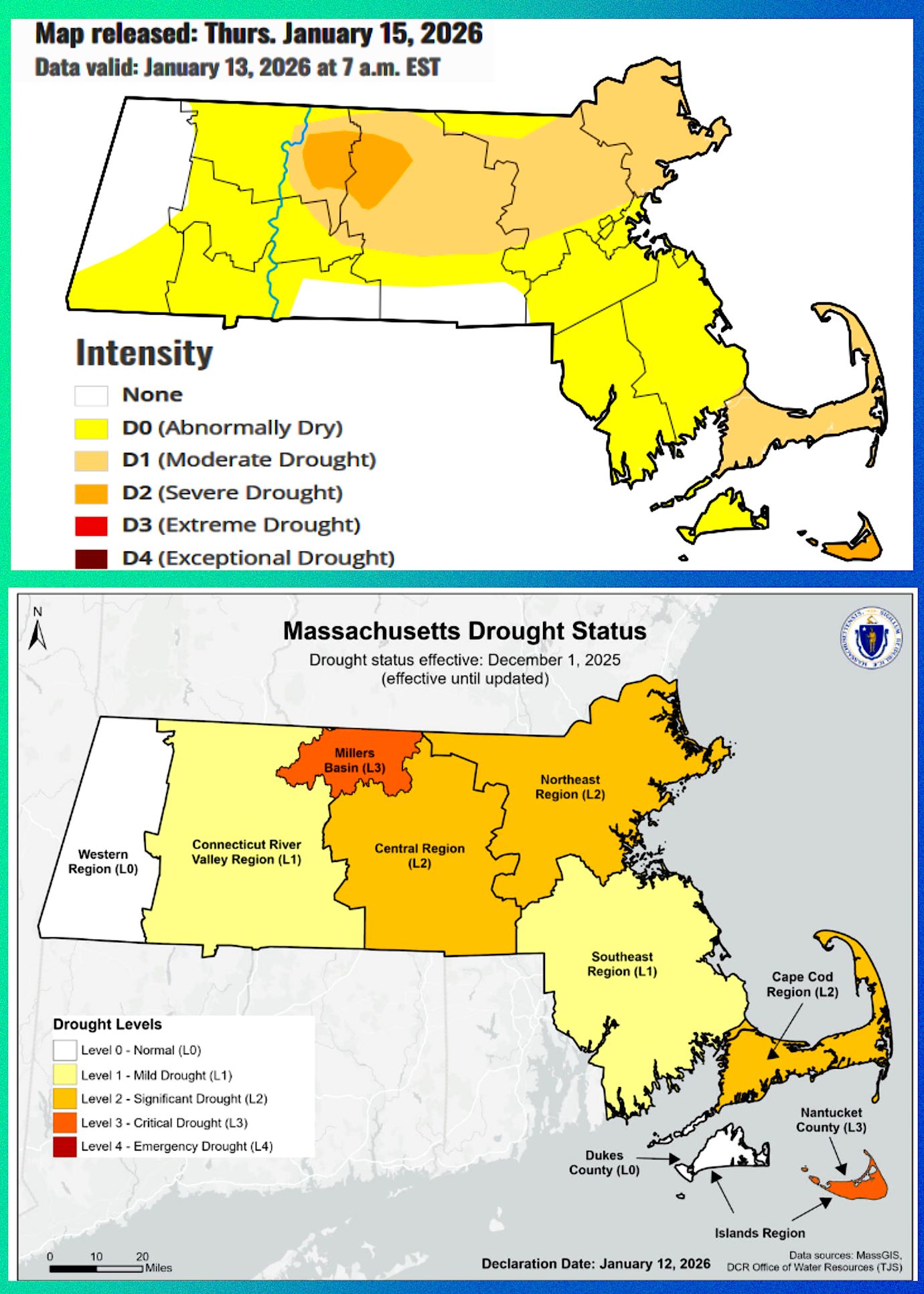
Greater Gardner MA is now in Moderate Drought or Level 2, Significant Drought depending on whether you use the Federal or State terms. Bottom line: Precipitation is needed.
Precipitation Needed in Greater Gardner MA and State of MA due to Various Levels of Drought
Our graphic shows 2 maps from Drought.gov and the State of MA. Greater Gardner is now suffering from Moderate Drought according to Drought.gov. And the State of Massachusetts calls it Level 2 – Significant Drought. We have a “Deep Dive” discussing the situation and providing recommendations. Listen on any device, CLICK PLAY.
On January 12th, Massachusetts Energy and Environmental Affairs (EEA) Secretary Rebecca Tepper declared that the Central and Northeast Regions have worsened to a Level 2–Significant Drought. Conditions also declined in nearly all other regions, moving the Southeast Region to a Level–1 Mild Drought and the Millers River Basin to a Level 3-Critical Drought. In the Islands Region, Dukes County has returned to Normal Conditions and Nantucket County has moved to a Level 3–Critical Drought. Conditions remain unchanged in the Western, Connecticut River Valley, and Cape Cod Regions.
During December, Massachusetts received rainfall ranging from 3 to 4 inches, but the month ended with totals at 1-2 inches below normal. When looking back over the past 3 to 6 months, precipitation deficits still persist. The forecasted rainfall is anticipated to bring near normal precipitation through the end of the month.
The current drought, which began in 2024, has continued to have significant impacts on the natural environment, including the drying of streams in nearly all regions, lower water levels in lakes and ponds, and impeding fish passage out to the ocean.
As outlined in the Massachusetts Drought Management Plan, continued detailed monitoring of drought conditions must continue. The drought levels also require ongoing coordination among state and federal agencies to implement drought response actions. Additionally, engagement with municipalities, including local Boards of Health (BOH), is essential. This includes providing technical outreach and assistance to water suppliers and affected municipalities. Residents are asked to report to their local BOH in case of wells drying up; BOHs are asked to report here on the condition of local private wells.
State agencies will continue to closely monitor and assess conditions across the state, coordinate any needed dissemination of information to the public, and help federal, state, and local agencies prepare additional responses that may be needed in the future. The DMTF will meet again on February 10th at 9:30 AM. For further information on water conservation and what residents can do, visit the EEA’s drought and water conservation pages.