
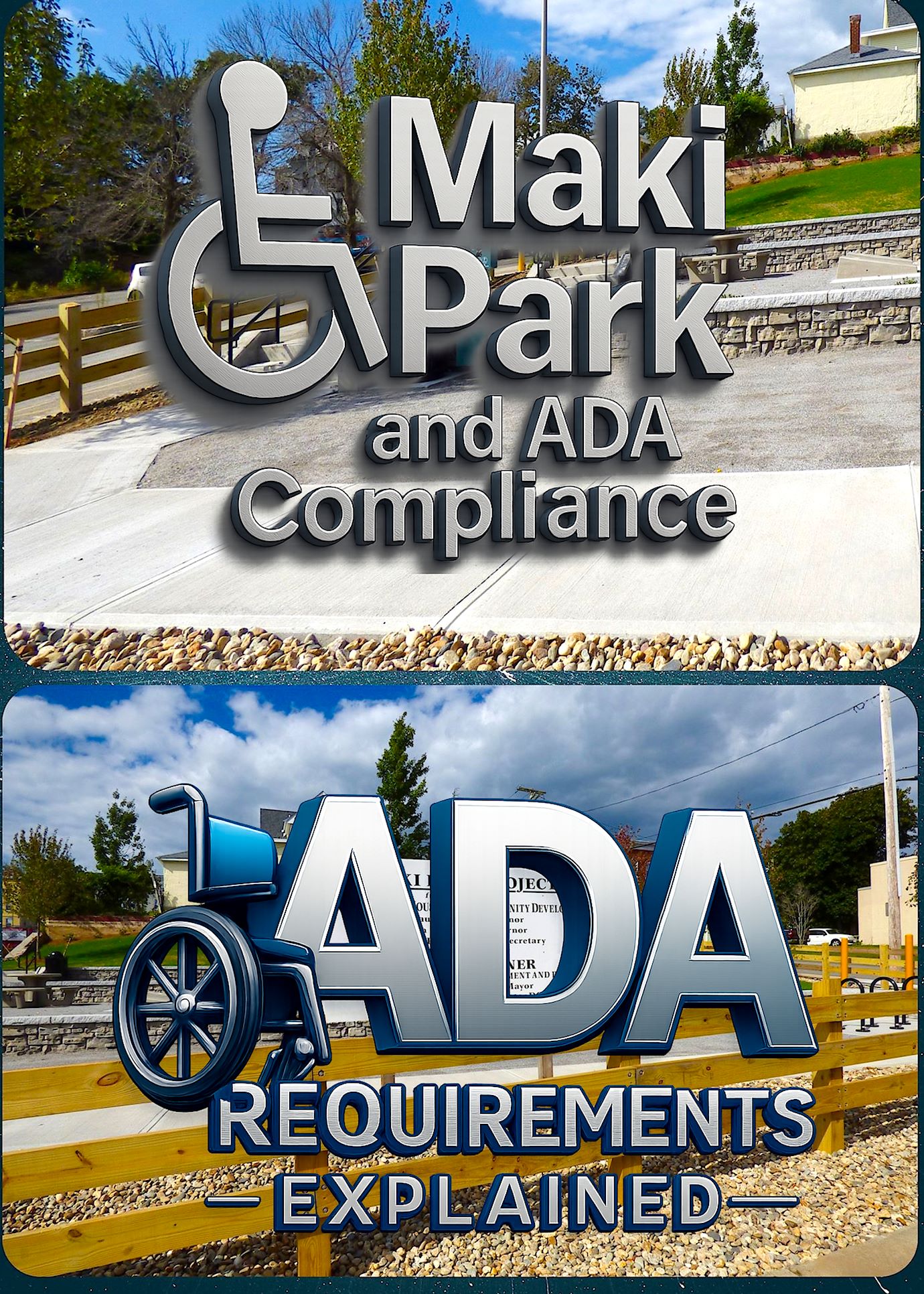
This Gardner Magazine Report concerns the Maki Park Project. It is intended to provide a factually accurate basis for discussion and evaluation. The Gardner City Council will decide at its next meeting whether Maki Park has been completed to its satisfaction.
The Question of Maki Park Accessibility and ADA Compliance Explained in this Gardner Magazine Report
Maki Park was the subject of an investigation by current Gardner City Council President George Tyros and as a result of subsequent actions, recent modifications to Maki Park have been made in an effort to make it ADA compliant. However, certain concerns still remain. The question: If access to persons with disabilities is still not optimal, can Maki Park still be considered ADA Compliant? That is a question to be decided by the full Gardner City Council at its second December meeting at which it has been proposed that the item be finalized.
The Facts: There are 4 levels of which accessibility is currently still limited. Access Issues: Via access from West Street Parking Lot – Currently there is only handicapped access to Level 3. From level 3 there is no access to level 4 (the grassy area), level 2 (cornhole area), or level 1. Via access from street level near intersection – Currently there is handicapped access to level 1, an accessible ramp to level 2, and no access to level 3 or level 4. Ground Issues: Ground within the the levels 1,2, and 3 areas is a combination of concrete, soil and stone dust with certain areas currently not suitable for wheelchairs as they get stuck and can’t move freely.
ADA Requirements: There is a requirement for alterations to existing land (i.e. the Maki Park Project) to be ADA Compliant. However, there are exceptions to these requirements relating to whether changes would be structurally impractical (i.e. grassy area in level 4). Or whether changes would affect an area’s primary function (i.e. a ramp in level 2 would disrupt Cornhole area) Or cost, if it exceeds 20% of the cost of the project. More details are provided below.
Conclusion: While current accessibility is still limited in practical scope, Maki Park may still be ADA compliant in accordance with regulations. It will be up to the City of Gardner through its City Council to make the final determination if it is prudent to bring the project to a formal close or keep it open for further consideration, further debate, and/or further changes.
The excerpts below are from the 143 page document of complete ADA Standards, CLICK HERE.
This may relate to level 4 – the grassy area.: (2) Exception for structural impracticability. ==(i) Full compliance with the requirements of this section is not required where a public entity can demonstrate that it is structurally impracticable to meet the requirements. Full compliance will be considered structurally impracticable only in those rare circumstances when the unique characteristics of terrain prevent the incorporation of accessibility features. ==(ii) If full compliance with this section would be structurally impracticable, compliance with this section is required to the extent that it is not structurally impracticable. In that case, any portion of the facility that can be made accessible shall be made accessible to the extent that it is not structurally impracticable. == (iii) If providing accessibility in conformance with this section to individuals with certain disabilities (e.g., those who use wheelchairs) would be structurally impracticable, accessibility shall nonetheless be ensured to persons with other types of disabilities, (e.g., those who use crutches or who have sight, hearing, or mental impairments) in accordance with this section.
This may relate to level 2 – the Corn Hole area where alterations might affect its primary function == (4) Path of travel. An alteration that affects or could affect the usability of or access to an area of a facility that contains a primary function shall be made so as to ensure that, to the maximum extent feasible, the path of travel to the altered area and the restrooms, telephones, and drinking fountains serving the altered area are readily accessible to and usable by individuals with disabilities, including individuals who use wheelchairs, unless the cost and scope of such alterations is disproportionate to the cost of the overall alteration.
About path of travel: (ii) A “path of travel” includes a continuous, unobstructed way of pedestrian passage by means of which the altered area may be approached, entered, and exited, and which connects the altered area with an exterior approach (including sidewalks, streets, and parking areas), an entrance to the facility, and other parts of the facility. == (A) An accessible path of travel may consist of walks and sidewalks, curb ramps and other interior or exterior pedestrian ramps; clear floor paths through lobbies, corridors, rooms, and other improved areas; parking access aisles; elevators and lifts; or a combination of these elements.
Costs are a factor: == (iii) Disproportionality. == (A) Alterations made to provide an accessible path of travel to the altered area will be deemed disproportionate to the overall alteration when the cost exceeds 20 % of the cost of the alteration to the primary function area. == (A) When the cost of alterations necessary to make the path of travel to the altered area fully accessible is disproportionate to the cost of the overall alteration, the path of travel shall be made accessible to the extent that it can be made accessible without incurring disproportionate costs.
These are excerpts from the complete ADA Standards which can be viewed on pdf here, CLICK HERE. Or visit the webpage, CLICK HERE.
Gardner Magazine also has a “Deep Dive” which explains ADA Standards in general over a wide variety of public and private projects. Listen on any device, CLICK PLAY.