
Gardner MA – Model City for America

The City of Gardner will always be fondly known as the “Chair City” because of its manufacturing heritage, but it is increasingly being referred to as a “Model City for America” because of its recent rapid successes in so many areas.
Gardner Magazine has a “Deep Dive” with the Chair Man and the Chair Lady which goes over Gardner History. Listen on any device, CLICK PLAY.
Gardner Magazine has a “DEBATE” with Max and Maxine Rogers about the “Model City” status.
Also on this page, a complete report on the history of the City of Gardner. CLICK HERE. — At the bottom of the page: Original song “Model City for America.”
The History of Gardner, Massachusetts: From “Chair City” to Contemporary Renaissance as a “Model City”

Gardner, Massachusetts, is a city whose identity is inextricably linked to its celebrated moniker, “The Chair City.” For over a century, its factories produced millions of chairs that furnished homes and institutions across the globe, establishing it as a powerhouse of American manufacturing. This monograph provides a comprehensive historical account of the city’s remarkable evolution. It traces Gardner’s journey from its founding in the optimistic aftermath of the Revolutionary War, through its rise as a global center for furniture production, to its navigation of late 20th-century deindustrialization and its inspiring emergence as a model of contemporary revitalization.
A Video on Gardner “Model City” Play by clicking the red button. You can even make it full screen.
1. The Founding of a New England Town (1764–1804)
The founding period of Gardner was a strategic and symbolic chapter that laid the groundwork for its future identity. In the context of post-Revolutionary War America, the establishment of the town was not merely a matter of drawing lines on a map; it was an expression of a new nation’s values and aspirations. From its patriotic namesake to its early economic activities, the origins of Gardner reveal a community built on independence, resourcefulness, and a pragmatic vision that would ultimately foster an industrial giant.
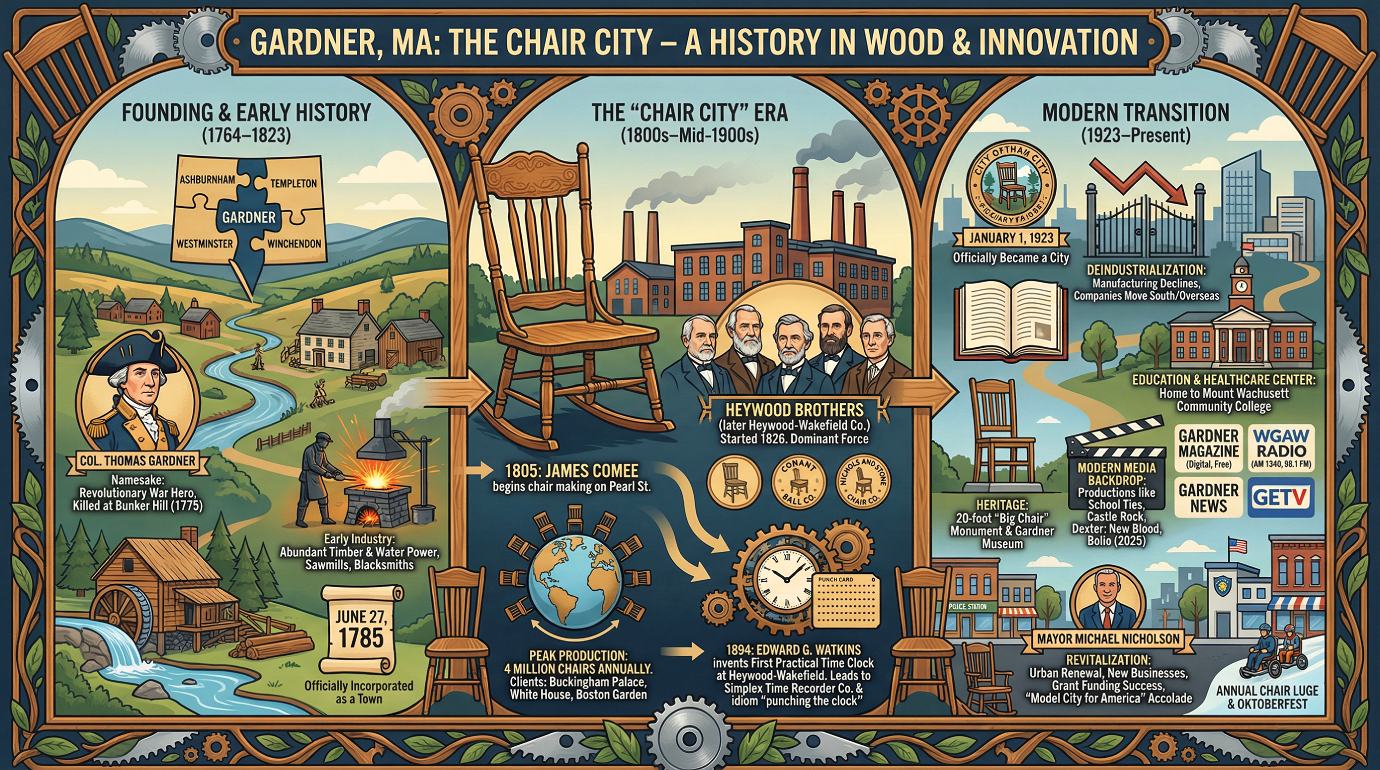
The area that would become Gardner was first settled by European colonists in 1764. The town was officially incorporated on June 27, 1785, forged from land grants contributed by four established neighboring towns: Ashburnham, Templeton, Westminster, and Winchendon. In a notable departure from its neighbors, many of whom bore the names of English locations, Gardner was christened in honor of a hero of the American Revolution. The town was named for Colonel Thomas Gardner, the second-highest-ranking officer killed at the pivotal Battle of Bunker Hill in 1775. This choice cemented a distinctly American identity for the new community, reflecting the patriotic fervor of the era.
While its initial economy was agricultural, Gardner’s trajectory soon shifted. The region’s dense forests provided abundant timber, and its waterways offered the necessary power to drive the machinery of a budding industrial economy. This combination of natural resources led to a rapid transition towards woodworking, with sawmills and blacksmith shops becoming the cornerstones of the local economy. This early focus on woodworking established the perfect foundation for the singular craft—chair manufacturing—that would soon define the town for generations.
2. The Rise of the “Chair City” (1805–1922)
What began as a collection of small woodworking shops soon coalesced into a manufacturing revolution, ignited by the focused craft of a single artisan. Over the next century, Gardner would transform into an industrial titan, earning its enduring title as “The Chair City.” Its name became synonymous with quality furniture, its factories dominated the global market, and its civic identity became a proud reflection of its primary craft.
The catalyst for Gardner’s industrial boom was James Comee, who began crafting chairs on Pearl Street in 1805. This humble enterprise sparked an industry that would grow to define the town. The most significant player to emerge was the Heywood Brothers company, founded in 1826 when five brothers—Walter, Levi, Seth, Benjamin, and William—began fashioning chairs in their family barn. The company, later known as the Heywood-Wakefield Company, became the dominant force in American furniture manufacturing. At the industry’s zenith, Gardner’s factories were astonishingly productive, manufacturing over four million chairs annually. Other notable firms contributed to this output, including the Conant Ball Company and the Nichols and Stone Chair Company, which relocated to Gardner at the turn of the 20th century. The reputation of Gardner’s furniture extended far beyond New England, with its factories supplying high-quality pieces to some of the world’s most prestigious clients, including Buckingham Palace, the White House, and the original Boston Garden.
In 1922, this industrial identity was formally immortalized in the city’s official seal, designed by native illustrator Harrison Cady. The seal is a rich tapestry of Gardner’s history and geography, depicting Colonel Thomas Gardner standing before Crystal Lake with Mount Monadnock in the distance. Encircling the central image are five smaller circles: one contains a chair, symbolizing the city’s economic backbone, while the other four display the letters W, W, A, and T, representing Westminster, Winchendon, Ashburnham, and Templeton—the towns from which Gardner was formed. This climate of industrial excellence not only perfected the craft of furniture making but also fostered technological innovation in entirely new fields, most notably with the invention of the time clock.
3. Innovation Beyond Furniture: The Simplex Time Recorder Company
While Gardner was world-renowned as the “Chair City,” the intense industrial activity and engineering expertise concentrated within its factories fostered significant technological advancements in other fields. The invention of the practical time clock, born from a need within the furniture industry itself, created a second major industrial force in the city and left a lasting mark on the language of American labor.
In 1894, an engineer at the Heywood-Wakefield factory named Edward G. Watkins was tasked with creating a better method for tracking employee hours. His invention, the first practical time clock, was so effective that it gave rise to the American idiom “punching the clock.” Recognizing the immense nationwide need for his device, Watkins founded the Simplex Time Recorder Company. The company grew steadily, but its most significant expansion occurred in 1958 when it acquired the IBM Time Recorder Division. This acquisition, which included IBM’s fire protection division, propelled Simplex to a position of leadership in the fire alarm and business systems industries. The company remained a family-run institution for over a century, with leadership passing from Edward Watkins to his son, Curt, from 1942 to 1967, and then to his grandson, Chris, from 1967, until its sale to Tyco International in 2000. This period of dual industrial strength marked the apex of Gardner’s manufacturing power, preceding an era of significant economic and social transformation.
4. An Era of Transition (1923–1999)
This period began with the civic triumph of Gardner’s incorporation as a city, a testament to its industrial might. Yet, this milestone would soon be contrasted by the profound economic anxieties of the late 20th century, as the forces of deindustrialization began to challenge the very foundation of the city’s identity. Like many manufacturing-dependent communities across New England, Gardner was forced to confront the economic realities of a changing global market, setting the stage for a fundamental re-evaluation of its future.
Reflecting its growth and regional importance, Gardner was officially incorporated as a city on January 1, 1923. This transition from a town to a city marked a new chapter in its municipal governance and civic status. During the latter half of the 20th century, however, Gardner experienced the significant manufacturing declines that affected the entire region. Many of its foundational companies relocated operations to the southern United States or overseas in search of lower costs. This trend is poignantly illustrated by the fate of the Nichols and Stone Chair Company. After a long and storied history, the company terminated production in Gardner in July 2008. While its name and intellectual property were purchased by L. and J.G. Stickley, the closure of its local factory marked the end of an era for one of the city’s legacy manufacturers. The economic headwinds of this period necessitated a new vision, compelling the city to redefine its purpose and embark on a path toward renewal in the new millennium.
5. The Contemporary Renaissance (2000–Present)
The 21st century has been a period of deliberate and multifaceted revitalization for Gardner. The city has embarked on a strategic effort to leverage its proud industrial heritage while simultaneously embracing new economic sectors, bold civic initiatives, and a dynamic cultural identity. This ongoing transformation has reshaped Gardner from a former mill town into a thriving, modern community.
Gardner’s contemporary character is defined by a blend of economic evolution, civic modernization, and cultural vibrancy.
• Economic Evolution
◦ Core Sectors: The city’s economy has pivoted toward stable and growing sectors, with education (anchored by Mount Wachusett Community College) and healthcare becoming primary economic drivers.
◦ Remaining Manufacturing: A connection to its industrial roots remains through several key manufacturers, including Seaman Paper, Standard Chair of Gardner, and the Saloom Furniture Company.
◦ Retail: The furniture heritage is also preserved through retail, with two prominent stores: Lachance Interiors and Gardner Outlet Furniture.
• Civic Revitalization under Mayor Michael Nicholson (post-2020)
◦ Infrastructure & Development: A strategic revitalization has transformed the city’s commercial landscape, encompassing the redevelopment of downtown buildings, construction of the new Timpany Crossroads plaza, the successful filling of vacancies in other shopping plazas, and a feasibility study for a fourth industrial park to accommodate new growth.
◦ Municipal Modernization: The city has embraced technology to improve services, undertaking a website refresh in 2025 and expanding online access to municipal functions like building permits.
• Culture and Media
◦ Film and Television: Gardner’s classic New England aesthetic has made it an attractive backdrop for major productions, including the films School Ties and Bolio, Spirit of the Mustang, and the television series Castle Rock and Dexter: New Blood.
◦ Local Events: The city hosts unique and popular annual events that foster community spirit. As of 2025, these include the 15th annual Chair Luge and the 20th annual Oktoberfest, as well as the New England region’s largest American Cancer Society Relay For Life.
◦ Media Outlets: Gardner is served by a diverse media landscape. Gardner Magazine, a free digital-only publication founded in 2000, is the city’s largest outlet with a circulation of over 30,000 households. The Gardner News, a newspaper founded in 1869, is noted for its sports coverage and is the only local source for daily obituaries. WGAW, a news/talk radio station founded in 1946, broadcasts on AM and FM frequencies and streams globally. Other outlets include the City and Comcast funded Gardner Educational Television (GETV), the online news aggregator ChairCityNews.com, and The Fiscal 6 Project at Fiscal6.com, a website dedicated to chronicling the city’s recent successes.
The city’s successful transformation has not gone unnoticed. Gardner has earned recognition as offering the “best bang for your buck” and has been named the “kindest City in Massachusetts.” This success led some media outlets, including Gardner Magazine, to refer to it as the “Model City for America.” A key driver of this progress has been a strategic investment in a third-party grant writer, which turned an initial $50,000 investment into an astonishing $50 million in funding. This fiscal and civic achievement prompted an invitation for Mayor Michael Nicholson to the White House to share insights on the city’s success. In 2025, his leadership was further recognized with his election as President of the Massachusetts Mayors Association. The success of these initiatives has been such that local media portrayals of Mayor Nicholson often include speculation about a future on the national political stage. This dynamic story of revitalization is grounded in the city’s distinct geography and foundational demographic profile.
6. A Profile of Modern Gardner: Geography, Demographics, and Services
A complete understanding of Gardner requires an examination of its geographic and demographic foundations. This section provides a statistical profile of the city, outlining the geography, 2000 U.S. Census data, and key infrastructure that constitute the framework of modern life.
Located in Worcester County, Massachusetts, Gardner has a total area of 23.0 square miles, of which 22.2 square miles is land and 0.8 square miles is water. The city is situated on the shores of Crystal Lake, and its highest point is Reservoir Hill, which rises to an elevation of over 1,280 feet (390 m) above sea level.
The following data from the 2000 U.S. Census provides a detailed demographic profile of the city at the turn of the century, supplemented by the most recent population count.
• Population (2000): 20,770
• Population (2020): 21,287
• Households (2000): 8,282
• Families (2000): 5,085
• Racial Makeup (2000): 93.13% White, 2.29% African American, 1.37% Asian, 0.34% Native American, 0.08% Pacific Islander, 1.22% from other races, and 1.58% from two or more races.
• Hispanic or Latino (2000): 4.08% of the population.
• Key Ancestries (2000): 19.6% French Canadian, 17.6% French, 12.7% Irish, 6.7% English, 6.3% Polish, and 6.2% Italian.
• Median Household Income (2000): $37,334
• Median Family Income (2000): $47,164
• Per Capita Income (2000): $18,624
Gardner’s public school system includes Gardner Elementary School, Gardner Middle School, and Gardner High School. The city is also home to Mount Wachusett Community College, a cornerstone of regional higher education. The original Gardner Public Library opened in 1885 and its historic building now serves as the city’s history museum. The community is currently served by the state-of-the-art Levi Heywood Memorial Library. Public transport is primarily provided by the Montachusett Regional Transit Authority (MART), which operates local bus routes and van service connecting to the MBTA Fitchburg Line’s Wachusett terminus. A private service, “Swift Ride,” also offers on-demand transportation. This statistical profile provides the context for Gardner’s historical journey and its contemporary identity.
Conclusion
The history of Gardner, Massachusetts, is a compelling narrative of American resilience and adaptation. From a small, post-revolutionary settlement born of patriotic ideals, it grew into an industrial giant whose moniker, the “Chair City,” was known across the world. The city’s workshops and factories not only defined its economy but also fostered a spirit of innovation that produced transformative technologies like the Simplex time clock. When faced with the profound challenges of deindustrialization in the late 20th century, Gardner did not fade. Instead, it embarked on a deliberate and strategic path of reinvention. Through forward-thinking leadership, civic investment, and a renewed sense of community pride, Gardner has successfully transitioned into the post-industrial era, emerging as a vibrant center for education, healthcare, and culture—a true “Model City for America.”
Original Song “Gardner, Model City for America”