
An Explainer Video on the Remarkable Way State Representative Zlotnik Works. 2025 Achievements and 2026 Priorities.
Briefing: Key Themes and Priorities from Representative Jonathan Zlotnik
Constituent Summary
This page synthesizes the key accomplishments, strategic priorities, and governing philosophy of State Representative Jonathan Zlotnik, as detailed in an interview regarding the 2026 legislative year. The central themes emerging from the discussion are a commitment to fiscal responsibility through pragmatic efficiency, targeted state investment in local infrastructure and services, and a governing approach rooted in bipartisan compromise.
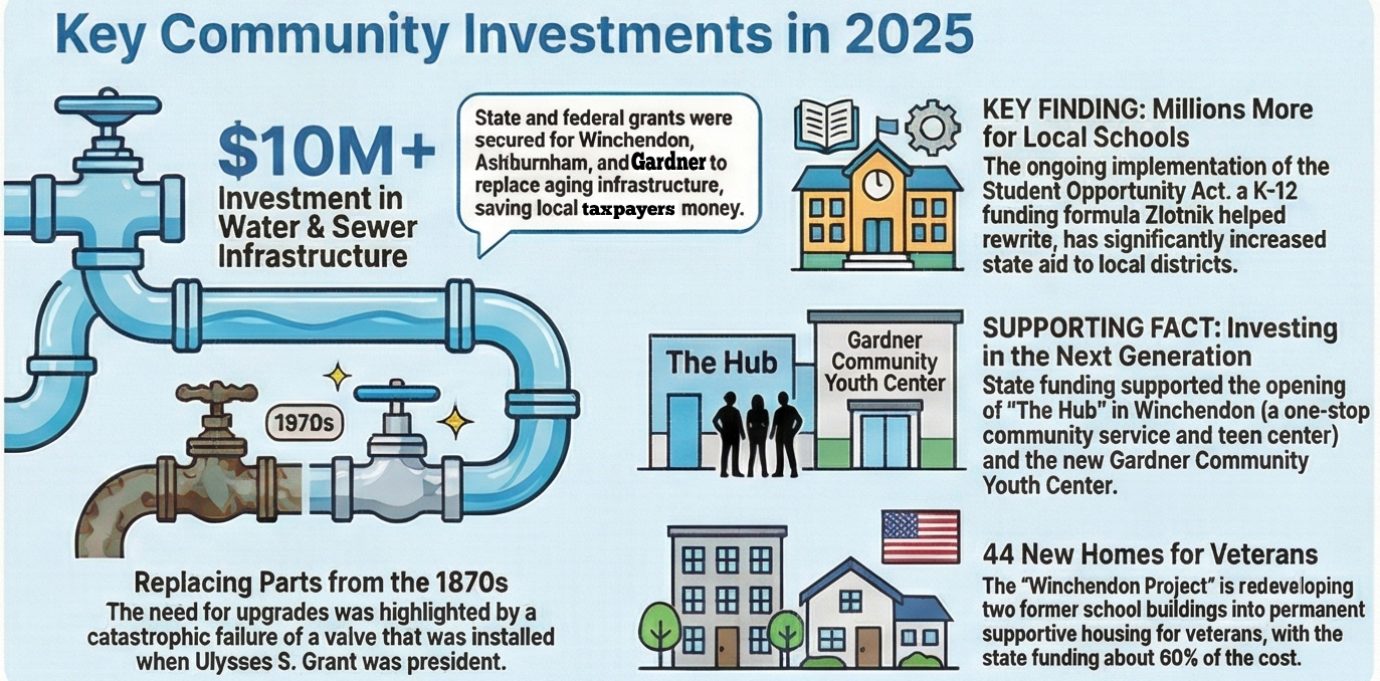
In 2025, significant achievements included securing over $10 million for water and sewer infrastructure in the district, championing a revised road funding formula that benefits rural communities, and advancing major youth service initiatives like “The Hub” in Winchendon and the Gardner Community Youth Center. A cornerstone project, the redevelopment of two Winchendon schools into 44 units of veterans’ housing, moved forward with approximately 90% state funding.
Looking ahead to 2026, Representative Zlotnik’s top priorities are twofold: ensuring the full and continued funding of the Student Opportunity Act to provide stable support for K-12 education, and aggressively addressing the regional housing crisis through state investment in redevelopment projects. Supporting priorities include ensuring the financial sustainability of Heywood Healthcare, continuing investment in youth services and infrastructure, and strengthening local food security systems. Throughout, Zlotnik contrasts the Massachusetts legislature’s track record of consensus-building with federal-level gridlock, underscoring a pragmatic approach to governance.
——————————————————————————–
I. Fiscal Prudence and Budgetary Outlook
A core theme of the discussion is the imperative for fiscal responsibility and efficiency, particularly in light of a challenging state budget environment. Zlotnik highlights the end of the “post-COVID boom,” significant cuts in federal spending, and a legislative reduction of nearly one billion dollars from the governor’s proposed 2025 budget as factors necessitating a search for savings.
The Gardner-Winchendon District Court Consolidation
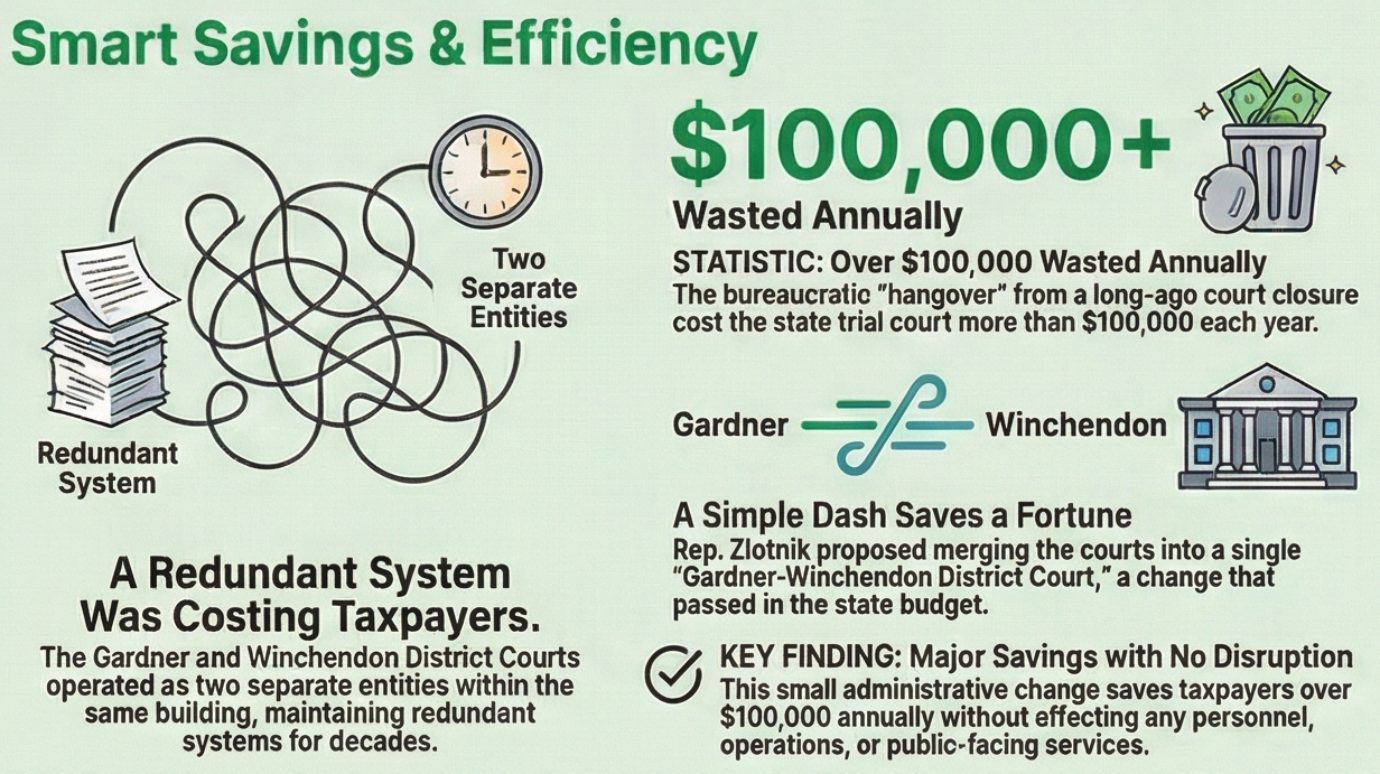
A key example of this approach is the successful consolidation of the Gardner and Winchendon District Courts. Zlotnik identified a “bureaucratic hangover” where the two courts, though co-located in the same building for years, operated with redundant systems.
• The Issue: The separate administrative structures for the Gardner District Court and the Winchendon District Court cost the trial court over $100,000 annually in redundant expenses.
• The Solution: Zlotnik proposed an amendment, passed in the 2025 budget, to merge the two entities into a single “Gardner-Winchendon District Court.”
• The Impact: This administrative change produced over $100,000 in annual taxpayer savings with no change to personnel, operations, or front-end services, as the courts had already shared staff and a judge for many years.
• Broader Principle: Zlotnik uses this example to illustrate the difficulty and importance of finding “wasteful spending,” which never appears as a specific line item. He argues, “…if the 200 legislators in the state each found something in their district of similar size and similar low actual impact, the budget savings, you know, would be in the tens of millions of dollars.”
II. Key Accomplishments and Investments in 2025
Representative Zlotnik detailed several major state-funded initiatives from the past year that directly impacted the communities of Gardner, Winchendon, and Ashburnham.
Infrastructure Upgrades
• Water and Sewer: A focused effort resulted in over $10 million in state and federal investment to replace aging water and sewer infrastructure across three of the four towns in the district.
◦ This initiative was spurred by a catastrophic failure of a water valve that was installed when “Ulysses S. Grant was president,” highlighting the urgent need for modernization.
◦ The grant funding offsets costs that would otherwise fall on local ratepayers and taxpayers.
• Rural Road Funding: A significant increase in funding for local road and bridge repair was achieved through a new compromise on the distribution formula.
◦ The Problem: The traditional formula, based on population, road miles, and jobs, disproportionately favored denser, more urban communities and did not account for a community’s wealth.
◦ The Compromise: The existing $200 million program was kept in place, but several hundred million dollars in new funding was added, to be distributed via a new formula that “generously benefits road miles.”
◦ The Funding Source: This new investment is supported in part by revenue from the “millionaires tax,” which is earmarked for transportation.
Youth and Community Services
• The Hub in Winchendon: This facility serves as a “one-stop shop” for community services, combining the operations of the state-funded Project Heel, the Winchendon CAC, and a new teen center located in a former bowling alley.
• Gardner Community Youth Center: The state funded a pilot program to establish this new center, replacing the former Gardner branch of the Fitchburg Leominster Boys and Girls Club. Having completed its first semester, Zlotnik intends for the state to continue the pilot for at least another year based on its initial success.
Housing and Redevelopment: The Winchendon Project
This project represents one of the largest state investments in the region and is the area’s first major housing construction project in approximately 20 years.
• Project Scope: A joint venture between the state and the Montachusett Veterans Outreach Center (MVOC) to redevelop two former school buildings in Winchendon into 44 units of permanent supportive housing for veterans.
• State Investment: The state is funding approximately 90% of the project’s total cost.
• Project Timeline: After a “stutter step” where initial funding was withdrawn, additional state and private funding (from Home Depot and the Robinson Broadhurst fund) allowed construction to resume. Completion is anticipated in 2027.
• Community Impact: The project repurposes important community buildings, provides critical housing for veterans, and is strategically located next to the Winchendon Senior Center and G.A.R. Park.
III. Strategic Priorities for 2026
Representative Zlotnik outlined a clear hierarchy of priorities for the upcoming year, focusing on education, housing, and the sustainability of core local services.
Top Priority: Education Funding
The absolute top priority is to ensure the Student Opportunity Act (SOA) continues to be fully funded.
• Context: The SOA is a multi-year reconstruction of the state’s K-12 funding formula. All school districts in Zlotnik’s legislative district are “majority aid districts,” with Gardner and Winchendon receiving over 70% of their budgets from this state formula.
• The Goal: To provide consistent, predictable funding to avoid “roller coaster” budgets that are detrimental to student outcomes. Zlotnik notes that inconsistent funding in the past meant “some years you’d have electives. Some years you wouldn’t. Some years you’d pay for sports, sometimes you wouldn’t.” The SOA aims to eliminate this instability.
Co-Top Priority: Addressing the Housing Crisis
Sharing the top of the pyramid with education is the need to address the region’s acute housing crisis.
• The Crisis: Housing costs in North Central Massachusetts have “tripled or quadrupled in a 10-year period,” with supply falling far short of demand. Zlotnik states the current situation “is not sustainable for anybody.”
• The Strategy: Continued state investment is essential to make redevelopment projects viable. This includes advancing numerous projects involving the repurposing of former school buildings in Gardner (Prospect Street, School Street, Helen Mae Sauter, Waterford Street), Templeton, and Winchendon. The next six to eight months are considered critical for the Waterford Community Center project.
Supporting Priorities
1. Healthcare Sustainability: Ensuring the viability of Heywood Healthcare (including Heywood and Athol hospitals) is critical for both public health access and the regional economy. Zlotnik argues that the fundamental financing models for rural healthcare are decades old and need to adapt to prevent the loss of services seen in nearby communities like Leominster and Fitchburg.
2. Youth Services and Natural Resources: Building on the successes of 2025, the goal is to continue supporting youth programs in a budgetarily sustainable way. This includes not only centers but also investment in parks, playgrounds, and the region’s network of bike trails and hiking paths.
3. Sustained Infrastructure Investment: The work on roads, bridges, water, and sewer is not a one-time injection of funds but requires a sustained, efficient, and effective multi-year effort to complete.
IV. Governing Philosophy: Bipartisanship and Pragmatism
A recurring theme is the effectiveness of the Massachusetts legislature’s commitment to compromise and consensus, which Zlotnik sharply contrasts with the political climate at the federal level.
• Track Record of Compromise: In his 13 years in the House, Zlotnik has participated in 13 budget debates. He notes that “only one of them passed on a party-line vote,” with all others passing with near-unanimous support.
• Avoiding Shutdowns: While state budgets have often been completed a month late, the legislature has unanimously passed one-month stopgap budgets every time to “keep the lights on” and avoid a government shutdown while negotiations conclude.
• The Principle: Zlotnik emphasizes that this record exists despite significant disagreements. The prevailing approach is a commitment to reaching a compromise. He states, “I think that people are better served by that approach that we have chosen to take to government here in Massachusetts and that spirit of bipartisanship and compromise.”
V. Addressing Community Needs
Food Security
The strategy for addressing food insecurity focuses on supporting and strengthening existing local resources.
• Supporting Local Pantries: Direct state investment has been made in the Gardner CAC, Winchendon CAC, and the MVOC food pantry for veterans.
• The “Growing Places” Initiative: Zlotnik is a strong supporter of this initiative, located at the future Waterford Community Center. Its model strengthens the entire local food system by:
◦ Acting as a “buyer of last resort” for surplus crops from local farms.
◦ Processing fresh food to make it more shelf-stable and easier to use.
◦ Distributing this nutritious, locally grown food to those in need.
Constituent Services
Representative Zlotnik highlighted that constituent service remains a major priority, with his office handling over 1,000 cases annually on issues ranging from healthcare and housing to unemployment assistance.
| Contact Method | Details |
|---|---|
john.zlotnik@mahouse.gov | |
| Phone | 978-410-9559 |
| District Office | Gardner City Hall |
| Office Hours | Monday, Tuesday, Thursday, and Friday |
| Other Methods | Facebook messages, in-person encounters |
The $100,000 Hyphen: 5 Lessons from Local Government Washington Should Steal
Introduction: Beyond the Headlines
It’s easy to believe that government is a synonym for gridlock. The daily headlines are filled with stories of partisan standoffs, government shutdowns, and wasteful spending, leaving many with the impression that progress is impossible.
But away from the national spotlight, real progress often happens quietly. At the local and state levels, practical leaders are finding pragmatic, effective, and sometimes surprisingly simple solutions to long-standing problems. These aren’t stories that generate clickbait, but they are stories of how government is supposed to work. In a recent interview, State Representative Jonathan Zlotnik of Massachusetts shared several of these impactful, behind-the-scenes accounts of effective governance. Here are the top five takeaways.
——————————————————————————–
1. The $100,000 Hyphen: How a Tiny Edit Fixed a Decades-Old Problem
For years, the Gardner District Court and the Winchendon District Court operated as two separate entities, despite being housed in the same building and sharing the same staff. The Winchendon court building had been closed decades ago during a budget crunch, but its operations were moved—not merged—into the Gardner courthouse. This “bureaucratic hangover” created redundant systems that served no practical purpose.
The solution was a simple legislative fix proposed by Rep. Zlotnik through an amendment to the state budget: formally merge the two courts into a single “Gardner-Winchendon District Court.” This administrative change, which required no alteration to day-to-day operations or personnel, immediately saved taxpayers over $100,000 a year.
This story is a prime example of finding and eliminating “wasteful spending,” which, as Zlotnik notes, never appears as a line item in a budget. It highlights the critical need for deep institutional knowledge to find efficiencies that don’t cause “collateral damage.” Zlotnik is quick to share credit, noting the idea was first brought to him by court staff—the people with the boots-on-the-ground experience to spot an invisible problem.
Interviewer: “You have taken a dash and put it in between Gardner and [Winchendon] calling it the Gardner-Winchendon District Court and by the simple insertion of a dash you have saved the taxpayers $100,000. Is that correct?” Rep. Zlotnik: “Uh essentially that is what we did.”
2. Fixing Leaks from the Ulysses S. Grant Administration
For small towns, the critical issue of aging water and sewer infrastructure often remains invisible until it becomes catastrophic. This reality was brought into sharp focus when a significant break in a local water system wasted an enormous amount of water.
The culprit was a piece of infrastructure—a valve—that failed catastrophically. The astonishing detail that drove home the urgency of the problem was that the broken part was installed when “Ulysses S. Grant was president.”
This single failure became a powerful catalyst for action. It highlighted the urgent need for investment, helping to secure over $10 million in state and federal grant money for infrastructure replacement in the towns of Gardner, Winchendon, and Ashburnham. By leveraging these grants, local leaders ensured that the heavy financial burden of these essential upgrades did not fall solely on local ratepayers and taxpayers.
“…that piece that that hunk of metal uh was put in the ground when Ulysses S. Grant was president and you know that that’s well well past the warranty. um but really kind of brought it home for us why this needs to be prioritized…”
——————————————————————————–
3. The Politics of Potholes: A Quiet Compromise that Benefits Rural Roads
For years, state road funding formulas have been a point of contention, often disadvantaging rural communities. The old formula in Massachusetts, based on a combination of population density, road miles, and local jobs, naturally sent a larger portion of funds to more crowded urban and suburban areas.
The 2025 breakthrough was not a fight, but a compromise. Instead of trying to re-slice the existing $200 million program, leaders created a new, additional fund of a “couple hundred million.” Critically, this new fund uses a different formula—one that “generously benefits road miles.” This clever solution directs more money to less dense communities with many miles of road to maintain, but it does so without taking away from urban centers.
This success was made possible by a combination of factors, including a new transportation committee chair from a rural area and new revenue streams from the state’s “millionaires tax” earmarked for transportation. It stands as a powerful lesson in pragmatic coalition-building and finding win-win solutions instead of engaging in zero-sum battles.
——————————————————————————–
4. Giving Old Schools New Purpose
As Rep. Zlotnik articulated, repurposing old, beloved school buildings is essential to maintaining a community’s vibrancy. Instead of letting these landmarks fall into disuse, a strategic approach can transform them into vital community assets.
The prime example is the “Winchendon project,” where two former school buildings are being redeveloped into 44 units of permanent supportive housing for veterans. With the state funding approximately 90% of the cost, it represents one of the largest state investments in the region and one of the first major housing construction projects in the area in at least 20 years. In a detail that feels like poetry, the new homes are located right next to the town’s senior center and, as Zlotnik notes, “very fittingly, Grand Army of the Republic Park,” a space named for the veterans of the Civil War. It’s a story of a community honoring its service members, full circle, across generations.
This is not an isolated success. It is part of a repeatable, strategic approach to community development, with other school redevelopment projects in the pipeline to create housing and community centers in the nearby towns of Templeton and Gardner. It shows a clear vision for turning nostalgic liabilities into tangible, forward-looking assets.
——————————————————————————–
5. The Unseen Consensus: How to Pass a Budget Without Shutting Down
While the federal government lurches from one shutdown threat to the next, the Massachusetts state legislature offers a starkly different model of governance.
The surprising fact is this: in Rep. Zlotnik’s 14 years in the House, he has participated in 13 annual budget debates. Of those 13 massive, complex spending plans, only one passed on a strict party-line vote. Every other budget was approved with near-unanimous, bipartisan support. But the most powerful part of this story isn’t just that they cooperate; it’s why. Legislative Democrats hold a supermajority and could, Zlotnik points out, pass the budget every year without a single Republican vote. The key is that they choose not to.
This remarkable record is not due to a lack of disagreement, but to a shared, foundational commitment to consensus-building and keeping the government running. Even when the final budget is late, temporary one-month budgets are passed unanimously. It’s a process built on the assumption that the goal is not to win, but to govern.
“I think it shows our commitment to consensus building, uh, to reaching across the aisle, you know, to making compromise… I think it’s something that our federal uh partners uh could take a lesson from…”
——————————————————————————–
Conclusion: Finding Progress in the Details
These stories paint a clear picture: effective governance is often found in the details. It’s in the small administrative fixes that save a surprising amount of money, in the smart funding formulas that build consensus instead of division, and in a steadfast, bipartisan commitment to getting the job done.
These stories remind us that progress isn’t always loud. It makes you wonder: what other complex problems have simple, overlooked solutions hiding in plain sight?